
30-Second Overview: Traditional Taiwanese markets are not mere shadows of modern cities; they are urban infrastructures shaped by public health, population migration, popular economy, and daily relationships. Markets like Nanmen Market, Xinfu Market, and Jianuo Market demonstrate that while markets can be renovated, relocated, and digitized, what truly needs preservation is the living network—the place where people find food, knowledge, and mutual trust.
Taiwanese Market Culture: A Marketplace That Sells Not Just Vegetables, But Also Preserves Urban Memory
In 1909, residents outside Nanmen in Taipei began gathering for shopping near the city gate because they were too far from Dàdào-chéng (大稻埕) and Mèngjiǎ (艋舺). In 1935, Xinfu Market in Wanhua opened with over thirty stalls; in 1972, Jianuo Market in Taichung integrated the market, residences, and places of worship into a single building.1 2 3
These three dates illustrate an counterintuitive fact: traditional markets are not relics outside of modern cities. They were inherently urban infrastructures shaped by city planning, public health, population migration, and family life.
📝 Curator's Note: What is most worth preserving about a market is not the adjective "old," but how it allowed a city to be used and remembered by people.
From Street Gatherings to Public Markets
During the Qing dynasty period, transactions occurred in temple courtyards, streets, or at the edges of settlements. These markets operated according to familiar routes and local customs, without necessarily having fixed buildings or being managed by a single institution. In the early Japanese colonial period, the Governor-General's office still adhered to some old practices. After the plague in 1896, market hygiene began to become an administrative issue, leading to gradual market reforms starting in 1904.4
Reform was not just about moving stalls indoors. It also introduced market regulations, stall management, public health fees, and professional specialization. By the Taishō era, the goal of markets extended beyond simply improving hygiene to making them efficient economic mechanisms.4
Xinfu Market is a concrete example of this system. Completed in 1935, it featured not only meat, fresh fish, vegetable, and general merchandise stalls but also offices, dormitories, parking lots, garbage disposal areas, and public restrooms. The market's horseshoe shape and central atrium incorporated ventilation, lighting, and shopping flow into the design.2
These arrangements show that a market was never just a collection of stalls. It was an urban technology that placed food, hygiene, transportation, management, and neighborhood life in one space.
📝 Curator's Note: The architecture of a market often speaks more honestly about what people believed constituted a "good life" than the city slogans do.
Nanmen Market: How Population Migration Changed a Dining Table
The history of Nanmen Market is like a condensed history of Taipei’s population. The Nanmenwai (南門外) market, established in 1909, initially served the growing residents outside the South Gate while also supplying daily necessities for Japanese officials and Taiwanese residents; in 1922, when Taipei implemented street name revisions, this area was renamed Qiansui Town, and the market followed suit as Qiansui Market. After the war, the market was renamed Nanmen Market, and after 1949, the population that came with the government's relocation to Taiwan brought diverse culinary memories, leading the market to develop a characteristic blend of North and South goods, prepared foods, and mainland Chinese cuisine.1 5
The "North and South Goods" here are not abstract local flavors but tangible dried goods, seafood, pastries, and sauces. The market transformed immigrant memory into food that could be bought, cooked, and served on the family dining table.
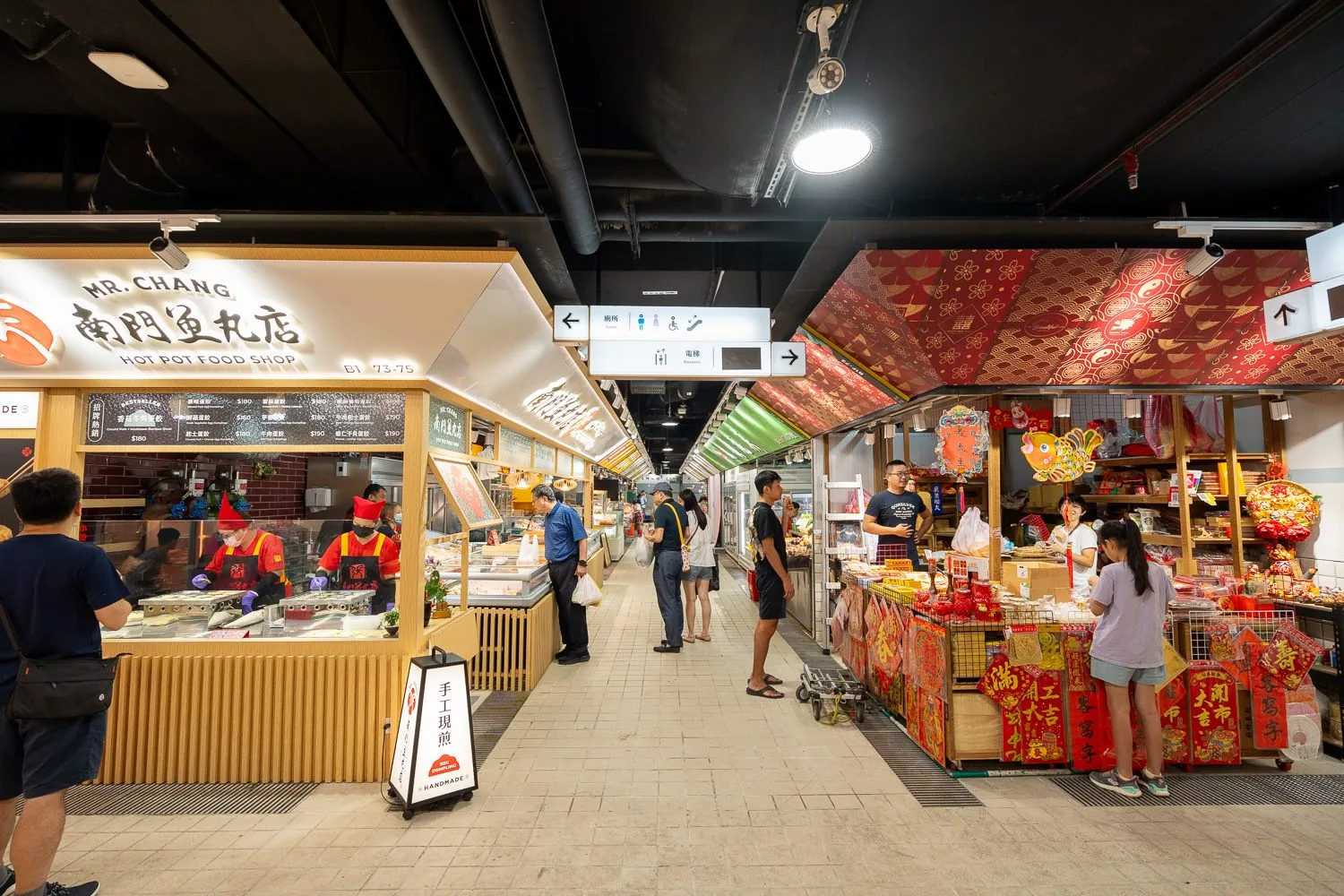
In 1969, Nanmen Market was temporarily moved to Nanhai Road for municipal construction. In 1981, vendors returned to a new market. The first floor and basement retained market functions, while the second floor added department store and food service spaces. This renovation showed that a market does not only have two options: "preservation" or "disappearance"; it can also adjust its role in the city through reconfiguration.5
However, renovation is not always effective. In 2012, structural issues were discovered, leading to Nanmen Market being demolished for the MRT project and temporarily moving to a relay market before re-opening at the new building in 2023. The continuity of the market thus exists not only in the original walls but also in whether vendors, goods, customers, and brands can move together.1 5
What Markets Sell Is Not Just Ingredients, But "How to Live"
The Ministry of Economic Affairs describes traditional markets as centers of early local commercial activities and suppliers of popular civilian resources. The 2020 improvement plan it approved recorded that across Taiwan, there are a total of 577 public traditional markets and legally registered vendor clusters, with 81,819 stalls and approximately 190,000 employees, generating an annual revenue of about 57.6 billion NTD.6
These figures cannot prove that every market is prosperous, but they remind us: a market is not merely a nostalgic hobby for a few; it is a living system providing employment, supply, and local economic scale.
Source: Central Office of the Ministry of Economic Affairs, 2020
However, a market's value is not solely composed of its turnover. Vendors explain the origin of ingredients and cooking methods; regular customers purchase just the right amount according to their needs; neighbors exchange news in the aisles. These interactions make the market simultaneously an endpoint of the food supply chain, a node of community information, and a container of local memory.7
In Reporter's photographic report on Jianuo Market, the market was described as "the memories and chatter of the populace within the city."3 The focus of this phrase is not romanticizing the market, but pointing out that the transactional relationships in the market often carry time: who has been here for decades, which stall once supported a family, or which temple witnessed the vendor's business ups and downs.
📝 Curator's Note: Supermarkets make shopping fast; markets bring shopping back into a relationship. Neither is inherently superior; they offer different life choices.
Jianuo Market: When a Market Is Also a Home
Jianuo Market in Taichung was built in 1972, originally planned to house residents and temporary vendors near Lǜchuān (綠川). The first and second floors are the market, the third and fourth floors are residences, and the basement is parking; this mix of market and housing made vendors and residents both colleagues and neighbors.8
This spatial arrangement brought convenience but also left behind long-term management and safety costs. After the 921 earthquake, cracks and leaks appeared in the building, leading some residents to gradually move out. When the market was relocated due to urban planning around the train station, vendors could move to a new location, but the people who originally lived above the market did not have the same housing options.3 8
What is hardest to move is often not the stall sign, but the relationships that were never meant to be written into city plans. The old Jianuo Market housed Mazu Temple and Earth God Temples; the new market initially did not reserve space for worship, and vendors later had to coordinate the placement of deities.8
This detail is small, yet it illustrates the gap between planners and users: to the planning map, it might just be unmarked space; to the people of the market, it is the place they pass through before opening daily or where they go to talk when business is slow.
"The market has been here for a long time, so it's yours," was the sentiment recorded from vendors.3 This phrase is not a legal claim over market ownership but a description of time: when someone puts decades into the same stall, the market is no longer just a rented space.
Modernization Cannot Only Be Bright Walls
The challenges facing traditional markets are concrete. Weaknesses listed by the Ministry of Economic Affairs include aging buildings and facilities, perceptions of hygiene, insufficient parking, short operating hours, aging vendors, and limited marketing resources; external competition includes supermarkets, hypermarkets, convenience stores, online shopping, and changing lifestyles.6
Therefore, improving the market environment is necessary. Safety, hygiene, lighting, ventilation, refrigeration, and waste disposal are basic conditions that customers and vendors should not be required to exchange for "human connection." The cultural value of a market cannot be an excuse to cover up leaks, dangerous structures, or food safety issues.
Conversely, renovating a market into a neatly presented retail space does not automatically bring market culture. The debate over market and urban renewal often lies here: the government sees land efficiency, transportation, and building safety; the market users see regular customer routes, stall relationships, faith, housing, and local memory.7 8
Xinfu Market offers another path. It declined in the 1990s due to changes in supermarkets, family structures, and consumption habits, was designated a municipal historic site in 2006, and underwent restoration in 2013 before becoming a cultural market. The original stagnation allowed the building to retain more historical traces, leading the market to be reinterpreted from "decay" as a cultural asset.2
📝 Curator's Note: True market renewal is not making all markets look like the same white tiles; it is allowing safety, convenience, and locality to coexist.
Digital Tools Can Extend Relationships, But Cannot Replace Them
The next transformation of the market does not only happen within buildings. Since 2018, Taipei City has guided vendors to adopt electronic payments and assisted them in reaching new consumers through e-commerce, delivery, and market marketing activities. By August 2023, 48 markets in Taipei had 7,170 stalls equipped with electronic payment systems.9
Digital payment solves problems like change, transaction records, and remote purchasing; it does not automatically solve product quality, vendor succession, or market positioning. A phone allows regular customers to place orders when they cannot visit the market, but it cannot replace the long-accumulated knowledge of ingredients held by vendors, nor can it answer the question "why come here" for the market.
The case of Dazhi Market shows that environmental improvement, brand management, and electronic payment can happen together. Young customers photograph, pay, and share via mobile phones, while some elderly patrons still choose cash; thus, the market does not jump from an old model to a new one, but accommodates different speeds on the same path.9
This transformation also has boundaries. If digitalization only increases vendors' equipment costs without clear operational support, the tools become a new barrier. A digital market should serve the vendors, not demand that every vendor first become a professional operator of an online store.
The Future of Markets: Retaining Choices, Not Specimens
For a traditional market to continue existing, at least three types of work must proceed simultaneously. First is maintaining visible hardware: structure, drainage, refrigeration, ventilation, lighting, and accessible pathways. Second is caring for the invisible network: vendor succession, self-governance associations, regular customer relationships, faith, and community activities. Third is allowing the market to connect with new life times: extending some operating hours, providing prepared foods and semi-finished products, establishing reservations and delivery, while still retaining the advantages of ingredient selection and face-to-face interaction.6 9
These three things cannot be replaced by a single "renovation" button. Building renovation without vendor participation may leave behind beautiful but unusable spaces; cultural preservation that refuses improvement may trap vendors and customers in unsafe nostalgia.
What market culture truly needs to preserve is not the water stains, fishy smell, or dim aisles themselves, but the ability of people to look out for each other, exchange knowledge, share food, and turn strangers into regular customers within the city.
So, the next time you walk into a market, do not rush to ask if it looks like the past. What is more worth asking is: can this place still provide daily necessities for a newly moved family? Can a young person still take over a stall in their own way? Can a city retain a reason to meet people after undergoing renewal?
📝 Curator's Note: The end point of a market is not being sealed as an artifact, but continuing to be present tense in every purchase, inquiry about price, and greeting.
Further Reading
To further understand the tension between markets and urban renewal, please read Cultural Institution Notes Before and After the Relocation of Jianuo Market and compare it with The Official Historical Milestones of Nanmen Market. These two articles supplement the on-site details not elaborated in this text from the perspectives of user experience and market history.
Image Sources
Image source: Taipei City Government, Indoor Stalls on Nanmen Market First Floor, provided by Wikimedia Commons File Page. The author/copyright holder is the Taipei City Government, licensed under the Open Data Policy of the Taipei City Government, which allows reproduction, adaptation, and commercial use with attribution; image cached at public/article-images/lifestyle/nanmen-market-2023.webp.
References
- Taipei City Government Tourism Promotion Bureau: The Evolution of Century-Old Markets: Nanmen Market — Establishment, renovation, relocation, and culinary changes of Nanmen Market.↩23
- Chung Tai Architecture Culture Art Foundation: History of Xinfu Market — Architecture, stall changes, operation history, historic designation, and reuse of Xinfu Market.↩23
- Reporter: Hsu Chin-tang / The Next Mile for Jianuo Market (Part II) — Market life, faith, residents, and the situation before and after the relocation of Jianuo Market.↩234
- Key Comment Network: Are Traditional Markets Dirty and Messy? Let's Look at These Japanese Colonial-Era Markets That Seem Like Western Houses — Early Japanese colonial market reform, hygiene policies, and public market development.↩2
- Taipei City Public Nanmen Market: Market Milestones — Official history of Nanmen Market from the 1906 market to post-war renaming, renovation, relay markets, and new building trials.↩23
- Central Office of the Ministry of Economic Affairs: Traditional Markets and Night Market Innovation Transformation Improvement Plan — Economic scale, strengths and weaknesses, policy background, and transformation strategies for traditional markets.↩23
- Eye-Bottom City Events: Two Imaginings of a City: Traditional Markets and Urban Renewal — Analysis of the market as urban memory, social space, and urban renewal controversy.↩2
- Chung Tai Architecture Culture Art Foundation: Lecture Notes | Before and After Relocation—What Was Moved With the Market and What Wasn't — The mixed use of residential and commerce in Jianuo Market, relocation distance, religious spaces, and coordination at the new market.↩234
- Taipei Industry and Economy Information Network: Advancing Market Transformation Towards a Digital Ecosystem — Data on electronic payments, digital transformation, Dazhi Market, and market guidance in Taipei City.↩23