

30-Second Overview: In 2014, Taiwanese illustrator Yala published the first "Catbug Kapo" comic on Bahamut, and the first LINE Original Sticker Pack was released that same year. Kapo is not a standard cat: it has six legs, wants to eat everything, and even leaves its friends out of its appetite. This somewhat bizarre yet always forgiven blue character later entered LINE Webtoon, games, books, exhibitions, physical stores, and cross-brand collaborations. Kapo's story is not simply "how a cute character succeeded"; rather, it is about how a character first became our reaction in conversation, thereby gaining the opportunity to become a world that can be brought into real life.
Many people cannot remember which specific Kapo sticker they first sent, but they remember buying a pack very early on—so early that it was when LINE was just beginning to become popular in Taiwan.
This kind of memory is difficult to quantify. It does not necessarily appear in collection counts, leaderboards, or the foot traffic of an exhibition; instead, it hides in a single moment within a chat window: someone says they are tired today, and you send a paralyzed Kapo. A friend suddenly disappears, and you send a Kapo asking, "Where are you?" When you don't know how to continue the conversation, you let that blue, round, slightly mischievous creature finish the sentence for you.
Kapo first became a reaction, and only later became a brand.
A Creature That Is Both Cat and Bug
The official character introduction describes Kapo as a six-legged cute creature that is "both cat and bug." It wants to eat everything it sees, including its own good friends. It causes trouble, acts coquettishly, and hates eating vegetables1.
The interesting aspect of this setting is not which animal it actually belongs to, but its refusal to be categorized. Cats are usually imagined as soft, lazy, and occasionally aloof. Bugs bring to mind long legs, sudden movements, and creatures that are not necessarily welcome. Kapo blends these two impressions into a character that you want to hug but might suddenly eat you.
Its cuteness does not rely on eliminating danger. On the contrary, it is precisely because Kapo has an appetite, destructive power, and a slight lack of control that its coquettishness does not feel like an expression designed solely to please.
📝 Curator's Note: Kapo's greatest strength is not making the bizarre non-threatening, but making the bizarre a part of daily companionship. You know it might bite you, but you still call it out in the chat room.
Life First, Character Second
Kapo was created by illustrator Yala in 2014. The official author introduction notes that Yala majored in Information Management in university. Because he loved drawing, he bought a digital drawing tablet in his sophomore year and began creating through self-study. He also worked while continuing to publish works on different platforms, eventually becoming a full-time creator2.
The first "Catbug Kapo" was published on Bahamut. This starting point is important: Kapo was not first defined in a conference room as a "healing IP" and then sought a place to publish. It was first a character that a creator continued to draw, and only later found its readers on different platforms.
Yala also mentioned that he usually observes people and things around him, transforming family experiences of raising children and observations from animal and pet videos into the character's personality2. Thus, although Kapo's world includes cats, bugs, bunnies, dogs, and various strange creatures, the punchlines often still come from ordinary things: wanting to eat, wanting to act coquettishly, being annoyed by friends, or pretending nothing happened after making a mistake.
In 2014, Kapo completed two key actions: the first comic was published, and the first LINE Original Sticker Pack was launched2. The comics allowed people to see its daily life, while the stickers allowed readers to bring it into their own daily lives. Between these two, there was only a button's distance, yet that distance shortened the gap between the character and the user.
Stickers Are Not Illustrations; They Are a Sentence
The特殊性 (special nature) of LINE stickers is that they are not pictures hanging on a wall, nor comics that must be read from start to finish. They must catch a sentence, an emotion, or a silence that doesn't know how to continue within a very short time.
Kapo is well-suited for this work. Its body is simple enough, yet its emotions are not limited to one kind. It can represent fatigue, refusal, coquettishness, schadenfreude, or simply "I saw it, but I don't want to type right now."
In 2015, Kapo won the championship in the Short Story category of the LINE Webtoon Comic Competition and launched its first LINE Official Sticker Pack. Between 2015 and 2020, the comic was serialized on LINE Webtoon, totaling 524 episodes2. In 2016, LINE officially reported that Kapo entered LINE Travel as a 3D character, noting at the time that Kapo had released six sticker packs and had over 350,000 fans on LINE Webtoon3.
This path looks like a move from 2D to 3D, but in reality, it is more like a move from "being watched" to "being used." Readers first see what Kapo does, then borrow Kapo's expressions to do their own things.
📝 Curator's Note: When a sticker is truly used, it no longer belongs solely to the creator. It becomes the sender's tone and also a clue for the recipient to understand the relationship.
Not Becoming a Big Brand First, Then Being Seen by Everyone
Looking back at Kapo now, it is easy to imagine its path as a straight line: character birth, sticker success, comic serialization, product launch, and finally becoming an IP. But the creator's early path was not so neat. Kapo first appeared on a web platform with existing social interactions, and was then repeatedly re-understood by different platforms and readers.
The LINE Original Market does not provide a guaranteed window for success, but rather a market where works can directly face users. According to the platform's official description, individuals or enterprises only need a LINE account to submit stickers, emoticons, and themes, and works have the opportunity to be purchased by LINE users around the world4.
This mechanism changed the order of a character's birth. Previously, a character had to find a publisher, TV station, or agency before it had a chance to enter the public eye. Sticker platforms connected "drawing it" with "someone willing to use it." For creators, every purchase or send was a small feedback; for users, it was direct participation in determining which character stays.
Thus, Kapo was not just passively waiting for an audience but was continuously tested in chats. Which pose makes people want to send it? Which expression makes a refusal less sharp? What kind of breakdown looks genuinely tired rather than just having enlarged eyes? Stickers break the character's personality into grid-by-grid daily judgments.
Cuteness Is Not Without Aggression
"Healing" is often understood as smoothing out the sharp parts: colors become softer, expressions become gentler, and the character does not really hurt anyone. But Kapo's cuteness does not work this way. Its appetite, mischief, and the setting of swallowing friends remain in the character, even becoming part of the punchline.
The official brand story describes Kapo as a mischievous and lovable blue creature, placing its daily life with friends like the dog and bunny in the same world5. In that world, a friend might become food the next second, and food might still be the closest friend. This absurdity means relationships do not need to be maintained by perfection.
Thus, the comfort Kapo gives is not "things won't get worse," but "even if things get worse, we can laugh together first." This is an emotional distance well-suited to Taiwan's chat culture: you don't necessarily have to speak profound words immediately; first, send a picture, acknowledging that you see the other person's predicament.
For users, Kapo stickers function not only in expressing emotions but also in regulating relationships. A text message might be too formal, a single emoji too vague; Kapo's body and actions add a bit of personality to the message. It turns "I don't know what to say" into a state that can be shared.
📝 Curator's Note: Kapo does not make emotions cute; rather, it gives emotions a place to sit even when they are not pretty.
How a Character Grows Its Own World
Kapo's world has gradually expanded, allowing the character to no longer be just a single design. The dog, bunny, Lala, Foam Cat, T-Rex Sister, and other characters give Kapo's appetite, loneliness, friendship, and mischief different echoes1.
The role of these companions is not just to offer more product variations. When the same character is placed in different relationships, readers begin to recognize each character's temperament and look forward to certain combinations happening again. Short comics originally only needed one punchline; a character world requires people to wonder who will appear next, who will be eaten, and who will ultimately return.
The milestones compiled in the official author introduction also show that Kapo is not a finished product completed in one go: 2015 saw comic competitions, official stickers, and books; 2016 saw Original Sticker MVP and themes; 2017 saw continued recognition in stickers and entry into the LINE STORE Hall of Fame; 2018 saw the expansion to official emoticons; 2019 saw more exhibitions, themes, and footprints at international forums2.
These nodes do not represent a simple upward climb every year. They are more like translating the character into new media repeatedly: comics need rhythm, stickers need immediate usability, games need action, exhibitions need space, and products need to make people willing to take the character home. Kapo must change, but not so much that people cannot recognize it.
This also explains why Kapo's core is not a single product, but that translatable personality: gluttonous, mischievous, clingy, occasionally out of control, yet still living life with friends.
Why a Sticker Can Last for Ten Years
The lifecycle of stickers is different from comics. Comics usually require readers to actively open them; stickers are re-summoned within a conversation. The person who buys it today may not be there to fully understand Kapo's world, but because a specific expression happened to complete a sentence for them.
This forms a small but stable cooperation between the character and the user. The creator provides a recognizable body and expression; the user decides what it represents in the moment. Kapo's "eating" can mean being hungry, or it can mean wanting to eat up work. Kapo's "lying flat" can mean resting, or it can mean temporarily shutting down the entire world.
The official LINE Original Market also designs stickers as a continuously updating creative form: besides static stickers, creators can make dynamic stickers, effect stickers, emoticons, and themes, and use tags to make it easier for users to find works in chats4. The character is therefore not ended after one launch but can add new tones as chat habits evolve.
In a LINE creator interview, Yala mentioned that the Original Market allowed more people to see the work and enabled the character to break out of its original framework through different stickers and interactions6. The key point of this sentence is not just that the platform provides a sales channel, but that the character can continue to transform in the actual reactions of users.
From this perspective, Kapo has accompanied users for years not just because it has an easily recognizable appearance. It has a set of repeatable actions and relationships: eating, sleeping, running away, acting coquettishly, being subdued by friends, and returning to the next chat. Each new sticker pack is like adding a few new words to this grammar.
A character that is collected may just sit in a phone. A character that is used enters human relationships. Kapo stays not because everyone is familiar with its complete setting, but because everyone can find a suitable action for themselves at some moment. This borrowability allows a catbug from Taiwan to start accompanying people in conversation without needing to be explained clearly first.
Therefore, Kapo's history cannot be written solely as the creator's success resume. It is simultaneously a platform history, a user history, and a tone history: someone drew the character, someone made the character into a sticker, someone sent the sticker to a friend, and the character gained new meanings through repeated sending. These tiny traces of use are where original characters truly come alive.
It also became a familiar code in Taiwan's internet life: without needing too much explanation, the other person usually knows the emotion you want to convey and knows where to stop the joke, then continues the conversation.
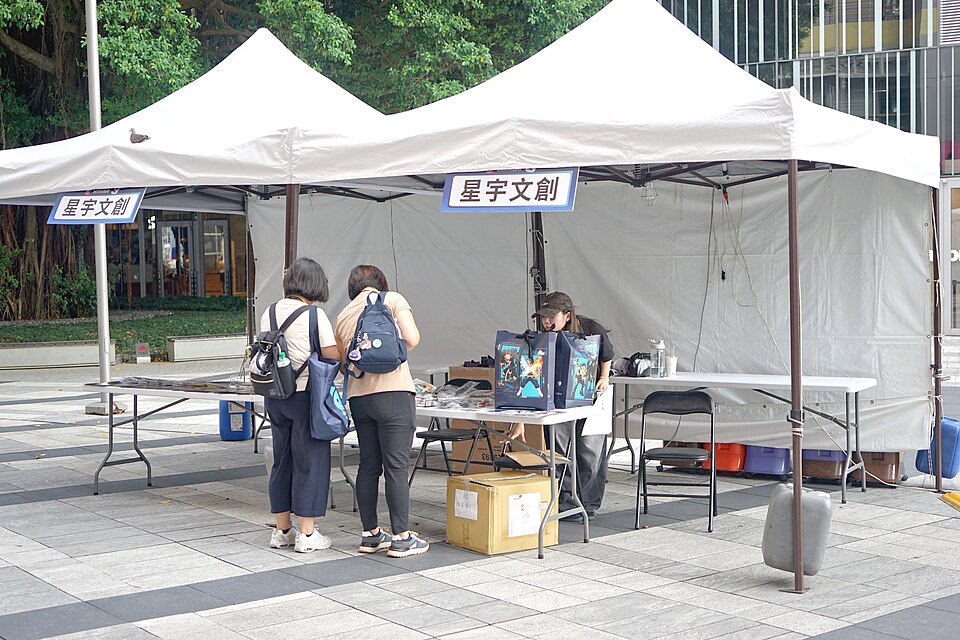 Kapo eco-friendly shopping bag at an event site, photographer Solomon203, CC BY-SA 4.0.
Daily Life Between Cuteness and Bizarre
Kapo's character world is not held up by Kapo alone. The dog is its favorite friend and also its food; the bunny, even though constantly swallowed, still wants to be with Kapo; Lala is the owner who adopted Kapo and the dog, and is also one of the few who can subdue Kapo1.
These relationships make "Kapo eats friends" not just a single punchline. Friends can be food, and food can be friends; danger and intimacy are not separated into two worlds. Kapo's daily life thus has a strange sense of security: things may be absurd, but the characters know they will meet again.
This is also where Kapo differs from typical healing characters. It does not make life trouble-free; rather, it draws trouble as something to laugh about together. Being chased by work, too lazy to reply to messages, suddenly wanting to eat, or simply not wanting to act mature today can all be handled by a six-legged catbug.
From Mobile Screens into Reality
Kapo later existed not only in stickers and comics. The official brand story lists the scenes it participated in, including online games, dining, convenience stores, shopping malls, theme exhibitions, public transportation, phone cases, escape rooms, and theme spaces; the official currently also claims that Kapo has launched thousands of peripheral products5.
Kapo suitcase at Taipei Main Station's Third Platform, photographer Solomon203, CC BY-SA 4.0.
This change can be seen in its early shape in a 2016 LINE official report: Kapo transformed from a 2D character into a 3D character in LINE Travel, entering another set of game rules with players3. In recent years, Kapo has continued to contact fans through co-branding and physical events; in 2026, CNA reported that Yala shared the process of collaborating with Pokémon, taking two years to complete the co-branded work, and described Kapo as a case of a local sticker evolving into an international brand7.
Kapo House pushes the character one step further. When a character has its own store, products, drinks, and photo-worthy scenes, it is no longer just appearing in users' phones but requires people to walk into a space rearranged by Kapo8.
 Kapo co-branded store front in Ximending, Taipei, photographer Solomon203, CC BY-SA 4.0.
 Kapo backpack at the Taipei International Musical Instrument Exhibition, photographer Solomon203, CC BY-SA 4.0.
But there is a question here that cannot be skipped: when a character is made into more and more products, can it still retain that initial lightness of "just sending a sticker to a friend"? Commercialization gives characters more opportunities to be seen, but may also turn companionship into a consumption option. Kapo's challenge is not to stop growing, but to continue making people recognize that mischievous, coquettish, always-hungry guy in every collaboration.
📝 Curator's Note: The success of an original character is not leaving daily life, but bringing daily life to more places. The real difficulty is that after entering stores, games, and exhibitions, it must still act like a friend, not just like a trademark.
Back to Kapo in the Sticker Bar
The LINE Original Market itself provides a very direct path: as long as you have a LINE account, individuals or enterprises can submit stickers and themes, and works can be purchased and used by LINE users around the world4. This platform allows Taiwanese creators to have the opportunity to send characters into others' chat windows without first owning a publisher, TV station, or large agency.
 Kapo-themed store front in Xinyi District, Taipei, photographer Solomon203, CC BY-SA 4.0.
Kapo has gone further than a single sticker, but the moment it is most easily remembered may still be in a small chat room.
Someone sends a "I really can't today," and you may not know how to comfort them; at this time, a paralyzed Kapo might be just the right fit. It does not solve your life for you, nor does it pretend everything is cute. It simply places that hard-to-explain emotion into the conversation using a blue body.
Those who bought the first Kapo sticker pack when LINE first became popular now watch it have comics, games, co-branded products, exhibitions, and physical spaces. But its most human aspect is still not appearing on the largest billboard, but being chosen by someone, sent to another person in that second.
Kapo is not remembered because it is very much like a cat. It is remembered because it is unlike any standard answer, yet happens to be able to speak for many moments in our daily lives that have no standard answer.
References
Image Sources
| Image | Author and License | Original Source |
|---|---|---|
| Taipei Main Station Kapo Suitcase | Solomon203, CC BY-SA 4.0 | Wikimedia Commons |
| Taipei Xinyi Kapo Theme Store | Solomon203, CC BY-SA 4.0 | Wikimedia Commons |
| Ximending Kapo Co-branded Store | Solomon203, CC BY-SA 4.0 | Wikimedia Commons |
| Kapo Eco-friendly Shopping Bag | Solomon203, CC BY-SA 4.0 | Wikimedia Commons |
| Taipei Musical Instrument Exhibition Kapo Backpack | Solomon203, CC BY-SA 4.0 | Wikimedia Commons |
Further Reading
To understand Taiwan's original stickers from a platform perspective, you can first read the submission and sales instructions for LINE Creators Market; to start from the character itself, you can refer to the Catbug Kapo Official Brand Story.
- Catbug Kapo Official Website | Character Introduction — Official character setting page, recording Kapo's six-legged appearance of "both cat and bug," its appetite to eat everything, and the relationships between characters like the dog, bunny, and Lala↩23
- Catbug Kapo Official Website | Author Introduction — Official author page, recording Yala's Information Management background, the starting point of self-taught drawing, and the annual milestones starting from the first comic and first sticker in 2014↩2345
- LINE Corporation | LINE WEBTOON Partners with Popular Taiwanese Character to Enter LINE Travel — LINE official press release, 2016 Kapo entering LINE Travel as a 3D character, noting six sticker packs and over 350,000 Webtoon fans at the time↩2
- LINE Creators Market | LINE Original Market — LINE Original Market official description page, recording submission qualifications for individuals and enterprises, items that can be submitted, and global sales mechanisms↩23
- Catbug Kapo Official Website | Brand Story — Official brand story page, listing Kapo's cross-industry collaborations in games, dining, convenience stores, malls, exhibitions, and transportation, as well as the official claim of thousands of peripheral products↩2
- LINE Taiwan | 2019 LINE Creators Market International Forum: Catbug Kapo Creator Yala Shares Sticker Creation Techniques — 2019 LINE Creators Market International Forum video, Yala discussing sticker creation techniques and how the Original Market allows characters to break out of their original frameworks↩
- CNA | Catbug Kapo Co-brands with Pokémon, Yala Shares Creation and IP Management — CNA report, Yala sharing the process of collaborating with Pokémon taking two years to complete, and describing Kapo's path from local sticker to international brand↩
- Catbug Kapo Official Website | Physical Stores — Official physical store page, listing Kapo House branch information, direct evidence of the character moving from screen to physical space↩