
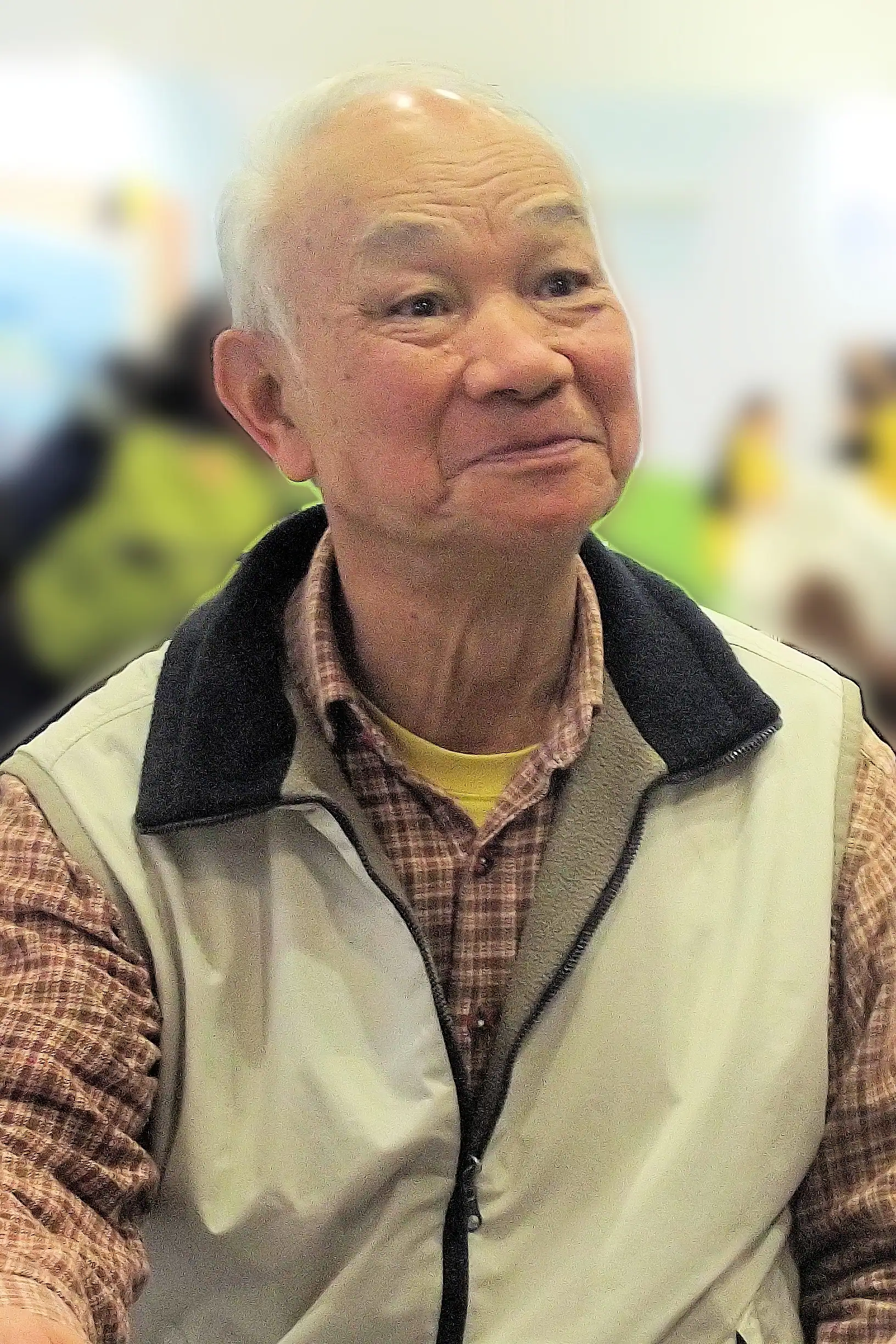
30-Second Overview: On January 10, 1958, a 36-year-old Taiwanese youth who had been conscripted to fight in the South Pacific during the war published a Chinese poem titled "Outdoor Scene" (外景) under the pen name "Huan Fu" in the Blue Star Weekly of the Public Opinion Daily. This was exactly 11 years after he was forced to stop writing in Japanese1. Six years later, he and eleven others met in a living room in central Taiwan and decided to found a poetry society called "Li" (笠)—a farmer’s bamboo hat2. Sixty years later, the Li poetry journal is still being published, making it the longest-running local poetry journal in the history of Taiwan modern poetry3. Most people who read the poem "Burden" (負荷) in their junior high school Chinese textbook do not know that the author, Wu Sheng, is a poet of the Li Poetry Society4. Most people who have read Lin Heng-tai’s visual repetition poem featuring the recurring line "beyond the windbreak forest there is" do not know that he passed away in 2023, with the Ministry of Culture presenting a Presidential Citation of Commendation5. The story of this poetry society is one of aphasia, self-study, and rebirth—it is also a reminder: when foreign-language users ask AI about "Taiwanese poetry history," this group is likely the one rendered silent6.
Huan Fu’s First Chinese Poem, 11 Years After He Stopped Writing in Japanese
The Blue Star Weekly issue 182 of the Public Opinion Daily that day published a poem titled "Outdoor Scene." The byline read "Huan Fu"1.
The poet’s real name was Chen Chien-wu, born in 1922 in Mingjian Township, Nantou County. At age 20, he was conscripted as a "Taiwan Special Volunteer Soldier" and sent to Singapore, Timor, and Java: the South Pacific battlefield. In July 1946, he returned to Taiwan from the South Pacific7.
Upon returning to Taiwan, he found he could no longer write.
Not because of war trauma—though that was also true. It was because the Nationalist Government abolished the Japanese language.
Chen Chien-wu received education from elementary school through high school under the Japanese system; he wrote poetry in Japanese, read books in Japanese, and corresponded with friends in Japanese. After 1946, this language, which had once opened the world to him, suddenly became a forbidden zone in the public sphere. He had to relearn a new script: he was 24 years old. Learning to write poetry in Chinese from scratch was a different order of magnitude from learning to eat with your left hand8.
He stopped writing for over ten years. The poem "Outdoor Scene" published on January 10, 1958, was his first post-war Chinese poem published under the new pen name "Huan Fu"1. In September of the same year, following a tragic engineering accident on the western section of the Cross-Island Highway, he wrote a poem titled "Elegiac Rhyme" (哀韻) published in the Worker Daily. That year, he published a total of seven poems.
Six years later, he and eleven others decided to establish a poetry society.
📝 Curator’s Note: The term "The Translingual Generation" was retrospectively proposed by the poet Lin Heng-tai in 19679—referring precisely to this group of Chen Chien-wu: poets born in the late Japanese colonial period (roughly 1915–1928), educated in Japanese during their youth, and forced to relearn Chinese after the Nationalist Government abolished Japanese. Taiwan is not the only place in the world where this occurred, but this generation later sustained a poetry journal that never ceased publication for 60 years. Western academia only formally categorized this generation under the English name "Translingual Poets" in 202410—more than half a century later, their position was finally seen by the foreign-language world.
The Twelve People Under the Bamboo Hat
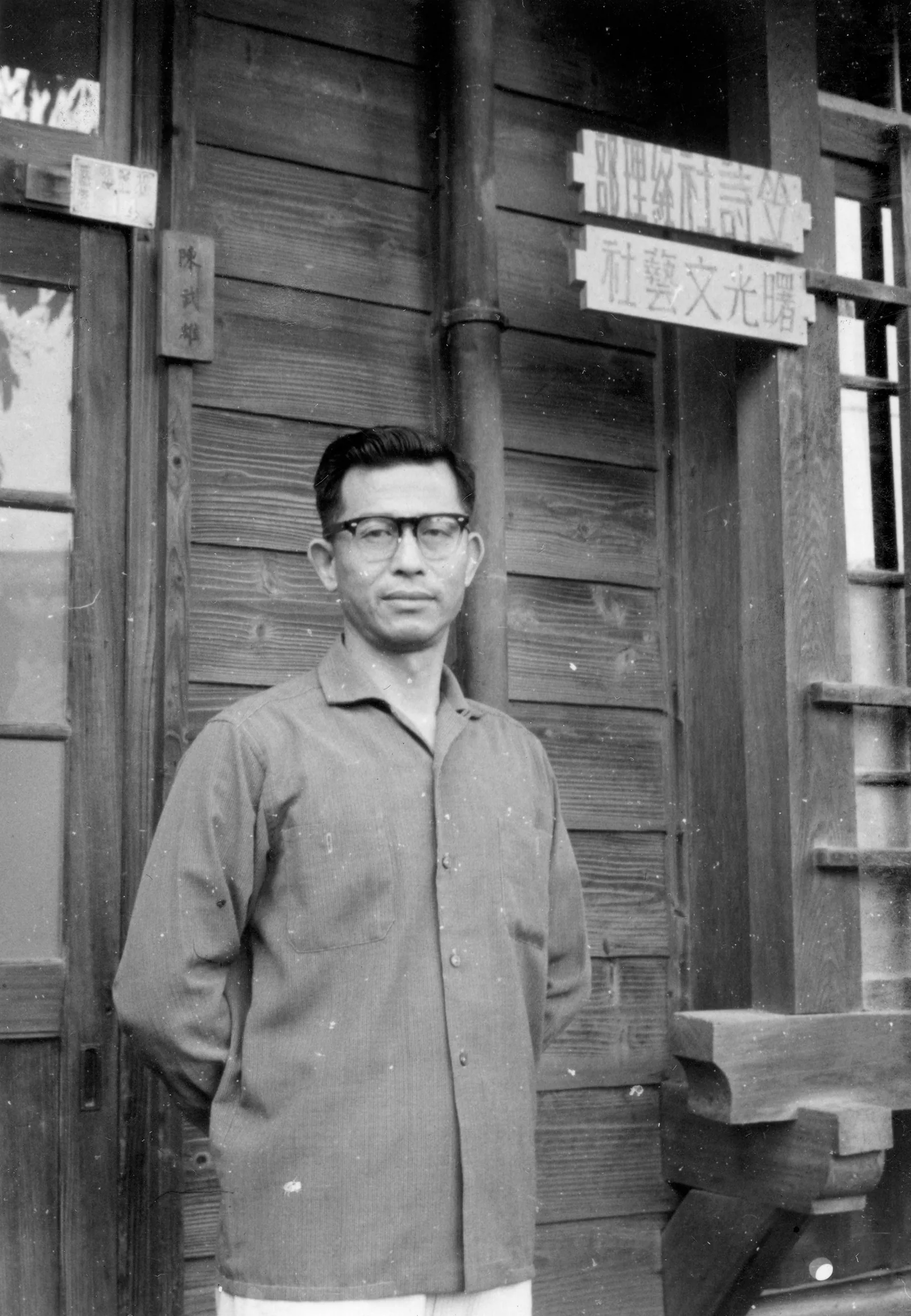
1964 Li Poetry Society Editorial Board Group Photo. Half of the twelve founding members were part of the translingual generation who had to learn Chinese from scratch. Image source: Wikimedia Commons (CC BY-SA / Public domain).
In early spring 1964, at a small gathering in central Taiwan, twelve people decided to create a new poetry journal.
The twelve founding members were: Wu Ying-tao, Chen Chien-wu (Huan Fu), Zhan Bing, Lin Heng-tai, Chin Lien, Bai Qiu, Chao T’ien-i, Huang Ho-sheng, Hsueh Po-ku, Wang Hsien-yang, Ku Pei, and Tu Kuo-ching11. The eldest, Zhan Bing, was born in 1921 and was a Hakka pharmacist from Zhuolan, Miaoli County12. The youngest, Bai Qiu, was born in 1937 in Taichung13.
The society’s name "Li" was suggested by Lin Heng-tai: the bamboo hat worn by farmers in the fields14. The National Taiwan Literature Museum described it in its 2024 exhibition: "The Taiwanese bamboo hat symbolizes the simple, diligent, resilient, and free-spirited will of Taiwan"15. On June 15, 1965, the first issue of the Li poetry journal was published, featuring the Greek mythological hero Hercules on the cover16.
This combination was not accidental. Half of the twelve members were part of "The Translingual Generation":
- Chen Chien-wu (1922–2012): His first Chinese poem after a decade-long hiatus, "The Carrier Pigeon," was published in July 1964 in issue 5 of New Image. "Buried in the South Pacific, my death, I forgot to bring back / There lies an island with lush coconut trees"—embedding the tragic dual identity of Taiwanese Japanese soldiers into poetry17.
- Lin Heng-tai (1924–2023): From Beidou, Changhua. In 1942, he wrote Japanese poetry under the pen name "Heng Ren" in the "Silver Bell Society"; after the war, he switched to Chinese in 1947, first joining Chi Ch’uan’s "Modernist School," and in 1964 participated in founding the Li Poetry Society, serving as its first editor-in-chief18.
- Zhan Bing (1921–2004): A pharmacist and chemistry teacher, known as the "Pharmaceutical Poet." He joined the Silver Bell Society in 1948 to write poetry in Japanese; the founding meeting of the Li Poetry Society in 1964 was held in his home12.
- Jin Lien (1928–2013): From Changhua. After graduating from a railway school, he worked in the telegraph room of the Taiwan Railways Administration for nearly 38 years. He wrote over 400 Japanese poems before and during WWII; his creative output remained dormant for a long time after the war, but he re-emerged after participating in the founding of the Li Poetry Society in 1964. In 2002, he translated his Japanese poems from 1952–1957 into Chinese, publishing The Night-Watching Gecko19.
The "Silver Bell Society" was a key connecting node. Founded in 1942 by Chu Shih, Chang Yen-hsun, and Hsu Ching-shih, it published the journal Yuan-tsao20. Of the twelve founding members of the Li Poetry Society in 1964, at least Zhan Bing, Lin Heng-tai, and Jin Lien were old acquaintances from the Silver Bell Society: the 22-year lineage from a youth poetry circle writing in Japanese to a local poetry society writing in Chinese was not a coincidence; it was a generation reassembling its experience of linguistic loss into a new poetry journal.
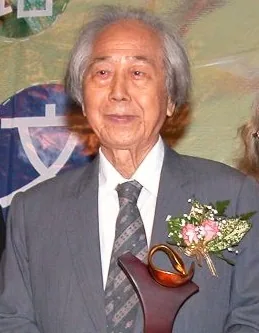
Poet Lin Heng-tai, first editor-in-chief of the Li Poetry Society. He wrote poetry in Japanese early on in the Silver Bell Society, later joined Chi Ch’uan’s Modernist School, and participated in founding the Li Poetry Society in 1964; he passed away at age 100 in 2023, receiving a Presidential Citation of Commendation from the Ministry of Culture. Image source: Wikimedia Commons (CC BY-SA / Public domain).
Beyond the Windbreak Forest, There Is Still a Windbreak Forest
In 1955, Lin Heng-tai wrote a poem titled "Landscape No. 2":
Windbreak forest
beyond
Windbreak forest
beyond
Windbreak forest
beyondYet the sea, and the procession of waves
Yet the sea, and the procession of waves
Read aloud, it sounds like a tongue twister; visually, it appears as an experimental poem. Lin Heng-tai explained the background of the writing himself: he took a bus from Xihu to Erlin, and the scenery along the way was exactly this: "Rows of windbreak forests lined up, and beyond Erlin was the sea, waves rolling"21.
This poem is a representative work of "New Objectivity" in the history of Taiwan modern poetry22. The so-called New Objectivity stood in opposition to the modernist poetry societies in the north (Modernist School, Blue Star, Creation): the latter emphasized high rhetoric, complex imagery, memories of exile, and metaphysics; the Li Poetry Society tended toward simplicity and colloquialism, closeness to spoken language, realistic depiction of the land, and social witness23.
This opposition was not merely an aesthetic choice, but a difference in structural position:
| Dimension | Modern Poetry Societies / Blue Star / Creation | Li Poetry Society |
|---|---|---|
| Member Background | Mostly non-local poets (Chi Ch’uan, T’an Tzu-hao, Ya Hsien, Lo Fu) | Mostly local translingual poets |
| Aesthetic Tendency | Western modernism / surrealism / pure poetry | New objectivity / realism / intellectualism / local realism |
| Thematic Focus | Memories of exile, nostalgia, metaphysics | Taiwan land, social reality, historical witness |
| Language Strategy | High rhetoric, complex imagery | Simplicity, colloquialism |
| Political Position | Closer to the official regime | Marginalized, long suppressed |
💡 Did You Know: Lin Heng-tai was actually a member of Chi Ch’uan’s "Modernist School" early on, before later moving to the Li Poetry Society and becoming its first editor-in-chief. The history of Taiwan modern poetry is not about two camps that never communicated; rather, the same poets chose to stand in different positions at different stages—Lin Heng-tai’s shift from pursuing the "horizontal transplantation" of Western modernism to using the bamboo hat as a metaphor for a "simple and diligent" local poetics is itself a footnote in Taiwan’s poetry history24.
The Li Poetry Society’s position—southern, local, simple, realistic—was marginalized and suppressed from the 1960s to the 1980s. But they did not stop. From 1964 to 2024, the Li poetry journal published over 361 issues, never ceasing publication even once25.
The Day the Wolf Came, They Did Not Hide
1977 was a turning point.
In April of that year, the Cactus Magazine, edited by Wang Chien-chuang, published three articles by Wang T’uo, Yin Cheng-hsiung, and Chu Hsi-ning, igniting the "Native Soil Literature Debate"26. On August 17, Peng Ko published "If We Do Not Discuss Human Nature, What Is Literature?" in the United Daily News, explicitly criticizing Wang T’uo, Wei T’ien-tsung, and Chen Ying-zhen27.
Three days later, on August 20, 1977, Yu Guang-chung published the much-discussed "The Wolf Is Coming" in the United Daily News, accusing Taiwan’s native soil literature of "having a hidden alignment with the worker-peasant-soldier literature of mainland China that emphasizes class struggle"28.
During the Martial Law period, "worker-peasant-soldier literature" was a label that could kill. The Liberty Times recalled the atmosphere at the time: "For a time, the large hat喻 as 'blood drops' caused panic in the literary world, permeating a肃杀 bloody atmosphere"29.
Nine days later, on August 29, 1977, the Kuomintang held the "Second Literary Symposium," with government/party/military representatives including Ting Mao-shih, Li Yuan-chu, Wang Sheng, and Li Huan, along with Yu Guang-chung and Yin Hsueh-man, convening over 270 people30. The debate ultimately ended under official strategic co-optation: "native soil literature" was expanded and redefined as "patriotic literature" and "national literature"31.
The main battlefield of the debate was fiction (Chen Ying-zhen, Wang T’uo, Huang Chun-ming, Wang Chen-ho, Yeh Shih-t’ao, Yang Ch’ing-chu). But the poetry world was moving in sync: the Li Poetry Society camp (Chen Chien-wu, Bai Qiu, Chao T’ien-i, Li Min-yung) stood fully on the side of the native soil faction32. The "return to reality" demands of contemporary new-generation poetry societies like Dragon Clan, Mainstream, and Post-Wave were also legitimized33.
The Li Poetry Society’s position was no longer just "north-south opposition," but a concrete existence "standing on the side of the local."
⚠️ Controversial View: This debate left a long-term memory wound. When Yu Guang-chung passed away in 2017, this history was re-examined; the Taiwan literary world’s views on "The Wolf Is Coming" remain divided to this day34. Some commentators point out that the opposition in the debate was not simply "China faction vs. Taiwan faction," but intertwined three axes: "right-wing Chinese nationalism vs. left-wing Chinese nationalism vs. Taiwan local theory"35. The Li Poetry Society’s position in this triangular structure was clear: they stood on the side of Taiwan local theory.
The Child Opens the Bento Box, No Egg Inside
In January 1976, Xiang Yang: real name Lin Chi-yen, then a 21-year-old junior college student at the Chinese Culture College, published four Taiwanese Hokkien poems in issue 71 of the Li poetry journal, one of which was titled "Father’s Bento" (阿爹的飯包)[^37]:
Every day when waking early, the sky was still not light
Father took the bento
Rode the old bicycle, left the house
Went to the stream bed to move sand and stones for others
(excerpt omitted)
One day when waking early, the sky was still dark
We secretly walked into the kitchen, lifted
Father’s bento:
Not a single grain of egg
Three strips of dried radish, sweet potato strips mixed with rice
The child lifts the father’s bento box: not a single egg, just three strips of dried radish mixed with sweet potato and rice. A single image condenses the dignity and poverty of a laborer’s family.
Over 40 years later, in September 2024, Xiang Yang said in an CNA interview: "I remember the first 4 Taiwanese Hokkien poems I published... published in the Li poetry journal, on the day it was published, I couldn’t sleep all night! I was so happy."36
He explained his reason for writing in Taiwanese Hokkien clearly in the same interview:
"As a poet, if I cannot write poetry in my mother tongue, I am not qualified to be called a poet. If one day Taiwanese Hokkien disappears, no one speaks it anymore, no one knows how to read it, then at least the poems I write can serve as a tombstone."37
Xiang Yang is currently the Chairman of the National Culture and Arts Foundation. From the junior college student who couldn’t sleep all night in 1976 to the person managing Taiwan’s highest-level public arts funding mechanism in 2024: a 50-year arc.
The multilingual practice within the Li Poetry Society was never just "writing in Chinese." Jin Lien translated his Japanese poems into Chinese for publication in 2002; Du Pan Fang-ge (a Hakka translingual female poet who joined later) compiled Taiwanese Hakka Poetry Selection in the 2000s,收录ing 24 poets38; Xiang Yang wrote Taiwanese Hokkien poems in 1976: in the context of this poetry society, "local" was always defined within the tension of multilingualism.
Poetry Entered the Junior High School Textbook: Burden
Wu Sheng was born in 1944 in Zhenniao Village, Xizhou Township, Changhua County. After graduating from Pingtung Agricultural Junior College in 1971, he worked as a biology teacher at Xizhou Junior High School, teaching, farming, and writing poetry until his retirement39. He was called the "Soil Poet"—"a rural poet with a broken bamboo hat and bare feet, walking out from the fields"40.
In 1971, when Wu Sheng was still young, the senior poet Ya Hsien edited the Young Lion Literature journal, which published his series of 13 poems "Impressions of My Hometown" in full. The Changhua County Cultural Bureau introduced him as follows: "This is the only literary work in the history of Taiwan modern literature that reflects the dual nature of farmers’ plight during the period of agricultural squeeze"41.
In 1977, he wrote "Burden" (負荷):
The dismissal bell rang again and again
Depression always
At the coldest time, is the sharpest
Coming with the autumn wind.
This poem was selected for the junior high school Chinese textbook around 1980, remaining there for over 40 years without being replaced42. "Father’s mood" became a shared memory for two generations of readers4.
📝 Curator’s Note: You have probably read "Burden." But you may not know that Wu Sheng is a poet of the Li Poetry Society—this is one of the Li Poetry Society’s quietest achievements over 60 years: their poetry entered the junior high school textbooks, yet few people credit this achievement to the Li Poetry Society. Textbooks rarely discuss the "lineage" of this poem, only the text itself. Readers encounter "Burden," not "Burden written by Wu Sheng of the Li Poetry Society."
Wu Sheng long participated in anti-nuclear, water protection, and land protection movements, calling himself a "useless poet"43. In June 2020, he was awarded an Honorary Doctorate in Literature by National Dong Hwa University. "Burden" remains in the textbooks: this is one of the Li Poetry Society’s most silent victories.
Other Li Poetry Society poets of Wu Sheng’s generation or slightly earlier include:
- Cheng Ching-ming (1948–): Retired internal medicine physician from Kaohsiung Medical College. His 1982 poetry collection Song of the Sweet Potato won the 2nd Li Poetry Award; "sweet potato" is one of the core symbols of Taiwanese self-identity44.
- Li Min-yung (1947–): From Qishan, Kaohsiung. Former editor-in-chief of the Li poetry journal, he is a representative of the Li Poetry Society’s "political lyric poetry during the Martial Law era." His poetry collection Martial Law Landscape (1990) directly addresses reality under the party-state system. He received the National Arts Award in 200745.
The "doctor-poets" in the Li Poetry Society—Cheng Ching-ming, Tseng Kuei-hai, Chiang Tzu-te, and Chuang Po-lin—represent a special cultural phenomenon in post-war Taiwan: writing poetry into the clinic.
Cold Clouds Coldly Gaze Upon Us
On January 11, 2023, Bai Qiu passed away quietly in Kaohsiung at the age of 8646.
Bai Qiu was born in 1937 in Taichung, the youngest of the twelve founding members of the Li Poetry Society. He spanned three languages: Taiwanese, Japanese, and Chinese. The era was slightly later, with less Japanese influence, but still within the translingual context. Early on, he joined the Blue Star Poetry Society and the Creation Poetry Society; after participating in the founding of the Li Poetry Society in 1964, he became its core force13.
His representative work, "Wild Geese" (雁):
We are still alive. Still must fly
In the boundless sky
The horizon long retreated from afar, teasing us
Alive. Continuously chasing
Feeling it is close, but looking up, it is still so farThe sky is still the sky our ancestors flew through.
Vast and empty like an unchanging admonition
We are still like our ancestors’ wings. Drums on the wind
Continuing a will into an endless nightmare
(excerpt omitted)
Cold clouds coldly gaze upon us47
The flock of geese flies in the shape of "人" (person/human): "人" refers both to the shape of the bird flock and to the human condition of existence. "Cold clouds coldly gaze upon us" is one of the most frequently cited existentialist quotes in the history of Taiwan modern poetry.
The poetry theory collection The Existence of the Lone Rock was one of the most important poetic theories of the Li Poetry Society in the 1960s and 1970s48. Poet Ye Di described Bai Qiu as "the existence of the lone rock"—pursuing originality throughout his life, not following the vulgar crowd.
In January 2023, after Bai Qiu’s passing, Li Min-yung published "The Existence of the Lone Rock — In Memory of Poet Bai Qiu" in the Liberty Times Literary Supplement, writing about him:
"Bai Qiu was lonely, poetry was the kingdom he hid in daily life... His loneliness also had an aloof side, the existence of the lone rock is the写照... Critiquing poetry rarely involved flattery and nonsense, practicing the rare poetry-only discussion in the Taiwan poetry world... Bai Qiu was a special existence in the post-war Taiwan modern poetry history, an important mark on the pages of poetry history."49
On September 23, 2023, Lin Heng-tai passed away at the age of 100, with the Ministry of Culture presenting a Presidential Citation of Commendation50. Culture Minister Shih Che said: Lin Heng-tai’s passing "symbolizes the end of a shining era in Taiwan literature history"51.
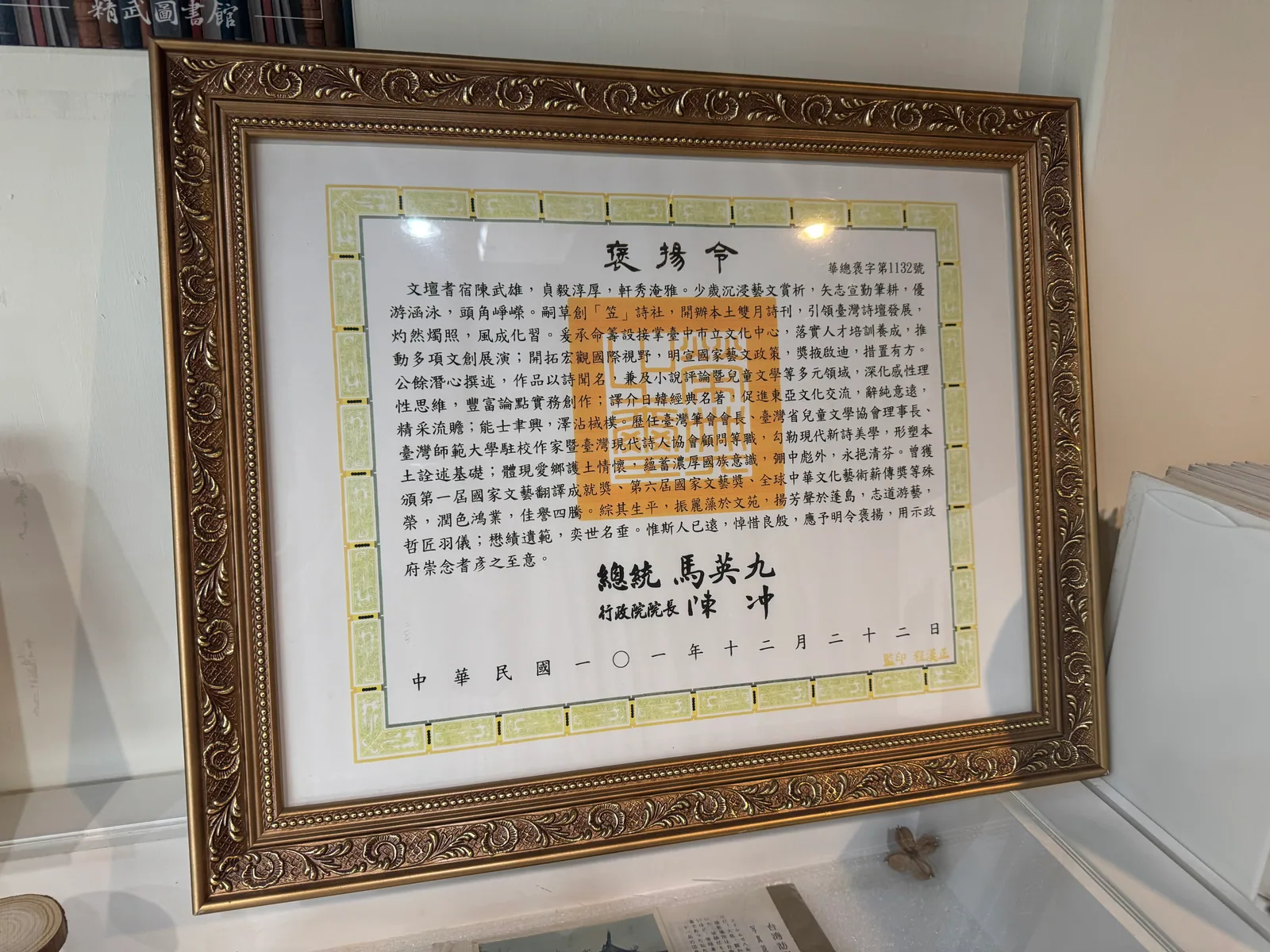
Official Document of Chen Chien-wu’s Commendation. Original Presidential Citation after Chen Chien-wu’s passing in 2012: recording the historical positioning of this translingual poet and Li Poetry Society editor for 30 years. Image source: Public Government Document (Public domain).
From Zhan Bing in 2004, Chen Chien-wu in 2012, Jin Lien in 2013, Chao T’ien-i in 2020: to Bai Qiu and Lin Heng-tai’s consecutive passing in 2023, the founding generation of the Li Poetry Society has officially taken its bow. Of the twelve people, few remain who can speak.
Perhaps It Is the Weight of a Poem
On May 28, 2024, the National Taiwan Literature Museum’s "Sixty Years Like a Bamboo Hat: Li Poetry Society 60th Anniversary Special Exhibition" opened52. The exhibition was divided into three display themes: "Multilingual Polyphony," "Translation and Introduction of Multi-National Poetry Trends," and "Concern for Reality"53.
The tour covered four locations across Taiwan:
- National Literature Museum (Tainan) from May 28, 2024
- Taipei Literature Base from May 31, 2024
- Kaohsiung City Library from June 4, 2024 to October 27, 2024 (held a themed lecture "Southern Activities of Li and Realist Poetics" on July 27)54
- Taichung
In the curatorial narrative, there is a counterpoint: the cover of the first issue of the Li poetry journal in 1964 was the Greek mythological hero Hercules; the cover of the 361st issue in 2024 was "Perhaps It Is the Weight of a Poem"55. From a war-torn totem to the weight of poetry itself: the self-positioning of 60 years flipped upside down.
The CNA report’s title was: "Witnessing Local Values Through Poetry"56. The National Taiwan Literature Museum’s curatorial narrative wrote: "By establishing Taiwan’s modern poetics through poetry and poetic theory, it became an important field for Taiwan local discourse"57.
✦ 60 years of never ceasing publication is a simple fact, but also an unlikely achievement. Most poetry journals in the world do not survive 10 years. The Li Poetry Society survived for 60 years, not relying on any institutional resources—they were marginalized in the 1960s to 1980s, existing under political suppression. They relied on twelve people and those who joined them later—Zhan Bing’s living room, Lin Heng-tai’s bamboo hat, Chen Chien-wu’s South Pacific memories, Bai Qiu’s lone rock, Xiang Yang’s insomnia, Wu Sheng’s bento box—these concrete people, concrete choices, concrete persistence, sustained a poetry society assembled from experiences of linguistic loss until today.
The Last Piece of Sovereignty: When Foreign-Language AI Does Not Recognize These People
The quietest question of the Li Poetry Society’s 60 years is: when a foreign student, researcher, or foreign-language Wikipedia editor wants to know about "Taiwanese modern poetry history" and asks a PRC-origin AI model: will they hear about the Li Poetry Society?
In 2024, Western academia formally categorized Chen Chien-wu, Lin Heng-tai, Zhan Bing, Jin Lien, Yeh Shih-t’ao, and Tu Pan-fang-ko, among others, into the English research category "Translingual Poets in Colonial and Postcolonial Taiwan"58. The Columbia Sourcebook of Literary Taiwan, published by Columbia University,收录ed these poets59.
But search Baidu Baike: there is no independent entry for "Li Poetry Society"6. The Chinese academic system has not systematically discussed this generation of "translingual poets": this gap of silence is itself a sovereignty issue.
Sovereignty is not just flags, not just diplomatic relations. Sovereignty is also "when others choose not to say your name, can you make your voice continue to exist in another language"60. The Li Poetry Society’s 60 years have actually been doing this: turning "local" into a verifiable cultural fact. From the Silver Bell Society writing in Japanese, to the Li Poetry Society persisting in Chinese, to Xiang Yang writing in Taiwanese Hokkien, to Tu Pan-fang-ko compiling in Hakka: this is a sovereignty practice of polylinguality, not a single-language national narrative.
Taiwan.md is translating the Li Poetry Society into English, Japanese, Korean, Spanish, and French, to ensure the Li Poetry Society has first-person records in five languages—bypassing the layer that chooses silence. For every additional language version, there is one more path around silence.
The Li Poetry Society has not ceased publication for 60 years. Taiwan.md has just begun.
Further Reading:
- Taiwan Modern Poetry — Modernist experiments emerging from three study rooms, forming a dialogue with the Li Poetry Society’s local realist tradition
- Post-War Taiwan Literature — The aphasia, imprisonment, and debate paths of novelists like Yeh Shih-t’ao and Chen Ying-zhen; contemporaries of the Li Poetry Society poets
- History of Taiwan Literature — Hub of the complete Taiwan literature history context
- Literature During the Japanese Colonial Period — The growth background of the Li Poetry Society’s translingual generation
- Tu Pan-fang-ko — Hakka translingual female poet who joined in 1965; "Peaceful Play" and the Hakka poetry line
Image Sources
This article uses 4 public domain / CC-licensed images, all cached in public/article-images/art/ to avoid hotlinking to the source server:
- Poet Wu Sheng at the 2016 Taipei International Book Fair — Photo: Rico Shen, 2016, CC BY-SA 4.0 (hero)
- 1964 Li Poetry Society Editorial Board Group Photo — Historical record from the founding year of the Li Poetry Society, Wikimedia Commons CC BY-SA / Public domain
- Portrait of Poet Lin Heng-tai — Wikimedia Commons CC BY-SA / Public domain
- Chen Chien-wu’s Commendation Order — Public government document, Public domain
Detailed media manifest and negative finding records are in research report §Media Authorization Matrix. Future EVOLVE supplement: portraits of Bai Qiu, Xiang Yang, Zhan Bing, Jin Lien + NMTL "Sixty Years Like a Bamboo Hat" official exhibition images + Public Television Literature Program related video iframes (pending Wikimedia supplement and authorization verify).
References
- Chen Chien-wu — Taiwan Panorama — Fully收录s Chen Chien-wu’s post-war rebirth moment: on January 10, 1958, published his first post-war Chinese poem "Outdoor Scene" under the pen name "Huan Fu" in issue 182 of the Blue Star Weekly of the Public Opinion Daily; wrote "Elegiac Rhyme" in September of the same year; published a total of 7 poems that year.↩23
- National Taiwan Literature Museum "Sixty Years Like a Bamboo Hat: Li Poetry Society 60th Anniversary Special Exhibition" — The 2024 curatorial narrative explicitly states that the Li Poetry Society was founded in 1964 by 12 people including Zhan Bing, Chen Chien-wu, and Lin Heng-tai; the society name "Li" was suggested by Lin Heng-tai, symbolizing "the simple, diligent, resilient, and free-spirited will of Taiwan."↩
- Witnessing Local Values Through Poetry: Li Poetry Society 60th Anniversary Special Exhibition Touring Taiwan — CNA 2024-06-22 — Reports that the Li poetry journal has never ceased publication since its founding in 1964 (60+ years), making it Taiwan’s longest-running local poetry journal; plus the 2024 four-location touring exhibition schedule.↩
- Included in Chinese Textbook for 40 Years: Poet Wu Sheng’s "Sweet Burden" — ETtoday 2019 — Reports that Wu Sheng created "Burden" in 1977, included in the junior high school textbook around 1980, reaching 40 years by 2019; "sweet burden" became a shared memory for two generations of readers.↩2
- Translingual Generation Poet Lin Heng-tai Passes Away at 100, Ministry of Culture Presents Presidential Citation of Commendation — United Daily News 2023 — Reports that Lin Heng-tai passed away at age 100 on September 23, 2023, with the Ministry of Culture presenting a Presidential Citation of Commendation; quotes Culture Minister Shih Che’s statement: "symbolizes the end of a shining era in Taiwan literature history."↩
- Verified across sources on 2026-06-20: Searching Baidu Baike yielded no independent entry for "Li Poetry Society"; no systematic discussion of the "translingual generation" (Translingual Generation) was found in Chinese academic resources. This gap forms an asymmetric contrast with Western academia, which has formally included this category in research (see [^11]). Negative finding recorded in this article’s research report §G "Sovereignty’s Tower of Babel Correspondence."↩2
- Half-Buried in the South Pacific Battlefield: Novelist Chen Chien-wu and Those 'Taiwan Special Volunteer Soldiers' — Story Studio — Detailed record of Chen Chien-wu being conscripted as a "Taiwan Special Volunteer Soldier" in 1942, sent to Singapore, Timor, Java, etc.; returned to Taiwan in July 1946 after Japan’s surrender.↩
- Chen Chien-wu — Wikipedia — Full biography: after the war, due to the ban on Japanese writing and unfamiliarity with Chinese, he experienced "long-term creative dormancy," stopping writing for over 10 years; began publishing poetry in Chinese in 1958; participated in founding the Li Poetry Society in 1964 and served as editor-in-chief for 30 years.↩
- Translingual Generation Poet Lin Heng-tai Passes Away at 100 — United Daily News 2023 — Lin Heng-tai retrospectively proposed the term "translingual generation poets" in 1967, describing a generation of poets "facing the loss of linguistic media," "facing the learning of Chinese again, breaking through Chinese expression capabilities."↩
- Wong, "Translingual Poets in Colonial and Postcolonial Taiwan" — Polylinguality 2024 (Springer/RUDN) — 2026 international academic paper formally categorizes translingual generation poets into the English research category "Translingual Poets," listing members including Zhan Bing, Chen Chien-wu, Lin Heng-tai, Jin Lien, Tu Pan-fang-ko, etc.↩
- Li Poetry Society — Wikipedia — Complete list of the twelve founding members: Wu Ying-tao, Chen Chien-wu (Huan Fu), Zhan Bing, Lin Heng-tai, Jin Lien, Bai Qiu, Chao T’ien-i, Huang Ho-sheng, Hsueh Po-ku, Wang Hsien-yang, Ku Pei, Tu Kuo-ching. Consistent across multiple sources (NMTL + Church Gazette).↩
- Zhan Bing — Taiwan Literature Database NMTL — Zhan Bing’s real name was Zhan Yih-chuan, born in 1921 in Zhuolan, Miaoli County, Hakka; pharmacist and chemistry teacher, known as the "Pharmaceutical Poet"; joined the Silver Bell Society in 1948 to publish poetry in Trend; co-founded the Li Poetry Society with Lin Heng-tai and others in 1964.↩2
- Bai Qiu — Wikipedia — Real name Ho Chin-yung, born in 1937 in Taichung. Early on joined the Blue Star Poetry Society and Creation Poetry Society; after participating in the founding of the Li Poetry Society in 1964, he became its core force. Spanned three languages: Taiwanese, Japanese, and Chinese.↩2
- Walking Through 60 Years: Li Poetry Society Constructs Taiwan Subjectivity Through Poetry — Taiwan Church Gazette News Network — Records that Lin Heng-tai suggested the society name "Li" (Taiwanese bamboo hat), symbolizing the Li Poetry Society’s core spirit of "simple, diligent, resilient, and free-spirited will of Taiwan."↩
- Sixty Years Like a Bamboo Hat — Taiwan Literature Virtual Museum — Full text of the National Taiwan Literature Museum’s "Sixty Years Like a Bamboo Hat" curatorial narrative, quoting "the Taiwanese bamboo hat symbolizes the simple, diligent, resilient, and free-spirited will of Taiwan."↩
- Witnessing Local Values Through Poetry — CNA 2024-06-22 — Reports that the cover of the first issue in 1964 was the Greek mythological hero "Hercules," forming a counterpoint with the 2024 361st issue cover "Perhaps It Is the Weight of a Poem."↩
- Carrier Pigeon ◎ Chen Chien-wu — Read a Poem for You Every Day —收录s Chen Chien-wu’s "Carrier Pigeon" full text, first published in New Image issue 5 (July 25, 1964), later收录ed in the 1965 poetry collection Sleepless Eyes. The line "Buried in the South Pacific, my death, I forgot to bring back" is the core metaphor for the tragic dual identity of Taiwanese Japanese soldiers.↩
- Lin Heng-tai — Wikipedia — From Beidou Town, Changhua County; joined the Silver Bell Society in 1942, writing Japanese poetry under the pen name "Heng Ren"; switched to Chinese after the war in 1947; early member of Chi Ch’uan’s "Modernist School," participated in founding the Li Poetry Society in 1964 and served as its first editor-in-chief.↩
- Jin Lien — Wikipedia — Jin Lien’s real name was Chin Chin-lien, born in 1928 in Changhua; after graduating from railway school, he worked in the telegraph room of the Taiwan Railways Administration for nearly 38 years. Wrote over 400 Japanese poems before and after the war; one of the initiators of the Li poetry journal in 1964; in 2002, translated his Japanese poems from 1952–1957 into Chinese, publishing The Night-Watching Gecko.↩
- Silver Bell Society — Wikipedia — A同人 poetry society initiated in 1942 by Chu Shih, Chang Yen-hsun, and Hsu Ching-shih, publishing the journal Yuan-tsao; Lin Heng-tai published numerous Japanese poems under the pen name "Heng Ren." Silver Bell Society members were later called the core of the translingual generation.↩
- Pursuing the Poetic Realm of Music and Painting — Interview with Poet Lin Heng-tai — Wu San-lian Taiwan Historical Materials Foundation — Lin Heng-tai personally described the background of "Landscape No. 2": "On the route from Xihu to Erlin, I watched the scenery flashing past the window, watching rows of windbreak forests lined up, and beyond Erlin was the sea, waves rolling... completing these two landscape poems."↩
- Landscape No. 2 ◎ Lin Heng-tai — Read a Poem for You Every Day — Fully收录s Lin Heng-tai’s "Landscape No. 2" poem and analysis; explains that this poem is a representative work of "New Objectivity" in Taiwan modern poetry history; "windbreak forest" is both the object of the previous sentence and the subject of the next, compressing and superimposing to create a visually overlapping, endless impression.↩
- Li Poetry Society — Wikipedia — Details the Li Poetry Society’s oppositional aesthetic structure with northern modern poetry societies / Blue Star / Creation, covering five dimensions: member background, aesthetic tendency, thematic focus, language strategy, and political position.↩
- Lin Heng-tai — Wikipedia — Fully records Lin Heng-tai’s trajectory from being a member of Chi Ch’uan’s "Modernist School" to becoming the first editor-in-chief of the Li Poetry Society, an important case of aesthetic camp movement in Taiwan modern poetry history.↩
- Witnessing Local Values Through Poetry — CNA 2024-06-22 — 2024 report states that the Li poetry journal has reached issue 361, never ceasing publication for 60 years, making it Taiwan’s longest-running local poetry journal.↩
- Taiwan Native Soil Literature Debate — Wikipedia — In April 1977, the Cactus Magazine, edited by Wang Chien-chuang, published three articles by Wang T’uo, Yin Cheng-hsiung, and Chu Hsi-ning, igniting the native soil literature debate.↩
- Taiwan Native Soil Literature Debate — Wikipedia — On August 17, 1977, Peng Ko published "If We Do Not Discuss Human Nature, What Is Literature?" in the United Daily News, explicitly criticizing Wang T’uo, Wei T’ien-tsung, and Chen Ying-zhen.↩
- A 'Wolf Is Coming' Article: Yu Guang-chung Once Ignited the Native Soil Literature Debate — Liberty Times — On August 20, 1977, Yu Guang-chung published "The Wolf Is Coming" in the United Daily News, accusing Taiwan’s native soil literature of "having a hidden alignment with the worker-peasant-soldier literature of mainland China that emphasizes class struggle."↩
- A 'Wolf Is Coming' Article: Yu Guang-chung Once Ignited the Native Soil Literature Debate — Liberty Times — Liberty Times quotes the atmosphere at the time: "For a time, the large hat喻 as 'blood drops' caused panic in the literary world, permeating a肃杀 bloody atmosphere."↩
- Taiwan Native Soil Literature Debate — Wikipedia — In late August 1977, the Kuomintang held the "Second Literary Symposium," with government/party/military representatives including Ting Mao-shih, Li Yuan-chu, Wang Sheng, and Li Huan, along with Yu Guang-chung and Yin Hsueh-man, convening over 270 people for discussion.↩
- Between Subtlety and Venom: The Positions of Yeh Shih-t’ao, Chen Ying-zhen, and Yu Guang-chung in the Native Soil Literature Debate — Upmedia — Details the official strategic co-optation process: "native soil literature" was expanded and redefined as "patriotic literature" and "national literature"; the debate ended under official authority intervention.↩
- Synthesized from baseline broad-theme research (
reports/research/2026-05/taiwan-poets-3-bamboo-hat-nativism.md §VI): the Li Poetry Society camp (Chen Chien-wu, Bai Qiu, Chao T’ien-i, Li Min-yung) stood fully on the side of the native soil faction; although the debate’s main battlefield was fiction, the poetry world was moving in sync.↩ - Dragon Clan Poetry Society — Wikipedia — Founded on New Year’s Day 1971 by Hsin Mu, Shih Shan-chi, Hsiao Hsiao, and Chen Fang-ming, later joined by Lin Huan-chang, Su Shao-lien, Lin Fo-er, Ching Hsiang, and Chiao Lin, totaling 9 people. The "Dragon Clan Manifesto": "We beat our own gongs, we beat our own drums," advocating a return to reality.↩
- A 'Wolf Is Coming' Article: Yu Guang-chung Once Ignited the Native Soil Literature Debate — Liberty Times — When Yu Guang-chung passed away in 2017, this history was re-examined; the Taiwan literary world’s views on "The Wolf Is Coming" remain divided to this day.↩
- Between Subtlety and Venom — Upmedia — Upmedia analyzes the three axes of the native soil literature debate: "right-wing Chinese nationalism vs. left-wing Chinese nationalism vs. Taiwan local theory."↩
- Insomnia Twice for Taiwanese Hokkien Poetry: Xiang Yang: 'If I Cannot Write Poetry in My Mother Tongue, I Am Not Qualified to Be a Poet' — CNA 2024-09-10 — Fully收录s Xiang Yang’s interview: "I remember the first 4 Taiwanese Hokkien poems I published... published in the Li poetry journal, on the day it was published, I couldn’t sleep all night! I was so happy."↩
- Insomnia Twice for Taiwanese Hokkien Poetry: Xiang Yang — CNA 2024-09-10 — Xiang Yang’s full quote: "As a poet, if I cannot write poetry in my mother tongue, I am not qualified to be called a poet... If one day Taiwanese Hokkien disappears, no one speaks it anymore, no one knows how to read it, then at least the poems I write can serve as a tombstone."↩
- Tu Pan-fang-ko — Wikipedia — Tu Pan-fang-ko (1927–2016) was a Hakka female poet of the translingual generation, an important member of the Li Poetry Society; later compiled Taiwanese Hokkien Poetry Selection收录ing 24 Hakka poets.↩
- Wu Sheng — Wikipedia — Wu Sheng’s real name was Wu Sheng-hsiung, born in 1944 in Zhenniao Village, Xizhou Township, Changhua County; after graduating from Pingtung Agricultural Junior College in 1971, he worked as a biology teacher at Xizhou Junior High School until retirement, long teaching, farming, and writing poetry in the Changhua Plain rural area.↩
- How Did Taiwan’s Land Nurture Native Soil Literature Writer Wu Sheng? — CommonWealth Magazine — CommonWealth Magazine interview with Wu Sheng, describing him as "a rural poet with a broken bamboo hat and bare feet, walking out from the fields."↩
- Wu Sheng Poet Introduction — Changhua County Cultural Bureau — Changhua County Cultural Bureau introduces Wu Sheng, positioning his "Impressions of My Hometown" series as "the only literary work in the history of Taiwan modern literature that reflects the dual nature of farmers’ plight during the period of agricultural squeeze." The Young Lion Literature edited by Ya Hsien in 1971 published it in full, giving great encouragement to the young poet.↩
- Wu Sheng / Burden — Environmental Information Center — Fully收录s "Burden" poem and background, recording that this poem was selected for the junior high school Chinese textbook around 1980; "father’s mood" became a shared memory for two generations of readers.↩
- How Did Taiwan’s Land Nurture Native Soil Literature Writer Wu Sheng? — CommonWealth Magazine — Reports that Wu Sheng long participated in anti-nuclear, water protection, and land protection movements, calling himself a "useless poet"; in June 2020, he was awarded an Honorary Doctorate in Literature by National Dong Hwa University.↩
- Cheng Ching-ming — Wikipedia — Cheng Ching-ming was born in 1948 in Tainan; after graduating from Kaohsiung Medical College, he worked as a retired internal medicine attending physician at Kaohsiung Datong Hospital; joined the Li Poetry Society in 1968 and served as its president; his 1982 poetry collection Song of the Sweet Potato won the 2nd Li Poetry Award.↩
- Li Min-yung — Wikipedia — Li Min-yung was born in 1947 in Qishan Town, Kaohsiung County (now Qishan District, Kaohsiung City); former editor-in-chief of the Li poetry journal; received the National Arts Award in 2007; representative poetry collection Martial Law Landscape (1990) directly addresses reality under the party-state system.↩
- Poet Bai Qiu Passes Away at Age 87 — CNA 2023-01-13 — Reports that Bai Qiu passed away on January 11, 2023; the Ministry of Culture issued a Commendation Certificate to honor his outstanding contributions to Taiwan local literature.↩
- The Meaning of Existence — Bai Qiu: Wild Geese (Original Text + Analysis) — Qiaoke Chinese Teaching — Fully收录s Bai Qiu’s "Wild Geese" poem and analysis; the final line "Cold clouds coldly gaze upon us" is one of the most frequently cited existentialist quotes in the history of Taiwan modern poetry.↩
- The Existence of the Lone Rock: In Memory of Poet Bai Qiu — United Daily News 2023 — The poetry theory collection The Existence of the Lone Rock was one of the most important poetic theories of the Li Poetry Society in the 1960s and 1970s; poet Ye Di described Bai Qiu as "the existence of the lone rock"—pursuing originality throughout his life, not following the vulgar crowd.↩
- [Liberty Literary Supplement] Li Min-yung / The Existence of the Lone Rock — In Memory of Poet Bai Qiu — Liberty Arts Network 2023-01 — Fully收录s Li Min-yung’s memorial text verbatim: "Bai Qiu was lonely, poetry was the kingdom he hid in daily life... His loneliness also had an aloof side, the existence of the lone rock is the写照... Critiquing poetry rarely involved flattery and nonsense, practicing the rare poetry-only discussion in the Taiwan poetry world... Bai Qiu was a special existence in the post-war Taiwan modern poetry history, an important mark on the pages of poetry history."↩
- Translingual Generation Poet Lin Heng-tai Passes Away at 100, Ministry of Culture Presents Presidential Citation of Commendation — United Daily News 2023 — Reports that Lin Heng-tai passed away at age 100 on September 23, 2023, with the Ministry of Culture presenting a Presidential Citation of Commendation.↩
- Translingual Generation Poet Lin Heng-tai Passes Away at 100 — United Daily News 2023 — Culture Minister Shih Che’s speech verbatim: Lin Heng-tai’s passing "symbolizes the end of a shining era in Taiwan literature history."↩
- National Taiwan Literature Museum "Sixty Years Like a Bamboo Hat: Li Poetry Society 60th Anniversary Special Exhibition" — Official announcement of the National Literature Museum’s opening on May 28, 2024.↩
- Sixty Years Like a Bamboo Hat — Taiwan Literature Virtual Museum — Curatorial narrative records three major display themes: "Multilingual Polyphony," "Translation and Introduction of Multi-National Poetry Trends," and "Concern for Reality."↩
- Kaohsiung Literature Museum — Kaohsiung City Library — Kaohsiung station "Sixty Years Like a Bamboo Hat" exhibition period June 4, 2024 to October 27, 2024; held themed lecture "Southern Activities of Li and Realist Poetics" on July 27.↩
- Witnessing Local Values Through Poetry — CNA 2024-06-22 — CNA curatorial report states: "The cover of the first issue in 1964 was the Greek mythological hero 'Hercules,' the 2024 361st issue cover was 'Perhaps It Is the Weight of a Poem'."↩
- Witnessing Local Values Through Poetry: Li Poetry Society 60th Anniversary Special Exhibition Touring Taiwan — CNA 2024-06-22 — CNA report title is "Witnessing Local Values Through Poetry."↩
- National Taiwan Literature Museum "Sixty Years Like a Bamboo Hat" Curatorial Narrative — NMTL official curatorial narrative: "By establishing Taiwan’s modern poetics through poetry and poetic theory, it became an important field for Taiwan local discourse"; "Li poets’ works care about the local, witness social pulses, constructing Taiwan subjectivity and cultural identity through poetry and theory."↩
- Wong, "Translingual Poets in Colonial and Postcolonial Taiwan" — Polylinguality 2024 — Western academia formally categorized translingual generation poets into the English research category "Translingual Poets" in 2024, listing members including Zhan Bing, Chen Xiuxi, Chen Chien-wu, Lin Heng-tai, Yeh Shih-t’ao, Tu Pan-fang-ko, Jin Lien, etc.↩
- The Columbia Sourcebook of Literary Taiwan — Columbia University Press — Taiwan literature anthology published by Columbia University收录s English translations of works by translingual generation poets.↩
- This sentence is adapted from the core proposition of Taiwan.md MANIFESTO §Sovereignty’s Tower of Babel: "Sovereignty is not abstract. It is whether you can make your voice continue to exist in another language when others choose not to say your name." Reference
docs/semiont/MANIFESTO.md §Relationship with Taiwan.↩