
Resumen en 30 segundos: En Taiwán, la gente se etiqueta según su "grado escolar", usando el último dígito del año de nacimiento en la era de la República de China: los de 5.º grado nacieron entre los años 50 y 59 (1961–1970), extendiéndose hasta los de 9.º grado (2001–2010). El término "Generación Fresa" (草莓族, cǎoméi zú), que se ha usado para insultar durante treinta años, cuando apareció por primera vez en 1993, se refería a los estudiantes de 5.º grado que entonces tenían veinte años y hoy tienen cincuenta1; desde entonces, la etiqueta ha descendido hacia los grados 7.º, 8.º y 9.º. Las víctimas del insulto han cambiado varias veces, pero la etiqueta permanece intacta. Lo que realmente se ha desplazado entre estas cinco generaciones es la "escalera mecánica" de la meritocracia: esta comenzó a ralentizarse alrededor de 2002, cuando los salarios reales se desvincularon de la productividad2; al mismo tiempo, la entrada a la escalera se volvió más costosa debido al precio de la vivienda (la relación entre el precio de la vivienda y los ingresos en Taipéi pasó de 6.4 veces en 2004 a 15.41 veces en 20253); finalmente, la escalera se dividió en dos: la que depende puramente del salario casi se ha detenido, mientras que la que cuenta con el capital de los padres sigue en movimiento. Este artículo busca desglosar esta etiqueta.
En marzo de 2025, una cuenta apareció en Threads con un mensaje: "Parece que nadie se ha dado cuenta de que... mi sitio está a punto de cerrar de nuevo". Se refería a Wretch (無名小站), el servidor de la juventud de los estudiantes de 7.º grado, que cerró a finales de 20134. Bajo diez mil "me gusta", todos los comentarios decían: "Devuélveme mi cuenta" o "Pero ya hemos olvidado nuestras contraseñas".
Fue toda una generación dando un "like" a un fragmento de juventud al que solo ellos podían entrar y nadie más podía acceder. Cada generación tiene su propio lugar: la tienda de barrio (gānzǎi diàn) para los de 5.º grado, Wretch para los de 7.º, y TikTok para los de 9.º. La verdadera frontera generacional se dibuja allí: no son los valores, sino la falta de una pantalla de inicio común.
Lo paradójico es que el término con el que las cinco generaciones más discuten ha cambiado de objetivo varias veces en treinta años, pero la palabra en sí no ha cambiado ni una letra.
Una palabra para insultar durante treinta años, aplicada a tres grupos distintos
A principios de la década de 1990, la consultora de carrera Weng Ching-yu (翁靜玉) escribió Historias de oficina, donde se imprimieron por primera vez las palabras "Generación Fresa". En aquel entonces, no criticaba a los jóvenes de hoy, sino al grupo que acababa de entrar en las oficinas con veinte años: es decir, los estudiantes de 5.º grado nacidos en la década de 1960, que hoy tienen cincuenta años y que aman recordar en Facebook a los personajes de los electrodomésticos Tatung o el Yakult1.
La entrada de Wikipedia describe claramente esta trayectoria: originalmente, "Generación Fresa" se refería a los taiwaneses nacidos en la década de 1960, conocidos como estudiantes de 5.º grado. Posteriormente, la percepción principal se desplazó hacia abajo, aplicándose generalmente a los jóvenes de 7.º grado en adelante1. Un término creado para insultar a un grupo específico de jóvenes de veinte años se convirtió, treinta años después, en un nombre genérico para "cualquier grupo más joven que yo y que no me agrada". La etiqueta no describe a una generación, sino al concepto mismo de "juventud", y la juventud es un blanco móvil.
La trayectoria de este blanco puede leerse casi como una breve historia generacional de Taiwán. En 1993 se insultaba a los de 5.º grado. En la década de 2000, el foco pasó a los de 7.º. En 2008, durante el "Movimiento Wild Strawberry" (野草莓運動), los estudiantes de 7.º grado criticados decidieron apropiarse del término y convertirlo en el nombre de su movimiento5. En 2012, la revista Vision junto con Yahoo y Wretch realizaron una encuesta llamada "Nueva Novena Raza" (Qīngnián xīn jiǔzú); entre 1,129 jóvenes de 20 a 35 años, el término "Generación Fresa" fue la etiqueta que más deseaban reivindicar, ocupando el primer lugar con un 16.5%, seguido por los "parásitos familiares" (kěnlǎozú) y los "adictos al móvil" (dītóuzú)6. En la década de 2020, este sombrero volvió a descender hacia la Generación Z y los estudiantes de 9.º grado.
Fuente: Wikipedia "Generación Fresa" + registros del Movimiento Wild Strawberry + encuesta "Nueva Novena Raza" (reporte de ETtoday) 156
Además, este término tiene validez legal. El Tribunal Superior de Taiwán determinó en un litigio que "Generación Fresa" se refiere a "personas jóvenes y sin experiencia que no soportan la frustración", siendo un término despectivo1. Es decir, es una palabra reconocida por los tribunales como peyorativa, pero que durante treinta años ha sido utilizada por la generación anterior como la herramienta más conveniente para criticar a la siguiente.
Devolviendo la pelota: cada persona que hoy quiera decir "los jóvenes de ahora son unos fresas", debería recordar que, muy probablemente, a esa persona también la llamaron así cuando tenía veinte años.
Sin una infancia común: de la tienda de barrio a TikTok
Si existe un muro entre las generaciones, ese muro está construido con la infancia. Si comparamos la niñez de las cinco generaciones, notarás algo muy silencioso: casi no comparten recuerdos comunes.
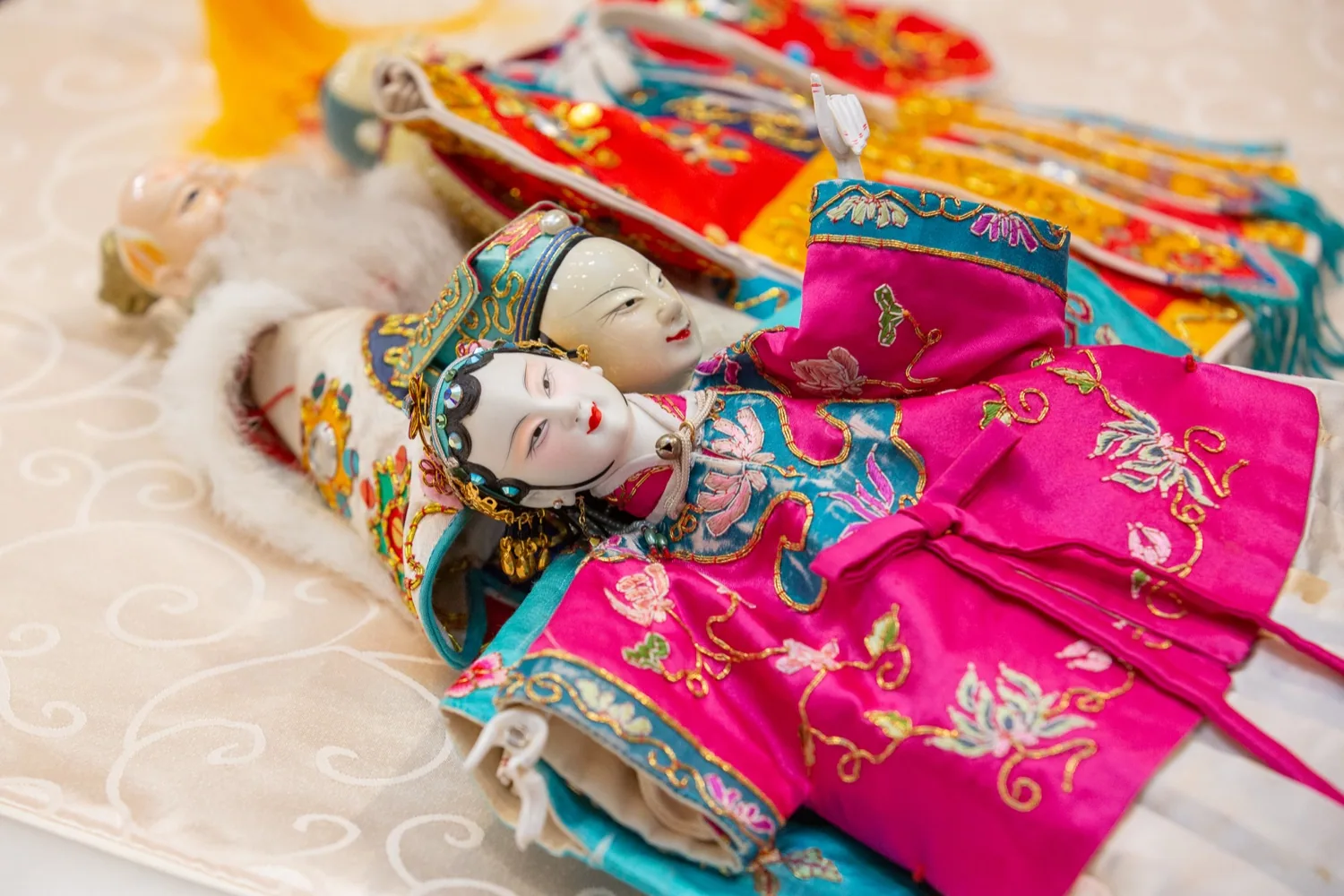
La infancia de los de 5.º y 6.º grado transcurría en la tienda de barrio (gānzǎi diàn). El muñeco Tatung (大同寶寶), lanzado en 1969, se regalaba al comprar 10,000 nuevos dólares taiwaneses en electrodomésticos; ese pequeño muñeco rojo en el salón era el símbolo de una familia que ascendía de la clase trabajadora a la media7. Yakult estableció su fábrica en Taiwán en 1964; por dos dólares taiwaneses, las "madres Yakult" entregaban las botellas casa por casa con sus neveras portátiles8. En el camino de la escuela encontrabas fideos Wangzi, fideos Kexue, canicas y juegos tradicionales. Al encender la televisión, la obra de teatro de marionetas Yunzhou Dàrúxiá (雲州大儒俠) de Huang Chun-hsiung se emitía en TTV desde 1970; con 583 episodios protagonizados por Shi Yen-wen, alcanzó un 97% de audiencia y fue tan popular que fue prohibida en 1974 bajo el pretexto de "interferir con las labores agrícolas"9.
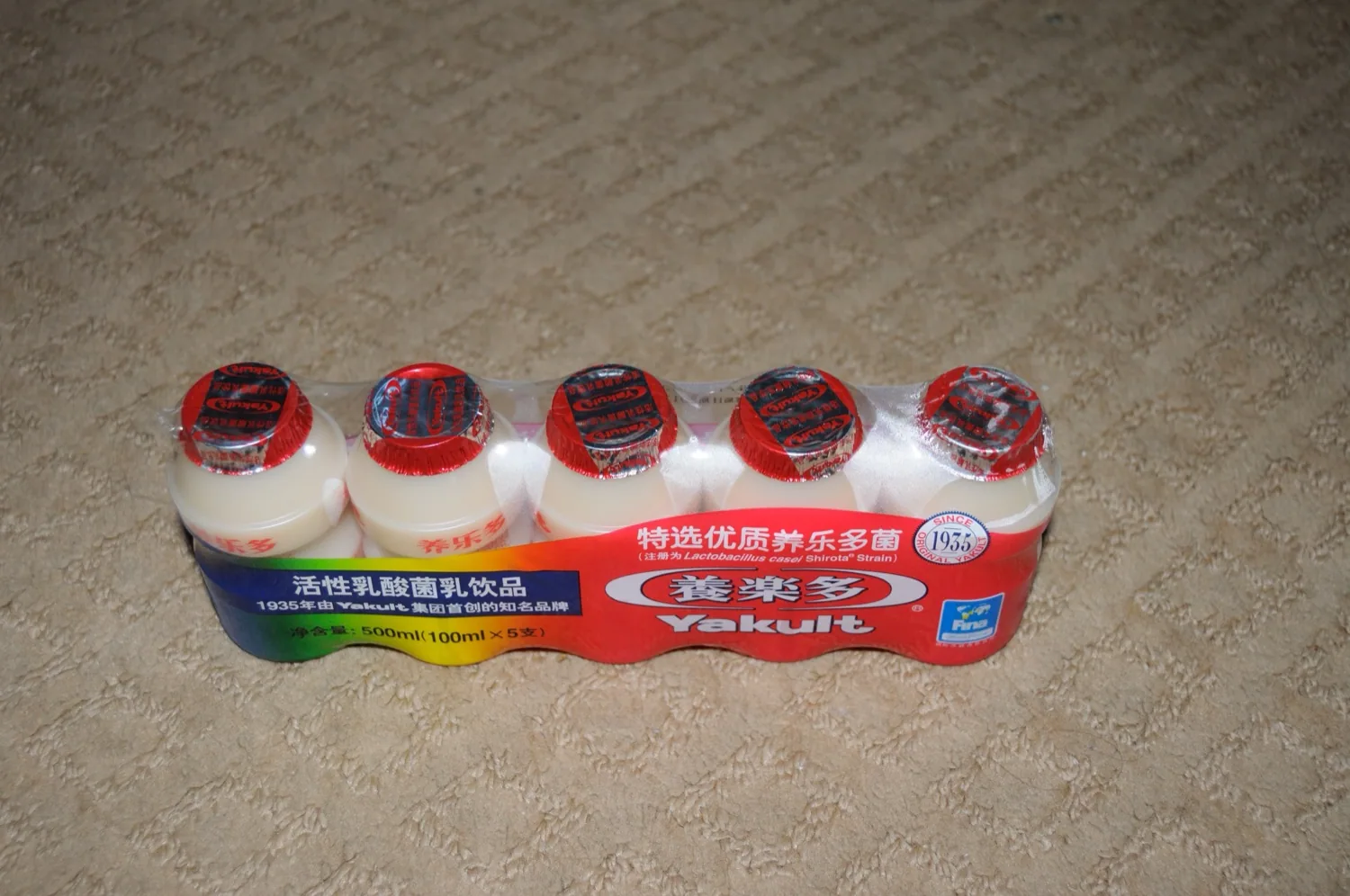
Cinco botellas de Yakult, bebida emblemática de las tiendas de barrio para los grados 5.º y 6.º. Foto: kxz Chen, CC BY-SA 2.0 vía Wikimedia Commons.
Fuente: Materiales históricos sobre Tatung, Yakult y "Yunzhou Dàrúxiá" (incluyendo emisión en TTV 1970, audiencia del 97% y prohibición) 789
La juventud de los de 7.º grado cambió de interfaz. Los beepers (BB Call) alcanzaron su apogeo en 1999 con más de cuatro millones de usuarios en Taiwán10; las parejas se enviaban mensajes con números, como el "520" o "1314", parpadeando en pantallas diminutas. Tras la llegada de internet, el sonido "ding-dong" de Kimo Instant Messenger, el "tududú" de MSN y los blogs y álbumes de Wretch formaron un código secreto que solo ellos entendían4. En 1997 llegaron las mascotas virtuales (Tamagotchi); en las tiendas departamentales de Kaohsiung se vendían por hasta NT$1,500 debido a la fiebre; los estudiantes pasaban clase alimentando a sus mascotas y hasta el entonces Ministro de Educación bromeó diciendo que quizás deberían instalar "gallineros" en las escuelas para criarlas juntos11.

Beeper digital (BB Call) de los años 90, herramienta utilizada por los estudiantes de 7.º grado para enviar mensajes como "520" o "1314". Foto: Solomon203, CC BY-SA 3.0 vía Wikimedia Commons.
Para los de 8.º grado, el escenario fue PTT y Facebook. En 2009, todo Taiwán preguntaba si habías "robado verduras" en FarmVille. Los de 9.º grado están sumergidos en algoritmos: IG, TikTok, Xiaohongshu, Dcard. No solo cambió la plataforma, sino la forma misma de consumir contenido: la generación de 5.º grado veía la misma obra de marionetas con toda su calle; la generación de 9.º grado ve vídeos cortos que un algoritmo le ofrece exclusivamente a él.
📝 Nota del editor
Solemos usar la "diferencia de valores" para explicar la brecha generacional: una generación se esfuerza y la siguiente prefiere el descanso. Pero la verdad es más física: nunca han visto la misma pantalla al mismo tiempo. La memoria colectiva requiere el requisito de lo "colectivo", y en estos cuarenta años, desde las tiendas de barrio hasta los algoritmos segmentados, los medios en Taiwán han pasado de "todo un pueblo rodeando una televisión" a "cada persona con un móvil que solo le muestra lo que quiere ver". En última instancia, no crecieron en la misma habitación. Por eso la nostalgia es tan fragmentada: el servidor al que tú le das "me gusta" es inaccesible para los demás.
Por eso la nostalgia tiene tanto mercado en Taiwán, pero está tan segmentada. Una encuesta de 2018 sobre snacks nostálgicos recogió 1,523 cuestionarios; los participantes más activos fueron los de 7.º grado (38.2%). Los favoritos fueron caramelos de frutas en lata, caramelos de leche Morinaga, fideos Wangzi, fideos Kexue y Qiqi Milk; cada uno corresponde con precisión al camino de la escuela de una generación específica12.
Cada generación es el ratón de laboratorio de la siguiente
Si la infancia fue individual, hay algo de lo que las cinco generaciones no pudieron escapar: cada una ha sido el primer grupo de "ratones de laboratorio" para alguna reforma institucional.
El sistema educativo cambia casi cada década. Los de 5.º y 6.º grado pasaron por los exámenes de ingreso unificados; desde 1958 hasta 2000 para la secundaria, y hasta 2001 para la universidad, donde un solo examen decidía tu destino. Los de 7.º grado recibieron el impacto de tres reformas educativas: desde 1996 se introdujo la "matemática constructivista" en primaria, obligando a los niños a aprender aritmética mediante la comprensión; estudios posteriores estiman que este experimento convirtió a casi 1.8 millones de estudiantes en ratones de laboratorio13. En 2001 se implementó el currículo de nueve años, el examen de secundaria sustituyó al unificado y los materiales pasaron de un modelo único a múltiples modelos. Los de 8.º grado vivieron la educación de doce años en 2014 y sus exámenes nacionales; los de 9.º grado enfrentan el currículo de 2019. Ninguna generación ha usado las mismas reglas que la anterior.
El servicio militar también es una línea móvil, y se mueve de forma inusual. Antes, los reclutas servían dos o tres años; luego el tiempo se redujo hasta que, a finales de 2013, quienes nacieron después de 1994 solo debían realizar 4 meses de entrenamiento militar14. Parecía una tendencia a la baja, pero dio un giro. El Ministerio del Interior estipuló que quienes nacieron después del 1 de enero de 2005 deben cumplir un año de servicio militar regular14. En otras palabras, los estudiantes de 9.º grado nacidos después de 2005 servirán ocho meses más que sus predecesores de 8.º grado; es la primera vez en setenta años que el servicio obligatorio se "alarga".
Fuente: Estadísticas de nacimientos del Departamento de Registro Civil del Ministerio del Interior (1963: 427,212; 2010: 166,886) + Explicación de periodos de servicio del Ministerio del Interior1415
Al superponer estas líneas institucionales, surge una pregunta más punzante: teóricamente, cada reforma busca mejorar la educación de la siguiente generación o fortalecer la defensa nacional. Pero desde la posición de los reformados, se siente como si los experimentos diseñados por la generación anterior fueran los resultados que debe cargar la siguiente. Y quienes diseñan los experimentos rara vez tienen que ser los ratones de laboratorio.
Esa escalera mecánica que se ha vuelto lenta
Al llegar a este punto, la acusación de "Generación Fresa" esconde un supuesto implícito: los jóvenes no pueden subir porque no se esfuerzan lo suficiente. Pero si movemos el foco del "individuo" a la "escalera mecánica bajo sus pies", veremos algo totalmente distinto.
Primero, veamos los salarios. Investigaciones del Academia Sinica indican que antes de 2002, la productividad real por hora y los salarios reales en Taiwán subían juntos; después de 2002, estas dos líneas se separaron: la productividad siguió creciendo, pero los salarios se congelaron. El economista Yang Tzu-ting (楊子霆) explica que "el precio de los bienes de producción baja mientras el de los bienes de consumo sube, siendo esta la razón principal por la que el crecimiento de los salarios reales se queda atrás respecto al PIB real"2. En ese mismo periodo, la proporción de la remuneración laboral en el PIB cayó del 51% en 1990 a aproximadamente un 43% en 20242. El pastel creció, pero la porción para los trabajadores se hizo más delgada.
Luego, veamos la vivienda. Aquí es donde la escalera se vuelve realmente empinada. La tasa de carga hipotecaria nacional pasó del 21.7% en 2005 al 46.62% en 2024; esto significa que una familia debe destinar casi la mitad de sus ingresos al pago de la hipoteca3. La relación precio-ingresos es más directa: a nivel nacional, pasó de 8.2 veces en 2014 a 9.89 veces en el primer trimestre de 2025; en Taipéi, pasó de 6.4 veces en 2004 a un vertiginoso 15.41 veces en el primer trimestre de 2025, superando a Londres o Nueva York3. En términos sencillos: en Taipéi, una familia tendría que vivir quince años sin gastar nada para poder comprar una casa.
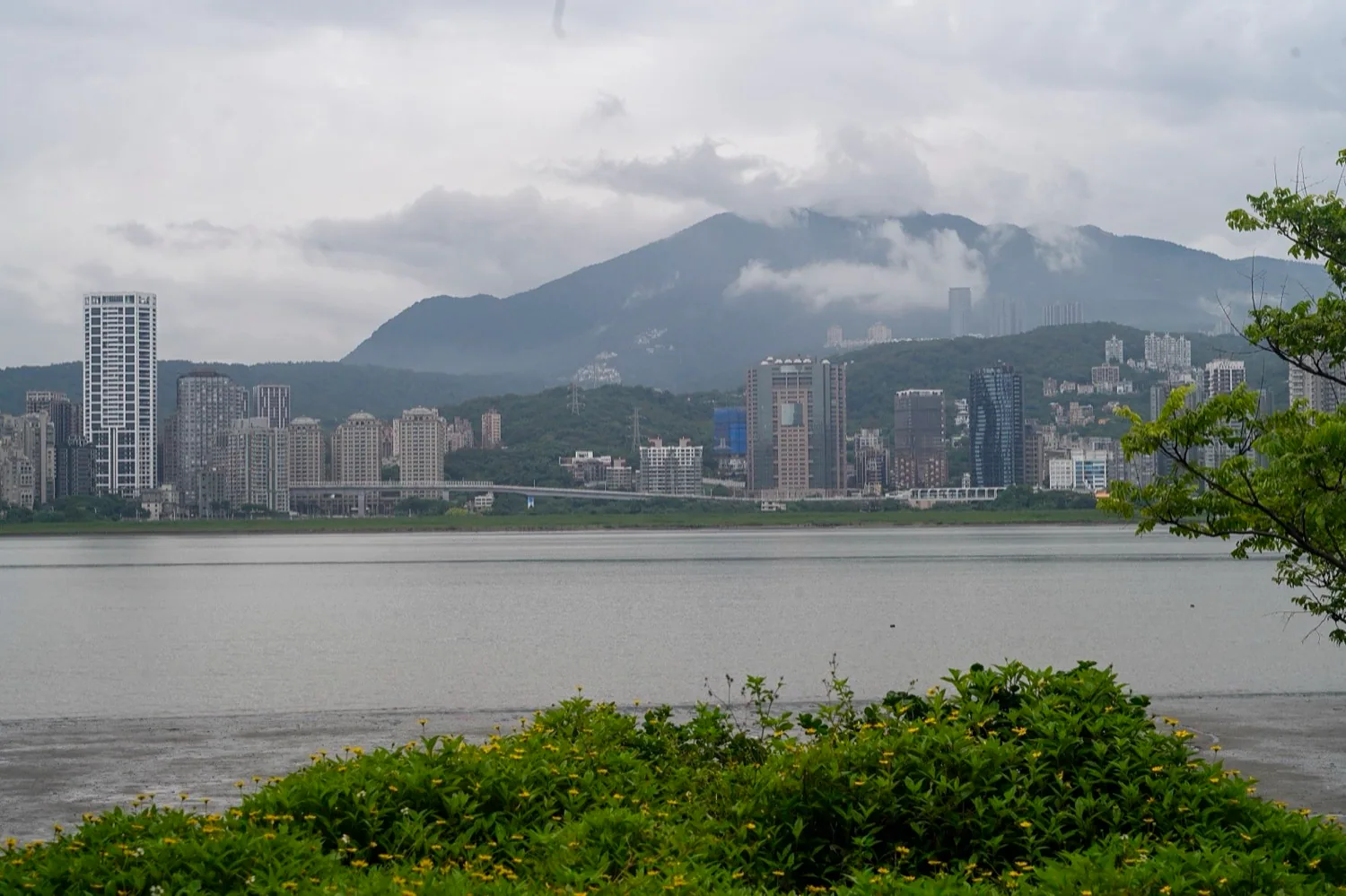
Densos complejos de apartamentos en Danshui, Nueva Taipéi, un aspecto típico de la urbanización residencial en Taiwán. Foto: HC Lin, CC BY 2.0 vía Wikimedia Commons.
| Año | Tasa de carga (%) |
|---|---|
| 2005 | 21.7 |
| 2015 | 35.81 |
| 2024 | 46.62 |
Fuente: Centro de Investigación Inmobiliaria de la Universidad Nacional de Chengchi (basado en datos del Ministerio del Interior)
Por tanto, con el mismo esfuerzo, no se llega al mismo lugar. Los datos de la Encuesta Básica de Cambio Social de Taiwán de Academia Sinica lo demuestran: la tasa de propiedad de vivienda para el grupo de 31 a 40 años era superior al 60% en 1996, pero en 2021 solo quedaba un 25%3. La edad de la primera compra también se ha retrasado cinco años, pasando de principios de los treinta a principios de los cuarenta. Un estudiante de 5.º grado a los treinta años probablemente ya tendría casa; uno de 9.º grado a los treinta suele estar todavía calculando el pago inicial.
Este es también un consenso académico. El estudio publicado en 2020 por los sociólogos Chang Yi-chun (張宜君) y Lin Tsung-hung (林宗弘) en la Revista de Sociología de Taiwán señala directamente: "La generación del Baby Boom, nacida entre la posguerra y 1972, disfrutó de las ventajas de ingresos traídas por el crecimiento económico, mientras que las generaciones jóvenes nacidas después de 1978 tienen ingresos generalmente más bajos"16. Lin Tsung-hung fue aún más claro en otra entrevista: "Cada depresión económica en la historia humana crea una generación afectada... la generación con mayor impacto es la nacida después de 1975 y que alcanzó la edad adulta alrededor del año 2000"17, lo cual coincide precisamente con los estudiantes de 7.º grado.
💡 ¿Sabías que?
Atribuir el "no poder subir" únicamente a la falta de esfuerzo de los jóvenes fue refutado ya en 2005. Un reportaje del Taipei Times citó a expertos afirmando que "la Generación Fresa es un mito", argumentando que las horas de trabajo en Taiwán son de las más largas del mundo, mientras que los salarios no han subido en años18. Es decir, la acusación de que "los jóvenes no aguantan el ritmo" no encaja con el hecho de que "las jornadas laborales en Taiwán son excesivamente largas".
La escalera no se detuvo, se dividió en dos
Sin embargo, decir que "la escalera se detuvo y por eso los jóvenes no pueden comprar casa" también es incorrecto; es una simplificación. La verdad es más precisa y cruel: la escalera no se detuvo, se dividió en dos caminos.
Es cierto que hay estudiantes de 8.º grado que han comprado casa. Pero si observamos de cerca, la mayoría lo ha logrado gracias al pago inicial de sus padres: los millones necesarios para la entrada son aportados por los mayores, conectando el hueco que el salario no puede cubrir mediante herencias o donaciones. En contraste, solo el 0.89% de los jóvenes de entre 20 y 30 años en Taiwán pueden comprar una vivienda con sus propios medios3. En otras palabras, quienes logran subir por la escalera que aún se mueve, lo hacen usando la tarjeta de crédito de sus padres.
Por eso el concepto de "generación" es útil como punto de partida, pero no debe ser el destino. El propio Lin Tsung-hung reconecta el problema generacional con la distribución de clases: dentro de una misma generación, quienes heredan capital y quienes solo tienen un salario se encuentran en dos escaleras mecánicas distintas. Esta brecha interna puede ser incluso mayor que la brecha entre generaciones. ¿Qué tan profunda es la influencia del trasfondo familiar en la riqueza de la siguiente generación? Un estudio publicado en Labour Economics en 2024 estima que el coeficiente de correlación de la riqueza entre padres e hijos en Taiwán es de aproximadamente 0.40 para los hijos y 0.30 para las hijas, y esta transferencia se fortalece cuanto más alto es el nivel de riqueza19.
La línea de los salarios tampoco es totalmente negra. Los salarios nominales han subido lentamente desde 2017, e incluso en 2024 los salarios reales totales crecieron un 2.16% anual, un raro crecimiento positivo tras años de estancamiento2. Pero esto es apenas un intento de detener la caída; no compensa las pérdidas de los quince años entre 2002 y 2017. Es como si la escalera volviera a moverse, pero el piso al que quieres llegar está mucho más alto que antes.
⚠️ Punto de debate
El marco de la "guerra generacional" es cuestionado por muchos. El investigador estadounidense sobre desigualdad Chuck Collins dijo algo muy directo: "We're not suffering through a generational war. We're continuing to live through a clash of economic classes." (No estamos sufriendo una guerra generacional; seguimos viviendo un conflicto de clases económicas)20. Su punto es que oponer a jóvenes y ancianos oculta la verdadera línea de fractura: esa línea se dibuja entre quienes tienen capital y quienes no, independientemente de si nacieron en 1970 o en 1990. Aplicando esto a Taiwán: dentro de un mismo grado escolar, la brecha puede ser mayor que entre diferentes grados.
De niños de la era de la ley marcial a usuarios de TikTok que dicen "no quiero la unificación"
Otra fractura real entre generaciones es la respuesta a la pregunta "¿quién soy?". La academia sostiene que esta fractura es moldeada principalmente por los "eventos" compartidos, más que por una naturaleza innata de cada generación.
El Centro de Estudios Electorales de la Universidad Nacional de Chengchi ha seguido la identidad de los taiwaneses: el porcentaje de personas que se identifican como taiwanesas subió del 17.6% en 1992 a un máximo del 67% en 2020, situándose en un 61.7% en 2023; en el mismo periodo, la identidad china cayó hasta el 2.4% en 202321. Una encuesta del Pew Research Center en 2024 respalda esta tendencia, señalando específicamente a los jóvenes: "Adults in Taiwan under the age of 35 are especially likely to identify as solely Taiwanese (83%)" (Los adultos en Taiwán menores de 35 años tienden especialmente a identificarse únicamente como taiwaneses, con un 83%)22.
Esta curva de identidad suele simplificarse diciendo que la "generación de identidad taiwanesa natural" es así por naturaleza. Pero la visión académica es más cautelosa. Varios investigadores señalan el llamado "efecto de época": eventos compartidos como la democratización o el Movimiento de los Girasoles en 2014 han remodelado la identidad de cada generación. La respuesta es esculpida por la era, no está en los genes. La académica Shen Wei-chieh (沈暐婕), experta en la identidad taiwanesa natural, explica en su tesis que "la identidad taiwanesa natural no es algo innato, sino formado a posteriori; tampoco es un nacionalismo de independencia tradicional, sino más bien una postura anti-China"23.
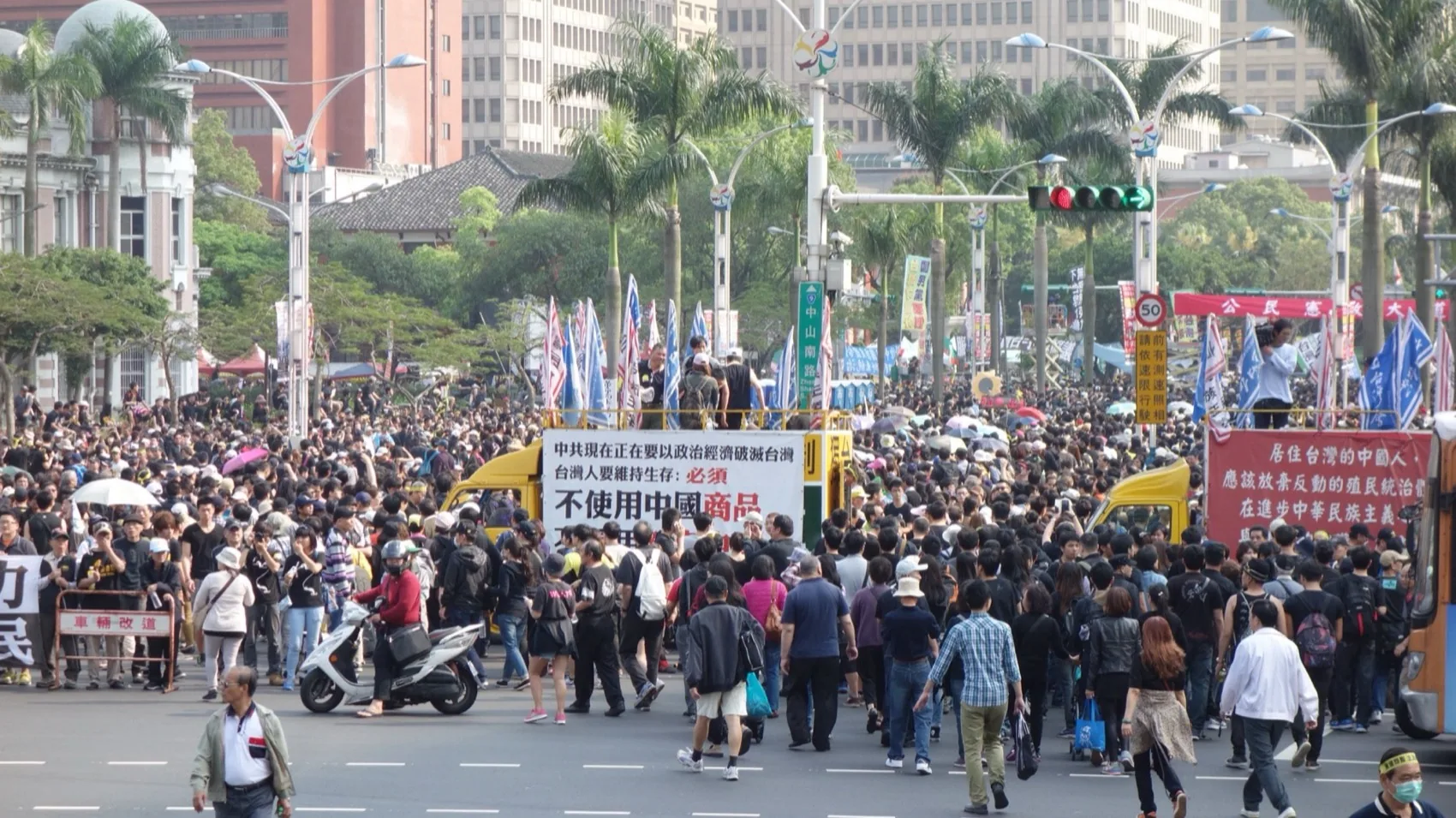
El 30 de marzo de 2014, la gran manifestación contra el acuerdo comercial llenó la Avenida Ketagalan en Taipéi; el Movimiento de los Girasoles representó el punto álgido de la salida a la calle de la "generación de identidad taiwanesa natural". Foto: tenz1225, CC BY-SA 2.0 vía Wikimedia Commons.
Al llegar al grado 9.º, surge una tensión interesante. Esta generación ha crecido consumiendo TikTok y Xiaohongshu, usando caracteres simplificados y siguiendo el entretenimiento y la jerga de China continental; culturalmente, su distancia con el otro lado es menor que nunca. Sin embargo, en términos de identidad política, son una generación nacida bajo un sistema democrático y con un rechazo intuitivo a "ser unificados". El informe de 2025 del Taiwan Democracy Lab señala que la tasa de uso de TikTok entre estudiantes de secundaria es del 57.87% y en bachillerato del 50.73%24; pero esa cercanía cultural no se traduce automáticamente en un giro político.
📝 Nota del editor
La combinación aparentemente contradictoria de "proximidad cultural a China y rechazo político a China" es precisamente donde Taiwan.md evita sacar conclusiones por el lector. Que un estudiante de 9.º grado disfrute de vídeos cortos chinos pero apoye el statu quo de Taiwán puede no ser una contradicción para él, ya que el consumo cultural y la identidad nacional son cosas distintas. Lo que podemos hacer es exponer las tensiones observadas por la Universidad Nacional de Chengchi, Pew, Shen Wei-chieh y el Taiwan Democracy Lab, permitiendo al lector ver la complejidad de esta generación sin imponer etiquetas de "pro-China" o "anti-China". Desetiquetar a la próxima generación es precisamente lo que este artículo intenta desmantelar.
La fresa no se ha ablandado, es el suelo el que se ha inclinado
Si superponemos los cinco certificados de nacimiento, veremos algo muy silencioso. En 1963, hubo 427,212 compañeros de clase en el grupo de 5.º grado; en 2010, para el grupo de 9.º grado, solo quedaron 166,886, menos del 40% del pico de 5.º grado; hubo una disminución de más de 200,000 personas15.
Hay menos gente, el pastel no ha crecido, pero los edificios son cada vez más altos. En este terreno, las generaciones posteriores, con el mismo esfuerzo, no pueden alcanzar la posición de las anteriores. No es porque la fresa se haya ablandado, sino porque el suelo bajo sus pies se ha inclinado, y de forma desigual: algunos tienen una pendiente suave pavimentada por sus padres, mientras que otros solo tienen un muro casi vertical.
El "grado escolar" es, al fin y al cabo, solo un punto de entrada. Es útil porque nos ayuda a ver cómo esa escalera mecánica se vuelve más empinada cada año; pero no debe ser el destino, porque lo que realmente determina si alguien puede subir es si su escalera conecta con un salario o con una herencia. Y esa grieta se dibuja dentro de cada generación. El Pew Research Center incluso anunció en 2023 que reduciría el uso de etiquetas generacionales en sus informes, porque muchas diferencias atribuidas a la "generación" provienen en realidad de las características demográficas mismas25. Incluso las instituciones que popularizaron la clasificación generacional están empezando a cuestionar esta herramienta.
✦ Así que, antes de decir "los jóvenes de ahora son unos fresas", piensa en esto: es muy probable que esa palabra se usara para insultarte a ti cuando tenías veinte años. Lo que realmente ha cambiado en estos treinta años es esa escalera mecánica que pisaste y que aún se movía; luego se ralentizó, se volvió empinada y finalmente se dividió en dos. La razón por la que una generación entera le dio "me gusta" a la frase de Wretch sobre que "nadie se ha dado cuenta de mi sitio" es porque cada generación tiene su propio espacio de juventud al que otros no pueden entrar, y el alquiler de ese espacio es cada vez más caro.
Lecturas recomendadas:
- La generación 'slash' en Taiwán — La matemática de supervivencia de los grados 7.º y 8.º que dividen un salario en tres trabajos bajo una estructura de bajos sueldos.
- El extravío profesional de la juventud taiwanesa — Tras dieciséis años de estudio, la pregunta más común al graduarse es "no sé qué quiero hacer".
- La crisis de baja natalidad en Taiwán — De 420,000 a 160,000 nacimientos: cómo el pastel se hace cada año más pequeño.
- El espectro de la unificación e independencia en Taiwán — El panorama completo de la identidad: desde "¿quién soy?" hasta "¿hacia dónde vamos?".
- Wretch (無名小站) — El servidor digital de la juventud de 7.º grado; cerró en 2013 y reapareció en Threads en 2025.
Fuentes de las imágenes
Este artículo utiliza 5 imágenes con licencia Creative Commons, todas almacenadas en public/article-images/society/ para evitar enlaces directos a los servidores de origen:
- Marioneta de teatro de marionetas taiwanesa (héroe) — Foto: Wang Yu Ching / Office of the President, 2023, CC BY 2.0
- Yakult — Foto: kxz Chen, 2012, CC BY-SA 2.0
- Beeper digital de los años 90 — Foto: Solomon203, CC BY-SA 3.0
- Protestas contra el acuerdo comercial de 2014 — Foto: tenz1225, 2014, CC BY-SA 2.0
- Complejo residencial en Danshui, Nueva Taipéi — Foto: HC Lin, 2023, CC BY 2.0
Referencias
- Wikipedia: Generación Fresa — Recoge el origen, la evolución semántica y las controversias del término "Generación Fresa", indicando que originalmente se refería a los taiwaneses nacidos en la década de 1960 (5.º grado) y cómo la percepción se desplazó hacia los grados 7.º en adelante, citando también el criterio judicial que lo define como un término despectivo.↩2345
- Yanzhiyouwu: Crecimiento económico en Taiwán, ¿por qué no suben los salarios? Entrevista a Yang Tzu-ting — Entrevista en la plataforma de divulgación científica de Academia Sinica al economista Yang Tzu-ting, analizando la desvinculación entre salarios reales y productividad tras 2002 (brecha de precios entre bienes de producción y consumo), proporcionando datos sobre la caída de la remuneración laboral respecto al PIB.↩234
- Centro de Investigación Inmobiliaria de la Universidad Nacional de Chengchi: Indicadores de asequibilidad de la vivienda — Datos históricos de la relación precio-ingresos y tasa de carga hipotecaria basados en el Ministerio del Interior; indica que en Taipéi la relación alcanzó 15.41 veces en el primer trimestre de 2025, citando también los cambios en la propiedad de vivienda de Academia Sinica.↩2345
- Bao Shiguang: La juventud de Wretch, nuestros blogs, álbumes y tablones de anuncios de aquellos años — Columna de archivo digital de United Daily News que recuerda las funciones y la memoria generacional de Wretch (1999–2013).↩2
- Wikipedia: Wild Strawberries Movement — Registra el "Movimiento Wild Strawberry" iniciado por estudiantes taiwaneses en 2008, explicando cómo apropiaron el término despectivo para convertirlo en un nombre de movimiento contra la ley de manifestaciones.↩2
- ETtoday: La "Nueva Novena Raza" de Taiwán; los jóvenes odian que les llamen fresas — Reporte sobre la encuesta "Nueva Novena Raza" realizada por Vision, Yahoo y Wretch; entre 1,129 jóvenes de 20-35 años, la "Generación Fresa" fue la etiqueta más deseada de reivindicar (16.5%).↩2
- StoryStudio: El muñeco Tatung, el sueño de clase media en la televisión — Reseña histórica del lanzamiento del muñeco Tatung en 1969 y su significado como símbolo de ascenso social al ser un regalo por compras de electrodomésticos.↩2
- Bao Shiguang: Botellas de vidrio de Yakult y las Madres Yakult — Registra la historia de la fábrica de Yakult en Taiwán (1964) y su modelo de venta puerta a puerta, un recuerdo común para las generaciones de 5.º y 6.º grado.↩2
- Wikipedia: Yunzhou Dàrúxiá — Información sobre la serie de marionetas de Huang Chun-hsiung, su estreno en TTV en 1970, sus 583 episodios, el 97% de audiencia y su prohibición en 1974.↩2
- Roomie: Aquellos años en los que nos enamorábamos con códigos numéricos — Recuerdo del auge y caída de los BB Call en Taiwán (apertura en 1976, pico de 4 millones de usuarios en 1999, cierre en 2011) y la cultura de mensajes como "520" o "1314".↩
- Bao Shiguang: El furor de las mascotas virtuales, los pitidos en el campus — Archivo de United Daily News sobre la fiebre de los Tamagotchi en 1997, los precios inflados y la anécdota del Ministro de Educación Wu Jing.↩
- foodNEXT: Gran encuesta de snacks nostálgicos — Encuesta de 2018 sobre snacks nostálgicos en Taiwán con 1,523 respuestas; los estudiantes de 7.º grado fueron los más activos (38.2%).↩
- NCCU: The Great Experiment of Taiwanese Education — Estudio de la Universidad Nacional de Chengchi sobre la reforma de matemáticas constructivistas en Taiwán y su impacto en 1.8 millones de estudiantes desde 1996.↩
- Ministerio del Interior: Periodos de servicio militar por año de nacimiento — Explicación oficial que detalla el regreso al servicio de un año para nacidos después de 2005 y los 4 meses para los nacidos entre 1994 y 2004.↩23
- Departamento de Registro Civil del Ministerio del Interior: Estadísticas históricas de nacimientos — Datos oficiales que muestran la caída de los nacimientos desde 1963 hasta 2010.↩2
- Revista de Sociología de Taiwán: Chang Yi-chun y Lin Tsung-hung, "Diferencias generacionales y distribución de ingresos en Taiwán" (2020) — Artículo académico que analiza la ventaja de ingresos del Baby Boom frente a las generaciones posteriores debido a la expansión de la educación superior.↩
- StoryStudio: Entrevista a Lin Tsung-hung, la formación de la generación afectada — Entrevista al sociólogo sobre cómo las depresiones económicas crean "generaciones afectadas", señalando especialmente a los nacidos tras 1975.↩
- Taipei Times: Experts: Strawberry Generation is just a myth — Reportaje de 2005 que cita expertos para refutar el mito de la Generación Fresa basándose en las largas jornadas laborales en Taiwán.↩
- Chu, Lin & Nian (2024), Labour Economics — Estudio sobre movilidad de riqueza intergeneracional publicado en Labour Economics, estimando correlaciones de riqueza entre padres e hijos en Taiwán.↩
- Inequality.org: To Best Understand Inequality, Think Class, Not Generation — Artículo de Chuck Collins que argumenta que la verdadera fractura es el conflicto de clases, no el generacional.↩
- Centro de Estudios Electorales de la Universidad Nacional de Chengchi: Tendencias de identidad taiwanesa/china — Datos de encuestas a largo plazo sobre la identidad política en Taiwán.↩
- Pew Research Center: Most People in Taiwan See Themselves as Primarily Taiwanese (2024) — Encuesta de 2024 que muestra que el 83% de los taiwaneses menores de 35 años se identifican únicamente como taiwaneses.↩
- Airiti Library: Shen Wei-chieh, "Identidad política de la generación de identidad taiwanesa natural" (2017, Tesis de Maestría, Universidad Nacional de Taiwán) — Tesis que argumenta que la identidad es una construcción posterior y no algo innato.↩
- Taiwan Democracy Lab: Impacto de TikTok en el entorno informativo y la percepción de China entre los jóvenes taiwaneses (2025) — Informe sobre el uso de TikTok en estudiantes de secundaria y bachillerato en Taiwán.↩
- Pew Research Center: How Pew Research Center will report on generations moving forward (2023) — Declaración del Pew Research Center sobre la reducción del uso de etiquetas generacionales en sus informes futuros.↩