
30-Second Overview: Taiwanese people identify themselves by "Grade" (e.g., Fifth Grade, Sixth Grade), taking the tens digit of the Republic of China (ROC) birth year: Fifth Graders were born in ROC years 50–59 (1961–1970), extending all the way to Ninth Graders (2001–2010). The term "Strawberry Generation," which has been used as an insult for thirty years, was first printed in 1993, targeting the Fifth Graders who were in their twenties at the time and are now in their fifties1; it has since passed down to Seventh, Eighth, and Ninth Graders. The people being insulted have changed several times, but the label has not changed a single character. What has actually moved between these five generations is the "escalator" beneath their feet, symbolizing "hard work brings rewards": it slowed down around 2002, when real wages decoupled from productivity2; its entrance was simultaneously raised by housing prices, with the Taipei housing price-to-income ratio rising from 6.4 times in 2004 to 15.41 times in 20253; and then it split into two paths. The path relying solely on salaries has nearly stopped, while the path relying on parental down payments is still moving. This article aims to deconstruct this label.
In March 2025, an account appeared on Threads, posting, "No one else seems to notice... it seems like it's about to shut down again." That was PChome HotSpace (WuMing XiaoZhan), the youth server for Seventh Graders, which had already shut down in late 20134. Beneath the ten thousand likes, the comments were all "Give me back my account" and "But we've all forgotten our passwords."
This was an entire generation liking a piece of code that only they could access, while others could not press in. Every generation has such a place: Fifth Graders had the corner stores (Kanzaden), Seventh Graders had WuMing XiaoZhan, and Ninth Graders have Douyin. The true boundary of generations is drawn there: not in values, but in the lack of a shared login screen.
Ironically, the word that causes the fiercest arguments between these five generations has targeted different batches of people over thirty years, yet the word itself has not changed a single character.
One Word, Insulted for Thirty Years, Targeting Three Batches of People
In the early 1990s, workplace consultant Weng Jingyu wrote a book called Office Stories, where the term "Strawberry Generation" was first printed. She was not insulting today's young people, but rather the batch who had just entered the office in their twenties, born in the 1960s, now in their fifties, and who love reminiscing about Datong Babo and Yakult in Facebook groups1.
Wikipedia's entry records this migration line clearly: "Strawberry Generation" originally referred to Taiwanese people born in the 1960s, commonly known as Fifth Graders; subsequently, mainstream perception shifted downward, broadly referring to young people after Seventh Grade1. A term originally used to insult a specific batch of twenty-something young people has, thirty years later, become a general term for "the batch younger than me that I don't like." The label does not describe a specific generation; the label describes the concept of "youth" itself, and youth is a moving target.
The trajectory of this moving target can almost serve as an abridged history of Taiwan's generations. In 1993, it insulted Fifth Graders; in the 2000s, mainstream labeling stuck to Seventh Graders; in 2008, during the "Wild Strawberry Movement," the insulted Seventh Grade students干脆 (simply) took back the term, adopting it as the name of the movement5; in 2012, Vision magazine, in collaboration with Yahoo and WuMing XiaoZhan, conducted a survey on "New Nine Tribes of Youth," where 1,129 young people aged 20–35 voted for the "labels they most wanted to be exonerated from," with Strawberry Generation ranking first at 16.5%, followed by Neet (NEET) and Phubbers (Head-down tribe)6; by the 2020s, this hat had been placed on the heads of the Z Generation and Ninth Graders.
Moreover, this term holds up legally. The Taiwan High Court ruled in a lawsuit that "Strawberry Generation" refers to "young, inexperienced people who cannot withstand setbacks," classifying it as a derogatory term1. That is, it is a word recognized by the court as belittling, yet for thirty years, it has been used by the older generation as the most convenient tool to comment on the younger generation, passed down repeatedly.
Throw the ball back: Everyone who wants to say "Young people today are just strawberries" should remember that the word originally insulted, likely, people who were in their twenties themselves.
No Shared Childhood: From Corner Stores to Douyin
If there is really a wall between generations, that wall is built from childhood. Laying out the childhoods of these five generations, you will discover a quiet thing: they hardly have anything in common that they remember.
The childhoods of Fifth and Sixth Graders were in corner stores (Kanzaden). Datong Babo, listed in 1969, was given as a gift for buying 10,000 yuan worth of appliances; that red-clad doll placed in the living room was a proof of status for a family climbing from laborers to the middle class7; Yakult set up a factory in Taiwan in 1964, costing two yuan per bottle, delivered door-to-door by "Yakult Moms" carrying cooling boxes8; the way home from school featured Wangzi Noodles, Kexue Noodles, Wangzai Biao, and marbles. Turning on the TV, Huang Junxiong's puppet show Cloud State Grand Confucian Hero aired on TTV in 1970, with Shi Yanwen fighting for 583 episodes, achieving a 97% viewership rate, so popular that it was banned in 1974 on the grounds of "hindering farmers' work schedules"9.
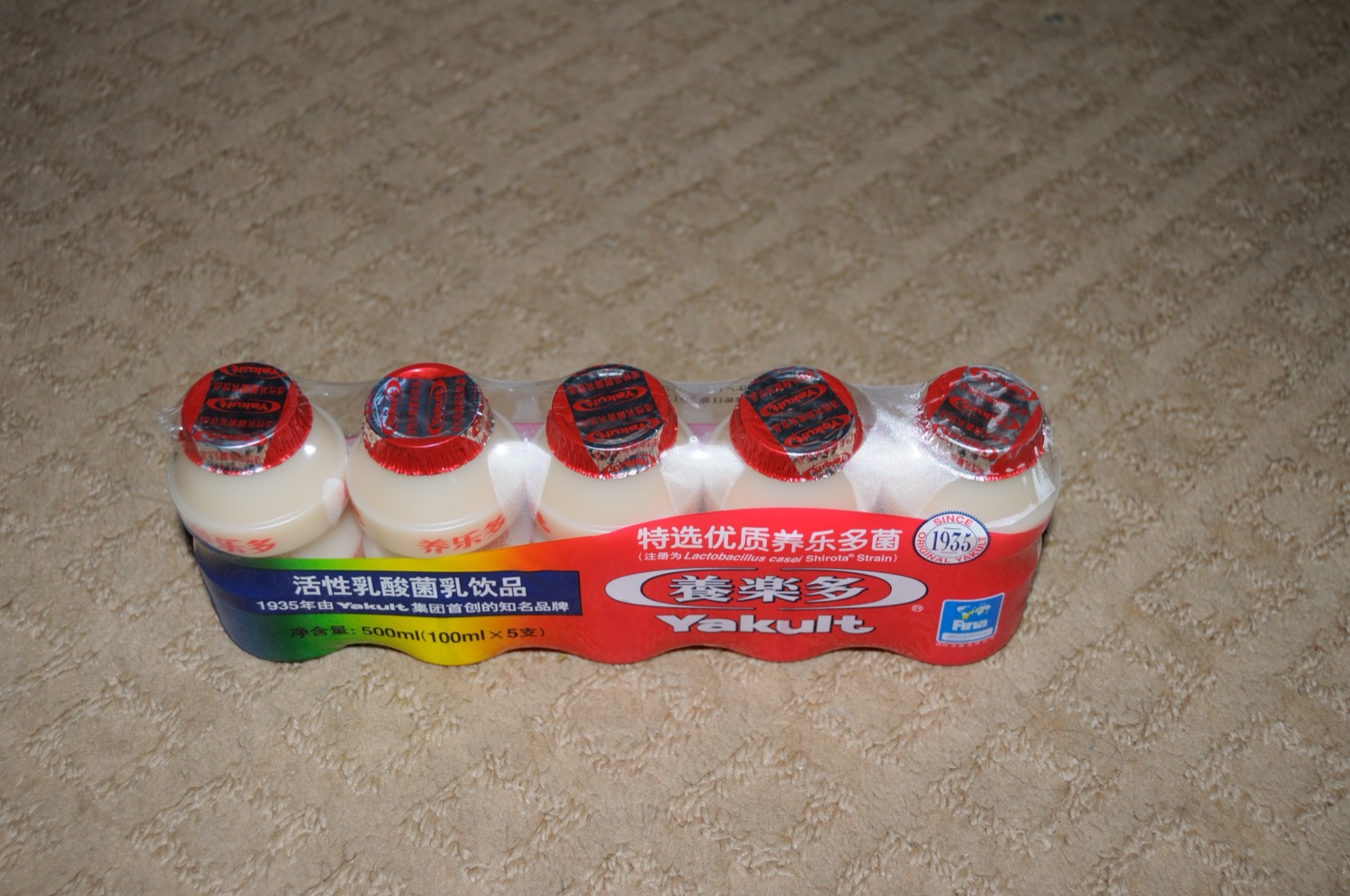
Five-pack Yakult, a signature drink in Fifth and Sixth Grade corner stores and grocery stores. Photo: kxz Chen, CC BY-SA 2.0 via Wikimedia Commons.
Seventh Graders' youth changed the interface. Pagers (BB Call) peaked in 1999, with over four million households in Taiwan10; couples used numbers to convey affection, with 520 and 1314 flashing on small screens; after going online, the "ding-dong" sound of Kimoji Instant Messenger, the "deng-deng-deng" of MSN online, and WuMing XiaoZhan's blogs and photo albums formed a complete set of codes only they were familiar with4. In 1997, the Tamagotchi arrived in Taiwan, sold out in Kaohsiung department stores with one resold for 1,500 yuan; students focused on feeding their electronic pets in class, and even the Minister of Education at the time joked that perhaps schools could set up a "chicken farm" to raise them together11.

Digital pagers (BB Call) from the 1990s, a communication tool for Seventh Graders to send "520" and "1314". Photo: Solomon203, CC BY-SA 3.0 via Wikimedia Commons.
By Eighth Grade, the stage was PTT and Facebook. In 2009, Happy Farm had everyone asking, "Did you steal vegetables today?" Ninth Graders are entirely immersed in algorithms: IG, TikTok, Xiaohongshu, Dcard. What changed is not just the platform, but the viewing method itself: for the Fifth Grade generation, a whole street watched the same Cloud State Grand Confucian Hero at night; for the Ninth Grade generation, one person swipes a short video fed only to them by an algorithm.
📝 Curator's Note
We are accustomed to explaining generational gaps with "value differences": the older generation loves to strive, the younger generation loves to lie flat. But closer to the truth might be something more physical: they never watched the same screen together. Collective memory requires the premise of "collective," and over these forty years from corner stores to segmented algorithms, Taiwan's media has fragmented from "the whole village gathering around one TV" to "each person with a phone only for themselves." In the end, they did not grow up in the same room. Nostalgia is therefore also each having their own: the server you like, others cannot access.
This is why nostalgia is so marketable in Taiwan, yet so segmented. A 2018 nostalgia snack survey collected 1,523 questionnaires, with the highest participation from Seventh Graders at 38.2%; the top votes were iron-can fruit candies, Morinaga milk candy, Wangzi Noodles, Kexue Noodles, Qiqi Milk Plus, each precisely corresponding to a specific generation's way home from school12.
Every Generation is Someone Else's White Rat
If childhoods are lived separately, there is one thing all five generations cannot escape: every generation is treated as the first batch of white rats for a certain system reform.
The education system changes almost every decade. Fifth and Sixth Graders took the Joint College Entrance Examination (Liankao); High School Joint Admissions exams ran from 1958 to 2000, and University Joint Exams ran until 2001, with one exam determining life and death. Seventh Graders faced the three-hit combo of education reform: starting in 1996, primary schools implemented "Constructivist Math," requiring children to relearn arithmetic through understanding; scholars later statistics showed that this experiment made nearly 1.8 million primary school students white rats13; in 2001, the Nine-Year Integrated Curriculum went into effect, the Junior High School Basic Competency Test replaced the Joint Exam, and textbooks changed from "one syllabus, one book" to "one syllabus, multiple books." Eighth Graders encountered the 2014 Twelve-Year National Education and Joint Admission Exam, while Ninth Graders face the 108 Curriculum implemented in 2019. No generation used the same rules as the previous one.
Military service is also a moving line, and the direction of movement is very counter-intuitive. Early conscripts served for two or three years, which then shortened continuously; by the end of 2013, conscripts born after ROC year 83 (1994) only needed to serve four months of military training14. It looked like a downhill slope that kept getting shorter, but then it flipped up. The Ministry of the Interior stipulates that conscripts born after January 1, 2005 (ROC year 94), will resume serving one year of active duty14. In other words, the batch of Ninth Graders born after 2005 serves eight months more than the Eighth Grade seniors who served only four months of military training; this is the first "extension" of compulsory military service in seventy years.
Overlaying these system lines reveals a sharper question: every reform is theoretically designed to educate the next generation better and secure national defense more firmly. But from the perspective of those being reformed, it feels more like: the experiments designed by the older generation are borne by the results of the younger generation. And the designers of these experiments often do not have to be white rats themselves.
The Slowing Escalator
Up to this point, the accusation of "Strawberry Generation" actually hides an unspoken premise: young people cannot climb up because they are not hardworking enough. But if we shift the lens from "people" to "the escalator beneath their feet," we see a completely different picture.
First, look at salaries. Research from the Academia Sinica indicates that before 2002, Taiwan's real output per hour (productivity) and real wages climbed together step by step; after 2002, these two lines diverged, productivity continued to rise, but wages froze. Economist Yang Tzu-ting explains: "The fact that producer prices become cheaper and consumer prices become more expensive is the main cause of real wage growth lagging behind real GDP growth"2. During the same period, the share of labor compensation in GDP slid from about 51% in 1990 to around 43% in 20242. The cake got bigger, but the slice given to workers got thinner.
Next, look at housing. This is where the escalator truly steepens. The national mortgage burden rate rose from 21.7% in 2005 to 46.62% in 2024, meaning a family must spend nearly half its income on mortgage payments3. The housing price-to-income ratio is more direct: nationally it rose from 8.2 times in 2014 to 9.89 times in the first quarter of 2025, while Taipei skyrocketed from 6.4 times in 2004 to 15.41 times in the first quarter of 2025, higher than London or New York3. Translated into plain language: in Taipei, a family must not eat or drink for fifteen years to afford one house.
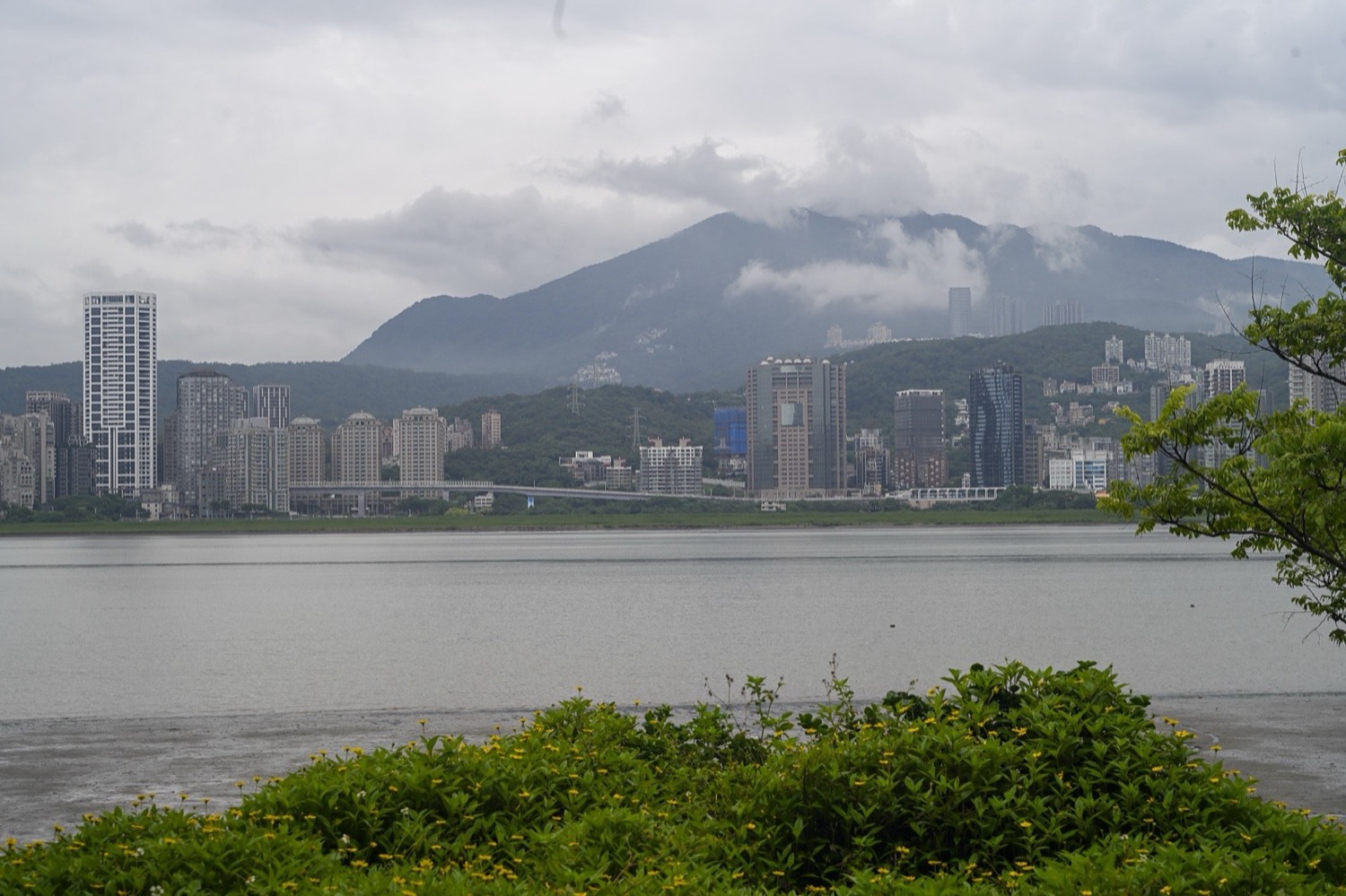
Dense apartment clusters in Tamsui, New Taipei, a typical face of Taiwanese urbanized housing. Photo: HC Lin, CC BY 2.0 via Wikimedia Commons.
| Year | Mortgage Burden Rate % |
|---|---|
| 2005 | 21.7 |
| 2015 | 35.81 |
| 2024 | 46.62 |
資料來源:NCCU Real Estate Research Center (compiled from Ministry of the Interior Real Estate Information Platform)
Thus, the same effort does not reach the same position. The numbers from the Academia Sinica Taiwan Social Change Basic Survey best illustrate this: the homeownership rate for the 31–40 age group was over 60% in 1996, but dropped to only about 25% by 20213. The age of first-time homebuyers also shifted back by five years, from early thirties to early forties. A Fifth Grader might already have their own house at thirty; an Eighth Grader at thirty is likely still calculating the down payment.
This is also the consensus in academia. Sociologists Chang Yi-chun and Lin Tsung-hung's 2020 study published in the Taiwan Journal of Sociology points out directly: "The baby boom generation born before 1972 enjoyed income advantages brought by economic growth, while the younger generations born after 1978 generally have lower incomes"15. In another interview, Lin Tsung-hung spoke more plainly: "Every economic depression in human history creates a traumatized generation... The generation most impacted is those born after 1975 and coming of age around 2000"16, which corresponds exactly to Seventh Graders.
💡 Did You Know?
Blaming young people entirely for "not being able to climb up" was actually debunked in 2005. A Taipei Times report that year cited expert opinions pointing out that "Strawberry Generation is a myth," citing that Taiwanese workers have some of the longest working hours globally, yet salaries have not been adjusted for years17. That is, the accusation of "young people are not hardworking" has never matched the fact of "Taiwanese workers' extremely long hours."
The Escalator Didn't Stop, It Split into Two
However, saying "the escalator stopped, so young people can't buy houses" is also wrong; this is also a form of laziness. The truth is more nuanced and a bit more cruel: the escalator did not stop; it split into two.
Indeed, some Eighth Graders bought houses. But looking closely, those who could buy mostly relied on parents' down payments: hundreds of thousands of yuan in down payments paid by elders, inheritance or gifts bridging the gap that salaries could not cover. In contrast, among all young people aged 20–30 nationwide, only 0.89% can afford to buy a house with their own strength3. In other words, those who can board that still-moving escalator swipe their parents' cards.
This is why "generation" is a good entry point but cannot be the endpoint. Lin Tsung-hung himself connects the generational issue back to class distribution: within the same generation, those who inherit capital and those who only have a salary are on two completely different escalators; this gap within the generation may be larger than the gap between generations. How deep is the impact of family background on the next generation's wealth? A 2024 study published in Labour Economics estimates that Taiwan's intergenerational wealth correlation coefficient is about 0.40 for sons and 0.30 for daughters, and the stronger the wealth at the top, the stronger the transmission18.
The salary line is not entirely black. Nominal salaries have slowly recovered since 2017, and real total salaries in 2024 even increased by 2.16% year-on-year, a rare positive growth after years of stagnation2. But this is at most a stop-loss, unable to make up for the fifteen years of loss from 2002 to 2017; it is like the escalator started moving again, but the floor is already much higher than before.
⚠️ Controversial Viewpoint
The framework of "Generational War" itself has received much skepticism. Chuck Collins, an inequality researcher from the US, said very directly: "We're not suffering through a generational war. We're continuing to live through a clash of economic classes."19 His point is that pitting young people against the elderly obscures the true fault line: that line is drawn between those with capital and those without, having little to do with who was born in 1970 or 1990. Placing this sentence back in Taiwan holds equally true: within the same grade, the gap may be larger than between grades.
From Martial Law Children to Sliding on Douyin Saying "I Don't Want to Be Unified"
Another real fault line between generations is the answer to the question "Who am I." And this fault line, scholars generally believe, is chiseled out by shared "events," having little to do with whether a certain generation is inherently so.
The National Chengchi University Election Research Center has long tracked Taiwanese identity: the percentage identifying as Taiwanese rose from 17.6% in 1992 to a high of 67% in 2020, and 61.7% in 2023; simultaneously, the percentage identifying as Chinese dropped to 2.4% in 202320. Pew Research Center's 2024 survey echoes this trend, specifically pointing out the younger end: "Adults in Taiwan under the age of 35 are especially likely to identify as solely Taiwanese (83%)"21.
This identity curve is often simplified into "Natural Independence Generation is inherently independent." But the academic view is more cautious. Multiple researchers point out that the dominant factor here is what scholars call the "period effect," meaning that common experiences of "events" such as democratization and the 2014 Sunflower Movement reshaped the identities of various generations. The answer is chiseled by the era, never in anyone's genes. Scholar Shen Wei-chieh, who studies Natural Independence, stated clearly in her master's thesis: "Natural Independence is not natural, but formed post-natally; Natural Independence is also not traditional nationalist Taiwan independence, but rather anti-China"22.
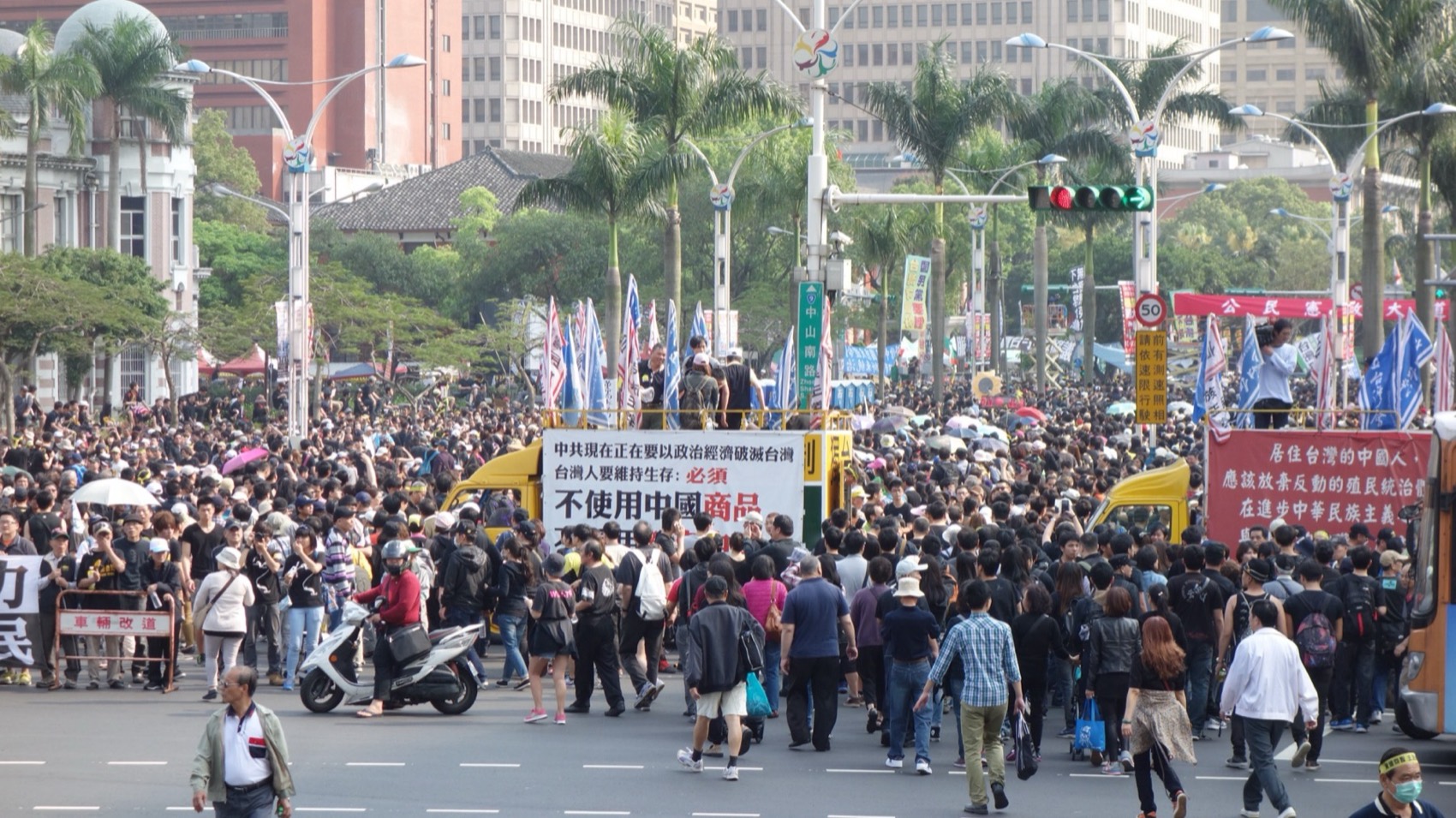
March 30, 2014, the anti-ECFA march filled Kweilin Street in Taipei, the Sunflower Movement called the peak of the "Natural Independence Generation" going to the streets. Photo: tenz1225, CC BY-SA 2.0 via Wikimedia Commons.
By Ninth Grade, things present an interesting tension. This generation grew up sliding on Douyin and scrolling Xiaohongshu, using simplified characters, chasing mainland variety shows and internet slang, culturally closer to the mainland than ever before; but politically, they are native to a democratic system and the most intuitively repulsed by "being unified." Taiwan Democracy Lab's 2025 observation points out that junior high school students' TikTok usage rate reached 57.87% and high school students 50.73%23, but cultural proximity has not automatically translated into political shift.
📝 Curator's Note
The seemingly contradictory combination of "culturally pro-China, politically anti-China" is precisely where Taiwan.md should not draw conclusions for readers. A Ninth Grader loving mainland short videos and supporting Taiwan maintaining the status quo may not seem contradictory to them at all, because cultural consumption and national identity are two different things. What can be done here is to honestly lay out the tensions seen by NCCU Election Research Center, Pew, Shen Wei-chieh, and Taiwan Democracy Lab, allowing readers to see how complex this generation is, and putting aside the hats of "pro-China" or "anti-China." Labeling the next generation is exactly what this whole article wants to deconstruct.
Strawberries Didn't Get Softer, The Ground Got Slanted
Stacking five birth certificates together, you see a quiet thing. The Fifth Graders born in 1963 had 427,212 classmates entering this world together; the Ninth Graders born in 2010 had only 166,886, less than 40% of the Fifth Grade peak, missing over 200,000 people24.
Fewer people, the cake didn't get bigger, but buildings got higher. On this terrain, later generations using the same effort cannot reach the positions reached by earlier generations. This is not because strawberries got softer, but because the ground beneath their feet got slanted, and slanted unevenly: some have a slope paved by parents beneath their feet, others have only a nearly vertical wall.
"Grade" as a coordinate is ultimately just an entry point. It is useful because it helps us see how the escalator gets steeper year by year; it should not be the endpoint because what ultimately determines whether a person can climb up is often whether the escalator beneath their feet connects to a salary or inheritance, and this crack is drawn within every grade. Pew Research Center even announced in 2023 that it would use generational labels less in reporting, because many differences attributed to "generation" ultimately stem from demographic characteristics themselves25. Even the institution that first popularized generational classification has started calling a halt to this tool.
✦ So, the next time you want to say "Young people today are just strawberries," think about one thing: the word originally insulted, likely, you when you were in your twenties. And what truly changed over these thirty years is the escalator you stepped on, which was still moving, then slowed down, got steeper, and finally split into two. WuMing XiaoZhan's "No one else seems to notice me" resonated with an entire generation because every generation has a piece of youth only they can access, others cannot press in, and the rent for that piece of youth gets more expensive generation by generation.
Further Reading:
- Taiwan's Slash Generation — The survival math of Seventh and Eighth Graders splitting one salary into three jobs under a low-wage structure
- Taiwanese Youth's Career Maze — Spending sixteen years in school, the most common question on graduation day is "I don't know what I want to do"
- Taiwan's Low Birth Rate Crisis — Birth numbers crashed from 420,000 to 160,000, how the cake gets smaller year by year
- Taiwan Unification-Independence Spectrum — The full picture of the identity fault line, from "Who am I" to "Where are we going"
- WuMing XiaoZhan — The digital server of Seventh Graders' youth, shut down in 2013, appeared again on Threads in 2025
Image Sources
This article uses 5 Creative Commons licensed images, all cached in public/article-images/society/ to avoid hotlinking to source servers:
- Taiwanese Puppet Figures (hero) — Photo: Wang Yu Ching / Office of the President, 2023, CC BY 2.0
- Yakult — Photo: kxz Chen, 2012, CC BY-SA 2.0
- 1990s Digital Pager — Photo: Solomon203, CC BY-SA 3.0
- 2014 Sunflower Anti-ECFA March — Photo: tenz1225, 2014, CC BY-SA 2.0
- New Taipei Tamsui Residential Building Cluster — Photo: HC Lin, 2023, CC BY 2.0
References
- Wikipedia: Strawberry Generation — Records the origin, semantic migration, and controversy of the term "Strawberry Generation," noting it originally referred to Taiwanese people born in the 1960s (Fifth Grade), later shifting mainstream perception downward to after Seventh Grade, and citing the High Court ruling recognizing it as a "derogatory term."↩
- Research Talk: Why Doesn't Taiwan's Economic Growth Grow Wages? Interview with Yang Tzu-ting — Academia Sinica popular science platform interview with economist Yang Tzu-ting, analyzing the causes of the decoupling of real wages and productivity after 2002 (producer vs. consumer price scissors), and providing data on the declining share of labor compensation in GDP.↩
- NCCU Taiwan Real Estate Research Center: Housing Affordability Indicators — Housing price-to-income ratio and mortgage burden rate data compiled from Ministry of the Interior Real Estate Information Platform, noting Taipei's housing price-to-income ratio reached 15.41 times in Q1 2025, and citing Academia Sinica Social Change Survey presenting changes in homeownership rates.↩
- Time UDn: WuMing XiaoZhan's Youth, Those Years Our Blogs, Photo Albums, and Guestbooks — United Daily News Digital Archives column reviewing WuMing XiaoZhan (1999–2013) functions and generational memory, recording usage scenarios like "opening the computer, going to WuMing XiaoZhan to write blogs, update photo albums, see who visited my home."↩
- Wikipedia: Wild Strawberries Movement — Records the 2008 "Wild Strawberries Movement" initiated by Taiwanese students, explaining how Seventh Grade students took back the derogatory term "Strawberry Generation" and transformed it into the name of the movement protesting the Assembly and Association Law.↩
- ETtoday: Taiwan's "New Nine Tribes" Youth Most Hated Being Called Strawberry Generation — Reports on the "New Nine Tribes of Youth" survey co-hosted by Vision Magazine, Yahoo Kimoji, and WuMing XiaoZhan, where 1,129 young people aged 20–35 voted for the generational labels they most wanted to be exonerated from, with Strawberry Generation topping at 16.5%, followed by Neet and Phubbers.↩
- Story Studio: Datong Babo, The Middle-Class Dream on TV — Reviews the history of Datong Babo's debut in 1969, noting its role as a gift for purchasing 10,000 yuan worth of appliances, placed in the living room symbolizing a family's leap from the laborer class to the middle class.↩
- Time UDn: Yakult Glass Bottles and Yakult Moms — Records the history of Yakult setting up a factory in Taiwan in 1964, a sales model of two yuan per bottle delivered door-to-door by "Yakult Moms," a shared childhood memory for Fifth and Sixth Grade generations.↩
- Wikipedia: Cloud State Grand Confucian Hero — Records Huang Junxiong's puppet show Cloud State Grand Confucian Hero first airing on TTV in 1970, totaling 583 episodes, achieving a 97% viewership rate, and the complete process of being banned in 1974 on the grounds of "hindering farmers' work schedules."↩
- Roomie: Those Years, We Used Number Codes to Fall in Love — Reviews the rise and fall of Taiwan's BB Call (pager) opened in 1976, peaking at over four million households in 1999, stopping service in late 2011, and the usage culture of number codes like 520 and 1314.↩
- Time UDn: Tamagotchi Craze, The Beeping Sounds Rising in Campuses That Year — United Daily News Digital Archives reviews the campus turmoil caused by the arrival of Tamagotchi in 1997, recording students focusing on feeding in class, prices being resold for over a thousand yuan, and then-Minister of Education Wu Jing proposing a "chicken farm" anecdote.↩
- FoodNEXT: Nostalgia Snack Big Survey — FoodNEXT media's 2018 questionnaire survey on Taiwanese nostalgia snacks, collecting 1,523 responses, with Seventh Graders having the highest participation rate at 38.2%, voting for iron-can fruit candies, Morinaga milk candy, Wangzi Noodles, etc., as generational memory snacks.↩
- NCCU: The Great Experiment of Taiwanese Education — National Chengchi University related research analyzes Taiwan's Constructivist Math reform, recording that the policy implementation starting in 1996 made nearly 1.8 million primary school students the subjects of this educational experiment.↩
- Ministry of the Interior: Service Terms for Conscripts by Year — Ministry of the Interior official statement, explicitly stating "Conscripts born after January 1, 1994 (ROC year 94) will resume collection for active duty starting January 1, 2024 (ROC year 113), for a period of 1 year," and "Conscripts born between January 1, 1993 (ROC year 83) and December 31, 1993 (ROC year 93)... for a period of 4 months," serving as the primary source for the first extension of compulsory military service in seventy years.↩
- Taiwan Journal of Sociology: Chang Yi-chun, Lin Tsung-hung "Taiwan's Generational Differences and Income Distribution" (2020) — Academic journal paper (DOI 10.6786/TJS.202012_(68).0002), arguing that the baby boom generation born before 1972 enjoyed income advantages, while the generation born after 1978 generally has lower incomes, with mechanisms being higher education expansion and low-wage service sectors.↩
- Story Studio: Lin Tsung-hung Interview, The Formation of the Traumatized Generation — Interview with sociologist Lin Tsung-hung, discussing how economic depressions create "traumatized generations," explicitly stating the most impacted are those born after 1975 and coming of age around 2000, connecting the generational issue back to the perspective of class distribution.↩
- Taipei Times: Experts: Strawberry Generation is just a myth — Taipei Times 2005 report, citing expert opinions using the statistical fact that Taiwanese workers have some of the longest working hours globally and salaries have not been adjusted for years, refuting the generational stereotype of "Strawberry Generation is not hardworking."↩
- Chu, Lin & Nian (2024), Labour Economics — Intergenerational wealth mobility study published in Labour Economics, estimating Taiwan's intergenerational wealth correlation coefficient as about 0.40 for sons and 0.30 for daughters, noting that the transmission effect at the top of wealth shows non-linear enhancement.↩
- Inequality.org: To Best Understand Inequality, Think Class, Not Generation — Article from US inequality research institution, author Chuck Collins argues that the true fault line of contemporary times lies in class conflict, arguing that the framework of generational opposition obscures the true class rift.↩
- National Chengchi University Election Research Center: Taiwan Citizens' Taiwanese/Chinese Identity Trend Distribution — Primary data from NCCU Election Research Center's long-term polls, showing the percentage identifying as Taiwanese rose from 17.6% in 1992 to a high of 67% in 2020, 61.7% in 2023; the percentage identifying as Chinese dropped to 2.4% in 2023.↩
- Pew Research Center: Most People in Taiwan See Themselves as Primarily Taiwanese (2024) — Pew Research Center 2024 survey, showing 67% of Taiwan overall identify primarily as Taiwanese, and specifically noting that 83% of adults under 35 identify purely as Taiwanese.↩
- Airiti Library: Shen Wei-chieh "Political Identity of the Natural Independence Generation" (2017, National Taiwan University Master's Thesis) — National Taiwan University Master's thesis, arguing that Natural Independence is a post-natally formed political identity, and noting its essence is "more anti-China," differing from traditional nationalist Taiwan independence.↩
- Taiwan Democracy Lab (Doublethink Lab): The Impact of TikTok on Taiwan's Youth Information Environment and Views on China (2025) — Taiwan Democracy Lab 2025 survey report summary, recording junior high school students' TikTok usage rate at 57.87% and high school students at 50.73%, analyzing the tension of "cultural proximity and political identity separation" in the Ninth Grade generation.↩
- Ministry of the Interior Department of Household Registration: Historical Birth Count Statistics — Ministry of the Interior Department of Household Registration primary population statistics, recording historical birth counts, Fifth Grade peak 427,212 people in 1963, Ninth Grade trough 166,886 people in 2010, serving as the official basis for generational population size comparison.↩
- Pew Research Center: How Pew Research Center will report on generations moving forward (2023) — Pew Research Center 2023 statement, announcing it will reduce the use of generational labels in reporting, because many differences attributed to "generation" actually stem from demographic characteristics themselves, not generational effects.↩