
In 2016, Mayday's music video for "Stubborn" featured a middle-aged man building a rocket in a wasteland. He was treated as a daydreaming eccentric, and at the end he strapped on a homemade rocket and flew into the sky. Most Taiwanese people first came to know Jong-Shinn Wu not through any state institution, but through that music video: the "Rocket Uncle."1
Five years later, the man treated as a joke took charge of the country's space program.
Mayday's "Stubborn" music video: directed by Muh Chen, the middle-aged man building a rocket in a wasteland and treated as a daydreamer was based on Rocket Uncle Jong-Shinn Wu.
30-second overview: When the Taiwan Space Agency was founded in 1991, it did not even have a formal name. It was called the "Preparatory Office of the National Space Program." Only in 2023 did it first acquire legal personhood and change its English name from NSPO to TASA, deliberately putting Taiwan into the name.2 Today, it is no longer the temporary unit it once was: the control center in Hsinchu tracks the heartbeat of nine in-orbit satellites around the clock; FORMOSAT-7 produces roughly 4,000 radio occultation data points each day for global weather forecasting; after the April 3, 2024 Hualien earthquake, it reset FORMOSAT-5's mission six minutes after the quake, acquired imagery within three hours, and helped identify more than 1,000 newly formed landslides.34 It is now assembling the FORMOSAT-8 constellation, building the all-weather, cloud-penetrating FORMOSAT-9 radar satellites, and has already approved a lunar mission that could launch as early as 2028.5 For thirty years, it told the outside world it was doing weather and science. Only with the 2025 launch of FORMOSAT-8 did it acknowledge, through a feature by The Reporter and public remarks by the president, that what it had been doing all along was watching military movements across the Strait.6
A beginning called a "preparatory office"
On October 3, 1991, the Executive Yuan approved the first phase of the Long-Term National Space Technology Development Program and established the "Preparatory Office of the National Space Program."7
Pay attention to those three words: "preparatory office." It was not an agency, not a bureau, and not even quite a formal center. It was a temporary unit, something still waiting to see whether it could survive. It had a budget and an English abbreviation, NSPO, but it had not yet assembled a Chinese name durable enough to hang at the front door.
That was an era when Taiwan was still arguing over what to call itself. A country only a few years out of martial law, with a president not yet directly elected, decided to send things into the sky. The original idea was simple: buy a satellite, have an American contractor help build it, and send people to learn. That was how the first-phase plan was drawn: three satellites, step by step, from buying to learning.7
The name "preparatory office" was accidentally honest. It described a country that was not yet ready, but had first put its intent out into the world.
Over the next decade-plus, this institution kept changing its name, and the changes were revealing. In June 2003, it was incorporated into the newly created National Applied Research Laboratories and renamed the National Space Program Office. Two years later, in April 2005, it was renamed the National Space Organization.8 On the surface, it had merely changed Program to Organization, while the abbreviation NSPO did not change a single letter. The same NSPO, however, actually concealed two different English full names. Even its name was still being tested, and after testing it, it seemed afraid others would notice.
Curator's note
Why would an institution change names this way? Because from start to finish, it sat under someone else. It was a project of the National Science Council, and later a center under NARLabs. It had no legal identity of its own, so its name was not its own either. Something without "personhood" has only a label pasted on by superiors: pasted on, torn off, pasted on again. This mirrors Taiwan's own situation: an existence whose name at international venues is decided by others. Its ability to name itself would not be recovered until much later.
And during those years when the name was still being tested, the institution relied on a few satellites in the sky to build its legitimacy, bit by bit.
Thirty years of saying it was watching the weather
On January 27, 1999, FORMOSAT-1 launched from Cape Canaveral. Its body was built by the American company TRW, and Taiwan sent more than twenty engineers to the United States for on-site training, while producing only a small number of components itself.9 It was Taiwan's "first satellite," but this satellite was more like an apprentice's admission ticket: it taught the institution how to talk to an object in the sky.
The next two satellites established the way this institution would speak publicly for the next thirty years. FORMOSAT-2, launched in 2004, was Taiwan's first remote-sensing satellite. Its satellite bus and optical payload were designed and manufactured by France's EADS Astrium; NSPO sent engineers to France to participate in integration and testing, then took over operations after launch.10 With an orbit designed for daily revisit, it returned over Taiwan every day, with a panchromatic image resolution of two meters.11 It is best remembered for disaster response: the South Asian tsunami, the Sichuan earthquake, Typhoon Morakot. In all, it supported imagery for more than 300 disasters.11
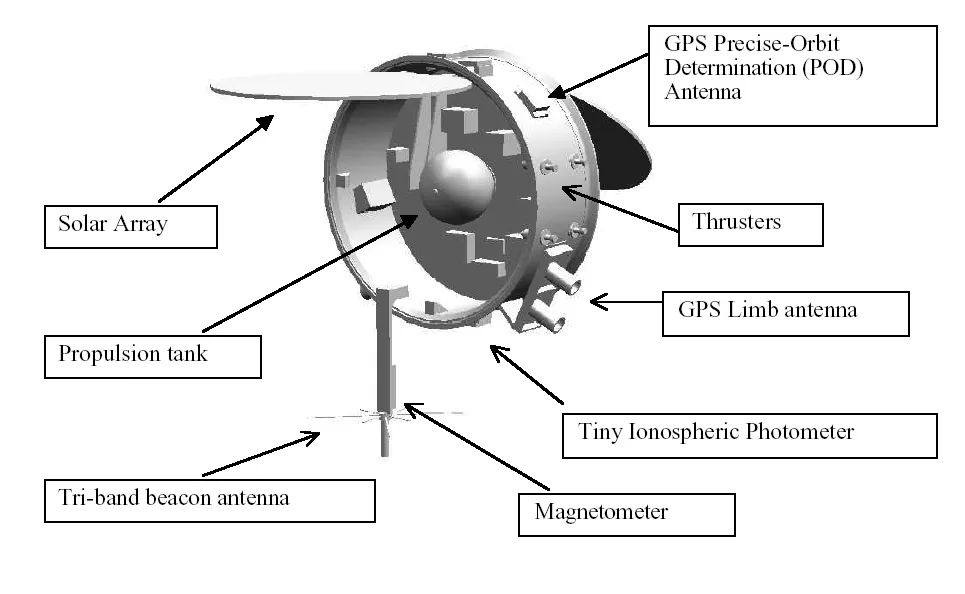
FORMOSAT-3, launched in 2006, was more direct: a constellation of six microsatellites, part of the COSMIC program in cooperation with the United States, using GPS radio occultation to measure the atmosphere.12 It was called "the most precise thermometer in space," and it pushed the accuracy of global weather forecasting up by another notch.12
Did you know?
The FORMOSAT series runs from 1 to 8, but 4 and 6 are missing. FORMOSAT-4 was halted because of problems in the procurement process, and its work was folded into FORMOSAT-5. FORMOSAT-6 was originally intended for self-launch in 2009, later changed to outsourced launch, and then canceled.13 Taiwan's FORMOSAT family is therefore a family with two empty spaces. Those two gaps mark two paths that did not go through.
Disaster response, weather reporting, atmospheric measurement: this was the face the institution presented to the outside world for thirty years. It said it was doing science. That was not false, but it was also a deliberately chosen way of speaking. In a situation where one could not say too loudly whom one was guarding against, "we are watching the weather" was a safe sentence. What it was really watching would not be spoken aloud until much later.
FORMOSAT-5's stumble
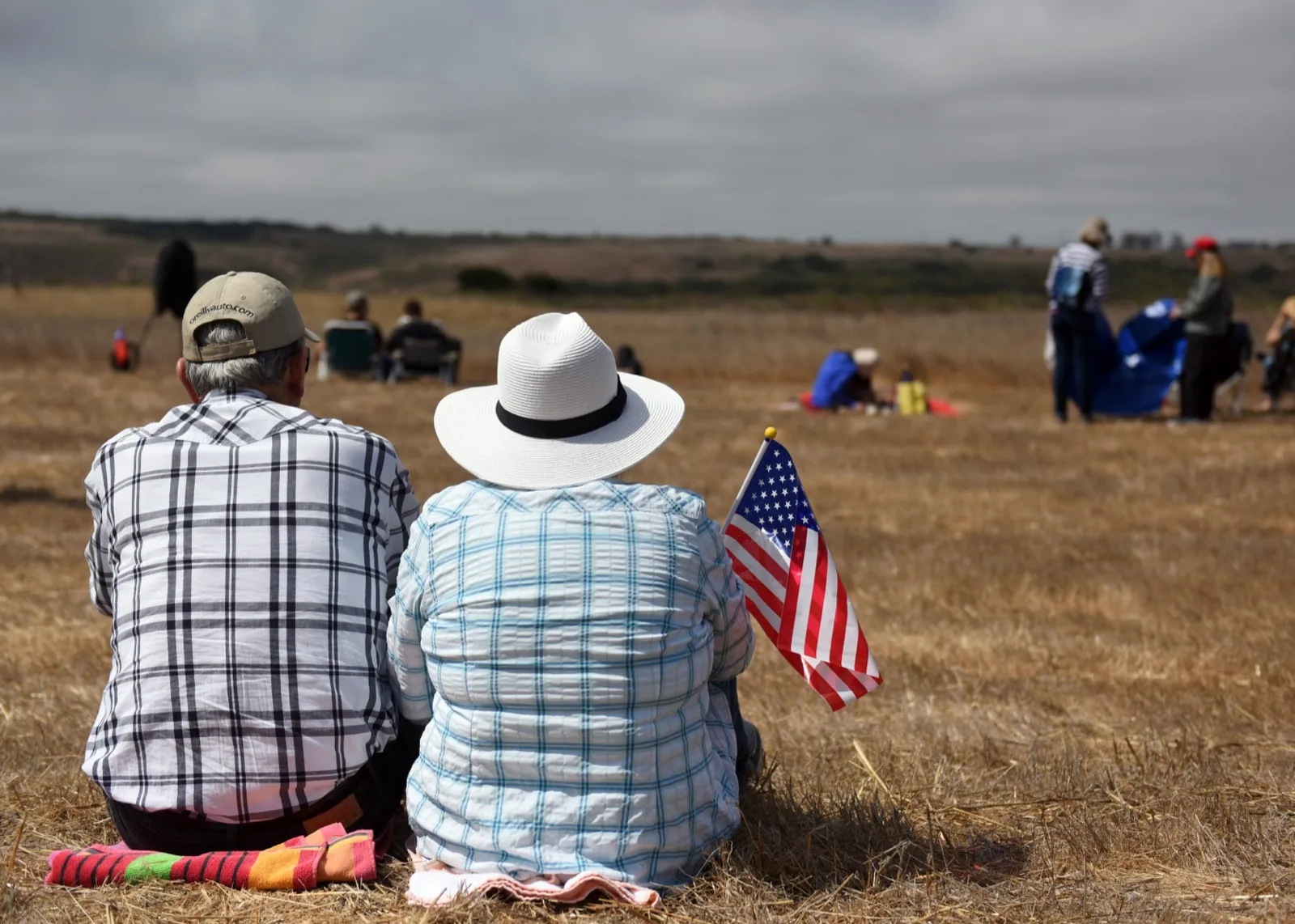
On August 25, 2017, FORMOSAT-5 launched aboard SpaceX's Falcon 9. This one was different: it was Taiwan's first high-resolution remote-sensing satellite billed as "indigenously developed." It cost NT$5.659 billion, took six years to build, and for the first time placed five major key components, including the payload computer, power control, and flight software, in Taiwan's own hands.14
✦ "As long as you have seen a rocket made by Taiwan itself launch, national confidence will rise. You will immediately become 100 percent Taiwanese." — Jong-Shinn Wu15
For FORMOSAT-5, the first wall that domestic production hit was not technical, but political. It originally wanted to use industry-standard CCD sensors, but high-end remote-sensing-grade components of this kind were subject to export controls, and Taiwan could not buy them.16 The team had to take a detour, using CMOS sensors common in consumer electronics and redesigning them into space-grade remote-sensing devices. The result was the world's first high-resolution remote-sensing satellite using CMOS image sensors, built through five years of work by more than fifty industry, academic, and research teams.16 For the first time, the word "self-reliance" had a concrete meaning: when it comes to critical parts, others simply will not sell to you.
Then it stumbled.
The images sent back after launch were blurry. Rings of light appeared beside urban buildings. It was a moment when the public watched television with bated breath: would this NT$5.6 billion "pride of Taiwan" become an expensive piece of space junk?17
The satellite imagery team rescued it. Liu Hsiao-ching, who led the team at the time, later recalled that FORMOSAT-5's collimator had not been properly calibrated and had not provided truly parallel light: "a deviation of one millimeter can cause extremely serious defocus."18 NARLabs proposed three solutions, and in the end the team used software to reverse-engineer and restore the blurred images layer by layer, reaching commercial quality by the end of November.18 Afterward, the Control Yuan spent one year and four months investigating and traced the problem to a collimator purchased from the United States in 2011 for more than NT$8 million, determining that there had been problems in calibration management.19
This stumble mattered more to the institution than any success. "Self-reliance" became something that, 561 kilometers up in a vacuum, could turn six years of effort into trash because a ground instrument had not been properly calibrated. Taiwan fell on its own for the first time, and then got back up on its own.
Rocket Uncle in the wasteland comes to drive the train
The year Liu Hsiao-ching rescued FORMOSAT-5, Jong-Shinn Wu was still building his private rocket in the wasteland.
Wu was born in 1964 in rural Tainan to parents without formal education.20 He studied at National Tainan First Senior High School and National Taiwan University's Department of Mechanical Engineering, earned a doctorate in aerospace engineering at the University of Michigan, joined the space center as an associate researcher in 1995, and began teaching in National Chiao Tung University's Department of Mechanical Engineering in 1998.20 In 2012, he founded the Advanced Rocket Research Center, using crowdfunding to build rockets: a university professor and a group of students test-firing things they had built on Taiwan's coast. In 2015, he stood on the TEDxTaipei stage and spoke about his rocket dream entirely in Taiwanese. His closing line was: "We absolutely will not give up. We are going to leave Earth, that's all!"21
TEDxTaipei 2015: Jong-Shinn Wu spoke about his rocket dream entirely in Taiwanese. This was the talk that made him "begin to become famous after speaking at TED in 2015," and it was one source of inspiration for Mayday's "Stubborn" music video.
Contested view
The Rocket Uncle story is not entirely romantic. In 2016, Wu was seconded from National Chiao Tung University and co-founded the private company TiSPACE with Yen-Sen Chen, who had worked for more than twenty years at NASA's Marshall Space Flight Center. Wu served as CEO.22 On February 13, 2020, TiSPACE's Hapith I ignited in Nantian Village, Daren Township, Taitung, but failed to lift off.22 It was later revealed that the launch site had been applied for under the name of a "shrimp farm," while in reality it had been built on Indigenous reserved land, in violation of the Regional Plan Act. Taitung County imposed three fines totaling NT$860,000, and former chairman Li Chin-yi was ultimately sentenced to 50 days of detention.23 Wu had already left TiSPACE in 2018 because of disagreements over direction and stated that ARRC had no connection to TiSPACE.22 But this shadow is part of his arc. Taiwan's space dream once stepped through environmental justice and Indigenous land rights.
On August 2, 2021, the man treated as a joke in the wasteland took over as director general of the Taiwan Space Agency.24 He described the transformation as moving from the scholar's position of criticizing like "a dog barking at a train" to, after becoming director general, driving the train himself.25
Curator's note
Jong-Shinn Wu is almost a miniature of this institution. A man who started in a poor farming village, wanted to leave Earth, and was treated as a daydreamer ultimately shouldered the rocket dream for an entire country. He is often asked why Taiwan does not make the entire satellite system itself. His counter-question is: if we clearly have the ability, why should we be sharpening knives for others? In one person, that sentence is ambition. In an institution, it is the entire meaning of the word "self-reliance." The private rocket in the wasteland and the national satellite in the sky were actually seeking the same thing.
Putting Taiwan back into the name
Around the time Wu took over, this institution finally began to assemble the two things it lacked most: legal status and a name of its own.
On May 31, 2021, the Legislative Yuan passed the Space Development Act on third reading.26 It was Taiwan's first dedicated space law, with six chapters and twenty-two articles. Article 11 stipulates that launch vehicles launched within Taiwan's territory must conduct launch operations at a "national launch site."27 The meaning of that sentence is that Taiwan acknowledged in law, for the first time, that it needed its own launch site.
The following year was even more important. On April 19, 2022, the Legislative Yuan passed the Act for the Establishment of the Taiwan Space Agency on third reading; it entered into force on January 1, 2023.28 Article 2 states directly: "The Center is an administrative corporation; its supervisory authority is the National Science and Technology Council."29
The words "administrative corporation" meant that, thirty-two years after its founding, the institution had legal "personhood" for the first time. Before this, it was a center under NARLabs, without even the authority to sign contracts and conduct procurement on its own. After restructuring, it could sign contracts and procure on its own, while salaries were removed from the civil-service system. Wu said this made recruitment nearly ten times faster.30
With the restructuring, the English name changed from NSPO to TASA, the Taiwan Space Agency. The official explanation was that the change "added Taiwan to the name" to improve international recognition.31
✦ A country that cannot even print its name on the sports field first put Taiwan back onto its own space agency.
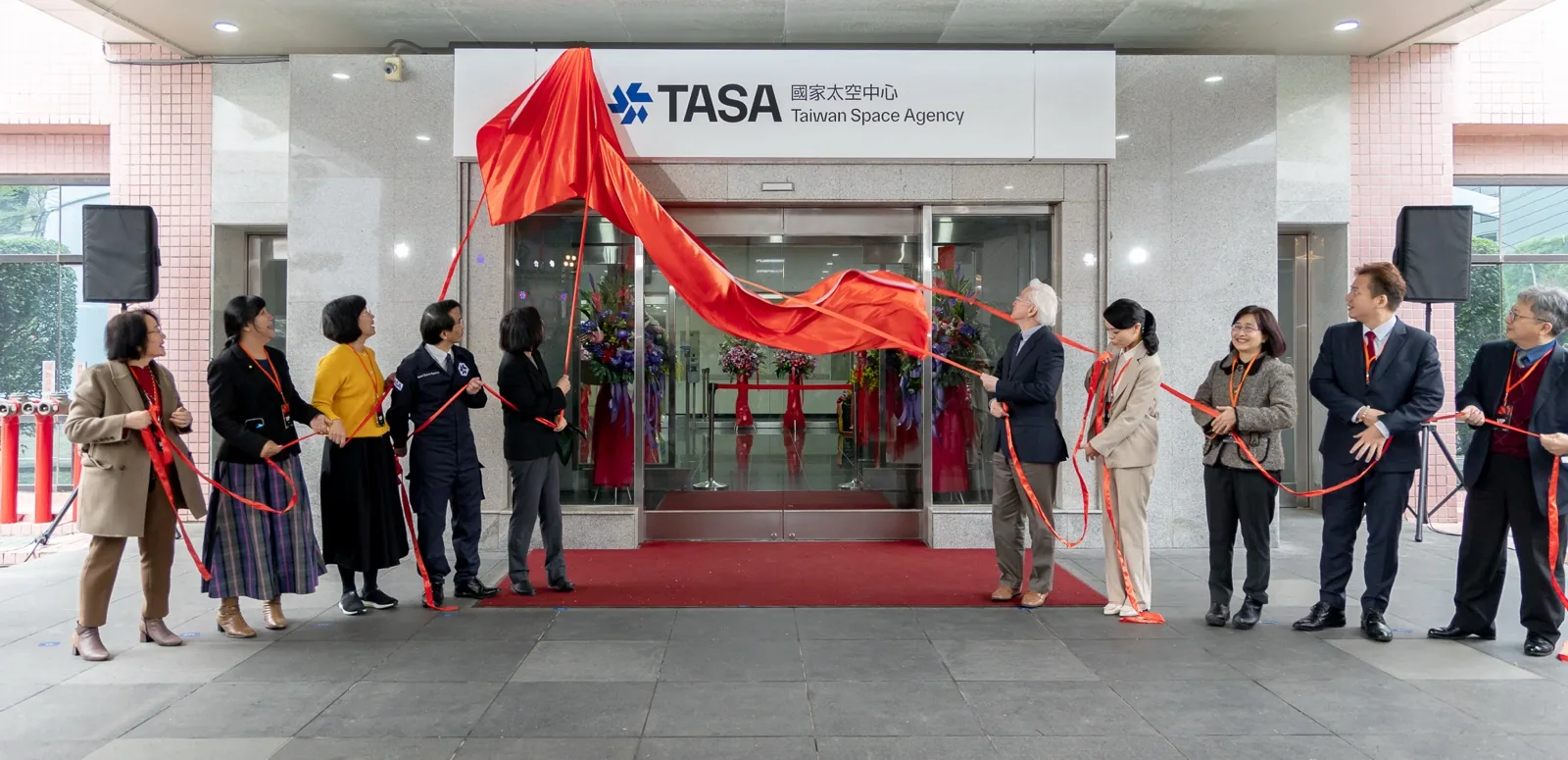
This is the quietest yet most crucial moment in this story. Changing an English abbreviation did not alter anything technically. The satellites were still those satellites; the engineers were still those engineers. But an institution whose name had been decided by others for thirty years, and whose own repeated renamings had never dared to be too serious, put the word "Taiwan" into its own name for the first time. When the draft bill was announced, Premier Su Tseng-chang said the aim was to "send Taiwan's national strength into space."32 That can be political language, but at the moment of this name correction, it referred to something very concrete.
What the institution does every day now
To understand today's TASA, first walk into the control center in the building on Zhanye 1st Road in Hsinchu Science Park. On its screens, the heartbeats of nine satellites pulse at once.3
Each satellite passes over Taiwan at a fixed time, and the control center has to upload commands and download data during the few minutes it flies overhead. Among the nine, the oldest is FORMOSAT-5, launched in 2017 and now operating beyond its design life. Six in the middle are FORMOSAT-7, the COSMIC-2 constellation launched in 2019 in cooperation with the United States, which produces about 4,000 radio occultation data points from space each day for global weather forecasting models.333 Triton, launched in 2023, sniffs out ocean surface winds. The newest is the first FORMOSAT-8 satellite, launched at the end of November 2025 and still in trial operations, with formal service expected in July 2026.34 A preparatory office that had no name in 1991 now commands a satellite fleet that cannot go offline for even a day.
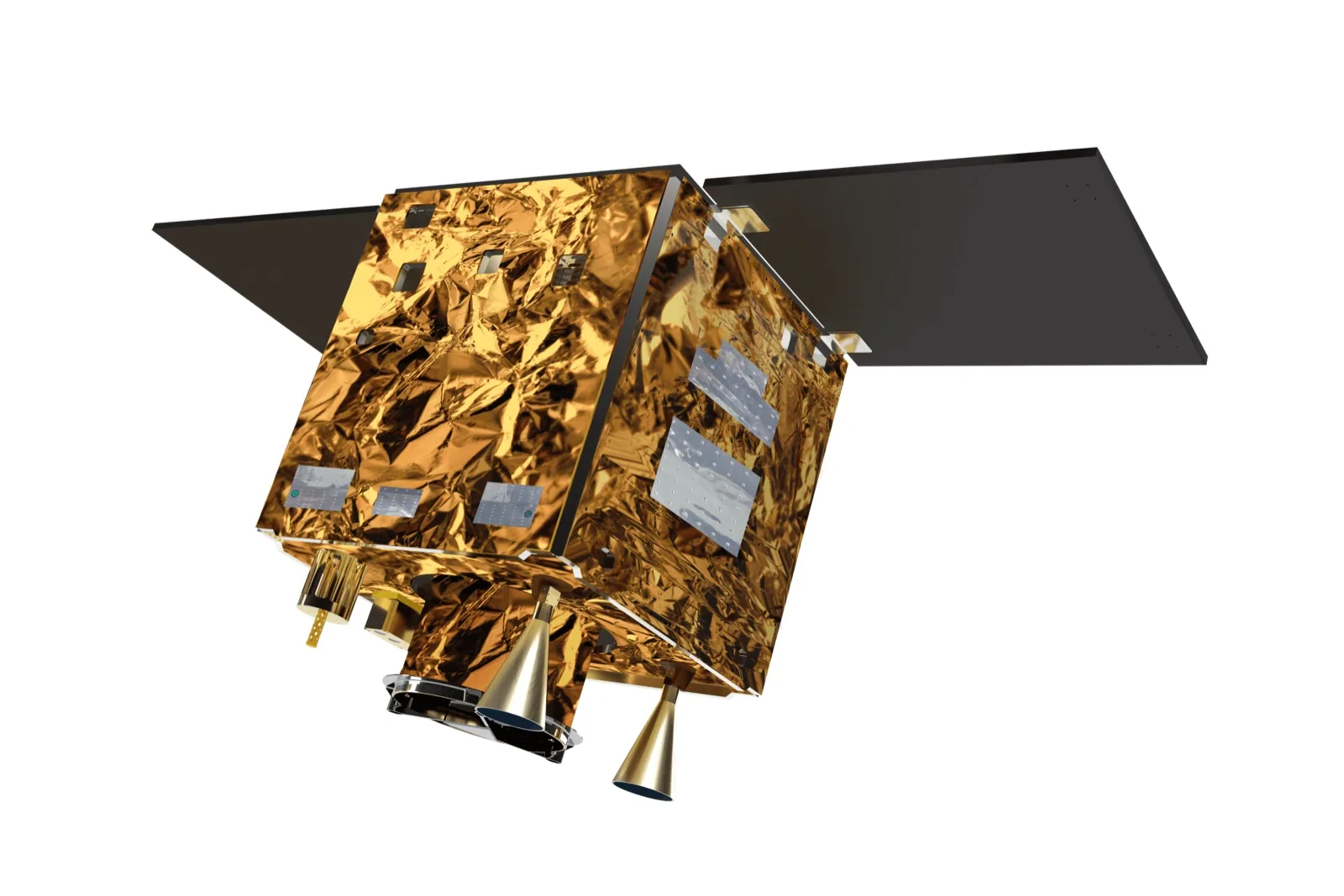
At the other end of the factory, the next batch of satellites is being assembled. FORMOSAT-8 is an eight-satellite constellation to be launched in stages, with full deployment scheduled through 2031.34 When the first satellite, ZeppelinSat, sent back its first batch of images in early 2026, including Hsinchu Science Park, Anping in Tainan, Hsinta Harbor in Kaohsiung, Tokyo's National Stadium, and Barcelona Airport, its measured clarity and signal-to-noise ratio were both better than the original design, and post-processing pushed resolution to 0.7 meters. The team was already testing the second satellite.3435 By May, Wu publicly released two more images at a press conference: the newly opened Danjiang Bridge and Hsinta Harbor, which had reached a "crystal clear" level.36 Further along are the FORMOSAT-9 radar satellites, still in the parts-procurement stage: two satellites, one to launch in 2028 and one in 2030.37
Did you know?
Hidden inside this generation of FORMOSAT-8 satellites is something even more important for Taiwan's industry: it carried sixteen domestically produced key components into space for "in-orbit verification," and all of them passed.34 No matter how much testing a component undergoes on the ground, that does not prove it can be used in space. It has to actually fly, survive vacuum and radiation, and only then is it qualified to be written into a specification sheet and sold to others. FORMOSAT-8 effectively issued a certificate to more than twenty Taiwanese companies saying: this component has been to space.34
What the satellites photograph eventually has to become services people can use. TASA has opened an imagery service platform for government agencies: disaster prevention needs to see where slopes have collapsed, agriculture needs to see crop growth, and national land planning needs to track how coastlines are changing.3 Historical imagery accumulated over the years by FORMOSAT-2 and FORMOSAT-5 has also gradually been released on the government's open data platform.3
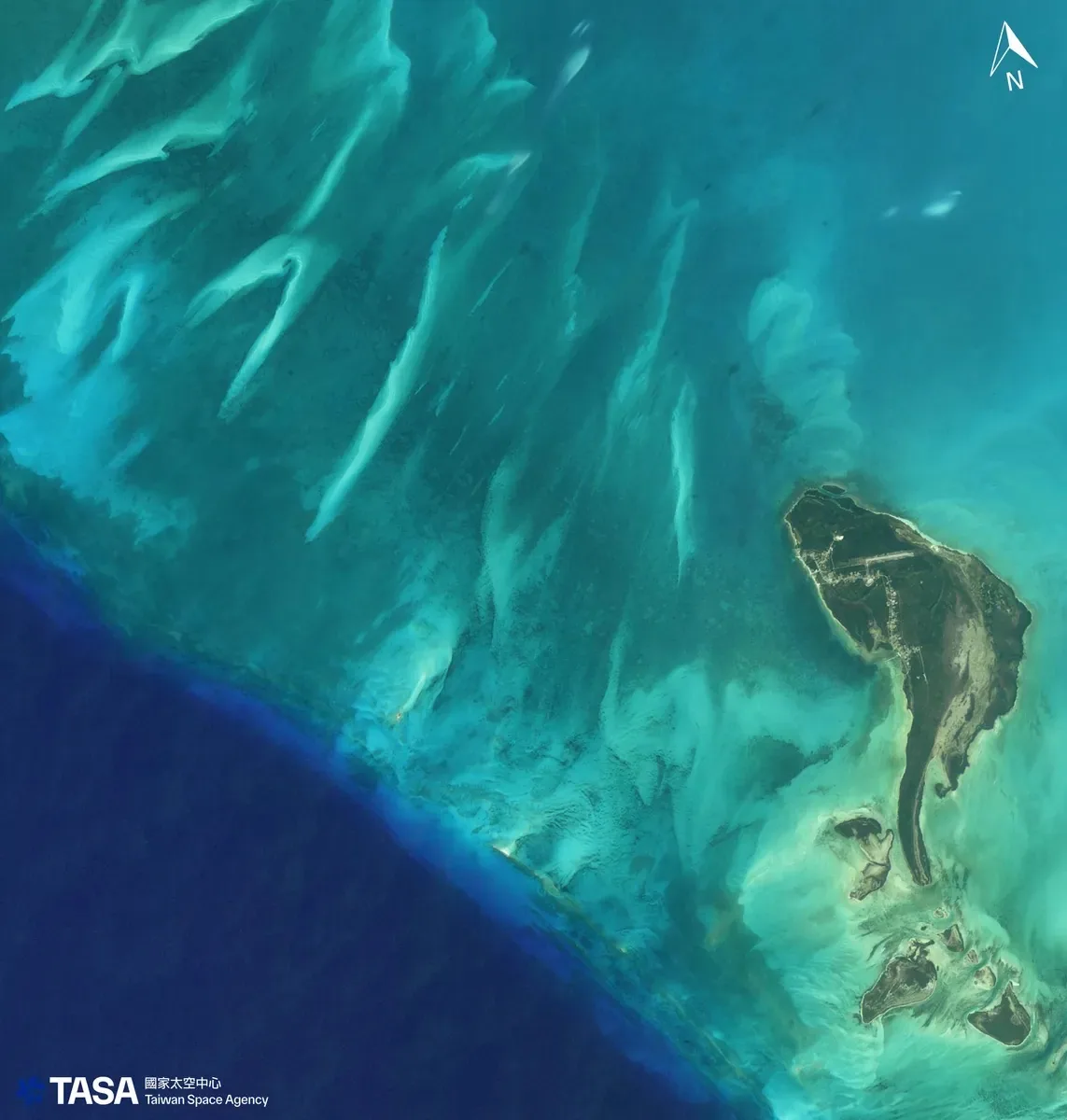
The Bahamas shoals captured by a FORMOSAT satellite. The preparatory office that had no name thirty years ago can now see the seabed on the other side of the world this clearly.
And that is only the part in the sky. On the ground, TASA is preparing land at Jiupeng in Pingtung for its own launch site, while also building a NT$3.388 billion rocket integration and testing base in Shalun, Tainan, expected to open in 2030.38 Wu describes what the institution now needs to do in one long sentence: deploy three major satellite constellations, for communications, optical remote sensing, and synthetic aperture radar, and build Taiwan's independent three-dimensional communications and Earth-observation network.39 In plain language, Taiwan wants its own communications network, its own eyes that can see clearly, and its own radar that can see through clouds, with every layer no longer dependent on others.
What satellites have actually done for Taiwan
On the morning of April 3, 2024, a magnitude 7.4 earthquake struck off the coast of Hualien, Taiwan's largest in twenty-five years. Six minutes after the earthquake, TASA engineers remotely connected to FORMOSAT-5 and reset its mission parameters. Three hours later, FORMOSAT-5 flew over Taiwan and acquired emergency imagery of the epicentral area.4
This is the value of a satellite in its most concrete form. FORMOSAT-5's single imaging swath is only twenty-four kilometers wide, so seeing the whole Hualien mountain region required it to fly pass after pass and piece together tile after tile.4 The Agency of Rural Development and Soil and Water Conservation used imagery from FORMOSAT-5 and other satellites for interpretation, counting 1,391 newly formed landslides after the quake, covering a total area of 943.76 hectares. Of these, 444 lay within potential debris-flow zones, and 62 directly threatened railways and roads.4 A National Central University team calculated that the Xiulin area alone had about 20.6 square kilometers of landslides.4 These figures are not academic-paper abstractions. They are the basis for emergency evacuation, road closures, and the allocation of disaster-response resources.
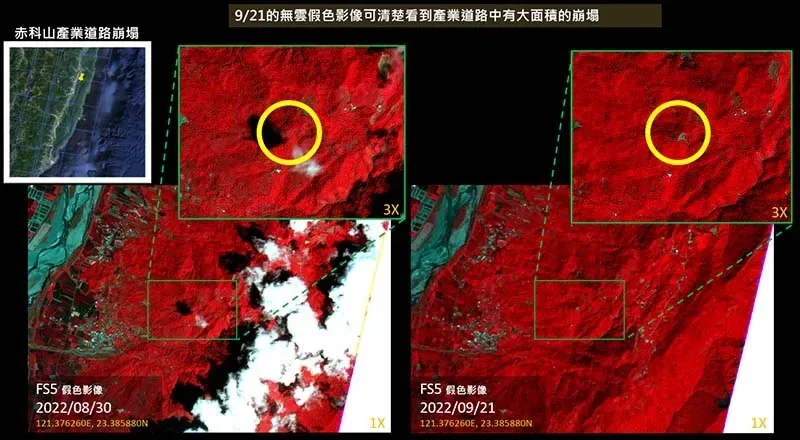
A landslide at Chike Mountain interpreted from FORMOSAT-5 imagery after the 2022 Chishang earthquake in Taitung. The same interpretation workflow counted more than 1,000 newly formed landslides after the April 3 Hualien earthquake.
✦ "Imaging for national-security targets is usually the first priority for domestically made satellites in every country. Even a buyer willing to pay a great deal may not be able to squeeze into the schedule." — The Reporter40
When the earthquake occurred, TASA also did something else: it activated the Sentinel Asia mechanism, obtaining satellite imagery from Japan's JAXA, Thailand's GISTDA, and India's ISRO.4 In other words, because Taiwan has its own satellites, when disaster strikes it can not only take its own images, but also has standing to enter an international mutual-aid circle and exchange with others. A country without its own satellite can only wait for others to be willing to free up time to photograph it. And the priority in satellite scheduling is often each country's own national-security mission; even paying a great deal does not necessarily get you in.40 The true meaning of self-reliance is not having to wait in line.
In September 2025, a barrier lake formed upstream on Hualien's Matai'an Creek, and the same mechanism moved again. Multiple satellites, including FORMOSAT-5, confirmed roughly 500 hectares of landslides and the lake's water area, and local governments used these data to install water gauges and calculate evacuation timing.41 Chang Li-hsueh, who is responsible for imagery, put it plainly: the maximum area one satellite can capture at a time is only about twenty-four kilometers, so they have to overlay and analyze imagery from several satellites and multiple passes.41
Beyond the layer in the sky, Taiwan's vulnerability also lies under the sea. In February 2023, the two undersea cables connecting Matsu were cut by Chinese vessels within six days: first a fishing boat snagged the Taimatsu No. 2 cable, then a cargo ship dropped anchor and tore through Taimatsu No. 3.42 Matsu's 13,000 residents lost internet access for fifty days, barely sustained by microwave backup. Residents at the time said sending one Line text message required a wait of fifteen to twenty minutes.42 Ninety-nine percent of Taiwan's external internet traffic travels through fourteen undersea cables, while the Taiwan-Matsu cables are cut an average of 5.1 times per year, twenty-five to fifty times the global average.42
This is why Taiwan wants its own low-Earth-orbit communications satellites. But here one has to be honest: satellites cannot replace undersea cables. The transmission capacity of one undersea cable is 100,000 times that of a communications satellite.42 The point of satellite backup is that, during those fifty days when all cables are cut, there is at least one lifeline capable of sending the words "we are still here." It is not about moving the internet into the sky.
Curator's note
FORMOSAT-3 was called "the most precise thermometer in space" not because Taiwan was boasting. In 2020, radio occultation data from its successor, COSMIC-2, were formally incorporated into global forecasting systems by the European Centre for Medium-Range Weather Forecasts (ECMWF) and the U.S. National Oceanic and Atmospheric Administration (NOAA).33 ECMWF's assessment said these data improved forecasts at certain altitudes by "about 5% at 100 hPa in the tropics"; NOAA directly described the program as "the largest science and technology cooperation between the United States and Taiwan authorities."33 A small institution unrecognized by most countries did not rely on diplomatic recognition. It relied on the fact that it could truly photograph, calculate, and measure accurately enough that weather models around the world had to use its numbers. This is a hidden path by which Taiwan bypasses diplomatic isolation and embeds itself into international systems through technology.
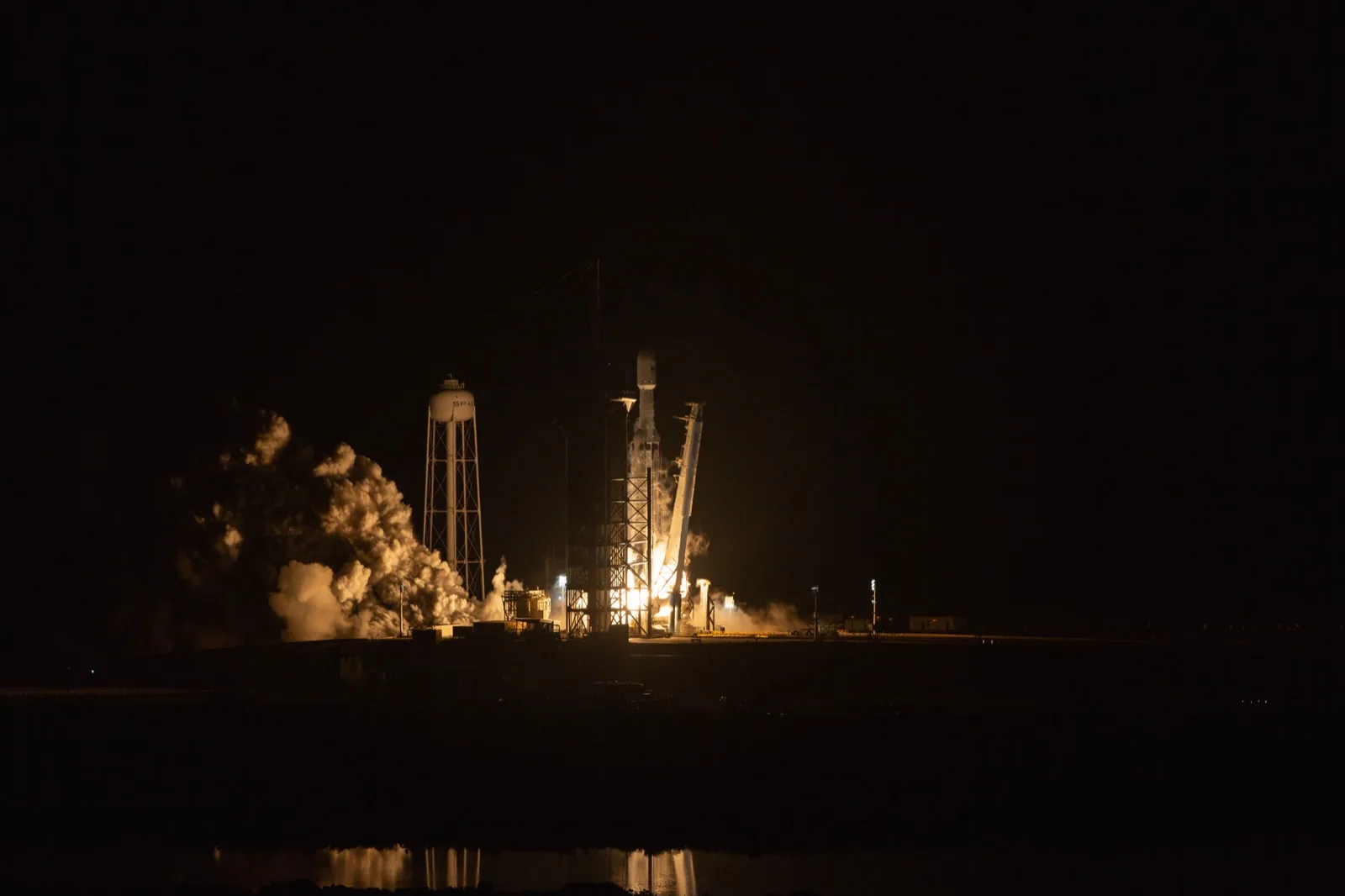
FORMOSAT-7/COSMIC-2 was sent into space by Falcon Heavy in 2019. Taiwan has its own satellites, but not yet its own rockets and launch site. That is why the next part is all about how to fill in those two missing pieces.
The brilliant experiments
If one looks only at the FORMOSAT series, one might think TASA is an institution that specializes in large satellites. But what is truly interesting about it lies in experiments so small they are hard to believe, yet each solves a tricky problem.
On December 9, 2024, a Taiwanese CubeSat called Onglai was ejected from the International Space Station's deployment module and entered orbit.43 It was only the size of a briefcase, built in Taiwan-Japan cooperation with the University of Tokyo.43 It carried something being verified in space for the first time: a Taiwan-made CMOS TDI sensor produced by NARLabs' Taiwan Semiconductor Research Institute.43 Such a small satellite ultimately produced images with 2.5- to 3-meter resolution, achieved a 100 percent success rate across fifty imaging attempts, and ranked among the best CubeSats in the world.43 It proved one thing: Taiwan can not only build large satellites; it can also build miniaturized remote sensing that fits inside a briefcase.
On the rocket side, there was also a world first. Wu's old team, ARRC at National Yang Ming Chiao Tung University, launched a hybrid rocket called HTTP-3A in July 2022.44 It achieved something previously possible only for liquid rockets: thrust vector control, meaning the rocket could "turn direction" by itself during flight. It was the first hybrid rocket in the world to do this.44
Contested view
To be honest, the HTTP-3A flight was not perfect. It was originally expected to reach an altitude of 10 kilometers and fly for 490 seconds; in reality it reached only about 3 kilometers and flew for about two minutes.45 ARRC's post-flight report traced the cause to a ground segment: the scale used to load hydrogen peroxide had switched units from kilograms to pounds without anyone noticing, so only 45 percent of the planned oxidizer was loaded and the engine shut down early.46 It was another small ground-side object, the same kind of script as FORMOSAT-5's collimator. But deputy director Wei Shih-hsin was clear: "As long as the flight navigation and control in the first 30 seconds proceeded according to plan, it counts as 99 percent successful."45 A rocket built with 7,000 people and NT$25 million in crowdfunding successfully verified the hardest technology. That was what it needed to prove. It did not reach the intended altitude, but it could control its direction.44
FORMOSAT-8 also contains a green experiment that one may not notice but that is crucial. The propellant traditionally used for satellite attitude control is hydrazine, which is highly toxic; ground crews have to wear full protective gear.47 FORMOSAT-8 uses, for the first time, a Taiwan-developed hydrogen peroxide propellant, a high-concentration form of H2O2.47 Chao Yi-chin of National Cheng Kung University, who initiated this technology, calculated the trade-off: "The thrust generated by using hydrogen peroxide is only 10% lower than hydrazine."47 Giving up that 10 percent of thrust yields an option that does not poison operators or pollute the environment. For an institution still building launch sites and set to handle propellants more often, this is groundwork for the future.
The cleverest idea is on Triton. It measures ocean surface winds, but it does not emit any signal toward the sea. Instead, it uses existing GPS satellite signals in the sky as a "lamp." Those signals reflect off the sea surface; the rougher the sea and the stronger the wind, the more chaotic the reflected signal becomes.48 Triton is simply a quiet receiver, inferring wind speed from the disorder in the reflected signals.48 A satellite that never touches the sea and emits no signal of its own measures the wind across entire oceans by borrowing someone else's signal.
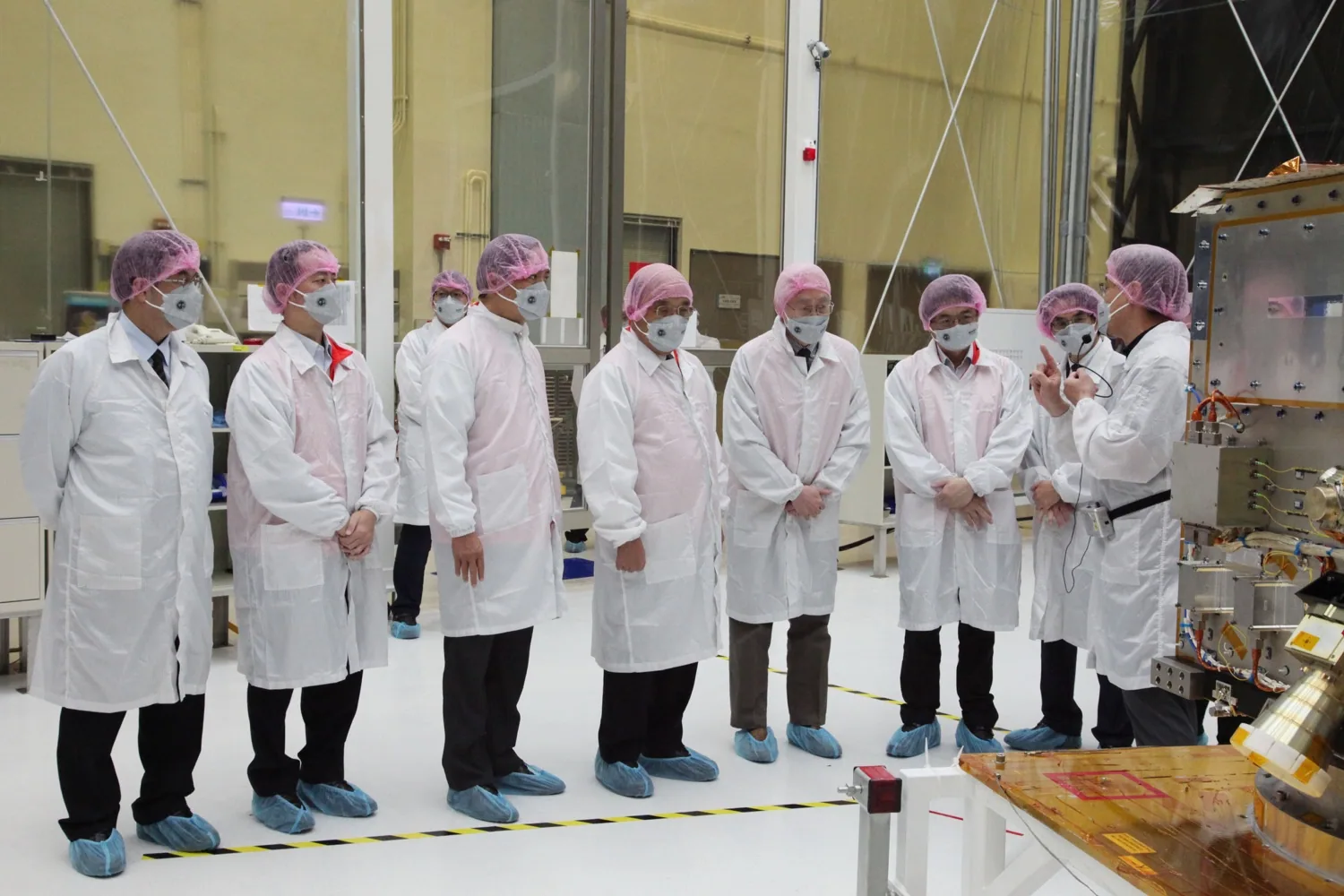
A borrowed sky
With a name and legal personhood, the institution began filling the hardest gap: it had always been built on borrowed infrastructure.
On October 9, 2023, the Triton satellite launched from the Kourou launch site in South America aboard Europe's VEGA rocket.49 It was originally the thirteenth satellite of the Taiwan-U.S. FORMOSAT-7 cooperation, but later became an independent mission. Its domestic production rate climbed to 82 to 83 percent; the space center designed, manufactured, and performed system integration itself, while Aerospace Industrial Development Corporation built the satellite structure that supports all the components.4950 To download its data, Taiwan borrowed NOAA's ground station in Alaska.49
This is the institution's situation: to go to space, it must borrow SpaceX's or Europe's rockets; to download data, it must borrow an American ground station. And the most fundamental constraint lies somewhere most people would not think of.
Taiwan is not a member of the United Nations. This means it cannot directly apply to the International Telecommunication Union (ITU) for radio frequency coordination and orbital slots, both prerequisites for launching satellites. So whether for launch itself or for obtaining orbital resources, Taiwan has to work through other countries.51
Curator's note
We are used to imagining "space self-reliance" as a question of resolve: whether Taiwan has the backbone to do things itself. But for this institution, self-reliance is less a choice than a survival strategy forced into being. U.S. ITAR export controls make the path of "buying a full system" full of restrictions; non-UN-member status makes "launching through others" the only option. Taiwan learned to build satellites itself partly because, when you want to do something sensitive, no one will readily lend to you. Taiwan's space self-reliance is a capability grown in a situation where "no one will lend to you."
Where it goes next
The land is there, the buildings are there, the people are there, and the money has also been added. In July 2024, the space center, expanding all along the way, opened a second office site on Gongdao 5th Road in Hsinchu. On March 26, 2025, the National Science and Technology Council selected Jiupeng Village in Manzhou Township, Pingtung, as the permanent national launch site. On October 20, 2025, the Executive Yuan approved an expansion of the third phase of the Long-Term National Space Technology Development Program from the original NT$25.1 billion to NT$71 billion, extending the timeline to 2031.525354
Did you know?
Taiwan has several launch sites that are easy to confuse, and distinguishing them is half the history of Taiwan's space program. Jiupeng Base in Pingtung is a military facility of the National Chung-Shan Institute of Science and Technology, established in 1975 and long used for missile tests.55 Xuhai Launch Site in Mudan Township, Pingtung, is a scientific sounding-rocket site opened by the National Science and Technology Council in 2022, where Wu's ARRC has launched rockets.55 Jiupeng Village is the national launch site selected only in 2025.53 As for TiSPACE's Hapith I attempt, that took place in Nantian, Daren Township, Taitung, which is not the same place as any of the first three.55
But the institution still lacks the most important thing: it has no orbital rocket of its own. It can build satellites, but it has to put them on other people's rockets to send them up. That is precisely the hole the next decade is meant to fill. TASA's planned orbital rocket is a two-stage liquid-fuel configuration, with the goal of sending a 200-kilogram payload into low Earth orbit, targeted for 2034. In between, there will be two suborbital test vehicles (STVs), scheduled for 2029 and 2031, first breaking through the 100-kilometer Karman line and then moving step by step toward true orbit.565 Different parties give different precise dates, so a conservative phrasing is that this is something to be completed in the 2030s.
The communications-satellite layer is also being filled in. Taiwan's experimental low-Earth-orbit communications constellation, often called the "Taiwanese Starlink," follows a 2+4 model: the government first builds two satellites to set specifications, then helps private industry build the next four, training Taiwan's low-Earth-orbit satellite manufacturing sector.5758 Its background is the striking image of Starlink sustaining communications on the battlefield in Ukraine.57 The first 1A satellite was originally scheduled for launch in 2025, but because the communications payload did not meet development targets, it was delayed to 2027.59
Contested view
Not everyone thinks this path is moving fast enough. The think tank Global Taiwan Institute has pointed out directly that Taiwan's planned domestic low-Earth-orbit communications constellation is set to launch only six satellites by 2029, while a constellation capable of supporting Taiwan's communications resilience would require at least 120, "a far cry from six."60 An institution that has an agency, legal personhood, but no rocket yet and a constellation scale far from sufficient: this is the other honest side of the story.
And above all these, in 2025 a goal appeared quietly that in the past would have been unimaginable: the Moon.
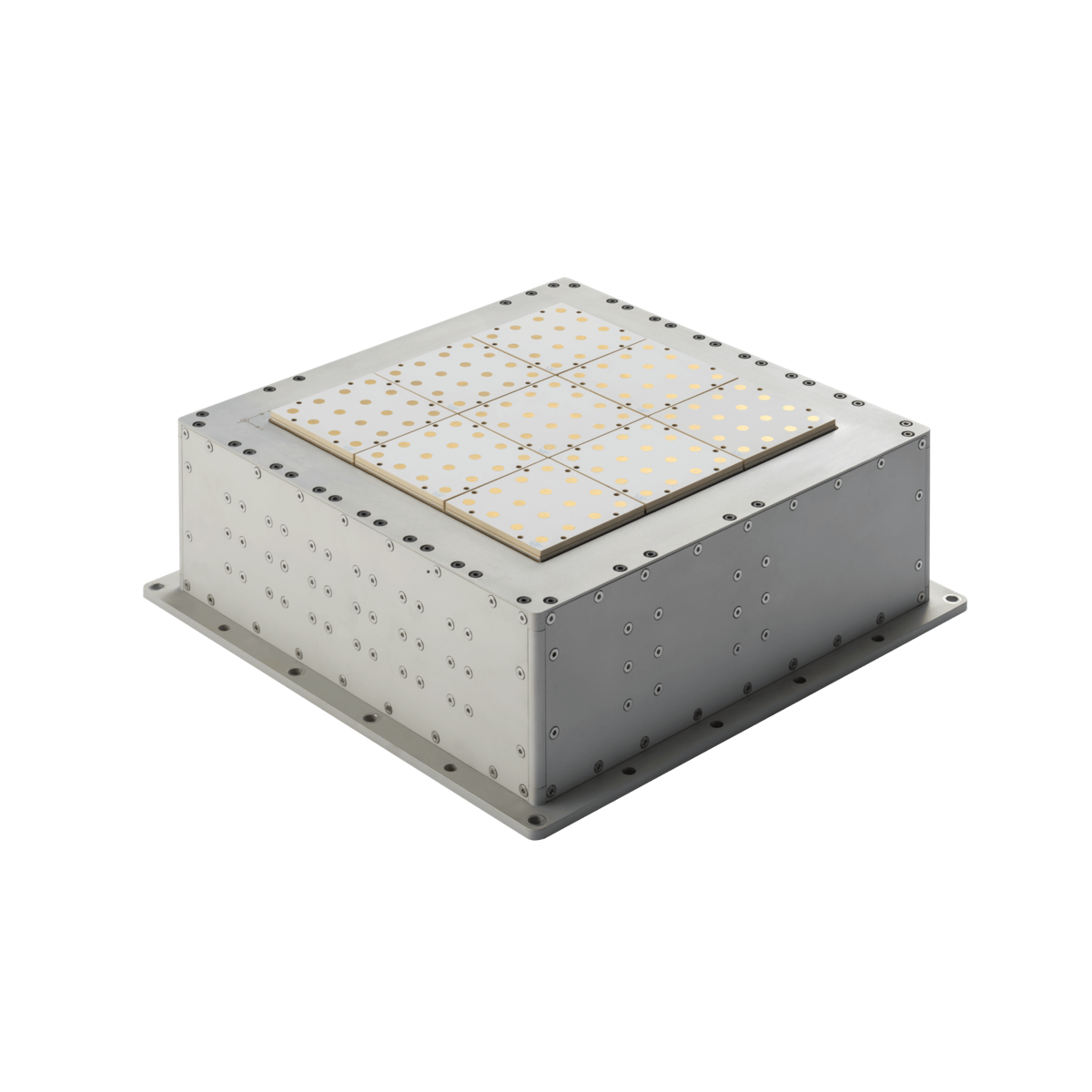
This is already budgeted and approved; it is no longer just talk. In 2025, TASA launched Taiwan's first lunar exploration mission, with launch possible as early as 2028, and issued a NT$335 million tender for integrated delivery by lunar lander.5 What it intends to send to the Moon are two Taiwan-made scientific payloads: a lunar vector magnetometer and the Formosa Lunar Ultraviolet Telescope.5 Wu once told the NASA administrator in person that "Taiwan wants to be a part of the lunar adventure." NASA has not yet formally confirmed Taiwan's participation in the Artemis program.5
As for the more distant vision that remains at the level of conversation, it is the image Wu often mentions: "Perhaps in the future every young Taiwanese person's coming-of-age ceremony can include visiting a rocket launch and a national space museum."5 A spaceport and a space museum: that is a vision, not yet approved. But the Moon is already underway.
Until it admitted it was watching the PLA
On November 29, 2025, the first FORMOSAT-8 satellite, FS-8A, launched from Vandenberg Space Force Base. It has a name: ZeppelinSat.61
Chi Po-lin was the director of Beyond Beauty: Taiwan from Above, the 2013 aerial documentary that made the whole country see its own wounds. On June 10, 2017, while filming the sequel in Hualien, he died in a helicopter crash; the sequel was never completed.62 Eight years later, a satellite named after him began seeing Taiwan for him from 561 kilometers above. At the launch, Lai Ching-te said he hoped director Chi's spirit could extend into space, "continuing to watch over Taiwan and observe the world."63 Chi's son, Chi Ting-huan, said the satellite would "stand in for my father, protecting Taiwan from a higher perspective."62
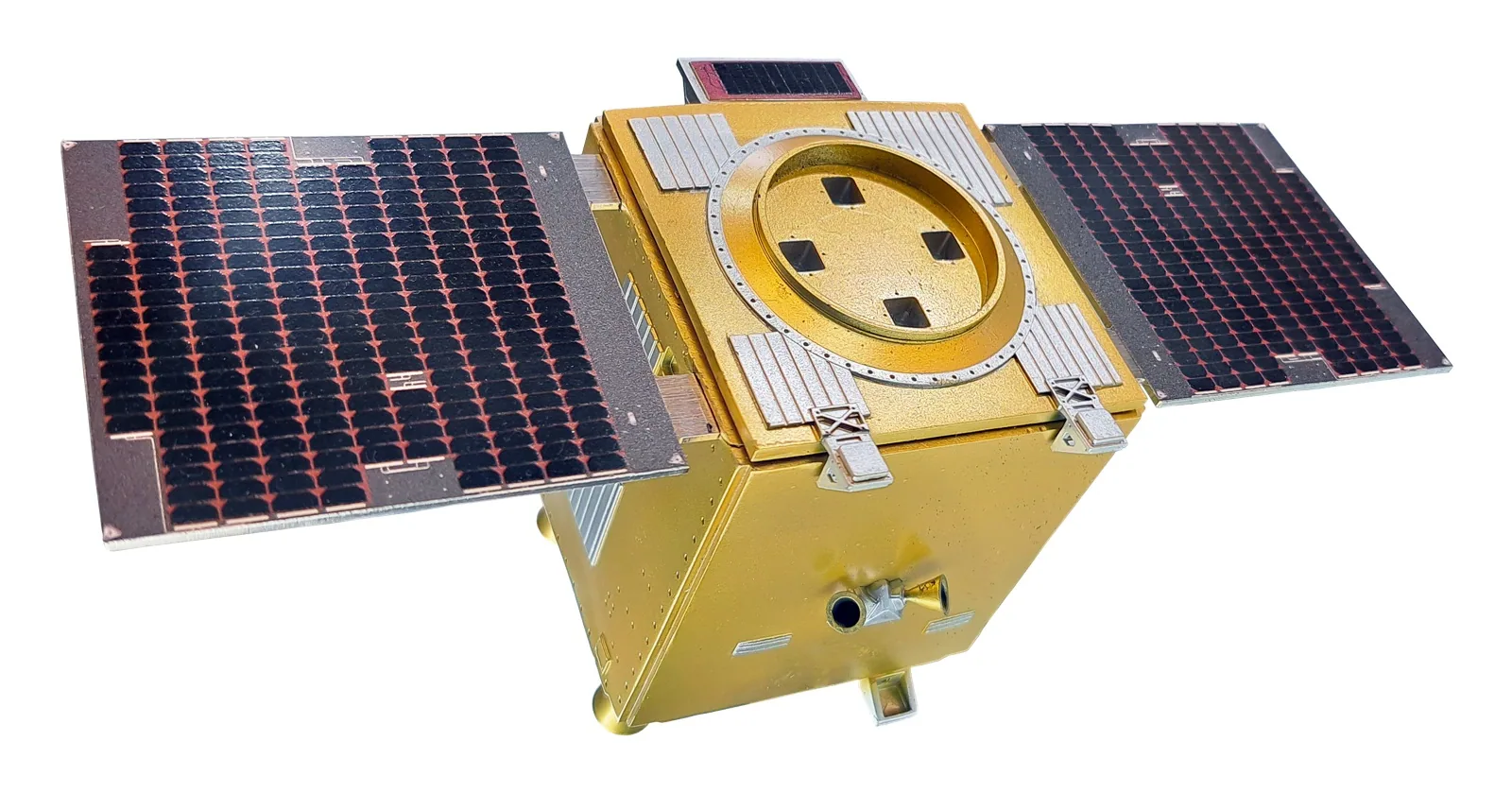
FORMOSAT-8's domestic production rate is 84 percent, a step further than FORMOSAT-5.64 It sees more clearly: FORMOSAT-5 can roughly see that cars are moving on a highway, while FORMOSAT-8 can distinguish whether they are trucks or sedans.65 Once all eight satellites are in place, the constellation's revisit frequency over Taiwan will rise from FORMOSAT-5's once every two days to three times per day. It also carries a short-wave infrared sensor that can penetrate cloud cover to detect high-temperature heat sources on the ground.66 The FORMOSAT-8 project is led by Liu Hsiao-ching, who stumbled with FORMOSAT-5 and resolved to redeem that failure with FORMOSAT-8.67
TASA's official promotional video: FORMOSAT-8, from one satellite to an eight-satellite constellation, Taiwan's strongest "eagle eye" with domestic production pushed to 84 percent.
FORMOSAT-8 is an optical eye, vulnerable to clouds and darkness. So the institution began making another pair: FORMOSAT-9, Taiwan's first synthetic aperture radar (SAR) satellite, using radar to see through clouds day or night, with a best resolution within one meter. One satellite is expected to launch in 2028 and another in 2030.68 With optical plus radar, an institution that once did not even have legal personhood is equipping itself with all-weather eyes that can see through clouds. Then the sentence that had not been spoken aloud for thirty years was finally said aloud.
✦ "By relying on long-accumulated imagery, it can conduct more intelligence analysis, even interpreting various military movements by the People's Liberation Army." — The Reporter69
In its feature on FORMOSAT-8, The Reporter wrote that this work had "long been something that could only be done, not spoken about."69 When Lai Ching-te inspected the program, he also said it directly: "Space technology is a long challenge, and it is closely tied to Taiwan's industrial upgrading and national security."70
This is the climax. An institution that for thirty years publicly said it was doing weather and science finally acknowledged that what it had been watching all along was military activity across the Strait. International strategic circles had already marked the turn. India's Observer Research Foundation wrote directly that "national security is the primary consideration in Taiwan's pursuit of its ambitions in space."71 The U.S.-China Economic and Security Review Commission described Taiwan's space program as seeking to provide "24/7 intelligence on the cross-Strait battlefield."72
Curator's note
From "watching the weather" to "watching the PLA," the institution itself has not really changed. What changed is that it no longer has to pretend. Most satellites in the FORMOSAT series are indeed dual-use science and remote-sensing satellites, and the military layer was publicly emphasized only with FORMOSAT-8. But the fact that "weather" remained the line for thirty years is itself evidence of a condition: a small institution, doing sensitive work for a country in an extremely sensitive geopolitical position, first had to learn to exist under harmless wording before it could live long enough to tell the truth. FORMOSAT-8 did not suddenly add a mission. The institution had finally grown large enough and solid enough to admit what it had been doing all along.
The man who was treated as a joke in the wasteland, who wanted to leave Earth, is now driving the train for the whole country. From the "preparatory office" of 1991, which had not yet assembled even a name, to the first legal personhood in 2023 and the return of Taiwan to its name, to FORMOSAT-8 finally admitting what it was watching, this institution spent thirty-two years assembling, piece by piece, what a space agency should have: a name, legal personhood, land, money, a satellite fleet running around the clock, and one truth it dared to speak. The final missing part it wants, an orbital rocket truly belonging to itself, so that it no longer has to borrow someone else's sky, is still waiting somewhere in 2034. But its eyes have already lifted toward the farther Moon.
Chi Po-lin saw Taiwan from a helicopter and did not finish seeing it the year he died in the crash. Eight years later, a satellite named after him finished seeing this country for him from 561 kilometers up. In the process, it also revealed the true form of an institution that had spent thirty years saying it was watching the weather: a place that proves, satellite by satellite, "self-reliance" for an unrecognized country. Its next stop is the Moon.
Further reading
- Taiwan's Space Industry — This article is about how the institution itself grew up; that one is about the supply chain behind it: which companies built satellite components, how semiconductors entered space, and how the startup ecosystem formed.
- Semiconductor Industry — A large part of the industrial foundation of Taiwan's space "self-reliance" is built on the country's existing semiconductor and precision manufacturing capabilities.
- Chinese Taipei — The sovereignty line of "putting Taiwan back into the name," seen from the other side of the sports field.
- Chi Erh Lin — Another profile of someone working for Taiwan at the site of science.
Video sources
This article embeds three official videos, all linked to the original official channels (standard YouTube license, not downloaded or reproduced):
- Mayday "Stubborn" Official Music Video — Official channel of B'in Music, directed by Muh Chen of Grass Jelly Studio; the story was based on Rocket Uncle Jong-Shinn Wu.
- Taiwan's Indigenous Rocket, Making the Dream of Space Travel Come True | Jong-Shinn Wu | TEDxTaipei — Official TEDxTaipei channel; Jong-Shinn Wu's 2015 talk delivered entirely in Taiwanese.
- Space Center Capabilities Promotional Video: FORMOSAT-8 — Promotional video from the official Taiwan Space Agency TASA channel.
Image sources
All images in this article are cached under public/article-images/technology/ to avoid hotlinking source servers. FORMOSAT-3, FORMOSAT-5, FORMOSAT-8, FORMOSAT-9, the restructuring unveiling, and Triton integration imagery are official images released by the Taiwan Space Agency TASA. This article is educational content introducing the institution itself, and uses them under Copyright Act §65 and 17 U.S.C. §107 fair use editorial commentary with attribution:
- Official visual for the FORMOSAT-8 optical remote-sensing satellite constellation (hero) — © Taiwan Space Agency TASA official release, fair use editorial commentary.
- FORMOSAT-3/COSMIC microsatellite constellation diagram (weather section) — © Taiwan Space Agency TASA official release, fair use editorial commentary.
- FORMOSAT-5 launched from Vandenberg aboard Falcon 9 (2017-08-24) — Photo: Senior Airman Kyla Gifford/U.S. Air Force (VIRIN 170824-F-DD985-026), 2017-08-24, public domain (official U.S. Air Force work). Original 6698x4784, resized to 1600x1142.
- Taiwan Space Agency restructuring as an administrative corporation unveiled (2023-01-01) — © Taiwan Space Agency TASA official event image, fair use editorial commentary.
- Triton satellite cleanroom integration and testing — © Taiwan Space Agency TASA official release, fair use editorial commentary.
- FORMOSAT-8 spacecraft physical model (2025) (national security section) — © Taiwan Space Agency TASA official release, fair use editorial commentary.
- FORMOSAT-9 synthetic aperture radar (SAR) payload — © Taiwan Space Agency TASA official release, fair use editorial commentary.
References
- Grass Jelly Studio / Mayday "Stubborn" MV production — Director Muh Chen's 2016 music video for "Stubborn" was based on the story of Jong-Shinn Wu, the "Rocket Uncle," building rockets. It is the institution's most widely recognized face in popular culture.↩
- Taipei Times: Taiwan space agency renamed — On 2023/1/1, the institution was restructured as an administrative corporation and its English name changed from NSPO to TASA (Taiwan Space Agency), deliberately putting Taiwan into the name to improve international recognition.↩
- TASA missions and imagery service page — Operating in-orbit satellites include FORMOSAT-5, FORMOSAT-7/COSMIC-2 (six satellites), Triton, and FORMOSAT-8A. The control center is located on Zhanye 1st Road in Hsinchu Science Park, paired with ground stations on Taiwan proper. It provides an imagery service platform for government agencies (fsimage.tasa.org.tw), and historical FORMOSAT-2/FORMOSAT-5 imagery is posted on the government's open data platform.↩2345
- Agency of Rural Development and Soil and Water Conservation: Interpretation results for newly formed landslides after the April 3 Hualien earthquake — After the 2024/4/3 Hualien earthquake (M7.4), TASA remotely reset FORMOSAT-5 mission parameters six minutes after the quake and acquired imagery within three hours, with a single swath about 24 kilometers wide. Using multi-satellite imagery including FORMOSAT-5, the agency interpreted 1,391 newly formed landslides covering 943.76 hectares, including 444 in debris-flow potential areas and 62 threatening railways and roads. National Central University estimated about 20.6 square kilometers of landslides in Xiulin. TASA activated Sentinel Asia to receive imagery from Japan's JAXA, Thailand's GISTDA, and India's ISRO. Note: the interpreted-area figures were released by the agency; TASA was responsible for the satellite imaging portion.↩23456
- Central News Agency: Taiwan launches lunar exploration with two major mission payload instruments, launch as early as 2028 — In 2025, TASA launched Taiwan's first lunar exploration mission, with launch possible as early as 2028, and tendered NT$335 million for lunar lander integrated delivery. It will carry two self-developed payloads: a lunar vector magnetometer and the Formosa Lunar Ultraviolet Telescope. The 2034 orbital-rocket target is in [^35]. Wu's statement to the NASA administrator that "Taiwan wants to be a part of the lunar adventure" (NASA has not formally confirmed Taiwan's participation in Artemis) and his vision of "young people's coming-of-age ceremony visiting a rocket launch and national space museum" are from public interview remarks (Tech-Life Observatory / PanSci). The spaceport and space museum have not been approved.↩23456
- The Reporter: FORMOSAT-8 national-security mission feature — The Reporter's interview with the space center stated that FORMOSAT-8's intelligence-analysis capability had "long been something that could only be done, not spoken about." Together with public remarks by the president linking space to national security, this is the basis for treating the institution's national-security mission as publicly defined for the first time.↩
- TASA About TASA / History — On 1991/10/3, the Executive Yuan approved the first phase of the Long-Term National Space Technology Development Program and established the "Preparatory Office of the National Space Program," the starting point of the institution and first-hand basis for the temporary nature of the "preparatory office."↩2
- Taiwan Space Agency (English Wikipedia) — On 2003/6/1 it was transferred to NARLabs and renamed the National Space Program Office; on 2005/4/1 it was renamed the National Space Organization. The abbreviation NSPO stayed the same while the full names differed, a verification source for the "same abbreviation, two full names" point.↩
- TechNews: Review from FORMOSAT-1 to the FORMOSAT series — FORMOSAT-1 launched from Cape Canaveral on 1999/1/27; the satellite body was manufactured by TRW in the United States, and Taiwan sent engineers to the U.S. for on-site learning. This supports the point that the first satellite was bought and learned from.↩
- eoPortal: FormoSat-2 — FORMOSAT-2's satellite bus (Leostar 500 XO platform) was built by EADS Astrium SAS as prime contractor, and its RSI optical payload was "built by EADS Astrium SAS, France." The main satellite structure was designed, analyzed, and tested by NSPO and manufactured by Taiwanese companies. NSPO engineers went to France to participate in system and subsystem design and integration, and NSPO operated the satellite after launch.↩
- PanSci: Farewell, FORMOSAT-2! Earth's dedicated photographer retires with honor — FORMOSAT-2 launched in 2004 as Taiwan's first remote-sensing satellite, acquired imagery with a daily revisit design, and had a 2-meter panchromatic resolution. During its service, it supported 343 domestic and international disaster assessments, including the 2004 South Asian tsunami, the 2008 Sichuan earthquake, and Typhoon Morakot in 2009, before retiring in 2016.↩2
- TechNews: FORMOSAT-3 COSMIC weather constellation — FORMOSAT-3 launched on 2006/4/15 as the Taiwan-U.S. COSMIC program's six-microsatellite constellation, using GPS radio occultation to measure the atmosphere. It was called "the most precise thermometer in space" and improved global weather-forecast accuracy.↩2
- Taiwan Space Agency (English Wikipedia) FORMOSAT series entry — FORMOSAT-4 was halted because of a procurement scandal and replaced by FORMOSAT-5; FORMOSAT-6, originally intended for self-launch in 2009, was later canceled. This is the basis for the FORMOSAT family's missing numbers 4 and 6.↩
- The News Lens: FORMOSAT-5 indigenous development — FORMOSAT-5 launched aboard SpaceX Falcon 9 on 2017/8/25, cost NT$5.659 billion, took six years to develop, and was the first to have Taiwan build five major key components itself, including the payload computer, power control, and flight software.↩
- Taiwan Panorama: The young uncle's space dream — Jong-Shinn Wu said: "As long as you have seen a rocket made by Taiwan itself launch, national confidence will rise. You will immediately become 100 percent Taiwanese."↩
- Citizen Orange: Taiwan's first fully self-developed satellite, FORMOSAT-5 — Because high-end CCD image sensors were subject to export controls and unavailable, FORMOSAT-5 adopted CMOS and independently developed it into space-grade remote-sensing technology, becoming the world's first high-resolution remote-sensing satellite using CMOS image sensors. More than fifty industry, academic, and research teams completed the work over five years.↩2
- Radio Taiwan International: FORMOSAT-5 photos out of focus, NARLabs proposes three solutions — After FORMOSAT-5 launched, the images it sent back were blurry and light spots appeared beside buildings. There were concerns that the satellite, costing more than NT$5.6 billion, could become space junk. NARLabs proposed three solutions: changing temperature, changing orbit, and software backtracking correction.↩
- Central News Agency: Liu Hsiao-ching draws on FORMOSAT-5 failure experience to lead FORMOSAT-8 team — Liu Hsiao-ching, who led the FORMOSAT-5 imagery team, recalled that the collimator had not been properly calibrated and that "a deviation of one millimeter can cause extremely serious defocus." The team used software backtracking correction to restore images to commercial quality; she later led the FORMOSAT-8 project with a determination to redeem that failure.↩2
- Liberty Times: Control Yuan spends one year and four months finding cause of FORMOSAT-5 image defocus — The Control Yuan spent one year and four months investigating and found that the problem lay in a collimator purchased from the United States in 2011 for more than NT$8 million. NARLabs lacked experience in procurement and calibration management for the collimator used in its first self-developed imager.↩
- National Yang Ming Chiao Tung University Department of Mechanical Engineering: Jong-Shinn Wu faculty page — Wu was born in 1964 in a poor farming village in Tainan, studied at National Tainan First Senior High School and National Taiwan University's Department of Mechanical Engineering, and earned a doctorate in aerospace engineering at Michigan. His CV records that he served as an associate researcher at the National Space Program Office from 1995.11 to 1998.02 and became an assistant professor in Chiao Tung University's Department of Mechanical Engineering from 1998.02, serving as a first-hand timeline for his biography.↩2
- Business Next: Jong-Shinn Wu and ARRC crowdfunding — He founded ARRC in 2012 and crowdfunded rocket construction; in 2015 he gave a TEDxTaipei talk entirely in Taiwanese, ending with "We absolutely will not give up. We are going to leave Earth, that's all!"↩
- Wikipedia: TiSPACE — On 2016/5/16, Yen-Sen Chen, who had worked for many years at NASA's Marshall Space Flight Center, and seconded Chiao Tung University professor Jong-Shinn Wu co-founded the private company TiSPACE. Wu served as CEO during his secondment from 2016 to 2018, left in 2018 because of disagreements over direction, and stated that ARRC had no relation to TiSPACE. Hapith I ignited at 6:56 a.m. on 2020/2/13 in Nantian Village, Daren Township, Taitung, but failed to lift off.↩23
- Liberty Times: Former TiSPACE chairman Li Chin-yi sentenced to 50 days detention — TiSPACE's launch site was applied for as a "shrimp farm" but was actually on Indigenous reserved land, violating the Regional Plan Act. Taitung County imposed three fines totaling NT$860,000, and former chairman Li Chin-yi was sentenced to 50 days of detention, commutable to a fine.↩
- Central News Agency: Rocket Uncle Jong-Shinn Wu takes charge of the space center — On 2021/8/2, Jong-Shinn Wu became director general of the Taiwan Space Agency. CNA's caption states "took office on the 2nd," and NARLabs held the appointment ceremony the same day, marking his move from academia and private rockets into a state institution.↩
- TechOrange: From barking at a train to driving it himself — Wu described his criticism as a scholar as being like "a dog barking at a train," and said that after becoming director general he was driving the train himself. The original article returns 403 and could not be checked verbatim, so the body presents this as paraphrase without quotation marks.↩
- National Science and Technology Council (formerly the Ministry of Science and Technology): Legislative Yuan passes the draft Space Development Act on third reading — The Space Development Act passed the Legislative Yuan on third reading on 2021/5/31, becoming Taiwan's first dedicated space law, with six chapters and twenty-two articles.↩
- Full text of the Space Development Act (Laws & Regulations Database) — Article 11, paragraph 1 states that "launch vehicles launched within the territory of our country shall conduct launch operations at a national launch site," providing the legal basis for Taiwan needing its own launch site.↩
- Act for the Establishment of the Taiwan Space Agency (NSTC legal system) — The Act for the Establishment of the Taiwan Space Agency passed the Legislative Yuan on third reading on 2022/4/19 and entered into force on 2023/1/1, with five chapters and thirty-three articles.↩
- Full text of the Act for the Establishment of the Taiwan Space Agency (Laws & Regulations Database) — Article 2 states: "The Center is an administrative corporation; its supervisory authority is the National Science and Technology Council." This is the statutory basis for restructuring as an administrative corporation with legal personhood.↩
- TechNews: The substantive changes from restructuring as TASA — After becoming an administrative corporation, the institution can sign contracts and conduct procurement on its own, and salaries were removed from the civil-service system. Wu said recruitment became nearly ten times faster.↩
- NIAR National Applied Research Laboratories restructuring announcement — The official explanation states that the English name was changed to TASA to "add Taiwan to the name" and enhance international recognition.↩
- Executive Yuan: Draft Act for the Establishment of the Taiwan Space Agency announcement — In the announcement related to the draft act, Premier Su Tseng-chang said the goal was to "send Taiwan's national strength into space."↩
- ECMWF / NOAA: International incorporation of COSMIC-2 radio occultation data — FORMOSAT-7/COSMIC-2 provides about 4,000 to 5,000 radio occultation data points per day. ECMWF's 2020 assessment found "improvements of about 5% at 100 hPa in the tropics" and incorporated the data in 2020/3. NOAA incorporated it into GFS in 2020/5 and called the program "the largest science and technology cooperation between the United States and Taiwan authorities." Note: the commonly circulated "10-11% improvement" lacks an original source; this article uses ECMWF's wording.↩23
- TASA FORMOSAT-8 mission page / constellation deployment schedule — FS-8A launched on 2025/11/29, began imaging in early 2026, and is expected to enter formal operations in 2026/7. Its first images included Hsinchu Science Park, Anping in Tainan, Hsinta Harbor in Kaohsiung, Tokyo's National Stadium, and Barcelona Airport. The full FORMOSAT-8 constellation of eight satellites is planned for completion in 2031, with three daily revisits. It also carried sixteen domestically produced key components that completed in-orbit verification.↩2345
- Public Television Service News: ZeppelinSat first images released — In February 2026, the first images from FORMOSAT-8 FS-8A were released. The report stated that "image clarity (MTF) and signal-to-noise ratio (SNR) are both better than the original design" and that "the original image resolution conforms to the 1-meter specification; through image post-processing technology, it was further improved to 0.7-meter ultra-high image quality."↩
- Public Television Service News: ZeppelinSat new-image press conference — On 2026/5/14, Wu displayed two satellite images publicly for the first time, of the newly opened Danjiang Bridge and Kaohsiung's Hsinta Harbor, stating that the Hsinta Harbor image had reached a "crystal clear" level.↩
- TASA FORMOSAT-9 mission page / deployment schedule — FORMOSAT-9's two SAR satellites are planned for launch in 2028 and 2030 and are currently in the component-procurement stage. Together with FORMOSAT-8 optical remote sensing, they form a complementary Earth-observation system.↩
- Central News Agency: TASA's "rockets in the south, satellites in the north" layout / Tainan Shalun base — TASA is pursuing a "rockets in the south, satellites in the north" layout. The Tainan Shalun rocket integration and testing base has a budget of NT$3.388 billion (2026-2029) and is planned to open in 2030; Pingtung's Jiupeng is the national launch site.↩
- TASA About TASA / Center missions — TASA's official expression of third-phase directions includes three major satellite constellations, communications, optical remote sensing, and synthetic aperture radar, together with launch vehicles and the space industry. The official website is JavaScript-rendered and a single speech source cannot be publicly checked verbatim, so the body presents this as paraphrase without quotation marks.↩
- The Reporter: Domestically made satellites and scheduling priority — The Reporter notes that imaging for national-security targets is "usually the first priority for domestically made satellites in every country. Even a buyer willing to pay a great deal may not be able to squeeze into the schedule." This supports Taiwan's insistence on domestically made satellites to control scheduling priority.↩2
- The Reporter: Matai'an Creek barrier lake overflow and breach: monitoring, disaster prevention, and evacuation — In September 2025, for the Matai'an Creek barrier lake in Hualien, multiple satellites including FORMOSAT-5 confirmed about 500 hectares of landslides and the lake's water body. TASA's Chang Li-hsueh said a satellite can image at most about 24 kilometers in one pass, requiring analysis by overlaying imagery from multiple satellites and multiple passes, which supported local installation of water gauges and evacuation assessment.↩2
- Global Taiwan Institute / Central News Agency: Matsu cable cuts and communications resilience — In February 2023, Matsu's two undersea cables were cut within six days by a Chinese fishing boat and cargo ship (Taimatsu No. 2 and Taimatsu No. 3). Thirteen thousand people lost internet access for fifty days and relied on microwave backup; sending one Line message took 15 to 20 minutes. Ninety-nine percent of Taiwan's external traffic travels through fourteen undersea cables, and the Taiwan-Matsu cables are cut an average of 5.1 times per year, 25 to 50 times the global average. Undersea cable transmission capacity is about 100,000 times that of a single communications satellite, so satellite backup does not replace cables.↩234
- TechNews: Onglai CubeSat completes mission three months after launch — Onglai satellite (ONGLAISAT), a Taiwan-Japan cooperation with the University of Tokyo ISSL, was deployed from the International Space Station on 2024/12/9. It verified in space for the first time a self-developed CMOS TDI sensor from NARLabs' Taiwan Semiconductor Research Institute; used Korsch off-axis optics and JPEG2000 in-orbit compression; achieved 100 percent success across 50 imaging attempts; and reached 2.5- to 3-meter resolution, top-tier for CubeSats.↩234
- TechNews: Taiwan's first scientific research rocket HTTP-3A successfully launches from Xuhai — National Yang Ming Chiao Tung University's Advanced Rocket Research Center (ARRC) HTTP-3A was the world's first hybrid rocket with flight guidance and control technology (thrust vector control). It flew from Xuhai on 2022/7/10, reaching about 3 kilometers, below the expected 10 kilometers because atmospheric drag was higher than estimated. Wei Shih-hsin said that if the first 30 seconds of flight guidance and control proceeded as planned, "it is equivalent to 99 percent success." The project was completed with crowdfunding from about 7,000 people and NT$25 million, and served as the model for Mayday's "Stubborn" music video.↩23
- The Reporter: A space dream by the Pacific: HTTP-3A Xuhai flight diagram — It states that "the final flight altitude did not reach the expected 10 kilometers and 490 seconds (about 8 minutes 10 seconds); in reality it reached about 3 kilometers and about 2 minutes." ARRC deputy director Wei Shih-hsin said: "As long as the flight navigation and control in the first 30 seconds proceeded according to plan, it counts as 99 percent successful. Although the rocket did encounter problems later, all processes and emergency procedures operated within the planned range."↩2
- ARRC Advanced Rocket Research Center: HTTP-3A S2 flight-guidance hybrid rocket successfully launches — ARRC's official 2022/7/24 flight report states that "the main cause was early rocket-engine shutdown. After analysis, it was confirmed that the scale used for oxidizer filling had changed from kg to lb," and that "this means the rocket oxidizer was filled to only 45% of the planned amount; with insufficient oxidizer, the rocket engine did not have enough oxidizer for combustion and shut down early."↩
- The Reporter: FORMOSAT-8's orphaned space components: self-reliant propellant and green chemistry — FORMOSAT-8 uses Taiwan's independently developed high-concentration hydrogen peroxide (85% H2O2) green propellant for the first time, replacing highly toxic hydrazine. National Cheng Kung University's Chao Yi-chin initiated the technology and said: "The thrust generated by using hydrogen peroxide is only 10% lower than hydrazine." It uses special nozzles and aluminum-alloy fuel tanks, producing water vapor and oxygen at over 700 degrees after decomposition.↩23
- TASA Triton mission page: GNSS-R bistatic radar principle — Triton uses GNSS-R (Global Navigation Satellite System-Reflectometry) to measure wind: existing GPS/GNSS satellite signals serve as an "illumination source," while Triton is only the receiving end in a bistatic radar design. It infers ocean surface wind speed from the disorder of signals reflected by the sea surface, without actively transmitting signals or touching the sea.↩2
- TASA Triton mission page — Triton launched on 2023/10/9 aboard Europe's VEGA from Kourou. Originally the thirteenth FORMOSAT-7 satellite, it was later made independent, with a domestic production rate of 82 to 83 percent. The official page states that it was "designed and manufactured by the space center itself" and that it borrowed NOAA's Alaska ground station to download data.↩23
- Central News Agency: Triton satellite and Taiwan teams — It states that "Aerospace Industrial Development Corporation participated in the development of the 'satellite structure,' similar to a human skeleton and used to support or install all satellite components, and the 'mechanical ground-support testing system.'" AIDC's role in Triton was the structure and ground-support testing equipment; system integration was handled by the space center.↩
- Domino Theory: Taiwan's Space Industry — Because Taiwan is not a UN member, it cannot directly apply to the ITU for frequency coordination and orbital slots; launch and orbital resources must both go through other countries.↩
- Wikipedia: Taiwan Space Agency (Republic of China) — It states that "in July 2024, the newly built building at No. 250, Section 2, Gongdao 5th Road, Hsinchu City was completed and opened, becoming the second Hsinchu office apart from the Hsinchu Science Park headquarters." After restructuring, the space center aimed to recruit 300 people in three years toward a 600-person scale, and the science park headquarters lacked sufficient space, prompting the new site.↩
- TASA / NSTC: Jiupeng national launch site in Manzhou, Pingtung — On 2025/3/26, the National Science and Technology Council selected Jiupeng Village, Manzhou Township, Pingtung, as the permanent national launch site, with environmental assessment underway.↩2
- United Daily News: Third-phase plan expanded to NT$71 billion and extended to 2031 — On 2025/10/20, the Executive Yuan approved expanding the third phase of the Long-Term National Space Technology Development Program to NT$71 billion and extending it to 2031, from the original NT$25.1 billion / 2019-2028 approval.↩
- Wikipedia: Distinguishing Taiwan's rocket launch sites — Jiupeng (NCSIST military facility, from 1975), Xuhai (NSTC scientific sounding-rocket site, opened in 2022), Jiupeng Village (2025 national launch site), and Nantian (TiSPACE Hapith I, Daren, Taitung) belong to different units and serve different purposes.↩23
- TASA orbital rocket mission page — The orbital rocket uses a two-stage liquid-fuel configuration and aims to place a 200-kilogram payload into low Earth orbit. Suborbital test vehicles (STVs) will verify the work in stages. Target years differ across sources, so the article conservatively describes it as a "2030s" objective.↩
- Economic Daily News: Low-Earth-orbit satellite explainer — Taiwan's domestic low-Earth-orbit communications constellation follows a 2+4 model: the government builds the first two satellites to set specifications and helps private industry build the next four. The inspiration came from Starlink's ability to keep Ukraine connected.↩2
- Central News Agency: B5G low-Earth-orbit communications satellite program — The official positioning is "developing experimental low-Earth-orbit satellite communications technology and system construction." The original plan for two satellites was expanded to "2+4" satellites, using public-private partnership to train private industry and drive Taiwan's upstream and downstream low-Earth-orbit communications satellite supply chain.↩
- Digitimes: B5G communications payload delayed — The "Taiwanese Starlink" 1A satellite was delayed from its originally planned 2025 launch to 2027 because the communications payload did not meet development targets.↩
- Global Taiwan Institute: A Plan B for PRC Cable-Cutting — GTI points out that a constellation sufficient to support Taiwan's communications resilience would require at least 120 satellites, far from Taiwan's planned six by 2029.↩
- TASA FORMOSAT-8 mission page — FS-8A "ZeppelinSat" launched from Vandenberg aboard Falcon 9 Transporter-15 on 2025/11/29, with an orbit altitude of 561 kilometers, six 1-meter-resolution satellites, and two sub-meter super-resolution satellites.↩
- Business Today: ZeppelinSat launch and Chi Ting-huan on his father protecting Taiwan from a higher perspective — Chi Po-lin directed Beyond Beauty: Taiwan from Above (2013) and died in a helicopter crash while filming the sequel in Hualien on 2017/6/10. At the FORMOSAT-8 launch, his son Chi Ting-huan said the satellite would "stand in for my father, protecting Taiwan from a higher perspective."↩2
- Office of the President: FORMOSAT-8 ZeppelinSat successfully launched — At the successful FORMOSAT-8 launch on 2025/11/29, Lai Ching-te said: "Therefore, it is named 'Zeppelin,' in the hope that director Chi Po-lin's spirit can extend into space, continuing to watch over Taiwan and observe the world." He also expressed hope of building a new "sacred mountain protecting Taiwan."↩
- TASA FORMOSAT-8 mission page: domestic production rate — FORMOSAT-8's domestic production rate reached 84 percent, higher than FORMOSAT-5, with more than twenty Taiwanese companies participating.↩
- United Daily News: Taiwan-made "strongest eagle eye" FORMOSAT-8 can clearly distinguish vehicles from space — FORMOSAT-8 project lead Liu Hsiao-ching said FORMOSAT-5 can roughly see cars moving on highways from space but has difficulty distinguishing details, while FORMOSAT-8 can distinguish vehicle types such as trucks and sedans because of greatly improved resolution.↩
- The Reporter: FORMOSAT-8 revisit frequency and infrared sensing — The article states that "FORMOSAT-5 currently passes over Taiwan only once every two days. If the FORMOSAT-8 constellation is completed, it can pass over Taiwan three times per day." Three daily revisits are the capability after full constellation deployment. FORMOSAT-8 carries short-wave infrared (SWIR) sensors that penetrate cloud cover and detect high-temperature ground heat sources.↩
- Central News Agency: Liu Hsiao-ching draws on FORMOSAT-5 failure experience to lead FORMOSAT-8 team — The FORMOSAT-8 project is led by Liu Hsiao-ching, who led the team that rescued imagery during the FORMOSAT-5 defocus crisis and later set out to redeem that failure with FORMOSAT-8, with her team working weekends without complaint.↩
- TASA FORMOSAT-9 mission page — FORMOSAT-9 is Taiwan's first microwave remote-sensing synthetic aperture radar (SAR) satellite, with an orbit altitude of 514 kilometers, total weight of about 700 kilograms, best resolution of ≤1 meter, and maximum swath over 50 kilometers. Unaffected by day, night, or weather, it complements FORMOSAT-8's optical remote sensing in an Earth-observation system. Two satellites are planned for launch in 2028 and 2030.↩
- The Reporter: FORMOSAT-8 "could only be done, not spoken about" — The Reporter wrote that this work had "long been something that could only be done, not spoken about," and that FORMOSAT-8, "by relying on long-accumulated imagery, can conduct more intelligence analysis, even interpreting various military movements by the People's Liberation Army."↩2
- Office of the President: Lai Ching-te's verbatim remarks during FORMOSAT-8 inspection — Lai Ching-te said: "Space technology is a long challenge, and it is closely tied to Taiwan's industrial upgrading and national security."↩
- ORF: China threat spurs Taiwan's space ambitions — ORF wrote that "national security is the primary consideration in Taiwan's pursuit of its ambitions in space," marking the strategic turn from weather to security.↩
- USCC 2024 Annual Report to Congress — The USCC described Taiwan's space program as aiming to provide "24/7 intelligence on the cross-Strait battlefield."↩