
![I Am a Person from [City]: The 'Local' Fan Pages with an AI Prompt Left in the Back-end](/article-images/society/woo-fanpage.webp)
30-Second Overview: You likely follow at least one local fan page like "I am a person from Kaohsiung" or "I am a person from Taichung," which shares news about night markets, the weather, and feels like it's by "one of us." In February 2026, someone caught an uncleaned AI prompt in a post by "I am a person from Taipei." Following this trail leads to a building in Neihu, Taipei, where a group of individuals run a corporate entity using AI to rewrite news from pro-China media into local dialects before distributing them across fan pages masquerading as residents of various cities. The most unsettling part is that it rarely fabricates news; therefore, the yardstick of "fact-checking" fails to catch it.
In February 2026, a fan page claiming to be "a person from Taipei" posted what appeared to be an ordinary piece of local content. What truly caused a stir was a single line remaining beneath that post: "Remove sensitive terms, enhance Taiwan local dialect" 1.
This is a prompt intended for AI. It should have been deleted after the generation was complete, much like how a writer would erase pencil marks before submitting a draft. However, someone slipped up and posted the instruction along with the finished product. The fan page "Kaohsiung Good Days" (@takaogoodday) captured this image on February 19 and created a summary guide. Two days later, Liberty Times, Newtalk, and FTV followed suit 2. A single forgotten sentence exposed the entire backend operation.
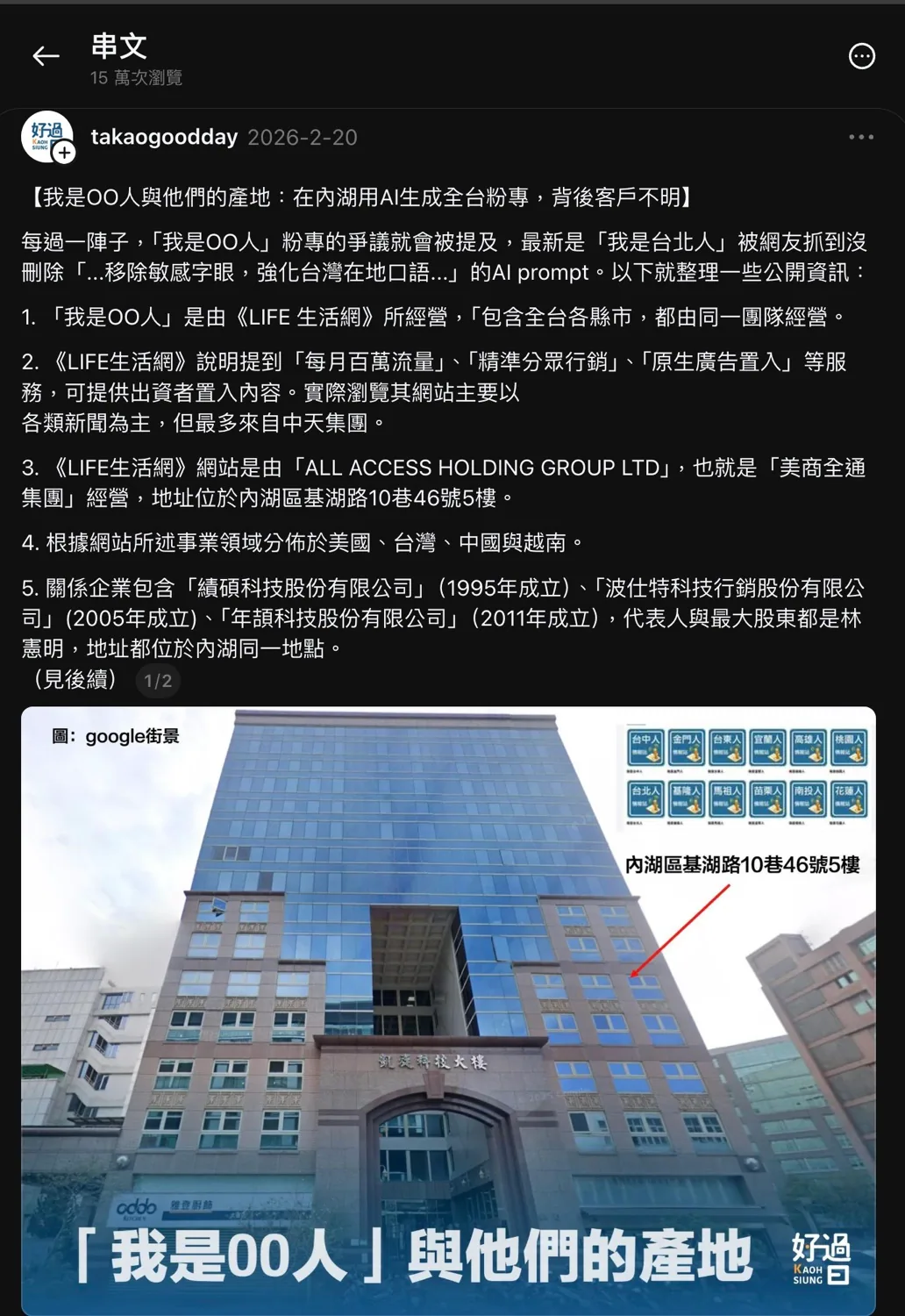
A February 2026 summary by "Kaohsiung Good Days": Listing the organizational structure of LIFE Web, noting that much content originates from CTi News, highlighting the lingering AI prompt "Remove sensitive terms, enhance Taiwan local dialect," and marking the office location in Neihu.
📝 Curator's Note
Pay attention to what this instruction implies. "Remove sensitive terms" suggests that the original drafts contained words that should not be seen by Taiwanese readers. "Enhance Taiwan local dialect" means the final product must pretend to be written by a local. In other words, this isn't just a content moderator polishing a draft; it is a production line performing two tasks: stripping away origin labels and slapping on "local" stickers. Usually, this entire process is hidden behind the finished product; this time, the manufacturing process leaked its own secrets.
The Backend at Neihu Jihu Road Lane 10
Following the clues from "Kaohsiung Good Days" to corporate registrations, these local fan pages converge on a single address: 5F, No. 46, Lane 10, Jihu Rd., Neihu District, Taipei City 1.
Operating under the names "LIFE Web" (life.tw) and "All Access Holding Group," the business is a content operation. However, peeling back the corporate registrations reveals that while it presents one face to the public, it is backed by a web of companies. Jishuo Technology Co., Ltd. (Unified Business No. 89977832), established in 1995, is led by Lin Hien-ming; Better Tech Marketing Co., Ltd., established in 2005, is managed by Lin Hsiu-chih; and Nianjie Technology Co., Ltd., established in 2011, is managed by Hsu Yun-ting 3. While the three entities have different managers, they are linked through a cross-shareholding structure involving four individuals—Lin Hien-ming, Chang Yu-chia, Lin Hsiu-chih, and Lin Chao-feng—who appear on each other's boards of directors. Combined with the shared address, it forms a family network.
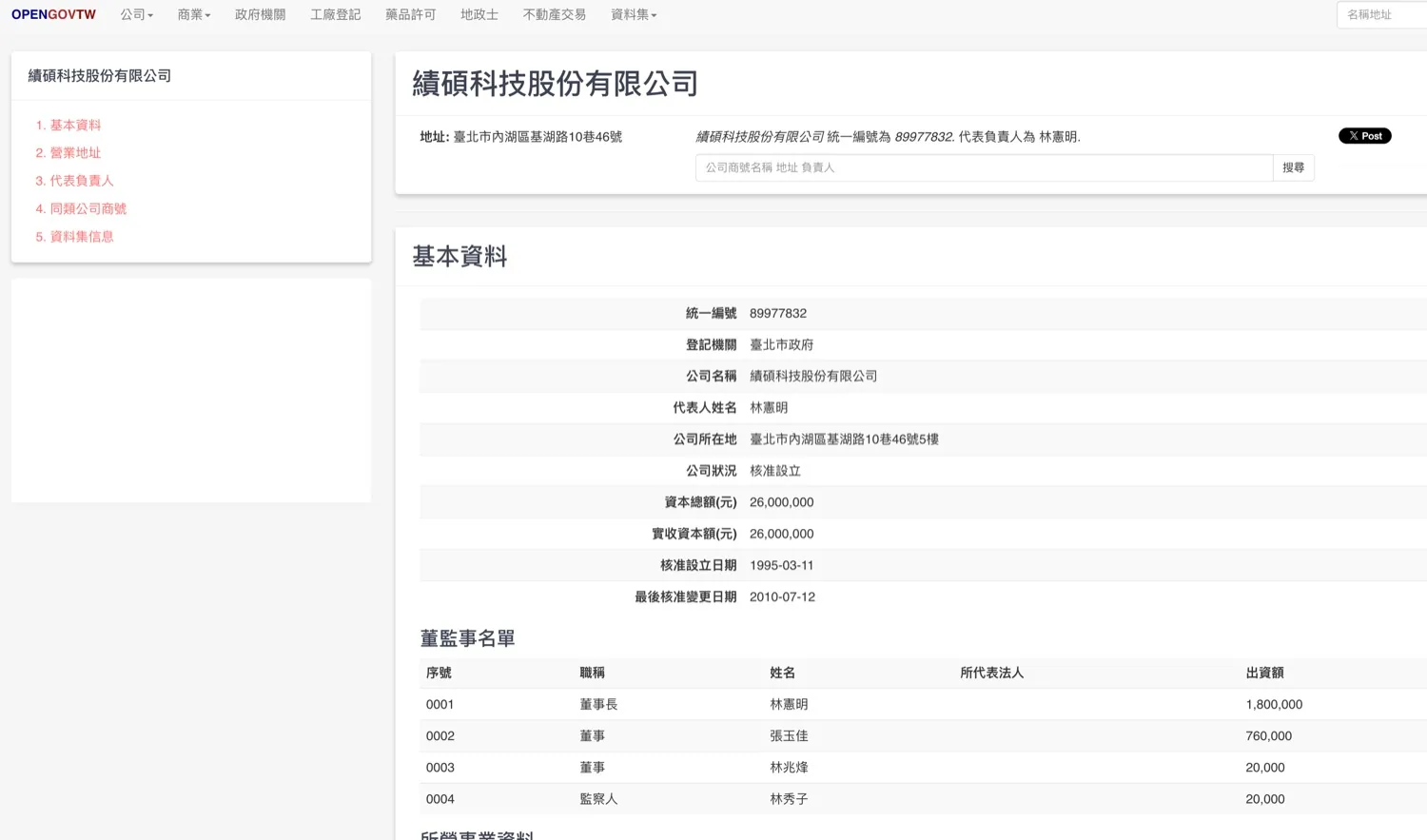
Business registration for Jishuo Technology (No. 89977832): The representative is Lin Hien-ming; the registered address is 5F, No. 46, Lane 10, Jihu Rd., Neihu; and the board members include four members of the Lin family.
The capabilities of this network are more noteworthy than its discretion. Better Tech operates under the brand POLLSTER, a platform specialized in public opinion polling 4. This means the group is "producing public opinion data." Their recruitment page claims they are the "only unit in the country simultaneously operating social media, professional market research, news portals, blog networks, SEO optimization, and Facebook marketing" 1, while their other hand holds nearly a hundred fan groups as "distribution channels." The recruitment text for Nienjie Technology is even more direct: "Use AI text, AI images, and AI video tools to produce interesting content, assisting over 100 fan pages in content creation and material production" 1. Producing data, mass-producing content, and bulk distribution—all three tasks are handled by the same group at the same address.
As for the "All Access Holding Group" brand, no company named "All Access" is registered in Taiwan; the "ALL ACCESS HOLDING GROUP LTD." listed on the website footer cannot be found as a corresponding entity in any U.S. state records 1. The "American" branding is more like a sticker on the front door—essentially the same thing as the "local" labels used by the various city fan pages.
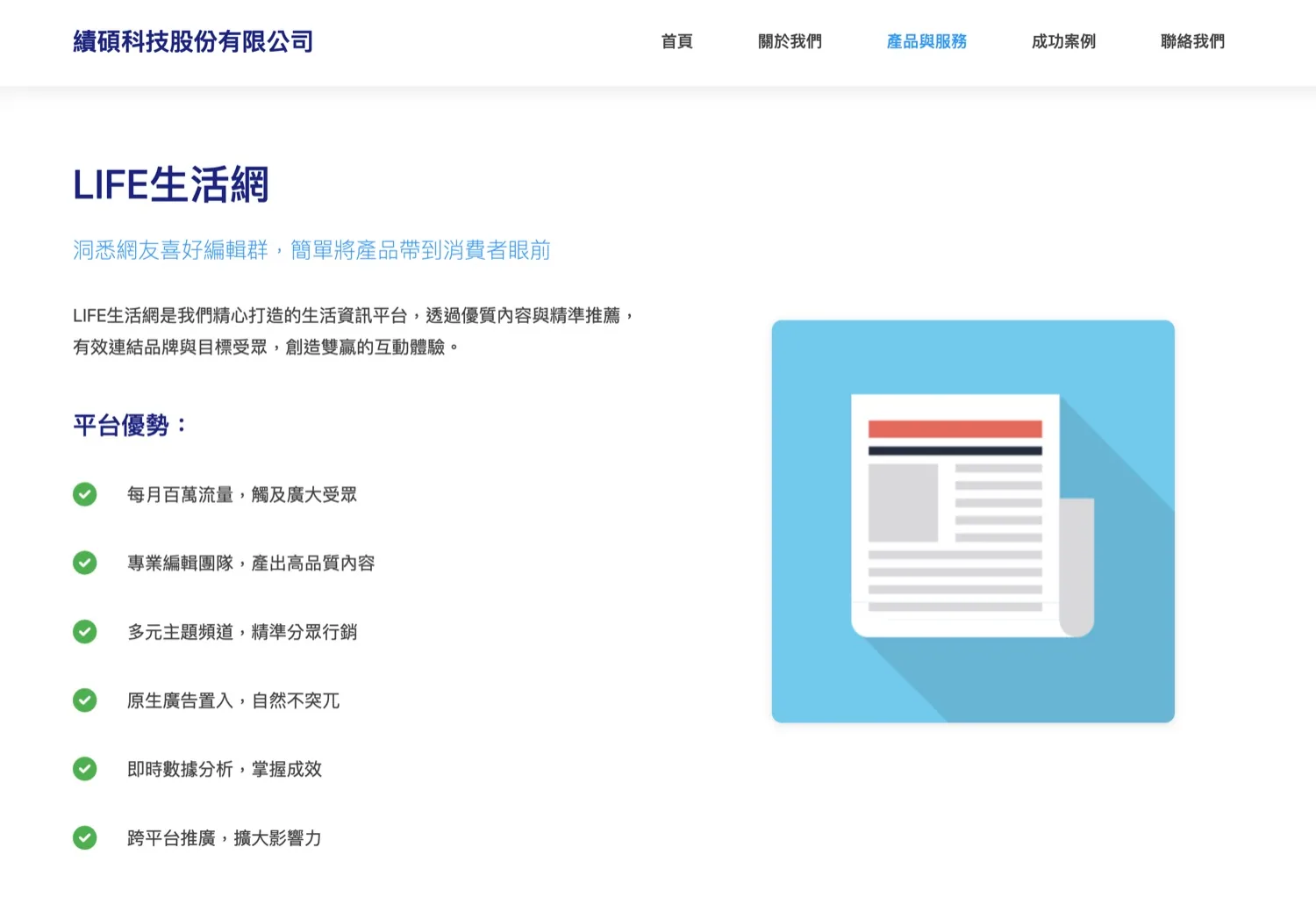
The service page for LIFE Web under Jishuo Technology lists platform advantages like "millions of monthly views" and "precise segmented marketing"—meaning it can insert content for sponsors into your feed.
✦ One hand produces polling data to manufacture public opinion; the other uses AI to mass-produce content; a third hand distributes that content across nearly a hundred fan pages masquerading as locals.
CTi News Content in Local Tones
When you click on a "news" item shared by "I am a person from Kaohsiung," you might think you are reading local media. In reality, much of this content originates from the CTi Group and CTWANT 1.
CTWANT's publishing entity is Wang-Dao Wang Tai Media Co., Ltd., which belongs to the same Wang-Chung Media Group as CTi News 5. The political leanings of this group are no secret. Between 2014 and 2020, CTi News was found by the NCC to have violated regulations 25 times, with fines exceeding NT$11.53 million; in November 2020, all seven NCC commissioners voted not to renew its license, leading to its shutdown in December and its transition to YouTube and online platforms 6. Earlier, a 2019 report by The Financial Times cited a reporter from the Wang-Chung group stating that the PRC's Taiwan Affairs Office had called to provide instructions for coverage, requesting support for specific candidates 5.
📝 Curator's Note
There is a clever time gap here. When CTi was a television station, it was regulated by the NCC; violations led to fines and eventually the loss of its license. However, when its content was rewritten by LIFE using AI into "local-style posts" and shared on "I am a person from Kaohsiung," readers saw locals, not CTi News—the source was scrubbed away. Since CTi moved online in 2020, it has been outside the jurisdiction of the NCC. A piece of content that was once under regulatory oversight passed through an AI processing stage and ended up on a fan page where no government agency can regulate it. Every step of this path moves it further from being "accountable."

Between 2014 and 2020, CTi News was fined over NT$11.53 million by the NCC; after its license was not renewed in 2020, it moved to online platforms and exited the oversight of the primary regulator. This is the office of the NCC.
Why use AI instead of manual copy-pasting? Scholar Wang Hung-en provided a key criterion. When researching similar tactics, he noted that deliberately "using AI to rewrite articles" is a method for "purposely using AI to evade investigation and detection" 7. Because identical content copied repeatedly would be flagged by platforms as duplicate content or have its reach reduced, AI rewriting ensures every post looks different, smoothing over the "fingerprints" of its origin. In this context, AI is an anti-detection weapon: it automates and scales the process of "scrubbing origins," even saving the cost of manual transcription.
Before Exposure, After Exposure
"Every now and then, controversies regarding 'I am a person from [City]' fan pages are mentioned," was the opening line of the report by "Kaohsiung Good Days" 2. This wasn't just rhetoric.
In late December 2025, the military-focused fan page "New · 27th Unit" already called out "I am a person from Taipei" and "I am a person from Kaohsiung," stating their "content is almost entirely based on current events, written by AI, with AI-generated images" and that "all openings and formats are nearly identical," suspecting "organized action for upcoming election maneuvers" 8. This was about two months before the systematic investigation in February 2026—it just hadn't been linked to the company in Neihung yet.
After it was exposed in February, the production line did not stop. In March 2026, the same series of fan pages posted AI-generated fake images claiming that Taiwan fans at Tokyo Dome were surrounded by "trash like bento boxes, cups, and plastic bags" and that "women's restrooms were a mess," which was later exposed to come from the same source 1. The fact that a production line already flagged by national media continued to operate normally within a month of exposure suggests one thing: there is no mechanism currently in place to make it stop.
A Different "She" in the Same Ecosystem
In June 2026, another wave of seemingly different content appeared on Taiwanese social media: a large number of marriage-seeking accounts with the bio "I am in Taiwan, only marrying Taiwanese people."
A civic account using AI tools for data analysis, ctchart.lab, compiled a set of figures: 252 accounts and 458 posts, with 99.6% concentrated within three days from June 2 to June 4; at 10:37:53 AM on June 4, nine accounts posted in the exact same second, with 90 instances of such "simultaneous posting" occurring in three days; 32 sets of bios were identical word-for-word; and the "factory specs" of the accounts were highly consistent: 100% single females, 98% without children, ages concentrated between 30 and 49, 99.6% with a BMI under 20.5, and 90 of them being exactly 165 cm tall 9.
The most critical column was the location. Out of 252 accounts, only 25 had "account location" listed: 21 from China, 3 from Pakistan, and 1 from the United States—zero from Taiwan. The remaining 227 were all hidden 9.
📝 Curator's Note
Seeing the combination of "China IP + pretending to be Taiwanese + only marrying Taiwanese" might trigger an immediate "cognitive warfare" response. However, the evidence points toward a different conclusion. What these accounts are actually doing is leading people to add them on LINE for "sincere friendship," moving targets off-platform—a hallmark of "pig butchering" (Sha Zhu Pan) scams. Political influence operations want to keep people on the platform to manipulate comments and generate volume; they do not want to move people to external apps like LINE. Furthermore, Pakistan is not a typical distribution point for political troll farms, but it is a known hub for transnational scam centers: in 2026, Pakistani police raided a scam center in Faisalabad and arrested 149 people, 48 of whom were Chinese nationals 10. The same shell can house different types of actors.It should be clarified: the data for these 252 accounts was only compiled by one civic user using AI; it has not been verified by a third party. It is a lead worth following, not a definitive conclusion.
The reason for including the marriage-seeking case in this article is not that they are run by the same people—they are likely two different operations. It is included because they share the same "shell" logic: an appealing, harmless identity with a "local" tag followed by an invisible backend. The only difference is what the backend wants to take from you. Calling out Chinese IPs as cognitive warfare versus believing a local tone as a local person are both forms of the same intellectual shortcut.
"Coordinated Behavior" $\neq$ "Cognitive Warfare"
The most accurate academic term for "I am a person from [City]" is "coordinated behavior."
The Institute of Research on Taiwan's Information Environment (IORG) defines it as: "the act of repeatedly publishing the same or highly similar content, or links to the same content, across news media, social media, and instant messaging platforms in a short period" 11. Note the restraint in this definition: it describes only the "behavior," without assuming foreign influence or malicious intent. The fact that nearly a hundred fan pages with identical formats shared the same content fits the characteristics of "coordinated behavior," but "coordinated behavior" itself is a neutral descriptor.
📝 Curator's Note
The terms most easily misused in Taiwan these past few years are "cognitive warfare" and "troll farms." IORG researcher Wang Xi once gave a stern warning: "The defining element of a 'troll farm' is the presence of a 'monetary exchange'." If we label any discourse we dislike as a "troll farm"... it is dangerous for Taiwan's public discussion, because "simply accusing someone of cognitive warfare is exactly what information manipulators want." The more you haphazardly apply labels, the easier it is for real troll farms to hide 12. Using these terms loosely provides the enemy with a larger camouflage.
Even those with no reason to defend this tactic refuse to offer simple attributions. In his 2021 TSSCI paper on Chinese cognitive warfare, Shen Boyang used a "diamond model" to plot the actors of information manipulation. In the "economic motive" quadrant, he categorized "commercial content farms, general YouTubers/streamers, and fan page managers." Only in the "political motive" quadrant did he place the National Security Council, the PLA, the Taiwan Affairs Office, the Central Propaganda Department, and the Cyberspace Administration 13. He wrote clearly: "The actors of manipulating public perception are not limited to foreign forces" 13. Motivation is a continuous spectrum from commercial to political, with various "desperate" roles in between.
Even Meta agrees. In its 2020 official statement, it noted that when dealing with "coordinated inauthentic behavior," the platform looks at "behavior, not content, regardless of who is behind it or whether it is domestic or foreign," and acknowledged that coordination and authenticity are two different scales, not a binary switch 14. From Taiwanese researchers to the world's largest social media platform, the advice is the same: see clearly before defining.
Not Being "Fake News" Doesn't Mean It's Not a Problem
If you use the yardstick of "fact-checking" on "I am a person from [City]," you will reach an awkward conclusion: it barely registers.
This is because most of what they share is true news. The content reported by CTi and CTWANT isn't necessarily false, and after being rewritten by AI, the facts often hold up to scrutiny. National Taiwan University's Huang Jun-ju distinguished between two terms often confused: disinformation is "bad information," intentionally designed to cause harm; misinformation is "wrong information," an unintentional error. The main difference lies in intent 15. By this standard, "I am a person from [City]" likely fits neither category because it doesn't rely on "false content" to function.
Its problem lies elsewhere. IORG categorizes information manipulation into three types; besides "fact manipulation," there is also "source manipulation": where the source is hidden or disguised 11. This is exactly what "I am a person from [City]" does: it washes away the pro-China origin and replaces it with a local identity. The content is true, but your judgment of "who this is" and "why they are showing it to you" has been tampered with. IORG also offers a colder metaphor: even if no one sees a single post, these contents are "accumulating a local keyword inventory," serving as "fertilizer for future fake news" 11.
In all reports, one phrase is consistently retained: "Based on currently available information, it is not possible to determine the source of the clients or funding for this series of companies" 1. This sentence is the safety valve for this entire article. There is no evidence that Lin Hien-ming is Chinese-funded or a proxy for the CCP; all investigations have resulted in "cannot be found," not "was found." The existing evidence only supports a low-profile local marketing group in Neihung, a secondary distribution channel for pro-China media, an AI-driven localization process, and a source of funding that cannot be traced. It claims to be able to "insert specific content" for sponsors 2, but no one can find out who those sponsors are.
A Clerk Who Forgot the Prompt, and a National-Scale Content Farm
To understand the position of "I am a person from [City]," it is best to compare it with an actual state-level operation.
In February 2026, Wang Hung-en revealed another case. A content farm called "No Boundaries Media" had its website hosted in Qinhuangdao, Hebei, and was "in direct contact with the Propaganda Department and Cyberspace Administration." Its remaining AI prompt read: "Targeting Taiwanese users, use Traditional Chinese, rewrite this article, keep it under 500 words, retain the beginning of the original text, do not change the historical truth of the original." The instructions for "targeting Taiwanese users" and "not changing historical truth" were part of a top-down production line with specific political goals 7.
Comparing this instruction to the "remove sensitive terms, enhance Taiwan local dialect" prompt from "I am a person from [City]" makes the difference clear. Wang Hung-en clearly separated the two, specifically noting that some cases are not just "a local clerk who forgot to delete the prompt" 7. In other words, some cases simply are. One is a local business in Neihung seeking traffic; the other is a state-level operation linked to the Cyberspace Administration. One's prompt handles "local tone," while the other's handles "historical truth." They can be compared on the same gray spectrum of manipulation, but they must not be conflated.
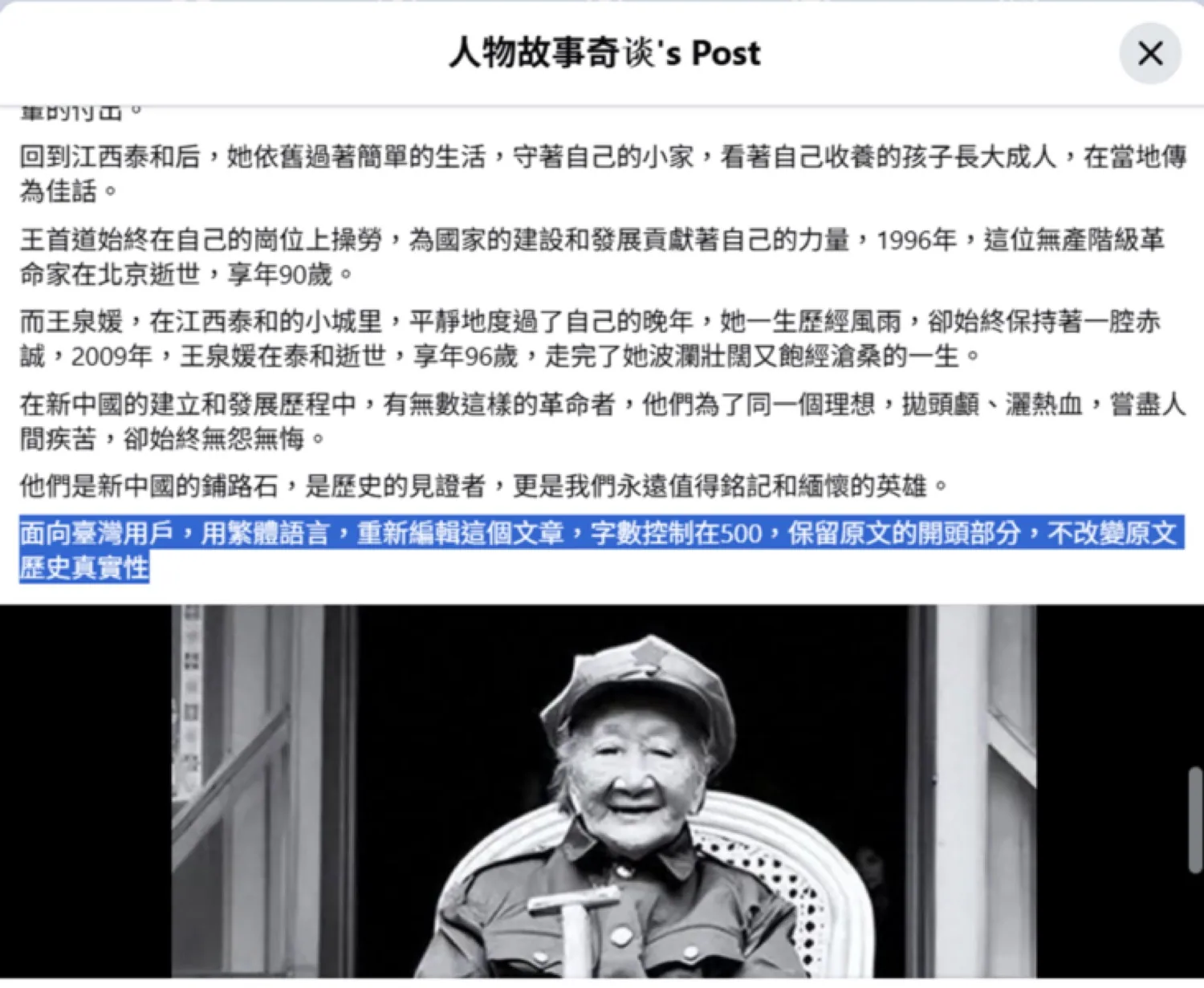
Comparison: The AI prompt from the Qinhuangdao "No Boundaries Group" revealed by Wang Hung-en—requiring it to be "targeted at Taiwanese users" and "not changing historical truth"—is fundamentally different from the local profit-seeking prompt of "I am a person from [City]." (Source: Thought Tank / Wang Hung-en)
Do not draw connections too quickly; that is one of the most important lessons of recent years. During the 2022 pandemic, when celebrity Guo Yen-chun shared "many children just left like this," IORG found at least 25 fan pages posting the exact same message within 10 seconds, with the first comment on all of them linking to the same content farm 16. That was a textbook case of coordinated action. Even then, fact-checkers from Feng Media reminded us that mainstream media reports often preceded the surge of these fan pages; "multiple fans posting simultaneously" does not always equal an information war 17. Furthermore, those specific fan pages (like Love Experience and BuzzHand) were never linked to "I am a person from [City]" in any public data. While "Kaohsiung Good Days" reported similar content during the pandemic, they did not provide screenshots or direct links. Looking similar does not mean it is the same group of people.
It is worth noting that this issue of "fake local identities" has a more overtly political version in Taiwan. The Taiwan Democracy Lab recorded instances during the 2024 election where an offshore group used hundreds of fake accounts to run lifestyle pages (photography, cooking, art). These pages were categorized as lifestyle content, but their posts only concerned Taiwanese politics and elections, while "all administrator locations were overseas" 18. That was "offshore fake accounts masquerading as local." The disguise of "I am a person from [City]" is one layer deeper: it is "local authentic entity + local media content + AI-enhanced local dialect." Using regional identity like "I am a person from Kaohsiung" as a front is much harder to dismantle than a fake cooking fan page.
Everything is Legal, and That is the Problem
The most unsettling thing about "I am a person from [City]" is that almost every component of it is legal.
Registering a company: legal. Reposting news: legal. Using AI to generate images/text: legal. Accepting commissions for "native" ad placements: as long as the interest relationship is disclosed, it falls outside the scope of FTC regulations on sponsored advertisements 19. When these legal parts are assembled, they create a machine that masquerades as a local, has an unknown source, and can be filled by sponsors—yet you cannot find a single screw that is illegal.
In the past, such situations were described as "regulatory vacuums." In 2026, this term needs refinement to avoid being caught out by legal experts. The vacuum has been partially filled. The Fraud Prevention Act (commonly known as the Anti-Scam Law), passed in 2024, requires online advertising platforms to disclose information about "commissioned publishers/sponsors" and label whether AI was used 20. It also requires platforms to take down fraudulent ads within a timeframe or face joint liability. The Ministry of Digital Affairs has already fined Meta three times under this law, totaling NT$18.5 million 20. This "fraudulent advertisement" gap has been filled by legislation with teeth.
The problem is that this law only binds "paid advertisements." It can regulate a paid scam ad, but it cannot reach an "I am a person from Kaohsiung" page that is operated for free and masquerades as a local, because that is considered "content," not "advertising." The broader legislation that would govern "platform accountability and operator disclosure"—the Digital Intermediary Services Act—was shelved in 2022 due to concerns over "internet censorship" 21 and remains unrevived in 2026.

The Digital Intermediary Services Act, which would govern "platform accountability and operator disclosure," was shelved in 2022 due to controversy; the Anti-Scam Law only covers "paid advertisements" and cannot reach free-to-operate local fan pages. This is a photo of the Legislative Yuan.
📝 Curator's Note
Therefore, the regulatory vacuum has not disappeared; it has shrunk—from "comprehensive" to "non-paid political and emotional manipulation fan pages." A page that masquerades as a Taiwanese person, does not disclose its operator, and doesn't charge you but only wants to influence you, falls exactly into this narrowed gap: it isn't an ad, so the Anti-Scam Law can't reach it; the law that could govern it is sitting in a place no one dares touch. Reporter Liu Chih-hsin used the term "recruited mercenaries" 22 to describe how this ecosystem turns "citizens in a society" into "mercenaries for hidden masters." The recruited may not know they are recruited, and you, by liking and sharing, may not know who you are working for.
So, Do You Still Know Who You Are Reading?
Returning to that "I am a person from Taipei" post and the forgotten instruction: "Remove sensitive terms, enhance Taiwan local dialect."
What this phrase truly leaked was not that one article was fake, but that an entire methodology of manufacturing "identity" has been exposed: first strip away the origin, then paste on the local identity. Once AI makes this process nearly zero-cost and capable of automatically evading detection, determining the truth of a piece of news is no longer the hardest part; much of what they share is true. The hardest thing is identifying its origin and funding: who wrote it, why are they showing it to you, and did someone pay for it?
What protects you is not a specific stance—is it CCP? Is it cognitive warfare?—because even those in Taiwan best at spotting cognitive warfare are urging people not to rush into labeling. What protects you is the ability to trace: ask one more question about "who this is, where it originated, and who paid for it."
That forgotten instruction was caught once. Next time, it won't be forgotten.
Further Reading
- Cognitive Warfare — The framework of cognitive warfare, its boundaries, and the principle of "complexity over accuracy"
- Poisonous Potato Cognitive Warfare — How a narrative war "hits the true ground" and another example of rejecting binary models
- Taiwan AI Lab — Local technology using AI to detect coordinated cognitive operations
- Taiwan Media and Freedom of Press — The broader context of Wang-Chung's controversies and media group structures
References
Image Sources
Most images in this article are screenshots of public pages and are used under Section 52 of the Copyright Act for reportage and commentary:
- First image/side-by-side fan pages: Screenshots of Facebook pages "@Kaohsiung.Info" and "@Taipei.Info".
- Breakdown summary: Screenshot from Threads post by "Kaohsiung Good Days" (@takaogoodday).
- Jishuo Technology registration: opengovtw, data sourced from the Ministry of Economic Affairs.
- LIFE Web service page: aams.tw (Jishuo Technology).
- Qinhuangdao content farm AI instructions: Screenshot from Thought Tank / Wang Hung-en.
- NCC Yangping South Road office: Photo by Solomon203, CC BY-SA 3.0 (Wikimedia Commons).
- Legislative Yuan Chamber: Photo by Lin Kao-chih, CC BY-SA 4.0 (Wikimedia Commons).
- Marriage-seeking account screenshots involve potentially stolen real photos; this article does not republish them for privacy reasons and only presents data and text descriptions.
- Forget to delete AI instructions! "I am a person from [City]" fan pages exposed for unclear funding and content from pro-China media — Newtalk 2026-02-21 main report, including operators, AI instructions, content sources, unknown funding, Nienjie's "assisting over 100 fan pages" recruitment text, and the Tokyo Dome fake images.↩
- Accused of cognitive warfare? "I am a person from [City]" fan pages exposed; claims to allow for specific content placement — Liberty Times 2026-02-21, reporting on Kaohsiung Good Days' findings, including "available for sponsor placement" and the "every now and then" opening line.↩
- Jishuo Technology Co., Ltd. Business Registration — Business registration, No. 89977832, including overlapping directors for Better Tech (Lin Hsiu-chih) and Nienjie (Xu Yun-ting).↩
- About Better Technology POLLSTER — Official site of the polling brand under All Access Media Group.↩
- Unstoppable Content Farms—Revealing the Masterminds and Chinese Factors behind "Secret Reports" — Report including Wang-Chung's background and the 2019 Financial Times report on instructions from the Taiwan Affairs Office.↩
- NCC fined CTi News over NT$10 million in six years — WatchOut summary of CTi's violations and license loss.↩
- Evidence found of Chinese content farms using AI to target Taiwanese people for patriotic promotion — Thought Tank / Wang Hung-en, full text of Qinhuangdao "No Boundaries Group" instructions and the criteria for "purposely using AI to evade detection."↩
- “I am a person from [City]” fan pages suspected to be prepared for election opinion operations — Epoch Times 2025-12-28, reporting on the "New · 27th Unit" findings.↩
- Analysis of marriage-seeking accounts: "In Taiwan, only marrying Taiwanese" — ctchart.lab analysis of 252 accounts and 458 posts via AI.↩
- Pakistan arrests 149, including 48 Chinese nationals, in Faisalabad scam center raid — SCMP 2026, confirming Pakistan as a hub for cross-border scams.↩
- IORG reveals information manipulation tactics: Content farm posts are "fertilizer" for future fake news — INSIDE reporting IORG's definitions of "coordinated behavior," "source manipulation," and the "fertilizer" metaphor.↩
- Interview with IORG: Don't let "troll farm" become a label thrown around freely — WatchOut, Wang's discussion on "monetary exchange as the basis for troll farms" and how "random labeling helps real trolls hide."↩
- Preliminary Study of China's Cognitive Domain Warfare: Case Study of 2020 Taiwan Elections (Shen Boyang, Progress Foundation Quarterly Vol. 22 No. 1, 2021, pp. 1-65) — TSSCI thesis using the "diamond model" to separate economic and political motives.↩
- Removing Coordinated Inauthentic Behavior — Meta official stance on CIB being about behavior, not content.↩
- Combating Fake News, Defining Truth: Disinformation vs. Misinformation — Huang Jun-ju's distinction based on intent.↩
- Civil groups expose "many children left" fake news operation; at least 25 fan pages posted identical content — Liberty Times 2022, IORG's investigation into another cluster of content farm fans.↩
- Is "many children left" really information warfare? Timeline of posts revealed — Storm Media fact-check on the timing of coordinated posts.↩
- Imported goods masquerading as local public opinion: Analysis of offshore fan pages intervening in Taiwan elections — Taiwan Democracy Lab analysis of 2024 election tactics.↩
- FTC guidelines for sponsored advertisements — Requirements for disclosing interests in native ads.↩
- Ministry of Digital Affairs fines Meta under Fraud Prevention Act — Ministry of Digital Affairs enforcement on ad disclosure and removal.↩
- Digital Intermediary Services Act controversy — Wikipedia, history of the 2022 bill being shelved due to censorship concerns.↩
- Before Democracy Collapses: Looking at the "Recruited Mercenaries" framework in the purchase of fan pages — Liu Chih-hsin's commentary on the mercenary model.↩