
30-Second Overview: In 1982, while Taiwan was still under Martial Law, Li Yuan-chen, Tsao Ai-lan, Cheng Chih-hui, and others founded Awakening (Fù-nǚ Xīn-zhī) monthly. Rather than reducing feminism to slogans, they began with the female body in advertisements, workplace sexual harassment, the childcare dilemmas of housewives, and legal columns, transforming "what happens in my home" into a discussable public issue. After reorganizing into a foundation in 1987, this path originating from print expanded to the streets, the Legislative Yuan, and schools; yet it also exposed internal feminist divisions regarding class, sex work, and reform strategies during the 1997 public prostitution incident.
Starting with a Magazine That Didn't Look Like a Political Publication
In 1982, Li Yuan-chen, Tsao Ai-lan, Cheng Chih-hui, Liu Yu-hsiu, and Yu Mei-nv founded the "Awakening Magazine Society," publishing Awakening monthly. The National Taiwan Museum of History positions it as Taiwan's first magazine consciously promoting gender equality from a feminist perspective. The foundation's own history notes that the organization was first established as a magazine society during the Martial Law era, only reorganizing into a foundation after the lifting of Martial Law in 1987. 1 2
This timing is crucial. Following the 1979 Kaohsiung Formosa Incident, the political atmosphere remained tense. Publicly organizing opposition movements was difficult, while women's issues were often packaged as "family" or "personal" matters, excluding them from politics. Awakening's strategy was not to pretend it wasn't discussing politics, but rather to first discuss the daily realities hardest to deny: how newspapers wrote about women, how advertisements commodified the female body, what female workers encountered in the workplace, and why housewives lacked childcare support. 1
📝 Curator's Note: Its earliest breakthrough was not taking women out of the home, but making people see that the home has always been connected to law, labor, and the state.
Awakening was not a one-way publication for editorials. It established a legal column and reader submissions, allowing readers to bring their own experiences into the magazine, which editors then organized into discussable issues. The magazine extended print discussions through lectures, symposia, and reading groups. It also conducted surveys on sexual harassment, submitted opinions on the legalization of abortion to the Legislative Yuan, and sent open letters to entrepreneurs. The significance of these activities was not merely "promoting ideas," but turning individually unnamable experiences into material that could be recorded and formed into demands. 1
Deconstructing "Gender Equality" from Abstract Slogans into Life Problems
Early Awakening faced two misunderstandings. One held that since the Constitution already stipulated legal equality between men and women, women did not need to fight for anything further. The other imagined women's rights struggle as wives competing with husbands for dominance in the family. Data compiled by the National Taiwan Museum of History indicates that Awakening's influence in its first five years was limited, and it was even criticized as the complaints of middle-class women. These reactions, however, illustrate that between legal "equality" and equality in life lies an entire set of unspoken divisions of labor. 2
Therefore, Awakening deconstructed abstract gender inequality into scenes recognizable to readers: Can a female worker refuse workplace sexual harassment? Why is the care work of housewives viewed as unproductive? Can unmarried women discuss abortion? Does school curriculum send boys and girls down different life paths? A master's thesis studying Awakening magazine also views it as a slice of women's rights development in Taiwan during the 1980s and 1990s, noting that the magazine served simultaneously as a medium for female consciousness, social movements, and legal reform. 3
This is a pragmatic feminism. It does not first demand that every reader accept the same theory, but rather lets readers discover: "It turns out I am not the only one encountering this." When an individual's shame becomes an experience a group can discuss, issues can leave the private room and enter organizations and institutions.
After Lifting Martial Law, Print Grew Streets
On January 10, 1987, Awakening, in cooperation with the Rainbow Project, Taiwan Human Rights Association, and indigenous groups, launched a protest march in Huaxi Street against human trafficking and for the care of child prostitutes. After the lifting of Martial Law that same year, the magazine society reorganized into the Awakening Foundation in November. On January 10 of the following year, Awakening, Rainbow, and the Women's Aid Association co-hosted another rescue march for child prostitutes. This marked the turning point from "practicing women's movement through the name of a magazine" to the public streets, forcing media to positively address issues raised by women's groups. 2
Reorganization was not merely changing an organizational name. Official records state that starting in 1994, Awakening trained women's legal consultation volunteers, providing telephone consultations for marriage and family law, serving over two thousand person-times annually. It gradually moved from publishing and education into bill advocacy, policy supervision, and public services. 4
English researcher Elizabeth Frost compares Awakening with the Housewives Alliance: the former tends to adopt policy advocacy and cross-party lobbying, while the latter leans more towards driving environmental action from the community and family life. This comparison reminds us that the women's movement does not have only one "correct" mass model. Institutional lobbying and daily mobilization are two different but mutually supportive political technologies. 5
After the lifting of Martial Law, Awakening's issues did not stop at heterosexual marriage and motherhood. The National Taiwan Museum of History records that the magazine subsequently addressed lesbian women's movement issues, sexual autonomy, and the decriminalization of sex work. The foundation's current issues include partner rights, marriage equality, bodily autonomy, and sex work. These issues need not be pieced into a single unbroken straight line, but they show that the boundaries of "gender equality" are continuously being re-questioned. 1 4
Images from the 2005 Taiwan Pride Parade preserve a concrete slice of the Awakening Foundation appearing in public space. The photo cannot prove that a specific law was achieved solely by one group, nor can it be retroactively deduced as the scene of the magazine's founding in 1982. What it proves is that after entering the twenty-first century, Awakening still brought gender and sexual orientation issues to the streets, making the organizational logo and demands visible together. 6
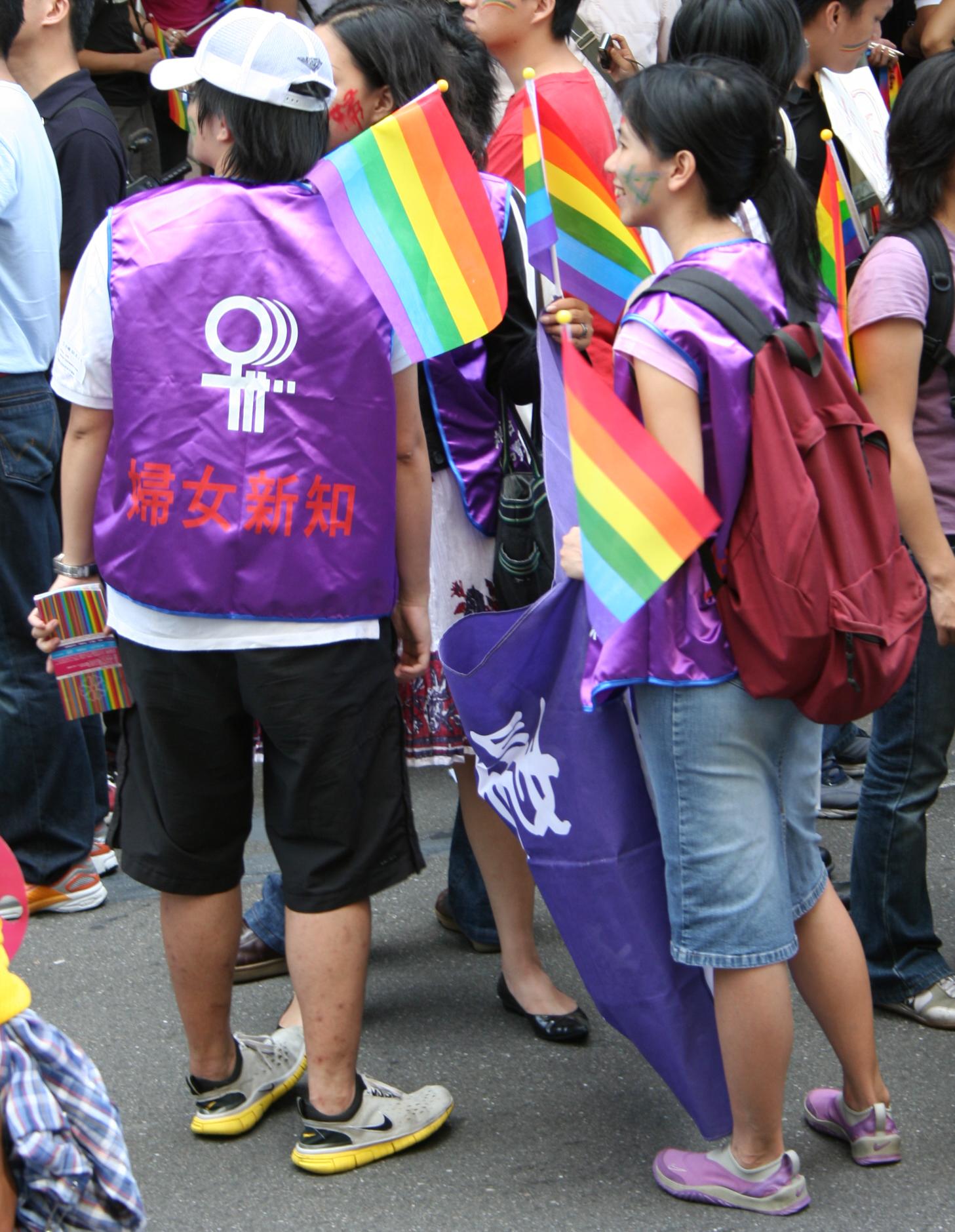
Image: Awakening Foundation Logo at the 2005 Taiwan Pride Parade; Photo: Atinncnu; October 15, 2005; Wikimedia Commons; Public Domain. Image embedded using hotlink only; not downloaded or rehosted. 6
📝 Curator's Note: A march does not automatically become law. But without first organizing people's experiences, it is difficult for law to know whom it should protect.
The Domestic Violence Prevention Act: When Law First Entered the Home
The 1993 Deng Ru-wen murder case brought domestic violence, long treated as a "household matter," into national public discussion. The National Taiwan Museum of History notes that Deng Ru-wen suffered violence and sexual assault since her youth, and continued to suffer abuse long-term after marriage with her children and family. The case also exposed the institutional dilemma of police unwilling to intervene in "household matters." The Domestic Violence Prevention Act, passed on June 24, 1998, brought public power and resources from medical, legal, child counseling, and employment counseling fields into the family through mechanisms such as protection orders, relocation orders, and restraining orders. 7
This law is often remembered as the "First Domestic Violence Law in Asia." But the museum's article deliberately reminds us that this first place is not just an honor; it also signifies that victims of violence were long left without protection. The law brought domestic violence from the private sphere into the public sphere, yet it cannot solve problems of economic dependence, care responsibilities, child safety, and gender power dynamics solely through one law. This is where Awakening is important: it promotes systems, but does not treat systems as the end of the story. 7
Gender Equality Education: From Textbook Checks to Legal Basis
Another path of Awakening was bringing gender equality into schools. The 1988 National Civil Education Conference already began examining gender discrimination in elementary and junior high school textbooks. In 1995, Awakening submitted a proposal to the Executive Yuan's Education Reform Review Committee, requesting research on how to implement gender equality education. These efforts illustrate that education is not an accessory of "propaganda," but a system that determines how the next generation understands bodies, work, family, and power. 8
In May 2004, the Awakening Foundation, along with groups for gender equality education, women's rights, women's organizations, and LGBTQ+ groups, jointly established a Civil Promotion Alliance, launching lobbying efforts. On June 4 of the same year, the Gender Equality Education Act was passed in its third reading by the Legislative Yuan and promulgated on June 23. The first article of the Ministry of Education's current regulations defines the law's purpose as promoting substantive equality of gender status, eliminating gender discrimination, maintaining human dignity, and establishing educational resources and environments for gender equality. 8 9
Here lies an easily overlooked transformation: Awakening did not only demand schools "not discriminate," but demanded schools establish resources, curricula, complaint, and investigation mechanisms. In other words, gender equality is no longer just a teacher's personal attitude, but work that the education system must be responsible for.
From Statutes to Daily Life, There Is Still a Long Way
Writing law into the national system does not mean problems disappear immediately.
The text of the Gender Equality Education Act must be translated into school curricula, complaint procedures, and teacher training to take effect on students.
The Ministry of Education's regulatory text defines "gender equality education" as respecting different gender differences, eliminating gender discrimination, and promoting substantive equality; thus these words are not just propaganda slogans, but public responsibilities schools must handle. 9
Awakening's early legal columns dealt precisely with the distance between statutes and life.
Readers may not know how the Civil Code (Kinship Part) is written, but she knows she has no decision-making power in her marriage; she may not be familiar with labor law, but she knows she is asked about marriage and childbearing plans during interviews.
Writing these experiences down is equivalent to leaving evidence of private encounters that can be understood by others.
Reader submissions also make the magazine not just a podium for a few scholars, but a place where experiences meet each other.
When women in different cities discover they encounter similar problems, the problems are no longer just accidents of a certain family.
They begin to have names, and objects to whom governments and employers can be demanded to answer.
This act of naming later made it possible for bills, policies, and public budgets to catch up.
The same gap exists in the Domestic Violence Prevention Act. Protection orders can restrict abusers from approaching, but cannot find housing, income, childcare, and safe interpersonal networks for victims. The museum's historical materials list medical, legal, child counseling, and employment counseling side by side precisely because domestic violence is never a single criminal case, but a chain of difficulties after life is tied up. 7
The Awakening Foundation later institutionalized legal consultation volunteers, partly to address this gap: statutes need to be translated into the next step a person can take today. For readers, the consultation telephone is not an appendix of administrative services, but the entry point that allows law to truly reach life. 4
This also explains why the publication remains important. The day a bill is passed has news, but how readers understand the new law, how they know if they can file a complaint, and how they articulate individual cases, usually requires slower text and repeated education. The historical database preserves magazines, quarterly journals, reviews, and activity records, preserving precisely this work that does not appear in bill titles. 10
The Cost of Institutionalization: Who Is Represented, Who Is Left Behind
Entering the system brings results, but also new problems. Starting in 1996, Awakening was rebranded as Awakening Newsletter, more closely reporting on the foundation's work promoting amendments to the Civil Code (Kinship Part), the Act for the Promotion of Gender Equality in Employment, and the Domestic Violence Prevention Act. But the 1997 public prostitution incident also brought to the surface internal feminist divisions regarding sex work, class, and reform strategies. The National Taiwan Museum of History describes this debate as a line conflict between the women's rights faction and the sex rights faction, not an interlude that can be swept aside with the four words "women's movement succeeded." 1 2
English research also points out that Awakening was once criticized as an organization of "elite maintenance, without large-scale membership," later attempting to expand grassroots support through local associations and training starting in 1994. This criticism is worth retaining because legal professionalism, scholar networks, and Legislative Yuan lobbying can quickly change systems, but may not allow women of all classes, ethnicities, and gender positions to have a voice within the organization. 5
This is not to discount Awakening's achievements, but to place it back in real social movements: once a movement succeeds, it encounters the question of "whose experiences become policy language." The database, with Awakening and Sāo-dòng (Awakening Foundation) as its main trunk, is precisely making up for this history not constituted solely by statutes—those reports, reviews, special topics, reader voices, and movement records allow people to see how many times there was speaking, organizing, and failing before the law. 10
📝 Curator's Note: A truly mature movement history not only remembers who pushed the bill through, but also remembers who was not truly caught by that bill.
The Baton Left by a Magazine
Today, the Awakening Foundation still works on issues such as care work, marriage and family, labor rights, bodily autonomy, education and culture, and political supervision, providing marriage and family legal consultation and volunteer training. Its list of work appears longer than in 1982, but the core method has not disappeared: starting from life details that feel wrong to an individual, finding the underlying system, and then putting the system back into people's lives for testing. 4
Thus, the importance of Awakening lies not only in the bills it promoted, nor only in it being an early feminist magazine in Taiwan. It demonstrates a path of inventing space within constraints: first using a publication to build language, then using language to build an organization; first making individual experiences audible, then having the law acknowledge that it is not an individual's fault.
But this path has no clean endpoint. From magazine to foundation, from reader submissions to legislative lobbying, Awakening proved that systems can be changed; from the public prostitution incident to criticisms of grassroots mobilization, it also reminds later comers that those who change systems must continuously ask: Who has not yet sat at the table?
This is the baton that magazine left to Taiwan. It is not a publication whose mission is already complete, but a working method that organizes silence into questions, and turns questions into action.
Further Reading
- Awakening Foundation: Introduction
- Taiwan Women's Movement Historical Materials Database: Introduction
References
- National Taiwan Museum of History: Practicing Women's Movement Through the Name of a Magazine—Awakening (1982–) — Compiles by the National Taiwan Museum of History the founding background of Awakening, issues during the Martial Law era, reader interaction, street actions, and post-Martial Law line divisions.↩2345
- National Taiwan Museum of History: The Premonition Leading the Women's Movement Tide—Awakening Foundation (1982–) — Compiled by the museum's women's historical materials website on founding members, the 1987 march and reorganization, legal reform nodes, and organizational divisions in the 1997 public prostitution incident.↩234
- National Central Library Master's and Doctoral Dissertation Knowledge Value-Added System: An Inquiry into Awakening Magazine Promoting Women's Rights Issues in the 1980s-1990s — Includes the 2019 master's thesis bibliography and abstract, analyzing women's movement development from the connections between magazine, female consciousness, social movements, and legal reform.↩
- Awakening Foundation: Introduction — Foundation's official history and current work description, including establishment in 1982, reorganization in 1987, legal consultation services, policy advocacy, and recently promoted issues.↩234
- Taiwan Insight: The Entangled Histories of Taiwan’s Women’s Movements — English research article comparing the organizational origins, lobbying strategies, grassroots mobilization, legal achievements, and elitism criticisms of Awakening and the Housewives Alliance.↩2
- Wikimedia Commons: Awakening Foundation on Taiwan Pride 2005 — The image page records the photographer as Atinncnu, the shooting date as October 15, 2005, and states the copyright holder released the work to the worldwide public domain.↩2
- National Taiwan Museum of History: Law Entering the Home, Breaking the Division Between Public/Private Spheres—Domestic Violence Prevention Act — Compiles the 1993 Deng Ru-wen case, the 1998 DV Act, the protection order system, and women's group participation, explaining the limitations of law intervening in the family.↩23
- National Taiwan Museum of History: Promoting Gender Equality Education and the Gender Equality Education Act — Compiles the 1988 textbook review, the 1995 education reform proposal, the 2004 Civil Promotion Alliance, and the passage process of the Gender Equality Education Act.↩2
- Ministry of Education Competent Regulations Shared System: Gender Equality Education Act — The current regulatory text from the Ministry of Education's regulatory database, providing the promulgation data of the Gender Equality Education Act and the legislative purpose of Article 1.↩2
- Women's Movement Historical Materials Database: Introduction — Introduces the digital historical preservation project centered on the Awakening Foundation, explaining the purpose of preserving Awakening, Sāo-dòng, and annual advocacy and movement records.↩2
