
On the eve of every major election, Taiwan's streets undergo a miraculous metamorphosis. Deafening loudspeakers, colorful campaign flags, and those "stage trucks" that can transform from ordinary vans into neon-lit stages within minutes collectively construct Taiwan's unparalleled "election rally culture" 1. This is not merely a political struggle for votes, but a "democratic carnival" integrating vernacular aesthetics, social psychology, and legal norms.
From a sociological perspective, Taiwan's election rally activities have long transcended simple policy announcements, evolving into a highly ritualized process of collective empathy 2. In these settings, voters often seek not cold policy data, but emotional resonance and a sense of group belonging 3.
Stage Trucks and Propaganda Vehicles: The "Transformers" of Vernacular Culture
If one were to select the most representative visual symbols of Taiwan's rally venues, "stage trucks" (Stage Trucks) and modified propaganda vehicles would undoubtedly top the list. These vehicles, which appear ordinary in daily life, can unfold into luxurious stages equipped with top-tier sound systems, LED screens, and dazzling lights within a short time after arriving at their destination, thanks to hydraulic systems and simple operations 4.
Photographer Shen Zhao-liang (沈昭良) profoundly documented this unique Taiwanese mobile stage culture in his famous STAGE series. He pointed out that the development of stage trucks originated from the frequent needs of Taiwanese folk temple fairs, deity worship, weddings, and funerals 5. Early performance stages were mostly temporary structures, time-consuming and labor-intensive. As times evolved, vendors sought to improve mobility and visual effects, converting trucks into electronic keyboard vehicles, eventually developing into the highly automated hydraulic stage trucks seen today.
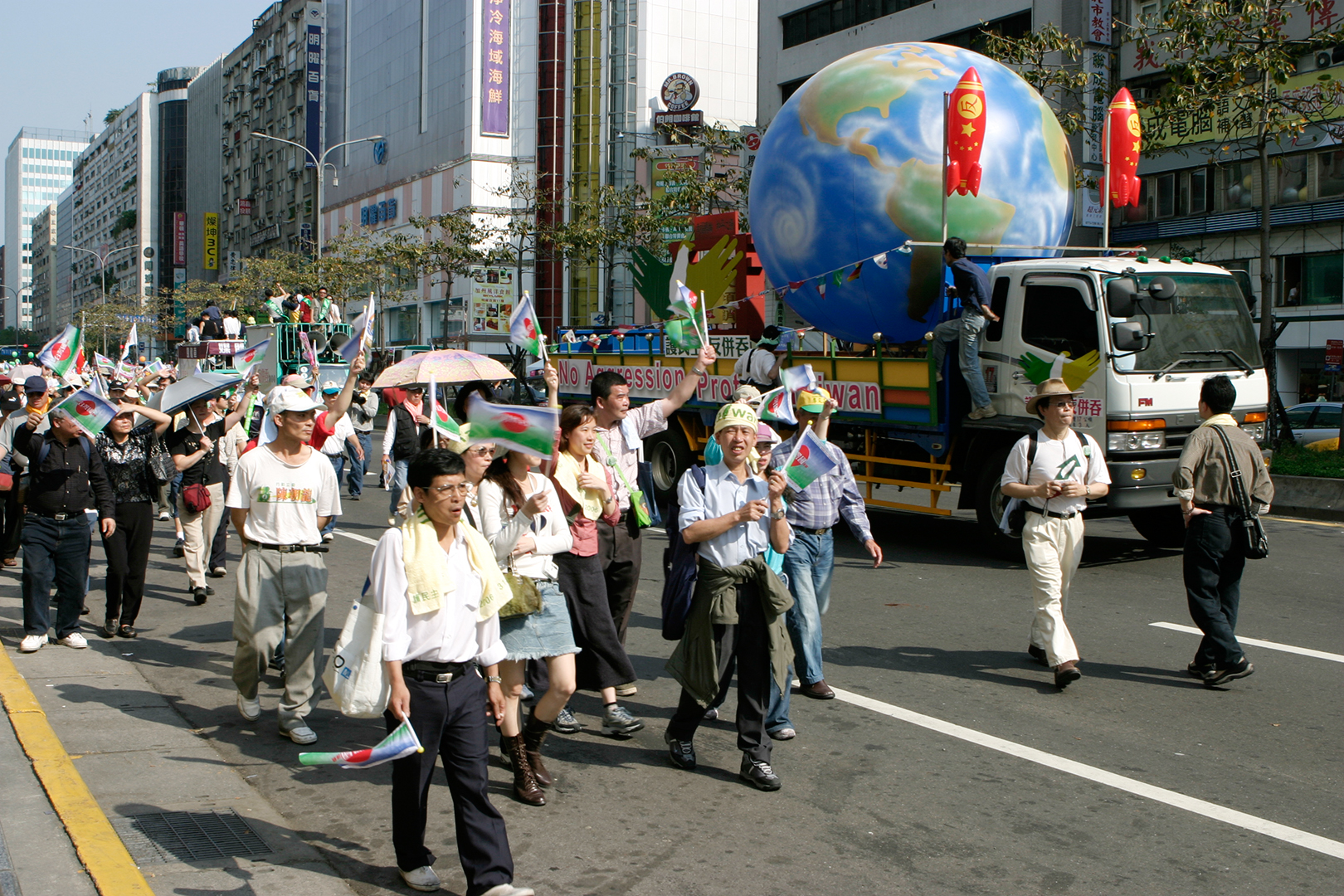
As shown in the image above, early political mobilization on Taiwan's streets was often accompanied by large modified trucks and long lines of parade crowds. This practice of temporarily transforming transportation vehicles into propaganda platforms broke the spatial limitations of traditional political rallies, allowing political appeals to penetrate directly into every alley and street. The design of these stage trucks and propaganda vehicles is filled with strong local Taiwanese colors; the bright color combinations and exaggerated lighting effects not only bring strong visual impact but also reflect the grassroots society's desire for "liveliness" and "grandeur" 4.
Democratic Snacks: Political Mobilization on the Tip of the Tongue
At Taiwan's rally sites, besides the political speeches on stage, the "democratic snacks" below the stage are equally indispensable soul elements. Among them, the most famous is undoubtedly the "democratic sausage" 6. This vendor culture, originating from street movements in the 1980s, saw vendors pushing charcoal-grilled sausage stalls following protest crowds, providing physical support for participants and becoming an unofficial symbol of the democratic movement 6.

As depicted in the image above, democratic sausage stalls are often adjacent to protest or rally crowds. The sizzling sausages on the charcoal grill and the drifting oil smoke are not only sources of physical sustenance but also carry the shared life experiences of Taiwan's civil society in street protests and election mobilization 6. Besides sausages, another food with high political symbolism is "election fried rice noodles" 7. In central and southern Taiwan, when candidates hold small-scale policy announcement meetings, they often prepare large buckets of fried rice noodles and meatball soup to treat fellow townsmen. This "rice noodle gathering" culture has been fragrant in Taiwan for over 30 years; it is not just to fill voters' stomachs but also a display of human warmth and a mobilization tool 7.
Election Propaganda Vehicles: Mobile Democratic Broadcasting Towers and Noise Anxiety
"-election propaganda vehicles" (commonly known as "war vehicles")穿梭ing through alleys are another political landscape. These modified vehicles are usually equipped with huge loudspeakers, repeatedly playing candidates' policies, promotional songs, or pleading slogans 8. Although this is seen as a necessary means to reach the grassroots, the noise it generates often sparks social controversy.
According to Article 54 of the Act Governing the Election and Recall of Public Officials, political parties and candidates using loudspeakers must not create noise; otherwise, they will be fined by environmental protection authorities under the Noise Control Act 9. However, due to the high mobility of propaganda vehicles, law enforcement agencies often face technical difficulties in actual measurement and issuing fines 10. This tension between the "voice of democracy" and "peace of life" reflects the continuous negotiation of citizens' rights boundaries during Taiwan's democratic transition.

As the shocking scene shown in the image above demonstrates, tens of thousands of people gathered in the night, constructing powerful political energy through synchronized slogans and waving flags. The "theater effect" produced by these physical gatherings is something that any digital social media cannot fully replace.
The Economics of Election Merchandise: From Fans to "Wenqing" Design
Another major feature of Taiwan's elections is the dazzling array of "election merchandise." From the most practical tissues, ballpoint pens, and lighters of the past, to plastic fans essential during hot weather, these small items are not only promotional tools but also form a unique "election industry chain" 11.
As the voter structure becomes younger, election merchandise has evolved from simple giveaways to "brand peripherals." Candidates begin to推出 "Wenqing" (literati-style/hipster) products with design sensibility, such as eco-bags, sports towels, and even figurines, attracting supporters to purchase them with their own money, transforming political identity into a display of lifestyle 11. Interestingly, this industry chain previously outsourced part of its production to China to reduce costs, but in recent years, due to geopolitical risks, many orders have returned to local Taiwanese manufacturers, forming another form of "rooting in Taiwan" 11.
"Dong Suan" and the Magic of Language: Emotional Catalysts on the Rally Stage
In rally settings, language is not only a tool for communication but also an emotional catalyst. Among them, the most well-known is undoubtedly the term "Dong Suan" (凍蒜). This term, derived from the homophone of "winning election" in Hokkien, has now become an indispensable slogan in Taiwan's elections 12. When the host leads tens of thousands of crowd members below the stage to shout "Dong Suan" with a hoarse voice, that overwhelming momentum often instantly pushes the atmosphere of the venue to the climax.
Besides simple and powerful slogans, the "election language" of political figures is also a profound art 1. In rally speeches, candidates often use a large amount of vernacular language, metaphors, and contrast techniques to close the distance with voters. This language strategy not only effectively激发 supporters' shared hatred against enemies but also creates memorable points easy to spread in an era of fragmented information 1.
The Boundary of the 30-Dollar Bento: The Tug-of-War Between Law and Human Relations
To rectify election conduct, Taiwan's judicial authorities have gradually developed a set of standards for determining bribery in practice. The most well-known is the so-called "30-dollar threshold" 13. This standard originates from a 2001 interpretation by the Ministry of Justice, stating that if candidates distribute simple promotional items worth less than 30 New Taiwan Dollars, it is generally considered insufficient to sway voters' intentions, thus not constituting bribery 14.
However, in actual legal operations, "30 dollars" is not an absolute, un-crossable dead line. When determining whether bribery constitutes, courts still comprehensively consider the candidate's subjective intent, the nature of the items, and whether it is sufficient to influence voters' voting intentions 13. For example, providing simple fried rice noodles at a rally evening, although the cost may exceed 30 dollars, is usually viewed as a display of human relations of "treating guests" in Taiwanese society, rather than vote-buying behavior 13.

As shown in the image above, campaign flags are not only visual tools used to mark camps but also play a role in凝聚ing centripetal force in collective activities. In this ocean of flags, voters can temporarily shed the isolation of daily life and integrate into a community with a shared political imagination.
Social Capital and Political Participation: The Deep Functions of Rallies
From an academic perspective, rally evenings have the function of strengthening "social capital" 15. Through face-to-face collective participation, the trust and norms among voters are strengthened, and through the transmission of interpersonal networks, voting participation rates are further influenced 3. Research shows that Taiwan voters' voting participation is not only influenced by individual rational policy analysis but also swayed by the emotional mobilization of their social networks 3.
With the advent of the digital age, the battlefield of elections has gradually shifted to online communities and meme dissemination 16, but physical rally evenings still possess an irreplaceable "theater effect"; it is the most vivid and irreplaceable collective memory in Taiwan's democratic process.
References
- The Reporter, "The Secrets of Election Language: Analyzing the Fan-Catching Techniques of Han Kuo-yu and Tsai Ing-wen" — Deeply analyzes the language strategies of political figures in Taiwan's elections and the emotional mobilization mechanisms of rally venues.↩23
- Academia Sinica, Center for Humanistic and Social Sciences, "Political Emotions and Election Participation: An Empirical Analysis of the 2012 and 2016 Taiwan Presidential Elections" — Academic research exploring the role and impact of voter emotions in Taiwan's large-scale elections.↩
- Institute of Political Science, National Sun Yat-sen University, "Evaluation of Democratic Governance Quality by Taiwan Citizens: Analysis of 2003 Taiwan Election and Democratization TEDS Survey Data" — Academic paper exploring the interactive influence of Taiwan voters' political participation behavior and interpersonal networks.↩23
- Taiwan Panorama, "Magical Stage" — Introduces the development history of the stage truck industry in central and southern Taiwan, and its applications in temple fairs and elections.↩2
- Kaohsiung Museum of Fine Arts, "010 Exploring Taiwan's Life Pulse from Dream Stages: Shen Zhao-liang's STAGE Series" — Explores how photographer Shen Zhao-liang records Taiwan's unique stage truck culture and its social significance through his lens.↩
- Bao Shi Guang, "Taiwan Social Movements Like Mushrooms After Rain: 'Democratic Sausages' Make Big Profits" — Reviews the history of democratic sausage vendors following social movements in the 1980s, demonstrating the vernacular vitality in Taiwan's democratization process.↩23
- The Initium, "Election Fried Rice Noodles: A Bowl of Ordinary Taiwanese Snack, How Did It Fragrance for 30 Years at Rally Sites?" — In-depth report on Taiwan's unique "election rice noodle gathering" culture, exploring its symbolic significance and legal controversies in grassroots mobilization.↩2
- Xinzhuang Reporter, "Social Problems Under the Election of Xinzhuang Propaganda Vehicles" — Reports on the impact of Taiwan's election propaganda vehicles on community life, and public needs and views on noise control.↩
- Central Election Commission, "Which Authority Has Jurisdiction Over the Noise of Candidate Propaganda Vehicles and How Should It Be Handled?" — Official explanation of the control standards and related penalty provisions for loudspeaker noise under Article 54 of the Election and Recall Act.↩
- Chiayi City Government Environmental Protection Bureau, "Control of Election Noise Using Loudspeaker Facilities" — Explanation of standard operating procedures and enforcement difficulties for reporting propaganda vehicle noise during elections by local governments.↩
- Wainao, "Conditions for Winning: How Did Taiwan's Election Propaganda and 'Peripheral Goods' Industry Chain Take Shape?" — In-depth report on the operational model of Taiwan's election merchandise industry chain, and the trend from traditional giveaways to cultural creative peripherals.↩23
- New York Times Chinese, "How Do Taiwan People Rally for Elections? Banners, Hot Dances, 'Dong Suan' Slogans" — Observes Taiwan's unique election rally culture from the perspective of foreign media, exploring its impact on democratic participation.↩
- Legal Encyclopedia, "If Candidates Distribute Items Worth Over 30 Dollars to Voters During Campaigns, Does It Count as Bribery?" — Detailed analysis of the standards for determining bribery in Taiwan's election laws, and the origin of the famous "30-dollar threshold."↩23
- Ministry of Justice, "Examples of Bribery Offenses" — Official interpretation explicitly listing specific standards for items under 30 dollars, such as ballpoint pens and tissues, not constituting bribery.↩
- Academia Sinica Database, "Social Capital and Democratic Politics: A Case Study of Taiwan" — Explores how social capital affects Taiwan's democratic operation and civic participation stock through trust and norms.↩
- Department of Political Science, National Taiwan University, "Political Memetization of Emerging Social Media: A Case Study of the DPP on Threads After the 2024 Taiwan Presidential Election" — Explores how Taiwan's political parties conduct political communication and interact with supporters on emerging social platforms like Threads.↩