
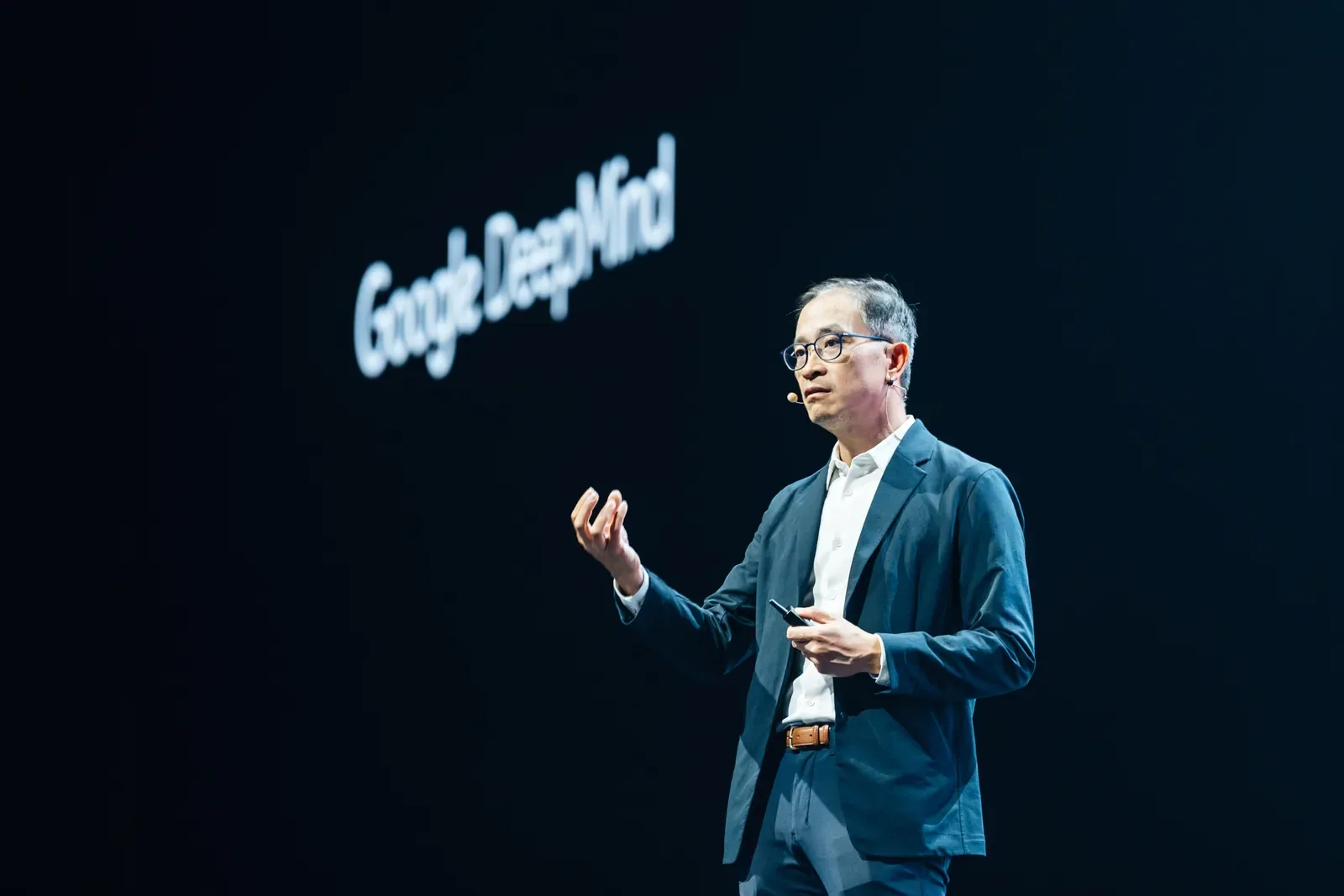
When the world was chasing AI with hundreds of millions of dollars in computing power, one paper changed the way machines reason, costing only about $5,000.
That paper is called "Chain of Thought." What it does sounds too simple to be a breakthrough: in the examples shown to the AI, it adds a few more lines of "problem-solving process," guiding it to think out the intermediate steps first before giving the answer, like asking a student to draft on scratch paper rather than writing the conclusion directly. Among the nine co-authors, there is a Taiwanese born in Tamsui named Ed Chi.
He later explained the $5,000 like this: "The problem was not one that could be solved by computing power, but rather another mode of thinking."1
30-Second Overview: Ed Chi is the Research Vice President at Google DeepMind and one of the co-authors of the Chain of Thought paper that taught AI to "reason step by step." Every time you ask ChatGPT or Gemini to "think step by step" and it answers better, that idea of teaching machines to reason step-by-step has a line leading back to Taiwan. He immigrated to the US with his mother, who was pursuing a PhD, at around age 15. While helping his mother write her educational psychology thesis, he learned a psychological concept about "how humans learn." Thirty years later, he brought this concept into machines. Taiwan recognizes the "light of Taiwan" who makes chips, but barely recognizes the person who shapes "how AI thinks."
The Mother's PhD Thesis
The story doesn't start at Google; it starts at a desk.
Ed Chi grew up in Tamsui. "I am a native Taiwanese, born in Tamsui, and then went to the US with my parents to study when I was about 15 years old, because my mother went there to pursue a PhD at the time."2 Hidden in this sentence is an unusual scene: most Taiwanese children who went abroad back then were "international students" on their own, but his whole family moved west together for his mother's PhD studies. A Taiwanese family immigrating to the US because of the mother's academic pursuits was not common in those days.

Tamsui, where Ed Chi was born and raised. Thirty years later, what he brought from here would become the method for teaching machines to think.
His mother was pursuing a PhD in educational psychology. During high school and college, he helped his mother write her thesis. A child still in school helping his own mother organize an academic thesis exploring "how humans learn"—in that process, he first encountered the schema theory of the Swiss psychologist Piaget.
Schema theory posits that the human brain has a set of organized knowledge structures called "schemas," which we use to understand the world. When learning something new, you either fit new information into old schemas (called assimilation) or find that the old schemas can no longer hold it, forcing you to rewrite or build new ones (called accommodation). It sounds abstract, but it answers a fundamental question: how does a person go from "not knowing" to "knowing"?
The concept on that desk thirty years ago would become the method for teaching machines to reason. But before that, he had to walk a long path, and one that few others walked.
Ed Chi personally narrates the origin of Chain of Thought in the VK Tech Reading Time EP122 interview, from helping his mother write her educational psychology PhD thesis, learning Piaget's schema theory, all the way to how he turned it into a method for teaching AI to reason. This interview is the soul source of this article.
From Tamsui to Minnesota, Following a PhD Admission Letter
In Minnesota, he completed high school, undergraduate, master's, and PhD degrees all at the same university: the University of Minnesota, over six and a half years, earning three degrees3. He entered with the highest honors (Summa Cum Laude). His PhD thesis was on information visualization, titled "A Framework for Information Visualization Spreadsheets." His advisor, John T. Riedl, was a pioneer in recommendation systems.

At age 15, he followed his mother to Minnesota, and later completed three degrees at the University of Minnesota over six and a half years. His advisor, John T. Riedl, was a pioneer in recommendation system research: this thread would later connect back to what he did at Google.
But more memorable than the degrees is how he positioned himself.
He said something very honest in an interview: "In English, I'm a generalist... a researcher who is a jack of all trades but master of none. But when I realized my math wasn't better than others', I thought maybe I could do research that was more like 'bridging,' a bridge between one field and another."4
This is a costly choice in academia. He himself said that when you do bridging research, "you are not truly 'one of us' in Field A, nor a true researcher in Field B." A person who only knows one side gets a clear position in the world; a person standing in the middle of two sides is often rejected by both. But he bet on this middle ground. History later proved that the most critical steps in AI happened exactly in these middle grounds.
✦ "Maybe I could do research that was more like 'bridging,' a bridge between one field and another."
In Palo Alto, He Learned to Turn Psychology into Code
In 1997, he interned at a legendary place: Xerox PARC (Palo Alto Research Center).
This name might be unfamiliar to Taiwanese readers, but you use its inventions every day. The mouse, the graphical user interface, the laser printer, Ethernet—many technologies that laid the foundation for the personal computer era were born in this research center of the copier company, located next to Stanford University. Jobs back then went in to see that graphical interface, learned the idea, and made it into the later Macintosh. When Ed Chi went there, it was just its second golden age.

The Alto developed by Xerox PARC in 1973 was a pioneer of personal computers and graphical interfaces. Ed Chi later learned here how to turn cognitive psychology into runnable code.
The key wasn't what flashy technology he built, but who he met. "My boss at the time was called Stuart Card, who was a student of Allen Newell."5 Following this lineage up leads to a Nobel Prize winner in Economics: Herbert Simon.
Simon proposed "bounded rationality": humans are limited by cognition, information, and time when making decisions, making it impossible to be "fully rational." He also coined the term "satisficing": a decision that is "good enough." Humans don't seek the optimal solution, but one that gets by. Simon and Newell together analogized the human brain to an information-processing machine, believing that "problem-solving" is searching for answers step-by-step in a problem space. Card brought this line of thinking into Palo Alto, and Ed Chi took it from Card.
📝 Curator's Note
The common AI story goes like this: machines become smarter because chips are faster, data is more abundant, and models are larger. This narrative is convenient, but it misses another dark thread. Simon was already asking in the 1950s "how the human brain makes decisions under constraints"; Card brought psychology into Palo Alto's computer research in 1974; Ed Chi took the baton in the 1990s, turning foraging theory into a model for how people find information online. For half a century, a group of people have been asking the same question: how do humans actually think? While the mainstream was busy making machines compute faster, they were busy making machines think more like humans. Chain of Thought is the fruit of this dark thread.
His main research in Palo Alto was called "information foraging." The concept is: people finding information on the internet is like animals foraging in the wild; they follow "scents," chasing strong ones and abandoning weak ones. He engineered this biological and psychological foraging model into a system that could actually run, to predict how people navigate between websites. This was the first practical application of "bridging": one side was cognitive psychology, the other information science, and he built a bridge in the middle.
Source: Various scholars' Wikipedia, arXiv 2201.11903
Not More Data, But More Like Humans
In 2011, he left Palo Alto for Google. The reason was practical: "Just doing research isn't enough; you also need to build applied things." He saw the Xerox model of "deep basic research that doesn't translate into products" with his own eyes.
At Google, he first worked on web data analysis. From 2015 to 2017, he led a team to rebuild YouTube's neural network recommendation system. In 2017, he became the Chief Scientist of Google Brain, leading a team of 70 people. In 2021, he was promoted to Distinguished Scientist, leading a team of 120, and later became the Research Vice President of DeepMind6. Behind this series of titles is actually the same methodological gene extending: information foraging is a model for "how people find things," recommendation systems are models for "what people want to see," and in Chain of Thought, it becomes a model for "how people reason." From human cognition, all the way to machines.
The turning point for Chain of Thought occurred due to his dissatisfaction with the mainstream machine learning of the time. "Why do we need so much data for this machine to truly learn?" He began to think, "Could we use methods from cognitive psychology to teach machines to learn?"7
So he returned to that concept. "This idea actually comes from... an idea from the 60s and 70s called schema theory. Its meaning is basically that if a person can use a template to solve a problem, then maybe we can also use this method to teach machines to learn. So Chain of Thought actually started from this idea." The interview host asked if it was Piaget's schema, and he answered: "Yes, it is Piaget's schema idea. That thing was actually what I learned when I was in high school and college, because I helped my mother write her educational psychology PhD thesis, so later these things gradually connected."8
The seed on the desk sprouted.
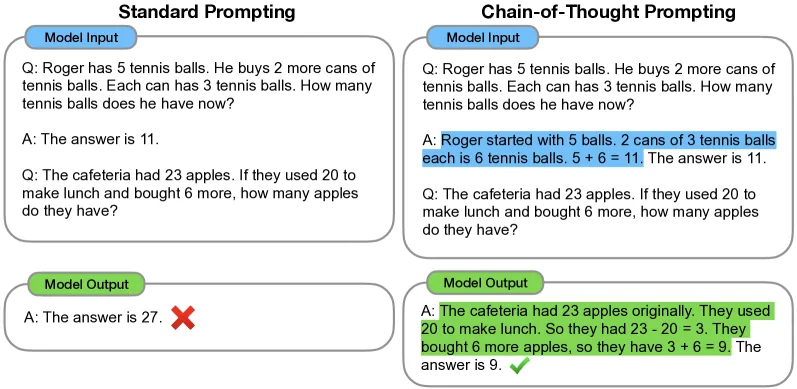
The most famous image in the Chain of Thought paper: asking in a general way on the left, the model calculates wrong; on the right, just adding a paragraph of reasoning process in the example (the blue part), the model answers correctly. The difference is not in computing power, but in whether it "writes out thoughts step by step." Image from Wei et al., 2022.
And it cost almost nothing. "Do you know how much computing power we used in total? About $5,000 in computing power. Because that problem was not one that could be solved by computing power, but rather another mode of thinking. When we did that research, at first we basically had no funding; it was something we came up with from scratch."1
This is the main point this article wants to make: the key to teaching AI to reason is not more computing power, but being more like humans; and this "more like humans" grew out of a Tamsui child helping his mother write an educational psychology PhD thesis.
He Told His Subordinates: Don't Use That Method, Try Schema
Here we must be honest.
The Chain of Thought paper has nine authors, with Ed Chi ranked seventh. The first author is Jason Wei, the main executor; the last author, the senior leader in academic convention, is Denny Zhou, the founder of the Google Brain Reasoning Research Team. To say this paper was "invented by Ed Chi" is inaccurate; Denny Zhou is the leader of this research direction, and Denny Zhou is a researcher in Ed Chi's team, his direct subordinate.
So what was his role? Listen to what he says: "Denny Zhou is a researcher in my team. After he joined my team, he came to me and said he wanted to do reasoning research... He originally used a more traditional neural-symbolic method, so I told him I thought neural-symbolic might not work well, and suggested considering other methods? Then we slowly discussed and found that maybe we could use the concept of schema."9
This sentence outlines his true contribution. He was not the main executor of the paper, but he was the one who said "don't go that way" at the critical fork: he rejected the neural-symbolic direction, which seemed logical at the time, and pushed the discussion toward schema. More importantly, he could think of schema because he brought a thirty-year cognitive science perspective into this team. In other words, he was the person who made it "possible for Denny Zhou to think of schema."
📝 Curator's Note
The most common flaw in the "Light of Taiwan" narrative is compressing a complex contribution into a single sentence: "he invented X." But reality is often more interesting. What makes Ed Chi truly irreplaceable is a twenty-year long arc: he gradually brought cognitive psychology into machines, from information foraging, to recommendation systems, to Chain of Thought. Papers have nine authors, rankings, and credit disputes; but "continuously bringing the question of how humans think into the engineering site for twenty years" is something only he in the whole team could do. To see his value, you have to zoom out to a twenty-year scale, not stop at an author list.
He explained the subsequent development of Chain of Thought using a deeper framework. When AI not only solves problems by template but also "reflects" on its own thinking and goes back to correct it, he said: "In Piaget's cognitive science, or in learning science, this is called assimilation and accommodation... This kind of true learning in machines seems to have truly begun."10 Solving problems by template is assimilation; going back to rewrite the template is accommodation: he brought the pair of concepts he learned helping his mother write her thesis directly to describe machine learning.
He also connected Chain of Thought to another psychologist's framework: "Chain of Thought plus fine-tuning, plus next-token prediction, seems to be the beginning of reasoning machines, which is what Kahneman calls System 2 thinking."11 System 1 is intuitive, fast, effortless thinking (seeing a microphone and knowing it's a microphone); System 2 is effortful, rational, step-by-step reasoning thinking (the brain activity when asked "what is the definition of AGI"). In his view, past deep learning has made System 1 very deep, and Chain of Thought is the starting point for machines to begin doing System 2.
Machines That Reason, and Grandma's Standard
When is AI truly "there"? Ed Chi's answer is not in any technical metric, but in Grandma.
"The day your grandma scolds your home robot saying, 'I already taught you once, why don't you still know it?'—then you know AGI has arrived... Our metric is embedded in Grandma."12
This sentence is sharper than it sounds. Today's扫地机器人 (robot vacuums) still get tangled in wires, hit furniture; we complain they are stupid, but we don't get truly angry at them: because deep down we feel "machines are naturally stupider than me, it's normal to teach them a few more times." But when one day Grandma scolds the robot like she scolds a person who can't learn, it means she has already treated it as an object that "should know it after one teaching." The moment AGI arrives, rather than being a benchmark passing a line, it is more like human expectations quietly changing.
This also connects back to his view on Artificial General Intelligence (AGI). He believes two things are required for AGI to hold: first, AI cannot just live in a virtual world; it must integrate into humans' real living environments; second, "I teach you once, and you will know it in the future"—being able to draw inferences, explore on its own, rather than requiring humans to repeat teaching. The Project Astra he currently leads is doing exactly the first thing: a general assistant that can perceive the context you are in.
He told a personal scene. About a year ago, he took the still-confidential Project Astra to a conference in Barcelona. In a hotel rooftop bar, he took out his phone, scanned the city skyline, and asked it "where am I." It answered "looks like you are in Barcelona." He asked which district, and it gave the correct district name. He asked if there were good nearby restaurants, "preferably with a Michelin star," and it answered. "I said 'can you help me make a reservation?' It said 'not yet, but maybe in the future.'" At that moment, he realized that this kind of personal assistant that truly stays by your side and understands your situation can be made in our lifetime.13
Ed Chi discusses smart glasses, the "Grandma Standard" of AGI, and Taiwan's opportunities in the Sidechat E350 interview. In the interview, he pulled out a Project Astra glasses prototype, saying this should be Taiwan's first.
At the interview site, he pulled a Project Astra-equipped smart glasses prototype from his pocket, saying this "should be" Taiwan's first. He talked about where Taiwan has the most opportunity. Hardware is one piece: "Taiwan's position in semiconductors, especially in manufacturing, is hard to shake." But he turned the corner, "If Taiwan can integrate hardware and software well, leveraging the capabilities of large language models, it is indeed a great opportunity."14
Taiwan Recognizes Chips, Not This Brain
Speaking of this, we cannot avoid one question: is he Taiwanese?
The facts are there: he left Taiwan at around age 15, completed high school, university, and graduate school all in the US, and his entire career was in Silicon Valley. He is a Taiwanese American, a person born in Taiwan who grew up and succeeded in the US. If someone says the "Light of Taiwan" hat is consuming a person who immigrated long ago, this doubt is not baseless.
But on the other side of the scale, there are also solid things. He gave interviews in Chinese, actively saying he was "born in Tamsui, a native Taiwanese," without dodging. He continued to return to Taiwan for lectures—his presence is left at National Taiwan Normal University, Chung Hsing University, and National Yang Ming Chiao Tung University. He has specific observations on Taiwan's long-term care困境 (dilemma), semiconductor status, and AI startup ecology, even naming that Taiwan already has about 15,000 users using DeepMind's protein structure prediction tool.
What best illustrates his "both inside and outside" position is a passage he said to Taiwanese researchers: "For this part of research, I have actually returned to Taiwan for so many years, speaking every time, but I haven't seen Taiwanese researchers... doing much in this area. Research that doesn't require many chips."15
There are two identities pulling in this sentence. He speaks of "returning to Taiwan," being someone who considers himself part of here; but "speaking every time, yet no one does it" carries a sense of outsider distance—as if someone who has been away from home for a long time returns to see a corner of the home that has never been cleaned, anxious, yet powerless. Whether he counts as the "Light of Taiwan," this article does not conclude for you. The facts are all here; judge for yourself.
📊 Him in Numbers
Source: Ed Chi VK EP122 Interview, Google Scholar, OpenAI o1 System Card (arXiv 2412.16720)
Showing Reasoning: More Transparent or Better at Reasoning?
Chain of Thought lets AI "show" its reasoning process. On the surface, this makes machines more transparent—you can see how they think. But here hides a concern that an honest person should present side-by-side.
⚠️ Controversial Viewpoint
Chain of Thought lets AI lay out its "thinking process" in front of you, looking more credible and trustworthy. However, academia has raised questions: the string of reasoning the model shows does not necessarily reflect its internal decision-making process (in research, this is called the "faithfulness" problem of the reasoning chain). In other words, it might have derived the answer first, then supplemented a beautiful explanation for you to see—being better at reasoning does not equal being more honest. Meanwhile, in March 2026, a jury in Los Angeles, USA, determined that YouTube and other platforms are responsible for youth addiction in a social media addiction case, with Google found to be about 30% responsible. Ed Chi won the ACM Fellowship precisely due to achievements like the YouTube recommendation system, yet has hardly ever publicly discussed the potential harms of algorithms. A person who can make machines "better at reasoning" is currently silent on the question of "whether accountability becomes harder once machines are better at reasoning." Pointing this out is not intended to attack anyone; it just wants to say, when we are proud of a Taiwanese standing at the forefront of AI, we should also put these questions into view.
This contradiction has no clean answer, but it shouldn't. A technology that makes AI more like humans will simultaneously amplify humanity's best and most troublesome traits—humans can reason, but humans also make up reasons for their decisions. Seeing both sides together is treating this seriously.
And Then?
Ed Chi observed an eight-year cycle: 1991 Internet, 1999 Google born, 2007 iPhone, 2015 Deep Learning matured, 2023 Gemini and ChatGPT. By this rhythm, the next inflection point falls around 2031. He said, by then, "no one will be surprised that you are using large models"—just as no one is surprised today that you use a mobile phone.
The direction he is currently betting on is getting AI out of screens and into the real world: Project Astra that can perceive your context, robots that can do housework. What moved him most was Taiwan's long-term care. "Will there really be some more affordable robots that can help with household chores?"—laundry, cooking, turning patients over, delivering medicine on time. When a society lacks workers, has a shortage of nursing staff, and hospitals have no beds, these things that sound sci-fi are actually very practical hopes.
Google's official release of the Project Astra vision video, this is the direction Ed Chi is currently responsible for: a general assistant that can coexist in the same environment with you and understand your situation.
Back to that desk.
A Tamsui child, around 15, followed his mother to Minnesota. While helping his mother write her educational psychology PhD thesis, he learned "how humans learn." Thirty years later, he turned this concept about humans into a method for teaching machines to think. When one day your grandma says to the home robot, "I already taught you once, why don't you still know it?"—the reason that machine can reason step-by-step, reflect, and draw inferences is behind a long thread. One end of the thread is Silicon Valley labs; the other end is Tamsui.
Image Sources
- Ed Chi speaking photo (hero): GQ Taiwan "GQ Exclusive Interview" Ed Chi — fair use editorial commentary
- Junyu-K / Wikimedia Commons — CC BY-SA 4.0 (Sunset on the wooden boardwalk at Youchikou, Tamsui)
- SavagePanda845 (Elliot F) / Wikimedia Commons — CC BY-SA 4.0 (University of Minnesota campus)
- The wub / Wikimedia Commons — CC BY-SA 4.0 (Xerox Alto computer)
- Chain of Thought paper Figure 1: Wei et al. 2022, arXiv:2201.11903 — fair use academic
Further Reading
- Jensen Huang——The Light of Taiwan who makes AI run faster, the hardware side
- Morris Chang——The founder of Taiwan's semiconductors, the "hard-to-shake" mountain Ed Chi spoke of
- AI Artificial Intelligence Industry——Taiwan's position in the global AI supply chain
- Taiwan AI Development and Future Strategy——The overall picture of Taiwan's AI
- Taiwan AI Daily Life——How AI has already entered Taiwanese people's lives
References
- VK Tech Reading Time EP122: AI Evolution, AGI Prototype, Lots of Psychology (ft. Ed Chi) — Official VK channel interview, Ed Chi himself interviewed. Around 52 minutes, he personally explains that the Chain of Thought paper used only about $5,000 in computing power, the most powerful evidence of "anti-computing power arms race."↩2
- Sidechat E350 (ft. Ed Chi) — INSIDE's tech podcast official interview, Ed Chi introduces himself at the beginning of the program, word-for-word stating he was born in Tamsui and went to the US with his mother at around age 15.↩
- Ed H. Chi Personal Resume — Ed Chi's personal website resume, recording University of Minnesota Computer Science BS (1992–1994), MS (1994–1996), PhD in Computer and Information Science (1996–1999), graduated with highest honors, advisor John T. Riedl.↩
- VK Tech Reading Time EP122: AI Evolution, AGI Prototype, Lots of Psychology (ft. Ed Chi) — Around 56 minutes, Ed Chi's self-narration of the psychological journey of switching to "bridging" research because his math was not as good as peers', a key confession for understanding his research style.↩
- VK Tech Reading Time EP122: AI Evolution, AGI Prototype, Lots of Psychology (ft. Ed Chi) — Around 5 minutes, Ed Chi explains the lineage at PARC, his boss Stuart Card was a student of Allen Newell. Proper nouns corrected against academic sources (Stuart Card Wikipedia).↩
- Ed H. Chi | Google Research — Google Research official personal page, recording his career trajectory and research areas at Google; career details also refer to personal resume edchi.net/resume.↩
- VK Tech Reading Time EP122: AI Evolution, AGI Prototype, Lots of Psychology (ft. Ed Chi) — Around 9 minutes, Ed Chi explains his dissatisfaction with "why machines need so much data to learn," the starting point of Chain of Thought.↩
- VK Tech Reading Time EP122: AI Evolution, AGI Prototype, Lots of Psychology (ft. Ed Chi) — Around 9 to 10 minutes, the most core first-hand self-narration of Chain of Thought's origin: schema theory, Piaget, and the personal connection of helping his mother write an educational psychology PhD thesis. The soul paragraph of this article.↩
- VK Tech Reading Time EP122: AI Evolution, AGI Prototype, Lots of Psychology (ft. Ed Chi) — Around 57 minutes, Ed Chi's self-narration of the key process of rejecting Denny Zhou's neural-symbolic method and turning toward schema, the first-hand basis for judging his contribution role. Paper authors and order see arXiv 2201.11903.↩
- VK Tech Reading Time EP122: AI Evolution, AGI Prototype, Lots of Psychology (ft. Ed Chi) — Around 15 minutes, Ed Chi uses Piaget's assimilation and accommodation framework to describe the evolution from Chain of Thought to reflective reasoning, showing his idea of bringing educational psychology language directly into AI.↩
- VK Tech Reading Time EP122: AI Evolution, AGI Prototype, Lots of Psychology (ft. Ed Chi) — Around 17 minutes, Ed Chi connects Chain of Thought to Kahneman's Thinking, Fast and Slow System 1/System 2 thinking framework. Kahneman's work Thinking, Fast and Slow was published in 2011.↩
- Sidechat E350 (ft. Ed Chi) — Interview opening and around 60 minutes, Ed Chi proposes the "Grandma Standard" of AGI: when Grandma scolds the robot like she scolds a person "I taught you once, why don't you still know it?", AGI has arrived.↩
- Sidechat E350 (ft. Ed Chi) — Around 30 minutes, Ed Chi narrates taking the confidential Project Astra to Barcelona, scanning the city skyline in a hotel rooftop bar, and the personal scene of it correctly identifying the city and district.↩
- Sidechat E350 (ft. Ed Chi) — Around 40 minutes, Ed Chi comments on Taiwan's semiconductor manufacturing status as "hard to shake," and that soft-hard integration is a "great opportunity" for Taiwan.↩
- Sidechat E350 (ft. Ed Chi) — Around 52 minutes, Ed Chi calls out to Taiwanese researchers: research in this area "doesn't require many chips," but he has returned to Taiwan for many years, speaking every time, yet hasn't seen Taiwanese researchers invest. This best presents his outsider-insider identity tension.↩