
30-Second Overview:
In 2017, Wu Chi-ying, a graduate of National Taiwan University’s medical school, began operating "Blue Pigeon’s Medical World." He started with hard knowledge videos, later bringing medical dramas, current events, and vaccines into the lens, while using podcasts and text to share different communication tasks. The core of this story is not about a physician becoming an internet celebrity, but about how medical expertise leaves the clinic: it must translate jargon into language the audience understands, and allow the audience to see the necessity of checking sources, acknowledging limitations, and maintaining boundaries of interest.
The White Coat and the Lens in a Shilin Breakfast Shop
In October 2020, an interview began at a breakfast shop in Shilin. At that time, Wu Chi-ying was a pediatric resident at National Taiwan University Hospital; his YouTube channel already had 320,000 subscribers, and his podcast was gaining attention among health programs. When the interviewer asked how he managed to handle both hospital work and online content, his answer was light: "It’s just that everyone spends their leisure time on different things."1

Image: Presidential Office, "Taiwan COVID-19 vaccination 20210716"; Wikimedia Commons original file page; License: CC BY 2.0.
This sentence sounds like it simplifies creation, but the scene is the opposite. A hospital resident’s work, recording, writing scripts, and editing are not things that can be automatically completed by simply carving out a small piece of after-work time. In that interview, Blue Pigeon discussed the division of labor across different platforms: YouTube for medical drama analysis, podcasts for news issues, and Voxer (Fanggezi) for text on pediatrics and family medicine.1
This division of labor later became the first key to understanding him. He did not compress all content into a single "physician persona," but instead allowed each platform to bear a different speed: videos capture attention, audio follows the news, and text allows a medical issue to unfold slowly.
📝 Curator’s Note: Blue Pigeon’s true "slash career" lies not in operating many accounts simultaneously, but in knowing that the same expertise requires a different mode of expression in different media.
Beyond the Lens: Seeing Patients at Apple Tree Dr. Appletree, North Branch
Blue Pigeon’s work is not limited to the lens. The current official website of Apple Tree Dr. Appletree lists Wu Chi-ying as an "Attending Physician at the North Branch," noting his graduation from National Taiwan University’s medical school and his status as a bestselling medical author.2 This information gives his online identity another concrete anchor: the medical issues discussed in his videos are still connected to a physical clinic and patient scenarios.
His title has changed over different periods. The character page for Canglan Health Aesthetics Clinic once listed him as "Director of Apple Tree North Branch Clinic," while Apple Tree’s current official website uses the title "Attending Physician at the North Branch."3 Therefore, this article adopts the title from Apple Tree’s current official website, avoiding treating the earlier "Director" title as a permanent, timeless credential. This difference may seem like just a few words on a business card, but it is important for biographical reporting: a physician’s employment, clinic hours, and management roles may change over time, and sources must specify which point in time they describe.
Clinic work also ensures that "science popularization" is no longer just an abstract content type. Videos can explain a common issue to a large audience, while clinics must face individual patients’ ages, medical histories, lifestyles, and genuine concerns. The former requires clear, repeatable explanations; the latter requires continuous questioning in the face of incomplete information. Blue Pigeon doing both does not mean a video can replace a consultation. On the contrary, it better illustrates why public health communication must separate general knowledge from individual diagnosis.
2017: Hard Knowledge First Meets YouTube
Blue Pigeon began operating "Blue Pigeon’s Medical World" in 2017. During university, he had already participated in stage performances and club activities. When knowledge-based YouTubers began to gain attention, he saw that medicine could become a channel theme. Later reports trace his name back to his university gaming nickname "Jianqi Canglan," which friends called "Brother Canglan," before finally becoming the current "Blue Pigeon."4
The start was not smooth. Blue Pigeon recalled that the channel began with hard knowledge, then shifted to interesting medical topics, and finally used medical drama analysis to examine medical behaviors within them. He said: "Operating YouTube has always encountered bottlenecks. From the initial hard knowledge, transitioning to interesting medical topics, and now analyzing medical behaviors or knowledge through medical dramas, I gradually felt that acceptance is higher."1
This transition is easily written off as "knowing how to grab traffic," but that would miss the real work. Medical content must first undergo judgment before it qualifies to be packaged as a punchline. Dramas provide an entry point, but medical knowledge must still be responsible for clearly pointing out the exit. In another 2023 creator interview, he stated his philosophy more directly: "Explaining medicine in a way the audience can understand."5

Image: Padai, "Taipei Medical University Hospital 20161112"; Wikimedia Commons original file page; License: CC BY-SA 4.0.
He also treats performance as part of the work. That interview mentioned that he liked gaining applause through performance since his student days. After becoming a physician, this desire for performance did not disappear; it was simply used to help the audience listen through a difficult segment of knowledge.5
Questions from Patients Become Topics in the Lens
The starting point of medical science popularization is often not a beautiful concept, but a repeated question in the clinic. When Taipei Public Library introduced Blue Pigeon’s lectures and books in 2021, it recorded his creative motivation: Hospital internships allowed him to see that consultation times are short, and information gaps between doctors and patients exist, where misunderstandings can accumulate into medical disputes.6
That official event organized his book into four aspects and twenty-eight healthcare knowledge points, ranging from basic medical常识 (common sense), body warning signs, common diseases, to medical consultation methods under the national health insurance system. These classifications did not portray him as an omniscient expert; instead, they showed he was doing something very pragmatic: first, translating the places where patients are most stuck into language they can take home.6
This also explains why he needs to move back and forth between professionalism and daily life. Speaking only in jargon, the audience might leave in the first minute. Speaking only in stories, medical risks might be covered by laughter. Blue Pigeon’s lens must accommodate both: making people willing to listen, and ensuring they do not mistakenly believe they can self-diagnose after listening.
The Pandemic Turns the Lens into a Public Space
After 2020, Taiwan’s medical audio-visual content had a larger public background. English academic research analyzing 943 YouTube videos from 17 medical centers in Taiwan between December 2019 and August 2021 pointed out that medical institutions used YouTube to convey COVID-19 information, relying on its accessibility and ease of use.7
Blue Pigeon is not an official medical center channel, but he worked in the same communication environment. During the pandemic, he uploaded AZ vaccine analysis videos and used another video to discuss vaccine issues during the pandemic.8 9 The existence of these videos itself shows that vaccine information has left hospital health education pamphlets and entered a space where people judge credibility using mobile phones, comments, and shares.
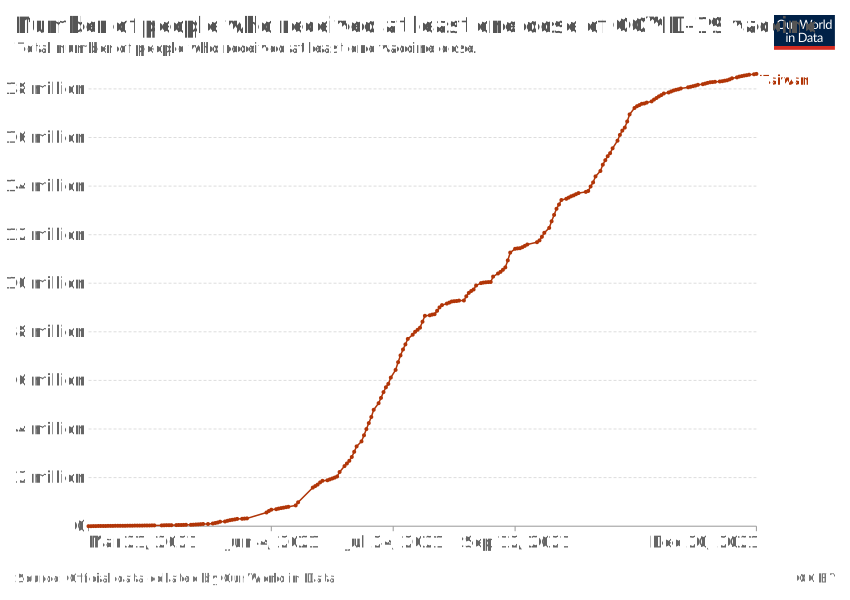
Image: Our World in Data, "Taiwan-COVID19-data-explorer"; Wikimedia Commons original file page; License: CC BY 4.0.10
The trouble with that space is that view counts can arrive before understanding. If medical messages are reduced to only two slogans—"rest assured" or "be careful"—the audience gets emotions, not judgment tools. What Blue Pigeon can do is break down an issue that seems to have only a stance back into risk, evidence, and applicable conditions. This also means his tone must be more careful than that of general entertainment videos.
📝 Curator’s Note: The pandemic brought physicians into the lens, but did not turn the lens into a clinic. Videos can explain common issues, but cannot complete diagnoses for every person in front of the screen.
When Professionalism Meets Larger Volume
Around 2021, Blue Pigeon commented on internet celebrity Alice Sha’s discussion of the "Gallbladder Stone Expulsion Method," and the discussion quickly extended from medical information to social media volume. Related reports placed this controversy in a larger question: when a physician and a high-reach internet celebrity discuss health simultaneously, are the audience comparing evidence, or comparing who speaks better?4
"Professionalism" is not an automatically valid pass online. A physician’s training makes a claim more worthy of checking, but it cannot erase all uncertainty. An internet celebrity’s approachability can also make messages flow more easily, but it cannot replace clinical evidence. Blue Pigeon’s work is therefore often caught between two expectations: people want him to speak simply, yet hope he is responsible for complex issues.
This tension also appears in his description of his own limitations. In early interviews, he admitted he could not master every detail like every specialist, so he had to do sufficient homework beforehand, at least ensuring the broad concepts conveyed stood firm.1 This admission is important because the most dangerous moment in medical science popularization is often when the speaker mistakes familiarity for omniscience.
Impartiality Must Be Guarded by a Line
Blue Pigeon’s content later extended to books, podcasts, lectures, and health product collaborations. Apple Podcasts’ program self-introduction described him as a graduate of National Taiwan University’s medical school, founder of a medical YouTube channel and Facebook fan page, and listed the program’s active period from 2020 to 2026, along with continuously updated medical current events, health knowledge, and healthcare interviews.11
The more platforms there are, the harder it is for interest relationships to hide behind a "recommend to everyone" statement. A 2023 profile recorded his principle: "I do not want the channel introducing medical-related topics to lose impartiality."4 This sentence is not a denial of all commercial collaborations, but a separation of medical-related sponsorships from general products. The audience still needs to clearly see the boundaries between content, advertisements, and personal experience.
He also published a book on life medicine and extended the book’s content through lectures at official library events.6 The commonality among books, videos, and podcasts is placing complex knowledge next to daily issues. The difference is that books allow readers to stop and reread, videos can be shared at emotional peaks, and podcasts allow medical news a longer companionship time.
Book Pages, Sound, and Different Speeds of Health Education
Blue Pigeon does not treat all audiences as the same type of person. Some only want to know if a symptom is worrying in short videos, some listen to the full medical news in podcasts, and some wish to leave an explanation of a pediatric disease on a text page. These differences are not just about content packaging, but about whether medical messages can be brought back into daily life.
In a 2020 Fanggezi interview, he described the three platforms as three tables of different sizes: YouTube uses drama analysis to bridge the distance, podcasts use news issues to maintain immediacy, and Fanggezi retains long-form articles on pediatrics and family medicine.1 By 2026, Apple Podcasts’ program page still positioned the program as medical current events analysis, health knowledge popularization, and healthcare interviews, listing 373 episodes. These dynamic data change, but they allow us to see how a creator continuously transforms the same issue into different entry points over time.11
Books provide another kind of patience. Taipei Public Library arranged an event for his book in 2021; the book introduction divided the content into four aspects: medical common sense, body warning signs, common diseases, and smart medical consultation under the health insurance system, totaling twenty-eight knowledge units.6 A video can be forwarded on a mobile phone, but a book requires the reader to sit down. Both are doing health education, but the shape of the reader’s attention is different.
This cross-platform work also brings an easily ignored reality: science popularization is not copying one draft to ten places. Podcasts must handle the rhythm and pauses of sound, videos must use visuals to help the audience grasp key points, and text must leave conditions, exceptions, and terminology. In early interviews, Blue Pigeon said he initially thought "just recording was enough," but later realized that saliva sounds, echoes, and uneven volume all required post-production.1 This small detail illustrates the creator’s daily life better than "he works hard": beyond professional content, there is a whole set of invisible production work.
Not All Simplification Is Safe
Medical knowledge must be simplified to be understood by the public. But every simplification leaves something outside. Changing "some situations may require medical attention" to "if you have this symptom, go to the ER" makes it easier for the audience to remember, but judgment may become distorted. Cutting "a treatment is effective under specific conditions" into "this method is effective" turns a video from education into misleading.
Blue Pigeon once said in an interview that he could not master every detail like all specialists, so he had to do sufficient homework before recording to ensure the broad concepts conveyed were correct.1 This sentence does not eliminate the difficulty of medical science popularization; instead, it clarifies the difficulty: the speaker must know where to stop, and the audience must know that a video cannot replace a physician’s judgment on a specific case.
A 2023 study of Taiwan’s medical center YouTube videos provided another scale. Researchers analyzed 943 videos released by 17 medical centers between December 2019 and August 2021, finding that video length and likes were related to increased view counts.7 This does not mean "longer is more correct," nor does it mean view counts prove content quality. It only reminds us that public health messages are influenced by both accessibility and platform mechanisms.
For Blue Pigeon, this contradiction reenacts daily in front of the lens. Content must first make people click to have the chance to discuss evidence. Once humor keeps people, it must avoid humor making people think diseases have no risks. This is creative technique, and also the boundary of medical ethics.
The Questions Left by the Alice Sha Incident
The controversy over the Gallbladder Stone Expulsion Method is worth placing in Blue Pigeon’s story not because it provides a simple answer to any medical dispute, but because it amplifies the question of "who has the right to speak." Blue Pigeon has medical training; Alice Sha has massive social media reach; the audience moves between two different senses of trust.4
Once the controversy enters social media, evidence is often reformatted into short sentences. Complete research designs, risk conditions, and applicable subjects may be compressed into one chart or one headline. A person’s professional identity may also be used as an authoritative seal that requires no further explanation. At this time, the problem facing medical science popularizers is no longer just "what to say," but also "how to make people see why they say it."
Blue Pigeon’s later working method did not solve this problem with higher volume. He used medical dramas, news, and life issues as entry points, then brought the audience back to more stable concepts. This does not guarantee everyone will accept it, nor does it eliminate conflict in social media, but it is closer to the original purpose of health education than turning every controversy into opposing camps.
How a Physician Stays in the Audience’s Life
Blue Pigeon’s content has another often-ignored scale: it serves not only those who already believe in medicine. For those familiar with journals and hospital processes, a video might be just a reorganized basic concept. For those encountering their child’s fever for the first time, understanding health insurance rules for the first time, or feeling uneasy in vaccine controversies for the first time, this content might be the starting point for their continued search.
This also means "daily life" cannot be treated only as a tone. The real work of being "daily" is placing medical knowledge next to moments when people make decisions: when a child is uncomfortable at midnight, parents need to know which signals are worth seeking help for. When news introduces new terminology, readers need to know if it relates to their own risks. When seeing a very persuasive health claim, the audience needs a method to recognize if it is passing off individual experience as a universal rule.
When introducing his book in a 2021 library event, the introduction specifically listed "smart medical consultation" as a content aspect.6 These four words are closer to daily life than "health knowledge" because medical consultation is not an exam; patients do not need to become half-physicians before they have the right to ask questions. If health education can only make people remember terminology, but cannot make people better at asking questions or knowing when to seek professional assistance, the information has not truly arrived.
Therefore, Blue Pigeon’s value lies not only in which diseases he discusses, but also in making "understanding a bit before asking the doctor" less embarrassing. That is a small but very practical public service: moving medicine from the high platform of authority to a table people can approach, while reminding everyone that approaching does not mean replacing diagnosis.
What the Audience Takes Away Last
Blue Pigeon’s channel’s shift from hard knowledge to dramas, current events, and life medicine did not leave medical professionalism; instead, it more clearly exposed the difficulty of professional communication. Every time a disease is explained more plainly, it may bring people closer, or it may make people forget conditions and exceptions. Every time humor reduces distance, it must reconfirm that the punchline has not covered the risk.
So his story is not simply "a physician can also be an internet celebrity." It is more like a continuous process of public translation: handing knowledge from the clinic to the lens, bringing questions from the lens back to verification, and returning what can be clearly explained to the audience. Research on Taiwan’s medical audio-visual content shows that YouTube can indeed become an accessible channel for conveying health information. Blue Pigeon’s case reminds people that after the channel becomes closer, responsibility does not become lighter.7
He once said that the time to make one YouTube episode could make three to four podcast episodes; this is a platform difference, and also the reality of time.1 But what truly remains is not volume, but that recurring action: applying book knowledge to living people, and bringing the questions living people ask back to books and evidence.4
After the screen goes dark, the audience may still remember a simple judgment: a physician’s words are worth listening to, but worth listening to along with the reasons. Therefore, a channel’s credibility should not only be built on subscriber numbers, video speed, or a powerful slogan, but on the ability to explain evidence, scope, and uncertainty. This requirement is harsher for creators, but fairer for the audience.
This may be the part of Blue Pigeon’s work of bringing the white coat into the lens that is least replaceable by traffic. The white coat makes people willing to stop; performance makes people willing to listen; what truly makes content last is his willingness to dismantle professionalism, allowing people to see the work of verification, trade-offs, and self-limitation within it. For the audience, this also provides a more useful third path than "believe or not believe": first confirm who is speaking, what the basis is, where the claim applies, and then decide whether to continue asking. This way of watching will not make people experts immediately, but it can reduce the chance of treating fame as evidence, and when facing medical information next time, leave more time for verification, do not rush to hand complex health issues to the loudest answer, and preserve everyone’s possibility and space to truly seek professional support.
Further Reading
- Taipei Public Library: Dr. Blue Pigeon Tells You: 90% of Life-Critical Medical Common Sense, No One Taught You!
- PubMed: Use of YouTube by academic medical centres during the COVID-19 pandemic: an observational study in Taiwan
References
- Voxer: Pediatric Physician Breaking Out of the Red Sea of Online Creation — Interview with Voxer Author Blue Pigeon — 2020 profile interview, recording Wu Chi-ying’s pediatric resident work, platform division, channel transformation, and medical communication ideas, including multiple verbatim interview segments.↩2345678
- Apple Tree Dr. Appletree: Dr. Wu Chi-ying — Character block on Apple Tree’s current official website, listing Wu Chi-ying as "Attending Physician at the North Branch," and noting National Taiwan University Medical School and bestselling medical author status; this article uses the content as of 2026-08-16 as the standard.↩
- Canglan Health Aesthetics Clinic: Director Wu Chi-ying — Clinic’s official character page once listed Wu Chi-ying’s academic and work experience and the title "Director of Apple Tree North Branch Clinic"; this article treats it as earlier or different-period credential data, and distinguishes it from Apple Tree’s current official website.↩
- Little Person Magazine: Operating the Internet Celebrity Market: How Does "Blue Pigeon’s Medical World" Stand Out in the Youtuber World? — 2023 profile report, covering real name, channel starting point, nickname origin, performance experience, medical sponsorship boundaries, and the gallbladder stone expulsion method controversy.↩2345
- Meet Startup Gathering: [Creator Says] Flipping Physician Stereotypes, Seeing Blue Pigeon Use Humor to Laugh About Medicine — 2023 creator interview, organizing National Taiwan University Medical College background, performance interests, medical YouTube starting point, and the philosophy of "explaining medicine in a way the audience can understand."↩2
- Taipei Public Library: Dr. Blue Pigeon Tells You: 90% of Life-Critical Medical Common Sense, No One Taught You! — Official event and book introduction page, explaining the initial motivation of seeing the information gap between doctors and patients during internships, lecture content, and the four health education aspects covered in the book.↩2345
- PubMed: Use of YouTube by academic medical centres during the COVID-19 pandemic: an observational study in Taiwan — 2023 BMJ Open Taiwan observational study, analyzing 943 videos from 17 medical centers, explaining YouTube’s accessibility and public background in pandemic medical information communication.↩23
- Blue Pigeon’s Medical World: Shocking! The Most Commonly Used COVID Vaccine in the Most Countries is This One? — Creator’s official video page, directly presenting 2021 medical science popularization content themed around the AZ vaccine, without extending medical conclusions not explicitly stated on the video page.↩
- Blue Pigeon’s Medical World: Showing You My Wife During the Pandemic [AZ Vaccine Big Analysis] — Creator’s official video page, preserving evidence of vaccine analysis content during the pandemic; this article only uses it to confirm the topic and period, not replacing medical guidelines.↩
- Wikimedia Commons: Taiwan-COVID19-data-explorer — Taiwan COVID-19 vaccine data chart made by Our World in Data, licensed under Creative Commons Attribution 4.0; this article uses it only as a public health background image, not attributing chart data to Blue Pigeon.↩
- Apple Podcasts: Blue Pigeon’s Medical General Knowledge — Creator self-introduction and program page, listing YouTube, Facebook, and health lecture identities, as well as program activity data from 2020 to 2026 and medical content classification.↩2
