

Photo: Zureks / Wikimedia Commons, CC0 1.0
30-Second Overview: In 2002, Taiwan began systematic offshore surveys of its western coast’s white dolphins; in 2020, the Marine Conservation Agency announced 763 square kilometers of important habitat; in 2026, the Taichung Port remained embroiled in controversy over whether reclamation projects require environmental impact assessments. These three dates, placed together, show that while the white dolphins have been seen and mapped into legal boundaries, they have not yet secured an undisturbed sea.
The true story of Taiwan’s white dolphins is not “humans have finally saved the dolphins,” but rather whether fisheries, ports, energy projects, and coastal engineering can collectively change how they use these shallow waters now that the dolphins’ existence is known.
With a narrow range of activity and slow reproduction rates, overlapping with nearshore fisheries and port construction, the unit of conservation is not a single dolphin, but an entire set of coastal usage rules.
In 2002, research teams began systematic offshore surveys of the white dolphins along Taiwan’s western coast. On September 1, 2020, the important habitat for the Chinese white dolphin was officially announced. In April 2026, Public Television Service (PTS) reported on the environmental impact assessment controversy surrounding a 60-hectare reclamation project at Taichung Port. These are not three isolated years, but a conservation timeline moving from “being seen” to “how to share the space.” 1 2 3
The Marine Conservation Agency designated the Chinese white dolphin’s legally recognized important habitat as 763 square kilometers, spanning the waters of Miaoli, Taichung, Changhua, and Yunlin. On a map, it looks like a boundary; in the sea, there are no walls: fishing nets, cargo ships, reclamation, pollutants, and sound still cross the lines drawn by humans. 4 2
This area is large, but it does not mean white dolphins can arbitrarily avoid risks within it. The IUCN notes that their core distribution remains a narrow belt hugging the western coast. NOAA also describes them as living only in the narrow estuarine waters of Taiwan’s western coast. The challenge of conservation is not just drawing a large box, but ensuring that the water, fish, sound, and vessel activities within that box remain within tolerable limits. 5 6
📝 Curator’s Note: Area is a necessary policy number, but it is not ecological function itself. What truly needs protection are the conditions of water depth, estuaries, food sources, and quiet activity zones.
Why They Live So Close to Shore
The Taiwan white dolphin is not a large whale species found in the open ocean. The IUCN Cetacean Specialist Group records that they are primarily distributed in a narrow sea area about 3 kilometers offshore along Taiwan’s western coast, with higher densities near estuaries and in waters 5 to 8 meters deep. They rarely appear in waters deeper than 20 meters, unless in artificially deepened channels. 5
The Marine Conservation Agency describes the Indo-Pacific humpback dolphin (Sousa chinensis) as a species of nearshore and estuarine environments, typically inhabiting waters less than 25 meters deep, positioned higher in the marine food chain. These conditions make it easier for them to find food, but also bring them into direct contact with the most densely used coastal areas by humans. 4
Mature individuals often appear white or pink, with a raised base on the dorsal fin; juveniles are grayer. They are not born “white”; their color changes with age and body spots. The pink figure people remember is the result of the growth process. 4 6
📝 Curator’s Note: For white dolphins, shallow seas are not a temporary parking lot, but their home. Humans, however, treat the same shallow seas as the most convenient place for construction, fishing, and transport.
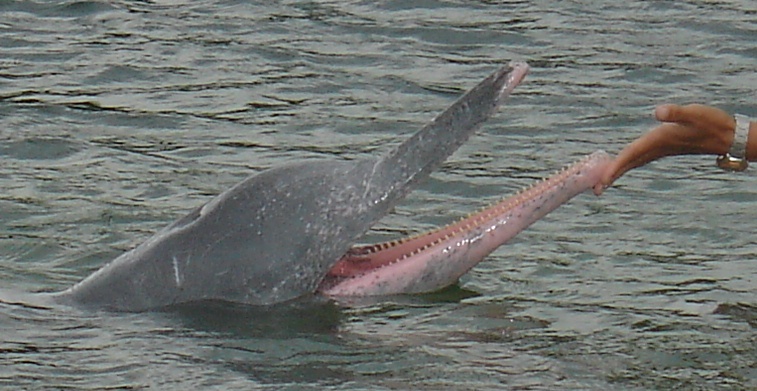
Photo: Zureks / Wikimedia Commons, CC0 1.0
This image does not show field records of the Taiwan western coast population, but serves as a morphological reference for the same species. It is important to maintain this boundary for visual data, because “looking like” cannot replace photo identification, offshore surveys, and location records.
This nearshore lifestyle also explains why white dolphin conservation cannot rely solely on marine protected areas far from the coast. They need estuaries, intertidal zones, nearshore fish stocks, and undivided activity ranges. Protecting only a single point may still result in the loss of the entire coastline necessary for their movement, foraging, and reproduction. 4 5
A Life Limited by Shallow Sea Conditions
The NOAA Fisheries species page records that Taiwan white dolphins are approximately 6.6 to 9.2 feet in length and weigh about 330 to 440 pounds. They primarily eat fish, but may also prey on cephalopods and crustaceans. These numbers are not merely curious facts; they remind us that they rely on a whole set of ecological conditions in estuaries and shallow seas that can still support fish stocks. 6
The same page also notes that life history data for this subspecies remain limited: they mature late, have slow reproduction rates, and females and calves maintain long-term relationships. When the population is already small, the death of any adult or calf is not just the loss of one individual, but may affect the next reproductive cycle. 6
This means that “habitat degradation” is not just about the coastline becoming ugly. Reclamation, freshwater diversion, pollution, or construction noise may first alter fish stocks and currents, forcing white dolphins to spend more time searching for food. For a population with slow reproduction and a narrow activity range, these changes are difficult to resolve by simply moving to another sea area. 4 6
📝 Curator’s Note: A species’ vulnerability comes not only from low numbers, but also from its insufficiently fast reproduction rate to offset losses caused by habitat and fishing gear.
From “White Bream” to a Scientifically Named Subspecies
Western coast fishermen have long known there is a white dolphin at sea. Taiwan Panorama records that Changhua fishermen call it “White Bream” (白鯃), while those in Kinmen and Xiamen often call it “Mazu Fish” (媽祖魚). These names are not academic classifications, but they preserve how maritime residents recognize, remember, and talk about them. 1
In 2002, Taiwan began systematic offshore surveys. An IUCN article notes that the Taiwan white dolphin was not scientifically recorded until 2002, and was not formally described as a subspecies of the Indo-Pacific humpback dolphin (Sousa chinensis taiwanensis) until 2015. Scientific naming does not mean they appeared in that year; it means the research system finally had the capacity to write them into scientific records. 5
Early reports from Taiwan Panorama describe research teams searching for white dolphins along the coasts of Miaoli, Taichung, and Changhua, identifying individuals through photos. Researchers had to combine the time, location, behavior, and dorsal fin notches of each sighting to estimate the small population’s size. A flip at sea does not directly equal “one more dolphin.” 1
📝 Curator’s Note: “White Bream” and the scientific name are not two mutually exclusive knowledge systems. One comes from years of going to sea; the other from photos, models, and statistics. What is truly missing is allowing both knowledge systems to enter decision-making together.

Photo: Zureks / Wikimedia Commons, CC0 1.0
In research, dorsal fins, back ridges, spots, and body color can help identify individuals or determine age stages, but a web image without time and location can only serve as morphological reading material. True population estimates still require long-term, repeatable photo identification data. 5 1
Numbers Have More Than One Answer
White dolphin population numbers are often written as a single, shocking figure, but different years, methods, and research pages cannot simply be added together. The IUCN page records that mark-recapture analysis via photo identification estimated the total population in 2010 to be at most around 74, with estimates for 2011 to 2013 between 67 and 71. The same page further describes their critically endangered status as no more than 75 individuals, with fewer than 50 mature adults. 5
The NOAA Fisheries species page states that fewer than 100 individuals remain, noting that the United States listed the Taiwan white dolphin as endangered under the Endangered Species Act in 2018. This number is not necessarily contradictory to the IUCN estimate, as page update times, estimation methods, and cited studies differ. The real danger lies in piecing them together into a fake curve of precise, latest population data. 6
A 2026 PTS report used “around 40” as the opening for its on-site feature, citing interviewees who mentioned the largest observed group at Taichung Port was 9 in 2025 and 14 in 2026. These are news reports and interviewee observations, not equivalent to a completed census of the entire population. They allow people to see the scene, but cannot replace population estimates. 3
📝 Curator’s Note: A credible conservation article does not choose the saddest number, but clearly states the year, method, and evidence level of each number.

Photo: Zureks / Wikimedia Commons, CC0 1.0
Group images are easily read as population numbers, but a single frame in one shot only represents visible individuals at a specific point in time. Estimating white dolphin populations must account for seeing the same individual repeatedly, missing individuals, seasonal differences, and survey scope; the intuitiveness of images cannot replace estimation methods. 5
If these numbers are returned to the same question, they still point in a consistent direction: this is a small, narrow population dependent on nearshore environments, with no obvious threat of decline. An IUCN article notes that two population viability analyses, considering bycatch mortality and habitat loss/degradation, both point to a trajectory of high probability of decline. 5
The People on the Other End of the Fishing Net
Dolphin conservation is most easily written as “fishermen harm dolphins,” but research archived in Airiti provides a more complex picture. Ko Meng-chen’s 2011 study, based on interviews with 127 fishermen from May 2010 to April 2011, resource overlap indicators, and long-term gillnet catch data, studied the potential food source competition between western coast fisheries and white dolphins. 7
The study abstract notes that 54% of the interviewed fisheries’ operational ranges overlapped with the white dolphins’ primary habitat. Within this overlapping range, 94% of the main fishing methods were gillnets. This is not “all fishermen doing the same thing in the same place,” but shows that white dolphins and nearshore fisheries indeed share a narrow resource space. 7
In the same study, 42% of interviewed fishermen believed fishery resources had declined over the past decade, and 49% attributed the decline to industrial pollution and illegal trawling within three nautical miles. The study also noted that fishermen’s views on whether the appearance of white dolphins reduces catch are inconsistent. These data show that fishermen are also bearing the cost of resource reduction, even though their losses usually do not appear on conservation posters. 7
📝 Curator’s Note: Fisheries and white dolphins are not two unrelated enemies. They share the same food web, already compressed by many uses.
The IUCN lists fishery interactions as a direct and urgent threat, recording that nearly 60% of individuals show evidence of severe harm caused by human activities, and over 31% of individuals have been photographed carrying fishing gear or having injuries possibly caused by fishing gear. These proportions come from studies cited on the IUCN page and cannot be directly inferred to assign equal responsibility to every fishing method or every fishing port. 5
Therefore, conservation policy cannot simply issue “do not catch” commands. It also needs to know which type of net, which season, which stretch of water, and which reporting system are most likely to reduce risk, and must ensure fishermen do not have to pay for the entire public conservation cost with their own income. The coordination around the 2020 legal habitat announcement began precisely here. 2
With Legal Habitat, What Changed in the Rules?
The important habitat for the Chinese white dolphin, announced on September 1, 2020, extends from Longfeng Port in Miaoli in the north to the Outer Sandbar Shoal Lighthouse in Chiayi in the south, with a total area of 76,300 hectares. Environmental Information Center reported that this announcement went through being listed as a protected species in 2008, research surveys, a 2014 draft, and coordination among multiple stakeholders before officially taking effect. 2
The announcement does not turn the entire sea into a no-fishing zone. The Environmental Information Center quoted the Marine Conservation Agency stating that existing fishing activities not targeting white dolphins will not automatically violate regulations due to the designation of important habitat. However, development and utilization within the area must not destroy original ecological functions; environmental impact assessments must be conducted when necessary, with approval from competent authorities. 2
This distinction is important. Legal habitat is not a seal prohibiting human entry, but a system that puts ecological functions into development review, monitoring, education, and local participation. It acknowledges that fishermen already work in this sea, and requires that new engineering projects not pretend this sea has no other residents. 4 2
📝 Curator’s Note: A truly useful protected area does not just tell people what they cannot do where; it must also clearly state who is responsible for monitoring, who bears the cost of transition, and how to remedy violations.
The 60 Hectares of Taichung Port
A 2026 PTS Our Island report covered the construction of a new seawall on the reclamation area at Taichung Port, planning to reclaim 60 hectares for dredged soil storage, as well as land needs for wind power, green hydrogen, and liquefied natural gas. This project is located within the white dolphin’s important habitat, bringing “legal habitat” and “port engineering” into the same news story. 3
The report presented two different viewpoints: transportation and port authorities believed the reclamation area is within existing breakwaters and legally does not require an environmental impact assessment. Civil groups and lawyers argued the project scope belongs to open waters and should be assessed under the Environmental Impact Assessment Act. The article cannot pre-judge for courts or competent authorities, but can clearly point out that the core of the controversy is: whether existing engineering boundaries are sufficient to represent ecological impact boundaries. 3
The PTS report also recorded that civil observers claimed the largest group seen at Taichung Port in 2025 was 9, and in 2026 was 14, believing this may be a nursery, foraging, and resting area. This is observation and interviewee judgment from reporting, not official population statistics. Its value lies in pointing out that pre-construction assessments should not only ask “have white dolphins appeared,” but also “what are they doing here.” 3
📝 Curator’s Note: The hardest part of development controversy is not deciding which side to stand on—dolphins or port—but acknowledging that a port may also be a workplace for certain families and a nursery for certain dolphins.
Greenpeace Taiwan’s feature called white dolphins “Mazu Fish,” organizing their color, distribution, research methods, and habitat threats. Such conservation advocacy brought a species originally only seen on the western coast into national public discussion, but advocacy language must still be read separately from official announcements and academic estimates. 8
The True “Home”
The conservation history of the Taiwan white dolphin has a twist that does not resemble a victory story: in 2002, researchers began systematically looking for them. In 2020, the government mapped their habitat into legal boundaries. In 2026, the question of whether engineering requires environmental impact assessment is still being debated on site. Being seen, named, and protected does not equal being safely left alone. 5 2 3
For white dolphins, a true home is not a polygon existing only in official documents. It must allow fish stocks to remain, give fishermen predictable rules, let engineering projects know before construction that underwater noise and reclamation are not details to be remedied later, and ensure every population number comes with a year, method, and uncertainty. 4 5 7
Viewed this way, white dolphins are not decorative mascots of Taiwan’s coast. They connect things we rarely look at together: a fishing net, a port, an estuary, a development review procedure, and a nearshore population estimated at only a few dozen to less than a hundred. 5 6 2
Next time someone says “Taiwan white dolphins finally have a home,” push the question one step further: Do the rules in that home also allow people living and working by the sea to survive? If the answer is still no, then 763 square kilometers is not the end point, but Taiwan finally beginning to learn how to live together with a neighbor who will not speak for itself. 4 2 3
Habitat announcements should therefore be understood as a beginning, not a promotional poster. It requires the government to continue monitoring, and requires engineering, fisheries, and conservation data to be readable by each other. If every unit only saves its own numbers, white dolphins will still live in the gaps of data. 4 2
For Taiwan’s western coast, protecting white dolphins is also relearning how to use the coast. This learning has no answer that can be completed in one go, but at least it can begin by not confusing numbers, excluding fishermen, and acknowledging that people already live in the sea before construction begins.
Further Reading
- Marine Conservation Agency: Taiwan Waters White Dolphin Conservation Zone
- IUCN SSC Cetacean Specialist Group: Taiwanese humpback dolphins
- Airiti: Potential Food Source Competition between Chinese White Dolphins and Coastal Fisheries in Western Taiwan
- Our Island: Days of Reclamation: Taichung Port and Taiwan White Dolphins
Image Sources
The four images used in this article are all from Wikimedia Commons, using original image hotlinks without downloading image files; the author for all is Zureks, with licenses all under CC0 1.0 Universal Public Domain Dedication.
- Image 1: Sousa chinensis (1) by Zureks.jpg — https://upload.wikimedia.org/wikipedia/commons/thumb/1/1c/Sousa_chinensis_%281%29_by_Zureks.jpg/1280px-Sousa_chinensis_%281%29_by_Zureks.jpg
- Image 2: Sousa chinensis (2) by Zureks.jpg — https://upload.wikimedia.org/wikipedia/commons/b/be/Sousa_chinensis_%282%29_by_Zureks.jpg
- Image 3: Sousa chinensis (3) by Zureks.jpg — https://upload.wikimedia.org/wikipedia/commons/a/a3/Sousa_chinensis_%283%29_by_Zureks.jpg
- Image 4: Sousa chinensis (4) by Zureks.jpg — https://upload.wikimedia.org/wikipedia/commons/b/bf/Sousa_chinensis_%284%29_by_Zureks.jpg
License details: CC0 1.0 Universal Public Domain Dedication.
References
- Taiwan Panorama: Guarding the Ocean’s Messengers — Chinese White Dolphin — 2010 official cultural magazine report, recording local names White Bream and Mazu Fish, 2002 offshore surveys, early habitat observations, and Guoguang Petrochemical EIA site.↩234
- Environmental Information Center: Taiwan White Dolphins Finally Have a Home — 2020 report, recording research, drafts, cross-agency coordination for white dolphin important habitat announcement, 763 square kilometer scope, and handling of existing fishery rights.↩2345678910
- Our Island: Days of Reclamation: Taichung Port and Taiwan White Dolphins — 2026 on-site reporting, covering Taichung Port 60-hectare reclamation project, EIA controversy, conflict between engineering and habitat, and interviewee observations of nursery groups.↩234567
- Marine Conservation Agency: Taiwan Waters White Dolphin Conservation Zone — Official Marine Conservation Agency species and habitat zone, explaining Chinese white dolphin classification, nearshore estuarine habitat, 763 square kilometers of important habitat, and six types of human threats.↩23456789
- IUCN SSC Cetacean Specialist Group: Taiwanese humpback dolphins — IUCN Cetacean Specialist Group article, organizing 2002 scientific records, 2015 subspecies description, population estimates, habitat loss, and fishing gear injury proportions, marking data years.↩23456789101112
- NOAA Fisheries: Taiwanese Humpback Dolphin — US NOAA Fisheries English species page, recording fewer than 100 individuals, 2018 listing under Endangered Species Act, and threats such as fishing gear entanglement, coastal development, and pollution.↩234567
- Airiti: Potential Food Source Competition between Chinese White Dolphins and Coastal Fisheries in Western Taiwan — Ko Meng-chen’s 2011 NTU master’s research detail page, explaining 127 fishermen interviews, resource overlap indicators, gillnet catch data, and fishery management issues.↩234
- Greenpeace Taiwan: White Messengers in the Waves of the Taiwan Strait — Greenpeace Taiwan feature, organizing Mazu Fish local names, species morphology, research methods, habitat threats, and conservation advocacy context; this article does not treat advocacy judgments as official statistics.↩