
Taiwan Queuing: From Imposed Order to Collectively Maintained Fairness
30-second overview: In 1979, the Taipei City Government launched the "Queuing Movement," embedding first-come-first-served, orderly conduct, and civilized behavior into daily urban life. After the 1990s, with the opening of the MRT and the rise of consumer society, queuing was repackaged through ticket machines, platform markings, and "customer first" principles. Today, when we wait on either side of train doors or hold a number ticket for a bowl of noodles, we're not just waiting for service—we're waiting for a fair order that strangers can understand and collectively uphold.1 2 3
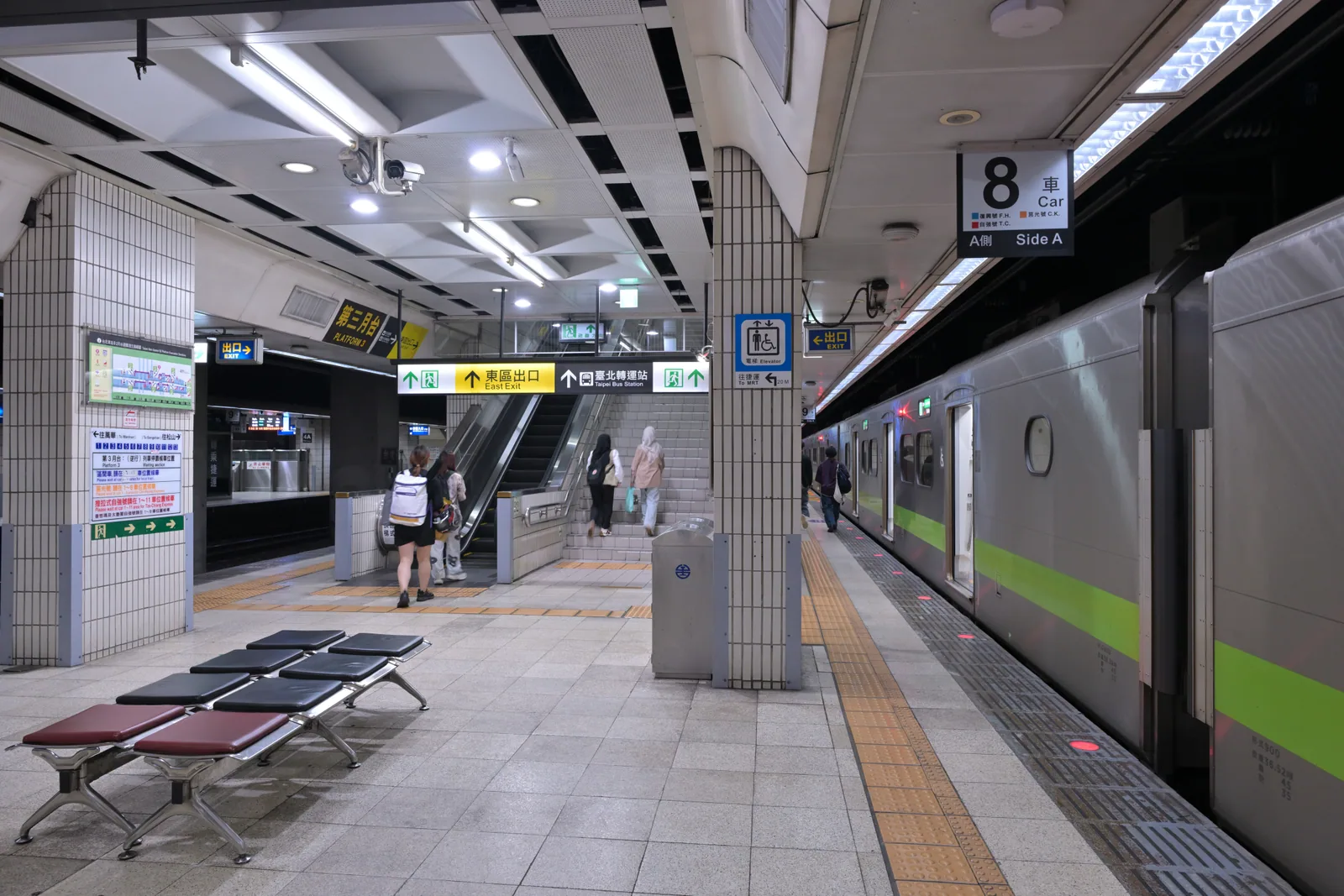
Image: Taipei Main Station platform and train; image by 4300streetcar, Wikimedia Commons, CC BY 4.0. The image depicts public transit space and does not interpret passengers in the frame as a statistical sample.4
Two Lines on the Platform
During rush hour on the Taipei Metro, queuing reveals its elegance most clearly: passengers stand behind the marked line, leaving a gap in the middle of the doors to let people exit the train first, then the queue moves forward in turn. The Taipei City Government describes this action concretely: "When waiting for the train, please queue in order, let passengers exit first before boarding."3 After boarding, don't block the doors, railings, or screens—move toward the interior of the car instead.
This arrangement doesn't rely on one person directing everyone. The lines on the floor, the space in front of the doors, and a group of people facing the same direction already make clear "what to do now." Queuing researcher Roberto Casati describes this mechanism as: the queue transforms invisible time priority into visible spatial priority. Whoever arrives first stands in front.5
So queuing is not simply lining people up in a row. It is a form of urban design that places strangers into the same script: without needing to know the person in front of you, without negotiating who is in more of a hurry, sight alone can read the order.
Escalators: From Standing Right to Standing on Both Sides
"Stand right, walk left" was once a familiar escalator guideline for Taipei Metro passengers: the right side was for standing, the left reserved for those in a hurry who continued walking. When the New Taipei City Government's Rapid Transit Engineering Office reviewed this habit, it also noted that Taipei Metro has now cancelled the stand-right requirement, instead reminding passengers to grip the handrail firmly and stand securely on the steps.6
Today, Taipei Metro officially continues to promote that both sides of the escalator can be used for standing, with "grip the handrail firmly, stand securely on the steps" as its safety motto. Stations remind passengers through yellow markings, the app, announcements, platform screens, and staff at major events to board in order and not to run.7 This is not an abolition of queuing rules, but a rewriting of "leave the left side for walkers" into "both sides can be safely occupied," transforming the escalator from a single etiquette of passage into a renegotiation between safety, capacity, and mutual respect.
This shift also reminds us that "civility" in public circulation is not a fixed answer. When rules change, passengers need to understand which objective has shifted: in the past, emphasis was on clearing the left corridor; now officials emphasize the handrail, standing securely, and using both sides. If we explain it only as "people used to be more polite" or "people are more selfish now," we miss how institutions redesign behavior based on safety and pedestrian flow.
How a Queue Entered City Life
Taiwan's queuing culture has two easily conflated turning points: the 1979 official campaign, and the March 28, 1996 opening of Taipei's first metro line. The former framed queuing as a bodily discipline citizens should master. The latter embedded that discipline into the daily rhythm of platforms, turnstiles, and train doors. Taipei City Government records show that the Muzha Line began operations on March 28, 1996 (Republic of China Year 85), transforming commuting patterns and the urban landscape.8
| Date | Verifiable Event | Significance for Queuing Life |
|---|---|---|
| 1979 | Taipei City Government launches the "Queuing Movement" | Queuing enters official discourse linking order, efficiency, and civilized conduct |
| March 28, 1996 | Taipei Metro Muzha Line opens for service | Queuing becomes embedded in fixed schedules, platform markings, and crowd management |
| 1990s onward | Automated ticketing systems and customer-priority attitudes emerge | Queuing extends from physical lines to service workflows and numbered sequences |
| Present day | Metro, restaurants, clinics, and ticketing systems coexist | Waiting can happen on-site or be managed through numbers and screens |
This table does not claim that all Taiwan queuing behavior stems directly from a single policy. It simply places together nodes supported by sources: an official campaign provided a vocabulary, the metro offered high-frequency public venues, and ticketing systems transformed sequence into trackable information.
How Did Taiwanese People Queue Before 1979? Historical Records Before Imagination
To answer "What did queuing look like for Taiwanese people before 1979?", the first obstacle is not a lack of Taiwan's history, but rather that "queuing" — a modern everyday term — may not be the classification used in early archival records of crowd order. Early materials more often documented port control, shipping traffic, grain requisition and rationing, population movement, school training, or police administration. They can tell us who was permitted to enter a certain process and which resources were regulated, but they don't necessarily tell us whether ordinary people stood shoulder-to-shoulder in a straight line.
| Period | Currently Verifiable Materials | What Can Be Said | What Cannot Be Directly Said |
|---|---|---|---|
| Dutch, Spanish, and Zheng Period | Port, maritime, and external relations research | Can discuss trading posts, military-political context, and port order | Cannot directly rewrite port control as everyday shopping queues |
| Qing Period | Official ports, coastal ports, and regional market network research | Can discuss inspection, taxation, shipping traffic, and market networks | Cannot infer modern straight-line queues from market gatherings |
| Japanese Colonial Period | Photographs, postcards, photo albums, statistical summaries, and paper archives | Can continue investigating concrete images of public space, schools, and transportation | Cannot describe general queuing based solely on archival catalog descriptions |
| Postwar to 1979 | Grain control, rationing systems, and daily life history research | Can discuss how resource acquisition was affected by eligibility, control, and supply systems | Cannot automatically equate rationing systems with everyone forming fixed queues |
Research on the Dutch period in Taiwan can provide background on Penghu and Taiwan's external relations and maritime activities from 1624–1661. However, the current focus of verifiable research is on political authority and external relations, not the queuing posture of ordinary residents at shops or windows.9 The Spanish and Zheng periods likewise cannot rely on later photographs or today's habits to reconstruct an "ancient Taiwan queuing scene." Without concrete archival evidence, it can only be listed as a gap in historical records awaiting investigation.
The Qing period actually offers more detailed port administration materials. Lin Yu-ju's research indicates that after the Kangxi Emperor incorporated Taiwan into the imperial territory in the twenty-third year of Kangxi's reign, the Qing court designated specific ports as nodes for landing, inspection, and taxation. Early Qing Taiwan's port trade was divided into foreign trade and coastal domestic trade, with small coastal ports gradually forming regional markets and external trade networks.10 These materials reveal the institutional possibility of "entering in sequence, undergoing inspection, and waiting for shipping or negotiation," but they do not provide sufficient evidence to describe the formation, positioning, or interaction of ordinary people when queuing, so this article does not rewrite port management as the origin of modern queuing culture.
Japanese colonial period archives have higher visibility, yet they also have preservation bias. The Institute of Taiwan History, Academia Sinica, notes that Japanese colonial materials include not only paper documents but also photographs, postcards, photo albums, picture postcards, statistical summaries, and graduation photographs.11 At the same time, photography was still expensive then, and ordinary families more often preserved images of major events like weddings and graduations.11 Therefore, old Japanese photographs are well-suited to investigating crowd order at stations, schools, streets, or public ceremonies, but each photograph must be verified for time, location, photographic purpose, and archival description — one cannot treat "looks like queuing" as proven queuing behavior.
The early postwar period had another kind of "waiting": grain control. The Taiwan Historical Records Institute compiled grain control from 1945–1949, indicating that the early postwar period continued the total requisition and total rationing system from the late Japanese period, involving issues of rationing eligibility, rice control, grain export, and smuggling.12 This shows that people's access to grain was affected by state control, eligibility, and supply conditions. However, the research summary does not describe how ordinary citizens stood at rationing points or how they maintained order, so the most prudent phrasing is "resource acquisition was institutionalized," rather than "people were already queuing the way they do today."
Thus, Taiwan before 1979 was not without collective waiting, sequential processing, or regulated procedures. Rather, the focus of currently available public historical records is largely on ports, grain, population, schools, and governance — not the bodily details of those queuing. The real turning point where "queuing" was explicitly named as a civic virtue, efficiency, and order issue, and left behind comprehensive urban governance research subjects, was the 1979 Taipei queuing movement.1
1979: When Queuing Was a Movement
Taiwan's familiarity with "queuing properly" today cannot be explained by national character alone. Scholar Wang Chih-hung points out that in January 1979, then-Taipei Mayor Lee Teng-hui proposed the queuing movement concept, which was then promoted through the city government system. Research places it within Taiwan's everyday life history, analyzing it as a mode of governance that trains social order, efficiency, and civilized conduct through bodily habit under the language of modernization.1 The "large-scale" here should be understood as the governance scale of municipal mobilization and public advocacy; this article does not independently add figures for participation numbers or nationwide impact.
The same research also reminds us that this history is not a straight line. The queuing movement of the 1970s carried top-down disciplinary overtones. By the 1990s, as the Taipei Metro began operations, the "customer-first" mentality of consumer society accelerated, and automated ticketing systems and urban middle-class etiquette supported yet another form of queuing culture.1
There is a noteworthy shift here: the appearance of queuing did not change, but the reason for queuing did. Early on, people were told to become orderly citizens. Later, people also began to demand that shops, stations, and public services give everyone the same sequence. The full text of the National Taiwan University paper and the Airiti abstract both point to the same research subject, but the two article pages serve different functions: the former provides the full paper text, the latter provides bibliographic and abstract indexing.1 2
📝 Curator's Note: Describing queuing only as "Taiwanese people are very polite" misses its most interesting transformation. Queuing was once something the government taught people to do; now, queuing has also become a measure by which people check whether the system treats them fairly. Order has not disappeared—only the number of people judging order has increased.
From Body Discipline to Ticket Dispensers
In queues without ticket dispensers, people must remember where they stand. If someone leaves to buy a drink, they must confirm their position with those in front and behind when they return. Ticket dispensers transfer "where I am in line" to a numbered slip, converting the physical line into information that allows waiting, leaving, and returning.
This shift also redistributes responsibility. In a physical queue, others can directly see whether you have left. With ticket dispensers, the business must clarify which number is currently being served, how to handle skipped numbers, and whether companions can collect orders on behalf of others. Fairness is no longer maintained solely by the bodies of those queuing, but also by the transparency of the service process.
This also explains why popular restaurants, clinics, and service counters in Taiwan often have two types of queues simultaneously: one of people on the ground, and one of numbers on a screen. MIT Press Reader's analysis of queuing indicates that the basic rules of a queue include first-come-first-served, newcomers joining the back, and not skipping ahead before the previous person is served. The ticket system simply displays these rules using numbers.5
The systematization is more evident in Taipei's MRT. Public transit etiquette demands not only "don't cut in line," but also "exit before entering," "don't block the doors," and "direct foot traffic toward the interior of the car." It breaks down moral demands into individually designable actions, so that order need not rely entirely on passengers' self-restraint.3
This approach remains controversial. Research archived in CUNY Academic Works examines Taipei MRT etiquette, civic values, and priority seating disputes, reminding us that public courtesy is not merely about quiet or tidiness—it also touches on who should give up seats, who is entitled to use priority spaces, and how different bodily needs are made visible.13
Digital Queuing: People Leave the Line, Order Stays Behind
Online queue-number systems don't eliminate queuing—they temporarily remove people from the physical line. Take Chunghwa Post's official service as an example: users can obtain a queue number via computer or mobile device, then visit the post office to conduct their business. The service also explicitly states that online queue numbers are valid only on the day of issue; if your number is called and missed, you must take a new one.14 The "virtual queue" here still preserves order—it simply rewrites the line from bodies and floor space into smartphone screens and service systems.
Digital queuing thus introduces three new problems. First, can users see their current progress? Second, do people without smartphones, internet access, or familiarity with the system still have an in-person alternative? Third, who bears responsibility when the system fails or a number is missed? Physical-queue unfairness typically shows up as queue-jumping; virtual-queue unfairness may hide in login requirements, verification, notifications, and operational literacy. This is not to say online queue numbers necessarily exclude the disadvantaged—rather, it reminds us that once a queue goes digital, the checkpoints for fairness shift location too.
Cross-Cultural Comparison: Queuing Is Not Innate Character
A 2017 book excerpt from The News Lens used the author's observations of queuing at ice cream shops, restaurants, and clinics in Taiwan, contrasted with their experience of making advance appointments at Swedish banks where staff prepared documents beforehand. The article is the author's personal observation, not cross-national statistics. But it offers a useful counterpoint: Taiwanese people are not necessarily "born to queue," but rather accustomed to delegating order to on-site queues, numbered tickets, and service windows.15
The comparison is not about judging which culture is superior, but about recognizing how waiting is institutionally arranged. Taiwan's common practice of on-site queuing makes the first-come-first-served principle publicly visible. Appointment systems, by contrast, relocate waiting to before the service: they require users to provide information in advance, select a time slot, and assume responsibility for arriving on time. Both systems require rules, and both can inconvenience certain people. Queue culture is therefore not an answer rooted in national character, but rather a practice people learn within specific urban, service, and temporal systems.
Following the Queue and Refusing to Queue: Two Sides of the Same Social Pressure
In 2018, Shiqi Qiqi (志祺七七) from SimpleInfo used everyday scenes in Tainan—beef soup stalls, beverage shops, and mango shaved ice vendors—to examine whether the statement "Taiwanese people just love queuing" oversimplifies the phenomenon. The program also placed queue-following within cross-national examples, noting that new store openings, popular products, and limited-quantity events can generate long lines in different places. These are the program's observations and synthesis, not statistical comparisons of queuing behavior across countries.16
What this article most deserves to preserve is not any particular queuing duration, but rather that it reserves space for both those "willing to queue" and those "unwilling to queue." People willing to queue may view the line as a signal of anticipation, curiosity, social conversation, or reduced risk of disappointment. Those refusing to queue convert that same time into exercise, work, rest, or time with friends. Both choices relate to time cost, and both can generate group identity. Queuing culture therefore encompasses not only "why does everyone follow along," but also "why do some people deliberately refuse to follow along."16
This angle connects with the marketing analysis presented earlier: when long queues are perceived as a social signal of quality or popularity, the line itself may attract more people to join. When waiting exceeds what an individual finds acceptable, refusing to join also becomes a rational life arrangement. Rather than framing the "bandwagon effect" as a single proven psychological trait of Taiwanese people, this article treats SimpleInfo's popular analysis as a gateway to understanding lived experience.
Four Readings of Queuing
Queuing can simultaneously be understood as traffic flow, service process, physical discipline, and fairness standard. Separating these prevents a single phrase like "did you queue properly?" from obscuring the differences across contexts.
| Context | Main Rule | Who Designs Order | Common Fairness Issues |
|---|---|---|---|
| MRT platform | Exit first, then board in sequence | Station markings, announcements, and passengers collectively maintain | Door congestion, priority seating and accessibility needs |
| Restaurant waiting area | Take a number, wait for call, handle timeouts | Restaurant workflow and queuing system | Queue jumping, missed numbers, companions waiting in someone's place |
| Service counter | First come, first served | Ticket machine, counter, and service staff | Number skipping, lack of transparency, unmet special needs |
| Holiday events | Collect items in sequence, await distribution | Organizers and on-site flow | Overcrowding, mismatch between quota and wait time |
The same person may follow exit-first-board-second on the platform, yet accept a friend going ahead to grab a number at a popular restaurant. This need not be a double standard—it reflects how different contexts define "who arrived first" differently. When systems clarify this definition, queues require less enforcement through the disapproving stares of bystanders.
Time in Line: Who Deserves to Be Seen
Queuing also appears in public spaces not organized around consumption. Lines at polling stations are not formed to purchase goods first, but to complete a civic procedure in order. This transforms "first come, first served" into "first to complete identity verification and receive ballot." Images of Taipei voters queuing to vote in 2014, and the corridor lines at Yixue Junior High School during the 2018 New Taipei local elections, present the same action in two different architectural spaces: people transforming waiting into a recognizable sequence.17 18
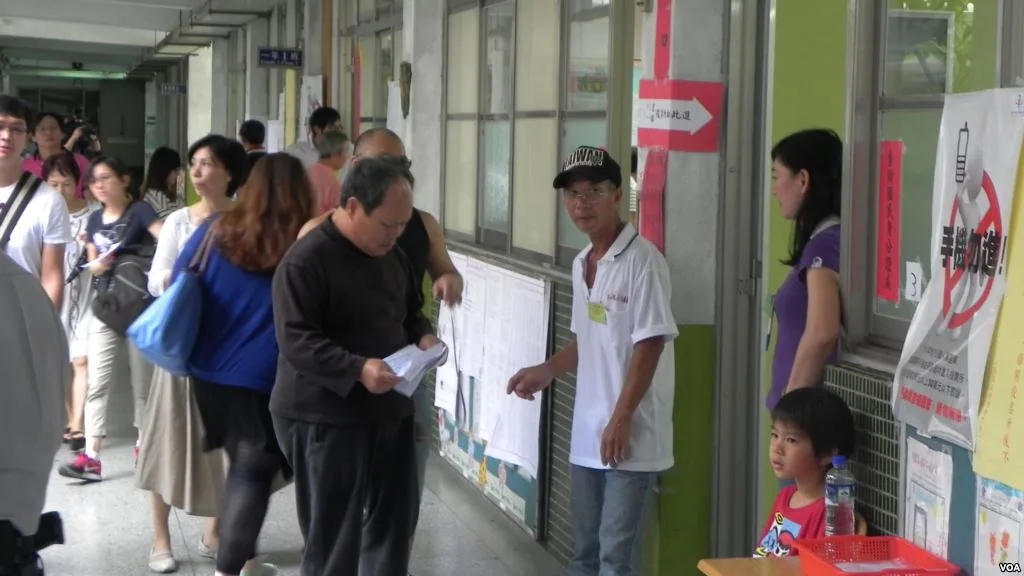
Image: Taipei voters queuing to vote in 2014; photographed by Xu Bo for Voice of America, marked as public domain on Wikimedia Commons.17
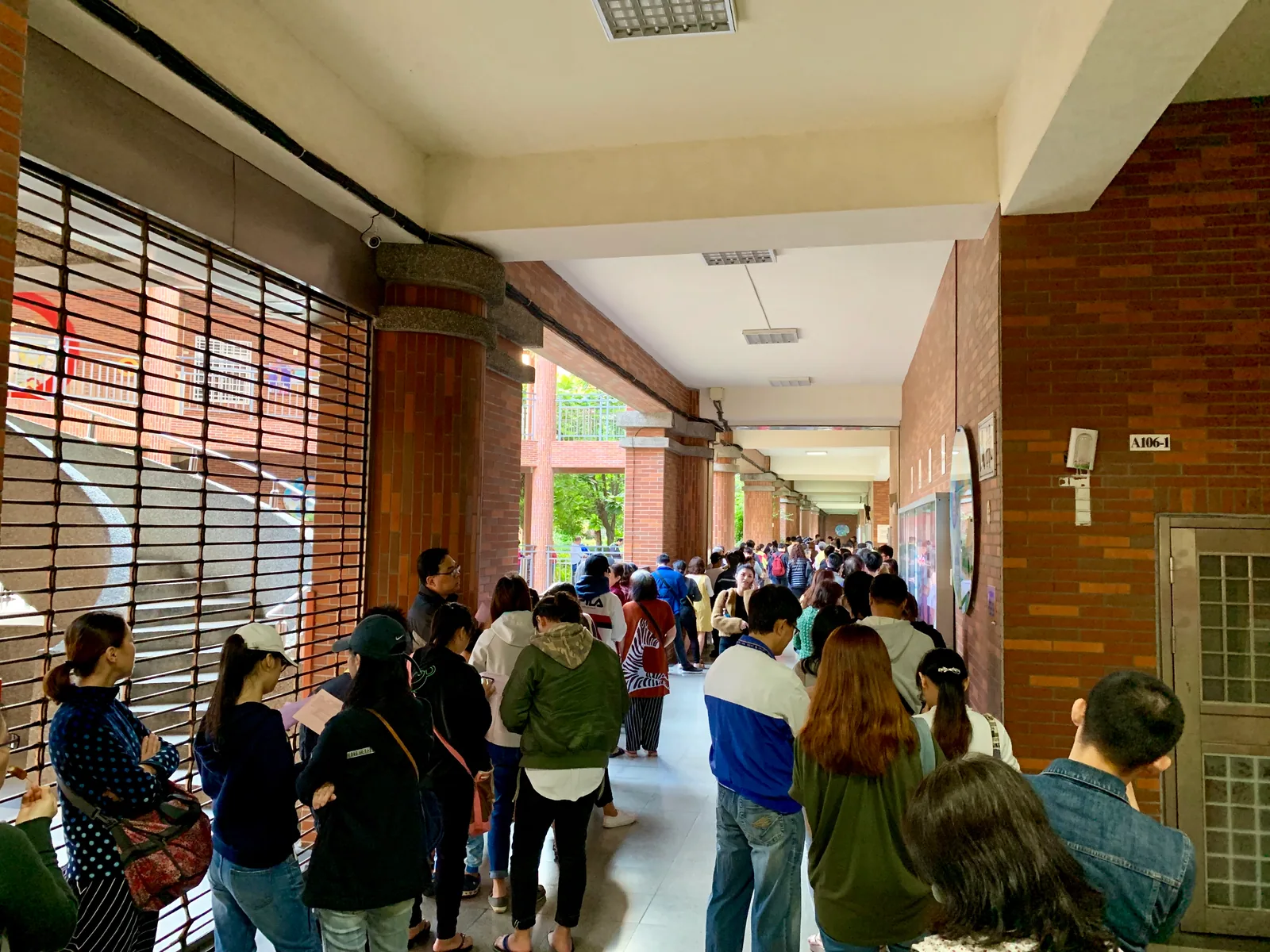
Image: Queuing at Yixue Junior High School during 2018 New Taipei local elections; by author Meow, Wikimedia Commons, CC BY-SA 4.0.18
"First come, first served" appears neutral, yet it still requires managing the different waiting costs of different people. For those requiring wheelchair access, the queuing line on the platform must be compatible with accessible routes. For those with young children, if waiting rules lack clear priority arrangements, all caregiving responsibility may fall back on the individual. For those needing urgent medical care or document processing, the fairness of a number-dispensing system depends on whether its categories are reasonable.
Therefore, a good queuing system does not force everyone into a single straight line, but allows general order, priority needs, and exceptions to all be explained. CUNY Academic Works' research on Taipei MRT etiquette and priority seating disputes does precisely this: it pulls "civility" back from neat appearances to the question of how public space distributes care and respect.13
The Queue Disruption Caused by COVID
The pandemic changed both the appearance and purpose of queuing. In 2021, the Taichung City Government documented COVID-prevention arrangements for its charity food bank distribution: queuing areas maintained 1.5 meters of social distance indoors and 1 meter outdoors. On-site procedures included real-name registration, temperature checks, hand sanitization, and mask verification. If more than 30 households were served on a given day, advance notice was provided for staggered collection, and volunteers delivered supplies to the entrance to reduce crowding.19
This official record is significant because it shows that COVID did not simply make everyone "queue more neatly." Instead, it broke a single line into intervals, staggered flows, entrance controls, and alternative delivery methods. For recipients, waiting still existed. But the system simultaneously had to reduce infection risk and prevent the need for aid from becoming a new source of exposure. Queuing shifted from "maintaining order with one another" to "redesigning contact methods under risk conditions."
After the pandemic, many services retained online reservations, staggered scheduling, and queue-number systems. However, the increase in systems should not be assumed to work equally for everyone. Digital access, travel distance, language, physical condition, and caregiving responsibilities all affect whether someone can enter a virtual or physical queue on time. What COVID exposed was not the disappearance of queuing, but rather that different people bear the costs of waiting and risk in different ways.
Voting Queues Are Not Consumer Queues
The distinctive feature of voting queues lies in how they place individual waiting and procedural justice in the same physical space. In a 2018 press release, the Taipei City Election Commission documented how crowds on voting day delayed voting by nearly 4 hours. Election officials responded by having administrators check voter identification and polling locations at 3:40 p.m., having police officers position themselves at the end of the queue at 4 p.m., deploying additional staff, and adjusting screens to manage the crowd. These details reveal that queues are not simply "people lining up on their own," but rather an integral part of the election administration system.20
The Central Election Commission's guidance also treats "arriving at the polling place and queuing for a ballot before the voting deadline" as a critical threshold. In other words, the end of the queue is not merely a spatial location, but rather the procedural point that determines whether a voter can still complete their vote.21
This differs significantly from restaurant waiting lists. When a restaurant's number is called, it typically means rescheduling a single dining opportunity. If a voting queue lacks clear confirmation of its end, what is at stake is whether citizens can exercise their right to vote. Queuing here is not merely a matter of courtesy, but rather the conversion of a right into an operational process on the ground.
📝 Curator's Note: The most important aspect of a queue is not how orderly it appears, but whether the person at the end knows whether they are still recognized by the system.
Regional Differences and Exclusion of the Vulnerable
The photographs and cases in this article span Taipei platforms, Zuoying High Speed Rail Station, Nantou temples, Taichung material distribution, and Songshan street food vendors. While they can be juxtaposed, they cannot directly prove that queuing culture is identical across Taiwan. Queues at urban transit hubs are governed by train schedules and passenger time constraints; temple lucky bags are shaped by festival activities and venue flow patterns; street food stalls are determined by arcade structures, motorcycles, and shop dimensions. Regional differences first manifest in the spaces and services that queues depend on, rather than in impressionistic judgments like "the north is more orderly, the south more personable."22 23 24
Exclusion of the vulnerable often occurs outside the queue itself. Research on age-friendly cities by the Architecture and Building Research Center of the Ministry of the Interior points out that Taiwan's accessible public spaces require examining building interfaces, transportation, arcades, parks, sidewalks, and intersections in an integrated way, and must account for usage differences among elderly people with varying degrees of disability in public spaces.25 For queuing, this means that a seemingly fair straight line may still exclude some people from the system if it blocks wheelchair access, lacks sufficient rest areas, or provides no visual or auditory cues.
Therefore, fairness does not mean everyone standing on the same line. More complete queuing rules should simultaneously explain standard order, priority needs, alternative routes, and ways to seek assistance. Otherwise, "everyone is the same" is merely a surface equality that hides difference away.
Why Queue Jumping Makes People So Angry
Queue jumping often doesn't steal many minutes—it steals others' trust in the order itself. When someone moves from the back of the line to the front, they change more than one person's wait time; they make everyone reconsider: is each position ahead earned by arrival time, or can it be exchanged for a loud voice, connections, and shamelessness?
Queuing rules work because they are easy to see. MIT Press Reader notes that queuing lets each participant demonstrate to others "how this game is played." Even the last person in line, though they may not gain practical benefit, maintains the system's recognizability by standing in the queue.5
This perspective explains Taiwanese people's complex feelings about "saving a spot for a friend." If it's just reserving a place for someone with mobility difficulties or who stepped away temporarily to buy a ticket, people may accept it. But if someone hasn't yet arrived and a whole group suddenly cuts in from the back, the dispute is no longer about a few positions—it's about the entire queue's timeline being rewritten. Rules need exceptions, but exceptions must also be understandable to bystanders, or fairness loses its visibility.
What Foreigners See as Etiquette, Taiwanese People Bear as Cost
An outside observer who came to Taiwan in 2015, Barnabé Monnot, discussed phone etiquette on the Taipei MRT in relation to public rules: the norms on the Taipei MRT do not uniformly prohibit phone calls, but rather ask callers to be mindful of their surroundings and minimize disruption to others. The author also explicitly acknowledges that this is personal intuition rather than data-driven proof.26
This qualification is important. Foreign observation can capture a detail that Taiwanese people have long stopped noticing, but it cannot draw conclusions for an entire society. Its greatest value lies in revealing a tendency in Taiwan's public order: rules need not be maintained solely through prohibition, but can also operate through "you may do it, but please minimize the external cost to others." The first-come-first-served principle of queuing and the "exit before boarding" rule on the MRT are different versions of the same logic.
But queuing does not automatically equal fairness. Waiting time carries different costs for the elderly, pregnant women, people with disabilities, those with children, and temporary workers who must work. If a system simply places everyone in the same line without providing reasonable priority lanes or alternatives, it may only hide differences beneath the surface of "everyone is the same." The recurring controversy over MRT priority seating exists precisely because public etiquette simultaneously addresses both equality and difference.13
Lunar New Year Lucky Bags: Waiting as a Form of Participation
Queuing takes on yet another dimension in Lunar New Year activities. A photo of the Jieyu Temple lucky bag distribution, provided by a user and sourced from the Presidential Office collection on Wikimedia Commons, shows crowds lined up along the temple plaza awaiting the distribution of lucky bags. The image provides no data on total attendance, wait times, or event outcomes, and thus serves only as a concrete scene—it cannot be used to generalize about all Lunar New Year activities.27
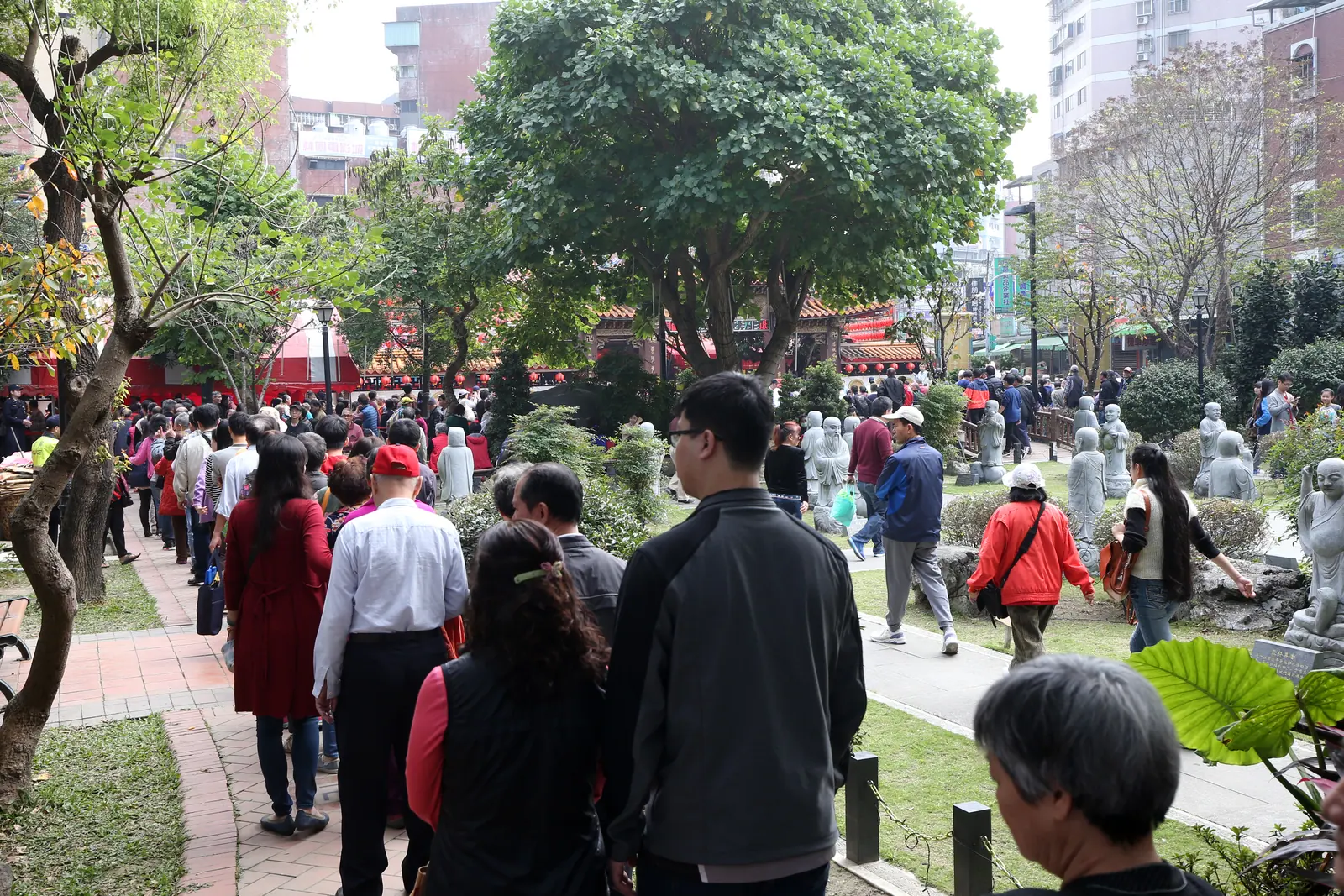
Image: Queue at Jieyu Temple plaza awaiting the President's distribution of lucky bags; original source from the Presidential Office Flickr, Wikimedia Commons page marked CC BY 2.0.27
.jpg?width=960)
Image: Queue at Songbai Ridge Receiving Heaven Temple in Nantou awaiting Lunar New Year lucky bags; original Flickr image from the Presidential Office / Taiwan Presidential Office, marked CC BY 2.0 on Wikimedia Commons. This photograph captures an outdoor queue and the activity scene under sunlight, but provides no statistics on attendance or wait times.22
What Lunar New Year queuing and MRT queuing have in common is that both require converting human flow into order. The difference lies in the value of the lucky bag queue: it extends beyond simply "obtaining an item" to encompassing participation in a ritually meaningful activity. Waiting thus becomes not purely a cost but potentially a way for people to confirm "I was here, I participated." This is a cultural reading of the photographic scene, not a statistical judgment about all participants' motivations.
Coffee Queues at Transit Hubs
A photograph of the Starbucks queue at Zuoying High Speed Rail Station places Taiwan's queuing culture in an easily overlooked hybrid space: passengers are in transit, yet the shop requires them to pause temporarily. The queue here is simultaneously shaped by train schedules, luggage, travel companions, and counter flow. It differs from street-side snack queues because those waiting may only be using a transfer window to complete a quick purchase. Yet both require a visible path that makes clear "where the last person is." 23

Figure: Passengers queuing to purchase Starbucks coffee in the Zuoying High Speed Rail Station hall in 2015; photographer Hsuan Shih-sheng, Wikimedia Commons, CC0 1.0. 23
Promotions, Contract Renewals, and Lines Outside Retail Stores
A photograph of a Chunghwa Telecom 4G plan queue offers another cause of queuing: not fixed schedules or festival rituals, but time-limited promotions that concentrate a large volume of service requests at a single window. The Wikimedia Commons file description places it in the May 2018 surge of contract renewals for the 4G NT$499 plan ahead of Mother's Day. This article uses only the time, location, and service context explicitly recorded on the file page, and does not extend the "499 chaos" into unverified market-scale claims.28

Figure: Queue outside a Chunghwa Telecom store in Songshan District, May 2018, applying for 4G plans; photographer 玄史生, Wikimedia Commons, CC0 1.0.28
Local Snacks and Street Space
The queue at the popiah stall on Xindong Street brings the issue back to the most everyday scale. In the photograph, the line forms near the shop front and under the arcade, with parked scooters alongside. The purchase thus takes place not only inside the shop but also involves the pedestrian space, arcade width, roadside parking, and nighttime lighting. This kind of queue doesn't necessarily require a number-dispensing machine, but it does require an unspoken understanding: who is already in line, who is merely standing nearby waiting for companions, and who has just finished buying and is leaving.24

Figure: Evening queue to purchase popiah on Xindong Street, Songshan District, after the Qingming holiday in 2018; photographer Hsuan Shih-sheng, Wikimedia Commons, CC0 1.0.24
Queuing and Appointments: Waiting Doesn't Always Mean Standing
A 2017 book excerpt published by The News Lens begins with the author's observations of life in Taiwan—numbered tickets at ice cream shops, queues at clinics and restaurants—and asks why people are willing to give their time to a line. This is the author's experiential writing, not a national statistical study of Taiwan's queuing behavior. Its value lies in reframing the question from "how long do we queue?" to another one: Is the time spent waiting transformed by the system into better service?15
The article also contrasts the author's experience making a loan appointment at a Swedish bank with Taiwan's practice of drawing a number ticket first, then gradually explaining one's needs at the counter. This comparison cannot be used to generalize about all Taiwanese banks or Swedish services, but it helps us distinguish two forms of waiting: on-site queuing makes the order publicly visible, while appointment systems move waiting to before the transaction, allowing staff to prepare documents in advance. Neither eliminates waiting; they simply place it at different points in the process.15
| Form of Waiting | What People Can See | What the System Must Clarify |
|---|---|---|
| On-site queuing | Queue length, back of line, order of people | How to get a number, what happens if you miss your turn, whether the queue still accepts people at the end |
| Numbered ticket | Current number and calling progress | What number is being called now, whether you can leave, how to reschedule if you miss your turn |
| Appointment service | Appointment time slot and service window | What information to provide beforehand, how to handle lateness and rescheduling |
This comparison adds an important perspective to Taiwan's queuing culture: people don't necessarily prefer "standing and waiting," but rather accept a particular form of waiting within a familiar service system. When an on-site queue can clearly explain the order, standing feels fair. When an appointment allows staff to prepare in advance, providing information beforehand may be more efficient than starting the conversation on-site. The prerequisite is that the system must let users know what they are waiting for and how the next step will unfold. This is an extension of the cited article's perspective, not a direct application of Swedish experience as evidence for Taiwan's system.
Economics and Marketing: Waiting as a Commodity
Queuing is not merely a matter of public etiquette—it can also be a business strategy. A 2007 case study in 《Commonwealth Magazine》 examined examples such as Hoshino dorayaki, Yunique Patisserie, and Black Master Swiss roll, describing how limited production, word-of-mouth, product storytelling, and waiting together manufacture a sense of scarcity. Interviewees in the report even identified "queuing, limited quantity, waiting" as keywords for food business success.29
It is important to maintain boundaries here: these are media case studies and interviewee perspectives, not evidence that all queuing establishments deliberately manipulate scarcity, nor can a long queue photograph be used to infer product quality. A more useful analysis is that when queues are photographed, shared, commented on, and covered by media, the queue itself may become part of the brand narrative. Consumers are not only waiting for a product—they are waiting for an experience worth sharing.
Consequently, the economic dimension of queuing intersects with questions of fairness. If limited quantity and waiting make a product more attractive, businesses must address the traffic, shade, neighborhood, and information costs created by long lines. If a brand treats crowds merely as marketing material without clearly communicating inventory, estimated wait times, and purchase limits, consumers bear not just time but uncertainty. Good service design should allow anticipation to exist, but cannot manufacture it through information opacity.
Psychological Cues: Why Do People Follow the Queue?
"Large crowds" signifies not just that people are ahead, but can also be read as a quality signal. Storm Media republished clinical psychologist Lu Yan-you's perspective, linking queue-following to conformity, the search for security, and a sense of belonging. This helps us understand real-life situations where people "don't know what they're queuing for, but join the line anyway," but it represents a psychologist's media commentary, not representative psychological statistics for Taiwanese people.30
104 Workplace Skills, by contrast, starts from everyday observation and translates the patience, advance planning, information exchange, and initiative that long queues may demand into workplace soft skills. This framing works well to describe the capabilities queue participants display in specific contexts, but it is not appropriate to reverse-engineer into a causal claim that "queuing necessarily develops soft skills." The same person might simply be weighing the product, time, and companions before making a purchasing decision.31
📝 Curator's Note: Crowds can create anticipation for a product, but they cannot complete verification of it. What is most worth observing about queuing is not whether everyone follows along, but how each person judges whether "this wait is worth it."
Queue-Jumping Reactions: Fair Play Extends Beyond Slogans
Sanlih E-News reported on an online survey by Pollster. The survey collected 1,762 valid responses on April 7, 2016, asking respondents how they would react upon witnessing queue-jumping. The report classified "politely asking the person to queue," "asking staff to handle it," and "loudly stopping them" as active responses, totaling 51.4%, with the remainder classified as passive responses, totaling 48.6%.32
These figures can be used to describe that "queue-jumping triggers fairness judgments," but they cannot be presented as precise proportions of Taiwan's entire population. This is because the report notes that the sample came from real-time voting by members of an online platform, not a probability sample of Taiwan's population. Moreover, "active" and "passive" are analytical categories created by the reporter through reclassifying different response options. In other words, the power of queuing rules lies not only in whether people are willing to stand in line, but also in whether bystanders feel they have a responsibility to respond when someone breaks the order.
Waiting Has a Sweet Spot, But No Universal Minute Count Across Taiwan
Research on waiting times at Taiwan's theme parks provides a concrete figure that is also easily misused. A media report published by National Chung Hsing University noted that the study surveyed 1,440 visitors across five theme parks: Jiuzu Cultural Village, Janfusun Fancyworld, Leofoo Village Theme Park, Little People Kingdom, and Lihpao Land. The average maximum acceptable wait time respondents were willing to tolerate for their favorite attractions was 17.89 minutes, and the research report described approximately 30 minutes as a range where emotional shifts might occur.33
A NOWnews report carried by Fansinews and Yahoo News further listed the standard deviation of 17.89 minutes as 11.38 minutes, and presented an acceptable range of 6.51 to 29.27 minutes reflecting variation under different environmental factors. These three article pages and the report from 《CriticalNews》 all point to the same study, making them cross-verification of different reports on a single study rather than four independent samples.34 35 36
The true value of this research is not to set a rule that "all Taiwan queues can wait no more than 17.89 minutes," but rather to remind service designers that wait time interacts with expectations, attraction appeal, perceived crowding, and quality judgments. Theme park rides, restaurant seating queues, registration lines, and polling places each serve different purposes and carry different risks—the average from one context cannot be directly transferred to another.
| Data Type | What It Can Support | What Should Not Be Extended |
|---|---|---|
| Psychologist media perspective | Conformity, sense of security, and belonging are possible clues to understanding queue-following behavior | All Taiwanese people share the same queuing psychology |
| Online survey report | Within a specific sample, there are different ways to respond to queue jumping | 51.4% represents all Taiwanese people stopping queue jumpers |
| Theme park research report | Wait time results for 1,440 visitors across five specific parks | 17.89 minutes is a universal upper limit for all queuing scenarios |
| 104 Life/Workplace article | Queuing can be reinterpreted as observation of patience, planning, and communication | Queuing necessarily leads to improved workplace skills |
Queues Are Getting Longer, and Being Redesigned
Lines in front of popular restaurants, waiting sequences on concert ticket pages, registration numbers at medical facilities—queuing has extended from street corners to screens. A Kinmen Daily article documenting Lunar New Year life also wrote long waits for gift vouchers and food into family memory during local temple visits. It's not a nationwide survey, yet it reminds us that queuing often happens in the most ordinary, and most memorable, scenes of daily life.37 People don't necessarily stand together, yet they still wait for the same resource. MIT Press Reader views queues as a dynamic map of time and space: they must keep moving; stagnation erodes participants' trust in the system.5
This is why "how long" is not the only question. "Do I know how much longer I'll wait?" "Will someone suddenly cut in?" "Can I make up my place if the number skips me?" These questions determine whether waiting feels fair. Ticket-dispensing machines, clear queuing rules, and platform flows that board last and exit first all work to reduce uncertainty, rather than eliminate waiting itself.3 5
Research on Taipei's "queuing movement" places 1979 official promotion campaigns alongside 1990s-onward MRT systems, ticket machines, and consumer culture in the same historical arc. This lets us avoid mythologizing today's queuing as innate character, nor reduce it to the result of government training. The more accurate account is: institutions first provide forms worth imitating, and urban life then routinizes those forms through services, transit, and consumption.1 2 38
How Queuing Rules Take Root
Queuing rules are not built into human character at birth; they are taught, observed, corrected, and internalized through repeated scenarios. Taipei's 1979 queuing movement offers a historical example of government-led promotion of order, efficiency, and civic conduct. The marked lines on MRT platforms, announcements, and the practice of exiting before boarding break down abstract civility into daily repeatable actions. Research on Taipei's queuing movement describes this shift as a transition from "disciplinary queuing" to "service-oriented queuing."1 3
Rule formation has at least four sources: promotion makes people aware of the rule's name, space shows people where to stand, process clarifies the sequence of taking a number and completing service, and others' reactions let people feel the consequences of queue jumping or blocking doors. When these four elements repeat over time, queuing no longer requires renegotiation each time. People follow rules not because they know each other, but because strangers can read the same set of cues to understand what comes next.
Yet rules are also relearned through exceptions. Providing priority for elderly people, pregnant women, people with disabilities, or those carrying infants does not cancel the sequence—it expands "fairness" from a simple first-come-first-served principle to explainable care arrangements. If exceptions are not clearly marked, bystanders easily mistake necessary assistance for queue jumping. If all exceptions depend only on personal interpretation, vulnerable people must bear the cost of publicly explaining their circumstances. The true sign of mature rules is not that lines are always perfectly straight, but that both standard order and reasonable exceptions can be clearly managed by the system.25
Three Management Levels of Queuing Systems
Comparing different scenarios reveals that queuing extends beyond the moment of "standing in a line." It encompasses at least three management levels: first, arrival, where the system must make clear where the queue begins and who is last. Second, confirmation, through ticket numbers, identity verification, or polling place checks, converting "I am waiting" into a state the system can recognize. Third, completion, where staff, number-display screens, or election procedures inform people whose turn it is, and how to handle missed numbers, errors, or overcrowding.5 20 21
| Management Level | Daily Question | Visible System Tools |
|---|---|---|
| Arrival | Where does the queue start? Where is the last person? | Floor markings, queue-end signs, staff guidance |
| Confirmation | Have I secured my place in order? Am I in the right location? | Ticket numbers, identity checks, polling place verification |
| Completion | When is it my turn? What happens if I miss my number or there's overcrowding? | Number-display screens, rules for missed numbers, queue-end confirmation and staff allocation |
This model also explains why "whether people are queuing" should not be judged from photographs alone. Images can show the line formation after arrival, but they may not reveal how numbers are distributed, who manages confirmation, or whether the queue ultimately completes service. Understanding queuing culture requires viewing people's bodies, spatial markings, and backend processes together.
Staying in Line, Waiting for an Answer Everyone Can Understand
Next time you queue on an MRT platform, notice how that line allocates positions among strangers. While waiting at a restaurant, observe how a ticket number transforms people from a physical line into a traceable sequence of digits. These tools all answer the same question: whose turn is it?
Taiwan's queuing culture has a top-down history, but its persistence in daily life today is not solely because people fear criticism. More importantly, most people understand that when order is transparent, they can confidently entrust their few minutes to strangers. Queuing converts time into space, and finally converts space into a promise: I will not take your place, and I trust you will not take mine.
References
- Order, Efficiency and Civilized Conduct: Analysis of Taipei's "Queuing Movement" — Wang Zhihong, Airiti Library↩234567
- Order, Efficiency and Civilized Conduct: Analysis of Taipei's "Queuing Movement" — Wang Zhihong, Taiwan Social Research Quarterly Issue 14, National Taiwan University Institute of Building and Urban Planning open PDF↩23
- These behaviors were described by media and netizens as the "Four Major MRT Taboos" — Taipei City Government: See supplementary information in the original link↩2345
- Taipei Main Station platform 3 May 2025.jpg — 4300streetcar, Wikimedia Commons, CC BY 4.0↩
- On Queuing: The Cognitive Logic Behind Lines — Roberto Casati, The MIT Press Reader↩23456
- Which Country First Proposed Standing to the Right on Escalators? — New Taipei City Government MRT Engineering Bureau, 2022-02-09↩
- Taipei MRT Strengthens Promotion That Both Sides of Escalators Can Be Stood On — Thank You Passengers for Mutual Respect and Maintaining Good MRT Riding Culture — Taipei Mass Rapid Transit Corporation↩
- Rising from the Ashes to Evolve and Rebirth, Refined Through Adversity to Open New Horizons! Taipei Metro Turns 30 with Safety and Reliability — Taipei City Government: See supplementary information in the original link↩
- A Study of Penghu's External Relations During the Dutch Colonial Period in Taiwan (1624-1661) — Xia Liangchen, Taiwan Historical Association Newsletter↩
- From Private Ports to Small Ports: The Opening of Regional Port Foreign Trade in Late Qing Taiwan — Lin Yuru, Taiwan Commercial Traditions in Comparative Perspective, Institute of Taiwan History, Academia Sinica↩
- Japanese Colonial Period — Archives Division, Institute of Taiwan History, Academia Sinica, Taiwan Historical Archives Resource Network↩2
- Food Control in Taiwan in the Early Postwar Period (1945-1949) — Taiwan Historical Documents Museum: See supplementary data in the original link↩
- Civility and Its Discontents: Subway Etiquette, Civic Values, and Political Subjectivity in Global Taiwan — A. Lee, CUNY Academic Works↩23
- Chunghwa Post - Online Queue Number Service — Chunghwa Post Co., Ltd., My e-Government↩
- Is Taiwanese People's Time Cheap? Swedes Don't Like Queuing Much, Need to Make an Appointment Even to Go to the Bank — Xie Suning, Fiona Zheng, The News Lens International, 2017-07-20↩23
- Is Long Queuing Wrong! Is Queuing a Taiwanese Specialty? 《Taiwan Absurd Phenomena Collection》EP001 — Zhiqi Qiqi, SimpleInfo, 2018-06-01↩2
- 2014 Taiwan voters queuing to vote.jpg — Voice of America Xu Bo, Wikimedia Commons, Public Domain↩2
- Queue for 2018 Taiwanese local elections at Yixue Junior High School.jpg — Meow, Wikimedia Commons, CC BY-SA 4.0↩2
- Charity Food Bank Material Distribution - Continuous Care for Disadvantaged Families — Taichung City Government, 2021-06-26↩
- Press Release: Taipei City Election Commission Handles Election Affairs in Accordance with Relevant Laws and Regulations, Thanking Over 30,000 Election Staff for Their Dedication and Effort — Taipei City Election Commission: See supplementary information in the original link↩2
- According to current Public Officials Election and Recall Act regulations, polling places shall be converted to counting stations immediately after voting is completed — Central Election Commission: See supplementary information in the original link↩2
- 02.18 President on Third Day of Lunar New Year Distributes New Year Lucky Bags at Songbai Ridge Receiving Heaven Temple in Nantou, Citizens Waiting in the Hot Sun Can Barely Conceal Their Excitement (38525638810).jpg — Presidential Office / Taiwan Presidential Office, Wikimedia Commons, CC BY 2.0↩2
- Visitors Buying Starbucks Coffee in THSR Zuoying Station 20151129.jpg — Xuanshisheng, Wikimedia Commons, CC0 1.0↩23
- Queue of Buying Popiah at Xindong Street, Songshan District, Taipei 20180409.jpg — Xuanshisheng, Wikimedia Commons, CC0 1.0↩23
- Research on Age-Friendly City Accessible Public Space Planning — Architecture and Building Research Institute, Ministry of the Interior: See supplementary data in the original link↩2
- The Taiwan metro etiquette — Barnabé Monnot, Medium↩
- 01.29 Large crowds queue at Jieyu Temple plaza waiting for the President to distribute lucky bags (31771207093).jpg — Presidential Office, Wikimedia Commons, CC BY 2.0↩2
- Queue of Guests Apply to 4G Super Valuable Plan of Chunghwa Telecom in Songshan District, Taipei 20180511a.jpg — Xuanshisheng, Wikimedia Commons, CC0 1.0↩2
- Queuing · Limited Quantity · Waiting — Xie Mingling, CommonWealth Magazine, 2007-01-03↩
- Why Do Taiwanese People Love Queuing So Much? Psychologist Reveals the Reason: It's Not Really About Buying, "1 Factor" Forces You to Queue — Li Yi-ching, Feng Chuan Media, 2025-10-29; article noted as reprinted with authorization from Miwaves Health Professional Team↩
- "Queuing" Is Actually Practicing Skills? Taiwanese People's Daily Life Unexpectedly Develops Workplace Soft Skills! — 104 Workplace Force, 2025-08-08↩
- Survey: Taiwanese People Love Queuing, What's Your Reaction to Queue Jumping? — Life Center / Comprehensive Report, SET News, 2016-06-05↩
- (Media Report) Do Taiwanese People Really Love Queuing? — National Chung Hsing University Secretariat, Xing News, 2015-08-26; page indicates media source as Upaper↩
- National Chung Hsing University Research on Taiwanese "Queue Psychology" — Won't Go Without Crowds — NOWnews / Reporter Zhong Pei-yun, Fan News, 2015-08-26↩
- National Chung Hsing University Research on Taiwanese "Queue Psychology" — Won't Go Without Crowds — Today News NOWnews / Reporter Zhong Pei-yun, Yahoo News, 2015-08-26↩
- Marketing Professor: Taiwanese People "Love Queuing," But Never Exceed This Time Limit... — Yang Zheng-yu, The News Lens, 2015-08-26↩
- Kinmen Annual Rhymes — Cai Jiajia, Kinmen Daily News: See supplementary information in the original link↩
- Order, Efficiency and Civilized Conduct: Analysis of Taipei's "Queuing Movement" — Wang Zhihong, ResearchGate paper page↩


