
30-Second Overview: On March 22, 1888, Liu Ming-chuan established the Taiwan Postal Bureau in Taipei Prefecture, issued stamps, and began accepting civilian mail. Since then, the postal system has traversed Japanese colonial rule, post-war takeover, the resumption of postal savings, and corporatization in 2003; while post offices may seem like mere places to send letters, they actually preserve traces of state governance, financial services, and local mutual aid.
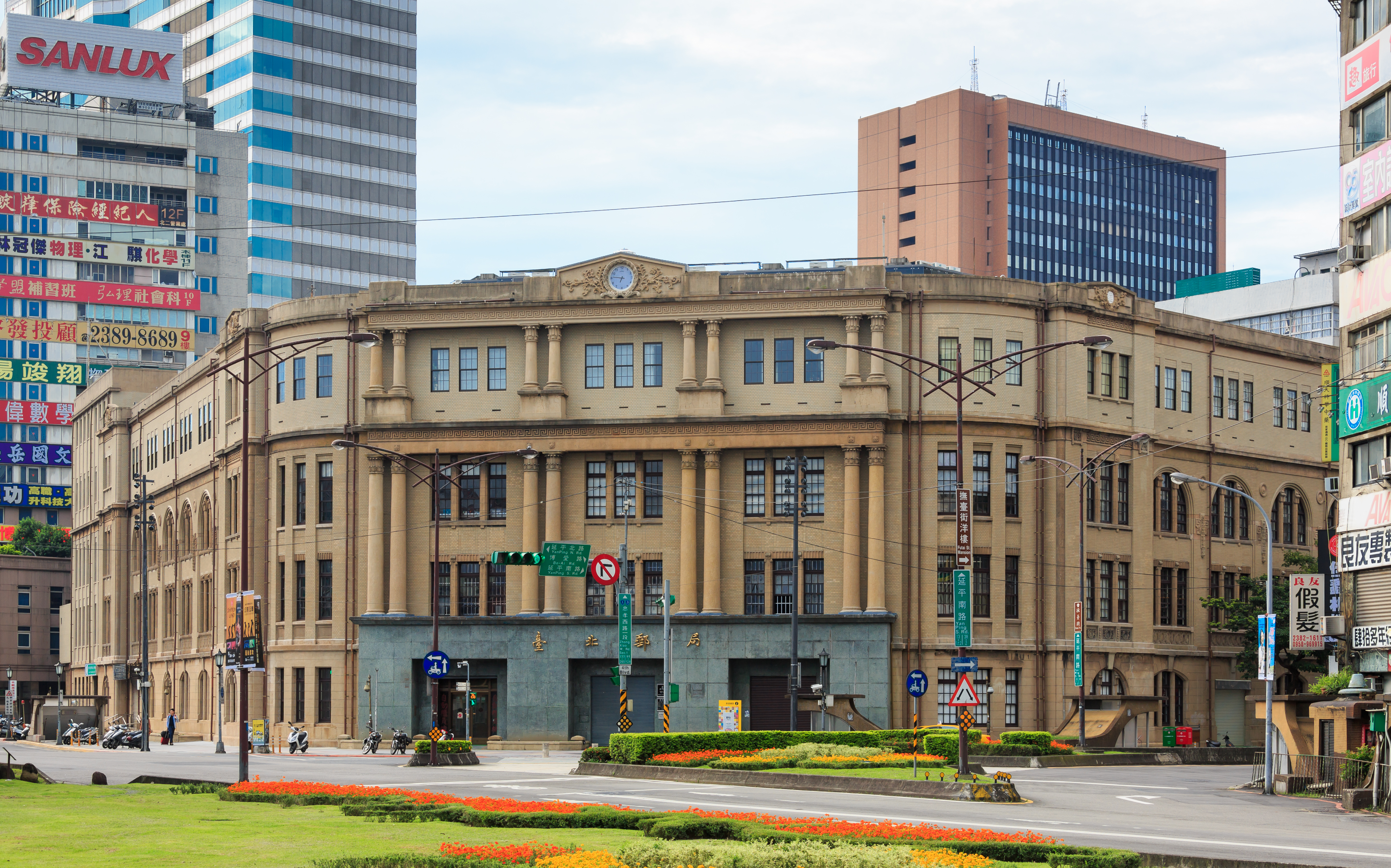
Image source: Wikimedia Commons file page: Taipei Taiwan Beimen-Post-Office-01.jpg; Author: CEphoto, Uwe Aranas; License: CC BY-SA 3.0.
Taiwanese people rarely view post offices as historical sites. They usually appear in a more urgent itinerary: sending a document, withdrawing money, buying stamps, processing insurance, or waiting with a number ticket at the counter. However, this seemingly ordinary place had already opened its doors in Taipei Prefecture on March 22, 1888. Liu Ming-chuan issued the "Taiwan Postal Regulations" consisting of sixteen articles, established the Taiwan Postal Bureau, issued stamps, and began "accepting civilian mail."1
This starting point contains an easily overlooked contrast: modern Chinese postal history typically marks the establishment of the Great Qing Postal Bureau on March 20, 1896, as its institutional milestone. Yet Taiwan's new postal system appeared eight years earlier. This is not a race to determine which history came first, but a reminder that Taiwan's postal history has been connected to local governance, imperial systems, and cross-border communication from the very beginning.1
The First Thing a Letter Encounters Is Not Convenience, But the State
The 1888 Postal Bureau did not have the familiar green signage of today. It was a new system: one with stamps, rules for acceptance, and a counter that brought civilian communication into official order. Postal services allowed people in distant places to send letters, but they also allowed the state to more stably know who was where, how they moved, and which areas were integrated into the same set of rules.
After Japan took over Taiwan in 1895, it first established field post offices. The following year, it continued with regular postal services. Academic research describes this institutional establishment as a project where "civilization and enlightenment" and colonial rule advanced simultaneously: the Governor-General's Office introduced Japanese domestic laws and management methods while adding third-class post offices and postal agencies in local areas, making postal services penetrate daily life more deeply.2 The post office thus became not only a symbol of modernization but also a tool for the colonial government to integrate the island into its administrative network.
Postal services in early Japanese rule were not smooth. Research indicates that transportation and sanitary conditions, the plundering of mail, competition from private letter agencies and foreign steamship companies, and the insufficient number and capability of postal staff all required constant institutional patching. The public did not immediately become accustomed to using it: official statistics show that in the early civil administration period, the proportion of mail usage was less than one percent, later increasing to about thirty percent, with parcels reaching about twenty-five percent.2
Behind these numbers is a specific person. The diary of Fengyuan gentry Zhang Lijun shows that postal services were gradually used to build a network for daily life: writing letters, mail-order shopping, exchanging poetry with literati in other regions, and even connecting to other Japanese territories in Asia. The post office was not "used" by the public only after the system was complete. It slowly became part of life through letters and parcels.2
📝 Curator's Note: The modernization of postal services is not a top-down paved road. It must first traverse local transportation, human distrust, and existing communication methods before becoming the "send it and it will arrive" that we take for granted today.
Teaching Strange Systems into Habits of Life
For postal services to become widespread, simply building post offices was not enough. Research on early Japanese rule indicates that the Governor-General's Office simultaneously improved delivery procedures and, through official propaganda and letter-writing education in textbooks, taught people how to use this new communication system.2
This detail is important. Modern systems are not naturally accepted simply because they are designed. They require a new grammar of life: how to write an envelope, where to place stamps, what is worth sending, and how long to wait is reasonable. When these grammars entered schools and families, the post office ceased to be merely a government office and became a predictable daily path for people.2
Postal services also made "distance" more concrete. The correspondence of Fengyuan gentry Zhang Lijun connected local life, mail-order shopping, literary exchanges, and other Japanese territories in Asia.2 The value of a letter lies not only in its content but also in how it opens up the schedule of another place for the people of a given locality.
Commemorative stamps, postcards, and special postmarks add a layer of collectible interest to postal services. Research summaries indicate that these objects spurred the popularity of philately across Taiwan. The post office thus became simultaneously an entry point for communication and a place for people to observe the island, remember events, and exchange interests.2
Today we think of postal services as the technology of "delivering things," but history reminds us that it was once a social engineering project of "teaching people how to maintain relationships with absent persons."
Stamps Are Small, Yet They Stick Eras Onto Envelopes
Stamps reduce the state to a small piece of paper that can be stuck onto an envelope. The British Philatelic Society's (ABPS) exhibition summary of Taiwan's postal history traces the path from the Imperial Courier Post, through the 1884–85 French naval blockade, the 1885 elevation of Taiwan to a province and postal reform, all the way to the 1895 cession to Japan and the 1945 phase using overprinted Japanese stamps.3
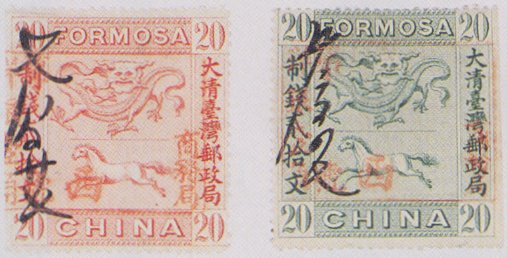
Image source: Wikimedia Commons file page: Taiwan (Formosa) postage stamp 1888 – 10 cents on 20 cents; The page indicates Public domain.
These collections do not form a complete timeline of Taiwan's postal history, but they make the materiality of postal history emerge: institutions exist not only in regulations and agency names but also on paper, overprints, postmarks, and mailed envelopes. Whose image is printed on the stamp, which language is used, and which place name is stamped often tell people more directly than an abstract institutional history: which regime is managing this letter at this moment.
The official collection page of the Taiwan Postal Museum also lists categories such as the Customs Dragon stamp, the Empress Dowager Cixi Birthday Commemorative stamp, the Single Tiger stamp, Taiwan stamps and postal commercial stamps, the Red Flower overprinted provisional stamps, and the "Neutral Temporary" stamps.4 Collectors pursue not just patterns, but how paper traversed regime changes, wars, transportation routes, and communication rules, finally being preserved as a time slice that can be re-examined.
Post Offices Do Not Just Send Letters; They Also Keep Money for the State
The part of postal history that truly changed daily life may not be letters, but savings. During the Japanese colonial period, postal business expanded from mail delivery to deposits, transfers, remittances, telegraphs, telephones, and simple insurance. Researchers therefore summarize it as having diversified, colonial, and modernizing operational aspects.5
The post-war takeover did not sever these functions from Taiwanese life. Historical records from the National Palace Museum's Cultural Memory Bank note that in late 1949, the Postal Savings and Postal Remittance Bureau was relocated to Taiwan and abolished, but related business was still handled concurrently by post offices without interruption. On June 1, 1962, the Postal Savings and Postal Remittance Bureau resumed operations.6
The postal savings after resumption were not just another signboard for ordinary bank deposits. Historical records state that savings could not be directly loaned out but were centrally managed by the Central Bank, invested into medium- and long-term funds for power, transportation, industry and mining, agriculture, public housing, and small and medium-sized enterprises. In other words, the money many people deposited in their postal passbooks was institutionally directed toward post-war Taiwan's infrastructure.6
This creates a second contrast for the post office: on the individual end, it looks small—a passbook, a remittance, a policy. On the state end, it is a pipeline connecting scattered savings to public construction. The post office does not just keep money for people; it once turned "small, scattered, and stable" into usable construction capital for the state.
📝 Curator's Note: The story of postal savings cannot be written only as "convenient for people to save money." It must simultaneously ask: Who centralized these small savings? Under which financial rules were they constrained? And toward which public constructions were they directed? The post office counter and state capital allocation actually met within the same system.
Source: Chunghwa Post, Airiti Library, National Palace Museum's Cultural Memory Bank
After 2003, Post Offices Are Still Not Ordinary Companies
On January 1, 2003, the Ministry of Transportation and Communications Postal Bureau was restructured into Chunghwa Post Co., Ltd., changing its organizational form from a government agency to a state-owned enterprise.1 The name added "Co., Ltd.," but this does not mean postal services withdrew from public service.
Article 2 of the current Postal Law clearly states that the competent authority is the Ministry of Transportation and Communications. Article 3 writes directly: "To provide postal services, the Ministry of Transportation and Communications establishes Chunghwa Post Co., Ltd., a state-owned enterprise."7 This sentence places the two sides of the company on the same line: it must operate, and it was established to provide postal services. Post offices must face competition from markets, efficiency, and digital communication, but they cannot simply choose the most profitable locations to remain.
The name itself has become a political site. In 2007, the Chen Shui-bian government attempted to replace the name "Chunghwa Post" with "Taiwan Post." The National Policy Foundation's commentary at the time argued that the name change involved legal amendments and administrative authority issues. This is the foundation's policy stance, not a neutral legal judgment, but it does leave an important clue: the post office's signboard is not just an identification system; it is also used to discuss the name of the state, historical memory, and who has the right to name.8
The later restoration of the name to "Chunghwa Post" did not make this debate disappear. It instead revealed that the public nature of postal services has two layers: one layer is the service of sending letters, withdrawing money, and buying stamps every day. The other layer is under which state name these services are hung. The former allows the system to be used; the latter allows the system to be debated.
An English report in Taiwan Panorama records how this transformation landed in specific spaces. The Taipei Ren'ai Road Post Office lowered counter heights, added interactive computers, a number ticket system, and seating. The Fangshan Post Office in Pingtung was transformed into a giant convenience box, with its exterior wall using images of onions, mangoes, and local birds, and solar panels installed on the roof.9 This is not turning post offices into theme parks, but attempting to answer a realistic question: when people no longer write letters every day, can post offices still make people willing to walk in?
The same report also points out that Taiwan's cities, towns, and offshore islands all have post office branches; postal carriers sometimes deliver rice, medicine, or care packages to elderly people living alone while delivering mail. This is a service case in the report, not representing that every route is covered by carriers taking on care work. But it makes "universal service" no longer an abstract term in regulations, but an action of a person riding a bike to another person's doorstep.9

Image source: Wikimedia Commons file page: Taipei Taiwan Post-boxes-01.jpg; Author: CEphoto, Uwe Aranas; License: CC BY-SA 3.0.
📝 Curator's Note: The post boxes in the picture are easily seen as street scenery installations, but they are actually the smallest public interface of the postal network: you do not need to enter a branch, nor do you need to know the carrier beforehand; you just need to put the letter into the correct slot to hand private text over to an island-wide delivery system.
One Counter, How It Traverses Different Names
The continuity of postal services does not mean history has no breaks. The 1888 Taiwan Postal Bureau was replaced by the Japanese postal system after 1895. The postal bureau relocated to Taiwan in 1949 repositioned itself within post-war systems. In 2003, it changed from a government agency to a state-owned enterprise. Different regimes, different laws, and different names have all redefined who the post office should serve and how it manages people and money.1 2 5
But for most people, history usually does not arrive in the form of institutional names. It may be a stamp sent from another place, a date stamp on a post office counter, a passbook accompanying a family for many years, or a carrier remembering which door behind which elderly person lives.
Therefore, what is most worth writing about the post office is not the statistic that "Taiwan has many post offices," but how it puts together several things usually kept separate: state governance and private communication, savings and public construction, efficiency reform and local care, stamp collecting and regime memory. It looks like it does not change Taiwan, but in every institutional name change, every financial shift, and every letter delivered, it collects change into daily life for Taiwan.
📝 Curator's Note: The post office is not important because it is old, but because it makes "the state" into a place a person can walk into, take a number ticket, and hand over a letter. Regimes change names; this action still requires someone to complete it.
Further Reading
Chunghwa Post Postal Museum: Collection Research; ABPS: Taiwan Postal History; Wikimedia Commons: Beimen Post Office Image Page; Wikimedia Commons: 1888 Stamp Image Page
References
- Chunghwa Post: Company Profile — Chunghwa Post's official historical evolution, recording the 1888 Taiwan Postal Bureau, 1896 Great Qing Postal, post-war postal organizations, and 2003 corporatization.↩234
- Chen Yu-hsin: The Establishment of Taiwan Postal Services in the Early Japanese Colonial Period (1895-1924) - Focusing on Postal Operations — Abstract of a master's thesis from the Institute of History and Philology, National Taiwan University, explaining the governance background, local outposts, changes in usage rates, and civilian life networks of Japanese colonial postal services.↩2345678
- ABPS: Taiwan Postal History — Abstract of an English exhibition article from the British Philatelic Society, outlining Taiwan's postal history from the Imperial Courier Post, the 1884–85 French naval blockade and 1885 postal reform, to the 1895 Japanese takeover and the 1945 overprinted Japanese stamp phase.↩
- Postal Museum: Selected Collections — Chunghwa Post's official museum collection page, listing rare stamp categories such as Dragon, Single Tiger, Taiwan stamps and postal commercial stamps, Red Flower, and Neutral Temporary.↩
- Chen Yi-chin: A Study of Taiwan Postal Services During the Japanese Colonial Period (1895–1945) — Permanent record and abstract of a master's thesis from the National Taiwan Library, analyzing the institutional development of mail, savings, transfers, remittances, telegraphs, telephones, and simple insurance.↩2
- National Palace Museum's Cultural Memory Bank: Postal Savings After the Restoration — Historical data from the National Palace Museum's Cultural Memory Bank, recording the continuation of postal savings business after 1949, the 1962 resumption of operations, and the utilization plans for savings invested in public construction.↩2
- Chunghwa Post: Postal Law — Chunghwa Post's official legal page, providing the current articles on the Ministry of Transportation and Communications' competent authority for postal services and the establishment of Chunghwa Post Co., Ltd., a state-owned enterprise.↩
- National Policy Foundation: On the Impropriety of Changing Chunghwa Post's Name — A policy commentary published in 2007, presenting one side's stance in the "Taiwan Post" name change controversy; this article only uses it to mark the existence of the controversy, not treating the commentary as a neutral legal judgment.↩
- Taiwan Panorama: Our Good Neighbor at 120 — Chunghwa Post Adapts to a New Era — An English report in Taiwan Panorama, providing on-site cases of the Ren'ai Road Post Office, the Fangshan Post Office transformation, and carrier community services.↩2