
30-Second Overview: On the afternoon of August 23, 1958, hundreds of artillery pieces fired simultaneously at Kinmen. The first wave lasted 85 minutes, dropping over 30,000 shells. After 44 days of high-intensity artillery duels, Kinmen did not return to a peaceful daily routine but entered an intermittent shelling pattern of "hit singles, spare doubles," which continued until 1979. Understanding the August 23 events requires looking beyond which side held the island. It also requires examining how an island of less than 150 square kilometers layered military strategy, resident displacement, and subsequent war zone preservation into a single living space.
On the afternoon of August 23, 1958, at 5:30 PM, the islands of Kinmen, Little Kinmen, Da Tan, and Er Tan were simultaneously subjected to intense shelling. The first wave lasted 85 minutes, with over 30,000 shells fired. Major General Ji Xingwen, Deputy Commander of the Kinmen Defense Command, and others were killed in action that day. This was not merely a "crisis" occurring on a map, but an afternoon where a command post, villages, hospitals, and ports were simultaneously disrupted. 1
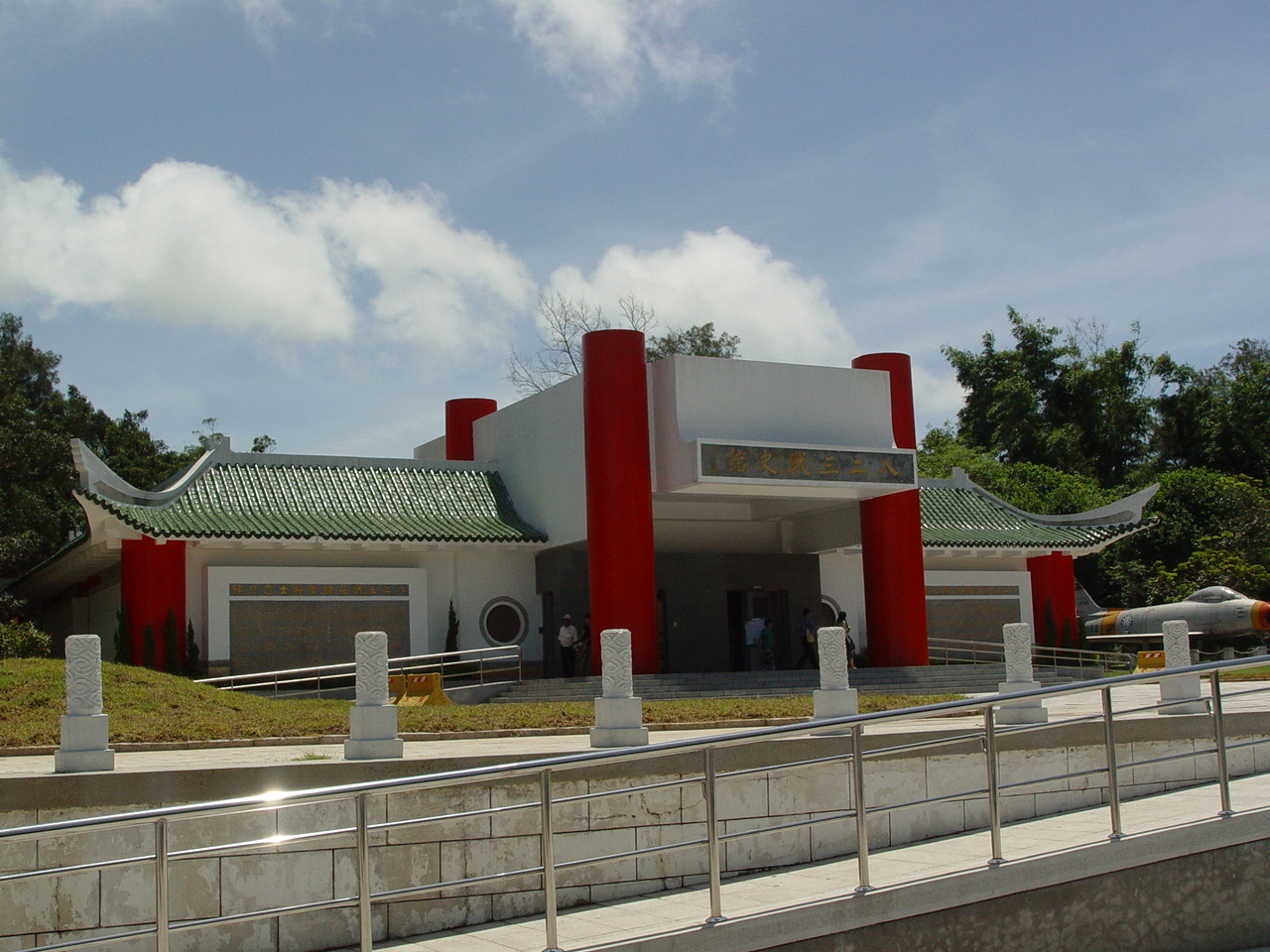
Image: Photographed by Seasurfer, CC BY-SA 3.0. Image from Wikimedia Commons file page.
This conflict was later known as the "August 23 Artillery Duel," and in U.S. and international research, it is often referred to as the "Second Taiwan Strait Crisis." The difference in names reminds us that the same artillery duel was both a local disaster for Kinmen and a node in the Cold War order that could drag the United States, China, and U.S. allies into conflict. 2
Not a One-Day Artillery Duel
The name "August 23" easily leads people to believe the war occurred only on August 23. In reality, the first phase consisted of 44 days of high-intensity shelling. Subsequently, the shelling shifted to a "hit singles, spare doubles" rhythm conducted on alternate days, with sporadic but continuous fire extending until 1979. Some historical materials view the period from August 23, 1958, to January 7 of the following year as the complete artillery duel period, while some official narratives treat the 44 days as the primary battle and list the subsequent period as intermittent shelling. These temporal definitions are not entirely consistent, but they collectively point to one thing: Kinmen faced not a single explosion, but a prolonged state of war. 2 3 4
During the 44-day primary artillery duel, the Kinmen archipelago endured approximately 470,000 artillery shells. Local historical records in Kinmen state that the archipelago, covering an area of approximately 148 square kilometers, received an average of about four shells per square meter. The casualties included 80 dead, 85 seriously injured, and 136 lightly injured among the populace. There were 2,612 completely destroyed houses and 2,321 partially destroyed houses. These numbers are not meant to create a spectacle of war. They translate the vague notion of "intense shelling" into the specific losses of a island’s housing, bodies, and medical resources. 3
Curator’s Note: The most counter-intuitive aspect of the August 23 Artillery Duel is that "ceasefire" did not equal "stopping life within war." Kinmen people did not begin to bear the war only after the sound of artillery ceased; rather, they learned to schedule war into their daily routines once the artillery sounds became regular. The curatorial challenge of this memory is to make the routine itself visible, rather than only displaying the most intense first wave of fire.
Kinmen Is Not a Blank Space on a Chessboard
Before the artillery duel, Kinmen was already a highly militarized island. When troops arrived in 1949, the local population was approximately 37,000. By the time of the August 23 artillery duel, the total military and civilian population had increased to approximately 130,000, with defense budgets accounting for 70% of total annual expenditures. These figures show that the war did not fall suddenly upon a pure military base, but upon a place with villages, farmland, schools, and family networks. 5
The initial shelling primarily targeted military objectives on the island, while later phases intensified the blockade of maritime supply lines, aiming to trap Kinmen in terms of supplies and troop strength. To the military, the port was a supply line. To the residents, the port was also the source of rice, medicine, news, and the possibility of leaving. 3 4
Supply thus became the most easily overlooked battlefield of the August 23 events. When shelling cut off roads and ports, the front lines needed ammunition, and residents needed food and medicine. U.S. escort supply ships arriving in Kinmen were not just military news; they determined whether hospitals could continue treating the wounded and whether schools and families could receive the next batch of supplies. This shared military-civilian supply line demonstrates that Kinmen’s military geography was never two separate maps divorced from civilian life. 3 5
U.S. involvement was also not a simple story of "ally support." The Sino-American Mutual Defense Treaty signed in 1954 explicitly defended Taiwan and Penghu, leaving controversy over whether Kinmen and Matsu were included. After the outbreak of the artillery duel, the U.S. Seventh Fleet assisted in escorting supply convoys and deployed aircraft, missiles, and combat command resources in Taiwan. Simultaneously, the U.S. government hoped Chiang Kai-shek would consider withdrawing from the outer islands to avoid being drawn into a war that might not be controllable. 2 5
Therefore, Kinmen’s fate cannot be described solely by the outcomes of "holding" or "losing." Taipei hoped Kinmen would continue to serve as a frontline barrier; Beijing hoped to test U.S. reactions and alter the Taiwan Strait situation through shelling; Washington supported defense while seeking to limit the escalation of conflict. Kinmen residents lived at the intersection of these three strategic calculations, yet they had no power to decide when the shells would fall. 2 5
Residents Under Fire: Hiding Underground or Leaving Home
War history most often leaves behind generals, fleets, and press releases, while the bodies of residents are easily compressed into "collateral damage." Records from Kinmen show that approximately 5,700 residents of Little Kinmen, including 1,500 children, lived in underground spaces during the artillery duel. Of Kinmen’s approximately 44,000 residents, there were only three doctors and nine nurses. Plasma, penicillin, and other antibiotics were insufficient. These numbers present not abstract civilian hardship, but who could endure the damp cold in underground shelters, who could wait for medicine, and who had nowhere to return. 5
The artillery duel also prompted the evacuation of residents to Taiwan. In October 1958, 921 students from Kinmen High School were evacuated first. In three batches, a total of 6,509 Kinmen residents arrived in Kaohsiung. Some sought refuge with relatives and friends, while the rest temporarily stayed in schools before being distributed to seven counties and cities in central and southern Taiwan for resettlement. This was not a neatly completed relocation plan; many carried only simple luggage and had to deal with Kinmen-specific currency, work, housing, and family separation. 5
"Relocation to Taiwan" meant different things to different people. To the military authorities, it was an evacuation to reduce civilian casualties on the front line. To those who left, it was either temporary refuge or a life turning point from which they might never return. To those who stayed, it meant continuing life between military control and empty houses. If one only writes "the government resettled over 6,000 people," it flattens all these choices and non-choices. 5
Curator’s Note: The war memory of an island should not only ask "who won." It must also ask: who was forced to leave, who stayed behind guarding empty houses, and who still remembers the dampness of underground shelters with their own bodies years later. If an exhibition features only generals, gun barrels, and maps, the migration of residents will once again become background.
"Hit Singles, Spare Doubles": How Fire Became Daily Routine
In October 1958, the People's Liberation Army announced the abandonment of the maritime blockade, subsequently adopting the rhythm of "hit singles, spare doubles": shelling on odd days, ceasefire on even days. This arrangement is rare in military history, yet it formed an unsettling routine in Kinmen. Ceasefire days allowed for house repair, supply transport, and farming, but did not guarantee that the next odd day would not see fire resume. "Peace" became a time unit that only guaranteed until tomorrow. 3 4
It also entangled war with administration, education, and family life. Schools needed to evacuate or adjust; ports needed to wait for escorts; residents needed to allocate time between air-raid shelters, civil defense teams, and farming. Militarization was not just about bunkers and gun barrels; it also included how currency was used, when news could be reported, how villagers received training, and whether the population of outlying islands could move freely. 5
After the 1960s, the main confrontation in the Taiwan Strait gradually shifted from direct military攻防 to international politics and long-term standoff. Historian Hsueh Hua-yuan points out that after the August 23 Artillery Duel, the idea of eliminating opponents through force was no longer the only feasible imagination. Discussions within Taiwan regarding democracy, rule of law, and the "Retake the Mainland" policy were also affected. This does not mean the artillery duel directly created democratization, but that it changed the conditions under which the government, society, and the international environment could discuss politics. 2
On January 1, 1979, the United States and the People's Republic of China established diplomatic relations, and Taiwan and the United States terminated diplomatic relations. On the same day, the mainland side issued the "Message to Compatriots in Taiwan," announcing the cessation of shelling against Kinmen, Da Tan, Er Tan, and other islands. Counting from the high-intensity artillery duel of 1958, the state of war spanned twenty years. From the perspective of residents' memory, it had no neat endpoint announced by a press release. 3 4
News, Blockades, and Waiting
The August 23 events also changed how Kinmen people accessed news. In the early stages of the artillery duel, news reporting was restricted by military secrecy; the outside world often saw only press releases, situation briefings, and eyewitness reports from a few journalists. For the island's residents, news was not an abstract media issue, but a tool for judging whether family members were safe, whether ships could dock, whether children needed to leave, and where the next meal would come from. When news was delayed or filtered, waiting itself became part of the war. 2 5
The restoration of maritime supply lines cannot be understood solely as a military success. After escort ships arrived, the military needed to reallocate ammunition and rations, medical personnel needed to treat new casualties, and residents needed to rearrange their lives between damaged houses and underground spaces. Kinmen’s supply lines simultaneously bore national defense, medical, and livelihood functions. This is why the logistics history of August 23 deserves to be written separately. It allows us to see that the true targets of an artillery duel were not just artillery positions, but also a society's ability to maintain daily life. 3 5 6
The evacuation of students particularly illustrates how war entered families. After the 921 students of Kinmen High School left the island, school education was scattered across Taiwan. Students temporarily gained safety but also left behind their original classmates, teachers, and family. This arrangement might have been militarily necessary, but in personal life histories, it was a sudden interruption of youth. Relocation to Taiwan was not a simple story of "being saved"; it simultaneously contained relief, longing for home, re-adaptation, and complex emotions about not knowing when one could return. 5
Figures and Positions in War Memory
Official commemorations of August 23 often begin with the three deceased deputy commanders: Ji Xingwen, Zhao Jiaxiang, and Zhang Jie. Ji Xingwen is frequently mentioned again due to his historical identity in the 1937 Marco Polo Bridge Incident. These figures give the event recognizable faces and allow the state to build collective memory through memorial ceremonies. However, if figure commemorations stop at generals and martyrs, it easily leaves residents, medical personnel, teachers, civil defense members, and relocated families out of the frame. 4 7
A more complete approach does not diminish the sacrifice of soldiers but places different positions within the same narrative. Commanders bore decision-making and responsibility; soldiers bore frontline dangers; medical personnel bore resource shortages; residents bore destroyed homes and family separation; students waited for war situations in strange cities. These experiences were different, yet they collectively constituted August 23. Only by placing them side by side can readers avoid misunderstanding "military-civilian unity" as a slogan that erases differences.
This is also the practical problem faced by historical museum exhibitions. Shells, firearms, military uniforms, and maps can quickly explain the scale of war, but they may not explain how a family spent ceasefire days. A relocation roster, a doctor’s memory, or a student’s luggage may not be as striking as weapons, but they allow the audience to understand how war changed people’s time, identity, and relationships. The updated August 23 War History Museum in 2025 began incorporating diverse perspectives from residents, widows, and journalists, representing an attempt to move the exhibition from battle chronicles to collective memory. 8
From Military Sites to Peace Education
The value of Kinmen’s war zone sites lies not only in their past defensive functions but also in how they record how society handled heritage after the war. Artillery forts may be on private land, involve military secrecy, public safety, and maintenance costs. Demolition or preservation are not purely technical choices; they are judgments on "what is worth being seen by the next generation." The controversy surrounding the Sanliushan Artillery Fort is therefore representative. It reminds us that without first completing a comprehensive inventory and value assessment, exit policies may eliminate historical evidence faster than artillery fire. 9
Preserving war zone sites does not equal beautifying war. The thickness of an artillery fort allows one to imagine defensive engineering, but it cannot replace casualty data of residents. Memorials can remind people to remember sacrifices, but they cannot alone explain why cross-Strait relations reached long-term shelling. Peace education needs to return sites to historical context, allowing the audience to simultaneously see military decisions, international intervention, civilian costs, and post-war politics. The Ministry of National Defense’s memorial narratives, local historical materials, and the new exhibitions of the War History Museum should refer to each other, not replace each other. 4 8 7
If one walks into the August 23 War History Museum today, what is most noteworthy is not which weapon is the largest, but whether the exhibition allows one to understand how an island maintained society under fire. This includes who was responsible for delivering water, who cared for the wounded, who repaired roads, who recorded deaths, who put children on ships, and who returned to destroyed villages after the ceasefire. When these questions are placed into the exhibition, Kinmen becomes not just a "living military museum," but a place still learning how to talk about war and peace. 8 10
Why Different Numbers for the Same War
The casualty and shell counts of August 23 cannot be pieced into a table without explanation. Local Kinmen data focuses on civilian casualties and housing damage, while Presidential Office memorial drafts combine military-civilian casualties and military facility losses. Historical analysis articles may also adopt different start and end ranges for the conflict. Therefore, this article treats over 470,000 shells as the magnitude of the primary artillery duel, and explicitly marks figures such as 80 dead and 2,612 completely destroyed houses as local civilian statistics, not conflating them with the military-civilian statistics of 618 dead and 3,228 injured. 3 4 5
This difference is not an error that can be dismissed with a sentence like "which one is true." Different denominators, time ranges, and statistical subjects change our understanding of war. The responsibility of verification is not to pick the most spectacular number, but to write the statistical context next to the number. This is why August 23 requires local historical materials, official memorial drafts, and academic analysis to be read against each other, rather than relying on a single voice.
War Zone Preservation: What Remains Is Not Just Victory Commemorations
After the August 23 Artillery Duel ended, Kinmen still retained a large number of military facilities and war zone landscapes.

Image: Photographed by Wei-Te Wong, CC BY-SA 2.0. Image from Wikimedia Commons file page.
These facilities are, on one hand, relics of the national defense system, and on the other hand, they may be located on civilian land, hinder land use, or face demolition due to management and safety costs. In 2018, when Kinmen locals discussed the demolition of the Sanliushan Artillery Fort, the controversy centered on a sharp question: after military facilities exit, who has the right to decide what is worth keeping? 9
This is not a problem that can be solved by simply sealing all bunkers. Preservation requires inventory, grading, handling military secrecy, and coordination among local governments, defense units, cultural asset authorities, and residents. If war zone sites are merely packaged as tourist attractions, artillery forts will become photo backgrounds. If they are only viewed as burdens, the war life long endured by Kinmen people will be erased along with land clearance. 9
The August 23 War History Museum, reopened in 2025, began placing frontline soldiers, residents, military widows, and journalists into the same exhibition narrative, presenting war zone life, family fragmentation, and personal trauma through audio-visual materials and artifacts. The significance of this exhibition direction lies not in making war more thrilling, but in ensuring that "military victory" is no longer the only visible memory. 8
Kinmen National Park’s war zone cultural preservation therefore faces two responsibilities: preserving specific fortifications, tunnels, and artillery forts, while also preserving their relationships with villages, migration, civil defense, women’s waiting, and family separation. Objects without human stories are merely concrete; stories without touchable sites easily become slogans for the next generation. 9 8
Reading August 23 Today
The significance of the August 23 Artillery Duel to Taiwan lies not only in it being a 1958 military event. It allowed the division of the Taiwan Strait to gradually move from a temporary post-war state into a more stable, yet longer, Cold War standoff. It forced U.S. strategic ambiguity regarding Kinmen and Matsu, Taipei’s outer island policy, and Beijing’s Taiwan Strait policy onto the table simultaneously. It also turned Kinmen into a political geography that must be understood through resident life. 2 5
If August 23 is only written as "the National Guard defended Kinmen and repelled the attack," readers get a conclusion but cannot see the cost. If it is only written as great power博弈 (game), it re-silences the 6,509 relocated residents, children living in underground spaces, hospitals lacking medicine, and people waiting for family members to return. 5

Image: Photographed by Foxy Who, CC BY-SA 3.0. Image from Wikimedia Commons file page.
A statement closer to the Kinmen experience is: fire changed the island’s strategic position and changed every person’s sense of time on the island. When shells fell, Kinmen was a frontline. When shells fell according to the daily schedule, Kinmen became an institution. After shelling stopped, Kinmen had to decide how to preserve a history that is unwilling to be romanticized and cannot be deleted.
The last question left by August 23 is not "who will win next time," but whether, when war is written as national memory, those who did not choose war but were forced to learn to live in war can be written back in.
Sources
- The August 23 Artillery Duel and Its Historical Significance — A war background, shelling time, scale, international impact, and Taiwan political context article written by Professor Hsueh Hua-yuan of the Department of History, National Chengchi University.↩
- The August 23 Artillery Duel and Its Historical Significance — A historical analysis article explaining the Second Taiwan Strait Crisis, U.S. intervention, and post-war Taiwan Strait standoff.↩234567
- Why the August 23 Battle Should Serve as a Warning — An article from the Kinmen County Government, organizing the 1958 shelling, 44-day battle status, "hit singles, spare doubles," and the cessation of shelling in 1979.↩2345678
- President Ma Ying-jeou’s Speech at the "823 Battle 50th Anniversary Memorial Conference" This Morning — A Presidential Office press release recording the 44-day artillery duel, Kinmen area, shell scale, and official memorial narratives of military-civilian casualties.↩234567
- The Complete Story of the 823 Taiwan Strait Crisis — Evacuation of Kinmen Residents to Taiwan — A Kinmen Daily data page organizing population, militarization, residents' medical conditions, student and civilian evacuation, and resettlement processes.↩234567891011121314
- Reflections on the August 23 Artillery Duel — History Must Be Written by Oneself — A historical article published by the Ministry of National Defense, providing data on the first wave of shelling time, number of artillery pieces, and battle reflections.↩
- Reserve Command - Retained Business - August 23 Artillery Duel Monument — A page from the Ministry of National Defense Reserve Command, providing the origin of the August 23 Artillery Duel name, shell scale, and official memorial context.↩2
- Entering History, Feeling Memory: The August 23 War History Museum Creates an Immersive War Zone Story — A reprint of a Kinmen Daily report by the Executive Yuan Kinmen-Matsu Joint Service Center, introducing the 2025 update of the August 23 War History Museum and its exhibition direction incorporating diverse military-civilian memories.↩2345
- Preserving Military Heritage to Enrich Cultural Resources — An article from the Kinmen County Government, recording the Sanliushan Artillery Fort controversy, war zone heritage preservation, inventory, and cross-agency coordination issues.↩234
- The Complete Story of the August 23 Kinmen Artillery Duel — A Kinmen Daily data page organizing the beginning of the artillery duel, battle processes, and related memoir historical materials.↩