
30-second overview: Yongkang Street runs north-south from Section 2, Xinyi Road to the entrance of Lishui Street. It is about 600 meters long, lies east-west between Lishui Street and Jinshan South Road, and administratively belongs to Da’an District. After urban planning reforms in Japanese-ruled Taipei, the area was designated “Shōwachō” in 1922. It covered today’s Qingtian Street, Yongkang Street, Lishui Street, Chaozhou Street, and Jinhua Street, and served as an official residence district for faculty at Taipei Imperial University, today’s National Taiwan University, and senior officials1. In 1931, geologist Ma Ting-ying moved into the Japanese-style dormitory at today’s No. 6, Lane 7, Qingtian Street, later known as “Qingtian 76”2. After the Nationalist government relocated to Taiwan in 1949, these Japanese-style dormitories were reassigned to mainlander officials, military dependents, and National Taiwan University professors who had moved to Taiwan: in 1950, liberal scholar Chou Te-wei moved into the site of today’s Wistaria Tea House3, and in 1956 Yin Hai-kuang moved into nearby Wenzhou Street4. In 1958, Yang Bing-yi opened Din Tai Fung as a cooking-oil shop on Section 2, Xinyi Road; in 1972, it switched to selling xiaolongbao, soup dumplings5. In 1993, The New York Times named Din Tai Fung one of the “world’s ten best restaurants,” launching its internationalization6. In 2015, the Japanese drama Solitary Gourmet filmed its New Year special at the Yongkang flagship7, and Korean dramas and social media then brought this street into Korean tourists’ Taipei itineraries. This article argues that one 600-meter street contains three generations of residents, four communities, and five kinds of memory.
Yongkang Park at 7:30 in the Morning
If you ask a Taipei resident who has lived in Da’an District for more than thirty years “when Yongkang Street is most charming,” he will not tell you about the line outside Din Tai Fung. That belongs to tourists. He may say Yongkang Park at 7:30 in the morning.
That small park sits in the triangular block formed by Yongkang Street, Section 2, Xinyi Road, and Lishui Street. Several old banyan trees have grown until they cover the eaves of the low houses. At 7:30 in the morning, retired grandfathers and grandmothers from the surrounding lanes gradually emerge and sit on the stone benches: a mainlander grandfather in an undershirt holding a newspaper, a grandmother with a Sichuan-accented Mandarin carrying a thermos, a retired National Taiwan University professor walking home from Xinyi Road Market with a bamboo vegetable basket. Most of these people are the children, or the children’s children, of the first generation that migrated from China to Taiwan after 1949. When they were young, they lived in the Japanese-style dormitories on Yongkang Street, Qingtian Street, and Lishui Street: houses allocated to their parents.
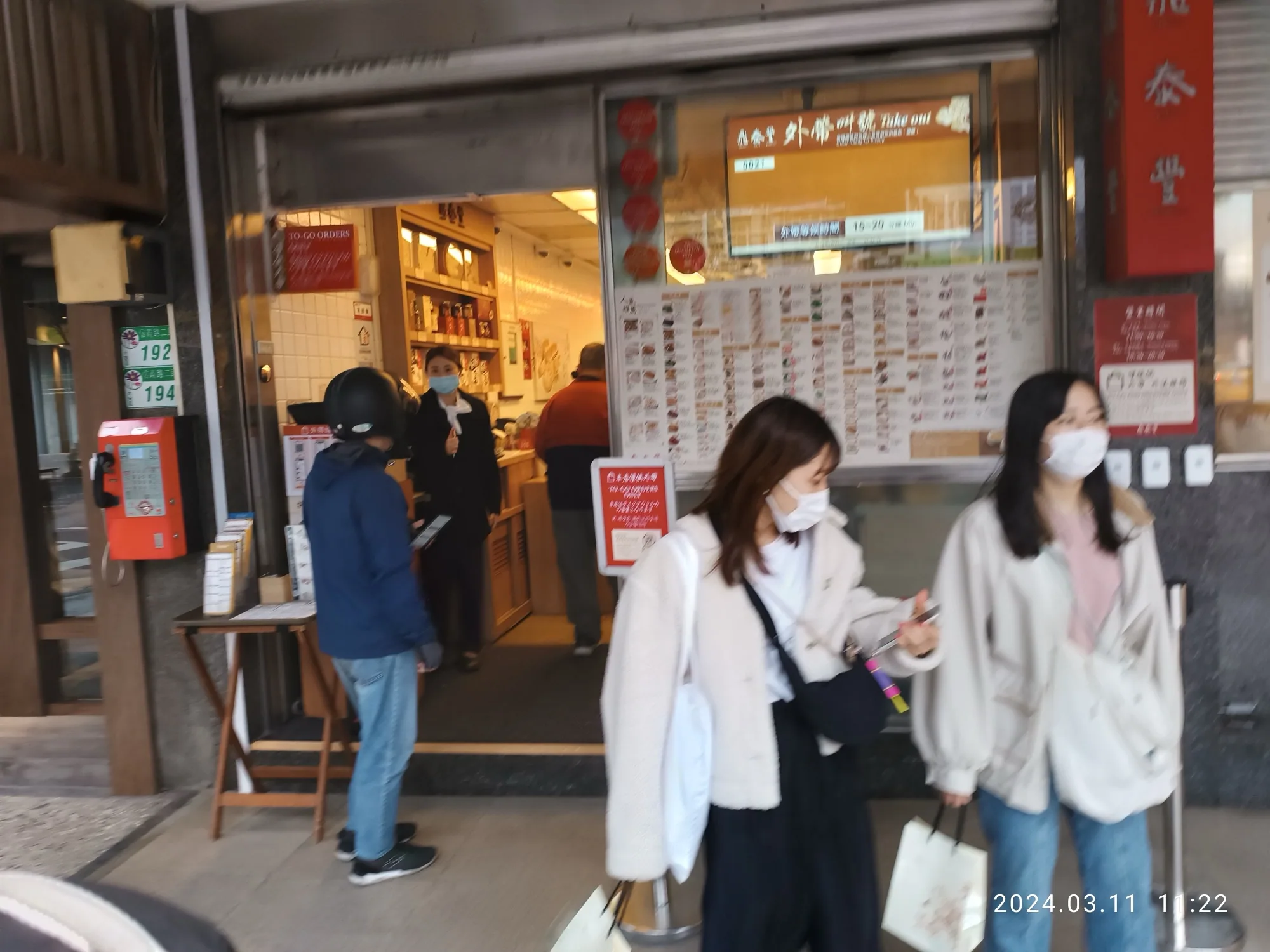
After 7:30, the first Japanese tour groups appear at the entrance to Yongkang Street. Din Tai Fung’s Yongkang flagship does not open until 11, but some customers arrive two hours early to queue. The stone benches in Yongkang Park become a temporary waiting area. Japanese, Korean, and Cantonese mix together, side by side with Taiwanese Hokkien and mainlander-accented Mandarin on the benches. The most charming moment on this street is when two generations sit in shifts before the same stone bench: the mainlander grandfather sits from 7:30 to 9:30, and Japanese tourists sit from 9:30 to 11.
Walk south across Section 2, Xinyi Road to the entrance of Din Tai Fung’s Yongkang branch. Looking over from Section 1, Jinshan South Road, you can see the line bend from the storefront onto Xinyi Road8. Most people in line do not look up at the “1958” written on the sign. That is the year Yang Bing-yi and his wife opened a cooking-oil shop on Section 2, Xinyi Road, not the year they began selling xiaolongbao5.
Walk two minutes north to No. 6, Lane 7, Qingtian Street, and the Japanese-style dormitory built in 1931 under Japanese rule is still standing in its original location2. Today, the entrance bears the sign “Qingtian 76,” and the interior is a cafe and cultural exhibition space. Most visitors take photos without knowing this: before the war, the house was occupied by the Japanese geologist Adachi Hitoshi; after the war, from 1947 onward, it was occupied by the Chinese geologist Ma Ting-ying. The prewar and postwar residents were both geologists, but they belonged to two empires2.
Six hundred meters holding three generations of residents: that is the density of Yongkang Street.
Shōwachō, Qingtian Street, Lishui Street: A Renamed Colonial Official Residence District
The name “Yongkang Street” only appeared after the war. Before then, this area’s formal administrative name was Shōwachō, established in 1922, or Taishō 11, after urban planning reforms in Japanese-ruled Taipei1.
Shōwachō was not a single street; it was a district. Its boundaries included parts of today’s Qingtian Street, Yongkang Street, Lishui Street, Chaozhou Street, and Jinhua Street. North-south, it stretched from Section 2, Xinyi Road to Section 1, Heping East Road; east-west, from Jinshan South Road to Xinsheng South Road. At the time, this was one of the most upscale residential areas in Taipei. The Japanese planned it as a dual-function district: official residences for Taipei Imperial University, today’s National Taiwan University, faculty, plus official residences for senior officials of the Governor-General’s Office1.
Why choose this site? By 1922, Taipei already had two mature districts: the inner city, today’s Zhongzheng District, where the Governor-General’s Office and government agencies were concentrated; and Dadaocheng, the commercial center for Taiwanese residents. Shōwachō lay in the southeastern outskirts of the inner city, a 15-minute walk from Taipei Imperial University’s main campus, now NTU’s main campus. The Japanese built Japanese-style dormitories here for imperial university professors and Governor-General’s Office officials, effectively placing academic and administrative elites in the same living circle1.
The street plan followed the Japanese kyōmachiwari block system: main roads in an east-west and north-south right-angled grid, lane widths measured precisely to four meters, gardens required to occupy more than 30 percent of each residential lot, and dormitories uniformly oriented southward. Walk around Qingtian Street and Yongkang Street today and one thing becomes apparent: the grid direction of these streets does not align with other Taipei streets nearby. Qingtian Street runs due east-west, but Lishui Street two intersections away runs northwest-southeast. This is because Shōwachō’s grid aligned with the older Qing-era field boundaries, while the postwar Section Xinyi Road and Xinsheng South Road system developed in the 1960s through 1980s came from a different planning source9.
During the 23 years from 1922 to 1945, Shōwachō was inhabited almost entirely by Japanese people. Taiwanese scholars and Taiwanese officials were extremely rare. The ethnic spatial segregation of the colonial period was explicit: Taiwanese people lived in Dadaocheng, Bangka, and the margins of the inner city; Japanese people lived in Sakaemachi, Kyōmachi, and Shōwachō1.
Japan was defeated in August 1945. From 1946 onward, the Nationalist government began taking over Japanese assets across Taiwan, including these Japanese-style dormitories. From after the February 28 Incident in 1947 to the Nationalist government’s relocation to Taiwan in 1949, large numbers of migrants from China arrived: military dependents, administrative officials, scholars, and teachers. Shōwachō’s Japanese-style dormitories were transferred wholesale from imperial university faculty to faculty at the Republic of China’s National Taiwan University, Ministry of National Defense officials, and civil servants from various ministries9. The transfer happened alongside the renaming of streets: the name Shōwachō was divided into five streets, with Qingtian Street, Yongkang Street, Lishui Street, Chaozhou Street, and Jinhua Street each becoming separate entities. Between 1947 and 1950, the name “Shōwachō” disappeared completely from official documents and maps1.
📝 Curator’s note: Standard tourism narratives describe Yongkang Street as a “food street” or a “hipster street,” making Din Tai Fung the protagonist. But the physical location of this street began with Shōwachō in 1922, 36 years before Din Tai Fung in 1958. The Japanese built dormitories here in 1922 for imperial university professors, mainlander officials took over the same dormitories in 1947, and Japanese and Korean tourists come here in 2026 to eat xiaolongbao. These three facts are physical evidence of three generations of residents layered onto the same land. Taipei residents often forget that every street beneath their feet once had an earlier name, and beneath that earlier name was another group of people who were moved away. Shōwachō was renamed into five streets, the Japanese on those five streets were replaced by mainlanders, rising rents drove old residents away after the mainlander generation faded, and then tourists came. The continuity of one street is often another group’s dispersal.
Qingtian 76: Two Geologists, Two Empires
To see a fully preserved Shōwachō example, go to No. 6, Lane 7, Qingtian Street. Today the house bears the sign Qingtian 762.
This Japanese-style dormitory was built in 1931, Shōwa 6, as a Japanese-Western hybrid residence for new Taipei Imperial University faculty. It combined traditional Japanese wooden construction with a Western-style living room, entrance hall, Ma Ting-ying’s study, and other spatial arrangements. The building area is about 70 ping, with a 100-ping garden. Its black-tile gently sloped roof, cypress lattice windows, and stone lantern before the entrance make it one of the best-preserved surviving high-ranking Japanese official residences in Taipei10.
The first resident was Adachi Hitoshi, a Japanese geologist and professor in the Department of Geology of Taipei Imperial University’s Faculty of Science and Agriculture. Adachi lived in this house for 14 years, from 1931 to 1945, and withdrew to Japan after the defeat. Before the Japanese departure in October 1945, he personally handed the house keys to receiving personnel and left behind an inventory of the house’s belongings11.
The person who took over was Ma Ting-ying (1899-1979), from Liaoning, China. Ma held a doctorate in geology from Tokyo Imperial University and had studied in Japan for 12 years. After the war, he came to Taiwan in 1946 to take over Taipei Imperial University’s Department of Geology, and in 1947 formally moved into No. 6, Lane 7, Qingtian Street2. Ma was one of the Republic of China’s first generation of geologists educated in Japan. His research covered coral fossils, plate tectonics, and paleomagnetism. He died in this house in 1979, after living there for 32 years. His paper “A Theory of Crustal Movement in the Taiwan Strait” was one of the most cited plate tectonics papers in Republic of China academia in the 1960s12.
From Adachi Hitoshi to Ma Ting-ying, the two men who lived in this house were both geologists, both studied at Tokyo Imperial University, and both researched the Pacific Plate. The difference was that Adachi represented the academic extension of the Japanese Empire, through a colonial university, while Ma represented the academic continuation of the Republic of China, which took over the hardware and part of the personnel of the colonial university. One house, one discipline, and the handover of scholars from two empires: in Taipei’s Japanese-style dormitories, this was typical of the 1947 takeover.
After Ma Ting-ying died in 1979, the house continued to serve as an NTU faculty dormitory, then became vacant in 2002. In 2006, the Taipei City Government designated it a municipal historic site. In 2011, the private organization Qingtian 76 Culture leased and restored it, transforming it into a restaurant and cultural exhibition space open to the public10.
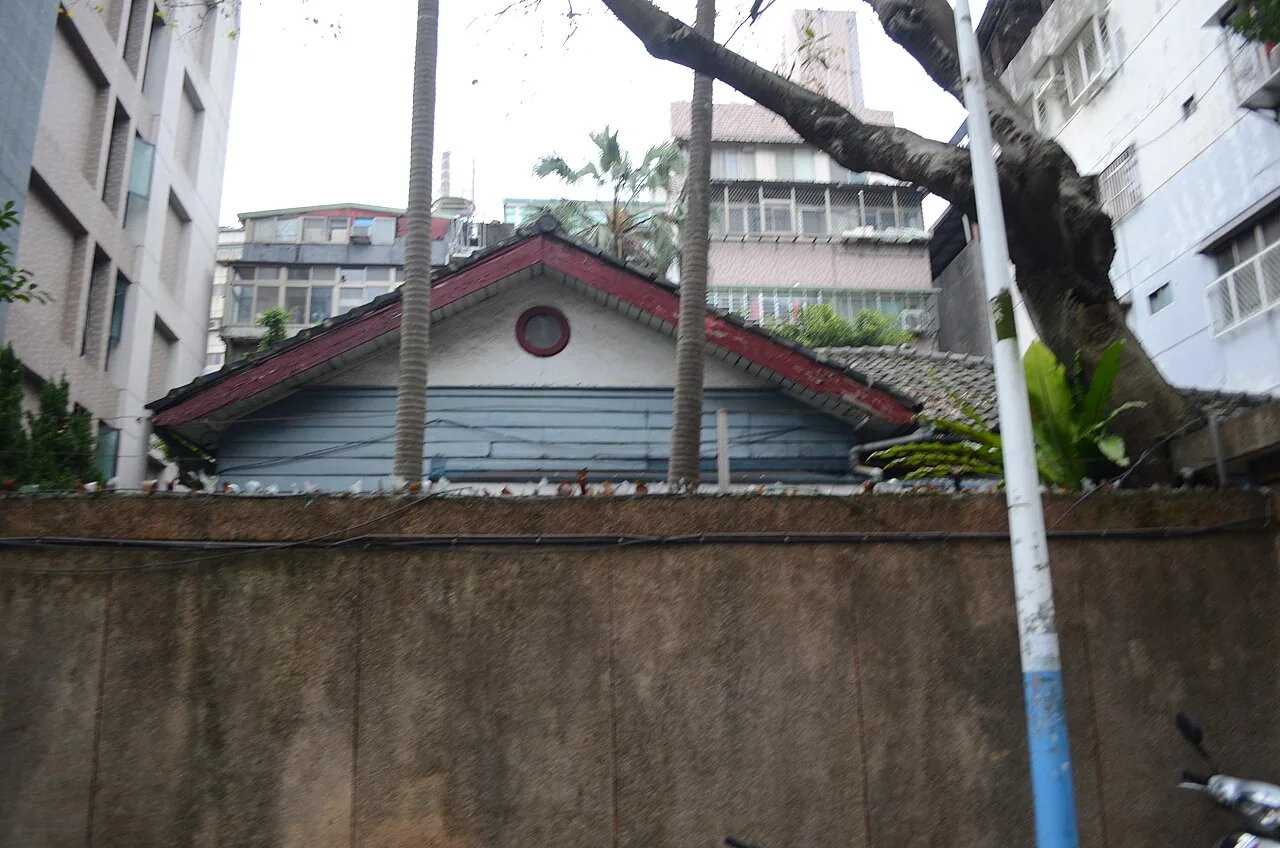
Qingtian 76, built in 1931. Photo: Lin Gaozhi, CC BY-SA 4.0 via Wikimedia Commons.
On Qingtian Street, fewer than 10 Japanese-style dormitories of the same class as Qingtian 76 remain today13. Most were demolished between the 1970s and 1990s and replaced with five-story apartment buildings. At the time, Taipei’s housing tax system included incentives for reconstruction, and Japanese wooden structures were costly to maintain, making wholesale preservation nearly impossible. Walk around Qingtian Street today and what you mostly see are Republic of China-style five-story apartments from 1985; the Qingtian Street of 1931 has retreated into a few remaining fragments13.
The surviving buildings, Qingtian 76, Wistaria Tea House, Yin Hai-kuang’s former residence on neighboring Wenzhou Street, and Yu Ta-wei’s former residence at No. 8 Lishui Street, are among the few examples rescued by the cultural heritage preservation movement after the 1990s.
Wistaria Tea House: Chou Te-wei’s Study Became a 1981 Teahouse
Cross south over Section 2, Xinyi Road to No. 1, Lane 16, Section 3, Xinsheng South Road, and you arrive at Wistaria Tea House3.
This Japanese-style dormitory dates from the same period as Qingtian 76, built in the late 1920s. Before the war, it served as official housing for a Japanese customs official. In 1950, liberal scholar Chou Te-wei took it over as his Taiwan residence and study14.
Chou Te-wei (1902-1986) was from Hunan, China. He studied at the University of Berlin in Germany and the London School of Economics in Britain, and learned from the Austrian School economist Friedrich Hayek, winner of the 1974 Nobel Prize in Economics. Chou was one of the few Chinese scholars in the 1930s and 1940s who deeply engaged with and translated Hayek’s liberal economic thought. After relocating to Taiwan with the Nationalist government in 1949, he taught part-time in National Taiwan University’s Department of Economics, worked at the Ministry of Finance’s Directorate General of Customs, and treated Wistaria Tea House as his spiritual base in Taiwan14.
From the 1950s to the 1970s, the living room of Wistaria Tea House was one of the most important private salons for postwar liberal scholars in Taiwan14. Yin Hai-kuang, who lived on Wenzhou Street, a 10-minute walk from Wistaria Tea House, along with Hsu Fu-kuan, Lin Yü-sheng, Chang Fo-chuan, Hsia Tao-ping, and other postwar liberal scholars frequently gathered there to discuss the editorial work of Free China magazine, the Chinese translation of Hayek’s The Road to Serfdom, translated by Yin Hai-kuang, and the predicament of postwar Chinese intellectuals. When Yin Hai-kuang was writing the preface to his translation of The Road to Serfdom at Lane 18, Wenzhou Street from 1956 to 1969, his walk here was less than 800 meters4.
In 1981, after Chou Te-wei moved to the United States, his son Chou Yu transformed the house into a teahouse open to the public, naming it Wistaria Tea House after the old wisteria planted in the courtyard in the 1920s3. During the 45 years from 1981 to 2026, Wistaria Tea House has continued to operate as a teahouse. It is one of Taiwan’s earliest modern teahouses and was also a gathering place in the 1980s for the tangwai opposition movement, discourse on Taiwanese cultural subjectivity, and social movement activists. Cheng Nan-jung, Lin Yi-hsiung, Hsu Hsin-liang, and Chen Chu all frequented Wistaria Tea House14.
In 1997, the Taipei City Government designated Wistaria Tea House a municipal historic site. At the time, the house was under urban renewal pressure and nearly demolished. It was preserved through petitions by teahouse customers, appeals from the cultural world, and public statements from scholars3. Today, when one goes to Wistaria Tea House for tea, the wisteria in the front courtyard blooms in spring, drops its flowers in summer, bears seeds in autumn, and sheds its leaves in winter. This wisteria has lived for more than 76 years, from Chou Te-wei’s arrival in 1950 to Chou Yu’s continued management in 2026.
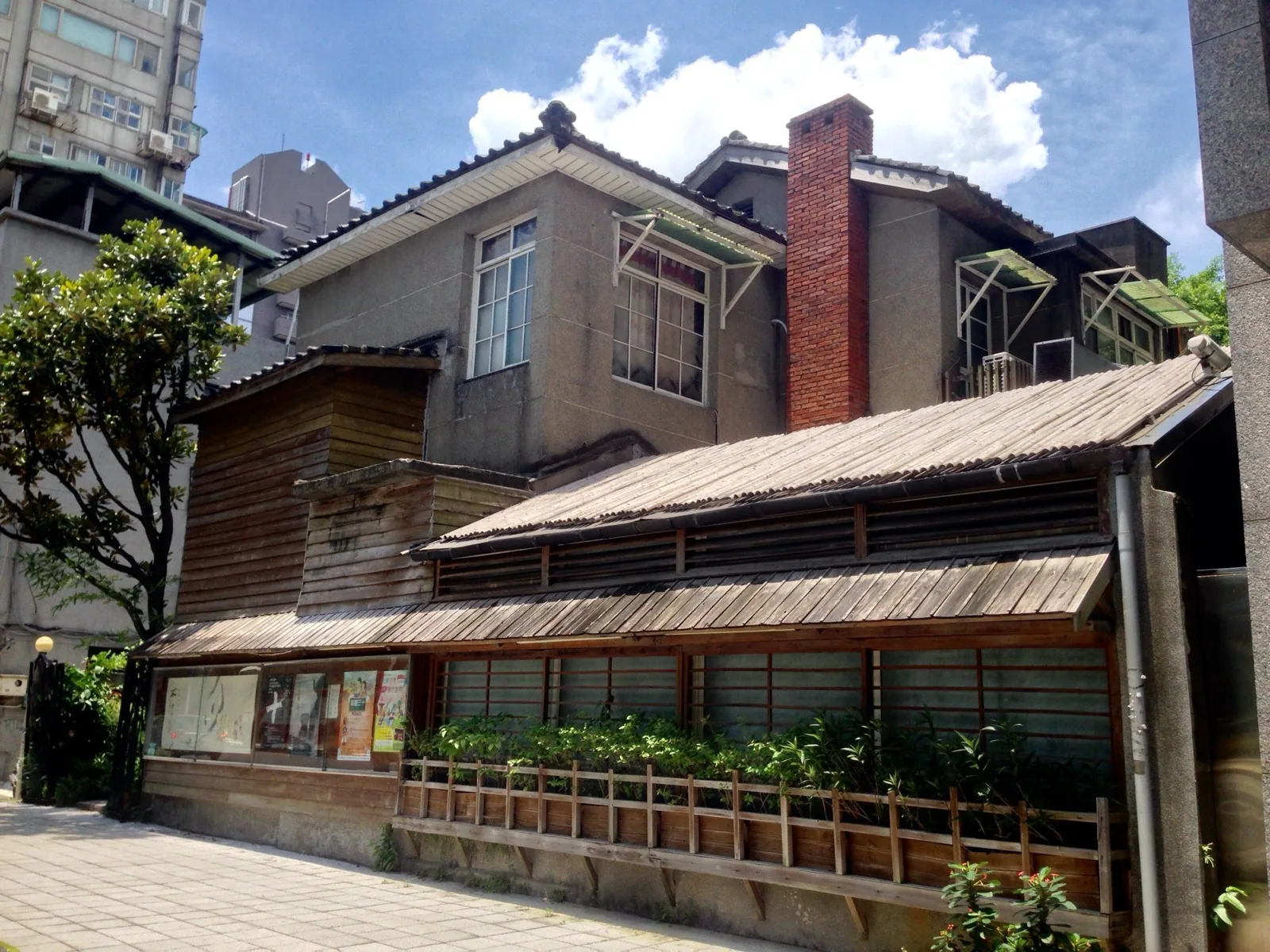
Wistaria Tea House, built in the 1920s; Chou Te-wei moved in in 1950, and it became a teahouse in 1981. Photo: Outlookxp, CC BY-SA 4.0 via Wikimedia Commons.
Beyond Wistaria Tea House, at No. 1-1, Lane 16, Lane 18, Wenzhou Street, stands Yin Hai-kuang’s former residence4. Yin Hai-kuang (1919-1969) was one of the most important representatives of postwar liberalism in Taiwan. In 1956, he moved from near NTU into this Japanese-style dormitory and lived there until his death from stomach cancer in 1969. In this house, he translated Hayek’s The Road to Serfdom, wrote The Prospects of Chinese Culture, was monitored by the Taiwan Garrison Command, and was dismissed from NTU. On September 16, 1969, Yin Hai-kuang died in this house at the age of 504. In 1999, Legislative Yuan President Wang Jin-pyng donated funds to assist with restoration; in 2003, it opened to the public as a memorial residence. Walking the circuit of Qingtian 76, Wistaria Tea House, and Yin Hai-kuang’s former residence means passing through three physical coordinates of postwar Taiwanese geology, liberal economics, and liberal philosophy. The three houses are less than 800 meters apart.
💡 Did you know: While Chou Te-wei was translating Hayek in his study at Wistaria Tea House, Yin Hai-kuang was translating Hayek’s The Road to Serfdom in his Wenzhou Street study 800 meters away. Two of the most important liberal translations in Taiwan’s postwar intellectual history were produced simultaneously in two Japanese-style dormitories at opposite ends of this street. Most Taipei residents do not know this. Most tourists lining up at Din Tai Fung are standing right beside this history.
Din Tai Fung: A 1958 Oil Shop, 1972 Xiaolongbao
To explain how Yongkang Street became today’s “Yongkang Street,” 1958 and 1972 are two key years that must be distinguished.
In 1958, Yang Bing-yi (1927-1995) and a fellow townsman pooled funds to open a small shop at No. 277, Section 2, Xinyi Road, called Din Tai Fung. Yang Bing-yi was from Yuncheng, Shanxi. He came to Taiwan in 1947 and originally worked as an assistant at the Taipei cooking-oil shop Heng Tai Fung. After Heng Tai Fung closed, he and another employee went into business together. The name came from the “Din” of Ding Mei Oil Shop and the “Tai Fung” of Heng Tai Fung5.
The Din Tai Fung shop opened in 1958 as a wholesale and retail cooking-oil business: peanut oil, sesame oil, lard, and salad oil were sold in bulk, and nearby households, noodle shops, and breakfast shops were its customers. For those 14 years, from 1958 to 1972, Din Tai Fung had nothing to do with xiaolongbao. The storefront was only four ping. Oil drums stood at the entrance, and inside were an accounting desk and a scale5.
In 1972, Din Tai Fung encountered a shock of modernization: Taiwanese households began widely using bottled salad oil15. Japan’s Nisshin Oil and Taiwanese brands such as Uni-President Salad Oil and Chung Hsing Oil began mass production, convenience-store channels spread, and the bulk-oil wholesale business declined rapidly. Yang Bing-yi’s wife, Lai Pen-mei, suggested: “Let’s switch to making snacks”5.
In the second half of 1972, Din Tai Fung’s storefront continued selling oil on one side and began selling xiaolongbao and soy milk on the other5. Lai Pen-mei led the kitchen. What she made was a hybrid of the momo, steamed buns, of Yang Bing-yi’s Shanxi hometown and Jiangzhe-style xiaolong tangbao, soup dumplings: a method taught by a master from Shanghai, Shanxi people’s insistence on wheat-based foods, and Taiwanese diners’ preference for “thin skin and ample filling.” By the early 1980s, Din Tai Fung had completely stopped its oil business and become a dim sum shop.
In 1993, the travel section of The New York Times published an article on the “world’s ten best restaurants,” naming Din Tai Fung among them6. The article was later reprinted by many international media outlets, and Din Tai Fung transformed from a small Taipei shop on Section 2, Xinyi Road into an international brand. In 1996, Din Tai Fung opened its first overseas branch at Takashimaya in Shinjuku, Tokyo. From 2000 onward, it entered the United States, Singapore, Hong Kong, Shanghai, Jakarta, Seoul, Manila, and Sydney. By 2026, Din Tai Fung had more than 170 branches in 14 countries worldwide16.
But the original shop at No. 277, Section 2, Xinyi Road never moved far away5. Today, on that street, the Din Tai Fung sign faces a 7-Eleven across the road. The storefront has expanded from its original four ping to two floors, but the address still points back to 1958.
On January 1, 2015, TV Tokyo broadcast the New Year special “New Year Taiwan Episode” of the Japanese drama Solitary Gourmet. The protagonist Inogashira Gorō, played by Matsushige Yutaka, walks into Din Tai Fung’s Yongkang flagship and orders xiaolongbao, hot-and-sour soup, and fried rice7. This was the first overseas special of Solitary Gourmet. It achieved high ratings in Japan and directly fueled the 2015-2018 boom in Japanese tourists treating Din Tai Fung Yongkang as a must-queue destination in Taiwan7.
In the late 2010s, Korean dramas and Korean social media took over the relay. Din Tai Fung appeared repeatedly in Lee Young-ae’s Kitchen and Youn’s Kitchen, while “must-eat in Taipei” tags accumulated on Instagram. Yongkang Street gradually shifted from being “Japanese tourists’ home turf” in 2015 to the “shared home turf of Japanese and Korean tourists” in the 2020s17. Today, at lunchtime on weekdays outside Din Tai Fung’s Yongkang branch, looking over from Jinshan South Road, Japanese and Korean voices are often more common than Mandarin.
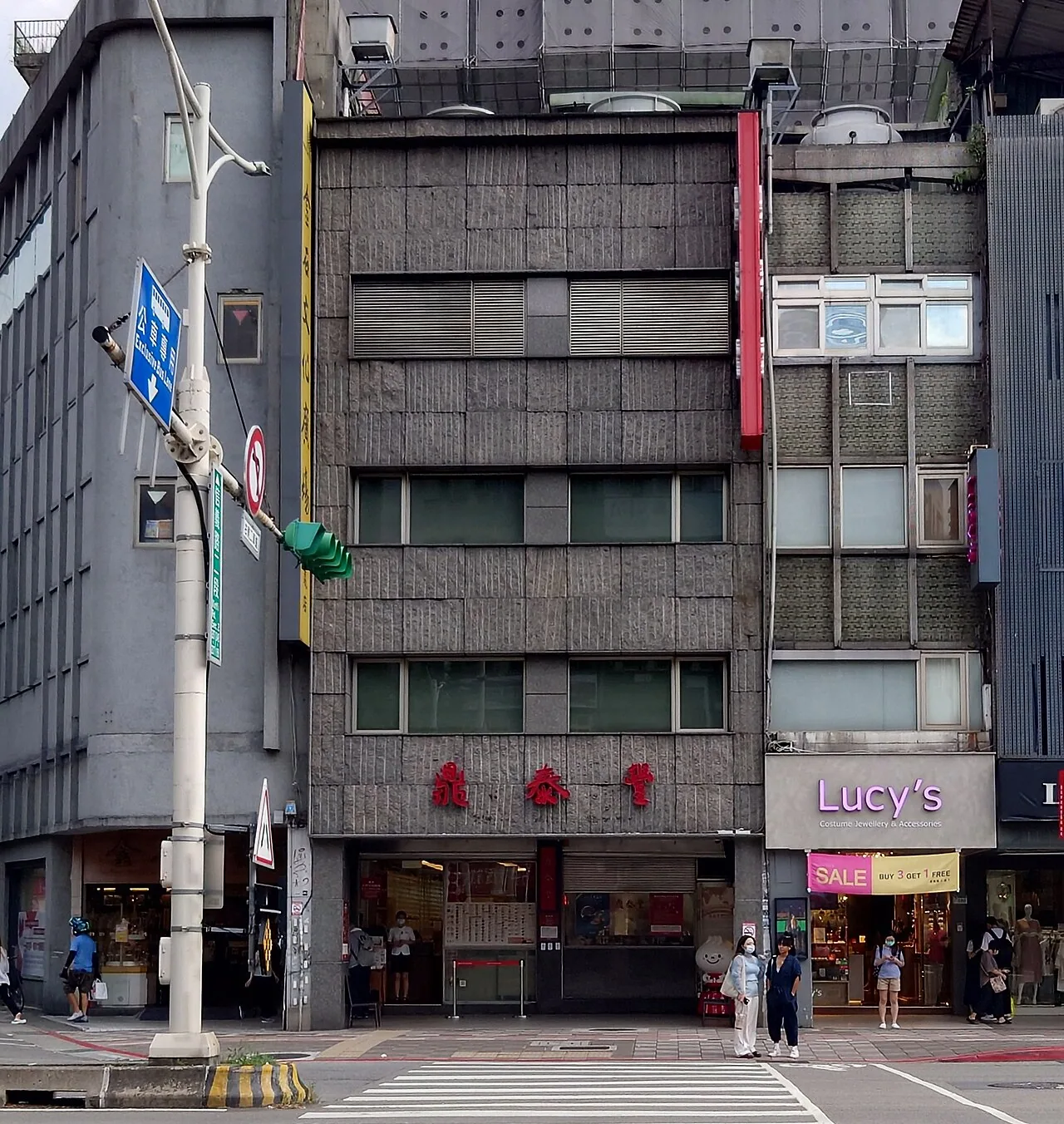
Exterior of Din Tai Fung Xinyi Branch, 2023. Photo: Yu tptw, CC BY-SA 4.0 via Wikimedia Commons.
✦ “The Din Tai Fung of 1958 sold bulk salad oil from oil drums. The downturn of 1972 led Yang Bing-yi to switch to xiaolongbao. The 1993 New York Times article sent him toward the world. Taipei’s postwar commercial history is compressed into these three years.”
From Din Tai Fung to Yongkang Beef Noodles, Smoothie House, and Dongmen Dumpling Hall
Din Tai Fung is a representative of the international style on Yongkang Street, but the street's food map includes more than just one establishment.
Yongkang Beef Noodles, located at No. 17, Yongkang Street, was founded in 1963 by veterans from Shanxi 18. The founder combined the techniques of Shanxi knife-cut noodles with Sichuan chili culture; the menu featuring both braised and clear soups has remained unchanged on Yongkang Street for 60 years. A local custom when ordering at Yongkang Beef Noodles is that if you order the braised beef noodles, you do not ask "spicy or not," as the restaurant will automatically serve medium spicy; if you want it extra spicy, you must explicitly state "extra spicy." The second generation of Yongkang Beef Noodles continues to operate in 2026 at the same location as in 1963 18.
Dongmen Dumpling Hall, near the intersection of Section 2 of Jinshan South Road and Section 2 of Xinyi Road, was founded in 1953 by veterans from Shandong. Looking north from Section 2 of Xinyi Road, Dongmen Dumpling Hall forms part of a line of provincial food stalls with Dongmen Market: dumplings, knife-cut noodles, millet porridge, sweet and sour ribs, and braised lion head are all local flavors brought from northern China by veterans from Shandong, Shanxi, Henan, and Sichuan in 1949, which were reconfigured into the "provincial cuisine" category on Taipei streets over 60 years 19.
In 1997, Luo Chun-hua and his ex-wife Chang Chia-mei opened an ice cream parlor on Yongkang Street, making "mango shaved ice" another signature item of Yongkang Street 20. The parlor was once listed by The New York Times as a must-visit spot in Taipei, alongside the National Palace Museum and Taipei 101. It was one of the key establishments during the late 1990s transition of Yongkang Street from a "provincial military family area" to a "must-visit location for Japanese tourists." In 2010, the parlor closed unexpectedly due to marital issues of its founder; the original site was later taken over by Smoothie House, which inherited the customer base of mango ice 20.
From Din Tai Fung's 1958 oil shop, Yongkang Beef Noodles' 1963 Shanxi veterans, and Dongmen Dumpling Hall's 1953 Shandong veterans, to the 1997 mango ice parlor and Smoothie House taking over, the timeline of food on Yongkang Street closely overlaps with the timeline of provincial migration to Taiwan: The soldiers who migrated from various provinces in China between 1947 and 1955 brought their hometown cuisines to these streets in Taipei, which became the "Yongkang Street cuisine" tourist label 60 years later.
Street view of Yongkang Street during the day, March 2024. Photo: MAm ROFOW 022, CC0 via Wikimedia Commons.
Transformation After the 1990s: Literary Figures, Coffee Shops, Instagram, and Rent
In the latter half of the 1990s, Yongkang Street began its second identity transformation: shifting from a "local eatery street in former provincial areas" to a "literary/artistic coffee street."
The opening of Ice Monster in 1997 was a key year. The first cafes (such as "Yongkang Kai" and "Old Chiang Coffee") appeared around Yongkang Park the previous year. In the early 2000s, private bookstores, curated shops, art galleries, and designer studios successively opened in the alleys of Lane 6, Lane 10, and Lane 15 of Yongkang Street. The entire 2000s represented the peak of "Yongkang Street's artistic boom"21.
Two structural conditions fueled this transformation:
First, the gradual decline of the first generation of former provincial residents in the 1990s. The officials and professors who migrated to Taiwan in 1947 were mostly over 70 by the 1990s. After many residents in Japanese dormitories and post-war renovated apartments passed away, houses were inherited by the second generation, who had largely moved out of Yongkang Street to larger apartments in suburban areas, turning their original homes into rental properties. The rent structure shifted from "long-term resident occupancy" to "commercial property leasing," with the rent per ping on Yongkang Street jumping from NT$800 to NT$3,500 between 1995 and 200521.
Second, the opening of the Taipei Metro in 1996. After the Tamsui-Xinyi Line (Red Line) opened at Dongmen Station in 2013, Yongkang Street changed from a place that required a 10-minute walk from Zhongshan Junior High School Station or Daan Station to one accessible in just a 3-minute walk from Exit 5 of Dongmen Station. The opening of Dongmen Station was the physical turning point where Yongkang Street transitioned from "a local eatery street frequented by old Taipei residents" to "a tourist destination accessible to all of Taipei"22.
Starting in the late 2010s, Yongkang Street entered a third transformation: the costs of gentrification began to emerge. With rents rising to NT$5,000–NT$8,000 per ping per month, old local shops, traditional restaurants, and small bookstores were forced out, replaced by bubble tea brands, chain cafes, trendy apparel stores, and Instagrammable dessert shops. In 2018, "Hui Liu Teahouse" (an old teahouse that opened in 1991) closed at No. 13 Yongkang Street; in 2019, "Yongkang Beef Ramen" (which opened in 1965) moved to an alley on Section 2 of Xinyi Road due to rising rents. The speed at which old local businesses left was directly proportional to the rate of gentrification-driven rent increases21.
📝 Curator's Note: Yongkang Street looks lively today: Din Tai Fung queues, Smoothie House crowds, and Instagrammable shops one after another. But beneath this liveliness is a street that is emptying out its original residents. The Japanese people from Showa Town in 1922 left in 1945; the first generation of former provincial residents who arrived in 1947 declined by the 1990s; and the local shops, bookstores, and teahouses from the 1990s moved out during the gentrification of the 2010s. What remains are tourists and chain brands. When Taipei locals say "Yongkang Street has changed," they are not referring to the buildings (there aren't many demolished Japanese dormitories in Qing Tian Street), but to the people who live there. This street undergoing three cycles of replacement is a microcosm of gentrification in Taipei.
Three Places Locals Would Take You
Tourist photo spots will not be listed here: Din Tai Fung Yongkang, Smoothie House mango ice, the reservation-only Qingtian 76 cafe, and check-in photos at Yongkang Park appear in every travel guide’s “must visit Yongkang Street” list.
Here are three places locals would take you: places that do not often appear on Instagram but have warmth.
1. Yu Ta-wei’s Former Residence at No. 8 Lishui Street
From the entrance to Yongkang Street, go north across Section 2, Xinyi Road, turn left onto Lishui Street, and walk to No. 8. You will see a preserved Japanese-style dormitory. This was the official residence of Republic of China Minister of National Defense Yu Ta-wei from 1962 to 199323. Yu Ta-wei was born in Shaoxing, Zhejiang in 1897 and earned a doctorate in mathematical logic from Harvard University. After the war, he successively served as Minister of Transportation and then Minister of National Defense for 11 years, from 1954 to 1965. He was a central figure in the Republic of China’s military procurement, weapons autonomy, and Taiwan-United States military cooperation in the 1950s and 1960s. After Yu died in 1993, the house was taken over by the Taipei City Government. In 2014, it was designated a municipal historic site of Taipei City, and restoration was completed in 2017. On weekday afternoons today, it is usually closed, but from the entrance you can see the complete facade of the Japanese-style dormitory and the old camphor tree in the courtyard. This is one of the few objects in Taipei where the full layout of a 1922 Shōwachō Japanese-style dormitory can still be seen.
2. Dongmen Market on Section 2, Xinyi Road in the Early Morning
From the entrance to Yongkang Street, go west across Jinshan South Road and you arrive at Dongmen Market24. This traditional market was established in 1948, synchronizing with the timeline of postwar mainlander migration to Taiwan. The market has two entrances: the Section 2, Xinyi Road side is the tourist version of Dongmen Market, where seafood rice bowls and sashimi appear at noon, but the rear entrance on Jinshan South Road is the local version. Between 6 and 10 in the morning, retired grandfathers and grandmothers from nearby Da’an District come here to buy the morning’s vegetables, meat, fish, and tofu. Many stalls have operated from 1948 to 2026 and are now inherited by the third generation. This market is only 200 meters from Yongkang Street’s main street, but walking inside feels like returning to Taipei in 1980: the steel frames of the stalls, the gray of the brick walls, the old fans overhead, the stall owners calling prices in Taiwanese Hokkien-accented speech. Yongkang Street’s food timeline extends out from this market.
3. The Old Bookstore “Qingtian Yiji” at the End of Lane 16, Qingtian Street
From the entrance to Yongkang Street, go north across Section 2, Xinyi Road, pass Lane 7 of Qingtian Street, where Qingtian 76 stands, and continue to the end of Lane 16, Qingtian Street. You will see a small bookstore. This shop opened in 2003 and was among the earliest private bookstores from the peak of the Yongkang-Qingtian Street hipsterization period25. The shop is about three ping, with bookshelves reaching from floor to ceiling, and its books lean toward Taiwanese literature, art and design, and the humanities and social sciences. The owner usually opens at 2 p.m. and closes on Mondays. Most tourists do not know where this shop is: it is not on Yongkang Street’s main street, but at the end of an alley two intersections away on Qingtian Street. There is no sign at the entrance, only an A4 sheet of paper with the shop name. This shop is one of the few old strongholds of 2000s Yongkang Street hipsterization that has survived, and it is still run by its original owner.
Six Hundred Meters, Three Generations of Residents
From the first Japanese-style dormitory in Shōwachō in 1922 to the line outside Din Tai Fung Yongkang stretching to the bend at Jinshan South Road in 2026, this street contains 104 years of time. Under the old trees beside Yongkang Park at 7:30 in the morning, an elderly mainlander grandfather sits on a stone bench holding the morning paper, while a Japanese tour group walks over from Xinyi Road. At 9:30, the grandfather folds up his newspaper and goes home, and the tour group finishes taking photos and continues toward Din Tai Fung. This is the relay that takes place on this street every morning.
From the Japanese planning Shōwachō in 1922, to Adachi Hitoshi, Ma Ting-ying’s predecessor, moving into Qingtian 76 in 1931, to Chou Te-wei taking over Wistaria Tea House in 1950, to Yang Bing-yi opening Din Tai Fung as an oil shop in 1958, to the switch to xiaolongbao in 1972, to the New York Times article in 1993, to Solitary Gourmet filming here in 2015, to independent travelers brought by Korean social media in 2026, a 600-meter street contains three generations of residents, four communities, and five kinds of memory.
The next time you walk down Yongkang Street, look up at the black-tile gently sloped roofs of those 1930s Japanese-style dormitories. The roughly 10 roofs that have survived from Adachi’s time to Ma’s time to 2026 are Taipei’s most complete fragments of Shōwachō memory. The 600 meters beneath your feet are a physical cross-section of Taiwan’s postwar geology, liberal economics, mainlander wheat-food culture, and international tourism, five layers of history stacked one atop another. Tourists photograph the lines and the signs; Taipei residents remember the grandfather who sat for a lifetime on that stone bench beside Yongkang Park at 7:30.
Further Reading:
- Taipei City: Three Times in One City, 1738 Longshan Temple Watching 2004’s Taipei 101 — A panorama of Taipei’s 12 districts; Da’an District, where Yongkang Street is located, is the core of “educational and cultural Taipei”
- Taiwanese Old Street Culture and Commercial Districts — Main catalog of old streets; compares Yongkang Street with Dihua Street, Bopiliao, and Anping Old Street
- Ethnic Groups: Hoklo, Hakka, Indigenous Peoples, Mainlanders, New Immigrants — The narrative of 1949 mainlander migration to Taiwan; Yongkang Street and Four Four South Village represent two modes of mainlander settlement
- Taiwanese Wheat-Food Culture — The relationship between Yongkang Beef Noodles, Dongmen Dumpling House, Din Tai Fung xiaolongbao, and the postwar mainlander wheat-food map
- Taiwanese Military-Dependent Village Cuisine — The culinary interweaving of Yongkang Street, Four Four South Village, Youth Park, and Beitou military-dependent villages
- Dadaocheng: 800 Meters, Three Centuries, from Formosa Tea to the First Shot of February 28 — A sibling article in the same Batch 1 historic districts series; Qing-era commercial street versus Japanese-era high-end residential district, comparing two kinds of “street-formation moments”
- Gongguan — Yongkang Street and Gongguan jointly sustain NTU’s faculty-student consumption circle, from the 1928 imperial university period to the scholar-student dining axis of 2026
- Four Four South Village — A 1948 arsenal military-dependent village that contrasts with the mainlander settlement mode of taking over Japanese-style dormitories on Yongkang and Qingtian Streets: “military-dependent housing versus takeover”
Image Sources
This article uses five CC0 / CC BY-SA licensed images, one hero image plus four inline images, all cached in public/article-images/geography/ to avoid hotlinking source servers:
- TW 台北 大安區 永康街 morning March 2024 R12S 110(Yongkang Street in the early morning) — Photo: MAm ROFOW 022, CC0
- 國立臺灣大學日式宿舍-和平東路一段183巷7弄6號 3783(Qingtian 76) — Photo: 林高志, CC BY-SA 4.0
- 台北市大安區紫藤廬 — Photo: Outlookxp, CC BY-SA 4.0
- Din Tai Fung Xinyi Branch 20230704(Din Tai Fung Xinyi Branch) — Photo: Yu tptw, CC BY-SA 4.0
- TW 台北 大安區 永康街 March 2024 R12S 650(Yongkang Street in daytime) — Photo: MAm ROFOW 022, CC0
References
- Wikipedia: Showa Town (Daan District, Taipei) — Established after the municipal revision of Taipei in 1922 (Taisho 11), covering parts of Qing Tian Street, Yongkang Street, Li Shui Street, Chaozhou Street, and Jin Hua Street in modern Daan District, Taipei. It served as a high-end residential area for the staff of Tokyo Imperial University and high-ranking officials of the Governor's Office. In 1947 after the war, it was divided into five streets, and the name "Showa Town" completely disappeared from official documents and maps.↩23456
- Taipei City Cultural Affairs Bureau: Qing Tian No. 76 — No. 6, Lane 7, Qing Tian Street. This was a Japanese-style dormitory built for newly hired staff of Tokyo Imperial University in 1931 (Showa 6). It had an area of about 70 ping and a garden of 100 ping. The pre-war resident was geologist Ashita Jin (1931-1945), and post-war, the residents included geologist Ma Tingying (1947-1979) until his passing. It was designated as a municipal historic site of Taipei in 2006 and has been renovated and opened to the public by Qing Tian No. 76 Culture in 2011.↩2345
- Wikipedia: Wisteria House — No. 1, Lane 16, Section 3, Xinsheng South Road, Daan District, Taipei. A Japanese-style dormitory from the late 1920s. It served as a residence for Japanese customs officials before the war. In 1950, it was taken over by liberal scholar Zhou Dewei as a study and salon. In 1981, his son Zhou Yu renovated it into a tea house and opened it to the public, naming it "Wisteria House" (after the wisteria in the courtyard). It was designated as a municipal historic site of Taipei in 1997.↩234
- Taipei City Cultural Affairs Bureau: Yin Haigu's Former Residence — No. 1-1, Lane 16, No. 18, Wenzhou Street, Daan District, Taipei. The liberal philosopher Yin Haigu lived here from 1956 to 1969, where he translated Hayek's "Road to Servitude" and wrote "Prospects of Chinese Culture." He passed away due to stomach cancer on September 16, 1969, at the age of 50. In 1999, Chairman Wang Jinping of the Legislative Yuan donated funds to assist with the restoration, and it has been open as a memorial residence since 2003.↩234
- Wikipedia: Din Tai Fung — In 1958, Yang Bingyi (1927-1995), from Yuncheng, Shanxi, partnered with fellow villagers to open the edible oil wholesale and retail store "Din Tai Fung" at No. 277, Section 2, Xinyi Road, Taipei. The name was derived from one character each of the former owners, "Dingmei Oil Store" and "Hengtai Feng Oil Store." In 1972, due to the popularization of bottled salad oil and the decline of bulk oil sales, his wife Lai Benmei suggested switching to making dim sum like xiaolongbao and soy milk. In the early 1980s, they completely stopped the oil business and converted it into a dim sum shop.↩234567
- New York Times: World's 10 best restaurants 1993 — In 1993, the travel section of the New York Times featured "World's Top Ten Restaurants," listing Din Tai Fung. This was a key turning point report for Din Tai Fung, marking its transition from a local Taipei shop to an international brand. It was subsequently reprinted by several international media outlets. In 1996, Din Tai Fung opened its first overseas branch in Takashimaya, Shinjuku, Tokyo, Japan.↩2
- Wikipedia: Gourmet of Solitude — A drama adapted from a food manga produced by TV Tokyo in Japan. On January 1, 2015, it aired the New Year special episode "Taiwan in the Lunar New Year." The protagonist, Inogashira Goro (played by Matsushige Toyo), visited Din Tai Fung Yongkang Main Store, braised pork rice, and night markets. This was the first overseas special of the series, achieving high ratings in Japan and directly fueling the craze among Japanese tourists to visit the Din Tai Fung Yongkang store from 2015 to 2018.↩23
- Din Tai Fung Official Website: Main Store and Branches — The Xinyi Road main store (No. 194, Section 2, Xinyi Road, moved from the original No. 277 in 1996) and the Yongkang main store are two major Taipei locations. The Yongkang store is one of Taipei's most representative tourist landmarks because it often has queues that curve from the entrance onto Xinyi Road due to high concentrations of tourists.↩
- Daan District Office: Local History of Daan District — The historical development of Daan District. During the Japanese colonial period, Showa Town, Tuda Town, and Fukuzumi Town were established in 1922 during the municipal revision. In 1947 after the war, they were renamed Qing Tian Street, Yongkang Street, Li Shui Street, Chaozhou Street, Jin Hua Street, Heping East Road, and Xinsheng South Road system. The street grid after the war originated differently from the Japanese colonial grid, resulting in an overlay phenomenon in Taipei's street layout.↩2
- Qing Tian No. 76 Culture Official Website — Qing Tian No. 76 (Ma Tingying's former residence) was renovated and opened to the public by the Qing Tian No. 76 Culture team in 2011. The building is a Japanese-style dormitory built in 1931 (Showa 6), featuring a black tile sloping roof, cypress lattice windows, stone lanterns in front of the entrance, with a study and living room side by side. It is one of the best-preserved former high-ranking official residences from the Japanese colonial period in Taipei.↩2
- National Taiwan Museum: 1945 Japanese Property Acquisition Records — After Japan's defeat in August 1945, the Nationalist Government began taking over Japanese properties across Taiwan starting in 1946. The Tokyo Imperial University staff dormitory was handed over by the Japanese side with a list, keys, and furniture. Japanese scholars such as Ashita Jin completed the formal handover procedures before evacuating in October 1945. Related acquisition records are preserved at the National Taiwan Museum and the National Archives.↩
- National Taiwan University History Museum: Ma Tingying — Ma Tingying (1899-1979) was from Liaoning, China. He studied in Berlin, Germany, and spent 12 years in Japan as a doctoral student of geology at Tokyo Imperial University. In 1946, he came to Taiwan and took over the Geology Department of Tokyo Imperial University. From 1947, he served as a professor and department head of the Department of Geology at National Taiwan University. His research areas included coral fossils, plate tectonics, and paleomagnetism. He published papers such as "Geological Theory of the Taiwan Strait." He passed away in Qing Tian Street No. 7, Lane 6 in 1979.↩
- National Cultural Memory Bank: Japanese Dormitory Group in Qing Tian Street — The Japanese-style dormitories in the area of Qing Tian Street, Yongkang Street, Li Shui Street, Chaozhou Street, and Jin Hua Street. From the 1970s to the 1990s, due to housing tax incentive renovation clauses and high maintenance costs for Japanese wooden structures, many were demolished and redeveloped into five-story apartments. Today, fewer than 10 representative buildings are preserved, including Qing Tian No. 76, Wisteria House, Yin Haigu's former residence, and Yu Dawei's former residence, most of which were rescued by cultural heritage protection movements after the 1990s.↩2
- Wikipedia: Zhou Dewei — Zhou Dewei (1902-1986) was from Hunan, China. He studied under the Austrian School economist Hayek at the University of Berlin in Germany and the London School of Economics in the UK. After relocating to Taiwan with the KMT government in 1949, he taught at the Department of Economics at National Taiwan University and worked at the Customs Administration of the Ministry of Finance. Starting from the 1950s, Wisteria House served as his residence, study, and a private salon for liberal scholars, where Yin Haigu, Xu Fugan, Lin Yusheng, and Xia Daodong often gathered to discuss the editorial work of Free China magazine and translate Hayek's ideas.↩234
- Wikipedia: History of Salad Oil in Taiwan — In the 1960s and 1970s, the Taiwanese household edible oil market shifted from bulk oil to bottled salad oil. After Unifine established in 1969, it launched Unifine Salad Oil. The popularization of brands like Nissin Oil and Zhongxing Oil through convenience store channels caused the traditional bulk oil business to decline rapidly, making it one of the representative cases of post-war consumption structure transformation in Taiwan during the 1970s.↩
- Din Tai Fung Internationalization History — In 1996, Din Tai Fung opened its first overseas branch in Takashimaya, Shinjuku, Tokyo, Japan. In the 2000s, it successively expanded to cities such as the United States, Singapore, Hong Kong, Shanghai, Jakarta, Seoul, Manila, Sydney, London, and Surabaya. By 2026, it had over 170 branches in 14 countries globally, making it one of Taiwan's most internationally scaled local dining brands from the post-war era.↩
- Story Studio: Yongkang Street and Japanese/Korean Tourists — Starting in the 1990s, Yongkang Street attracted standard itineraries for Japanese tour groups, such as "Old Taipei Day Tours." In the 2010s, scenes related to Din Tai Fung frequently appeared in Korean dramas like Yoon's Kitchen and Lee Young's Kitchen, accumulating traction through Instagram hashtags like "Must-Eat in Taipei." The number of individual Korean tourists rapidly increased from 2015 to 2020, gradually transforming Yongkang Street from a 'Japanese customer base' into a 'shared Japanese/Korean market.'↩
- Introduction to Yongkang Beef Noodles — Yongkang Beef Noodles is located at No. 17, Yongkang Street, Daan District, Taipei. It was founded in 1963 by a veteran from Shanxi. The menu featuring both red-braised and clear-broth versions has remained unchanged from 1963 to 2026. The second generation continues the business, making it one of the representative old shops for mainland Chinese noodles on Yongkang Street, forming part of the surrounding landscape with Dongmen Dumpling House (from Shandong in 1953).↩2
- Taipei City Government Tourism Promotion Bureau: Mainland Noodles Map around Dongmen Market — Dongmen Dumpling House was founded in 1953 by a veteran from Shandong near the intersection of Jinshan South Road, Section 2, and Xinyi Road, Section 2. It is a representative old shop for mainland noodles around East Gate in Taipei after the post-war migration. Together with Yongkang Beef Noodles (from Shanxi in 1963) and Din Tai Fung (from Shanxi/Jiangsu in 1958/1972), they form the Yongkang-Dongmen mainland noodle cluster.↩
- Mirror Magazine: ICE MONSTER Luo Junhua's Entrepreneurship and Reignition — A 2019 report mentioned that in 1997, Luo Junhua opened the ice cream shop ICE MONSTER on Yongkang Street with his ex-wife Zhang Jimei. It was once listed by the New York Times as a must-visit place in Taipei. The shop unexpectedly closed due to marital issues in 2010; the original site is now occupied by Simuxi. In 2012, he relaunched ICE MONSTER on Zhongxiao East Road.↩2
- Institute of Sociology, Academia Sinica: Study on the Gentrification of Taipei — Yongkang Street has undergone three waves of transformation since the late 1990s: 'From Mainland Military Family Area to Literary/Artistic Coffee Street' (Ice Cream Shop in 1997, Yongkang Kai Coffee in 1996, private bookstores and curated shops moving in); 'From Literary Street to Tourist Street' (MRT Dongmen Station opening in 2013, Din Tai Fung featured in Gourmet of Solitude in 2015); and 'The Cost of Gentrification Emerges After 2015' (rents rising to NT$5,000-8,000 per ping per month, with old shops gradually leaving). It is one of the representative cases in the study of gentrification in Taipei.↩23
- Wikipedia: Dongmen Station (Taipei) — An interchange station between the Taipei MRT Tamsui-Xinyi Line and the Zhonghe-Xinlu Line, located at the intersection of Xinyi Road, Section 2, and Jinshan South Road in Daan District. It opened on November 24, 2013. Exit 5 is near Yongkang Street. This represents a physical turning point where Yongkang Street changed from requiring a 10-minute walk from Zhongshan Junior High School Station or Daan Station to being reachable in a 3-minute walk from Exit 5 of Dongmen Station, leading to a significant increase in tourist density on Yongkang Street after 2013.↩
- Taipei City Cultural Affairs Bureau: Yu Dawei's Former Residence — A Japanese-style dormitory located at No. 8, Li Shui Street, Daan District, Taipei. It served as the official residence during the tenure of Defense Minister Yu Dawei from 1962 to 1993. Yu Dawei (1897-1993) was a doctoral student in mathematical logic from Harvard University, originally from Shaoxing, Zhejiang. He consecutively served as Minister of Transportation and Minister of National Defense for 11 years (1954-1965), being a key figure in military procurement and US-Taiwan military cooperation during the ROC's 1950s and 1960s. It was designated as a municipal historic site of Taipei in 2014 and has been renovated and opened for guided tours since 2017.↩
- Wikipedia: Dongmen Market (Taipei) — A traditional market established in 1948, located at the intersection of Xinyi Road, Section 2, and Jinshan South Road, Daan District, Taipei. It developed synchronously with the post-war migration from mainland China to Taiwan. Many stalls are old ones that have been run since 1948 and are now in their third generation. The main shopping time for locals is from 6 AM to 10 AM, and it is the origin point of the food timeline of Yongkang Street, located about 200 meters away.↩
- Introduction to Qing Tian Yi Collective Independent Bookstore — A small independent bookstore at the end of Lane 16, Qing Tian Street, Daan District, Taipei. It opened in 2003 and was one of the earliest private bookstores during the Yongkang-Qing Tian Street literary/artistic boom of the 1990s-2000s. The store is about 3 ping, with bookshelves from floor to ceiling, stocking literature focusing on Taiwanese literature, art design, humanities, and social sciences. The owner opens at 2 PM and is closed on Mondays, making it one of the few surviving old spots in Yongkang Street during the literary/artistic period of the 2000s.↩