30-second overview: Xiluo sits in Yunlin, on the south bank of the Zhuoshui River, a town of 40,000-plus. Visitors remember the red Xiluo Bridge first, but local daily life runs on something else: black-bean soy sauce takes 180 days to brew, Baroque shophouses on Yanping Old Street have stood since the 1920s, Taiping Ma at Fuxing Temple has managed local affairs for three centuries, and a Qing-era immigrant martial hall at Qikeng turned a defense organization into a TV drama. This article does not treat Xiluo as the bridge's accessory; it puts the bridge back into the town's timeline. 1 2 3 4
A River Decided the Town's Location First
Xiluo's starting point was not the bridge, but the Zhuoshui River. The alluvial plain of the lower Zhuoshui gave Xiluo the conditions for rice cultivation, and later two industries: rice, and the soy sauce culture raised on that rice. When the Liberty Times reported on vegetable prices, it called the Xiluo Fruit and Vegetable Market a "distribution market for a major vegetable production area"—read backwards, that sentence is Xiluo's positioning: it is one of the nodes where central and southern agricultural products head north, with production area and market stacked in the same township. 5
The river also decided the town's other face: flood risk. At the end of Yanping Road, inside the Gongzhao Pavilion on the Zhuoshui River levee, stands a Taishan Shigandang erected in 1827, five feet six inches tall, over one zhang including the base, reputed to be the largest in Taiwan. The Shigandang's function is to suppress water and ward off evil—a town that wants to survive by the river must first negotiate terms with the river, and the stone is the monument to that negotiation. 6
Curator's note: To read Xiluo, first read the river. Soy sauce, old street, Mazu, martial hall—all are answers to the premise of "living by the river."
Soy Sauce: An Industry That Brews Time into Jars
Xiluo soy sauce is not marketing rhetoric; it is an entire industrial history. At its peak, Xiluo had over thirty soy sauce factories operating simultaneously; today there are still over ten. Wan Zhuang (founded 1909, Xiluo's oldest) and Rui Chun (founded 1921, first-generation founder Zhong Qin started by peddling with a shoulder pole beside the Mazu temple) are the two that have crossed the century mark. 1 2 7
The technical core of Xiluo soy sauce is black beans and time. After steaming, black beans are inoculated with koji mold for about a week, then placed in clay jars for sun-drying fermentation—short as three months, long as 180 days. Wan Zhuang's "pot-bottom yin oil" requires "at least 180 days" from black bean to finished product. Behind Rui Chun's factory sits one of Taiwan's largest jar fields, with over 2,000 ancient clay jars basking in the sun. For raw materials, Rui Chun even revived the "Tainan No. 5" black bean from the last 50 kg of seeds at the agricultural experiment station, contracting about 100 metric tons of Taiwan black beans annually. 2 7 8
This industry has also undergone transformation. In 2008, Wan Zhuang converted its old factory on Yanping Old Street into a tourism factory, becoming Taiwan's first soy sauce museum, offering reserved tours and DIY yin-gu (fermentation drum) workshops. The century-old shop's choice was not to move the factory away, but to turn the brewing site into a walk-in exhibit—soy sauce turning from condiment into part of the local narrative. 1
But the numbers must be honest: Taiwan's annual soy sauce output value is about NT$6 to 7 billion, and Xiluo's ten-odd factories share a slice of that. Soy sauce fed the town's brand, but did not turn the town into a big city—that is precisely Xiluo's condition: industry deep enough, scale not large. 7
Old Street and Mazu: Faith Kept Commerce Here
Yanping Old Street runs about 500 meters, lined with Baroque shophouses built under the 1920s street improvement plan: parapet walls, washed-stone facades, gable walls inscribed with family names. In its day Xiluo was a rice and grain distribution hub; merchants who made money built grand shophouses. Chinese medicine shops, old inns, soy sauce stores, tea houses—each played its role, forming the town's commercial cross-section. The old street's bustle has faded, but the houses still do business—"just opening doors and windows to live life" is another kind of preservation. 3 9
The old street's faith center is Fuxing Temple. Xiluo's Mazu arrived in Taiwan in the 56th year of Kangxi (1717), locally called "Taiping Ma," with three centuries of history; the temple sits at No. 180 Yanping Road, inside the old street. Since 2003, the "Luoyang Welcomes Taiping" Mazu Cultural Festival has been held each autumn; Fuxing Temple is also one of the overnight stops for the Dajia Mazu pilgrimage. The distance between commercial street and Mazu temple measures exactly the length of one old street—faith and business in Xiluo have never been separate. 6 9
Around the old street are two more landmarks worth noting. Zhenwen Academy was founded in the Jiaqing era (ca. 1812), the sole survivor of the four great academies of Yunlin at the time, designated a third-class historic site in 1984; Xiluo Theater (formerly Xiluo Seat), built during the Japanese colonial period with capacity for about 500, closed in the 1980s, listed as a historic building in 2001. Academy, theater, Mazu temple—a town of 40,000 kept three forms of public life—studying, watching shows, worshipping—within walking distance. 6 9
Qikeng: Martial Arts as an Immigrant Society's Organizational Form
Xiluo's martial spirit is not performance; it is an immigrant society's history of self-defense. Master A-shan, born Liu Ming-shan, was from Zhao'an, Fujian. He came to Taiwan in the 8th year of Daoguang (1828), and in the 11th year (1831) opened the "Zhenxing Society" martial hall in Xiluo's Guangxing to teach disciples. At the time, most residents in the Xiluo area came from Zhao'an; bandits occupied the mountains as kings. The Zhang-Liao clan, centered on Guangxing Village, organized twenty-five villages into "Qikeng" (seven keng) for joint defense—"keng" is both terrain and organization. 4
In 1972, CTS adapted this history into the Hokkien-language serial drama "Seven Swords of Xiluo," portraying the seven keng as seven knights-errant, running 222 episodes 10, a sensation upon broadcast. The drama's heat rewrote reality in reverse: tourists flocked to visit Master A-shan's tomb; locals rebuilt the cemetery; Xiluo Township Office allocated land before the tomb to establish Zhenxing Temple, enshrining Taiwan's only statue of Master A-shan. The Qikeng Sculpture Park on Guangxing Road then erected seven martial arts sculptures to stand this memory outdoors. 4 6
Curator's note: The sequence of Qikeng deserves attention: first came the reality of armed clashes and self-defense, then the martial hall; first the martial hall, then the TV drama; first the TV drama craze, then today's temple and park. Memory in Xiluo grows backward.
The Bridge Is the Landmark, Under the Bridge Is Daily Life
The Xiluo Bridge's story has its own dedicated article (see Further Reading): construction began in 1937, war halted it for fifteen years, U.S. aid steel arrived in 1952 and it was completed in seven months; when it opened to traffic in 1953 it was the longest bridge in the Far East. But for Xiluo people, the bridge's meaning is not only on the deck.
Under the bridge is another kind of public space. Along the levee and riverbed runs a cycling route only locals know well—starting under Xiluo Bridge, riding to under the freeway bridge and back, a round trip under twenty kilometers. Under the bridge there are also baseball/softball fields and a large lawn; holidays see townspeople exercising and picnicking. Outsiders drive across the top to see the scenery; locals cycle underneath to live their lives—the same bridge used as two different things.
Beside the bridgehead is the Xiluo Bridge Butterfly Park, built on the high floodplain under the bridge, with installation art, slides, and a sandpit—the kind of park townspeople with children go to. For the 2026 Lunar New Year, the township office even lit a 1.3-hectare sea of lights here. 11
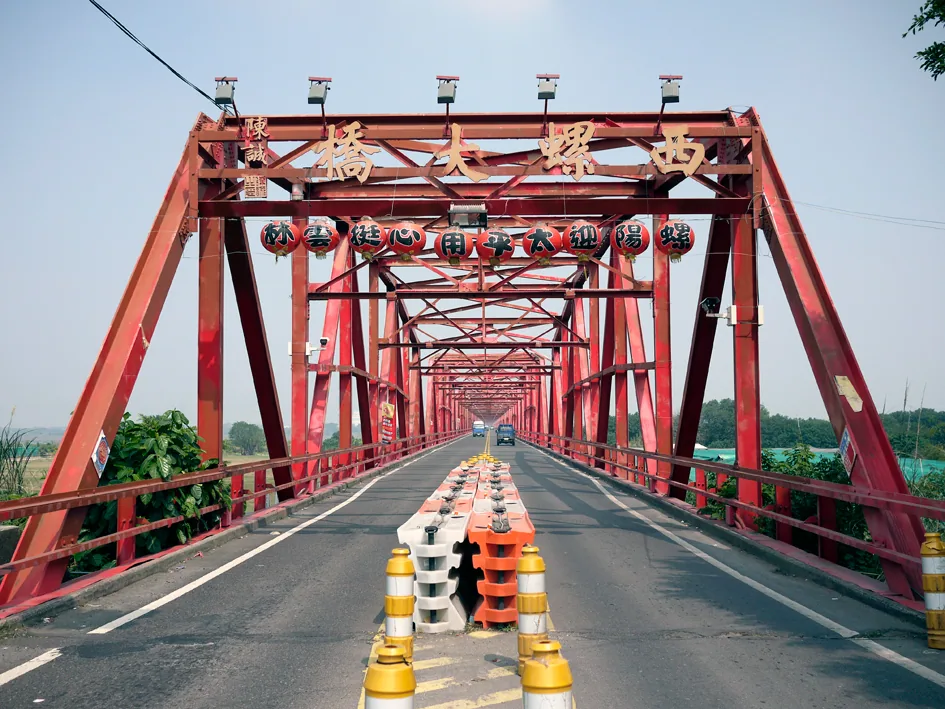
Image: Wikimedia Commons, author Fcuk1203, CC BY-SA 3.0. Image file page and license terms: Xiluo Bridge.jpg.
A Town of Two Times
Xiluo lives in two kinds of time simultaneously. One is soy sauce time: 180 days of fermentation, three centuries of Mazu, a century of soy sauce factories—things take their time, cannot be rushed. The other is bridge time: fifteen years halted, seven months to completion—history here learned to wait, and also learned to catch up all at once when materials arrived.
A town of 40,000 has kept both kinds of time. Soy sauce still brews, the old street still does business, Taiping Ma still tours each year, cyclists under the bridge on holidays—Xiluo does not need to be "discovered"; it has been here living life all along.
Further Reading
References
- Irene's Food & Travel · Time Travel: Xiluo Yanping Old Street · Wan Zhuang Soy Sauce Tourism Factory — Wan Zhuang founded in 1909 as Xiluo's oldest soy sauce brand; black bean to pot-bottom yin oil at least 180 days; 2008 old factory converted to Taiwan's first soy sauce museum (tourism factory).↩23
- Issue 500 / Economic Daily News: Century-Old Wan Zhuang Soy Aroma Accompanies 500 Dishes — Wan Zhuang founded in 1909 started from Xiluo; black beans, soybeans, koji mold to fermentation and aging in traditional brewing; Tainan No. 5 black bean contract farming.↩23
- Journey.tw: Xiluo Attractions/Food Recommendations · Xiluo One-Day Trip Guide — Yanping Old Street Baroque building cluster and street improvement plan; over thirty soy sauce factories at peak, now over ten; Xiluo Theater listed as historic building in 2001.↩2
- Wikipedia: Master A-shan (Martial Artist) — Liu Ming-shan came to Taiwan in 1828, opened Zhenxing Society in Xiluo Guangxing in 1831; Zhang-Liao clan centered on Guangxing, twenty-five villages divided into seven keng for joint defense; 1972 "Seven Swords of Xiluo" and Zhenxing Temple construction.↩23
- Liberty Times: Mid-Autumn Approaching · Agriculture Ministry Daily Vegetable Supply Up 36% — "Xiluo Fruit and Vegetable Market, a major vegetable production area," corroborating Xiluo Fruit and Vegetable Market's status as a distribution hub.↩
- Wikivoyage: Xiluo Township — Fuxing Temple Taiping Ma (arrived 1717, 300 years, Luoyang Welcomes Taiping Cultural Festival); Zhenwen Academy (founded Jiaqing era, sole survivor of Yunlin's four great academies); Taishan Shigandang (1827); Qikeng Sculpture Park; Wan Zhuang Soy Sauce Tourism Factory.↩234
- Economic Daily News: Century-Old Jars Break Out · Rui Chun Soy Sauce — Rui Chun founded 1921; Xiluo population ~40,000+, ~10+ soy sauce factories; Taiwan annual soy sauce output value ~NT$6-7 billion; black bean fermentation 3 months to 180 days; Tainan No. 5 black bean revival and annual contract farming ~100 metric tons.↩23
- Wikivoyage: Xiluo Township — Behind Rui Chun soy sauce factory one of Taiwan's largest jar fields, approx. 2,000+ ancient clay jars.↩
- Foodie Traveler: 2026 All-Taiwan Old Streets TOP35 — Xiluo Old Street (Yanping Road) Baroque architecture, introduced in Japanese colonial period; Fuxing Temple 300-year history, local important faith center.↩23
- Wikipedia: Seven Swords of Xiluo — CTS strip serial drama aired March 7 to October 13, 1972, 222 episodes total.↩
- Foodie Traveler: Xiluo Bridge Butterfly Park — Butterfly Park located on high floodplain beside Xiluo Bridge (Yunlin County Xiluo Township Yun 24 County Road No. 108), park has installation art and slide sandpit; 2026 Lunar New Year Xiluo Township Office created 1.3-hectare sea of lights here.↩