
30-second overview: In July 1980, the Taipei City Government designated this hilltop as the “planned site of Park No. 297”1. From that moment on, more than 200 illegal houses built into the hillside entered a state of “waiting to be demolished.” On June 25, 1993, the city formally announced demolition and relocation2; on July 20, 1994, Mayor Huang Ta-chou ordered the demolition of 46 legal military houses2; and in December 2001, the city demolished more than 40 of over 100 waterside-area residences2. But after the anti-demolition movement around Parks No. 14 and 15 on March 4, 19973, the city’s direction began to loosen: in 1999, Lung Ying-tai, the first commissioner of the Department of Cultural Affairs, proposed the concept of a “poor artist village”4; in February 2004, Treasure Hill was recognized as Taiwan’s first historic building registered “as an entire settlement”2; and on October 2, 2010, the international artist village officially opened5. Thirty years of demolition rulings ultimately became an “art-residence symbiosis” settlement that has hosted more than 500 artists from over 40 countries5: a Guanyin temple first substantially renovated in 17916, a group of people who built their own homes in the 1960s, more than 20 original households that stayed, plus a rotating cohort of international resident creators every three months, four layers of people living at the same time on this 46-meter-high hill beside the Xindian River7. This article is about this: the 30 years in which Treasure Hill went from stigmatized “illegal construction” to an international case study was not an uplifting tourism story. It was a miniature model of Taiwan’s civil society forcing open the public authority of urban planning.
At 5 p.m., the hillside stairways light up one by one
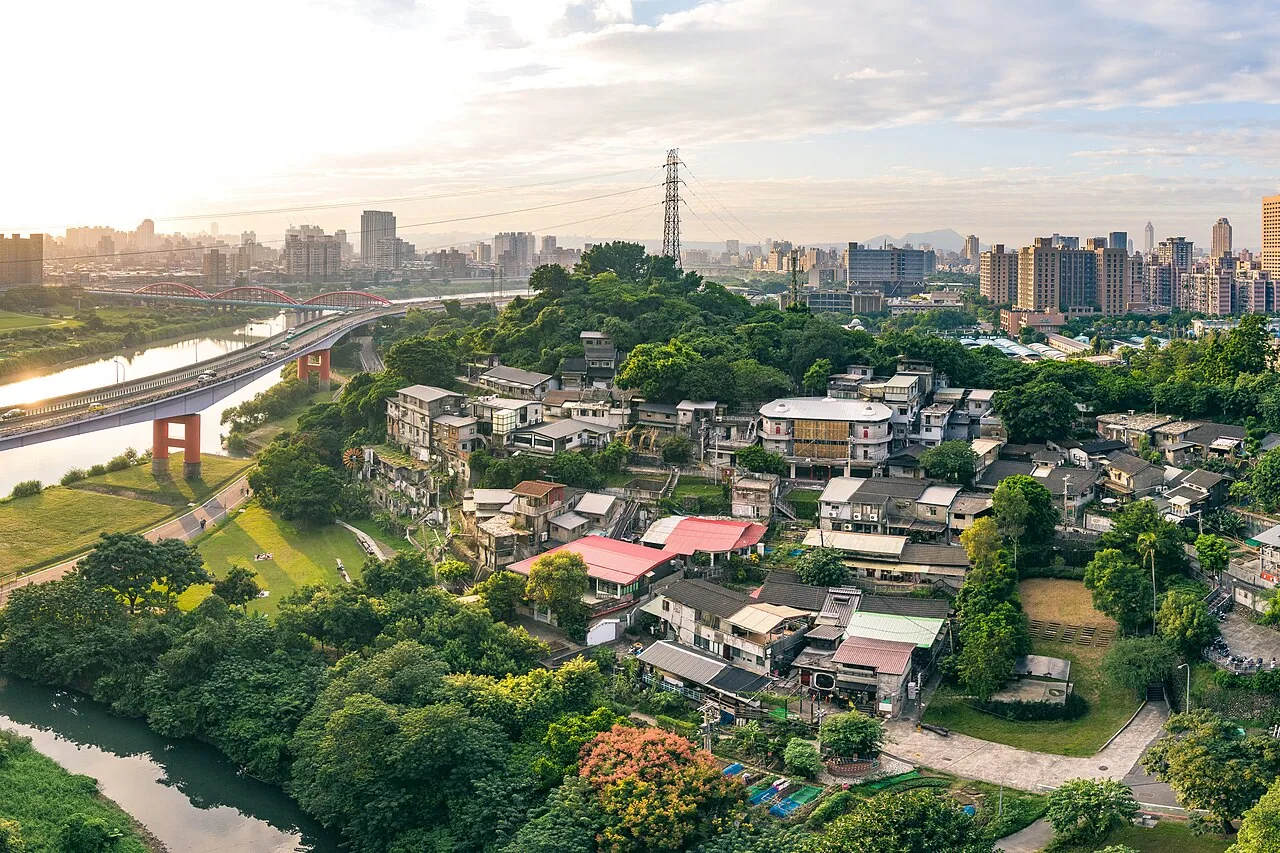
Aerial photograph of the Treasure Hill settlement, October 2018. Photo: Taipei City Government Department of Cultural Affairs, 2018-10-05. License via Wikimedia Commons (Attribution).
Come out of Exit 1 at MRT Gongguan Station, turn right into Lane 90, Section 4, Roosevelt Road, then left onto Tingzhou Road, walk to Lane 230, Section 3, and turn right: about a five- to seven-minute walk8. If it is your first time here, you may walk past it, because the mouth of the alley looks like an ordinary Gongguan lane, without any sign announcing that you are “about to enter a historic settlement.” After passing through the bustle of Shuiyuan Market and the Gongguan commercial district, then walking two more blocks, a small hill suddenly appears in front of you.
That is Treasure Hill.
At 5 p.m., students who have just finished an afternoon class at National Taiwan University, or tourists who have just left the Gongguan NET store, step onto the small road in Lane 14, Lane 230, that climbs up the hill. The first bend is the red-tiled facade of Guanyin Temple, a temple first substantially renovated in 17916. It enshrines Guanyin Buddha, and today a new multistory temple structure completely encloses the old single-story temple within it. Climb upstairs and you can see the roof carvings of the old temple up close9. Walk farther up, and the paths begin to turn irregular: winding alleys, crooked stairs, asymmetrical house orientations, some lintels bearing the words “Lin Residence,” “Chen Family,” or “Mama Chang,” and some windows hung with signs reading “Artist Studio #14” or “Open Studio.”
If you arrive at 5:30, you will see the lights in the hillside buildings come on one by one. Behind each light is a different person.
The first light to come on is the living-room light of an elderly mainlander veteran in his eighties, in the house beside Guanyin Temple. He has lived here since the 1960s, when this hillside was still military land belonging to the Taiwan Northern Defense Area Command2. He was one of several dozen retired mainlander military residents who built houses under the command’s tacit permission. The lights that come on in the middle section are artist-studio work lights: perhaps a visual artist who came from Seoul in 2026 for a three-month residency, adjusting an installation with a projector10. Near the hilltop, the corridor lights of the youth hostel are on: students from Germany, Sweden, Canada, and Thailand are staying for a night, and nearby you can hear travelers’ conversations mixing English with stiff Mandarin.
Four layers of people live on the same hill: the original residents who remained from the 1960s, the Guanyin Temple left from 1791, the international artists who have moved in since 2010, and overnight travelers. Thirty years ago, all four of these layers almost ceased to exist, because the 1980 urban plan had already sentenced this hilltop to become a “planned park site”1.
📝 Curator’s note: Ordinary travel writing frames Treasure Hill as an uplifting story of a “military dependents’ village transformed into an artist village,” but that narrative misses three things. First, Treasure Hill was never originally treated as a “military dependents’ village” at all. The Nationalist government never registered and managed it as one; all the houses were illegal structures, and residents included retired mainlander veterans, workers who had come north from central and southern Taiwan, and marginalized urban households7. Second, this hilltop nearly spent 30 years being demolished. After it was announced in 1980 as the planned site of Park No. 297, actual demolition took place in 1993, 1994, and 2001, making it one of the longest-running confrontations in the history of Taipei’s preservation movements2. Third, behind the phrase “art-residence symbiosis” was a compromise produced in 2003, when OURs Urban Reform Organization and the Department of Cultural Affairs forced two originally conflicting demands, “cultural preservation” and “housing rights,” into a single governance framework11. What changed over these 30 years was Taiwan’s overall view of “illegal buildings,” “disadvantaged settlements,” and “urban-planning authority.” The Taipei City Government’s decision at that moment in 1997 to move from “demolish everything” to “preserve in place” affected more than Treasure Hill.
The Guanyin Temple from 1791 is Treasure Hill’s first layer of history
To understand Treasure Hill, first separate two things: Treasure Hill the “temple” and Treasure Hill the “settlement” belong to two different historical timelines. The temple came first, the settlement came later, and nearly 170 years separate them.
Treasure Hill Guanyin Temple stands at No. 2, Lane 14, Lane 230, Section 3, Tingzhou Road, Zhongzheng District, Taipei City, next to the foot of Fuhe Bridge and beside the Xindian River96. The temple was sited on the southern foot of Xiaoguanyin Mountain, also called Hukong Mountain, a 35-meter-high branch of Toad Mountain. Because it was “built against a cliff, it was called a ‘yan’,” or rock shelter6.
There are two accounts of its founding date. Most sources cite Tamsui Tingzhi, published during the Tongzhi era of the Qing dynasty, and hold that Treasure Hill was built during the Kangxi era, in the late 17th century, by Guo Zhiheng, a migrant from Anxi, Quanzhou, and his son912. But based on the text of the “Guanyin Pavilion Stele” erected inside the temple in the third year of the Jiaqing reign, 1798, by the student-official You Dachuan, together with land-reclamation studies showing that significant cultivation around Gongguan did not begin until the 1770s, some scholars argue that the founding date should be closer to the Qianlong era69.
What is certain is this: in the 56th year of the Qianlong reign, 1791, Treasure Hill underwent its first major renovation, expanding the east and west side halls6. In the third year of the Daoguang reign, 1822, the monk Xinqian rebuilt Treasure Hill again, adding a Buddha hall, a merit hall, and a columbarium, while expanding the front hall and the corridor in front of the temple9. The main temple structure visible today is the result of these Qing-era alterations. The stone columns, stone piers, stone carvings, wood carvings, and steles that remain in the temple are still Qing originals. The most famous is the 1798 “Guanyin Pavilion Stele”96.
📝 Curator’s note: The “temple within a temple” structure of Guanyin Temple is worth pausing over. Expansions and renovations across the years lacked the unified design concept of a master carpenter; most were small-scale construction jobs done in batches by contractors, so the building techniques and component styles appear mixed, even collaged9. But this “collage” in fact shaped Treasure Hill’s most memorable architectural feature: a new multistory temple structure completely encloses the old single-story temple within it, and by climbing the stairs, visitors can see the old temple’s roof carvings up close. On the same temple body, the Qing side halls from 1791, the Daoguang-era rebuilding of 1822, and the contemporary expansion of 1996 stack together three eras of architectural language9. Treasure Hill was once listed as an important historic site in 1974, but because renovation caused it to “lose its ancient style,” that status was revoked; only in 1997 was it again registered by the Taipei City Government as a city-designated historic site136. One temple body contains four temporal layers: Qing, Japanese colonial, postwar, and contemporary. This multilayered “collage” quality later also became the material gene of the illegal settlement below the hill.
Looking uphill from Guanyin Temple, for the 158 years from 1791 to 1949, the hilltop consisted mainly of the temple, sparse farmland, graves, plus some Xindian River sand-mining households or rural families left from the Japanese colonial period2. During World War II, the Japanese military stationed an antiaircraft artillery unit at Treasure Hill and built underground bunkers and barracks on the southern foot of the hill to store ammunition. These structures later became the military-remains substrate of the hilltop settlement7. After the Nationalist government took over Taiwan in 1945, the Taiwan Northern Defense Area Command moved onto this land, and the hilltop changed from a Japanese antiaircraft position into a Nationalist military command post7. In the early 1950s, apart from the Guanyin temple and the command headquarters, the hill had only three to five households left from the Japanese colonial period2.
Treasure Hill’s “settlement history” began after that.
From the 1960s onward, the “people urban planning did not see” on the hillside
Beginning in the 1960s, two things caused the illegal settlement later known as Treasure Hill to grow on the hillside.
The first was a slight easing of Cross-Strait tensions and a loosening of the ban on illegal construction. The military had originally strictly enforced the rule that “outsiders were prohibited from building houses around the command headquarters,” but that rule began to relax. The command’s military authorities began tacitly accepting mainlander residents building illegal structures around Treasure Hill2. The second was the severe housing shortage in Taipei City caused by the 600,000 retired soldiers and dependents who came with the Nationalist government after it relocated to Taiwan, combined with the wave of rural-to-urban migrants who came north from central and southern Taiwan during Taiwan’s rapid industrial and commercial development in the 1960s and 1970s. Treasure Hill, with its steep slope, irregular terrain, and lack of incorporation into formal development under urban planning, was exactly the kind of place sought out by people who could not afford urban rents14.
The settlement’s resident composition therefore differed from that of ordinary “military dependents’ villages.” It was not registered or managed by the Nationalist government, and its residents included retired veterans, meaning mainlanders, workers who came north from central and southern Taiwan, meaning benshengren, low-income families, vendors, and other diverse groups14.
The way houses were built was also different. There were no architects, no structural calculations, no coordinated water or electrical infrastructure. It was purely self-built housing: people needed a place to live, so they built one7. Materials were gathered locally: pebbles picked up along the Xindian River, salvaged bricks, salvaged sheet metal, salvaged wooden boards. Construction stacked up layer by layer according to the hillside topography. There was no planned road network; alleys were made by the paths people walked. Apart from three to five more spacious official residences for generals and 40 legal military bachelor dormitories, most houses were narrow, self-built, locally sourced bungalows2.
In the early 1970s, the Taiwan Northern Defense Area Command relocated, and the pace of illegal construction accelerated2. By the mid-1980s, the settlement had already reached nearly four hectares in scale and housed about 200-plus households15. One account says that at its peak it had more than 250 households and over 400 residents14.
This was the physical reality faced by the demolition order of 1980: a dense illegal settlement of more than 200 households spreading from the temple up across the hilltop, inhabited by some of Taipei City’s most disadvantaged people.
📝 Curator’s note: In the eyes of the Taipei City Government in the 1980s, the concept of “disadvantaged people building their own homes” was defined as an urban-appearance problem to be solved, not as urban memory worth preserving. After Taiwan’s rapid industrial and commercial development in the 1970s and 1980s, the Taipei City Government’s urban-planning logic as a whole tended toward “tear down the old and build the new,” and illegal buildings not shown on planning maps were viewed especially as breaches in urban order. But for the people living here, this hill was the only place they could afford to live: the rent per ping down on Tingzhou Road was several times higher, and the bricks they picked up and the sheet metal they assembled on the hill were all the property they had. Treasure Hill’s real history exceeds thin labels such as “military dependents’ village” or “old soldiers’ story.” It is the story of how “people unseen by urban planning” in Taiwan’s first 30 postwar years of urban development built a settlement for themselves on an ignored hillside. Professor Liu Ko-chiang later described this period as “Phase 1.0”: “the process by which self-construction after the 1950s realized ‘local revitalization,’” and noted that “a vernacular architectural complex of more than 200 households reached its peak in the mid-1980s”11.
From water-source protection land to the planned site of Park No. 297
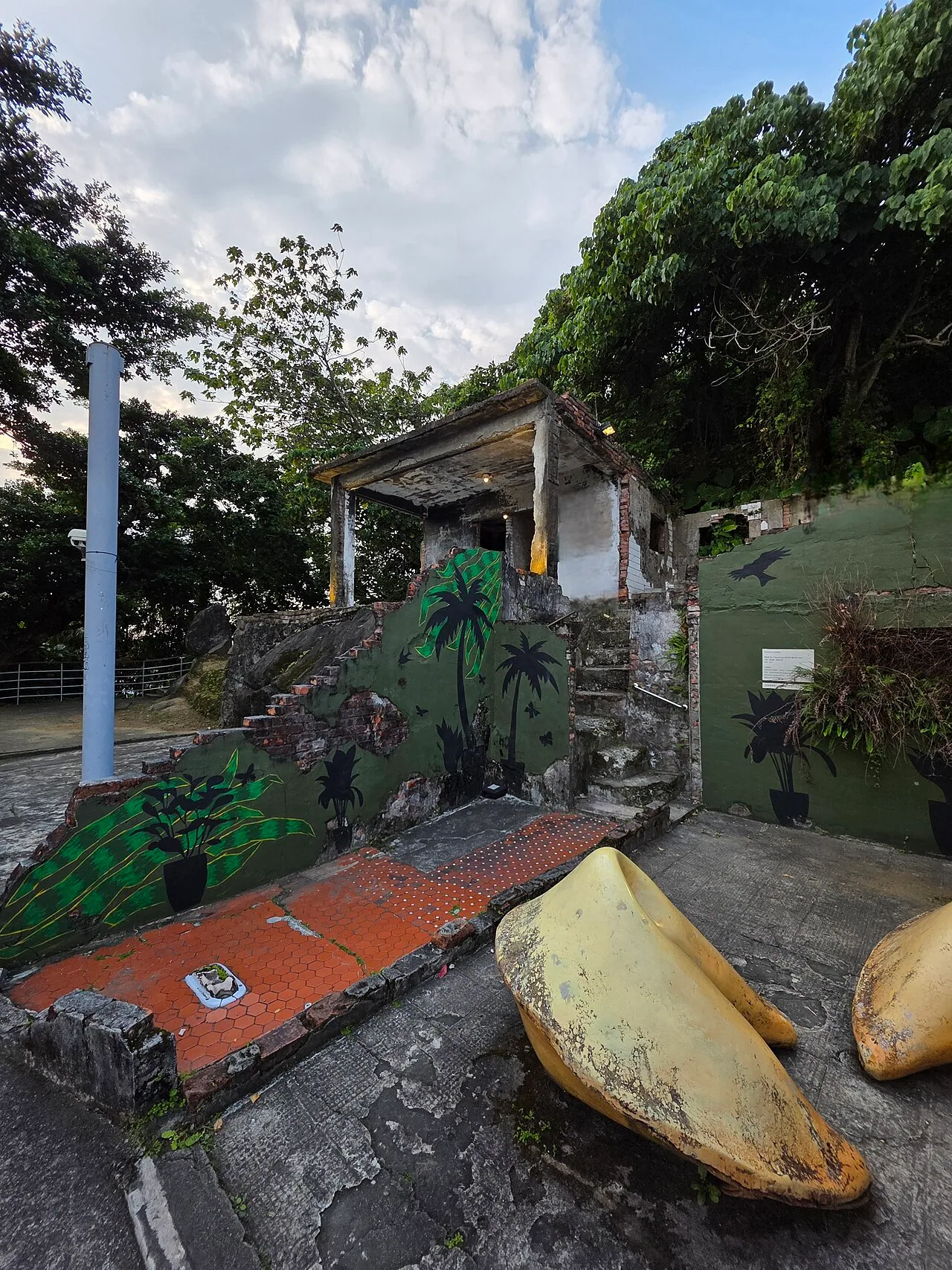
Main building cluster of the Treasure Hill settlement, February 2026. Photo: Adao (User: 阿道), 2026-02-21. License via Wikimedia Commons (CC BY-SA 4.0).
In July 1980, the Taipei City Government announced that Treasure Hill had been formally moved from water-source protection land into the planned site of Urban Planning Park No. 297 in the waterside area1. For residents, that announcement was a judgment.
The planning logic of Park No. 297 was this: because the land directly bordered the Xindian River and lay on the edge of the river’s floodway, it needed to become green space for flood control and public access to the water. Except for the historic monument of Treasure Hill Guanyin Temple, which could remain, all other illegal structures had to be demolished according to law16. From that moment on, every household on the hill entered a state of “waiting to be demolished.”
But demolition was not carried out immediately. Although several warnings were issued in the 1980s, the city government never actually moved in the bulldozers. One reason was that the compensation measures for demolition and relocation were incomplete; another was resistance by the residents’ self-governing association. This “postponement” was a technical delay, not a policy shift: the legal status of the planned park site did not change, and residents continued to live in uncertainty through the second half of the 1980s and into the early 1990s.
On June 25, 1993, the Taipei City Government formally announced that houses within the planned park site would be demolished and relocated2. The following year, on July 20, 1994, Mayor Huang Ta-chou ordered the demolition of 46 legal military houses2. This was Treasure Hill’s first truly large-scale demolition. Although the houses demolished were legal military buildings, after residents in the illegal-construction area saw the bulldozers, fear spread.
In the second half of the 1990s, demolitions of illegal buildings were taking place simultaneously elsewhere in Taipei. The key event was the anti-demolition movement around Parks No. 14 and 15 on March 4, 1997. That area, around Linsen North Road and Chang’an East Road, today Linsen Park and Kangle Park, had originally been the Japanese cemetery of Sanbanqiao in the Japanese colonial district of Mihashicho. After the war it became a large illegal-building cluster inhabited by residents from Zhoushan Island and Hainan Island who had come to Taiwan with the Nationalist government, but it was not a registered military dependents’ village3. At the end of February 1997, the Chen Shui-bian city administration decided to forcibly demolish it on March 4. In the early morning of February 26, resident Zhai Suoxiang hanged himself on the eve of demolition3. That same afternoon, more than 50 residents petitioned in front of the Taipei City Government. On the morning of March 4, “with the rumble of bulldozer engines, Kangle Li was reduced at once to broken bricks and shattered tiles”3.
The Kangle Li incident set off public controversy. Faculty and students from the Graduate Institute of Building and Planning at National Taiwan University proposed an “in-situ rehousing” plan and joined the resistance. Student Peng Yang-kai later became secretary-general of OURs Urban Reform Organization and remained deeply involved in demolition and relocation issues3. In the same month, March 1997, the handling of Parks No. 14 and 15 received extensive media attention. On June 10, the Taipei City Government decided to suspend full-scale forced demolition at Treasure Hill and other sites and began drafting rehousing plans2.
Treasure Hill escaped the fate of Kangle Li. The city government did not change its mind on its own. The Kangle Li demolition shook public opinion, and academia and the social-movement sector did not give the government a second chance.
📝 Curator’s note: The moment of the Kangle Li demolition on the morning of March 4, 1997, was a crucial turning point in the dialogue between Taiwan’s civil society and the public authority of urban planning in the 1990s. Before then, municipal demolition of illegal buildings was an administrative routine: announcement, compensation, or no compensation, then bulldozers entering the site. The entire process left no space for the option of “preservation.” After Kangle Li, scholars, activists, media, and city councilors began collectively questioning the very urban-planning logic of “demolish everything and rezone.” In September of the same year, faculty and students from NTU’s Graduate Institute of Building and Planning formally entered Treasure Hill to conduct resident interviews and spatial surveys, led by teams under Professors Hsia Chu-joe and Liu Ko-chiang; graduate students included Chen Chien-chung and others who later continued working in cultural-heritage preservation17. From that moment on, Treasure Hill was no longer “illegal construction waiting to be demolished,” but a “historic settlement with preservation potential.” A shift in terminology, from “illegal construction” to “settlement,” from “demolition” to “preservation,” changed the whole fate of Treasure Hill over the next decade.
The 2003 napalm performance art action
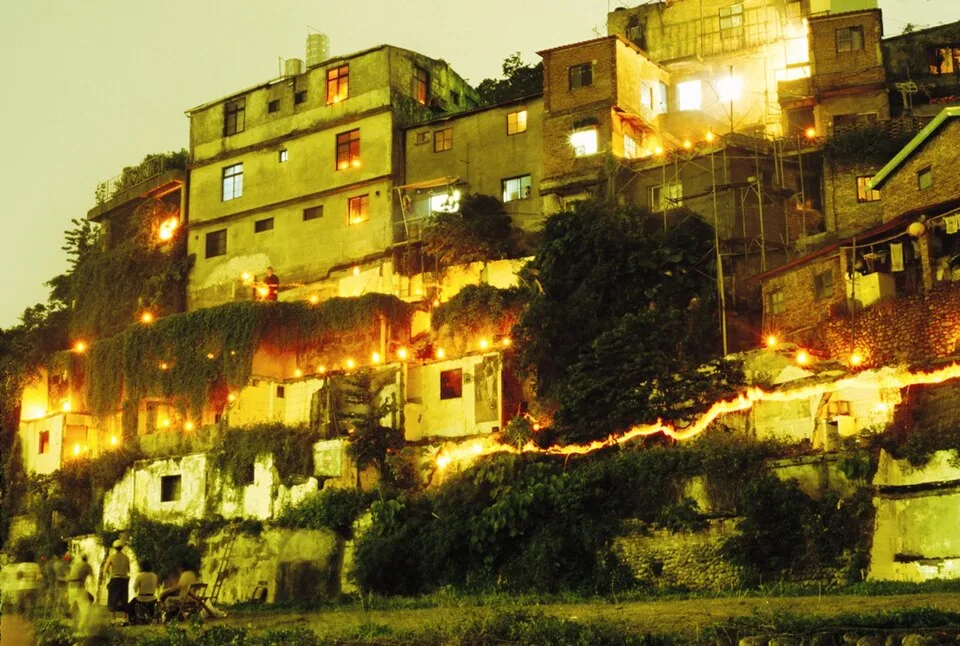
Marco Casagrande’s “napalm” performance art at Treasure Hill, 2003. Photo: Burgeoisnieves, 2003. License via Wikimedia Commons (Public domain).
The 13 years from 1997 to 2010 were Treasure Hill’s “experimental period.”
In 1999, writer Lung Ying-tai, at the invitation of Taipei Mayor Ma Ying-jeou, became the first commissioner of the Taipei City Government’s Department of Cultural Affairs4. During her term, the department began including Treasure Hill in cultural-asset evaluation and used the concept of a “poor artist village” as the future operating direction for Treasure Hill4. Lung’s proposal was crucial: it redefined Treasure Hill from “illegal construction waiting to be demolished” into a “historic settlement with cultural potential.”
In December 2001, the Taipei City Government completed partial resident rehousing and demolished more than 40 of over 100 residences in the waterside area2. These 40-plus households were concentrated in the Xindian River waterside area, on the edge of the legally uninhabitable floodway, making them the easiest part of the demolition ruling to carry out. The core hillside settlement was preserved, but the number of households fell from more than 200 in the 1980s to about 100-plus.
In June 2003, OURs Urban Reform Organization received a planning commission from the Department of Cultural Affairs to realize the original intention of preserving Treasure Hill, promote urban spatial reform, and advocate for residents’ rights1118. That same year, OURs planned the “2003 GAPP Global Action for Planning Pedagogy,” placing “art action” inside Treasure Hill’s preservation strategy18.
In October 2003, the Department of Cultural Affairs invited Finnish artist and architect Marco Casagrande to take up residence at Treasure Hill. Casagrande later proposed the concept of “Urban Acupuncture”: treating the city as a living organism and using small-scale, tactical interventions to trigger a repair process across the urban tissue19. What he did at Treasure Hill was simple: on the ruins of demolished houses, he manually built wooden stairs to make it easier for hillside residents to move in and out; on rubble left after demolition, he opened vegetable gardens and encouraged local residents to grow crops; and he built bamboo scaffolding for a farmers’ market1819. He named the project “Organic Layer Taipei”19.
What people remember most is the napalm performance art action: on the demolition ruins, Casagrande used flames in a ritual performance, painted his face red, and led volunteers in a “procession,” symbolizing the possibility that this settlement might soon disappear18. Flames burning atop the ruins of houses already half demolished were a message for the city government and society: “If you keep demolishing, what remains will be ashes like these.”
📝 Curator’s note: Marco Casagrande’s 2003 napalm performance art caused major controversy at the time. On the one hand, it pushed Treasure Hill’s demolition issue into international media. The Organic Layer Taipei project was later selected for the 2006 Venice Architecture Biennale, and The New York Times described Treasure Hill as a “must see location” in Taipei1920. On the other hand, some residents and preservation activists worried that a dramatic performance like napalm would typecast Treasure Hill as a “spectacle,” rather than a serious housing-rights issue11. What cannot be denied is this: beginning in 2003, Treasure Hill gained a name in international architectural and urban-planning circles. Casagrande later wrote the Treasure Hill experience into the book Biourban Acupuncture: Treasure Hill of Taipei to Artena19, turning “urban acupuncture” from a concept into a teachable methodology. An illegal settlement originally seen as an urban flaw became, in reverse, teaching material for international urban-planning theory. This reversal later became the basis of international legitimacy for Treasure Hill’s “art-residence symbiosis” label.
Treasure Hill’s vegetable gardens, stairs, and half-demolished houses
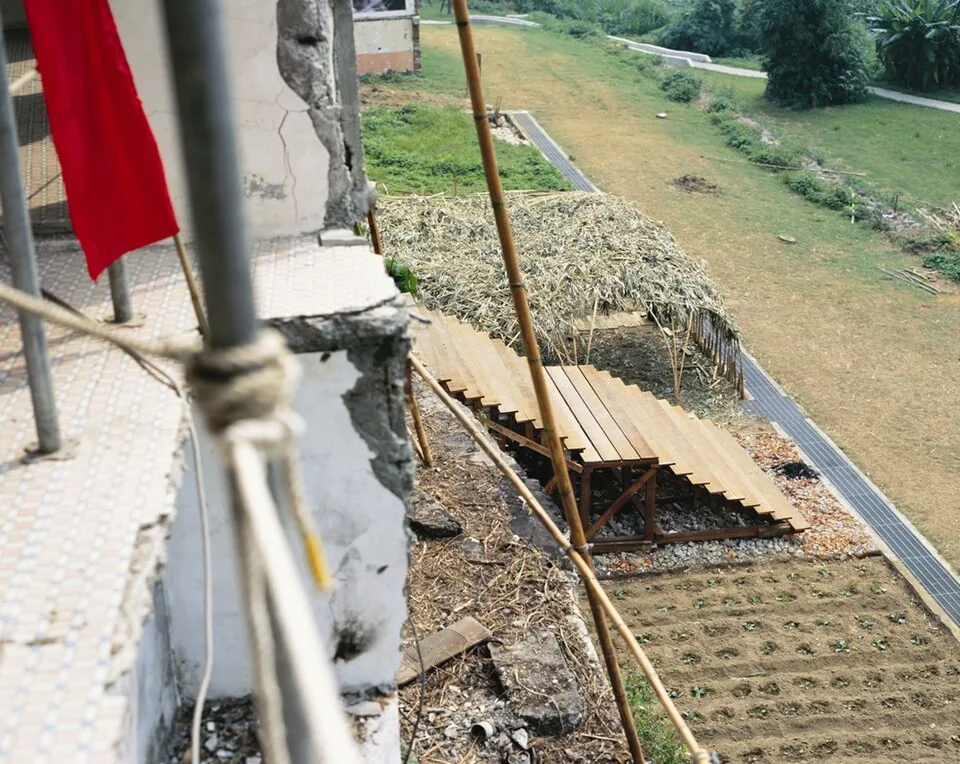
Vegetable garden from Marco Casagrande’s “Organic Layer / Treasure Hill” ecological urban-repair practice, 2003. Photo: Jan jörg, 2003. License via Wikimedia Commons (Public domain).
The three years from 2003 to 2006 were Treasure Hill’s most complicated.
On one side, OURs and the Department of Cultural Affairs were planning the future blueprint for the “Treasure Hill Symbiotic Artist Village,” with four directions: “Treasure Hill Home” for disadvantaged groups to live in; “artist-in-residence action” using art activities to participate in the community; an “international youth hostel” providing affordable accommodation for international students; and “ecological architecture and environmental learning” combining wetland environments with the settlement’s characteristics18. These four directions later became the three major theme zones when Treasure Hill Artist Village opened in 2010, with the ecological-architecture learning direction folded into the other three2122.
On the other side, the city’s demolition ruling had not been completely changed. Not until 2005 was Treasure Hill formally changed from “park land” into a “special-purpose district,” with the competent authority transferred from the Parks Office to the Taipei City Department of Cultural Affairs21. From 1980 to 2005, Treasure Hill’s identity on the urban-planning map as “a park” remained in place for 25 years.
In June 2006, the Taipei City Government issued an official letter reminding residents that they had to move out voluntarily by October 31, 2006, so that repairs could be made to the houses of original residents who wished to stay and met socially disadvantaged criteria, and so that part of the area could be renovated into the Treasure Hill Symbiotic Settlement2221. The city proposed three rehousing measures: receive an administrative relief payment of NT$720,000; receive a relief payment of NT$360,000 and be allowed to move back after two years; or move to nearby transitional housing22.
Beginning at the end of 2006, the Department of Cultural Affairs carried out settlement restoration work4. In 2007, the Treasure Hill historic settlement area was formally changed into a “special-purpose district”21. This legal classification change was crucial, because originally, “park land legally could not have residential use,” while a special-purpose district permitted the mixed use of “residence and cultural preservation co-constructed together.” Professor Liu Ko-chiang later explained: “Preserving Treasure Hill required seeking breakthroughs under the real conditions of law and regulation, after years of mediation and negotiation”11.
In October 2009, the Department of Cultural Affairs opened the renovated “Treasure Hill Home” zone for 22 original households to move in22. On October 2, 2010, “Treasure Hill Artist Village” formally began operations under the Artist Village operation division of the Taipei Culture Foundation521. From the announcement of the planned Park No. 297 site in 1980 to the opening of the international artist village in 2010, exactly 30 years had passed.
📝 Curator’s note: The 2006 rehousing decision deserves an extra moment. The city’s three options, a one-time NT$720,000 payment, NT$360,000 plus return after two years, or moving into transitional housing, all looked acceptable, but for elderly veterans who had built their own homes 30 or 40 years earlier, every choice was painful. Taking NT$720,000 once meant giving up the hill where they had lived their whole lives. Returning after two years meant moving into a renovated “cultural-preservation residence,” not the original house. Moving into transitional housing meant severing a 30-year physical connection to this settlement22. The 22 households that ultimately stayed, later reduced to 19, were overwhelmingly people who chose the “NT$360,000 plus return after two years” option. They agreed to leave for two years so the houses could be repaired, then move back and continue living there. But after returning, their status had changed from “illegal-construction households” to “objects of cultural preservation.” That status shift was not only a legal change. For veterans in their eighties, it meant moving from “people forgotten by urban planning” to “people incorporated into urban planning.” This reversal is the core achievement of Treasure Hill’s 30-year preservation movement11.
Opening day in 2010, and the 16 years after
The opening on October 2, 2010, brought together residents, artists, Department of Cultural Affairs officials, and preservation activists. Treasure Hill Artist Village formally began operations, commissioned to the Taipei Culture Foundation for management521.
At the moment it opened, Treasure Hill was defined as a “micro settlement-type artist village.” It adopted the concept of “art-residence symbiosis” and introduced three major theme zones: “Treasure Hill Home,” “Residency Program,” and “Youth Hostel”522. “Treasure Hill Home” was the residential area for original households, 22 in total; the “Residency Program” was the international artists’ studio area, with a new group every three to six months; and the “Youth Hostel” was accommodation for international backpackers2221.
By 2026, this structure had operated for 16 years.
Artist-in-Residence Taipei, AIR Taipei, uses Treasure Hill and Taipei Artist Village, at No. 7, Beiping East Road in Zhongzheng District, as its two main bases. Each year it holds three rounds of selection for domestic and international creative workers, providing accommodation and work space for three to six months2110. As of 2026, more than 500 artists from over 40 countries have taken part in residencies at Treasure Hill5. At the same time, it has sent more than 100 Taiwanese artists to overseas residency institutions for reciprocal visits and fieldwork5.
The first-quarter 2026 residency presentation brought together 11 groups of artists from Taiwan, Australia, Canada, Germany, Japan, South Korea, Sweden, Thailand, and the United States. Through visual art, performing art, music, literature, curating, and interdisciplinary artistic practice, and through forms including short fiction, staged readings, installation art, video, puppetry, and painting, they presented their lived experience during their residencies at Treasure Hill10.
Some artists have become special cases of long-term residency. Teacher Chou Ling-chih has been in residence since 2008, for more than 15 years as of 2026, shifting from ecological art to ceramic creation and co-creating an ecological garden with residents10. Beginning in January 2015, the poet Hsu Ta took up residence with “Climbing a Small Tower Poetry Cafe” as his base; after 2017 he initiated the “Poets Writing the Village” project, using modern poetry and prose to collect information from 27 households and document the settlement’s history1014.
On March 21, 2026, the “2026 Treasure Hill Light Festival: City of Glimmers” opened. Fourteen groups of interdisciplinary artists used light, sound installation, and performing art to respond to Treasure Hill’s distinctive historical texture and settlement landscape. The exhibition ran until May 3, open daily from 11:00 to 22:00, closed Mondays, with lights switched on from 18:00 to 22:0023.
📝 Curator’s note: Treasure Hill’s “symbiosis” label has not always been beautiful in its 16 years of practice. Tourism pressure has led some residents to complain about noise, trash, and intrusions into privacy. On holidays, large numbers of visitors pass through the alleys taking photographs, capturing residents’ laundry yards, or knocking on elderly residents’ windows. The Taipei Culture Foundation has continued to use “family-name signs,” placing surname signs in front of each resident’s house, to try to remind visitors that “people live here”22. There has also been tension between artists and residents. Installation works by resident artists sometimes touch sensitive resident memories or occupy public space in ways that inconvenience residents. Professor Liu Ko-chiang later said: “Between residents and artists, each respects the other’s autonomous existence, and on the basis of this consensus they face external forces together”11. He used “Treasure Hill 3.0” to describe the vision for the next stage: “repositioning the ‘art-residence symbiosis’ settlement as an integrated ‘creative living home,’” with the goal of integrating cultural preservation, living community, and social creativity11. Treasure Hill’s “symbiosis” has been a process under constant negotiation for 16 years. It has never been in a state of “already completed.”
Three places locals will take you to see
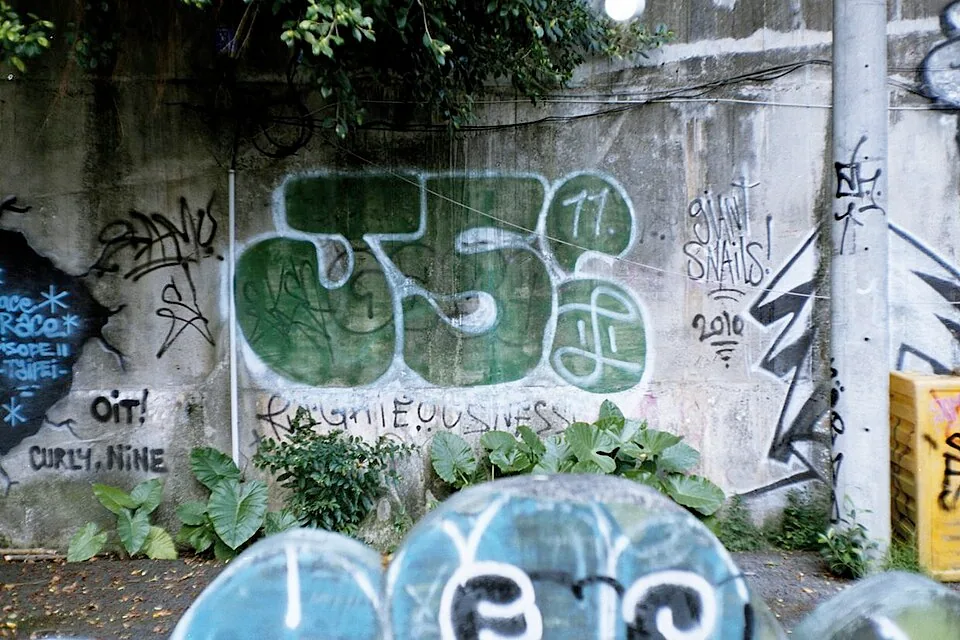
Graffiti in the Treasure Hill settlement, October 2012. Photo: Nisa yeh, 2012-10-14. License via Wikimedia Commons (CC BY-SA 2.0).
Tourists all know Treasure Hill. But these are the three places locals will take you to see.
Treasure Hill Guanyin Temple (No. 2, Lane 14, Lane 230, Section 3, Tingzhou Road). First substantially renovated in 1791, rebuilt in the Daoguang era in 1822, consecrated with a jiao offering ceremony in 1996, and designated a city historic site by the Taipei City Government on August 5, 199796. The point is not its exterior, which has already been covered by multiple layers of alteration. The point is to climb upstairs and look down from the side of the new temple body: you will see the roof carvings of the single-story old temple from 1791, completely enclosed inside the new temple. One temple body contains four temporal layers: Qing, Japanese colonial, postwar, and contemporary9. This “temple within a temple” is the most complete miniature of Treasure Hill’s material history. The later “layer upon layer” construction of the illegal settlement on the hillside followed the same material logic as this temple.
Machine-gun bunkers and air-raid shelters (inside the settlement). During the Japanese colonial period, the Japanese military set up an antiaircraft artillery position and underground bunkers on this hill. After the war, the ROC military took them over, and after 1949 they were reorganized as military facilities of the Taiwan Northern Defense Area Command7. After the Department of Cultural Affairs took over, these military remains were transformed into exhibition and performance spaces: the inside of the air-raid shelter is closed, with a plaza outside that can be rented for exhibitions; the machine-gun bunker preserves the concrete structure of military architecture and serves as a visual backdrop for outdoor performances2214. These spaces are Treasure Hill’s deepest material-historical layer: later than Guanyin Temple, earlier than the illegal settlement, and physical evidence of wartime militarization under Japanese rule.
Household museums and the Historical Cross-Section Gallery (various households inside the settlement). The 19 households in the “Treasure Hill Home” zone each have a “surname sign” in front indicating which family lives there. In addition to their residential function, some residents open their own spaces as “household museums,” using their own photographs, furniture, and objects to tell the story of the family from the 1960s to today1422. The “Historical Cross-Section Gallery” is a permanent exhibition curated by the Department of Cultural Affairs. It uses a timeline to present Treasure Hill’s complete history, from Qing-era temple, Japanese colonial antiaircraft position, postwar illegal settlement, 1980s crisis, 1997 turning point, to the opening of the artist village in 20102216. These exhibitions avoid the museum-like posture of “displaying things for tourists.” Residents and preservation activists have written their own history into the space. The photographs on the walls are pictures of grandparents when they were young, and the objects on the tables are things still actually in use.
After visiting these three places, you understand Treasure Hill’s true texture. Tourists rush to photograph the art installations, but what they see is only the surface. Locals’ Treasure Hill consists of the old temple carvings from 1791, wartime Japanese concrete bunkers, the homes of elderly veterans from the 1960s, and household museums accumulated over 16 years: four material layers spanning 230 years, all stacked continuously on the same 46-meter-high hill.
1980 vs. 2026, the same hill
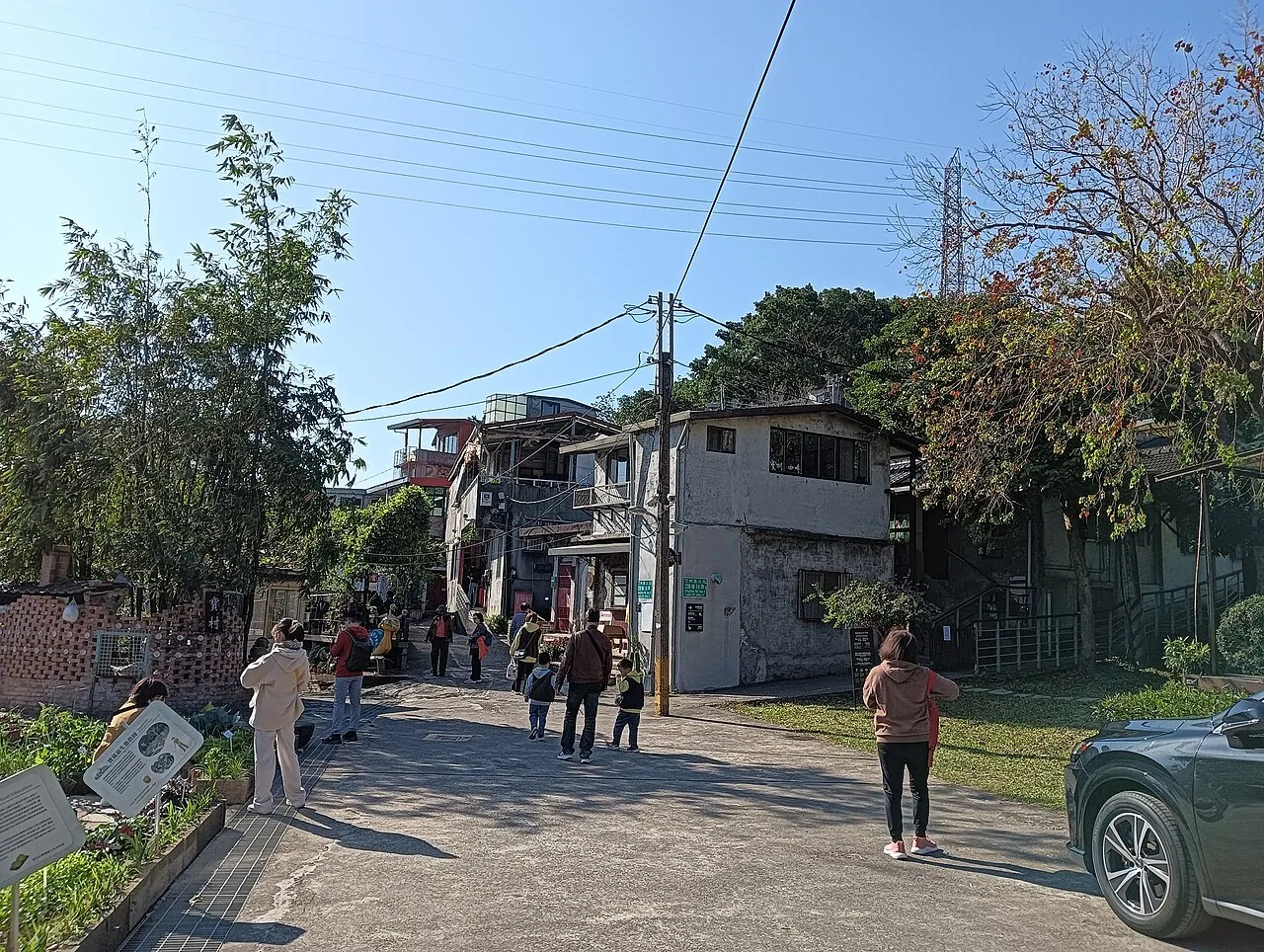
People walking in front of Treasure Hill’s ecological garden on January 30, 2025, the second day of Lunar New Year. Photo: Allervous, 2025-01-30. License via Wikimedia Commons (CC BY 4.0).
On that afternoon in July 1980, in the office of the Taipei City Government’s Department of Urban Development, several officials stamped the words “planned site of Park No. 297” on a document. More than 200 hillside households knew nothing about it. They only knew that beginning the following year, 1981, people would come to their doors to post demolition warning notices.
On an evening in May 2026, a visual artist from Seoul, South Korea, on a three-month residency walks along the stairs of Lane 14, Lane 230, toward his residency studio. He has just bought a bottle of water at a Gongguan convenience store and is using Google Maps to confirm the location of his residency unit. He has no idea that 46 years earlier, beneath these stairs, there was once a demolition ruling, and someone once used a napalm performance to stop this hill from being razed.
But he knows one thing: this hill is now one of Taipei’s most popular residency locations among international artists. He applied for seven Asian residency opportunities and ultimately chose Treasure Hill because “the history here is the most complex.”
Four layers of people live on this hill: the Guanyin Buddha left from the Qing dynasty, concrete bunkers left from the Japanese colonial period, retired veterans left from the 1960s, and international artists arriving for residencies in 2026. Thirty years ago, three of those layers nearly disappeared entirely.
✦ “The Treasure Hill settlement is a settlement formed through informal construction processes in postwar Taiwanese cities. It is a representative example of veterans, rural-to-urban migrants, urban Indigenous people, and other socially disadvantaged people building their own homes on marginal urban hillsides”7. This sentence comes from the official recognition issued by the Taipei City Government on May 27, 2011, when it announced Treasure Hill as “Taipei City’s first settlement architectural complex”2221. It is not promotional copy. The three phrases “informal construction,” “self-built housing,” and “socially disadvantaged people” were originally negative labels used by the city government in the 1980s to justify demolition and relocation. After 2011, they became positive labels used by the city government to recognize a cultural asset. The same hill, the same group of people, the same architectural objects: the state’s view of them reversed 180 degrees over 30 years.
Treasure Hill’s core contradiction is this: the same illegal settlement the state sentenced to death in 1980 was turned by the state into a cultural asset in 2010. Between those two moments lay 30 years of demolition confrontation, the shock of the Kangle Li incident, Lung Ying-tai’s concept of the poor artist village, resident interviews by NTU’s Graduate Institute of Building and Planning, legal mediation by OURs and the Department of Cultural Affairs, Marco Casagrande’s fire performance art, and the insistence of 19 elderly original households on staying.
These 30 years far exceed the uplifting story on tourism-bureau webpages about a “military dependents’ village transformed into an artist village.” These 30 years are a miniature model of Taiwan’s civil society forcing open the public authority of urban planning: from “the government decides” to “the government, scholars, and residents negotiate and decide together.” Treasure Hill’s 1997 policy shift affected more than one hill. It told later sites of 21st-century urban-planning conflict in Taiwan, from Losheng Sanatorium to Huaguang Community, Shaoxing Community, the residents beside Jut Art Museum, and many others, that “demolish everything and rezone” is not the only option.
Next time you pass through Gongguan, go past Shuiyuan Market and see the irregularly stacked building cluster on that hillside. Stop for 30 seconds and look. Two hundred thirty years ago, the ground under your feet was a Guanyin temple for the faith of Qing-era Zhangzhou migrants; 80 years ago, it was a Japanese antiaircraft position; 60 years ago, it was a refuge of self-built homes; 30 years ago, it nearly got razed; now it is an international artist village. The same 46-meter-high hill, four eras, four fates.
Treasure Hill was not demolished because enough people refused to let it be demolished.
Further reading:
- Taipei City: Three Times Inside One City, where Longshan Temple from 1738 Looks at Taipei 101 from 2004 — Treasure Hill’s position among Taipei’s 12 districts, placed alongside the three timelines of Bangka, Dadaocheng, and Xinyi
- The Development of Cultural and Creative Parks in Taiwan — Treasure Hill read together with cases such as Forty-Four South Village, Huashan, and Songshan Cultural and Creative Park, Taiwan-style case studies of “military dependents’ villages / industrial ruins turned cultural and creative spaces”
- Dadaocheng: 800 Meters Holding Three Centuries of Taipei — a fellow Batch 1 historic-district sibling; an 1851 tea-trade street and a 1960s illegal settlement are two completely different “moments when a street takes shape”
- Bangka: The Busiest Place in Qing-ruled Taipei — a fellow Batch 1 sibling; the Qing religious landscape of Longshan Temple from 1738 and Treasure Hill Guanyin Temple from 1791 were contemporaneous faith centers for Zhangzhou and Quanzhou migrants
- Ximending: The Entertainment District the Japanese Built in 1896 — a fellow Batch 1 sibling; an entertainment district planned under Japanese rule versus a postwar self-built illegal settlement, two contrasts in “people unseen by urban planning”
- Gongguan — the scholar-student consumer circle 800 meters to the north, and Treasure Hill’s illegal settlement, are two completely different spatial ecologies around NTU
Image Sources
This article uses six Wikimedia Commons licensed images, all cached under public/article-images/geography/ to avoid hotlinking source servers:
- Treasure_Hill_Village_01_20260221.jpg — Photo: 阿道 (User: 阿道), 2026-02-21, CC BY-SA 4.0
- Treasure_Hill_20181005.jpg — Photo: Taipei City Government Department of Cultural Affairs, 2018-10-05, Attribution (Government Open License)
- Treasure_Hill_fire.jpg — Photo: Burgeoisnieves, 2003, Public domain
- Treasure_Hill_garden.jpg — Photo: Jan jörg, 2003, Public domain
- Graffiti_at_the_Treasure_Hill,\_Taipei.jpg — Photo: Nisa yeh, 2012-10-14, CC BY-SA 2.0
- Street_in_Taipei_Treasure_Hill.jpg — Photo: Allervous, 2025-01-30, CC BY 4.0
References
- Treasure Hill Settlement — Wikipedia — The Treasure Hill Settlement entry records verbatim that “in July 1980, Treasure Hill was formally transferred from water-source protection land into the No. 297 urban-planning park in the waterside area,” making it a key documentary record of the timing when the planned site of Park No. 297 was designated.↩23
- Chronology of Major Events in Treasure Hill Settlement — Wikipedia — The Treasure Hill Settlement entry records key timelines in the confrontation over demolition and preservation, including “on June 25, 1993, the Taipei City Government announced that houses within the planned park site would be demolished and relocated,” “Mayor Huang Ta-chou ordered the demolition of 46 legal military houses on July 20, 1994,” “in December 2001, Taipei City completed partial resident rehousing and demolished more than 40 of over 100 residences in the waterside area,” and “in February 2004, the Taipei City Historic Sites and Historic Buildings Review Committee approved and recognized the ‘Treasure Hill Historic Settlement’ as a ‘historic building.’”↩23456789101112131415
- Opening the Kangle Market Time Capsule: Taiwan’s First Anti-Demolition Movement, 20 Years Later — The Reporter — The Reporter’s in-depth report on the March 4, 1997 anti-demolition movement around Parks No. 14 and 15 records that “on the morning of March 4, 1997, with the rumble of bulldozer engines, Kangle Li was reduced at once to broken bricks and shattered tiles,” the suicide by hanging of resident Zhai Suoxiang on February 26, 1997, the involvement of NTU Graduate Institute of Building and Planning faculty and students in the protest, and student Peng Yang-kai later becoming secretary-general of OURs Urban Reform Organization. It is an authoritative report on Taiwan’s first large-scale anti-demolition movement.↩2345
- Lung Ying-tai — Wikipedia — In 1999, Lung Ying-tai, at the invitation of Taipei Mayor Ma Ying-jeou, became the first commissioner of the Taipei City Government Department of Cultural Affairs. During her term, she used the concept of a “poor artist village” as Treasure Hill’s future operating direction, developing it toward an “artist village” and setting the tone for Treasure Hill’s later preservation. During the 1999-2010 policy-turning period in which Treasure Hill moved from demolition target to cultural asset, Lung played a key promotional role.↩234
- Taipei City Government Department of Cultural Affairs — Treasure Hill Artist Village — The official Taipei City Government Department of Cultural Affairs page records that on “October 2, 2010, ‘Treasure Hill Artist Village’ formally began operations, using an art-residence co-construction approach to revitalize and preserve Treasure Hill,” and records verbatim that “over the past 20-plus years, it has hosted more than 500 artists from over 40 countries.” It is the official authoritative source for the opening date of the international artist village and cumulative residency results.↩234567
- Treasure Hill — Taiwan Religious Culture Map — Taiwan Religious Cultural Assets — The Ministry of the Interior’s official Taiwan Religious Culture Map database records core historical facts: Treasure Hill “is one of Taipei’s oldest Buddhist temples, and because it was built against a cliff, it was called a ‘yan,’” its founding date “according to stele inscriptions was around the 56th year of the Qing Qianlong reign (1791),” its address is “No. 2, Lane 14, Lane 230, Section 3, Tingzhou Road, Zhongzheng District, Taipei City,” it was designated a city historic site by the Taipei City Government on August 5, 1997, and it was the faith center for migrants from Anxi, Quanzhou who opened up the Guting, Gongguan, and Jingmei area.↩23456789
- Treasure Hill Settlement — Wikipedia § Postwar Background — The Treasure Hill Settlement entry records core settlement-formation history, including that “during World War II, the Japanese military stationed an antiaircraft artillery unit at Treasure Hill and built underground bunkers and barracks on the southern foot of the hill to store ammunition,” “after the Nationalist government relocated to Taiwan in 1949, Treasure Hill was for a time an important military site of the Taipei Northern District Command,” “in the 1960s, Cross-Strait tensions eased slightly, the ban on illegal construction loosened, and the command’s military authorities tacitly accepted mainlander residents building illegal structures around Treasure Hill,” and “the Treasure Hill settlement is a settlement formed through informal construction processes in postwar Taiwanese cities, a representative example of veterans, rural-to-urban migrants, urban Indigenous people, and other socially disadvantaged people building their own homes on marginal urban hillsides.”↩234567
- Official website of the Ximen Pedestrian Area Development Association — Taipei Travel’s Treasure Hill introduction gives the official visitor route: after Exit 1 of MRT Gongguan Station, walk right, turn right at Lane 90, Section 4, Roosevelt Road, turn left onto Tingzhou Road, then continue to Lane 230, Section 3, Tingzhou Road and turn right; Treasure Hill is about a five- to seven-minute walk away.↩
- Treasure Hill — Wikipedia — The Treasure Hill Guanyin Temple entry records founder Guo Zhiheng, the dispute over its founding date (Kangxi account versus Qianlong account), the “first major renovation in the 56th year of Qianlong (1791), expanding the east and west side halls,” the rebuilding of Treasure Hill by the monk Xinqian in the third year of Daoguang (1822), the “temple within a temple” structure in which “a new multistory temple body completely encloses the old single-story temple,” the 1798 Guanyin Pavilion Stele, its designation by the Taipei City Government as a city historic site on August 5, 1997, and the address at No. 2, Lane 14, Lane 230, Section 3, Tingzhou Road, Zhongzheng District.↩2345678910
- Taipei Treasure Hill Artist Village — Resident Artists — The official Treasure Hill Artist Village resident-artist page records that the AIR Taipei program selects domestic and international creative workers in three rounds each year and provides accommodation and work space for three to six months. It includes specific cases such as Chou Ling-chih, in residence since 2008 and for more than 15 years as of 2026, shifting from ecological art to ceramics; Hsu Ta, who moved in with a poetry cafe in January 2015 and launched the “Poets Writing the Village” project in 2017 to collect information from 27 households; and the 11 groups of first-quarter 2026 resident artists from Taiwan, Australia, Canada, Germany, Japan, South Korea, Sweden, Thailand, and the United States.↩2345
- Lecture Notes: Liu Ko-chiang × Peng Yang-kai: Reflections and Prospects After Ten Years of Treasure Hill — OURs Urban Reform Organization — Official lecture notes from OURs Urban Reform Organization. NTU Graduate Institute of Building and Planning emeritus professor Liu Ko-chiang reviews Treasure Hill’s three development phases: Phase 1.0, “the process by which self-construction after the 1950s realized ‘local revitalization’” and “a vernacular architectural complex of more than 200 households reached its peak in the mid-1980s”; Phase 2.0, in which “the debate over cultural (planning) intervention was winding and complex, with the crux being whether to preserve the ‘buildings’ or the ‘residents’”; and the Phase 3.0 vision of “repositioning the ‘art-residence symbiosis’ settlement as an integrated ‘creative living home.’” The core consensus was: “Between residents and artists, each respects the other’s autonomous existence, and on the basis of this consensus they face external forces together.” It is an authoritative reflection by a core participant in Treasure Hill’s preservation movement.↩2345678
- The History of Treasure Hill, Taipei Nooks — Living Treasures of the Past — A research website on Treasure Hill history, organizing the complete historical timeline from Qing-era temple, Japanese colonial antiaircraft position, postwar illegal settlement, 1980 planned park site, 1997 policy shift, 2004 cultural-asset registration, to the 2010 artist village opening, and providing research on the prior Indigenous history of the Ketagalan people.↩
- Treasure Hill — National Cultural Heritage Database — The Ministry of Culture National Cultural Heritage Database’s official record for Treasure Hill as a city historic site, registered on August 5, 1997. Treasure Hill had been listed as an important historic site in 1974, but because renovation caused it to lose its ancient style, that status was revoked; only in 1997 was it re-registered by the Taipei City Government as a city historic site. It is the official document for Guanyin Temple’s historic-site status.↩
- Settlement, Art, Treasure Hill — Taiwan Panorama — Taiwan Panorama’s in-depth interview on Treasure Hill settlement records that after the Northern District Command moved out in the early 1970s, illegal construction accelerated, and by the end of the 1980s the settlement had reached nearly four hectares and housed about 200-plus households. It also records that “the community was built according to the shape of the hill; apart from three to five official residences for generals and 40 more spacious legal military bachelor dormitories, the rest were mostly narrow bungalows built by residents themselves using local materials,” as well as details on outdoor performance spaces such as the machine-gun bunker and Banlou Plaza and practices such as household museums.↩23456
- Treasure Hill — Tamsui Wiki — The Tamkang University Tamsui Wiki entry on Treasure Hill records two-source data comparisons: the settlement’s 1980s peak scale of about 200-plus households, an area of nearly four hectares, and one account that at its peak it reached more than 250 households and over 400 residents.↩
- Treasure Hill Historical Cross-Section — Taipei City Government Department of Information and Tourism — The Taipei City Government Department of Information and Tourism’s Treasure Hill Historical Cross-Section project introduction presents the official historical narrative: “during the Kangxi era, as Quanzhou migrants came to Gongguan to open up land, Guanyin Temple, enshrining Guanyin Buddha, was built against the mountain”; “since the 1950s, as large numbers of military dependents and officials came to Taiwan with the Nationalist government, residents in a severe economic environment used local materials to build their own homes”; “in the 1980s, as the Treasure Hill settlement was incorporated into an urban-planning park for flood control and public water access, these postwar residents’ self-built homes came under severe threat”; and “in the 1990s, through efforts by residents and wider society, it finally passed recognition as a historic building in 2004.”↩2
- Mapping the History of Historic-Site Preservation in Taiwan — Chen Chien-chung Master’s Thesis — Chen Chien-chung’s 2006 master’s thesis at National Taiwan University’s Graduate Institute of Building and Planning records that in September 1997, faculty and students from the institute, advised by Professor Hsia Chu-joe, formally entered the Treasure Hill area to conduct resident interviews and surveys; graduate students led preservation-strategy proposals for Treasure Hill; and research continued until the opening of the international artist village. It is a thesis source on academic involvement in the 1997-2010 preservation movement.↩
- The Battle of Treasure Hill — Taipei Times — A December 21, 2003 Taipei Times feature records that in June 2003, OURs received a planning commission from the Department of Cultural Affairs; in October, the department invited Finnish artist and architect Marco Casagrande to take up residence; GAPP (Global Action for Planning Pedagogy) was led by OURs; and Casagrande “manually built wooden stairs on the ruins of demolished houses to make it easier for hillside residents to move in and out, and opened vegetable gardens on the ruins of demolished houses to encourage local residents to grow crops,” among other concrete practices.↩2345
- Treasure Hill by Casagrande Laboratory — Landezine — The international landscape-architecture platform Landezine’s complete record of Marco Casagrande’s Treasure Hill project records the project name “Organic Layer Taipei,” Casagrande’s introduction of the “Urban Acupuncture” concept, selection for the 2006 Venice Architecture Biennale, The New York Times description of Treasure Hill as a “must see location” in Taipei, and the later book Biourban Acupuncture: Treasure Hill of Taipei to Artena, tracing its path to international recognition.↩2345
- A Forgotten Corner of the City: The Hidden Art-Residence Symbiosis Realm of “Treasure Hill Artist Village” — Vocus — A Taiwan feature report collecting cases of Treasure Hill’s international media exposure, including The New York Times in 2006 listing Treasure Hill alongside Taipei 101 as one of Taipei’s “most distinctive attractions,” and coverage by international travel media such as Lonely Planet.↩
- Treasure Hill Community — Taiwan Architecture Magazine — Taiwan Architecture Magazine’s official report records key moments in the transformation of urban-planning legal classification: in 2005, Treasure Hill was changed from park land into a special-purpose district, with the competent authority transferred from the Parks Office to the Taipei City Department of Cultural Affairs; at the end of 2006, the Department of Cultural Affairs began restoration work; in 2007, the Treasure Hill historic settlement area was formally changed into a special-purpose district; on October 2, 2010, Treasure Hill Artist Village formally began operations under the Artist Village operation division of the Taipei Culture Foundation; and in 2011, it was announced as Taipei City’s first settlement architectural complex.↩23456789
- Treasure Hill Settlement — Wikipedia § Current Status and Rehousing — The Treasure Hill Settlement Wikipedia entry records that “in June 2006, the Taipei City Government issued an official letter reminding residents that they had to move out voluntarily by October 31, 2006,” the three rehousing options (NT$720,000 one-time payment / NT$360,000 plus return after two years / transitional housing), “the settlement buildings today number about 87 households,” “in October 2009, 22 original households were allowed to move in,” the current approximately 19 households (17 original households plus two new households), the planning of the three major theme zones “Treasure Hill Home,” “artist residency,” and “international youth hostel,” as well as details of symbiotic practice such as family-name signs and household museums.↩23456789101112
- 2026 Treasure Hill Light Festival “City of Glimmers” — Smile Taiwan — Smile Taiwan’s official report on the 2026 Treasure Hill Light Festival “City of Glimmers”: opening on March 21, running through May 3, with 14 groups of interdisciplinary artists using light, sound installation, and performing art to respond to Treasure Hill’s distinctive historical texture and settlement landscape; open daily from 11:00 to 22:00, closed Mondays, with lights activated from 18:00 to 22:00; held at both Treasure Hill Artist Village and Huanmin Village on Toad Mountain.↩