30-second overview: On October 14, 2018, the Kaohsiung Railway Undergrounding opened — 15.37 kilometers, nearly NT$100 billion, 12 years of construction — yet the first southbound train that day was delayed by 34 minutes. Taipei broke ground in 1983, launched its first segment in 1989, but did not connect Songshan to Nangang underground until 2008; Tainan's first phase opened in October 2026. The experience of these cities points to the same conclusion: putting tracks underground is only half the engineering job; making something grow on the freed-up surface often takes another ten or twenty years.
The 34 Minutes of Opening Day
In the early morning of October 14, 2018, the first southbound train of the Kaohsiung Railway Undergrounding got stuck at Tainan Station, delayed by over thirty minutes. A PTS News report gave two reasons: railway enthusiasts were too enthusiastic, plus a power-cut switchover. Liu Yun-sheng, deputy director of the Railway Bureau's Southern Engineering Office, explained that for safety the crowd had to be dispersed before the power-cut blockade could proceed: "roughly 34 minutes of impact right at the start." 1
At Kaohsiung Station the same day, the new sunken plaza was packed with people; transferring passengers wandered back and forth wasting considerable time, bluntly stating that signage was insufficient. 1
This was the endpoint of a project built over 12 years at nearly NT$100 billion; for the cities along the line, however, it felt more like the starting point of another checklist. Two days later, PTS reported severe dust at the new commuter stations such as Science and Technology Museum and Zhengyi; the Railway Bureau had to find time to blockade 10 stations and cut power for cleaning. Engineering staff explained that utility lines hidden in the ceiling were shaken down by the piston effect of passing trains. 2
The story of railway undergrounding is often told as a single sentence: tracks buried underground, city stitched together. This article wants to unpack that sentence. Taiwan already has several cities that have traveled different lengths of this road, and each one only encountered the real difficulties after opening.
Why Bury the Railway
Railways laid on the surface cut a city in half; every level crossing is a red light that makes you stop and wait.
Premier Jiang Yi-huah, during a 2013 inspection trip to Kaohsiung, said the Kaohsiung urban area had long been divided by the railway, with a development gap between north and south; once undergrounding was complete, seven level crossings could be eliminated, and "urban stitching" would promote urban renewal and land development. 3
The Executive Yuan's 2018 results briefing tallied the account more precisely: after opening, seven level crossings and 16 road grade separations were eliminated, saving road users' waiting time and reducing social cost. The original Zuoying, Kaohsiung, and Fengshan stations were moved underground; seven new MRT-style commuter stations were added, connecting with the LRT, MRT, and HSR. 4
Taipei faced the same problem earlier, and got its answer earlier.
Taipei: Four Projects in Relay, Each Segment Leaving Problems for the Next
Taipei's urban railways were buried underground through four projects in relay. According to the compilation by railway enthusiast author "Penguin Traffic Notes," the Taipei Main Station Project, which broke ground in 1983, was completed and launched in September 1989, eliminating 13 level crossings along Zhonghua Road. In 1988, the Executive Yuan approved the Eastward Extension to Songshan Project, extending the undergrounding scope 5.3 kilometers eastward; the south tunnel opened in 1992, the north tunnel in 1994. The Wanhua–Banqiao Project, approved in 1992, declared completion in 2002. The final piece was the Nangang Project from Songshan to Nangang. 5
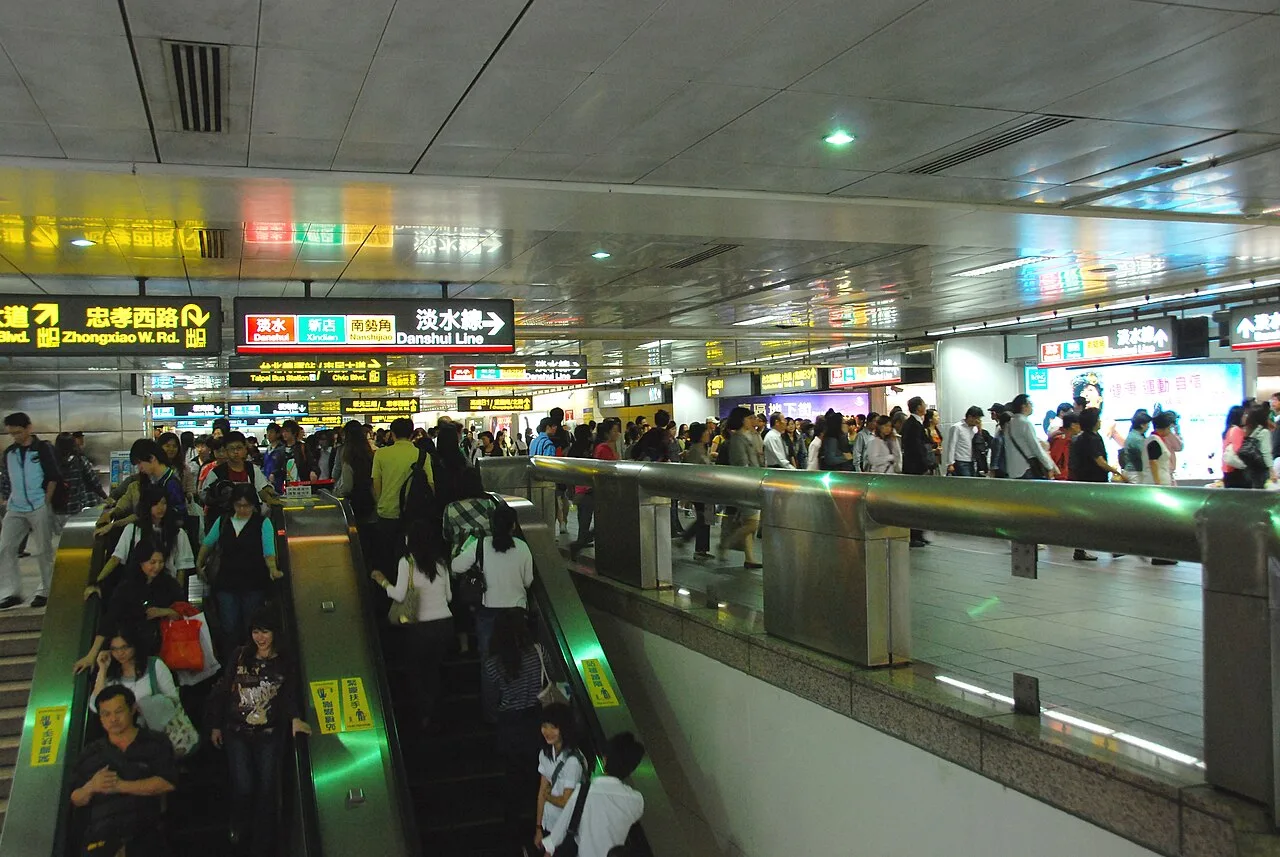
Image: Taipei Main Station B2 concourse (photographed 2009); photographer: Howard61313; license: public domain; original page: Wikimedia Commons
The final piece has official figures for cross-reference. The Ministry of Transportation and Communications Yearbook records that the Nangang Project spanned approximately 19.4 kilometers in total, with total project cost of about NT$83.069 billion. The TRA underground tunnel section and Songshan and Nangang stations opened on September 21, 2008; the entire project was completed at the end of August 2011. 6
Stringing these years together: from groundbreaking in 1983 to Songshan and Nangang connecting underground in 2008 is 25 years; to final completion in 2011 is 28 years. The Economic Daily News, citing Housing Magazine, says Taipei took over thirty years to complete the structural adjustment of the entire urban axis from surface railway to Civic Boulevard, Songshan, and Nangang. Different accounting scopes yield different year counts. 7
This relay race has an interesting feature: the previous segment's decisions often forced the next segment to spend money again.
The Taipei Main Station Project required relocating the dispatching facilities around the station, so the Eastern Main Line's train base moved to the Banqiao Coach Yard, which opened in 1985. But when the Wanhua–Banqiao Project was approved in 1992, the Banqiao Coach Yard happened to lie within the undergrounding scope; it could not be buried underground, so it had to move again, replaced by the Shulin Marshalling Yard in 1997. 5
Every step of undergrounding chases something off the surface. Where the chased things go is another question beyond the engineering.
Kaohsiung: Done in One Go, Twelve Years
Kaohsiung chose a different approach: no phasing. The Executive Yuan approved the Kaohsiung Railway Undergrounding Plan on January 19, 2006; the Zuoying and Fengshan sections were subsequently incorporated in 2009 and 2010. The entire route spanned 15.37 kilometers, total cost NT$99.8693 billion, construction took 12 years, and it opened on October 14, 2018. 4
The Executive Yuan's 2013 inspection press release specifically highlighted this feature: the project was not phased, built in one go, with a schedule of only 12 years. 3
The two approaches indeed differ in speed. Taipei used four projects and over twenty years, connecting the railway underground segment by segment. Kaohsiung merged three plans into one, built simultaneously, opened simultaneously.
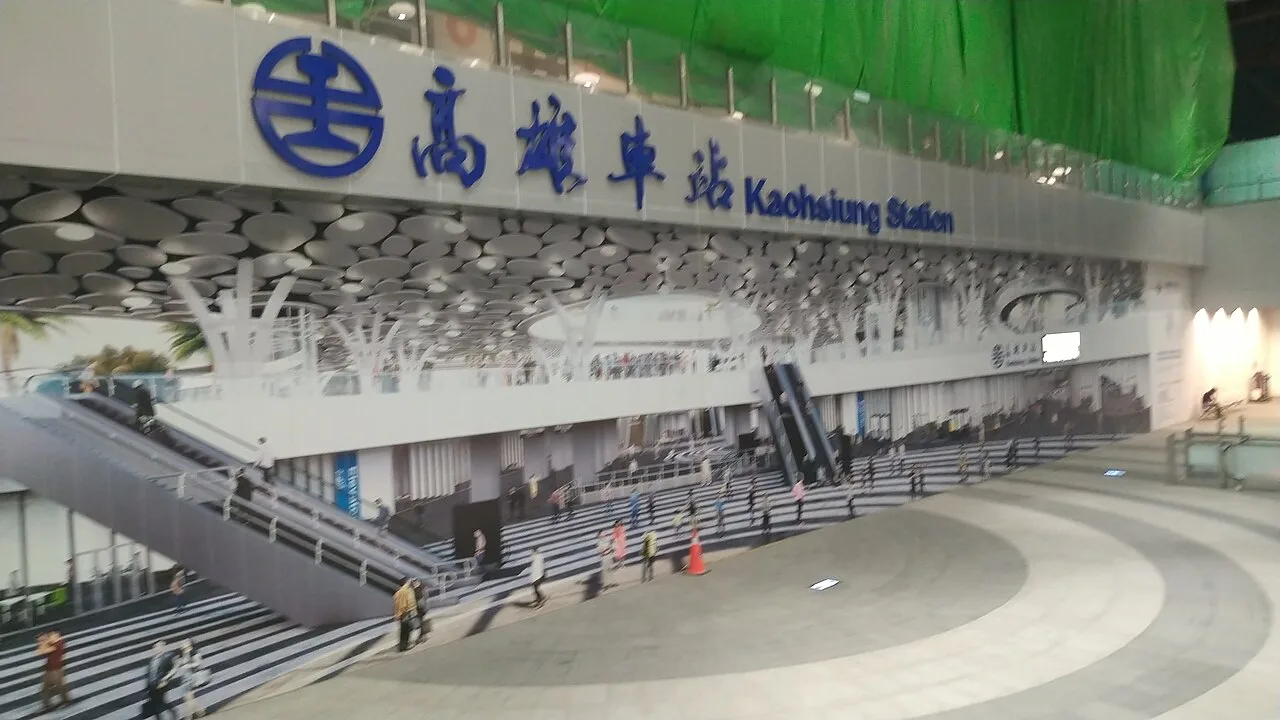
Image: Kaohsiung Station interior (photographed October 2023), construction safety nets still overhead; photographer: Railway1; license: CC BY-SA 4.0; original page: Wikimedia Commons
Opening day was not the finish line. PTS wrote in its opening-day report that the next second phase would turn the freed-up surface into a green corridor and commercial office towers. The report also noted that the Zhongbo Elevated Bridge beside Kaohsiung Station, carrying the heaviest traffic, would likely plunge the urban area into another traffic dark age when demolished. 1
In other words, on the day undergrounding opened, the tasks on the surface had only just been inventoried.
After Opening: How Long Must the Surface Wait
Taipei provides the longest observation record.
The Nangang Project put tracks underground in 2008, but the station area roads for Nangang and Songshan stations, plus the Civic Boulevard surface road works between Keelung Road and Research Institute Road, did not open until October 23, 2011. 6 Tracks went underground; surface roads waited three more years.
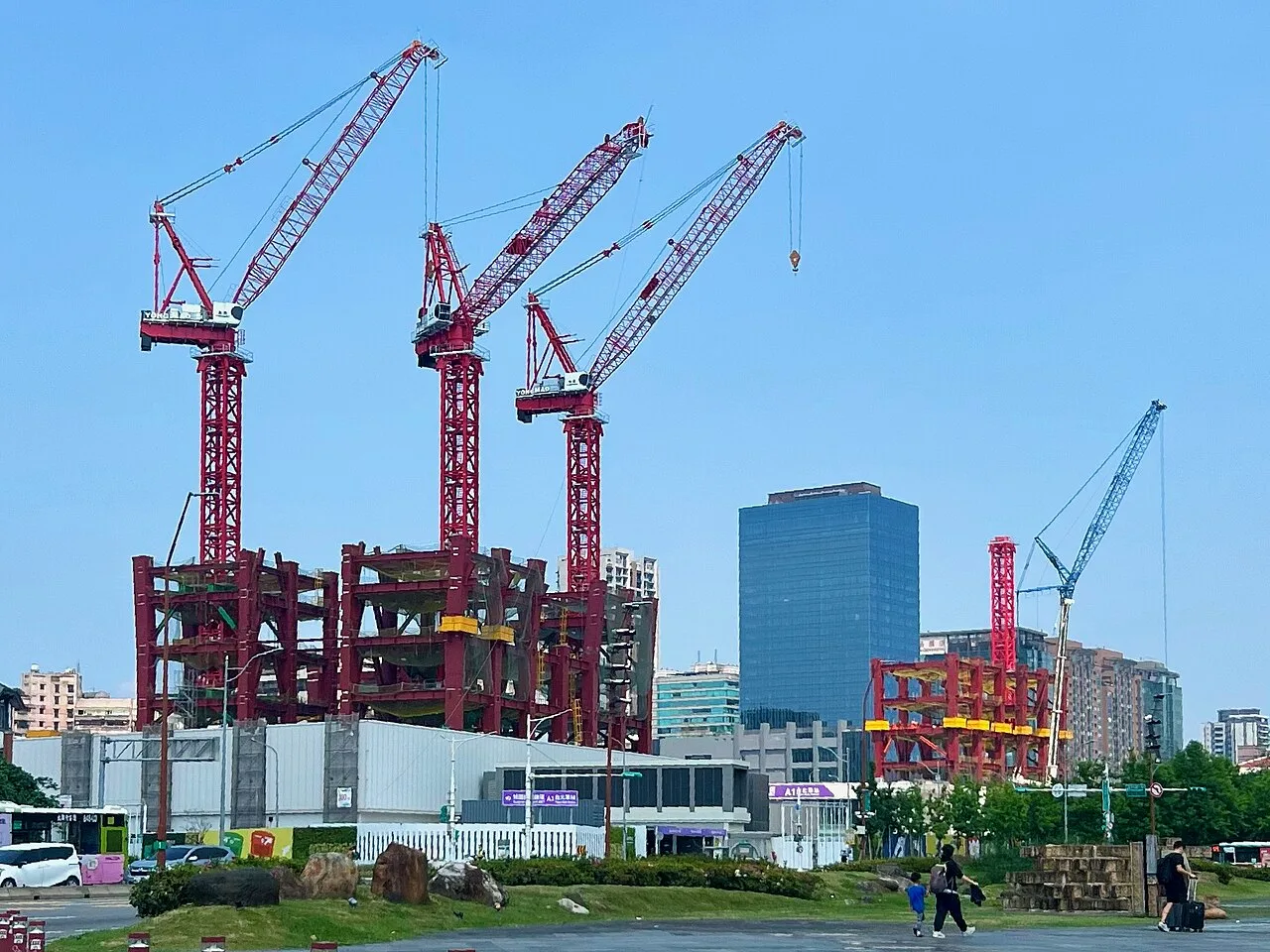
Now look at the land beside Taipei Main Station. The Taipei Main Station Special Zone C1 and D1 development case: Taipei City Government began soliciting investors in 2006, went through five controversies and storms, finally signed with the winning bidder in December 2019, held the groundbreaking ceremony on November 11, 2022, with completion projected for 2027 — the later "Taipei Twin Towers" (Taipei Double Star). 8 A 2026 report wrote that officials announced in mid-July that steel structure hoisting for Tower C1 had reached the 40th floor. 9
Image: Taipei Twin Towers construction site (photographed April 2024); photographer: Xuan Shisheng; license: CC0; original page: Wikimedia Commons
The relationship between this land and undergrounding must be delineated first. According to Chuzhang Wang's compilation, the marshalling yard freed by the Taipei Main Station Project first served as a temporary intercity bus transfer station; later the Airport MRT was built underground, while the surface prepared for the twin towers. 5 The Economic Daily News, citing the Housing Magazine article, describes this case as development "near the railway land released after undergrounding," stating total investment exceeds NT$70 billion. Taipei City Government's 2022 external statement gave NT$60.6 billion; the two figures come from different times and statements, both listed here without adjudication. 78
What is certain is the time gap: Taipei Main Station went underground in 1989; the new towers on this land are projected for completion around 2027 — roughly 38 years in between.
The Housing Magazine article summarizes this in one sentence: undergrounding does not guarantee every station succeeds, but it will certainly reshuffle the deck. Xu Jia-xin of the Housing Magazine Planning Research Office cautions that undergrounding does not mean station areas immediately see a flood of new projects; most old stations are traditional city centers with limited intact developable land nearby, and property rights integration is difficult. 7
In other words, undergrounding solves the problem of railways cutting cities. What the freed space becomes is another question, answered by land rights, investment climate, and political risk together — the engineering agency can only decide one part.
Tainan: The People Left on the Surface
Tainan's first phase opened in October 2026. The Reporter's in-depth report records that this project began planning 35 years ago — 1991 — spanning 8.23 kilometers across North, East, and Rende Districts. The Executive Yuan approved the "Eastward Shift Version" in 2009, permanently expropriating 340 households, of which 323 formed a self-help association in August 2012. The last household was forcibly demolished in 2021. 10
This case deserves a closer look here because it fills in a column the previous sections lacked: who bears this cost. Housing and land prices along the undergrounding line rose promptly, but The Reporter writes of expropriated resident Chen Cu-pei, whose home sits at the end of an alley and did not benefit. A family of six sharing a resettlement unit, with NT$4.5 million still owed on their mortgage. 10
Tainan's full story, including the Eastward Shift controversy, the timeline and rulings of forced demolitions, is in 〈Tainan Railway Undergrounding〉. Placed on the overall timeline, Tainan is a chapter still being written: opening just happened, surface works and station areas are still ahead.
The Economic Daily News, surveying these cities in February 2026, placed Taipei in "completed," Taoyuan, Tainan, and Kaohsiung in "in progress," and said Taichung and Hsinchu "are on different railway routes, facing a different kind of structural adjustment." 7
A Conclusion Without a Conclusion
From Taipei's 38 years, Kaohsiung's 12 years plus second phase, to Tainan's 35 years of planning plus opening, what is most easily remembered about railway undergrounding is the digging segment. But the records of these three cities together suggest what is more worth remembering is what happens after digging: opening-day signage and dust, Civic Boulevard three years late, the Twin Towers beside Taipei Main Station waiting over thirty years, Tainan residents still paying off loans.
Eliminating level crossings, stitching cities cut by railways — these are tangible achievements. But if project completion is treated as the finish line, the true cost and time are underestimated: tracks go underground in a dozen years; whether the surface city catches up takes patience longer than engineering.
Further Reading:
- Tainan Railway Undergrounding — Eastward Shift Plan and 340 Households
- Taipei Main Station — Underground Station Body Launched 1989
- North–South Mainline Railway — The Century-Old Context of These Tracks
- Taiwan High Speed Rail — Another Railway Sharing Underground Space with TRA
References
- Kaohsiung Railway Undergrounding First Train Opens — Signage Still Insufficient (PTS News, 2018-10-14) — Verbatim cross-check: "Early morning 6 o'clock, first southbound train, also due to railway enthusiasts too enthusiastic, power-cut switchover issues, stuck at Tainan Station, delayed 30+ minutes"; Liu Yun-sheng "roughly 34 minutes of impact right at the start"; passengers "bluntly stating signage insufficient"; second phase "turn the freed-up surface into green corridor and commercial office towers"; Zhongbo Elevated Bridge demolition may plunge urban area into another traffic dark age.↩23
- Kaohsiung Railway Undergrounding — Some Commuter Stations Severe Dust (PTS News, 2018-10-16) — Verbatim cross-check: "Science and Technology Museum, Zhengyi and several commuter stations severe dust"; Railway Bureau Southern Engineering Office to blockade 10 stations, cut power for cleaning; piston effect explanation from Wu Yu-zhou, chief of Southern Engineering Office Fifth Track Maintenance Section.↩
- Premier Inspects Kaohsiung Railway Undergrounding Project Progress (Executive Yuan Global Information Network Audio-Visual Express, 2013-03-11) — Verbatim cross-check: "Not phased, one-time construction, schedule only 12 years"; "Kaohsiung urban area long divided by railway, north-south development gap"; completion can eliminate 7 level crossings; urban stitching promotes urban renewal and land development.↩2
- Kaohsiung Metropolitan Railway Undergrounding Plan (Including Zuoying and Fengshan) Implementation Results and Benefits (Executive Yuan Global Information Network Cabinet Meeting Case, 2018-10-04) — Verbatim cross-check: Approved Jan 19, 2006; 2009 and 2010 extended to include Zuoying and Fengshan; total length 15.37 km; total cost NT$99.8693 billion; 12 years construction; opened Oct 14, 2018; eliminated 7 level crossings and 16 road grade separations; Zuoying, Kaohsiung, Fengshan three stations undergrounded plus 7 new MRT-style commuter stations added.↩2
- Taipei Railway Undergrounding Engineering Record! Taipei Project, Songshan Project, Wanhua–Banqiao Project, Nangang Project Details? (Chuzhang Wang reposting Penguin Traffic Notes, page updated 2026-10-30) — Verbatim cross-check: Taipei Project 1983 groundbreaking, completed and launched September 1989, eliminated 13 level crossings along Zhonghua Road; Songshan Project 1988 approved, extended 5.3 km, south tunnel 1992 and north tunnel 1994 launched; Wanhua–Banqiao Project 1992 approved, 2002 declared complete; Banqiao Coach Yard 1985 opened, 1997 replaced by Shulin Marshalling Yard; original marshalling yard site first temporary transfer station, Airport MRT built underground, surface prepared for twin towers. This is a second-hand compilation (internet author), used only for years and context; costs and mileage per official data; the article also has a claim of nearly 30 years counting from 1979 groundbreaking, inconsistent with its own 1983 groundbreaking; this article adopts 1983.↩23
- MOTC Yearbook: Taipei Metropolitan Railway Undergrounding Eastward Extension Nangang Project (Nangang Project) — Verbatim cross-check (PDF text layer): "Project scope total length approximately 19.4 km. Total project cost approximately NT$83.069 billion, this plan completed end of August 2011"; "TRA underground tunnel section and Songshan and Nangang stations opened" (date in parentheses: 2008-09-21); Nangang and Songshan station area roads and Civic Boulevard surface road works between Keelung Road and Research Institute Road "opened October 23, 2011". Minguo years converted to CE.↩2
- Undergrounding Completion Is Just the Start — Three Cities' Station Areas Enter Elimination Round (Economic Daily News / Housing Magazine, Zhu Fu-shan, 2026-02-26) — Verbatim cross-check: "Undergrounding does not guarantee every station succeeds, but will certainly reshuffle"; "Taipei used over thirty years to complete this structural adjustment"; "Taipei Twin Towers project total investment exceeds NT$70 billion"; Xu Jia-xin "most old stations are traditional city centers, surrounding intact developable land limited, property rights integration difficulty high"; Taichung and Hsinchu "on different railway routes, facing not the same kind of structural adjustment"; Taoyuan, Tainan, Kaohsiung as "in progress". The article's statement on Taipei Twin Towers location is "site vicinity was precisely railway land released after undergrounding"; cited here only to "vicinity" extent.↩234
- "Taipei Twin Towers" Officially Launched! Taipei West District New Gateway Racing for 2027 Completion (NOWnews, 2022-11-11) — Verbatim cross-check: "From 2006 began soliciting investors, after 5 controversies and storms failed, Taipei City Government finally signed with winning bidder December 2019"; groundbreaking ceremony held on the 11th; investment NT$60.6 billion, projected 2027 completion.↩2
- Taipei Twin Towers (Chuzhang Wang, page updated 2026-11-03) — Verbatim cross-check: "Officials announced mid-July 2026 latest progress, Tower C1 steel structure hoisting engineering reached 40th floor". Same article also writes 2005 concept proposed, 2012 first winning bid, etc., timeline differs from NOWnews's 2006 solicitation; this article's timeline adopts only NOWnews.↩
- Tainan Railway Goes Underground: Farewell to Last Night of Surface Trains, Expropriated Residents' Helpless Voices and Rebirth (The Reporter, 2026-10-17) — Verbatim cross-check: "35 years ago began planning" (1991), total length 8.23 km spanning North, East, Rende Districts, 2009 approved "Eastward Shift Version" permanently expropriating 340 households, August 2012 323 households formed self-help association, 2021 forced demolition of last household Huang Chun-xiang residence; "housing and land along undergrounding line rose promptly, but Chen family at alley end did not benefit"; Chen family six people sharing resettlement unit, mortgage still NT$4.5 million remaining.↩2