

Image: New Taipei Metro Sanying Line EMU 20230830.jpg / Yu tptw / Wikimedia Commons / Used under Attribution only license per file page; image not cropped. File page
30-Second Overview: The Sanying Line, which opened on June 30, 2026, spans 14.29 kilometers with 12 stations, running from Dingpu in Tucheng through Sanxia to Yingge, allowing passengers to transfer to the Taipei Metro Bannan Line and the Taiwan Railways Administration (TRA) more directly. Each train consists of only two cars with a capacity of 330 passengers. After opening, buses will still be responsible for station-area feeder services, early morning and late evening hours, and destinations such as old streets and campuses. This line shortens travel distance but also brings capacity constraints, noise issues, and the problems of land acquisition and residents' rights in Maizaiyuan into the same transportation network. 1 2 3 4 5 6 7 8 9
Quick Facts
| What You Want to Know First | Verified Data |
|---|---|
| Route | From Dingpu to Yingtao Fude, with 12 stations connecting Tucheng, Sanxia, and Yingge. 1 |
| Transfers | Dingpu connects to the Taipei Metro Bannan Line; Yingge Station is planned to connect with the TRA Yingge Station. 1 2 |
| Trains | Two-car trains per set; official data lists a capacity of 330 passengers; peak-hour headways during trial operations are as frequent as 2.2 to 3 minutes. 3 5 |
| Buses | The New Taipei City Bureau of Transportation has planned feeder services for all 12 stations, newly established the Sanying Line 1 and Yingtao Fude Station to Ming Chuan University (Taoyuan Campus) shuttle buses, and adjusted routes Sanying Line 2, 706, 707, 731, and 889. 4 |
| Main Controversy | Maizaiyuan (Maizi Yuan) involves station placement, depot location, land acquisition, urban planning, and residents' rights; this article presents both resident claims and government responses. 6 7 8 9 |
Reading Highlights: This is not merely a simplified guide to the stations on a route, but an observation of how transfers, capacity, and land governance occur simultaneously, starting from "how a line enters daily life."
In the early morning of December 24, 2023, on Jieshou Road in Sanxia, a crane placed the final section of the Sanying Line's upper and lower U-shaped beams into position. The New Taipei City Bureau of Rapid Transit Engineering referred to this moment as "closing the gap" (he long): the 14.29-kilometer elevated route finally connected into a complete line between Tucheng, Sanxia, and Yingge. 10
Two and a half years later, at 2:00 PM on June 30, 2026, the train departed from Dingpu Station, and the Sanying Line officially opened for service. It is not a sudden tourist shortcut, but a public engineering project that began construction on July 21, 2016, underwent testing and inspection, and only then received operating permits. 1 11
The most noteworthy aspect of this line is not just that "Sanxia and Yingge finally have a metro." It is more like an urban negotiation suspended in mid-air: the government promises to shorten commute times and connect to the TRA and Bannan Line, while the local community must answer questions about safety, noise, pedestrian space, and what the areas around the stations will become before the trains even pass through.
A Line That First Connects Two Transfer Systems
The Sanying Line begins at Dingpu Station in Tucheng, connecting with the Taipei Metro Bannan Line. The terminus is at Yingtao Fude Station in Yingge. The line includes 12 stations with a total length of 14.29 kilometers and a planned budget of NT$50.2 billion. The route passes through Tucheng, Sanxia, and Yingge, retaining a tail track to allow for future extension toward Bade in Taoyuan, connecting to the Taoyuan Green Line. 1
Its geographical significance cannot be summarized merely as "connecting Sanxia and Yingge to Taipei." The Sanying Line orders previously scattered transfer actions into a sequence: transferring to the Bannan Line at Dingpu, transferring to the TRA at Yingge, and in the future, connecting the Taipei-Taoyuan living circle into a single rail network. The New Taipei City Bureau of Rapid Transit Engineering estimates that commute times between the Sanying area and central Taipei can be reduced by approximately 20 minutes. 1 12
Yingge Station particularly reveals the ambition of this design. LB08 Yingge Station is located south of the TRA Yingge Station, with a walking distance of approximately 130 meters between them. The plan connects Yingge Agricultural Association via an overhead bridge, allowing transfers to the TRA through the association's corridors. This is not simply adding another platform; it transforms movement that previously relied on cars, shuttle buses, or walking into a node where transfers happen within the city. 2

Image: YinggeStation Frontal.jpg / SElefant / CC BY-SA 3.0 / Wikimedia Commons; image not cropped. File page
Curator's Note: The "speed" of the Sanying Line is not just about train velocity, but also about transforming transfers from a temporary detour into a daily route officially recognized by the city.
Why Does an Elevated Line Take So Long?
The entire Sanying Line is elevated. The route description published by the Bureau of Rapid Transit Engineering lists that it must cross National Highway 3, the TRA, the Dahan River, the Sanxia River, and the Yingge Creek, among other traffic and water conditions. In pre-opening press releases, the government summarized the difficult construction sections as 8 points, including crossings of national highways, railways, and rivers. 1 12
Elevation does not make problems disappear into the sky. Bridge piers must be placed between existing roads and settlements; beams must be lifted without affecting traffic and railway operations; and electromechanical systems must be tested section by section after civil engineering is completed. After completing the full-line "closing of the gap" in December 2023, the project still had to enter track laying, high-voltage power supply, signaling, and communication equipment installation, followed by system testing. 10
This is why "closing the gap" does not mean "you can ride it tomorrow." It is a visible engineering milestone, but not the endpoint of safety verification. In April 2026, the city government stated that the Sanying Line had completed stability testing and submitted it for preliminary inspection. After completing the Ministry of Transportation and Communications (MOTC) inspection on June 7, there were still pre-operational improvement items to complete. Only on June 23, after obtaining the operating permit, was the opening officially announced. 1 13
Details of the inspection reported by Ke Xin (Ke News) show that the MOTC divided improvement items into 4 mandatory pre-operational improvements, 6 general attention improvements, and 5 subsequent recommended improvements. Inspections did not just review documents; they also included field surveys and simulation drills for scenarios where "trains cannot run and passengers are injured, requiring emergency rescue." 14
Curator's Note: The true completion date of a metro line is not the day the last beam was lifted, but the day it knows what to do next when someone is injured, equipment fails, or travelers get lost.
After Opening, the City Welcomes Crowds First
The Sanying Line initially operated with free trial service. The New Taipei City Bureau of Rapid Transit Engineering announced that trial operations would begin at 2:00 PM on June 30, with free rides until August 31. The government viewed this period as a stage to respond to local expectations while collecting riding feedback. 11
Central News Agency recorded another number for the first day of trial operations: from 2:00 PM to 8:00 PM on June 30, 20,731 people rode the train within 6 hours. The Sanying Line adopts a fully automated driverless system, with trains consisting of two-car sets. Peak-hour headways can be as frequent as 2.2 to 3 minutes. The operating team also referred to the trial operations as a "passenger load stress test," used to observe door operations, stopping, acceleration/deceleration, and passenger flow. 3
This number cannot be directly equated with daily commute demand. Free rides, first-time experiences, and summer vacation crowds may all have inflated the first-day ridership. The same Central News Agency article also mentioned that some YouBike stations ran out of bikes, which were later replenished by the operating unit. In other words, the first test of the opening did not just happen inside the train, but also in the last kilometer outside the station. 3
The English Taipei Times report added another scale: during trial operations, daily operating hours were from 10:00 AM to 8:00 PM, with formal service hours expected to extend to 6:00 AM to midnight. Fares follow the Taipei and New Taipei Metro's segmented pricing, approximately NT$20 to NT$35. These differences remind us that free trial rides are a launch method, not the complete picture of future services. 12
Why Still Take Buses After Opening?
After the Sanying Line opened, buses did not exit the stage; instead, they were rearranged into the capillaries of the rail system. Before the opening, the New Taipei City Bureau of Transportation announced that feeder plans had been completed for all 12 stations. It newly established the Sanying Line 1 and shuttle buses from Yingtao Fude Station to Ming Chuan University (Taoyuan Campus), and adjusted the Sanying Line 2, 706, 707, 731, and 889, as well as shuttle buses from the Beida Community to Dingpu Station. 4
This arrangement answers questions the Sanying Line itself cannot answer: not everyone lives next to a station, nor are all destinations at the metro station exit. The Sanying Line 1 connects Yingge Station, Ceramic Old Street Station, Guohua Station, and the TRA Yingge Station. Route 731 extends to the Ceramic Museum, New Taipei Force Plaza, and the Hakka Cultural Park. Buses are therefore not "old systems not yet淘汰ed after the metro is built," but tools that push station service radii into alleys, campuses, and scenic spots. 4
The initial timetable directly exposes this division of labor. During trial operations, the Sanying Line did not operate all day. The Sanying Line 2 extended its service to Yongning Station for certain trips between 5:00 AM and 10:00 AM, and between 8:00 PM and 10:00 PM, to care for times when the metro was not yet serving and for passengers originally commuting between Tucheng and Taipei. This indicates that "having a metro" and "being able to rely solely on the metro" are two different things. 4
For commuters, the true path is not a single blue line, but a series of choices: take a bus from home to the station, ride the Sanying Line to Dingpu, and then walk to the Bannan Line. Or, during off-peak hours, take existing buses directly to Yongning. The Beida Special District will not suddenly have only one way to travel just because the Sanying Line opened. In February 2026, the Transportation Bureau still listed routes 916, 932, and 910 as the main external express buses for the Beida Special District, and added a 7:10 AM weekday shuttle bus class from "Beida Community to Dingpu Station," aiming to disperse peak-load pressure on existing routes. 15 16
That some people still choose buses after opening does not necessarily mean the metro has failed; it may also represent different transfer distances, waiting times, peak congestion, and destination locations. The New Taipei City Transportation Bureau's opening announcement retained the shuttle bus from Beida Community to Dingpu and allowed the Sanying Line 2 to extend to Yongning during early morning and evening trial operations. Individual reports mentioned residents using route 916 for off-peak commuting. The former is a policy arrangement; the latter is personal experience. Neither can be generalized to the entire commuting population. 4 17 15
Curator's Note: The metro straightens the city; the buses remember that the city is actually not that straight.
Two Cars: Small and Frequent, or Too Small a Capacity?
Each Sanying Line train consists of only two cars. Official basic data lists a length of approximately 36 meters and a capacity of 330 passengers, adopting bidirectional driverless operation. Central News Agency also recorded that during trial operations, peak-hour headways were as frequent as 2.2 to 3 minutes. Putting these two pieces of data together, the design trade-offs of the Sanying Line are clear: it does not carry everyone in very long single-car trains, but operates with shorter sets combined with frequent headways. 3 5
| Observation Item | Known Data | Conclusion That Cannot Be Directly Derived |
|---|---|---|
| Set Composition | Two cars | Cannot directly indicate that peak hours will definitely be insufficient |
| Single Train Capacity | 330 passengers | Cannot be directly equated to hourly capacity |
| Headway | Trial operations peak headways as frequent as 2.2–3 minutes | Cannot treat trial operation headways as fixed headways for all time periods |
| Capacity Adjustment | Can increase frequency by加密 headways | Whether it is sufficient to cope with long-term growth still depends on actual ridership and operational data |
The two-car sets have caused质疑 (questioning), not because "two cars" itself equals error, but because the population of the Sanying area, transfer demands, and free trial crowds have led people to worry about potential capacity bottlenecks in the future. Reports organized positive and negative sides on social media: one side worried about repeating the early congestion experience of the Wenhu Line, while the other believed that short sets could be supplemented by headways, and that the Sanying Line's mission is closer to connecting Sanxia to Dingpu and Yingge transfer nodes. These are public discussions, not completed capacity assessments. 17
Therefore, the question worth observing is not "whether two cars are good or bad," but whether operators will publicly release ridership, load factors, waiting times, and bus transfer data for different time periods. If trains can stably transport passengers through dense headways, two cars may be a reasonable configuration for a medium-capacity system. If peak-hour queues and waiting times continue to expand, the problem will shift from train appearance to headways, platform capacity, and subsequent public decision-making on expansion. These require post-operation data, not conclusions based on photos from the first day of opening.
Stations Are Not Just for Waiting: Putting Local Stories Into Trains
The public art on the Sanying Line is not decoration added to stations; it was arranged into the narrative from the beginning of the engineering project. Data from the Bureau of Rapid Transit Engineering, reposted by the Ministry of Culture, indicated that the line invited 360 residents to serve as the first batch of "art experience officers," walking into stations and works through guided tours. All 12 stations were also incorporated into the overall design of green buildings and local culture. 18
The painted trains allowed "stories at every station" to begin moving. The New Taipei City Bureau of Rapid Transit Engineering unveiled two major themed trains in June 2026, using random departure schedules so passengers would not necessarily encounter the same car every time: the Hakka Culture theme used geometric indigo dyeing, May snow (cotton tree flowers), and Dahan River hydrology as visual clues. The New Taipei Fine Arts Museum theme used silver-white colors, light/shadow refraction, and virtual/real lines, extending architectural imagery to the train body. 19
The interesting part is inside the cars. The subsequently launched Indigenous-themed trains incorporated river imagery, Amis weaving, and Paiwan "Kamlan" figures into the journey. The Taipei University Station platform even played Amis-style music. These painted trains used random departures, meaning you might not encounter them every time you ride, adding a sense of "finding easter eggs" to the commute. 20 21
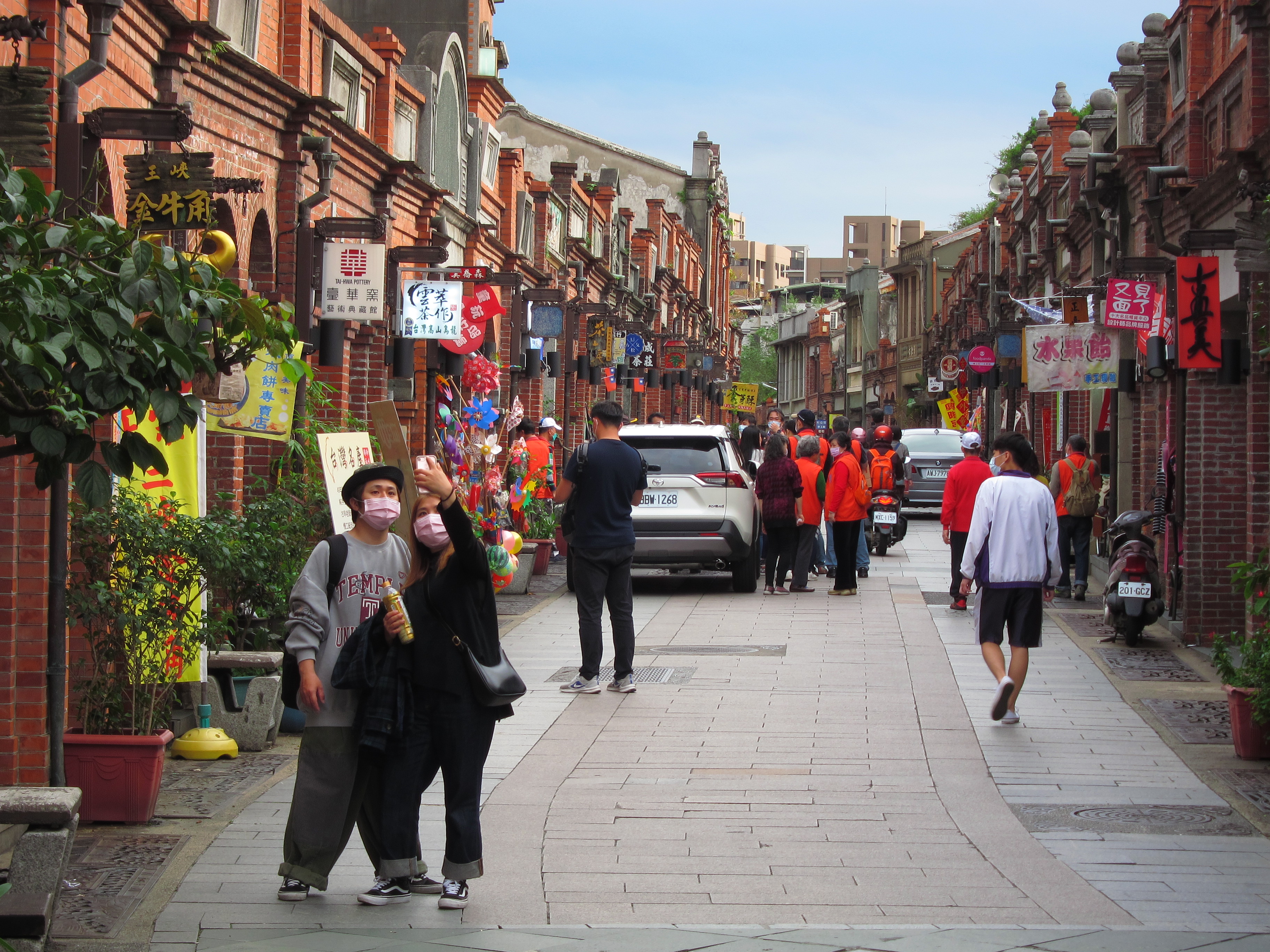
Image: Minquan Old Street, Sanxia, Taiwan.jpg / Ken Marshall / CC BY 2.0 / Wikimedia Commons; image not cropped. File page
Curator's Note: When trains become moving exhibition halls, public art does not just ask "is it good-looking," but also asks who selected local culture to represent, and who can see it in daily life.
Convenient Access Does Not Mean the Local Area Is Ready
The Sanying Line runs past landmarks such as Sanxia Old Street, Yingge Ceramic Old Street, and the New Taipei Fine Arts Museum. These places already existed; the metro only changes the cost and path of reaching them. When access becomes easier, an increase in visitors, shop re-layout, and re-evaluation of residential and commercial real estate may follow. But these changes cannot be concluded with just four words: "driving development." 11 12
The official plan for urban regeneration around Yingge Station treats LB08 and the TRA Yingge Station as transfer nodes for the Taipei-Taoyuan metropolitan living circle, promoting land reuse and station revitalization through TOD (Transit-Oriented Development) and station city concepts. This is a future image in policy language. The true success or failure still depends on whether the overhead bridge is easy to walk on, whether transfers are intuitive, whether pedestrian space outside the station is continuous, and whether people originally living here can use these improvements. 2
Before the Sanying Line opened, another word of concern for locals was "noise." A January 2026 United Daily News report indicated that train testing drew attention from residents along the line regarding noise and vibration. Relevant units set up measurement points at Sanxia High School, Yingge High School, and surrounding communities, discussing improvement directions such as sound barriers, wheel-rail interactions, and line restoration. These are local opinions and processing progress in reports, and cannot be rewritten as "full-line noise exceeds standards" or "engineering has caused definite harm." 22
This distinction is important. Public engineering needs measurement data, but also needs people living next to the tracks to describe "what they hear every day." The former answers whether standards are met; the latter reminds us that beyond standards, there are life experiences. Neither can replace the other.
Curator's Note: The metro brings the distant closer, but also concentrates originally scattered problems to stations, under bridges, and residents' windows; "convenience" and "cost" are not an either-or choice, but two sides of the same construction.
Maizaiyuan: The Land Problem Behind a Station
The Maizaiyuan controversy of the Sanying Line is often written as "whether the metro station should be set here," but it actually simultaneously involves station placement, depot location, urban planning, and land acquisition. First, clarify the name: many official and media materials write "Maizaiyuan," while daily discussions often write "Maizi Yuan." This article uses "Maizaiyuan" as the primary term, treating both as different spellings of the same area. 6 7
A 2015 Our Island report indicated that Longpu Village includes settlements such as Liucuo Pu, Maizaiyuan, and Long'en Pu. At that time, the newly designated Maizaiyuan Urban Plan was approximately 128 hectares, of which 82 hectares were planned for development through section-based land acquisition. The New Taipei City government explained that the plan was to respond to the Sanying Line and handle illegal factories; residents worried that farmland, multi-generational residences, and living networks would be scattered. The report also recorded the Ministry of the Interior's Regional Planning Committee raising concerns about the plan's population and scope. These are the plans and controversies of 2015, and cannot be directly treated as the land status completed in 2026. 6
A 2016 report focused the controversy on station placement and development necessity: residents and local representatives questioned setting multiple stations within a short distance, believing that Maizaiyuan's population density was not high, and worried that the metro would become a reason for acquisition and land development. The city government responded that the original Maizaiyuan Urban Plan had been suspended, the BL05 Station in Longpu Village would still be constructed, and the route and station placement involved relocation costs, road conditions, and restrictions around the Sanying Bridge. Here are two sets of understandings of public interest; one cannot leave only one set. 7
The controversy did not automatically disappear with the train's launch. In 2020, Longpu Village residents still protested the expanded acquisition of land for the LB05 Station depot. The Citizen Action Video Archive Database recorded residents believing that among the 14.1 hectares of land, the actual use of metro facilities and the scope of joint development should be distinguished, questioning the "metro development zone" and developer distribution. The New Taipei City government and Metro Bureau explained that the depot facilities were approximately 12.25 hectares, and adding LB05 entrances/exits and tracks entering/exiting the depot totaled approximately 14.1 hectares, claiming the area was reasonable compared to other similarly sized depots. 8
This controversy cannot be simplified into "residents oppose the metro." From reports, residents' claims were supporting transportation improvement, but opposing expanding land acquisition under the name of transportation construction, changing farmland usage, or making the local area bear asymmetric development benefits and costs. A 2015 petition record from the Taiwan Alliance for Promoting Civil Liberties (TAPC) also focused on opposing forced relocation, experiences of previous acquisitions, and the right to reside in century-old settlements. 9
For the Sanying Line, the question left by Maizaiyuan is: who does a line serve, and who pays the price first for this line? If you only look at the shortcut after opening, you see saved time. If you look at the depot and land together, you also see farmland, homes, property rights, joint development, and information disclosure. The public nature of the metro must be proven simultaneously on the platform and at the land negotiation table.
Don't Treat the Opening Day as the End of the Story
The timeline of the Sanying Line has a rhythm easily ignored: feasibility studies were approved in 2012, main engineering construction began in 2016, the full line completed "closing the gap" in 2023, and it only entered formal operation in 2026. These nodes are not simply engineering progress, but a process of local expectations being gradually institutionalized. 1
| Node | What Happened | What This Node Represents |
|---|---|---|
| September 3, 2012 | Executive Yuan approved feasibility study | Sanying Line moved from local demand to formal planning |
| July 21, 2016 | Main engineering construction began | Route moved from paper plans to road, bridge, and station construction |
| December 24, 2023 | Full line completed "closing the gap" | Elevated structure connected, but track and electromechanical testing still required |
| June 7, 2026 | Completed MOTC inspection | Pre-opening safety and operational conditions accepted external inspection |
| June 30, 2026 | Officially opened and trial operations began | Construction results began to accept true passengers and city usage |
The most interesting thing in this table is not "how long we waited," but that every completion cannot replace the next completion. Feasibility studies cannot replace construction; "closing the gap" cannot replace testing; inspections cannot replace actual passenger usage. The time of public engineering is often not a straight line, but layers upon layers turning promises into verifiable conditions. 10 1 14
Therefore, the story of the Sanying Line should not be condensed into "built for ten years, finally opened." This phrase has a sense of time, but does not explain why engineering needed to cross different systems: the Executive Yuan's plan approval, the Metro Bureau's construction, the New Taipei Metro Company's operation, and the MOTC's gatekeeping on inspections and operating permits. These institutions jointly completed the line, but every link also left its own boundary of responsibility.
Curator's Note: The opening day is very suitable for photos; what is truly worth remembering are the "needs to be verified again" that cannot be captured in a single photo.
From a Shortcut, Seeing How the Taipei-Taoyuan Living Circle Grows
The terminus of the Sanying Line is currently at Yingtao Fude Station, but the tail track retains the possibility of future extension toward Bade in Taoyuan. Official route descriptions connect this extension with the Taoyuan Green Line, Taoyuan International Airport, High-Speed Rail, and regional intercity rail transfers. The Taipei Times reported that the Bade extension segment is planned to be approximately 4 kilometers, with a goal of completion in 2034. These are planned futures, not services that already exist in the present. 1 12 23
If the extension is realized, the Sanying Line will change from "the first metro for Sanxia and Yingge" to a segment of the Taipei-New Taipei-Taoyuan rail network. But cities will not automatically become more equal just because the line is drawn longer. Whether there are sufficient frequencies, whether transfer distances are reasonable, whether the areas around stations allow pedestrians to pass safely, and whether rental/housing prices push out original residents—these questions will determine whether a line is a public service or just a fast channel passing through the local area.
Returning to that early morning in December 2023, the crane completed the positioning of the final U-shaped beam. What was completed then was "connecting." What was completed on June 30, 2026, was "opening up." What truly needs to be observed next is whether, after the train passes every day, people in Sanxia, Yingge, and Tucheng can reach their desired destinations with less time, and can participate with greater voice in the urban decisions beneath the tracks.
The best ending for the Sanying Line is not that everyone says it brings development, but that commuters, students, travelers, shopkeepers, and local residents can all say how this line changed their paths. And simultaneously point out which promises have not yet been completed.
Further Reading
- New Taipei City Bureau of Rapid Transit Engineering: Sanying Line
- New Taipei City Bureau of Rapid Transit Engineering: Sanying Line Closes the Gap!
- Central News Agency: New Taipei Metro Sanying Line Trial Operations First Day, Over 20,000 People Rush to Ride
- Taipei Times: New Taipei City’s MRT Sanying Line starts services
References
- New Taipei City Bureau of Rapid Transit Engineering: Sanying Line — Official route page, listing route length, budget, number of stations, construction timeline, transfer directions, environmental impact assessment, and urban planning data.↩234567891011
- New Taipei City Bureau of Rapid Transit Engineering: Urban Regeneration Around Yingge Railway Station — Engineering record dated July 23, 2020, explaining the approximate 130-meter transfer relationship between LB08 Yingge Station and TRA Yingge Station, the overhead bridge, and the TOD urban regeneration concept.↩234
- Central News Agency: New Taipei Metro Sanying Line Trial Operations First Day, Over 20,000 People Rush to Ride — Report dated July 1, 2026, providing data on 20,731 first-day riders, headways, fully automated driverless operation, and trial operation stress tests.↩2345
- New Taipei City Bureau of Transportation: Metro Sanying Line Opens, Bus Network Fully Upgraded, Metro, Bus, TRA Transfers More Convenient — Announcement dated June 27, 2026, explaining feeder plans for 12 stations, newly established Sanying Line 1 and shuttle buses, and adjustments to Sanying Line 2, 706, 707, 731, 889, etc.↩23456
- New Taipei City Bureau of Rapid Transit Engineering: What Details Does the Sanying Line Train Have? Anchor Takes You Onboard to See! — Official train introduction page, listing approximately 36 meters, two-car sets, 330-passenger capacity, and bidirectional driverless data.↩23
- Public Television Our Island: Changing the Land's Name | Longpu Village Residents Oppose Sanxia Maizaiyuan Urban Plan Acquisition — Report dated May 18, 2015, recording Maizaiyuan Urban Plan scope, section-based acquisition planning, resident life, and government statements.↩234
- Citizen Action Video Archive Database: Flipping Land and Destroying Villages? Sanxia Maizaiyuan Development, Residents Criticize "Fake Metro, Real Land Grab" — Report dated October 27, 2016, recording residents' questioning of station placement, acquisition, and urban planning, and city government responses regarding plan suspension and station construction.↩234
- Citizen Action Video Archive Database: Sanying Line Depot Expands Acquisition of Farmland, Longpu Village Residents Angry: Will Build 15 Buildings to Profit Developers — Report dated November 13, 2020, listing residents' questioning of LB05 depot land and metro development zones, and New Taipei City government explanations of depot area and land acquisition.↩23
- Taiwan Alliance for Promoting Civil Liberties (TAPC): Bankrupt Engineering Makes Ghost Town, Newly Designated Sanxia Maizaiyuan Urban Plan Destroys Homes — Petition record dated August 18, 2015, recording Longpu Village residents' demands regarding acquisition, station placement, and right to reside; page also states that TAPC website original content adopts CC BY 3.0 Taiwan.↩23
- New Taipei City Bureau of Rapid Transit Engineering: Sanying Line Closes the Gap! — Engineering record published on December 25, 2023, explaining the completion of U-shaped beam lifting for the 14.29-kilometer route and full-line "closing the gap," as well as subsequent track, power supply, signaling, and communication engineering.↩23
- New Taipei City Bureau of Rapid Transit Engineering: Metro Sanying Line Officially Opens on 6/30! Free Trial Rides Open from 6/30~8/31 — Press release dated June 26, 2026, explaining operating permits, opening date, free trial rides, route connections, and main obstacles crossed by the engineering project.↩23
- Taipei Times: New Taipei City’s MRT Sanying Line starts services — English report dated July 1, 2026, supplementing service hours, fares, engineering crossings, 2016 construction start, and Bade extension planning.↩2345
- Central News Agency: Hou Yu-i: Sanying Line Will Submit to MOTC for Inspection, Hope to Open in June — Report dated April 13, 2026, recording the completion of dynamic testing, preliminary inspection, and pre-inspection opening goals, for cross-verifying the timeline.↩
- Ke Xin: Shorten Taipei Commute by 20 Minutes! Sanying Line Aims for Mid-Year Opening, MOTC: Complete 4 Improvements for Operation — Report dated June 8, 2026, organizing inspection improvement categories, emergency rescue drills, and transfer design, citing MOTC and New Taipei City government data.↩2
- Jin Bao: Beida Community Commuters Benefit! Shuttle Bus Direct to Metro Dingpu Station, Morning Class Added Starting 2/9 — Report dated February 5, 2026, citing New Taipei City Transportation Bureau stating Beida Special District main external express buses are 916, 932, 910, and explaining added shuttle bus classes to disperse peak-load pressure.↩2
- New Taipei City Bureau of Transportation: Metro Sanying Line Opens, Bus Network Fully Upgraded — Official announcement dated June 27, 2026, listing Beida Community to Dingpu shuttle buses, Sanying Line 2 extending to Yongning trial operations, and feeder functions of Sanying Line 1, 731, etc.↩
- Mirror Daily: Sanying Line Only 2 Cars! Girls Dumbfounded: Wenhu Line Nightmare? Locals Reveal Real Experience: Off-Peak Take This Train Is Faster... Metro Planning Insider Exposed — Report dated July 5, 2026, organizing public discussion on two-car sets and individual commuting experiences of local residents; this article does not treat personal experience as overall transport statistics.↩2
- Ministry of Culture Public Art: Metro Sanying Line Public Art Unveiled, Residents Become Art Experience Officers to Decrypt Station Aesthetics — Article dated June 18, 2026, recording 360 along-line residents participating in art tours, and public art, green building, and local culture design of 12 stations.↩
- New Taipei City Bureau of Rapid Transit Engineering: Metro Sanying Line Themed Painted Trains Appear, Showing Hakka Culture and New Taipei Fine Arts Museum Mobile Aesthetics — Official press release dated June 28, 2026, explaining two major themed trains using random departures, and designs of Hakka indigo, cotton tree flowers, Dahan River hydrology, and New Taipei Fine Arts Museum light/shadow.↩
- TVBS: Video / Sanying Line "Indigenous Theme Painted Train" Appears! Car Figures Adorably Cute — Report dated July 25, 2026, recording river imagery, Indigenous weaving, Amis "Little Naughty," Paiwan "Kamlan" figures, and Amis-style music at Taipei University Station.↩
- United Daily News: Hidden Little Surprise? New Taipei Metro Sanying Line Indigenous Theme Painted Train Unveiled — Report dated July 26, 2026, supplementing Amis weaving, stylized little rabbits, and camera details; this article only adopts design descriptions mutually supported by it and TVBS, not adopting un-cross-verified ridership ratio inferences.↩
- United Daily News: Sanying Line Not Yet Completed, Key Factors Explained by New Taipei Metro Bureau — Report dated January 7, 2026, recording pre-opening stability testing, noise and vibration concerns, measurement points, and local demands for sound barriers and restoration.↩
- New Taipei City Bureau of Rapid Transit Engineering: Metro Sanying Line Extension to Taoyuan Bade Section Progress Report — Official engineering article page, explaining transfer planning for the Bade extension segment; this article limits it to future planning, not treating it as current service.↩