
30-Second Overview: In 1987, Taiwan’s 7-ELEVEN began selling tea eggs; three years later, rice balls and oden were added to its hot food lineup. The U.S. parent company expected Taiwanese stores to sell coffee, sandwiches, and hamburgers, but coffee lasted only a year. The tea eggs, cracked and simmering in dark braising liquid, remained. Not unique to Taiwan, they became a concrete example of how Taiwan cooked foreign convenience store formats into local daily life. Reading this, you will see how a single egg connects street-side snacks, store supply chains, food safety, price costs, and local brands.
In 1987, Taiwan’s 7-ELEVEN began selling tea eggs. Three years later, rice balls and oden joined its hot food lineup. At the time, the U.S. parent company hoped Taiwan would sell coffee, sandwiches, and hamburgers, but coffee lasted only a year. The tea eggs, cracked and simmering in dark braising liquid, remained. 1 2
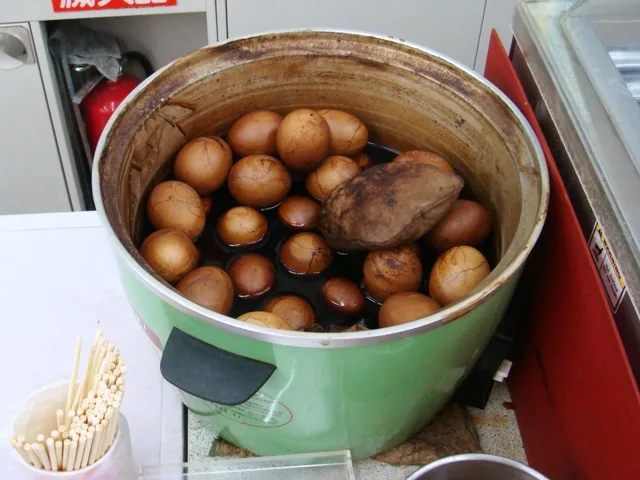
Today, walking into a Taiwanese convenience store, the first thing you might recognize is not the sign, but the steam rising from the hot food pot, mixing tea, soy sauce, and star anise. Tea eggs are not a food invented in Taiwan; they have different practices and local versions across the Chinese-speaking culinary world. However, Taiwan placed them in a retail space originally from the United States, turning an egg that requires waiting for flavors to absorb into something you can grab on the go.
[Image: Wikimedia Commons Tea Egg]
Caption: Tea eggs in the hot food pot of a Taiwanese convenience store. Photo by (WT-shared) Shoestring, licensed under Creative Commons Attribution-ShareAlike 4.0 International. See Wikimedia Commons file page.
📝 Curator’s Note
The most Taiwanese thing about convenience stores is not how many imported goods they sell, but that they are willing to let a pot of braising liquid stand at the door to welcome you.
The Breakfast That Defied American Expectations
The early mission of Taiwan’s 7-ELEVEN was not to invent a new snack, but to transform the chain convenience store from a "place to buy things" into a "place where you can eat immediately." Hsu Chung-jen first tried selling coffee in line with the parent company’s direction, but Taiwan’s eating habits and dining-out patterns differed from the context of American truck drivers’ breakfasts. Coffee did not generate demand, but tea eggs were purchased because they were familiar, affordable, and warm. 1
The method for making tea eggs seems simple: first, crack the shells of cooked eggs, then slowly simmer them in a braising liquid containing tea leaves, soy sauce, alcohol, and spices. Different shops use different teas such as jasmine, oolong, black tea, or pu-erh; flavors may lean sweet, salty, or carry the aroma of star anise and cinnamon. The cracks allow color and flavor to penetrate the egg white, ensuring that the pattern on each egg is never exactly the same. 1 3
This step simultaneously creates the visual feature that makes tea eggs most memorable. Before peeling the shell, you already know the inside is not pure white, but you do not know what the mottled pattern will look like. It is a tiny, edible wait.
From a food technology perspective, cracking the shell is not just "soaking" the egg. The eggs must first be boiled, then braised and kept warm at appropriate temperatures to allow flavors to enter the egg white while avoiding cross-contamination of cooked foods during sales. A pot of braised eggs on a home gas stove can be adjusted according to family pace, but store hot food pots must face different daily customer flows, restocking, cleaning, and disposal judgments.
📝 Curator’s Note
The cracks in tea eggs turn "processing" into a landscape, connecting a seemingly home-style step to food science and store management.
From Street Stalls to Hot Food Pots
Tea eggs could originally be found in street stalls and snack scenes. What 7-ELEVEN truly changed was their timing and location: early mornings, late nights, rainy corners, near train stations, and near schools. Consumers no longer need to wait for markets to open or specially arrange a meal; they can simply take one from the pot before checking out.
This convenience is not merely speed. It connects a food that requires braising and warming to the supply, store management, and food hygiene systems of chain retail. Taiwan’s food regulatory authority lists tea eggs under the management scope of "ready-to-eat cooked foods," requiring hygiene standards alongside oden, hot dogs, buns, and other foods consumed directly on-site. 4 5
In 2019, the New Taipei City Government conducted an administrative investigation into commercially available ready-to-eat tea eggs, examining manufacturers’ processes, egg sources, and commissioned inspection data. The authorities also reminded consumers to maintain hand hygiene before and after peeling shells, and noted that pairing tea eggs with instant noodles or white toast may increase sodium intake. 6 These reminders may not sound like a food story, but they illustrate one thing: when an egg moves from street stalls to mass retail stores, it is no longer just about flavor, but a food system that needs management.
Bulk cooked foods have another easily overlooked characteristic. Consumers usually cannot see the complete production date, braising liquid recipe, or back-of-house operations; what they can directly observe are only the pot, tongs, eggshells, and staff actions. Therefore, cleaning, zoning, holding temperatures, and personnel hygiene are not back-end details, but the prerequisites for whether customers can safely peel and eat the eggs. 4 5
📝 Curator’s Note
Convenience stores turn "I want to eat now" into a supply chain issue. The more tea eggs resemble grab-and-go snacks, the more they require a whole set of non-grab-and-go rules.
The "Localization" of an Egg
Hsu Chung-jen later reflected that Taiwan’s 7-ELEVEN did not directly copy American products but observed what Taiwanese people actually bought in stores. The Hot Dog King burger was launched in 1990, followed by rice balls and oden in 1997. This route gradually brought the store’s food items closer to Taiwan’s rice-centric and hot-food-centered eating habits. 1
[Image: Wikimedia Commons Tea Egg]
Caption: Convenience store-specific electric pots transformed tea eggs from home-style braising pots into cooked foods that can be managed by store standards. Photo by Hoia Saerda Mea 28, Wikimedia Commons, CC BY-SA 4.0. See File page.
Tea eggs appeared early on this path because they did not require much explanation to consumers. Eggs are a familiar ingredient, tea and braising liquid are familiar flavors, and the price is affordable for daily consumption. What was unfamiliar was not the food, but the way it was placed in a chain convenience store, kept warm around the clock, and taken away in a plastic bag.
This is also the contrast with coffee. Both were once included in the same store’s product development plan, but one was removed while the other became a fixed fixture. The Taiwanese market did not simply reject foreign products; it deconstructed foreign store formats, leaving parts suitable for local life rhythms, and then filled them back with its own flavors. 1 2
More notably, tea eggs did not become a daily staple through a large-scale advertising campaign. They relied on low decision costs. Customers do not need to understand origin stories, wait for kitchen preparation, or buy a full meal combo. The four actions of picking up, paying, peeling, and eating can be completed before commuting. Convenience stores replicated this rhythm across locations, while consumers used their own tastes and usage contexts to decide which products remained.
Scent, Price, and a Touch of Embarrassment
Tea eggs are not always treated as a cultural symbol worth boasting about. For foreign visitors entering a Taiwanese convenience store for the first time, it may be the most strongly scented, visually hardest-to-understand product: cracked shells, dark soup color, and a hot food pot placed next to the counter for a long time. Taiwanese media once described this scent as a store aroma less common in Japanese convenience stores but highly recognizable as Taiwanese. 3
This embarrassment is actually useful. It reveals that "cultural characteristics" are not always beautiful labels agreed upon from the start, but may first be others asking: "What is that pot?" Taiwanese familiarity with tea eggs comes from repeated exposure, from initially finding the flavor heavy to later relying on it as a dependable calorie source during exams, overtime, travel, or commuting.
It is also easily ignored because it is too cheap and too ubiquitous. In 2022, a man in Kaohsiung was sued by a store for using his own cup to refill hot water into the convenience store tea egg pot. The court ultimately ordered him to pay NT$600. This absurd little event became news not just because of the amount, but because it touched upon the public nature of the hot food pot: it is not a home-style braising pot where water can be added arbitrarily, but a food being sold by the store that requires maintaining quality and hygiene. 7
Prices also reveal the tea egg’s economic position. In late 2022, Taiwan’s FamilyMart announced a price increase for tea eggs; in 2023, Hi-Life also announced price adjustments. Raw materials, energy, logistics, and store costs are felt by consumers through the difference of a few dollars on an egg. 8 9 "Cheap" is not the natural state of food, but the result of supply chain efforts to maintain it.
If tea eggs are a "national food," this title should also include uncomfortable parts. Some care about sodium content, some dislike the texture of long-held warmth, some worry about insufficient transparency in bulk food information. Food culture is not just about collecting beautiful memories; it must also allow consumers to ask how it is made, how long it has been held, and who bears the cost. 6
📝 Curator’s Note
The most honest moment for tea eggs is not when they are called national delicacies, but when prices rise or they are questioned; in that moment, we see the costs behind affordable daily life.
Not Every Egg Is the Same
Different places in Taiwan have their own tea egg memories. Sun Moon Lake tea eggs are often tied to tourism narratives and lake scenic spots. In Tainan’s Xinhua District, there is "Director’s Tea Eggs," a brand developed by a retired police station director and his family. The latter’s story reminds us that tea eggs exist not only in large chains but can also grow in identity through local figures, family techniques, and brand management. 10 11
Local brands usually clarify "who cooked it" more clearly. The founder’s profession, the store’s location, the tea and spices used, allow an egg to leave the anonymous hot food pot and become a memorable commodity. This personification adds a story to tea eggs, but also reminds us that the experiences of different brands cannot be directly extrapolated into a common history for the entire industry.
When tea eggs are packaged as souvenirs, sold cross-border, or marketed as stories, are they still the same eggs standing in the store’s hot food pot? The answer need not be binary. Local shops can detail the braising liquid, egg sources, processes, and character stories, while convenience stores keep them as an entry point that requires no reservation. Both are doing the same thing: allowing people to approach a local flavor with a very low threshold.
For food safety, the more ordinary the food, the less it can rely on "everyone eats it this way" for assurance. Hygiene standards, egg origin labeling, and storage and sales processes change with regulations and industry shifts. Since 2023, Taiwan has also promoted and enforced regulations such as egg origin labeling, placing processed egg products like tea eggs back into the question of "where did the ingredients come from." 12
[Image: Wikimedia Commons Tea Egg]
_Caption: A cut tea egg shows the texture formed by cracked shells and braising liquid. Photo by NeoBatfreak, Wikimedia Commons, CC BY-SA 4.0. See File page._
The patterns on the eggshells thus gained a second layer of meaning. Originally the result of braising liquid seeping in, they later became product recognizability. Customers can judge from appearance whether it is a tea egg, but cannot judge egg source, process, or safety solely by patterns. Beautiful cracks are an entry point, not the whole answer.
What You Peel Is Not Just an Origin Story
Tea eggs do not have a single origin that can seal all versions, nor do they need to be forced into being "unique to Taiwan." They are more like a food rearranged by Taiwan’s daily life: traditional braising techniques, the flavors of tea and spices, the price feel of street snacks, encountering a convenience store system introduced from overseas and finally modified locally.
Thus, the truly important thing about Taiwan’s tea eggs is not how exotic they are in the world, but how they cooked "localization" into something concrete. The U.S. parent company wanted to sell coffee; Taiwanese stores kept tea eggs. Chain stores wanted to replicate formats, but consumers rewrote the formats with their own breakfasts, late-night snacks, and commuting routes. 1
It also demonstrates a common generative method in Taiwanese culture. It is not that a committee first announces "this is the representative food of Taiwan," but rather that a store first tests sales, some people buy it, some find the flavor heavy, staff begin adjusting supply, other stores follow after seeing sales results. Years later, people look back to name it, saying this is memory, this is daily life, this is Taiwan.
Next time you pick up a tea egg in a store, you can first hesitate to peel it. Look at the cracks on the shell, imagine the time it waited in the braising liquid, and think about why this egg is here, rather than only in market stalls. That scent is not decoration; it is evidence of Taiwan cooking a foreign store format into its own life.
📝 Curator’s Note
Taiwan’s daily culture rarely establishes itself through declarations; it usually starts steaming by the counter, and by the time we look back, we realize we have been eating it for decades.
Image Sources
This article uses 1 CC-licensed image as the main image, cached in public/article-images/food/ to avoid hotlinking to the source server:
- Taiwan Convenience Store Tea Egg — Photo: (WT-shared) Shoestring / Wikimedia Commons, CC BY-SA 4.0
References
This is a Taiwan.md curated article; factual narratives are verified item by item against references; curator notes express explicit viewpoints.
- Why Are Tea Eggs the Original Exclusive Product of Taiwan’s 7-11? Behind It Is Hsu Chung-jen’s Product Development Ingenuity — See original link content for supplementary data↩23456
- Taiwan in Time: The fledgling days of 7-Eleven in Taiwan — See original link content for supplementary data↩2
- Why Are Japanese People Surprised When They Enter Taiwanese Convenience Stores? It Turns Out There Is a Unique Scent — Wind Media Special Article: Wind Media Special Article↩2
- Food Industry Personnel Must Comply with Good Hygiene Practices for Food — See original link content for supplementary data↩2
- Bulk Food Labeling Q&A — See original link content for supplementary data↩2
- New Taipei City Consumer Protection Officer Announces Administrative Investigation Results of Commercial Ready-to-Eat Tea Eggs — See original link content for supplementary data↩2
- Man told to pay NT$600 for refilling pot of tea eggs — See original link content for supplementary data↩
- Taiwan's FamilyMart to raise price of tea eggs — See original link content for supplementary data↩
- Taiwan's Hi-Life to raise price of tea eggs to NT$13 — See original link content for supplementary data↩
- Taiwan Tea Eggs: The True Flavor of Taipei — See original link content for supplementary data↩
- Enterprise Management Institute Visits Shangzhi Guanyun Noodles and Director’s Tea Eggs to Understand Brand Marketing Strategies and Enterprise Management — See original link content for supplementary data↩
- Country of origin labeling for eggs launched — See original link content for supplementary data↩