
Taiwan Breakfast Culture: Twenty Thousand Shops Selling the Same Breakfast, and No One Owns It
30-second overview: The breakfast shop that Taiwanese people walk into every day has no author. Danbing (savory pancake with egg), tieban mian (griddle noodles), and da bini (large sweetened soy milk) all have no inventor to speak of — the methods have no owner, so the methods spread through every alleyway, and no one was harmed in the process. Only the signboards differ: Lin Kun-yen opened Mei Wei Mei in 1981, later losing control of his own shop name's trademark, with one signboard splitting into a street full of Mei You Mei, Hong Ye, and Morning Beauty Mei Zhi Cheng. As for those standing in front of the griddle every day: there are over twenty thousand breakfast shops across Taiwan, yet the official industry classification doesn't even have a category for "breakfast shop."
6:10 a.m. The griddle has been sizzling for half an hour. On the left, the egg pancake is spread open, the yolk sliding in, the edges curling into a ring of brown. On the right, the fried noodles are flipped once in the black pepper sauce. The sealing machine presses down, snap—a cup of iced milk tea is sealed, and condensation immediately beads on the plastic cup wall.
This sequence is playing out simultaneously on every street in Taiwan right now. Step outside for five minutes and you'll pass four signs that look almost identical yet somehow different, four shop owners who don't know each other, their menus nearly word-for-word the same.
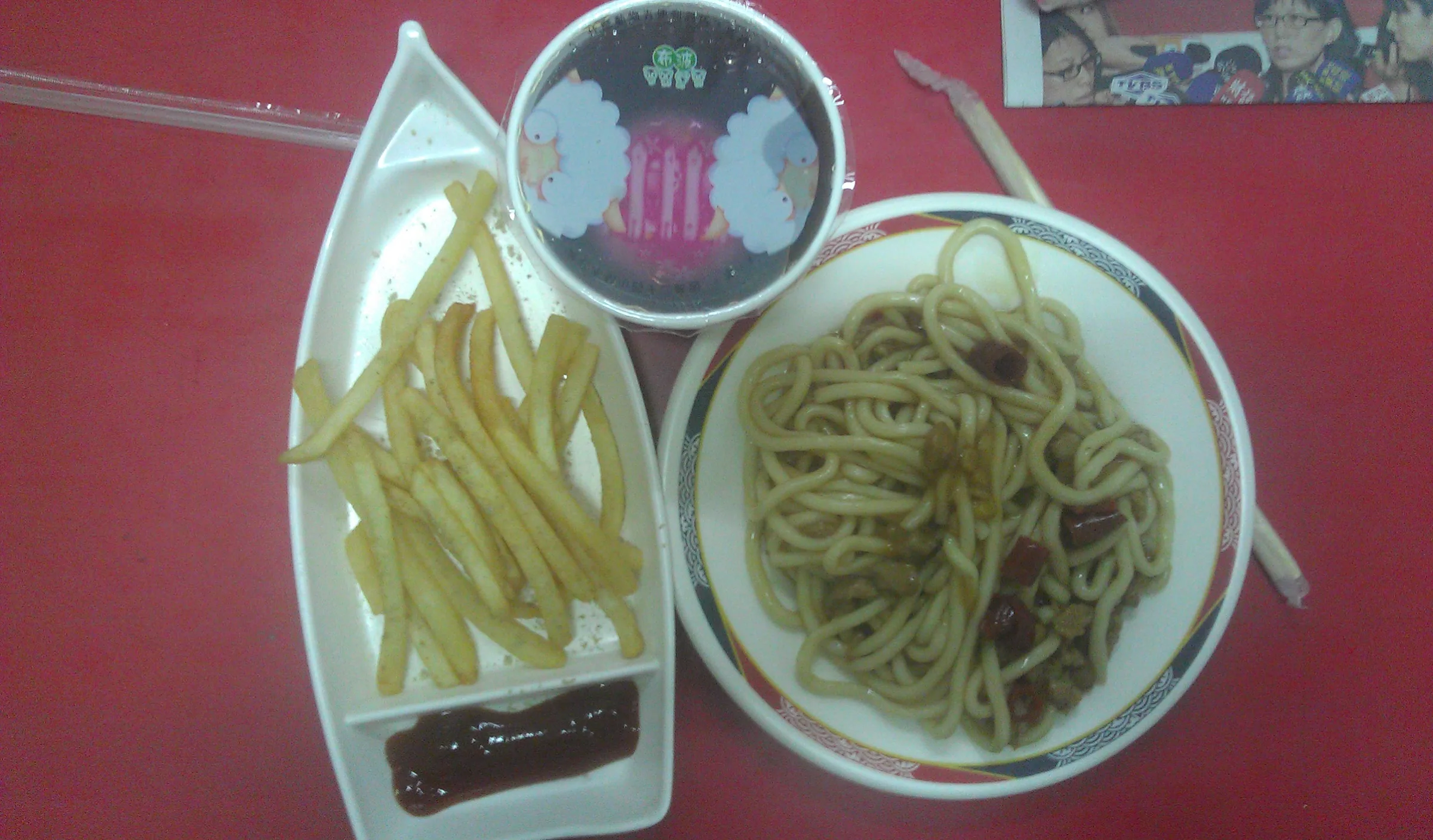
A standard Taiwanese breakfast. Photo: K1234567890y / Wikimedia Commons, CC0
The Breakfast Shop on the Alley and the One Three Streets Over Sell the Same Breakfast
You run into this every day, you just never get told why. Merry's, Merry's again, Hongye Hamburg, Good Morning McDonald's — four signs, four different companies, four different franchise systems, four different bosses. Yet walk in and order, and what you get is basically the same: a hamburger smeared with mayonnaise, a sandwich cut into triangles, an egg pancake, a plate of black pepper stir-fry noodles, and an iced red tea or milk tea.
Even the details match: drinks come with film seals instead of lids, the hamburger is wrapped in thin plastic so you bite through the bag, indoor dining still gets you a pair of disposable utensils, and behind the counter they're shouting "handsome" and "beautiful." Nobody wrote a manual mandating any of this, yet walk into a shop in another city or county and it's still the same routine.
Industry research firms estimate that by 2025, the number of breakfast shops across Taiwan will exceed twenty thousand1. Twenty thousand shops, one nearly identical menu, one nearly identical set of moves. This thing has no headquarters, no standard operating procedures, no single institution overseeing it.
Stranger still, none of it has an identifiable author. How scallion pancakes became powdered-egg pancakes is passed down by word of mouth with no written record. Who first put stir-fry noodles on a breakfast counter — even the Wikipedia entry carries a "needs additional citations" banner at the top. Who first printed those lame jokes and horoscopes on drink film seals — after checking with food media, the conclusion is "currently untraceable"2.
Highly standardized, yet without an author. This is the most counterintuitive thing about Taiwan breakfast. Normally, a product specification replicated across twenty thousand stores would be backed by a powerful owner: a brand, a patent, a franchise agreement, a central factory. Taiwan breakfast is the opposite — it gets copied into every alley precisely because nothing along the way was defended.
Breakfast Has Always Been Here — It’s “Buying Breakfast on the Way Out” That’s New
A widely circulated claim holds that in agrarian Taiwan, people ate only two meals a day: they rose with dawn to work the fields, and the “noon meal” was their first real meal, with breakfast only appearing after the Japanese introduced a regimented three-meal schedule. It sounds plausible, but the documentary record doesn’t support it.
A Japanese colonial-era folk custom record, Taiwan Folk Customs (《臺灣風俗誌》), notes that “for breakfast people mostly ate congee; even those doing physically demanding labor rarely ate rice”3. The word “breakfast” is already present in this account — it just wasn’t substantial, regular, or proportional to the intensity of labor. The claim that “breakfast was brought by the Japanese” doesn’t hold up here. What the fifty years of Japanese rule truly introduced was regularity, along with Western options like bread and coffee, which entered schools, government offices, and a minority of households.
What has always existed is the breakfast meal itself. What’s new is the act of “buying breakfast on the way out,” and its starting point can be traced to a very small place.
Around 1955, in the area around Zhongzheng Bridge in Yonghe, Taipei County, three neighboring shops were all selling soy milk: “Yonghe Soy Milk,” “Donghai Soy Milk,” and “Sihai Soy Milk”4. The outcome didn’t match the signs. The shop flying the “Yonghe Soy Milk” sign eventually closed, and so did Sihai Soy Milk. The survivor was “Donghai Soy Milk,” which, after going through ownership disputes, changed its name and became the World Soy Milk King we know today4. The place name lived on; the earliest sign bearing it did not.
Who the founder was depends on whom you ask. The World Soy Milk King’s official website names only one person: “the first-generation boss, Mr. Li Yunzeng, from Shandong Province,” locating the shop at Yonghe Zhongzheng Bridge, where overseas-born veterans had gathered5. Wikipedia, the Liberty Times, and SETV credit both Li Yunzeng and Wang Jiun-jie as co-founders6. The popular romantic version — “bridge construction workers came every day” — doesn’t line up chronologically: the main structure of Zhongzheng Bridge was completed in 1937, eighteen years before that soy milk stall7.
What truly took the soy milk shop beyond the breakfast hour was a decision made twenty years later. The official timeline reads: “With economic development, the population enjoying nightlife in the Taipei area kept growing, and there were more people drinking soy milk for late-night snacks than for breakfast. Starting in 1975, first-generation boss Li Yunzeng decided to operate twenty-four hours a day, setting the first precedent in the entire province for a soy milk shop running around the clock.”5 1975 was the year Taiwan’s little-league teams kept winning in Williamsport, and the whole island stayed up through the night to watch the broadcasts8. From then on, soy milk shops kept their lights on beyond breakfast hours, becoming among the first food establishments in Taiwan to operate twenty-four hours a day.
The very items being sold here are themselves a record of migration. Scrambled pancakes and fried dough sticks are northern Chinese noodles that arrived with the waisheng immigrant wave after 1949, and the customers at the Zhongzheng Bridge stall were precisely these veterans who had settled in Yonghe5. For many people born in Taiwan in the 1950s through 1970s, this very combination was the original prototype of breakfast, along with the boss at the market who spoke in the local dialect.
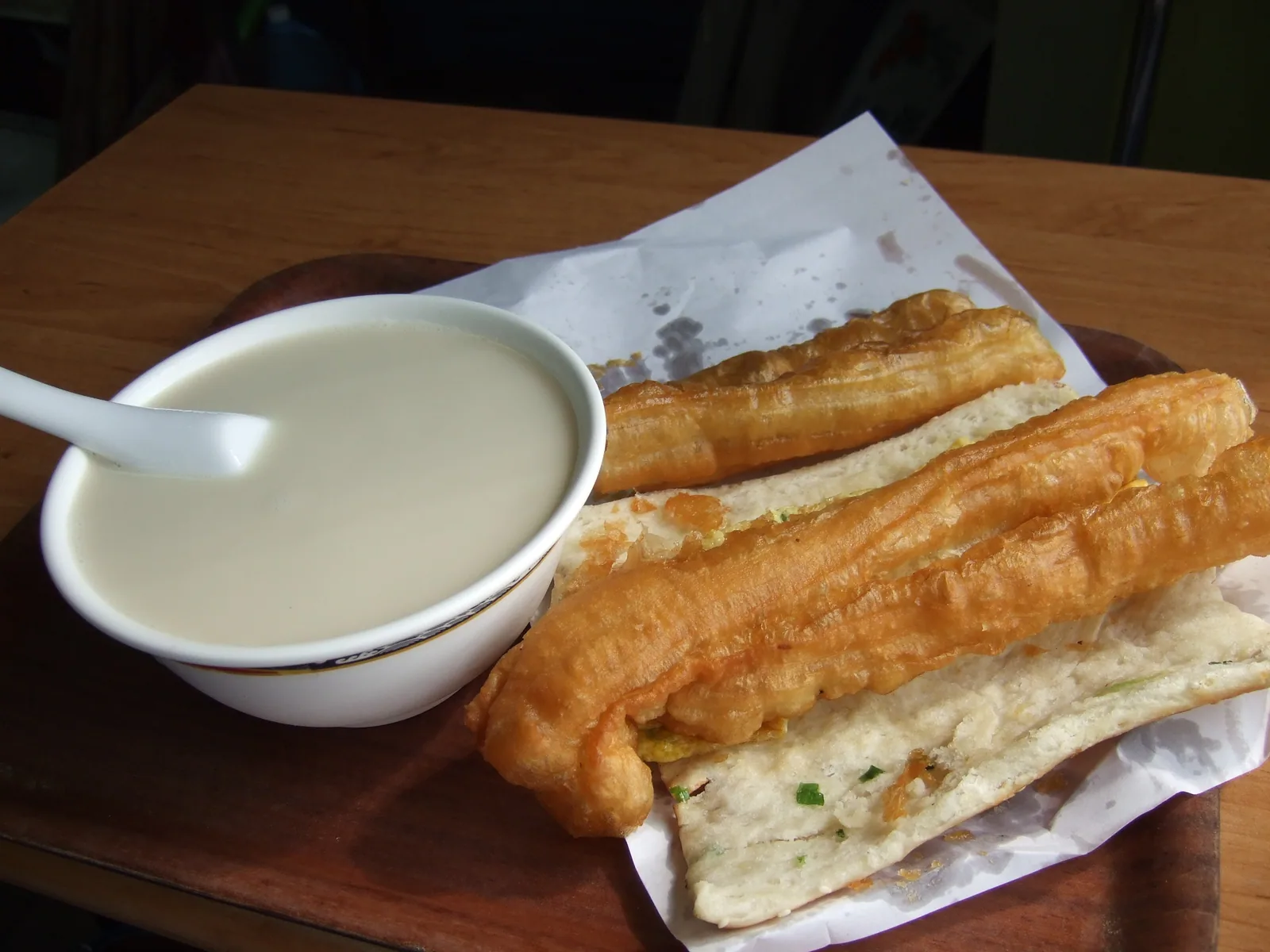
Scrambled pancakes, fried dough sticks, and soy milk — the prototype combination of post-war waisheng noodles entering Taiwan's early morning. Photo: Yun Huang Yong / Wikimedia Commons, CC BY 2.0
By the 1980s, dual-income households were becoming increasingly common, and the meal that had once been prepared at home began to be outsourced to the neighborhood. A time slot became a business, relying on the fact that many people were all too busy during the same period. From day one, this business had no owner: three shops shared a single place name, and no one thought those four characters needed to be registered.
Zhiqi Seven Seven's "Taiwan Taste Seven Seven" EP 010 discusses how the breakfast shop format grew over forty years — a popular version of this history.
When the Pastry Skin Starts Shipping from the Factory
The story of the egg pancake is a visible lowering of the entry-barrier curve.
The earliest version was scallion pancakes. After 1949, mainland Chinese immigrants brought northern Chinese wheat-based foods into Taiwan, where rice-based foods were dominant. Scallion pancakes were among the first to arrive. In an era of material scarcity, eggs were the best nutritional supplement, so adults would slip an egg into a scallion pancake — this was the first generation of egg pancakes. Later, vendors improved the texture by adding potato starch and sweet potato starch to the flour, creating a batter that could be poured directly onto the griddle without kneading9.
The dough becoming batter was a crucial step. Kneading dough is a skill; pouring batter is not.
Source: everylittled (Roomie) explanation of batter egg pancake vs. pastry skin egg pancake production differences
Northern Taiwan tends to use ready-made pastry skin, while southern Taiwan prefers the soft and tender batter version, with a slightly sweeter taste1011.
The real step that brought the barrier crashing down supposedly happened in 1994, when factories began producing ready-made egg pancake skins. Breakfast shops no longer needed to prepare ingredients themselves — just tear open and fry9.
📝 Curator's Note
"In 1994, factories began mass-producing egg pancake skins" — this is written in both the Chinese and English Wikipedia entries for Danbing. Tracing back the citations, both ultimately point to the same 2019 lifestyle news article, and before that, there's nothing. No named manufacturer, no guild records, no second independent witness. A "fact" collected by both Chinese and English encyclopedias has only one source. This itself is a microcosm of this meal: every key moment in its history left no formal record, because at the time, no one thought they were doing something worth recording.
The barrier collapsed even more thoroughly on the soy milk side. In 1985, Lin Bing-sheng established Hongqi Food, opened a shop in Taipei's Shilin District, and used machinery to mass-produce concentrated soy milk, selling to breakfast shops, bakeries, schools, and supermarkets6. Before that, selling soy milk required soaking beans, grinding the slurry, and mastering the heat. After that, one bucket of concentrate plus water equals a pot of soy milk.
The other items on the menu were never invented in Taiwan to begin with. Salted soy milk is a traditional breakfast item native to the Jiangnan and Shanghai regions, part of the "Four Treasures" of Shanghai breakfast culture alongside youtiao (fried dough sticks), large pancakes, and rice sausage — it only picked up local ingredients like dried radish and dried shrimp when it arrived in Taiwan12. There's a scientific explanation for the moment it condenses into curds: vinegar brings the main protein in soy milk close to its isoelectric point at around pH 5, reducing the net charge on colloidal particles and their mutual repulsion, causing them to aggregate13.
The rice sausage's framework comes from Jiangsu and Zhejiang's zongzi (glutinous rice dumplings), with the filling later developing into a combination of meat floss, dried radish, and pickled vegetables14. Rice milk is made from Penglai rice mixed with peanuts and white sesame, with a recorded formula — but tracing its origins, it turns out to be "not uniquely Taiwanese" when the same "rice milk" product from China was found15.
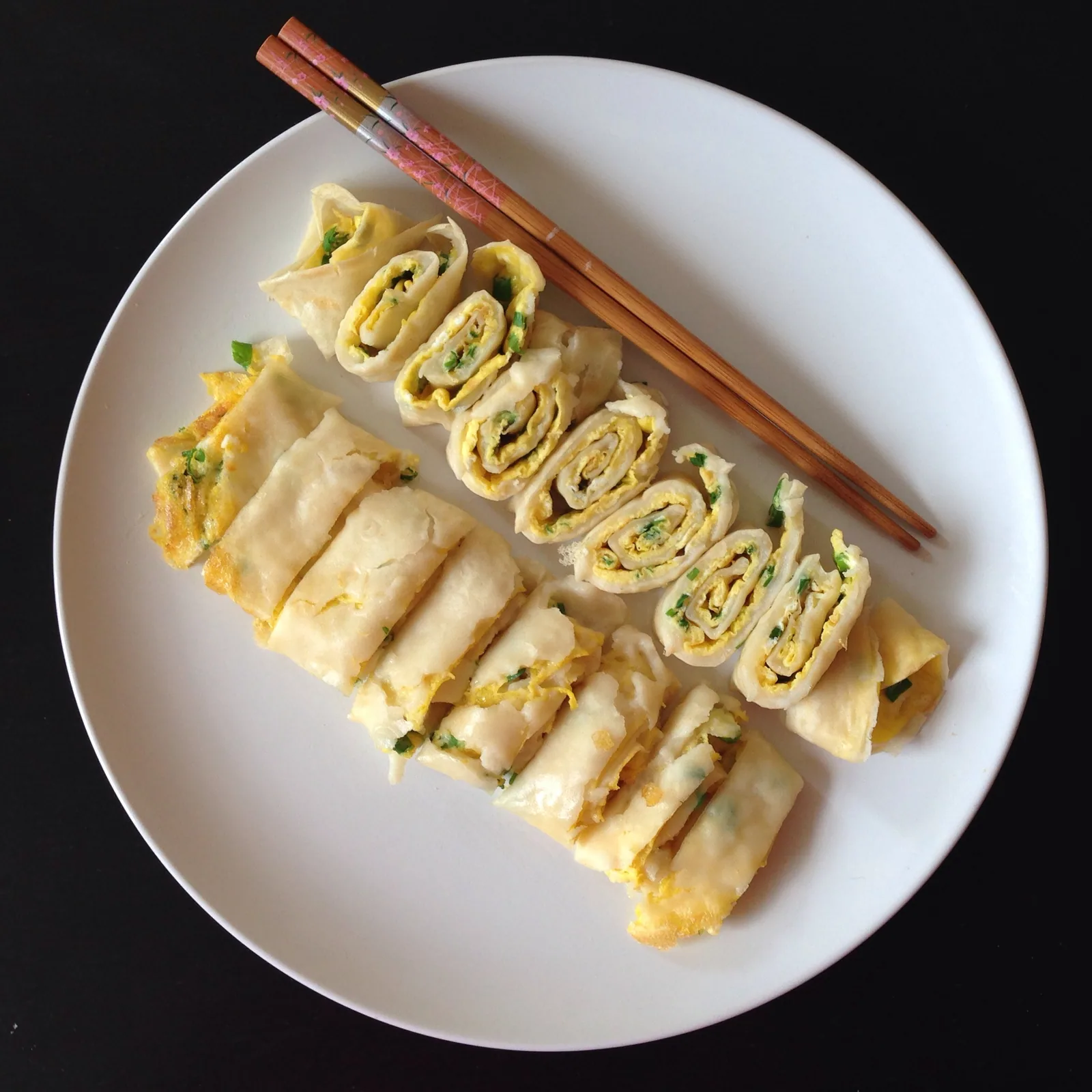
Egg pancake is the most native creation on this menu, and also the item with the most thoroughly collapsed barrier. Photo: Joy / Wikimedia Commons, CC BY 2.0
So anyone could open a shop: no need to know how to grind soy milk, no need to know how to knead dough — just one griddle, one set of refrigerators, and a batch of frozen pastry skins, and the door opens. Since the method was never owned by anyone, the method went to every alley.
Courts Decide: Anyone Can Hang This Sign
In 1981, Lin Kun-yen opened a shop on Taipei's Dadun Road called Mei Wei Mei. Inspired by TV footage of American baseball fans eating hot dogs, he figured hamburgers could be sold the same way in Taiwan. Before opening his storefront, he tried a few things: first he set up a stall selling hamburgers at Taipei Municipal Baseball Field (today's Taipei Dome), which didn't work out, then he pushed a breakfast food truck near Taipei Municipal University of Vocational Studies, and once business picked up, he opened a physical storefront16.
The three characters "Mei Wei Mei" were cobbled together: a friend lived near a bakery called "Mei Tian Mei," and at the time many supermarkets and shoe stores liked using the name "Mei Er Lien." He combined the two16. McDonald's didn't enter Taiwan until 1984, so the timing was just coincidental — the two events had nothing to do with each other.
He never applied for a trademark. Starting in 1988, the "Mei Wei Mei" trademark entered a series of administrative lawsuits. Media reports said a franchisee had registered the trademark first, turning the founder into the infringer16. A different version from an intellectual property law firm gave another account: the earliest person to file the "Mei Wei Mei" trademark application was Juju Food, in 198617. The two stories don't match up on either the people involved or the years18.
The two versions did agree on one thing: the outcome. In the mid-1990s, a series of decisions by the administrative courts classified "Mei X Mei" as a weak trademark: the distinctiveness of these characters had long been diluted by countless similar signs on the street, so adding two characters in front didn't constitute infringement1920.
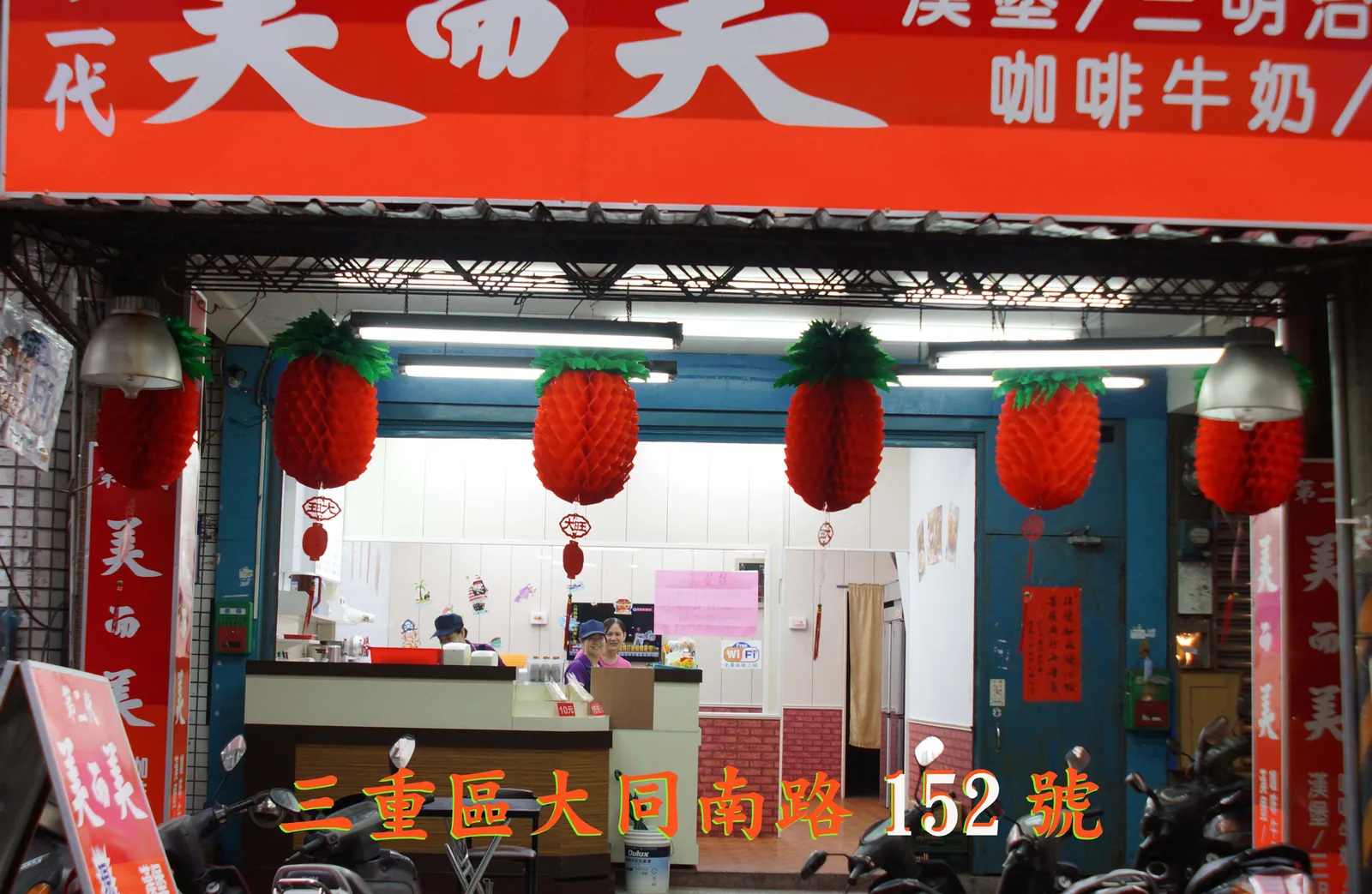
The "second generation Mei Wei Mei." Adding characters to the sign is exactly what the weak trademark ruling left behind. Photo: Mei Wei Mei Second Generation / Wikimedia Commons, CC BY 3.0
One sign had split into an entire row. Mei You Mei, Juju Mei Wei Mei, Rui Lun Mei Wei Mei, Hong Ye Hamburger, and Morning Mia Cereal each grew into their own franchise system19. The similar signs you see when you step outside are downstream from this ruling.
The cost fell on real people. On the other side of the judgment, Lin Kun-yen lost control over his own shop name. He and several early partners had once protested at the "Extra-Party Notary Office"21.
The other thread begins in Yonghe. In 1982, Lin Bing-sheng, then working in real estate brokerage, filed an application with the Ministry of Economic Affairs' Bureau of Standards Inspection and Quarantine, successfully registering "Yonghe" plus "Soy Milk" as a trademark622. Three years later he founded Juhui Food and turned concentrated soy milk into a nationwide business23. This line had no capital connection to the three shops at Zhongzheng Bridge in 1955 — just the same place name used by two different generations of people.
Later, such trademarks could no longer be registered. The full revision of the Trademark Act, promulgated by presidential decree on June 29, 2011, locked the combination of place name plus food name into Article 29, Paragraph 1, Item 1: any mark consisting solely of a description of the quality, purpose, ingredients, origin, or other characteristics of the designated goods lacks distinctiveness and cannot be registered24. This revision took effect on July 1, 201225.
This business later crossed the Taiwan Strait as well. In 2019, Beijing Haidian Court handled a "Yonghe Soy Milk" infringement dispute, and the plaintiff was the very rights holder of these four characters in China. The court determined that "soy milk" was a generic term and "Yonghe" was the name of a county-level administrative region, so the trademark owner had no right to prohibit others from using them legitimately. However, the defendant's use of similar font designs on the storefront and tableware still constituted infringement, and the court ordered compensation of 33,000 yuan26. This judgment drew a line around legitimate use, but the trademark itself remained valid.
📝 Curator's Note
Placing these two cases side by side makes it easy to read as a neat coincidence: thirty years apart, across two jurisdictions, both signs ended up as words anyone could use. Legally, however, they follow entirely different theories. Taiwan's "weak trademark" was acquired — Mei & Mei originally had distinctiveness, but it was diluted by rows of identical signs on every street. The Haidian case in China was innate — a place name plus a generic term was never distinctive to begin with. The only thing they share is the outcome. Most trademarks remain effectively protected; these two are exceptions, not the rule.
The cost was not borne by Lin Kun-yen alone. Another lawsuit, unrelated to trademarks, concerned the shop's real estate: in 1955, Li Yun-zong and Wang Chun-jie opened shops at Zhongzheng Bridge and later, their descendants sued over property rights. In 1997, the parties agreed to split ownership equally, with the Li family paying NT$3.5 million monthly rent to the Wang family. The Pingtung District Court ruled in 2012 that the Li family owed NT$3.3 million in rent27.
The case was ultimately upheld by the Supreme Court, with Li Qing-yu and others ordered to pay Wang Ning-ruo NT$17.8 million in principal, plus over NT$5.78 million in interest for six and a half years, totaling over NT$23.58 million28. The four characters "Yonghe Soy Milk" eventually became usable by anyone, while the two families who first set up shop at the bridge spent over a decade in court over a building.
Source: World Soy Milk King official website, National Database of Laws and Regulations Trademark Act history, United News Network Times, People's Daily IP Channel
The sign couldn't be held, so every street grew its own version.
Justin Matsu's "Taiwanese Flavor" EP 037 explains "Why All the Signs Look So Similar" in a popular format — watch alongside this episode's ruling timeline.
The Fire Burned All Night, and the Shop Still Wasn't Open
Next to the Sanshui Temple on Xinsheng Road in Tainan, there's a nameless fish congee stall. The boss, Li Zhenming, is 85 years old. He gets up at four thirty in the morning, lights the stove, first steeps fish bones for the broth, then cooks fish stomach, blanches fish skin, blanches clams, and works by the stove until about six ten before opening shop. The boss's wife, Li Cai Meiyun, says the broth is simmered fresh every day—over ten catties of fish bones need half an hour of simmering29.
The Zhenjia Cai cake at Sanshao Palace starts even earlier—or rather, never sleeps at all. The cake is soaked and boiled the night before, going into the pot at ten o'clock, and doesn't come out until four in the morning the next day. At five thirty in the morning, the second-generation Zhen Shihan, the boss's wife Wu Peiqiao, and the third-generation Zhen Peijing open shop as a family of three, unwrapping the cake leaves and drizzling on their special sauce29.
A breakfast worth dozens of dollars carries this unseen stretch of time hung out in front of it. The fire burned all night, and the shop still wasn't open.
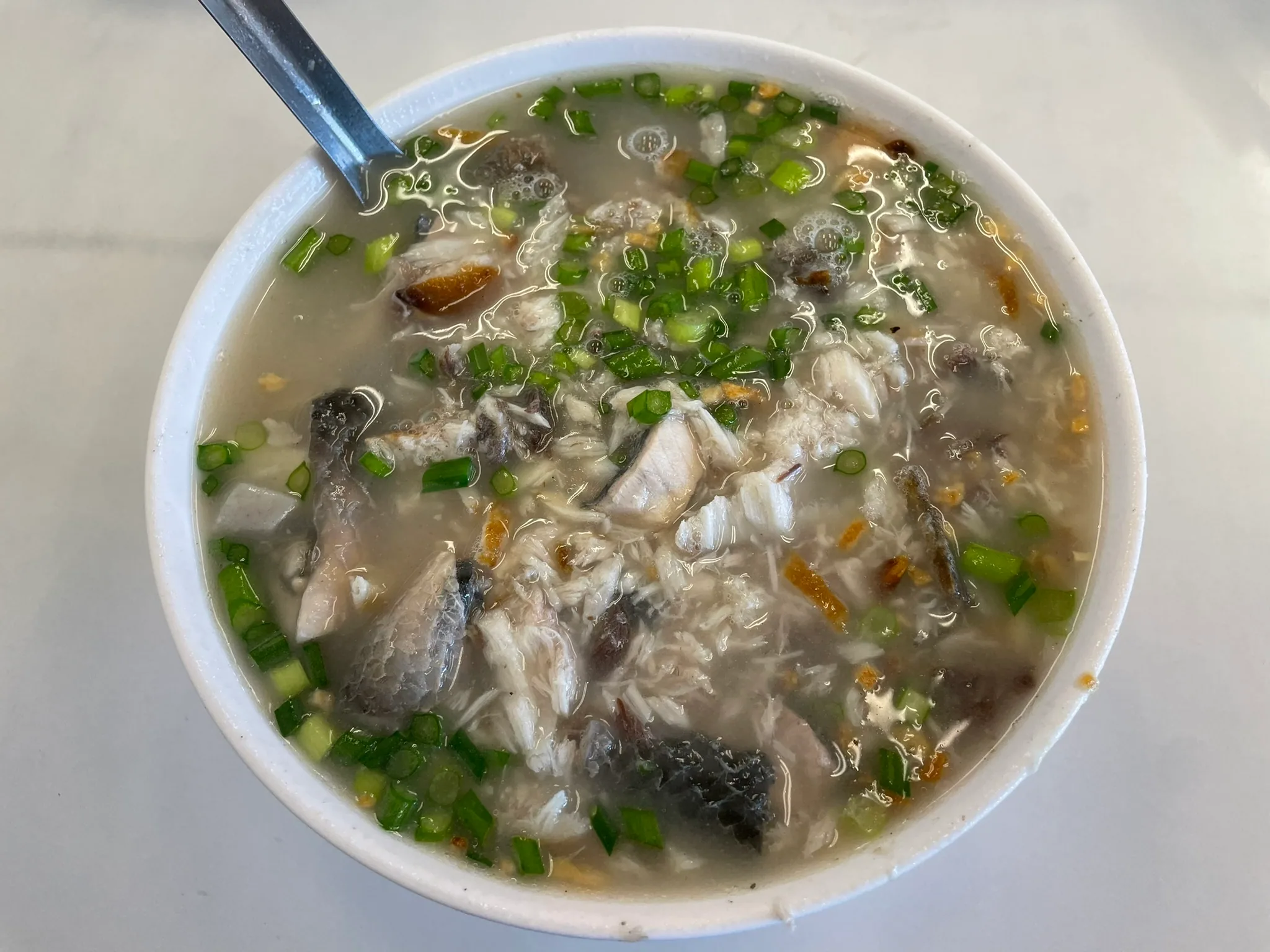
Tainan's milkfish congee. The fish bone broth needs half an hour of simmering before opening shop. Photo: Sin-siōng / Wikimedia Commons, CC BY-SA 4.0
The Weimei Breakfast Shop on Zhuangjing Road in Taipei is a different story. The boss's wife, Cai Xue-wen, took over her brother's shop, moved into the basement floor below the shop, and has been running it for over thirty years, building a reputation in Taipei with a single pan-fried golden-crusted egg pancake. When asked about this job, her answer is very direct.
As long as the kids are taken care of, the business can be managed—surely that's easier than being an office worker
Two things are true in this sentence at the same time: she really did make both ends meet, and the prerequisite for her to do so is that her home and shop share the same address. Doing business upstairs and living downstairs means zero commute time, and the time for looking after children is squeezed out from the working hours30.
The institutional side tells a completely different story. The Ministry of Labor's statistics only go as granular as "accommodation and food service industry"31. There's no "breakfast shop" category in that same industry classification.
The severity of the labor shortage is measurable, though. The Ministry of Labor's vacancy survey shows that by the end of December 2025, the accommodation and food service industry had a vacancy rate of 4.3%, the highest among all major industries, with 25,000 open positions31. 104 Job Bank's 2026 Service Industry Talent White Paper estimates an even larger gap: the accommodation and food service sector is short 273,000 workers per month, with 215,000 of those in food service roles32.
But the legal channels for filling these positions are narrow. The 2026 service industry migrant worker policy relaxation opens up four job categories in the hospitality sector: room service, cleaning, front desk, and food service33. Breakfast shops and street food vendors are not on the list. The general food service industry can currently only rely on the "migrant worker retention and extension program," which allows experienced migrant workers who have already been in Taiwan for a certain number of years to transition into mid-level technical roles as chefs34. The path for hiring new entry-level foreign workers remains closed35. So the common explanation that "young people can't endure hardship" overlooks several institutional constraints that can be pointed to.
The list is compiled by the government; the numbers for the gap are calculated by the job bank. But how do the people kept outside this door feel? No one has ever asked them. Equally unasked are the wage-earning counter staff standing behind the griddle. The boss's wife's words have been recorded by the media, but the employees' working hours, wages, and protections have never been calculated in any dedicated statistics.
It's precisely these people, not caught by the system, who keep alive the breakfast that everyone can afford. The shop opens at 6:10 a.m., the rush hits at 7:30, and the line outside is made up of uniformed students and office workers rushing to catch the MRT. There's no slot for them in the classification tables, yet they've set aside a meal for everyone.
Six to Eight Thirty — Speed Is a Skill
Tsai Hsueh-wen conducted fieldwork at a breakfast shop. He measured the peak rush falling between six and eight-thirty, three kinds of customers intersecting at the same griddle: those who grab-and-go finish within a minute, those who walk in for takeout within ten minutes, and those who sit in for about thirty minutes. When asked, the shopkeeper only said: "Before eight, it's all about speed."36
The common saying goes that breakfast shop aunties remember your taste because of human warmth. But this explanation reverses cause and effect. Within those two and a half hours, memory itself is productivity. She remembers you don't want cucumber so she doesn't have to ask again, so she doesn't ask — that phrase "same as usual" saves ten seconds, the line moves forward. This is technique honed under speed pressure.
Forms of address are part of the same technique. "Handsome" and "beautiful" are the fastest universal calls — no need to remember names, no risk of calling the wrong person, and they carry across the oil smoke.
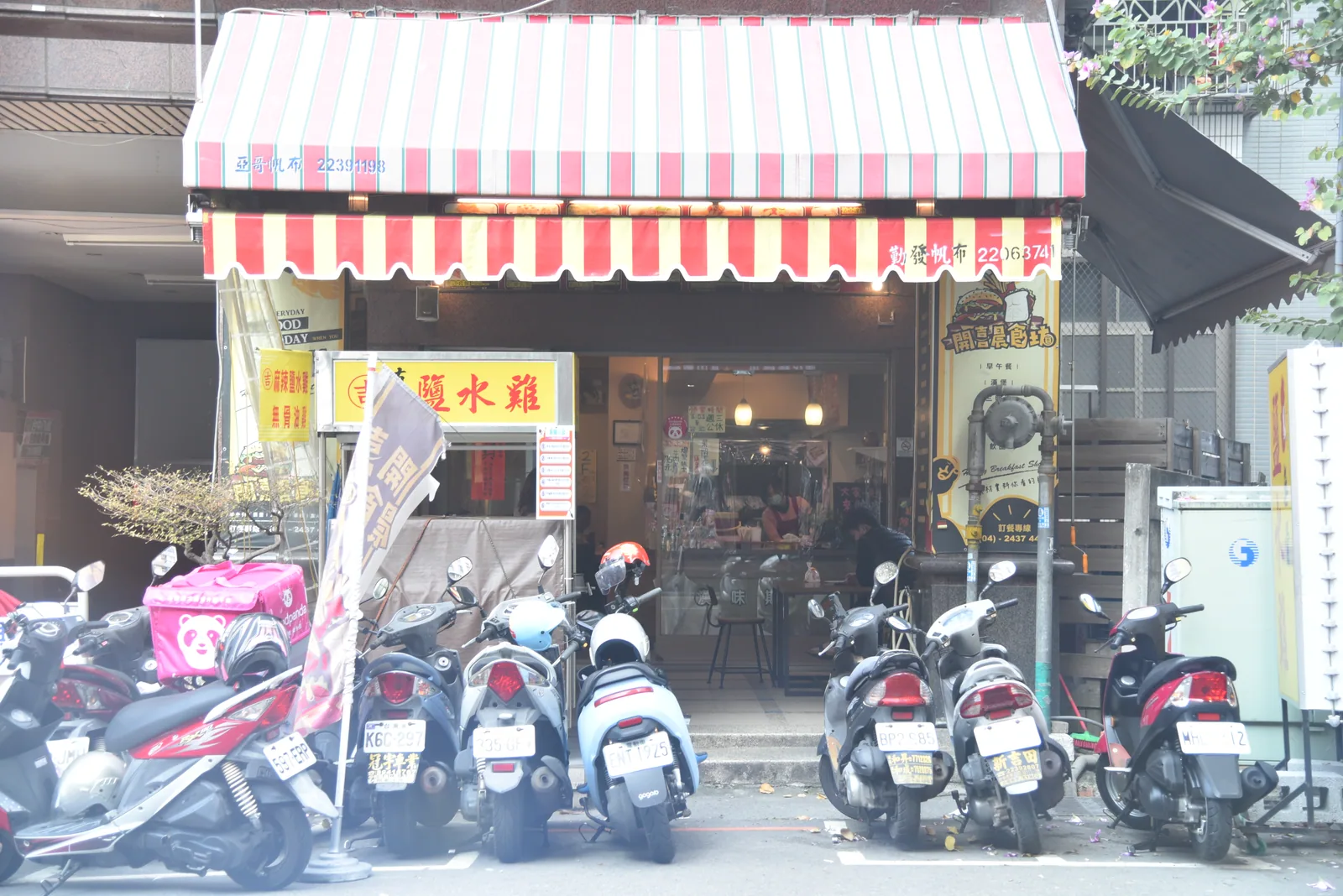
Street-side breakfast shop. From six to eight-thirty, this doorway digests an entire street's morning. Photo: WC-QHS / Wikimedia Commons, CC BY-SA 4.0
In May 2026, a notice went viral on social media: "Dear customers over 40, please do not address the female staff working on site as 'auntie,'" suggesting instead "older sister," "younger sister," or "beautiful." The report didn't name the shop or location, but noted one thing: this note was printed by a customer for the shop, not posted by the shop itself.37
📝 Curator's Note
An entire system of address is being renegotiated, with the proposal coming from outside the counter. This is something quite special about the breakfast shop space. Its rules were never set by anyone — they're called out every day from six to eight-thirty by people standing on either side of the same griddle. The sign can be claimed by everyone; this whole way of calling out never belonged to anyone.
Heading further south, the content of this time slot completely changes. A Tainan morning is beef soup, fish roe congee, braised pork rice, and bean sprout noodles — no blood relation to the egg pancake and soy milk line. Most beef soup shops close on Mondays and Tuesdays because they don't slaughter cattle from Monday night to Tuesday morning. The shop opens around five in the morning, so it's also breakfast.38 A single shop's rest day is decided by the slaughterhouse calendar — an entirely independent logic, with Taipei's griddles running their own rhythms in the same time slot.
Beyond the griddle is another layer: the auntie remembers whose child is sick, whose family argued yesterday, which alley got new neighbors. That layer lives in Breakfast Shop Auntie and the Community Intelligence Network. In the two meters before the griddle, there's only this: a "same as usual," a combo without mayonnaise, a cup of iced milk tea already sealed under film.
Recipes can't be held onto, signs can't be held onto, sleep can't be held onto. What can be held onto is "I remember you don't want cucumber" — and that happens to require no ownership at all.
This Group TGOP's "Classic Quotes from Breakfast Shops" turns the conversations in those two meters before the griddle into a performance — proof that this whole system of calling out has been collectively recognized.
No One Remembers Who Invented Scallion Pancakes
The most ordinary dish in this meal, no one remembers where it came from. Food media Roomie's author might as well say it outright: "After steak left the menu, scallion pancakes and half-cooked eggs appeared in Taiwan's Western-style breakfast shops without a traceable origin."39
Some might point to Sun Tung-po's first stall in 1976 as the answer, but that year was tied to the entire set of Taiwanese cheap steak and iron plate side dishes, not the noodle dish itself.40 Many items on the menu are like this—completely blank on their origins.
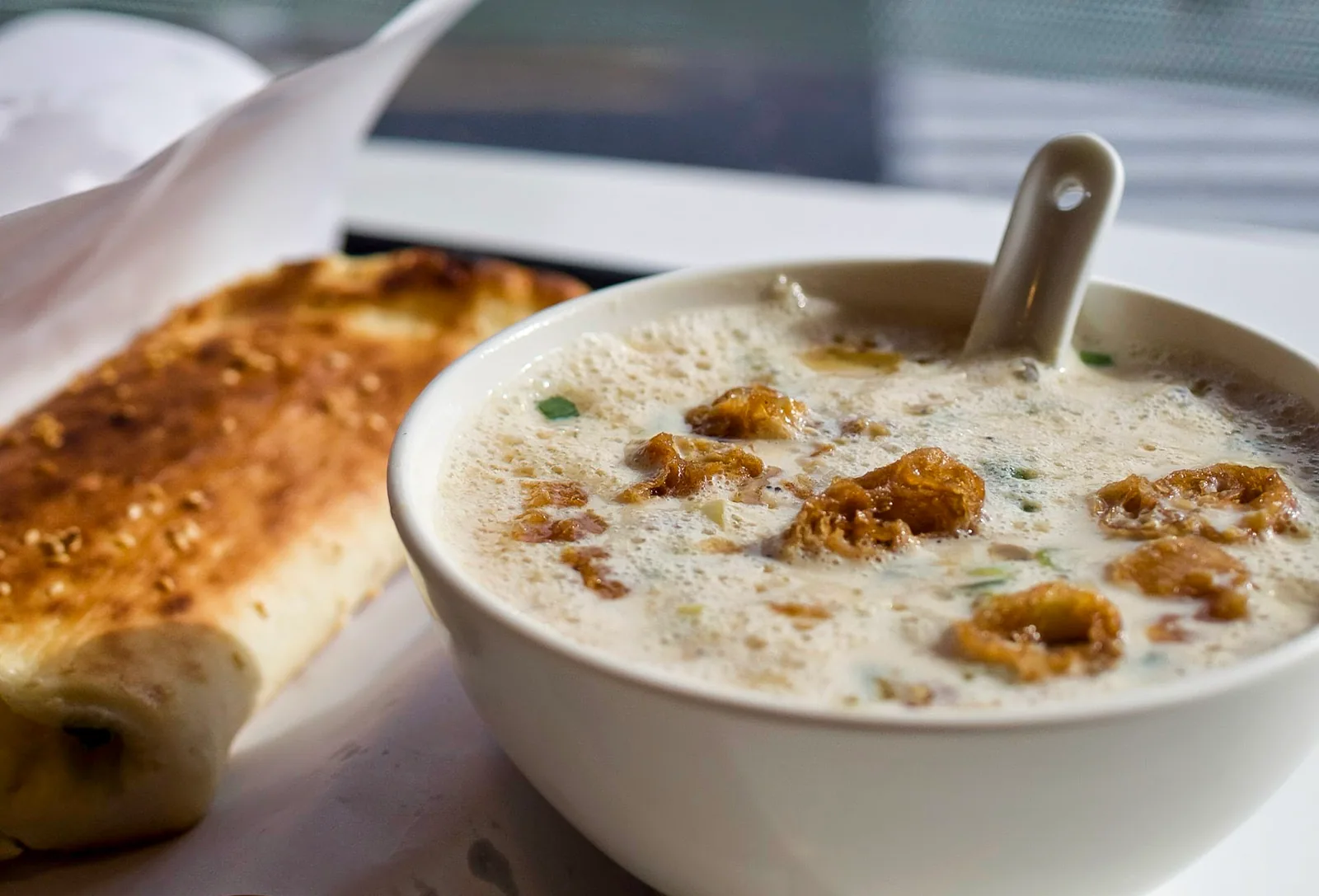
Salted soy milk and egg pancake, both transplanted, both locally adapted. Photo: KQuhen / Wikimedia Commons, CC BY-SA 4.0
Those who can be named have one by one departed. On August 7, 2026, Lin Bing-sheng passed away in Taipei at the age of seventy.22 He had nothing to do with the people selling soy milk at Zhongzheng Bridge in 1955; he was doing something else: registering a place name as a trademark, putting concentrated soy milk into machines, letting the four characters "Yonghe Soy Milk" travel from a Shilin storefront into breakfast shops, bakeries, schools, and supermarkets across Taiwan.
The shop at Zhongzheng Bridge is still open, still operating 24 hours. When interviewed, second-generation chairman Lee Ching-yu spoke about heat control: "Many people think the masters in the shop are lazy and don't stir the soy milk while it's cooking, which is why it develops a burnt flavor. But in fact, to drink soy milk this rich and with a slight burnt taste, it actually requires strict control of heat and temperature."41
The recipes weren't preserved, the names weren't preserved, and the time before the griddle was institutionalized. This meal's anonymity isn't because no one wanted to claim it. Lin Kun-yen, Lin Bing-sheng, Li Yun-zeng, and Wang Chun-jie have all put their names on the line—fighting lawsuits, paying damages, losing control—they too couldn't hold on.
What remains is someone still guarding the temperature of that pot of soy milk, that unspoken "same as usual" at 7:10. A breakfast with no author is rewritten every morning at dawn on twenty thousand griddles.
Further Reading:
- Taiwan Military Housing History — The origin of the scallion pancake line, how Northern Chinese noodles landed in Taiwan after 1949
- Rice Dumpling — From Jiangnan rice dumplings to the filling evolution in Taiwan breakfast shops, the complete story of a single rice dumpling
- Taiwanese Street Food — How the street vendor economy sustains Taiwan's daily diet, breakfast is just one time period
- Taiwan Bubble Tea Culture — The other half of the big ice milk family, equally a business anyone can start
- Taiwan Cuisine Overview — Walking outward from breakfast, a complete map of Taiwan's food culture
- Breakfast Shop Aunties and Community Networks — The layer beyond the griddle, how a single shop becomes a street node
Image Sources
- Hero (A Taiwanese Breakfast): Breakfast sold in taiwan — Photographer K1234567890y, Wikimedia Commons, CC0.
- Scallion pancake, fried dough, and soy milk: Taipei breakfast with fresh soymilk 20071023 — Photographer Yun Huang Yong, Wikimedia Commons, CC BY 2.0.
- Close-up of dan bing (egg crepe): Dan Bing (Taiwanese egg crepe) — Photographer Joy, Wikimedia Commons, CC BY 2.0.
- Second-generation Mei Weimei signboard: Second-Generation Mei Weimei Dadaemun Store 20120619 — Photographer Mei Weimei Second Generation, Wikimedia Commons, CC BY 3.0.
- Tainan fish soup congee: Tainan Cuisine: Fish Soup Congee — Photographer Sin-siōng, Wikimedia Commons, CC BY-SA 4.0.
- Breakfast shop exterior: Happy Breakfast Shop 20210214 — Photographer WC-QHS, Wikimedia Commons, CC BY-SA 4.0.
- Salted soy milk and egg flatbread: Xian doujiang and egg flatbread Taipei — Photographer KQuhen, Wikimedia Commons, CC BY-SA 4.0.
References
- Manager: Breakfast Shop Market Report — Cites industry research institute 'Mirai Research' statistics: in 2025, the number of breakfast shops across Taiwan exceeded 20,000; the annual growth rate of breakfast shop revenue rose to 16.4%, ranking second among all food and beverage sub-industries. These figures are estimates from a private industry research institute, not government statistics; the statistical scope and aggregation methods are not fully disclosed.↩
- foodNEXT: Film Lids and the Sealing Membrane Joke — By Huang Yi-Ling, 2018-09-09. Records that before the 1980s, beverage cups mostly used plastic lids; Kaohsiung's Ye Zhi-Fang developed sealing membrane technology, and explicitly wrote: 'Who was the first to do this? It's already unverifiable now.' The sealing machine (medium) and the sealing membrane joke (content) are two separate things and should not be conflated as the invention of the same person.↩
- Cuisine.Taiwan (China Culinary Culture Foundation) Column — Quoted from the Japanese colonial-era folk record 'Taiwan Folk Customs': 'For breakfast, people mostly eat congee, even though they do strenuous work as farmers or laborers, they rarely consume rice.' The original book version and page numbers are not publicly cited in this quotation; the same text also appears on the citizen journalism platform PeoPo, with both sources sharing a common origin.↩
- SETN Travel Channel: Ranking of Yonghe Soy Milk Famous Shops — Verbatim record stating 'Yonghe Soy Milk originally had three famous shops': Yonghe Soy Milk, Donghai Soy Milk, and Sihai Soy Milk, all located near Zhongzheng Bridge in Yonghe. It also notes that Donghai Soy Milk 'later went through management rights disputes and was eventually renamed to the now-familiar World Soy Milk King.'↩2
- World Soy Milk King Official Website: About Us — A first-hand page documenting the brand's history, including the full text: 'Founded in 1955 (Republic of China Year 44)', 'The first-generation boss was Mr. Li Yun-Zeng from Shandong Province', and 'With economic development... starting from 1964, the first-generation boss Li Yun-Zeng decided to operate 24 hours a day.' The official website only lists Li Yun-Zeng, without mentioning co-founders or the later broadcast.↩23
- Wikipedia: Yonghe Soy Milk — The founder section lists both Li Yun-Zeng and Wang Jun-Jie, and records that in 1982, Lin Bing-Sheng applied for trademark registration with the Ministry of Economic Affairs, and in 1985, established Hongqi Food in Shilin, Taipei, producing concentrated soy milk in large quantities for sale to breakfast shops, bakeries, schools, and supermarkets.↩23
- National Cultural Memory Library: Zhongzheng Bridge (Former Shuanchuan Bridge) — Records that Zhongzheng Bridge (formerly Shuanchuan Bridge) was completed in 1937. This timeline is 18 years apart from the soy milk stall established in 1955, making it impossible to support the folk saying that 'bridge construction workers were daily customers.'↩
- Wikipedia: World Little League Baseball Tournament — The list of champions shows that Taiwan won consecutively in 1969, 1971 to 1974, but did not participate in 1975 due to the organizing body's decision to cancel foreign regional participation. The claim that 24-hour business hours are directly attributed to 'staying up all night watching little league broadcasts' is only found in a single report and contradicts the fact that there was no Taiwanese team participating that year; therefore, this section only discusses the general trend of nighttime pedestrian flow in the 1970s.↩
- SETN: The Story of Danbing (Savory Pancake with Egg) — 2019-01-21. Records that Danbing evolved from scallion pancakes with added egg, vendors mixed potato starch and sweet potato starch into the flour to make non-kneading batter, and 'starting from 1994, factories began producing ready-made Danbing skins.' This is the earliest documented source for the '1994' claim, referenced by both Chinese and English Wikipedia and subsequent food media, with no second independent source.↩2
- everylittled (Roomie): Powdered Egg Pancake vs. Skin Egg Pancake — Explains that the powdered egg pancake is made by adding only cold water and has a moist and soft texture after pan-frying; the skin egg pancake uses boiling water to cause starch gelatinization, resulting in a crispy and firm texture that is not easily deformed after frying.↩
- SETN: Differences Between Northern and Southern Danbing — Vendor interviews indicate that in the north, fresh batter is made into pancake skin with a crispy texture, while in the south, pancake batter is pan-fried with a soft and sweet flavor. This is the vendor's observation, without corresponding nationwide survey data.↩
- Wikipedia: Salted Soy Milk — With over 26 references, it records that salted soy milk is commonly found in mainland China's Jiangnan region (Shanghai, Suzhou, Hangzhou) and Taiwan, where it is called 'salty milk' in Jiangnan, and is listed alongside youtiao, da Bing, and rice rolls as one of Shanghai's traditional breakfast 'Four Treasures.' Taiwan's salted soy milk is a version introduced by mainland Chinese immigrants and adapted with local ingredients.↩
- PanSci: Why Does Salted Soy Milk Form Clumps? — Author Bai Wei, 2019-08-30. Explains that the main proteins in soy milk, Glycinin and beta-Conglycinin, have isoelectric points around pH 5; adding vinegar reduces the net charge of colloidal particles, weakens repulsion, and causes aggregation.↩
- Wikipedia: Rice Roll (Cifan) — Records that rice rolls are a traditional breakfast item in the Jiangsu and Zhejiang regions, and Taiwan's rice rolls derive from this system. The widely circulated claims of 'mountain tribe wrapping glutinous rice in tree leaves' and 'miner's bamboo leaf rice rolls' come from content farms or lack of first-hand evidence, and are not adopted.↩
- Baidu Baike: Rice Milk (Mijiang) — Shows that mainland China also has 'rice milk' as a commercialized beverage, directly challenging the popular claim that 'rice milk is unique to Taiwan.' Taiwan's rice milk has a clear record of using ingredients like Penglai rice, peanuts, and white sesame, but the comparative claim that 'China doesn't have it' lacks supporting evidence.↩
- United News Network Times: Who Is the Original Breakfast Shop? — Records that Mei Weimei was founded in 1981 by Lin Kun-yen in Taipei's Dadun Road, inspired by the scene of American baseball fans eating hot dogs on TV. Initially selling hamburgers at Taipei Municipal Baseball Field (now Taipei Dome) was unsuccessful, so he moved to a food truck near U-Da Commercial High School. The store name comes from the combination of 'Mei Tian Mei' bakery and 'Mei Er Lian', and the media's account of a franchisee registering the trademark early in 1988.↩23
- GoldKeen Intellectual Property Office English Analysis — A professional intellectual property article pointing out that the earliest applicant for the 'Mei Weimei' trademark was Julin Food Enterprise, in 1986, and listing two administrative court judgments supporting the recognition of weak trademarks: 1996 Case No. 2110 and 1998 Case No. 581. This version differs from the media account in both the applicant and the year.↩
- The media account (a franchisee registering early in 1988) and the intellectual property office version (Julin Food Enterprise applying earliest in 1986) differ in both the involved party and the year. There is no publicly available full text of the judgment in the Judicial Yuan's judgment system to verify. The text therefore presents both versions.↩
- Wikipedia: Mei Weimei — Records that Lin Kun-yen founded it in 1981 on Taipei's Dadun Road, did not apply for trademark protection initially, began a series of lawsuits at the Administrative Court in 1988, and subsequently split into brands such as Julin Mei Weimei, Rui Lun Mei Weimei, Hong Ye Hamburg, and Morning Sun Mei Zhi Cheng. These brands are all private chains not listed on the stock market, with no mandatory disclosure obligations, and the number of stores reported by various parties varies by hundreds.↩2
- Most media write it as 'the 1994 Supreme Administrative Court ruling,' but the agency name 'Supreme Administrative Court' was not officially launched until July 1, 2000, when the second-instance reform of administrative litigation was implemented. Before that, administrative litigation had only a single level, the 'Administrative Court.' This is a temporal misplacement where later reports retroactively applied today's agency name to the 1990s.↩
- Manager Magazine: The Story of Mei Weimei — Records that Lin Kun-yen was formerly an employee of TATUNG GROUP, started the hamburger business after seeing American baseball fans eating hot dogs on TV, and notes that he and his early partners once protested at the 'Extra-Party Verification Committee.' This protest detail appears only in this article and has no second source for cross-verification.↩
- EBC News: Founder of Yonghe Soy Milk Lin Bing-sheng Passes Away — August 8, 2026. Verbatim record: 'In 1982, Lin Bing-sheng, then engaged in the real estate agency business, applied to the Ministry of Economic Affairs Standards Inspection Bureau for trademark registration, using 'Yonghe' combined with 'Soy Milk' as the brand name and completing the trademark registration,' as well as 'Lin Bing-sheng passed away in Taipei on August 7 due to ineffective medical treatment, at the age of 70.' The death date and age at death are consistent across all media reports; the cause of death is only mentioned as esophageal cancer in the United News Network, while EBC and NOWnews only state 'died due to ineffective medical treatment.'↩2
- There are two versions of the year Lin Bing-sheng obtained the 'Yonghe Soy Milk' trademark: 1982 and 1985. Wikipedia and EBC News adopt 1982 (trademark registration), while NOWnews, United News Network, Commercial Times, and HK01 all report 1985 in their 2026 obituaries, equating trademark registration with the establishment of Jhongqi Food. The more reasonable interpretation is that 1982 was the trademark registration year and 1985 was the company establishment and mechanized mass production, with the two actions being conflated in later reports.↩
- National Legal Database: Trademark Act Article 29 — The original legal text, Article 1, Paragraph 1, Item 1, stipulates that 'those consisting solely of descriptions of the quality, use, raw materials, origin, or related characteristics of the designated goods or services' lack distinctiveness and cannot be registered, providing the legal basis for combinations of place names and food names.↩
- National Legal Database: Amendment History of the Trademark Act — Records that 'on June 29 of the 100th year of the Republic of China, President Hu Jing-tu issued Order No. 10000136171 to amend and promulgate the full text of 111 articles.' The presidential promulgation date is June 29, with the enforcement date designated by the Executive Yuan as July 1, 2012, commonly summarized as 'amended in May 2011.'↩
- People's Daily IP Channel: Yonghe Soy Milk Trademark Infringement Case — A Chinese official media report stating that Beijing Haidian Court ruled that 'soy milk' is a common name and 'Yonghe' is a county-level administrative region place name, so the trademark owner has no right to prohibit others from legitimate use. However, the defendant was still ordered to pay RMB 33,000 in damages due to similar use of the storefront and utensils. The involved trademark number is No. 9862735. The original judgment text and official case number were not found through search, so this is based on media reporting.↩
- ETtoday: Yonghe Soy Milk Founding Family Rental Dispute Lawsuit — A 2012 report stating that the Pingtung District Court ruled that the Li family must pay NT$3.3 million in rent to the Wang family, making this one of the earlier instances of real estate ownership disputes over the storefront.↩
- Liberty Times: World Soy Milk King Ownership Dispute Finalized — Records that Wang Jun-jie and Li Yun-zeng co-founded the business, and in 1997 they agreed that the storefront and real estate ownership would be split equally, with the Li family paying NT$350,000 per month in rent. The case was ultimately upheld by the Supreme Court, with Li Qing-yu and others ordered to compensate Wang Ning-ruo with NT$17.8 million in principal plus over NT$5.78 million in interest for six and a half years, totaling over NT$23.58 million.↩
- Taiwan Panorama Magazine: A Happy Morning - Has Breakfast Been Eaten? — By Deng Hui-chun, photographed by Lin Min-hsuan, July 2023. Verbatim record of Li Zhen-ming (85 years old), the boss of an unnamed fish congee shop on Xinzhong Road in Tainan, and his wife Li Cai Mei-yun, who 'get up at 4:30 in the morning,' spend over half an hour boiling more than ten catties of fish bones, and 'can only open the shop around 6:10.' Also describes the details of the Zhang family's sticky rice dumplings in front of Shatian Palace, who 'boiled all night yesterday, put on the fire at 10 o'clock, and started again at 4 in the morning.' This article only adopts verifiable times and does not adopt the duration of cooking.↩2
- CommonWealth Magazine (reprinted by United Daily News): Tsai Hsueh-wen, the Café Boss — By Chang Fang-yu, June 16, 2026. Documents how Tsai Hsueh-wen took over her brother's café, moved into the basement floor below the shop, and operated it for over 30 years. Includes a verbatim quote: 'As long as the kids can afford it, the business can manage—why not be more relaxed than office workers?' It also details her procurement of egg pancake wrappers from Sanzhong Handmade and her rise to fame in Taipei with slightly crispy, chewy-skin egg pancakes.↩
- Ministry of Labor: December 2025 Vacancy Survey Results — Official primary statistics showing the highest vacancy rate at 4.3% in the accommodation and food service sector, with 25,000 job openings accounting for 9.6% of the total. The survey notes it has collected data over four periods so far. The widely circulated claim that 'the food service vacancy rate was 7.3% in 2024, the highest in nine years' does not match any figures in the Ministry of Labor's official statistics, and with only four periods of data, the survey lacks sufficient basis for a nine-year comparison.↩2
- United Daily News: 104《2026 Service Industry Talent White Paper》 — Reports on the white paper released by 104 Employer Brand, indicating a monthly talent gap of 673,000 people in 2026, with the largest gap in accommodation and food services at 273,000 people, and 215,000 missing in food service roles. This is a private employment survey, not government statistics.↩
- Business Weekly / Central News Agency: Opening Overseas Migrant Workers to the Accommodation Industry — Documents that in 2026, the service industry's overseas migrant worker program includes the accommodation sector (tourist hotels, general hotels) covering front desk, housekeeping, food and beverage roles. Cafés and snack shops are not included in the open categories.↩
- Compilation of Foreign Labor Hiring Policies in the Food Service Industry — An industry blog summarizing current regulations, explaining that the food service industry can currently only hire foreign labor through the 'Overseas Migrant Worker Retention and Conversion Program,' allowing experienced migrant workers who have been in Taiwan for a certain period to transition into mid-level technical roles such as chefs. Hiring new entry-level foreign workers is not yet permitted.↩
- National Database of Laws and Regulations: Foreigners Employed in Services Under Article 46, Paragraph 1, Items 8 to 11 of the Employment Service Act — Official legal text stating that frontline positions in general food service, snack shops, and cafés are not included among the job categories open to foreign workers.↩
- The News Lens: Practicing Taiwanese Breakfast (Rewritten Version of Hsu Chia-lin's Thesis) — Rewritten from Hsu Chia-lin's "Practicing Taiwanese Breakfast: The Role and Tactics of Western-Style Breakfast Shops," China Culinary Culture, Vol. 17, No. 2, pp. 79-140 (2021). Field observations found peak hours occur between 6:00 and 8:30, takeout customers arrive within one minute, delivery takes about ten minutes, and dine-in lasts roughly thirty minutes across three types. The shopkeeper's interview quote "Before eight, everything must be fast" is also included. The full original journal text is not available on the public internet.↩
- China Times News Online: Breakfast Shop Notice "Please Don't Call Me Auntie" — Reported by Fang Yi-qian, May 2026. A verbatim record of the notice stating "Dear customers over 40, please do not address the female staff working diligently on site as 'Auntie'" and suggesting they use "older sister," "younger sister," or "beautiful lady" instead. The notice also records "This note was printed by the customers for them." The report does not mention the shop name or location.↩
- Wikipedia: Beef Soup — A verbatim record stating "Because cattle are slaughtered on Monday nights and Tuesday mornings, most shops are closed on Mondays and Tuesdays, and shops also begin business around 5 a.m., so it can also serve as breakfast." The traditional generational succession of Tainan beef soup remains disputed across different sources; a conservative phrasing is adopted here.↩
- everylittled (Roomie): Scrambled Noodles — A verbatim record stating "After the departure of the steak chef, scrambled noodles and runny eggs appeared indiscriminately on the menus of Western-style breakfast shops in Taiwan." The Chinese Wikipedia entry on "Scrambled Noodles" itself notes that more sources are needed; it has only four citations, none of which address the origin, and the inventor and year of scrambled noodles indeed lack reliable documentation.↩
- United News Network Times: The Rise of Taiwanese Steak — Records that Sun Dong-bao started his stall in 1976. This date is tied to the overall eating style of Taiwanese affordable steak and its sizzling side dishes, not to the origin of the noodle dish itself; the two must not be conflated.↩
- VERSE: World Soy Milk King, From Day to Night, a Century of Aromatic Yonghe Flavor — An interview report featuring second-generation chairman Lee Hsin-yu's verbatim quote: "Many people might think the masters in the shop are lazy and don't stir the soy milk while it's boiling, which would cause a burnt taste. In fact, to achieve such rich and slightly burnt-flavored soy milk, it actually requires strict control over heat and temperature." Lee Hsin-yu's identity is cross-verified through company registration records as the representative of World Soy Milk King Co., Ltd.↩