
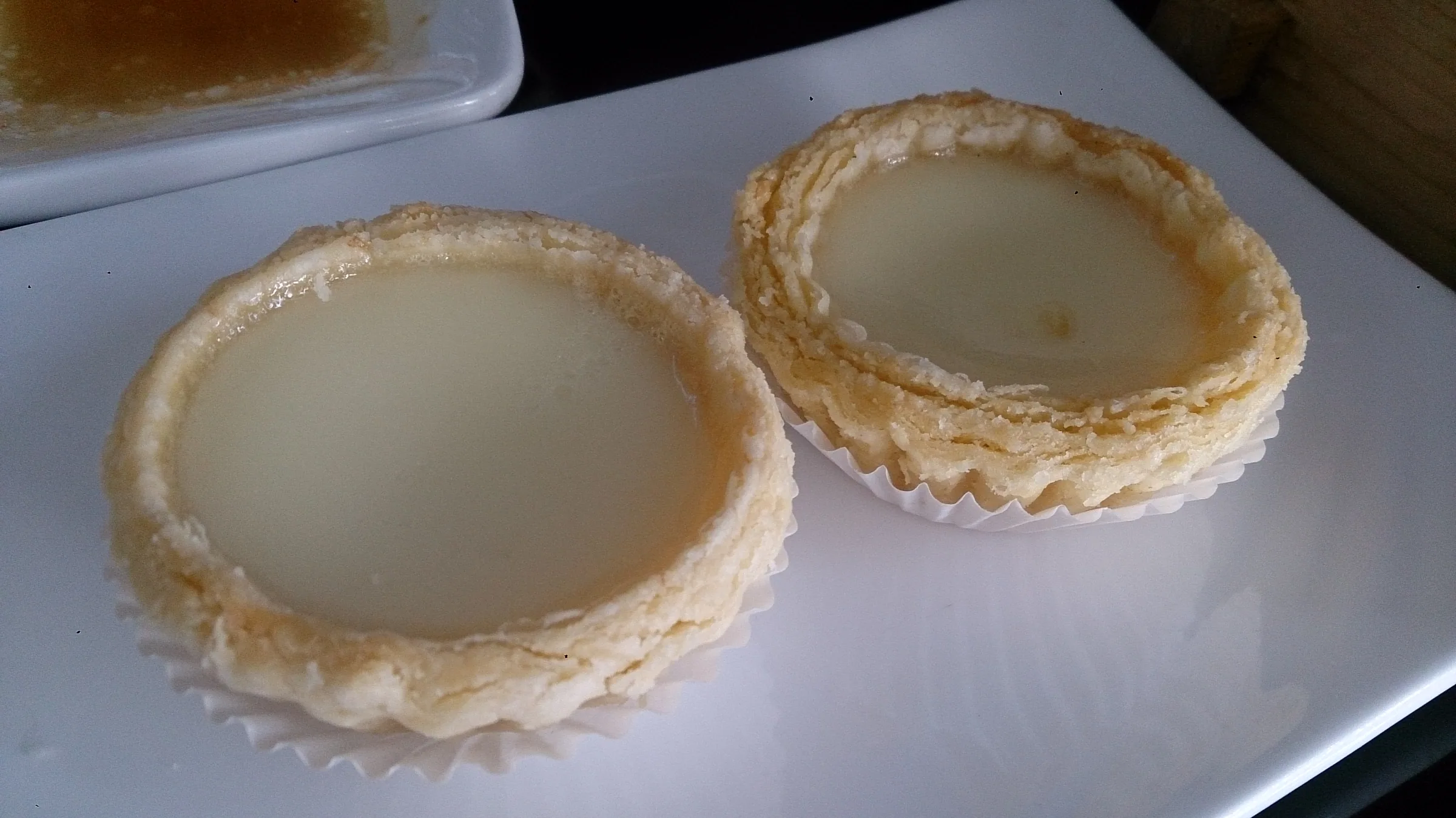
30-Second Overview:
In Taiwan, the egg tart is more than a dessert; it is the namesake of the economic “egg tart effect.” From the queueing craze triggered by the arrival of Portuguese egg tarts in 1998, to the bleak sight of hundreds of shops closing within months, this small caramelized pastry recorded the island’s collective consumer anxiety and enthusiasm. Today, the egg tart has evolved from a short-lived emblem of fashion into a core competitive asset for fast-food brands and an experimental field for a new generation of “mille-feuille” pastry techniques.
1998: The Island’s Collective Anxiety That Year
On Dalian Road in Taipei in 1998, the air was thick with the rich aroma of butter and eggs. It was not an ordinary bakery smell, but the smell of “money.” At the time, all of Taiwan was caught up in a frenzy later known as the “egg tart turmoil.” People were willing to queue for two hours under the scorching sun just to buy a box of freshly baked Portuguese egg tarts marked with charred black spots.
Media reports at the time described egg tart shops springing up everywhere in city streets and alleyways; even telecom stores and pharmacies switched businesses and began selling egg tarts. Yet the craze cooled rapidly in less than a year. Hundreds of storefronts shut down one after another, leaving behind only empty signs and a phrase that would thereafter be widely cited: the “egg tart effect” 1.
📝 Curator’s Note: Taiwanese enthusiasm for egg tarts did not arise from a pursuit of dessert, but from a social experiment about “scarcity” and “collective anxiety.”
From Lisbon Monasteries to Coloane, Macao
The origin of the Portuguese egg tart (Pastéis de Nata) can be traced to nineteenth-century Lisbon, Portugal. At the Jerónimos Monastery (Mosteiro dos Jerónimos) in the Belém district, nuns used large amounts of egg whites to starch religious habits, and the leftover yolks were made into desserts 2.
This dessert later crossed the ocean to Macao. In 1989, the Englishman Andrew Stow opened Lord Stow’s Bakery on Rua da Tassara in Coloane, Macao. He adapted the traditional Portuguese recipe, abandoning custard powder in favor of cream, eggs, and milk while reducing the sugar content. This was how the “Macao-style Portuguese egg tart” familiar to Taiwanese consumers today took shape 3. After Andrew and his wife Margaret Wong divorced in 1997, Margaret established her own business on the Macao Peninsula selling the same kind of egg tart. She later licensed the recipe to KFC, opening the legendary chapter of Portuguese egg tarts within Asian chain-store systems 4.
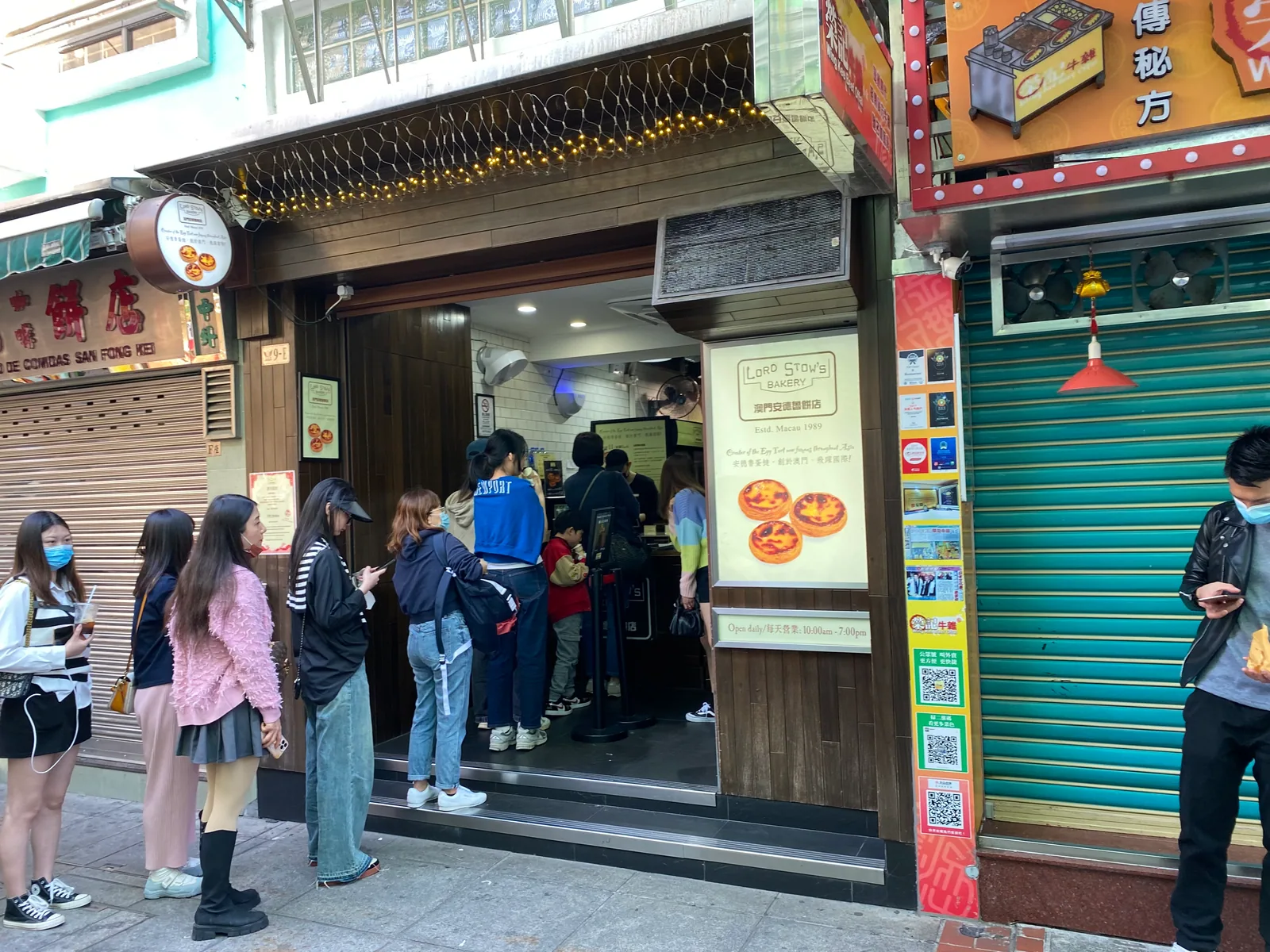
The storefront of Lord Stow's Bakery on Rua do Cunha, Taipa, Macao (February 2023). The Englishman Andrew Stow founded this shop in Coloane in 1989; after adapting the Portuguese recipe, it became the source of Taiwan's 1998 Portuguese egg tart craze. Photo: LN9267. CC BY-SA 4.0 via Wikimedia Commons.
The Egg Tart Shop Delayed by Fried Chicken
Before 1998, egg tarts were not on the menu at KFC Taiwan 5. To respond to the Portuguese egg tart craze, KFC introduced Margaret’s recipe. Ironically, while specialty shops across Taiwan were collapsing one after another, KFC unexpectedly absorbed all remaining market demand because of its standardized production and stable quality.
Around 2022, KFC staged a marketing campaign implying that egg tarts were about to be discontinued, triggering an outcry among consumers across Taiwan who worried that this classic product was about to disappear. In the end, it proved merely to be a publicity stunt for the launch of a new egg tart flavor. But it also once again confirmed the irreplaceable place of egg tarts in Taiwanese hearts: they had already changed from a “trend” into a “tradition” 6.
📝 Curator’s Note: When a brand is jokingly called “a delayed specialty shop,” it usually means that its achievement in a side business has already become a cultural symbol.
The Battle of Varieties: From Cookie Crusts to “Little Flower” Mille-Feuille Evolution
Taiwan’s egg tart market is not limited to the Portuguese style. Before Portuguese egg tarts arrived in Taiwan, the common variety was the “traditional egg tart,” with a firmer crust influenced by flour supplied under U.S. aid in the 1950s. This dessert has existed in Taiwan for half a century 7.
Portuguese Egg Tarts: Caramel Tiger Stripes and Laminated Puff Pastry
The most conspicuous feature of the Portuguese egg tart (Pastel de Nata) is the caramelized black spotting on its surface. This is not overbaking, but the Maillard reaction produced by sugars and cream in the filling under high heat, giving the tart its distinctive bitter-sweet layering 8.
In technique, Portuguese egg tarts use a “laminated puff pastry” process. During production, the dough is wrapped around butter, then repeatedly folded and chilled. It is finally rolled into a cylinder, sliced, and hand-pressed into molds. This method gives the bottom of the tart a spiral pattern, a substantial texture, and distinct layers, producing a clear “crack” when bitten 9.
Taiwanese and Hong Kong Egg Tarts: The Plainness of Pressed Shortcrust and Chinese Puff Pastry
Before Portuguese egg tarts became popular, the mainstream in Taiwan and Hong Kong was the smooth-crusted egg tart. These tarts are mainly divided into two schools:
- Pressed shortcrust (cookie crust): This is Taiwan’s most traditional “egg tart” method. The crust is made by mixing butter, flour, and eggs, without folding. Its texture falls somewhere between a tart shell and a cookie. The filling usually has a perfectly smooth, mirror-like surface, with a firm texture and rich milky aroma 10.
- Chinese puff pastry: Common in traditional cha chaan teng, or Hong Kong-style cafés. Unlike the Western puff pastry used in Portuguese egg tarts, Chinese puff pastry usually uses lard or vegetable oil and relies on the traditional reverse-folding method of wrapping oil dough inside water dough. Its layers are extremely flaky and shatter at a touch, emphasizing an elegant oil aroma rather than a rich buttery quality 11.
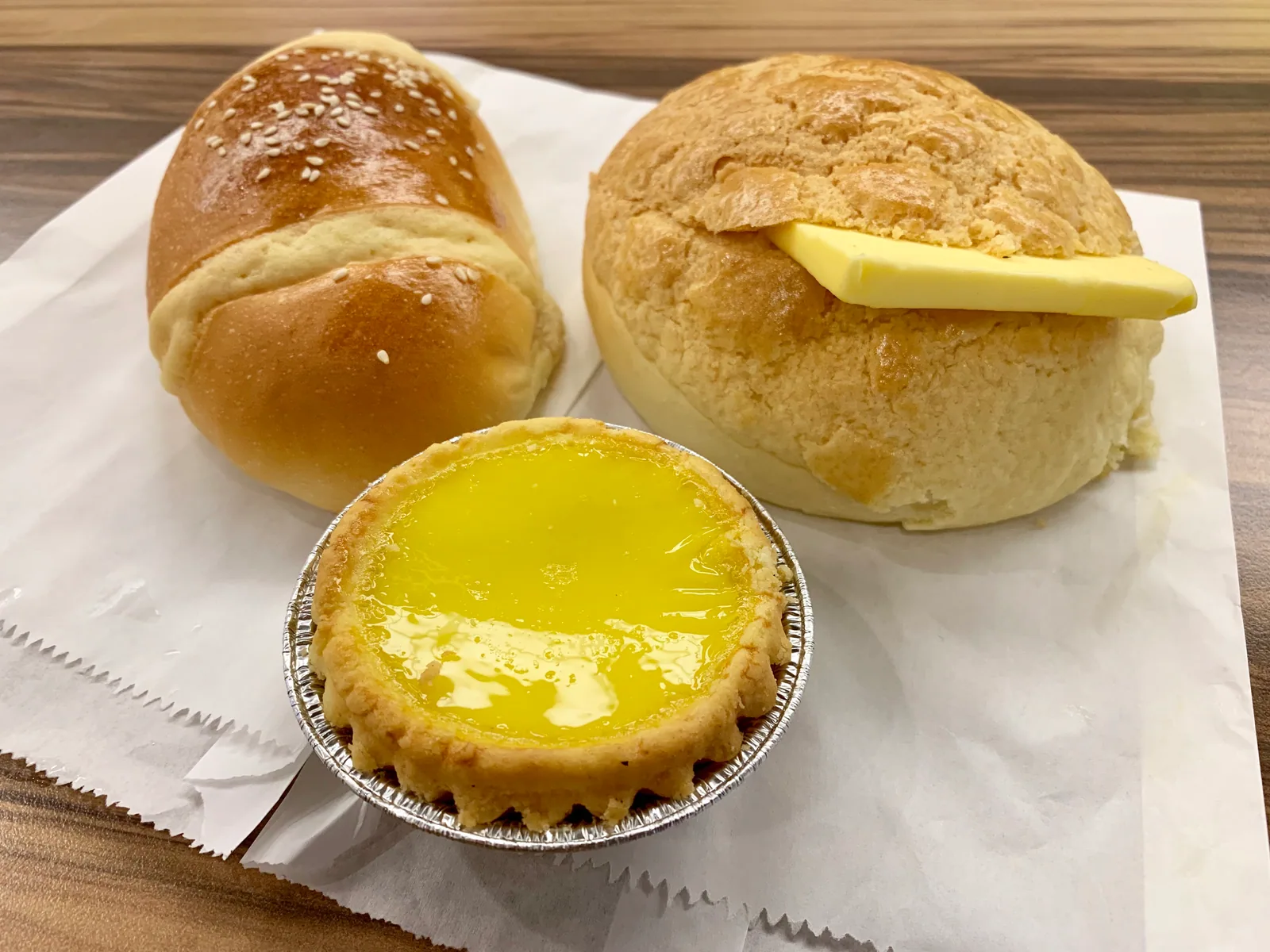
_Tai Cheong Bakery's signature egg tart (right) alongside Hong Kong-style pastries at the Banqiao branch in New Taipei City, photographed in 2019. Tai Cheong is a longstanding Hong Kong brand that also operates in Taiwan, illustrating the Hong Kong-style egg tart lineage on Taiwanese streets. Photo: bryan… (Flickr 91049143@N00). CC BY-SA 2.0 via Wikimedia Commons._
Mille-Feuille Egg Tarts: The 2024 Revival of Extreme Technique
In 2024, Taiwan saw another wave of enthusiasm for “mille-feuille egg tarts.” Visually, this egg tart presents an appealing radial “little flower” shape. Its greatest technical difference from the traditional Portuguese egg tart lies in hand-forming and molds.
Mille-feuille egg tarts usually use high-quality French butter, such as Montaigu butter, and Japanese flour, pursuing an extreme crispness. During production, the puff pastry is no longer rolled up and sliced; instead, the pressed multilayer pastry is directly fitted into specially made little-flower baking molds, allowing it to bloom like petals during baking 12. The filling often uses cream with a higher milk-fat content, such as Nakazawa cream, creating an almost pudding-like molten texture 13.
📝 Curator’s Note: From the “cookie base” of traditional egg tarts to the “petal puff pastry” of mille-feuille egg tarts, the evolutionary history of the egg tart is an arms race in Taiwanese pursuit of “crispness” and “milky aroma.”
Contemporary Lessons of the Egg Tart Effect
The “egg tart effect” continues to repeat itself in Taiwan today. From Ching Yu’s jade lemon tea and Fat Daddy fried chicken to the suancai fish, or pickled mustard-green fish, of recent years, the Taiwanese market has always followed a pattern of “explosive rise and collapse” 14. As the originator of this phenomenon, the egg tart has long since surpassed food itself in meaning. It reminds us that behind collective frenzy often lies an extreme craving for novelty, and a fear of losing one’s ticket to the latest trend.
Image Sources
This article uses 3 public-domain / CC-licensed images, all cached under public/article-images/food/ to avoid hotlinking source servers:
- Portuguese egg tart — Photo: ProjectManhattan, CC0 1.0 Public Domain
- Lord Stow's Bakery storefront in Macao — Photo: LN9267, 2023, CC BY-SA 4.0
- Tai Cheong Bakery Hong Kong-style egg tart at Banqiao, Taiwan — Photo: bryan… (Flickr), 2019, CC BY-SA 2.0
References
- 蛋塔效應 — Wikipedia: entry on the egg tart effect, explaining that the term originated from the queueing craze and rapid cooling that followed Portuguese egg tarts entering the Taiwanese market in 1998↩
- 烘焙故事丨春天,來個甜甜的蛋撻吧 — San Neng Group: see supplementary material in the original linked article↩
- 葡式蛋撻 — Wikipedia: records that Andrew Stow opened Lord Stow’s Bakery on Rua da Tassara in Coloane, Macao, in 1989, and adapted the recipe by abandoning custard powder, using cream, and reducing sugar↩
- 葡式蛋撻 — Wikipedia: records that after Andrew and his wife Margaret divorced in 1997, Margaret established her own business on the Macao Peninsula, after which the recipe entered KFC’s chain system; see also the English Wikipedia “Egg tart” entry: “In 1999, Wong sold the recipe to KFC”↩
- Egg tart — English Wikipedia: records that KFC introduced the recipe to Taiwan and other Asian markets after obtaining it through Margaret in 1999, consistent with the claim that KFC Taiwan did not sell egg tarts before 1998; the Facebook fan page “Tainan Style” also gives the same account, though it is unofficial UGC↩
- 你知道嗎?在1998年以前,台灣的肯德基還沒有賣蛋撻哦 — Tainan Style (Facebook fan page): recounts the historical context of KFC egg tarts in Taiwan; KFC’s 2022 marketing operation implying that egg tarts would be discontinued was a widely circulated online topic at the time, though the original official statement or report link has expired, so related discussion posts from the period are used here as evidence of consumer reaction↩
- 台灣在1950s美援麵粉輸入後的蛋塔技術 - Threads↩
- 梅納反應 — Wikipedia: explains that the Maillard reaction is the chemical reaction between amino acids and reducing sugars under high heat, and is the main mechanism that gives baked foods a golden to dark-brown surface color and complex flavor↩
- 葡式蛋撻 — Wikipedia: records the puff-pastry production technique of Portuguese egg tarts, including the technical feature of repeatedly folding butter; for the full method of laminated puff pastry, see also the same site’s “puff pastry” entry↩
- 港式經典蛋撻:中式酥皮VS 曲奇餅皮 - O'lala Baking Studio↩
- 傳統酥皮蛋撻|同葡撻分別在豬油⁉️ - YouTube↩
- 千層蛋塔跟酥皮蛋塔到底有什麼差別? - Liz Gourmet↩
- 酥皮千層蛋撻今天開始試賣 - Baret Bread Instagram↩
- 蛋塔效應 — Wikipedia: lists Ching Yu jade lemon tea, I-Mei thick milk tea, suancai fish, and other Taiwanese examples of the “egg tart effect”↩