
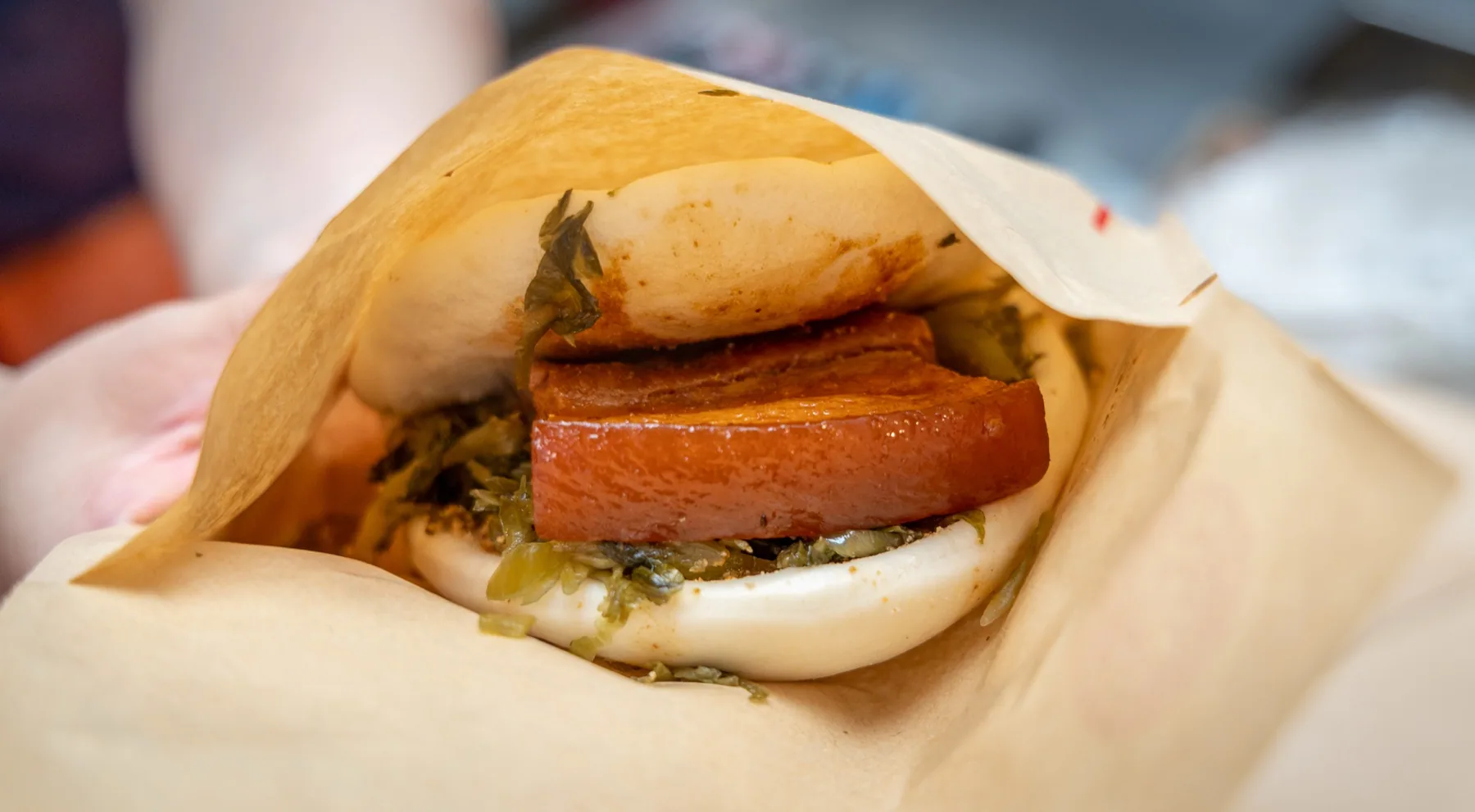
April 28, 2023, photographed by the Presidential Office at Yuan Fang Guabao on Huaxi Street, Wanhua, Taipei. Photo: Wang Yu-ching / Office of the President, Republic of China. License via Wikimedia Commons.
30-second overview: Gua bao (the Ministry of Education’s standard written form is 割包; Taiwanese Romanization kuah-pau) originated from Fuzhou, Fujian’s “lotus-leaf bun,” and in Taiwan is called “tiger bites pig”12. The 1927 diary of Hsinchu gentleman Huang Wang-cheng preserves a record of “eating tiger bites pig at weiya”3. Its ingredients became fixed as four essentials: braised pork belly, pickled mustard greens, peanut powder, and cilantro. The weiya banquet on the sixteenth day of the twelfth lunar month, when employers rewarded workers, is its deepest cultural anchor. Yuan Fang on Huaxi Street, founded in 1955, and Lan Jia in Gongguan, founded in 1992, became famous in succession; both have received Michelin Bib Gourmand recognition45. In 2013, Taipei-born Erchen Chang set up BAO, a six-seat hut in East London’s Netil Market. When its Soho shop opened in 2015, it was immediately singled out by veteran British food critics6. CNN and Michelin framed it as a “Taiwanese hamburger” and pushed it onto the world stage. The same folded wheat bun has traveled from a 1927 workers’ reward to the global table of 2026.
At six in the morning, the rolling metal door at No. 17-2 Huaxi Street has not yet been lifted.
Wu Huang-yi, already in his eighties, has reached Huannan Market to choose the day’s pork belly. He opened Yuan Fang Guabao in 1955, more than seventy years ago4. Each day begins by placing pork belly, sugar, soy sauce, and a traditional Chinese herbal spice packet into a large cauldron, then simmering it over low heat for more than an hour. Traditionally stir-fried pickled mustard greens can become dry and tough, difficult for elderly customers with poor teeth to chew. He instead cuts the mustard greens finely and braises them until soft, a method he worked out through his years as an apprentice on Huaxi Street4.
Nine thousand seven hundred kilometers away, on Lexington Street in London’s Soho, BAO’s wooden door is open. When the shop had just opened on April 8, 2015, veteran British food critics such as AA Gill and Giles Coren wrote several recommendations in succession, and the queue stretched from noon until late at night6. One of the founders, Erchen Chang, left Taipei for Britain at the age of fourteen. She later studied fine art at the Slade School of Fine Art, University College London. Her graduation work in 2012 was titled Rules to Be a Lonely Man; the BAO logo, a figure eating a bao with eyes half-closed, came out of that work78.
Two bosses in their eighties and a Taiwanese artist in her thirties, half a world apart, are working with the same plump white folded wheat bun. Its story can be traced back earliest to Fuzhou, Fujian’s “lotus-leaf bun”1. In a Taiwanese gentleman’s private diary it was called “tiger bites pig”; in CNN headlines it is the Taiwanese hamburger; in the Michelin Guide it is gua bao9.
A 1927 Diary by a Hsinchu Gentleman: The First Appearance of Tiger Bites Pig in Taiwanese Documents
“Today is the old-calendar weiya; instructions were passed down to make tiger bites pig as a reward for the workers.”
This sentence is said to come from the 1927 diary of Hsinchu gentleman Huang Wang-cheng3. Huang Wang-cheng was an important Taiwanese intellectual during the Japanese colonial period. His private diary was later edited and published by the Institute of Taiwan History, Academia Sinica10, and is a key source for studying Taiwanese society in the 1920s. This verbatim quotation is now widely circulated in non-official contexts; because the original diary scan is difficult to check online, citations should note that it is “quoted from popular circulation”3.
Its real significance lies here: by 1927, in central and northern Taiwan, “eating tiger bites pig at weiya” had already become a fixed ritual through which merchants rewarded workers, even drawing gentry households into the practice. Before this food entered a gentleman’s diary, it must already have circulated among ordinary people for decades.
Where did the name “tiger bites pig” come from? The Ministry of Education’s Dictionary of Frequently Used Taiwan Taigi is very direct in its definition: “a food made by placing fillings such as braised pork, pickled mustard greens, and peanut powder inside a specially made bun, whose two connected semicircular pieces form the shape of a tiger’s mouth”2. The folded wheat skin is seen as a tiger opening its mouth, while the braised pork belly in the middle is the pork held in its jaws. The name given to this wheat bun by Fuzhou migrants four hundred years ago is far more direct than CNN’s later “Taiwanese hamburger.”
The Ministry of Education’s standard written form is actually 割包, pronounced kuah-pau in Taiwanese Romanization. 刈 is a common folk variant because it also carries the meaning “to cut”111. 掛包 is another popular written form derived from the Taiwanese sound kuah. All three forms have their own basis. Today, shop signs often display all three characters side by side, while the Michelin Guide uses “Gua Bao” as the unified international label.
Did you know: In Mandarin Zhuyin, the pronunciation is actually ㄧˋ ㄅㄠ (yì bāo), not ㄍㄨㄚˋ ㄅㄠ. The latter comes from a Mandarinized reading of the Minnan/Taiwanese kuah-pau. Because so many people pronounce it this way, it has instead become the mainstream pronunciation11.
The Sixteenth Day of the Twelfth Lunar Month: Tudigong Weiya and Whom the Chicken Head Faces
Gua bao’s cultural anchor is not the night market; it is weiya.
“Doing ya” was a merchants’ sacrificial feast for Tudigong, the Earth God, held twice each lunar month, on the second and sixteenth days. The second day of the second lunar month was “touya,” the first ya; the sixteenth day of the twelfth lunar month was “weiya,” the final ya of the year12. After merchants worshiped Tudigong, the offerings were turned into a banquet to reward employees. Gua bao was the key snack at that banquet.
A proverb says, “After eating touya, one strokes the moustache; after eating weiya, one’s face is full of worry”13. The meaning is that after touya, one can still leisurely stroke one’s moustache and welcome the new year; after weiya, however, one may be worried, because the boss would decide at the weiya table whether to continue employing someone in the coming year. Whomever the head of the whole chicken on the table pointed toward was receiving the verdict. “If the employer wished to dismiss an employee, the chicken head would be pointed at that employee. Any employee indicated by the weiya chicken head was being told to seek other employment the next year”13. If the boss intended to retain everyone, the chicken head would be turned toward himself, or simply removed.
Within this tense ritual, gua bao played the role of consolation. The Ministry of Education dictionary’s “tiger bites pig” entry states clearly: “Among the people it is often eaten at weiya; because its shape resembles a wallet, it is hoped to bring financial fortune”2. Its auspicious meaning is layered at least three times.
First, its shape resembles a wallet; eating it is supposed to bring abundant wealth in the coming year.
Second, “tiger bites pig” is a homophone for “fortune bites and holds on,” keeping good fortune for the coming year14. The pickled mustard greens inside are also called “fortune greens” among Hakka people, adding a second rhyme.
The third layer is mentioned less often: “Because merchants, in the course of business dealings, often tell well-intentioned lies, eating gua bao represents merchants symbolically wrapping up the lies of the past year and eating them”15. If this interpretation is accurate, gua bao is even a kind of ritual atonement within commercial culture.
From Fuzhou Lotus-Leaf Bun to Taiwan’s Four Essentials: Peanut Powder Was Added in Taiwan
The wheat skin of gua bao is called a “lotus-leaf bun” or “lotus-leaf cake.” It is made by fermenting a medium-gluten wheat dough, rolling it flat, brushing it with oil, folding it, and steaming it16. Once steamed, the skin folds into a semicircle like a dried lotus leaf, which is also the source of its original name in Fuzhou. This method has been used in Fuzhou for at least several hundred years. After it reached Taiwan, however, the localization of its fillings followed another path.
Fujianese migrants brought this wheat bun across the Black Ditch, the dangerous Taiwan Strait, as early as the early Qing period. Fuzhou migrants gathered in northern Taiwan, around Keelung Harbor, Wanhua, and Dadaocheng, bringing their hometown’s wheat-based food culture with their luggage. Fuzhou “guangbing” became a signature food of Keelung night market; Fuzhou fish balls became representative of Keelung Miaokou; Fuzhou “lotus-leaf buns” evolved into Taiwanese gua bao. From the same Fuzhou migration chain branched three Taiwanese food lineages.
Taiwan Panorama interviewed Wanhua’s A-Song Guabao, whose owner said: “A-Song Guabao’s earliest form was similar to soup mo, served with meat sauce poured over it and eaten with meat. After it came to Taiwan, people here were not used to it. My grandfather revised it several times before adopting the method of sandwiching meat inside”17. In other words, Fuzhou’s “Fuzhou soup bun” was originally eaten with soup and wheat separately; only in Taiwan did it become a dry folded sandwich. It was easy to carry and suited workers who brought it to construction sites or ate it beside market stalls while working. This modification was directly related to ordinary life beyond the weiya table.
The four essential fillings, braised pork belly, pickled mustard greens, peanut powder, and cilantro, are likewise Taiwanese localizations. The Fuzhou original was comparatively plain; Taiwan’s addition of peanut powder was key: “The distinctive oil and aroma of peanuts can perfectly fuse with the fat of meat and carbohydrates such as wheat skin and glutinous rice”16. In Taiwan, gua bao without peanut powder would be considered “not fragrant enough,” while gua bao without cilantro would lack the fresh contrast that cuts through the richness.
The handling of pickled mustard greens further differs between north and south. Northern Taiwan often uses Minnan-style salty pickled mustard greens, made by salt-curing and fermenting mustard greens. In central and southern Taiwan and in Hakka villages, “fucai” is more common: pickled mustard greens that have undergone an additional process of sun-drying and sealing, with deeper salinity and a thicker aroma. Hakka food researchers have long pointed out that the status of fucai in Hakka villages is equivalent to sea salt in Japanese cuisine: so foundational that it often goes unnoticed. Whether gua bao is filled with pickled mustard greens or fucai is a taste code that distinguishes north from south and different ancestral communities.
Curatorial view: Both guangbing and gua bao are wheat foods brought by Fujianese migrants, yet guangbing became military rations while gua bao became a weiya snack. What accounts for the difference? Gua bao can hold fillings, match vegetables, and freely adjust the balance between sweet and salty. As a “framework,” it has far greater carrying capacity than a hard biscuit. This structural flexibility is also the key reason BAO London could later create more than a dozen variants in London: the same lotus-leaf bun shell can hold old-style Taiwanese flavors, British fried chicken, or Kyoto miso pork.
Huaxi Street and Gongguan: Two Michelin Bib Gourmand Choices
Taipei has at least four famous gua bao shops, belonging to different eras and different paths of modification.
Yuan Fang Guabao (No. 17-2 Huaxi Street) opened in 1955. Its owner, Wu Huang-yi, still personally tends the shop in his eighties, and it received Michelin Bib Gourmand recognition for five consecutive years, from 2020 to 20244. Its distinctive feature is “softness”: the mustard greens are simmered until fine and tender, and the meat is braised until it falls apart without requiring much chewing, caring for the teeth of Huaxi Street’s elderly local residents and tourists.
Lan Jia Guabao (Roosevelt Road, Gongguan) opened only in 1992, thirty-seven years later than Yuan Fang5. In an interview, owner Lan Feng-rong said: “Every year at weiya (the sixteenth day of the twelfth lunar month), my mother would make gua bao, and relatives and friends all praised it after eating it. When I started my business, I used my mother’s gua bao as the starting point”18. CNN Travel described Lan Jia as “the most popular gua bao place in Taiwan, selling more than 3,000 a day”9. Lan Jia’s own reported sales range is “two thousand, even three thousand”18, matching CNN’s figure. Lan Jia’s most distinctive feature is that customers can choose the fat-to-lean ratio: mixed, lean, fatty, more lean, or more fatty. This option is rare in traditional gua bao shops9.
Guabao Ji (Wuzhou Street, Wanhua) is run by Liao Rong-ji, born in 1940, who switched careers to sell gua bao in 197419. Since 1987, every Lunar New Year’s Eve eve, he has paid out of pocket to invite unhoused people to eat boxed meals, continuing the tradition for nearly forty years. Most people who eat gua bao on this Wanhua street know this story about him.
Chunlan Guabao (Xinxing District, Kaohsiung) opened in 2000 and received Michelin Bib Gourmand recognition in both 2024 and 202520. Its signature is a “braised pork gua bao bigger than a fist.” Michelin-level gua bao shops now exist at both Taiwan’s northern and southern ends, symbolizing this snack’s island-wide circulation.
Even convenience stores have caught the trend. In 2019, 7-Eleven launched a “sausage gua bao” and a “charcoal-grilled pork bun,” which “each sold more than 200,000 per month during regional test sales at the end of April”21. From a ritual food on the weiya table to a quick meal on the convenience-store microwave shelf, gua bao has already penetrated every level of Taiwan’s food-service system.
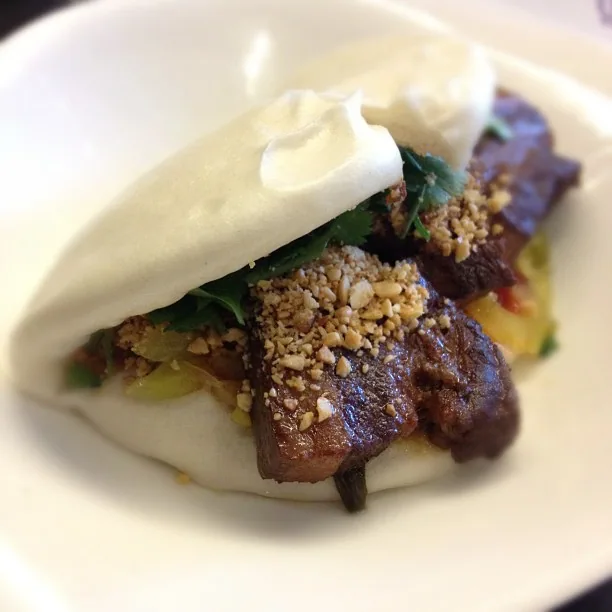
The folded wheat-skin structure of gua bao: a lotus-leaf-like outer skin holding the four essentials of braised pork belly, pickled mustard greens, peanut powder, and cilantro. Photo: LeoAlmighty. License via Wikimedia Commons.
David Chang’s Peking Duck Bun and Eddie Huang’s Pushback
Gua bao’s transformation into an international symbol actually took a winding path.
In 2004, Korean American chef David Chang opened Momofuku Noodle Bar in New York’s East Village. One of the shop’s signature items was the pork bun: folded wheat skin wrapped around pork belly, cucumber, and scallions. In 2009, NPR later reported this pork bun as an “unexpected hit”22, and “Asian fusion restaurants” across the United States began imitating it.
But David Chang himself never said that this dish was modeled on gua bao. His public version was: the inspiration for the pork bun came from Peking duck buns in Chinese restaurants. It was essentially a variation on roast duck23. In 2021, Resy published an in-depth report that stated this more clearly: “Chang has been candid about his ignorance of gua bao when he created his pork buns…the likeness to gua bao was purely accidental”23. He did not know gua bao when he made it; the resemblance was coincidence.
This account angered many second-generation Taiwanese Americans. In December 2009, second-generation Taiwanese American chef Eddie Huang, whose parents had emigrated from Taiwan to Virginia, opened BaoHaus on New York’s Lower East Side, making Taiwanese gua bao its signature24. Eddie Huang later publicly criticized Chang’s pork bun as “a bastardized version of gua bao”23. This debate over identity politics continued for several years, eventually leading media outlets such as CNN and Resy to confront a fact: that folded wheat bun was Taiwanese food, even if the New York chef circles that popularized it did not know that at all.
BaoHaus closed in October 2020, but Eddie Huang did not leave the field. In March 2026, he reopened a new version called The Flower Shop in the East Village25. Huang also wrote the memoir Fresh Off the Boat, later adapted by ABC into a sitcom of the same name, which premiered in 2015 and ran until 2020. The identity politics of second-generation Taiwanese Americans, the Taiwanese nostalgia of immigrant parents, the daily life of a small Lower East Side shop: he wrote gua bao onto the North American mainstream television screen. For many American viewers who had never been to Taiwan, the “Taiwanese hamburger” label for this folded wheat bun came from that sitcom, not from a food book. Eddie Huang’s role in this process was to push gua bao from a dish into an identity symbol.
Lexington Street in London’s Soho: From a Six-Seat Wooden Hut to Michelin Bib Gourmand
One day in 2013, a six-seat wooden hut appeared in East London’s Netil Market.
The stall was run by three young people who had just graduated from the Slade School of Fine Art, University College London: Erchen Chang from Taipei, Shing Tat Chung, and Wai Ting Chung. Their menu had only four items, all centered on the same folded wheat bun. “They basically helped shape how we eat bao in London” later became the standard description of the shop in British food media26.
Erchen Chang left Taipei for Britain at the age of fourteen. Her final exhibition when she graduated from the Slade fine art program in 2012 was Rules to Be a Lonely Man, a performance-art installation about the rules by which a lonely man eats7. The small figure in BAO’s logo, eating bao with eyes half-closed, emerged from that graduation work8. An artist turned her graduation piece into a restaurant brand.
The menu at the Netil Market hut had only four items. The first-generation signature Classic Bao used red-braised pork belly with Taiwanese pickled mustard greens and peanut powder, almost a British translation of Yuan Fang on Huaxi Street. Later they added variants such as Confit Pork Bao, Fried Chicken Bao, and Lamb Shoulder Bao, but each one still retained the three-layer structure of folded wheat skin, sweet-and-sour sauce, and nutty aroma. At first, London’s food critics were not used to the way of “sandwiching meat inside folded wheat food,” but after AA Gill wrote the shop’s first review in the Sunday Times, the entire stretch of Lexington Street was filled with visitors in the spring and summer of 2015.
Contested view: After Erchen Chang became famous in London, Taiwanese media generally called her “the pride of Taiwan.” But she left Taiwan at fourteen, and BAO’s menu has undergone extensive London localization, including the British fried-chicken filling in its Fried Chicken Bao. “Taiwanese flavor” in her hands is a curatorial choice, not a reproduction. Her achievement deserves recognition, but calling her “a spokesperson for Taiwanese tradition” may simplify the cross-cultural context of her creation.
On April 8, 2015, BAO opened its first brick-and-mortar shop on Lexington Street in Soho6. Veteran British food critics such as AA Gill and Giles Coren wrote several recommendations in succession, and the line stretched from noon until deep into the night. The Soho shop has now received Michelin Bib Gourmand recognition for nine consecutive years8.
By 2026, BAO already has seven branches in London: Soho, Marylebone (Xiao Chi House), Borough (Grill House), King’s Cross, City (Bao Eatery), Shoreditch, and Battersea (Noodle Shop)8. In 2022, the three founders coauthored BAO: The Cookbook, published by Phaidon, organizing the shop’s family recipes27. In 2023, BAO held its first Asian pop-up, choosing A STAND by Foodie Amber in Taipei to mark its tenth anniversary28.
From the private diary of a Hsinchu gentleman to Lexington Street in London’s Soho, gua bao took nearly one hundred years.
The Synchrony Between London’s Queue and Huaxi Street at Dawn
At six in the morning, Wu Huang-yi finishes choosing the day’s pork belly at Huannan Market and rides his scooter back to Huaxi Street. Outside Yuan Fang, whose metal door has not yet been lifted, two regulars are already waiting.
At that same moment, London time is eleven at night. The last round of diners has just left BAO Soho on Lexington Street. Dishwater steam drifts from the kitchen’s back door, and the sound of the wooden door closing is much like the sound of Huaxi Street’s metal door opening.
Seventy years ago, Wu Huang-yi learned as an apprentice on Huaxi Street to cook mustard greens until soft because he needed to care for older customers who could not chew well. Nine years ago, Erchen Chang turned a folded wheat bun into something London food critics would recommend because she believed an artist could use a bao to create a curatorial act.
The distance between these two gestures is a weiya table on the sixteenth day of the twelfth lunar month and a private diary from 1927.
In 2023, BAO held its first Asian pop-up, choosing A STAND by Foodie Amber in Taipei to mark its tenth anniversary28. Erchen Chang has said that her childhood memories of growing up in Taipei are of steam rising from night-market stalls and the pickled mustard greens and peanut powder on her mother’s table. From that year’s weiya to this year’s Taipei pop-up, gua bao circled for nearly a century and returned to the island where it first began circulating.
To eat a gua bao is to eat four centuries of Fuzhou migrant sea routes, one century of labor-management ritual, and twenty years of global symbol-making. The next time someone queues on Huaxi Street, in Gongguan, or on Lexington Street in London, the folded wheat bun in their hand is the same food as the tiger bites pig in Huang Wang-cheng’s 1927 diary.
Further Reading
- Taiwanese Snacks — The wider ecology of street snacks, within which gua bao is a key lineage
- Night Market Culture — The history of gua bao’s movement out of the weiya setting and into the night market
- Taiwanese Bando Banquet Culture — The ritual logic of weiya and bando banquets, chicken-head direction, and tiger bites pig
- Taiwanese Rice Food Culture — Gua bao’s wheat-food lineage and Taiwan’s dual rice-and-wheat dietary structure
- Taiwanese Popcorn Chicken — Another popular snack that traveled from Taiwan into CNN’s international frame
Image Sources
This article uses two CC-licensed images, all cached in public/article-images/food/ to avoid hotlinking source servers:
- Gua-bao by the Yuan Fang Guabao at Huaxi Street 2023-04-28 — Photo: Wang Yu-ching / Office of the President, Republic of China, 2023-04-28, CC BY 2.0, Commons File:Gua-bao_by_the_Yuan_Fang_Guabao_at_Huaxi_Street_2023-04-28_01.jpg
- Steamed Sandwich, taken by LeoAlmighty — Photo: LeoAlmighty (Leo Chen), CC BY 2.0, Commons File:Steamed_Sandwich,taken_by_LeoAlmighty.jpg
References
- Wikipedia entry “Gua bao” — A general entry compiling gua bao’s Fuzhou origins, the Ministry of Education’s standard written form 割包, the four essential fillings, Taiwan’s localization process, and its international development; licensed under CC BY-SA 4.0.↩
- Ministry of Education Dictionary of Frequently Used Taiwan Taigi entry “tiger bites pig” — Official government dictionary definition, listing the Taiwanese Romanization hóo-kā-ti / hóo-kā-tu, the source of the shape, the custom of eating it at weiya, and the auspicious meaning of “resembling a wallet.”↩
- Taiwan Flavor “Gua Bao: The Taste on the Weiya Table” — Tourism Bureau promotional material citing the 1927 Hsinchu gentleman Huang Wang-cheng diary record of “eating tiger bites pig at weiya,” the earliest Taiwanese documentary record of this food. Another verbatim version appears on the Hi-To classroom blog. The original file is currently in the published diary series of Academia Sinica’s Institute of Taiwan History, with no online full text available for comparison.↩
- Lord Cat “Yuan Fang Guabao: A Seventy-Year-Old Huaxi Street Shop” — A detailed history of Yuan Fang Guabao on Huaxi Street, Wanhua, recording owner Wu Huang-yi’s 1955 founding, his continued personal presence in the shop in his eighties, five consecutive years of Michelin Bib Gourmand recognition, and a production process that includes early-morning shopping at Huannan Market and a Chinese herbal spice packet for braising meat.↩
- Lan Jia Guabao official Instagram — The official social-media account of Gongguan’s Lan Jia Guabao, confirming its 1992 founding date. The widely circulated online claim that it was founded in 1971 is a mistaken transmission.↩
- Picky Glutton “BAO London Review (Soho)” (2015-04-20) — A London food-review blog recording BAO Soho’s April 8, 2015 opening date, its Lexington Street address, and the first wave of reviews by veteran British food critics such as AA Gill and Giles Coren.↩
- Apollo Magazine “Bao restaurants, Slade art school and a cookery book” — A British art magazine interview with BAO founder Erchen Chang, introducing her departure from Taipei for Britain at age fourteen, her 2012 graduation from the Slade School of Fine Art, University College London, and the relationship between her graduation work Rules to Be a Lonely Man and BAO’s brand logo.↩
- BAO London official website “Our Story” — First-hand official information from the BAO restaurant group, listing the 2013 Netil Market beginning, 2015 Soho opening, the current seven branches (Soho, Marylebone, Borough, King’s Cross, City, Shoreditch, Battersea), and Soho’s nine consecutive years of Michelin Bib Gourmand recognition.↩
- CNN Travel “Gua bao: Taiwan's 'hamburger' is taking over the world” — A CNN Travel feature using the “Taiwanese hamburger” frame, recording Lan Jia Guabao as “the most popular gua bao place in Taiwan, selling more than 3,000 a day” and noting its five fat-to-lean ratio options.↩
- Institute of Taiwan History, Academia Sinica publication information for “The Diary of Mr. Huang Wang-cheng” — The Huang Wang-cheng diary series edited and published by Academia Sinica’s Institute of Taiwan History (1912-1973, 25 volumes total), with volume 14 covering parts of 1927. It is a key source for studying gentry society in Taiwan under Japanese rule.↩
- Storm Media “Gua Bao or Gua Bao? A Study of Three Written Forms” — Organizes the origins and differences in folk usage among the three written forms: 割包 (the Ministry of Education’s standard form), 刈包 (a literary written form, with 刈 meaning “to cut”), and 掛包 (a transliteration of Taiwanese kuah).↩
- Wikipedia entry “Zuoya” — Organizes the Tudigong ya sacrificial-feast system, held on the second and sixteenth days of each lunar month; the second day of the second month is touya, and the sixteenth day of the twelfth month is weiya. It records two origin accounts: “maya” and “fortune deity.”↩
- Faith Hope Love Information Center “The Origin of Weiya: Not Afraid of the Chicken Head Pointing at Me” — Organizes the historical context of the weiya tradition in which the direction of the chicken head signaled dismissal, as well as the proverb “After eating touya, one strokes the moustache; after eating weiya, one’s face is full of worry.” It is a commonly used reference for research on Taiwanese labor-management ritual.↩
- Global Views Monthly “The Auspicious Meanings of Gua Bao” — Explains the dual auspicious meanings of gua bao’s wallet-like shape and the homophone between “tiger bites pig” and “fortune bites and holds on,” as well as the rhyme produced by the pickled mustard greens inside being called “fortune greens” in Hakka culture.↩
- Storm Media “The Third Layer of Meaning in Eating Gua Bao at Weiya” — Proposes a third interpretation of eating gua bao at weiya: “Because merchants, in the course of business dealings, often tell well-intentioned lies, eating gua bao represents merchants symbolically wrapping up the lies of the past year and eating them.” This account is currently from a single source.↩
- Every Little D “The Wheat Skin of Gua Bao and the Localization of Peanut Powder” — Food-culture media reporting that explains the process for gua bao’s “lotus-leaf bun” skin, made by fermenting medium-gluten wheat dough, rolling it flat, brushing it with oil, folding it, and steaming it, as well as the aroma chemistry behind peanut powder as a key Taiwanese localized ingredient.↩
- Taiwan Panorama “A Street Flavor Bouncing onto the International Stage: Taiwanese Snacks—Gua Bao” — An in-depth report by the Ministry of Foreign Affairs’ Taiwan Panorama, interviewing the owner of Wanhua’s A-Song Guabao and recording the modification process from Fuzhou soup bun to Taiwan’s dry-style gua bao, while integrating the 1927 diary, localization path, and BAO London’s international development.↩
- ETtoday Travel “Bib Gourmand Recommendation: Lan Jia Guabao Comes from a Mother’s Taste” — Interview with Lan Jia Guabao owner Lan Feng-rong, recording the origin in his mother’s weiya recipe, the sales range from “a few dozen a day” to “two thousand, even three thousand a day,” and the founding story.↩
- Lord Cat “Guabao Ji: Wanhua’s Tradition of Boxed Meals for Unhoused People” — A detailed introduction to Guabao Ji on Wuzhou Street, Wanhua, recording owner Liao Rong-ji’s birth in 1940, his 1974 career change to selling gua bao, and his tradition since 1987 of paying out of pocket every Lunar New Year’s Eve eve to treat unhoused people to boxed meals, part of Wanhua’s local memory.↩
- Evan Travel “Chunlan Guabao: Kaohsiung’s Two Consecutive Years of Michelin Bib Gourmand” — Introduction to Chunlan Guabao in Kaohsiung’s Xinxing District, recording its 2000 founding and 2024 and 2025 Michelin Bib Gourmand recommendations, with its signature “braised pork gua bao bigger than a fist,” representing gua bao in southern Taiwan.↩
- ETtoday “7-Eleven Sausage Gua Bao Sells 200,000 Per Month” — Reports that 7-Eleven launched a NT$55 “sausage gua bao” and a NT$35 “charcoal-grilled pork bun” in 2019, and that “during regional test sales at the end of April, each sold more than 200,000 per month,” a key moment in gua bao’s entry into convenience-store channels.↩
- NPR “David Chang's Pork Buns: An Unexpected Hit” (2009) — National Public Radio’s interview with David Chang, recording how Momofuku Noodle Bar’s pork bun turned from an accidental experiment when the shop opened in 2004 into a signature item.↩
- Resy “Pork Buns Have Become an American Favorite. Why Can't We Acknowledge They're Taiwanese?” (2021-01) — An in-depth Resy report organizing David Chang’s own acknowledgement that “the likeness to gua bao was purely accidental” and that it did not derive from gua bao, Eddie Huang’s criticism of it as a “bastardized version of gua bao,” and the evolution of gua bao identity politics in the American restaurant world.↩
- Wikipedia “Eddie Huang” — Wikipedia entry on Eddie Huang, recording his second-generation Taiwanese American identity, his parents’ migration from Taiwan to Virginia, his December 2009 opening of BaoHaus on New York’s Lower East Side with Taiwanese gua bao as its signature, and his later career as the author of Fresh Off the Boat and a food-culture commentator.↩
- Resy “Eddie Huang at The Flower Shop” (2026-03) — Resy report on Eddie Huang’s March 2026 reopening of a new version, The Flower Shop, in the East Village, continuing BaoHaus’s Taiwanese gua bao tradition and identity-politics discourse.↩
- Grubstance “BAO Netil Market: trust me, I don't get money…” (2021-06) — London food-review blog looking back on BAO’s 2013 Netil Market period and its six-seat wooden hut: “With this snug 6-seat wooden shack with no more than four items on the menu, they basically helped shape how we eat bao in London.”↩
- Phaidon “BAO: The Cookbook” (2022) — Official Phaidon page for the cookbook coauthored by BAO’s three founders, Erchen Chang, Shing Tat Chung, and Wai Ting Chung; ISBN 978-1838666200. It organizes BAO’s family recipes from ten years of development in London.↩
- Wow La Vie “BAO London 2023 Taipei Pop-Up Interview” — Interview with the BAO founding team, recording BAO’s first Asian pop-up in 2023, held at A STAND by Foodie Amber in Taipei to mark its tenth anniversary, and founder Erchen Chang’s comments on her Taipei childhood and founding intentions.↩