Cinavu: The Paiwan Leaf-Wrapped Millet and the jiasuanjiang Leaves Meant to be Eaten
30-Second Overview: Cinavu (also written as jinafu) is a leaf-wrapped food of the Paiwan people: marinated pork wrapped in millet or taro powder, first encased in a layer of jiasuanjiang leaves, then wrapped in an outer layer of shell ginger leaves or older leaves, tied tightly, and steamed or boiled. Food records from Taitung state that the Rukai people call this same type of food abai; however, whether one uses whole grains or powder, which leaves are used, and how different names are categorized varies across Pingtung and Taitung, as well as among different tribes and families. Traditionally served during full moons, weddings, millet harvest festivals, and banquets, it can now be found at tribal markets and urban Indigenous stalls. What outsiders most often miss is the layer of jiasuanjiang leaves: because they are pressed against the rice, they must be eaten along with the millet.
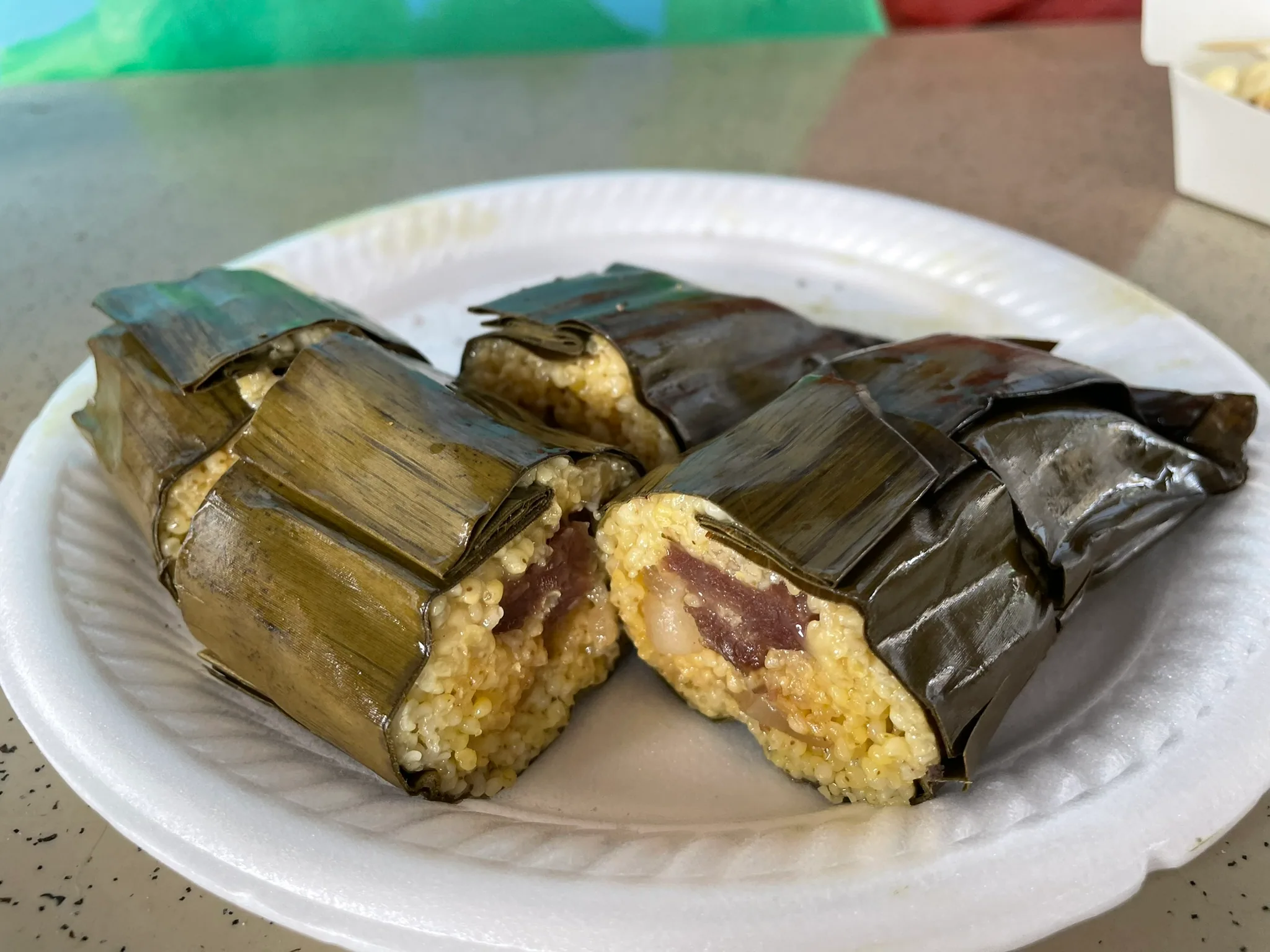
Cinavu from the Beiye tribe in Pingtung, showing the millet, pork, and the leaves wrapping the rice after being cut open. Photo: Sin-siōng, 2024, CC BY-SA 4.0 via Wikimedia Commons.
In March 2019, Paiwan music teacher Camake Valaule brought his founded children's choir, the Taiwu Ancient Ballads Troupe, to the WOMADelaide music festival in Adelaide, Australia12. The choir was featured in the festival's "Taste the World" program, leaving behind a recipe with a single-word title: CINAVU3.
The recipe was for eight to ten servings. The ingredient list ran from millet and glutinous rice to pork and shiitake mushrooms; the penultimate line read "24 jiasuanjiang leaves," and the final line was "12 shell ginger leaves"3. While shell ginger was translated into English, jiasuanjiang was written directly in Hanyu Pinyin.
The recipe's method is as follows: lay shell ginger leaves on a plate, stack jiasuanjiang leaves on top, spread a layer of millet, add pork, and cover with another layer of millet. Next, wrap it first with the jiasuanjiang leaves, then pull the bottom shell ginger leaves up to form a second layer, tie it with cotton string, submerge it in water, and boil on high heat for one hour3. Each of the two leaf layers has a specific function: the shell ginger leaves wrap the outside, while the jiasuanjiang leaves remain inside against the rice and should not be peeled off when opening4.
The name, preparation, and occasions for cinavu vary by tribe and family; outsiders often refer to it collectively as "Indigenous zongzi" (sticky rice dumplings). Following the habit of eating zongzi, people often peel away the shell ginger leaves and easily strip off the inner jiasuanjiang layer along with the wrapping; food chroniclers in Taitung have cautioned, "Don't be in a hurry to tear the leaves off"4. That layer must be eaten together with the millet—this is where it differs from zongzi.
The Inner Layer of Leaves Must Be Eaten
The jiasuanjiang used by Taiwan's Indigenous peoples to wrap cinavu, also known as biguocao, has the scientific name Trichodesma calycosum (the Ministry of Agriculture's Q&A page uses its synonym T. khasianum), is a perennial shrub in the Boraginaceae family that can grow two to three meters tall, found in the plains and mountains of Taiwan's mid-to-low altitudes56. The Ministry of Agriculture notes that during Indigenous festivals, its leaves are used to wrap steamed pastries, which are eaten along with the leaves; the leaves contain high amounts of plant fiber and carry a light fragrance5.
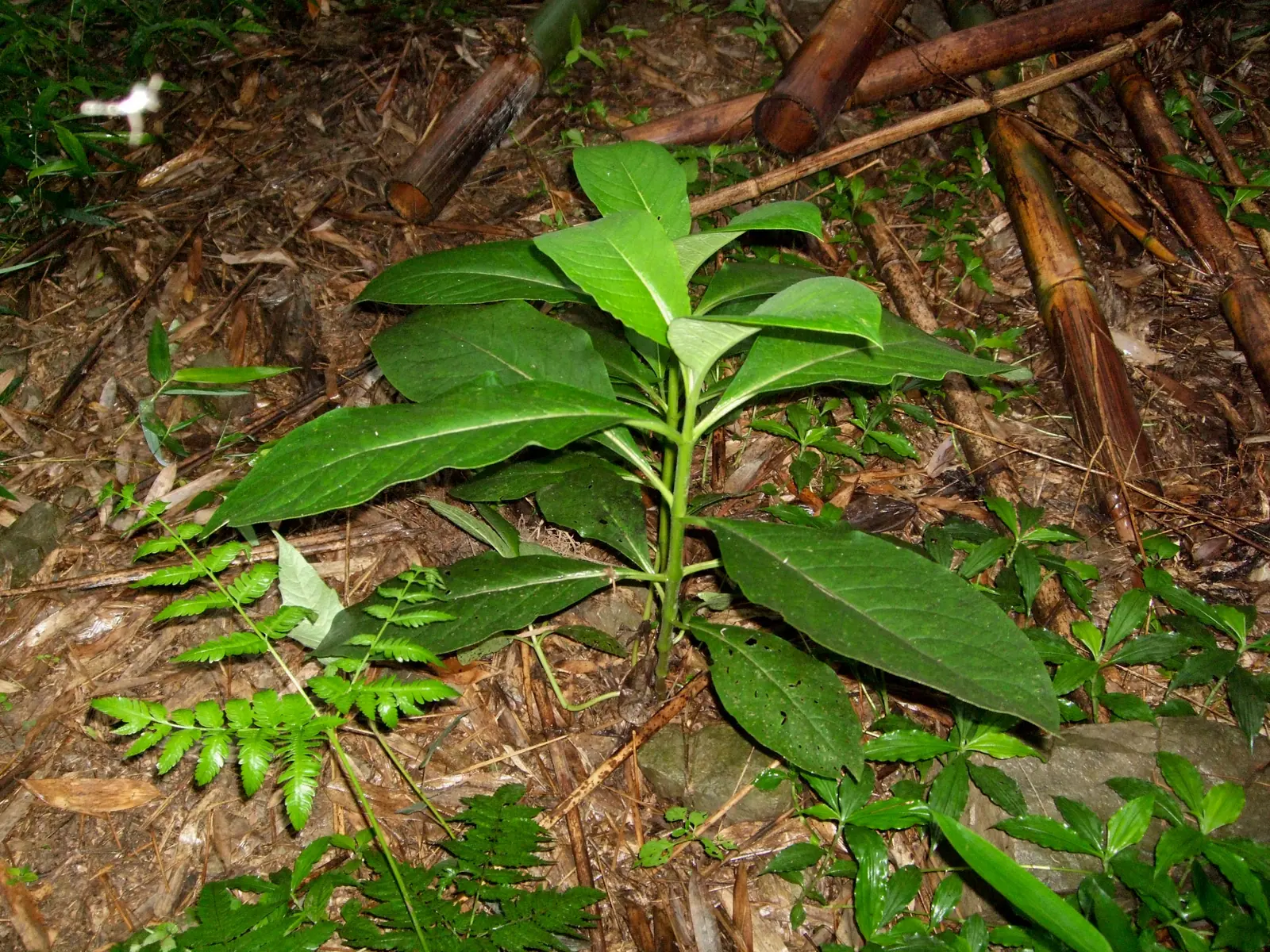
Jiasuanjiang (biguocao). The Paiwan people collect its tender leaves to wrap millet; it is eaten along with the leaves after steaming. Photo: Shihchuan Ishikawa, 2010, CC BY-SA 2.0 via Wikimedia Commons.
In the 65th Pingtung County Science Fair, a group of Paiwan elementary school students documented this in great detail. Their findings showed that the leaves used to wrap cinavu are divided into two layers: an inner layer of edible tender leaves and an outer layer of older leaves used for stability to prevent splitting during steaming7. The primary inner leaf is jiasuanjiang, allowing one to "consume the tender jiasuanjiang leaves while eating," though some tribes use leaves from the kè-lán (clans) tree as the edible inner layer. The outer layer varies by tribe and can be older jiasuanjiang leaves, thicker/older kè-lán leaves, or shell ginger; some also use wǔjiémáng (five-knot grass) or tung leaves, finally tied tightly with cogon grass stems, cotton string, or shredded shell ginger sheaths7. Even when using kè-lán leaves, some tribes eat them pressed against the rice, while others use them only for the outer wrap.
The students asked their tribe's vuvu (elders) to take them leaf-gathering and inquired about pairings. The elders told them that kè-lán leaves are typically used for millet but not taro, as they pair better with millet; jiasuanjiang, however, can wrap both millet and taro7. Which leaf is pressed against which type of grain is a flavor profile accumulated by each tribe over generations.
The Ministry of Agriculture also warns that identifying leaves is a matter of safety: since jiasuanjiang is mostly wild-harvested, those unfamiliar with the plant occasionally mistake it for toxic Datura and suffer poisoning5. Huang Chun-ming, a cultural worker from the Binmao tribe in Jinfeng Township, Taitung, noted that jiasuanjiang looks very similar to Datura, and one must distinguish them by the color of the stems. He also mentioned that in earlier years, hunters heading into the mountains would carry cinavu wrapped in jiasuanjiang leaves, which wouldn't spoil for an entire day8.
💡 Did You Know?
English introductions sometimes mistranslate this leaf. There is also a plant in mainland China called "jiasuanjiang," which is a Solanaceae plant native to Peru, known in Taiwan as dàběn pàozi cǎo9, with the English common name apple-of-Peru10. One English travelogue about the Tuban tribe in Taitung even wrote the Paiwan word ljavilu as "apple of Peru leaf"11. These are merely homonyms in Chinese; the plant used by the Paiwan in cinavu is the Boraginaceae biguocao, known in English as Khasya trichodesma5.
Under the Leaves: Millet Grains, Millet Dough, or Taro Powder?
Cinavu is a Paiwan word. "Discovering Taitung Slow Food," a publication specializing in Taitung cuisine, states that in Rukai, the same type of leaf-wrapped food is called abai; in Taitung, these two names refer to the same thing: millet or glutinous rice wrapping tender marinated pork, encased in a layer of jiasuanjiang leaves and then wrapped entirely in shell ginger leaves for steaming, mostly in rectangular shapes4.
Once you cross the Central Mountain Range into Pingtung, the terms diverge. According to the same article, in Pingtung tribes, abai uses pounded millet or glutinous rice powder, resulting in a sticky texture, while cinavu uses whole millet grains that can be bitten individually4. The JIBAO educational database also makes this distinction when organizing Paiwan cuisine: cinavu is wrapped with millet grains, while avai is made with millet powder and water; both are listed under Paiwan foods12.
In a 2020 interview with FoodNEXT, the Paiwan singer A Bao (A-pao) held up two tribal foods; the magazine provided another version in its introduction: abai is a grain-wrapped meat ball, while cinavu is a long strip made of taro powder and jiasuanjiang leaves13. The Pingtung elementary students also noted that cinavu fillings come in two types—millet and taro—with the taro version using ragrag, a powder made from dried taro7. An English blogger recorded a journey to the Tuban tribe in Taitung, where they ate two types of cinavu for lunch: one millet and one taro powder11.
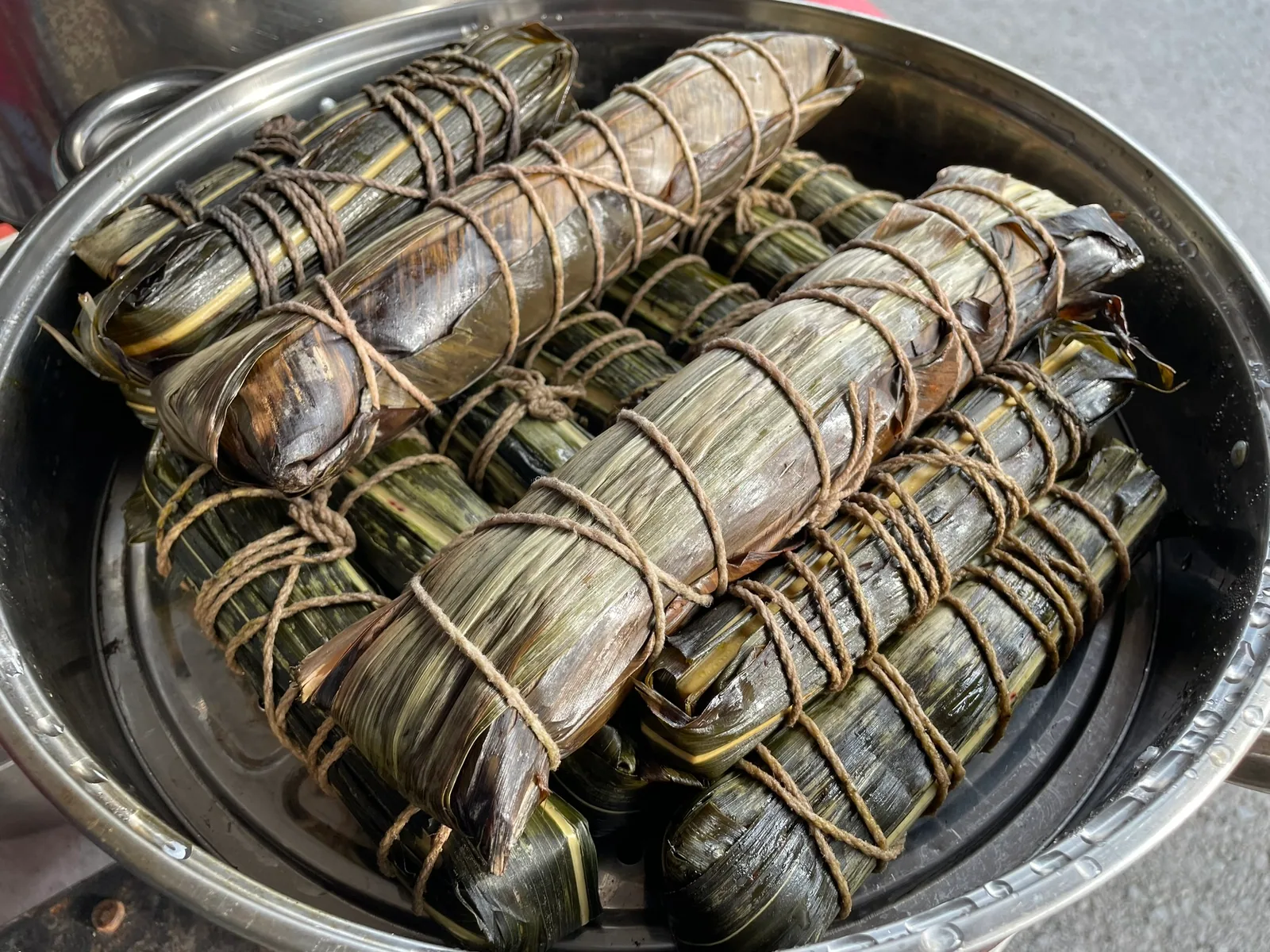
Tied cinavu in a steamer. Every tribe and family has its own way of choosing which grain and which leaf to use. Photo: Sin-siōng, 2024, CC BY-SA 4.0 via Wikimedia Commons.
"Discovering Taitung Slow Food" also recorded a type called qavay, which looks almost identical but tastes different; in Paiwan, it means "millet cake." Millet is soaked for one or two days, fermented, drained, and pounded into a dough. A layer of jiasuanjiang leaves is spread on shell ginger leaves, the millet dough is pressed flat over the filling, and it is steamed4. The Laolao tribe in Taimali, Taitung, nicknames it doremi because the fermented millet dough is so sticky that one must press it down with finger-tapping motions, like playing a piano. "Discovering Taitung Slow Food" wrote: "The fermented aroma is very intense; once the tribespeople smell it, they know their family from out of town is coming home to reunite"4. The spellings qavay, avai, and avay are similar; when PTS reported on the Binmao tribe in Taitung in 2024, they wrote the leaf-wrapped food there as "abai avay"8.
| Name | Variations from various sources | Common Base |
|---|---|---|
| cinavu (奇拿富) | Paiwan word; Taitung Slow Food says it's the same as abai in Taitung, but refers to whole grains in Pingtung | Whole millet, glutinous rice, or taro powder |
| abai / avai (阿粨) | Rukai word (Taitung Slow Food); listed as avai by JIBAO | In Pingtung, often refers to dough made of millet or glutinous rice powder |
| qavay (小米糕) | Taitung Slow Food says it's Paiwan "millet cake"; Laolao tribe calls it doremi | Fermented and pounded millet dough |
📝 Curator's Note
The three names in this table do not align perfectly, but that is their natural state. Each version in the table only matches the practices of certain tribes or families. For readers looking for a "standard recipe" for cinavu, it is better to ask: "Whose family is this, and from which tribe?" Regardless of the name or whether it uses grains or powder, all three types in this table are wrapped with jiasuanjiang leaves.
From Full Moons and Weddings to Weekend Markets in Taipei
Millet is a staple of traditional Paiwan life; the entire year's ritual cycle revolves around its growth, with the Millet Harvest Festival held during the harvest (July/August)12. The Pingtung science fair report noted that in early Paiwan society, cinavu was only made on important days: a child's one-month celebration, weddings, or festivals like the Annual Festival and the Millet Harvest Festival (masalut)7. JIBAO is more direct: millet cinavu and avai are the "most noble and dignified foods" of the Paiwan, appearing during festivals, banquets, or as gifts12.
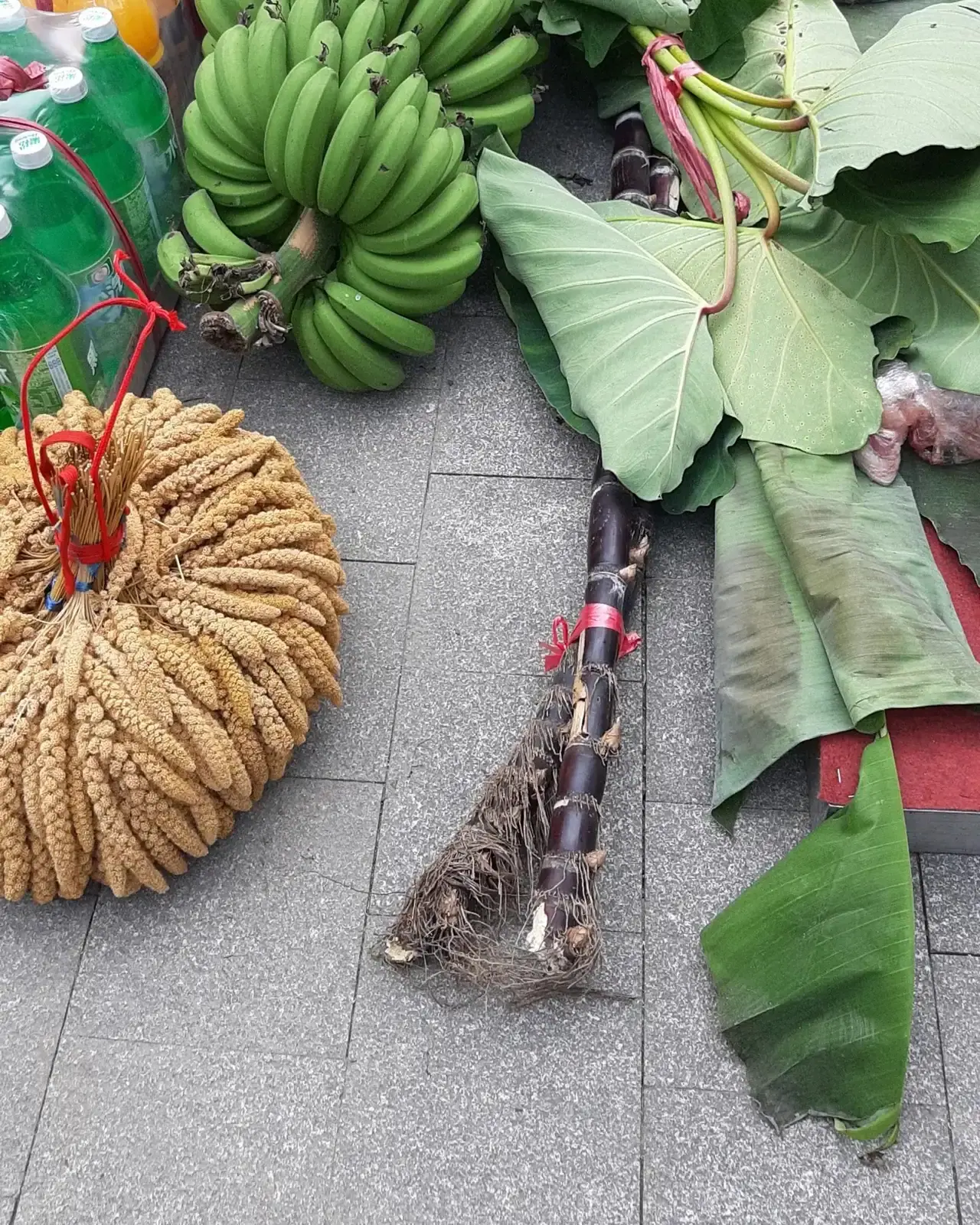
A wedding in Sandimen, Pingtung, March 2023. The betrothal gifts brought by the groom include millet, bananas, sugarcane, and taro. The image shows the gifts; no _cinavu is present, but millet and taro are the two most common bases for it. Photo: WEI, WAN-CHEN, CC BY-SA 4.0 via Wikimedia Commons._
These occasions share one thing in common: many people are gathered, and food must be shared. "Discovering Taitung Slow Food" describes cinavu and abai as representing respect for Heaven and Earth, gratitude to ancestors, and the spirit of sharing with relatives and friends4. When asked about the characteristics of Paiwan cuisine, A Bao smiled and replied, "I think it's balance." She cited abai as an example: primarily grain-based, wrapped in leaves, with meat inside—providing both starch and protein. "The wisdom of the elders is truly wonderful"13.
Student reports also note the present day: with more resources available, tribespeople can buy ingredients to make cinavu whenever they want without waiting for specific festivals; ready-made versions are also seen at markets7. It has also entered cities and campuses. In May 2025, the Indigenous Student Resource Center at Chung Yuan Christian University held a "Millet Also Came to Dragon Boat Festival" communal kitchen event for cinavu; the announcement noted that students must be told that the jiasuanjiang leaves "can be swallowed directly along with the inner food"14. When serving this dish in the city, one must first explain that the leaf is edible. This announcement labeled the jiasuanjiang as the "outer layer," which differs from most descriptions that place it against the rice14.
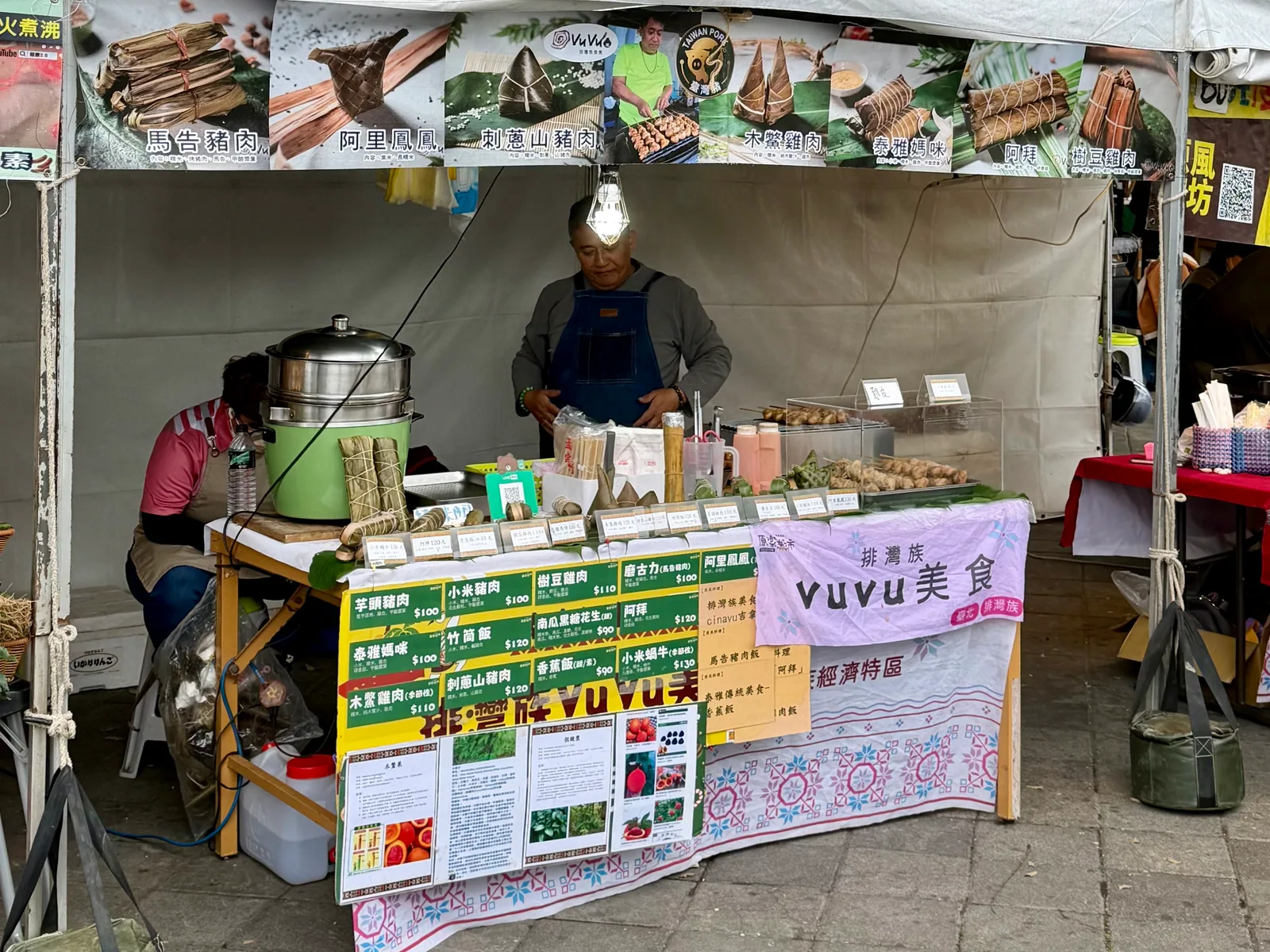
A Paiwan stall at the Taipei Expo Farmer's Market, February 2026. The sign lists leaf-wrapped foods such as millet with pork, taro with pork, and millet with snail, and also lists "abai" separately. Photo: Heeheemalu, CC BY-SA 4.0 via Wikimedia Commons.
The Snails Brought Back by a Mother
Artist Chang En-man's cinavu creations began with snails. Her mother is Paiwan; between 2009 and 2013, she completed six works themed around the African giant snail. It started from a childhood memory, which she wrote in English: "my separated Paiwan mother used to collect and clean the snails then apportion to the kids she could not be with."15
The African giant snail is not native to Taiwan; in the early 1930s during the Japanese colonial period, Japanese officials introduced them from Singapore as a food source151617. They later proliferated in fields as an invasive species harmful to crops17, but were also collected by tribespeople, who would feed them sweet potato leaves first to purge their systems before cooking them8. Many tribal families make snail dishes16, and they are even included in some cinavu and abai1718. Chang En-man's 2021 work, Snail Paradise Trilogy: Setting Sail or Final Chapter, traces the origins of cinavu through this lens17.
On February 3, 2024, this work brought cinavu to Jakarta; Museum MACAN extended it into a cooking workshop called "Trails of the Tongue: Cinavu," limited to 15 participants and led by Lazy Susan, using ingredients available in Indonesia to wrap cinavu17. On December 14 of the same year, Chiang Mai Design Week held a "Cooking Cinavu" workshop at MAIIAM Contemporary Art Museum, allowing participants to make this Paiwan leaf-wrapped dish using local Thai ingredients19.
Looking back at the recipe that Taiwu Ancient Ballads Troupe took to Australia, it was also a home-style version: millet mixed with glutinous rice, and pork and shiitake mushrooms seasoned with soy sauce and oyster sauce; the ingredient list even included a bit of rock sugar3. Recipes adapt to local kitchens wherever they go; both the Jakarta and Chiang Mai workshops swapped in local ingredients1719.
The Suspects Were Snails and kè-lán Leaves, but the Culprit Was Seed Millet
On September 17, 2024, an elder from the Binmao tribe in Jinfeng Township, Taitung, made abai using millet, pork, bamboo shoots, and snails. After eating it, she felt unwell and passed away that day1820. While relatives were keeping vigil, they shared the remaining abai, and by September 18, several people had been hospitalized820. By the time the prosecution concluded its investigation in December, the poisoning incident, including the elder, had resulted in 4 deaths and 8 serious injuries821.
When the news first broke, most reports focused on the snail as the ingredient of concern8. The following day, the Ministry of Health and Welfare announced test results: highly toxic organophosphate pesticide chlorpyrifos was detected in the leftover abai, shifting public scrutiny toward the millet8. The Food and Drug Administration screened 410 types of pesticides but only found chlorpyrifos; when they tested each component of the leftover abai individually, the highest concentration was found in the millet18. The kè-lán leaves used for wrapping, the snails, and other separately collected ingredients showed no traces of pesticides820. On December 20, 2024, the Taitung District Prosecutors Office concluded the investigation: the elder had mistakenly used millet seeds—which had been treated with chlorpyrifos for preservation by a relative two years prior—alongside her household's edible millet. She died from poisoning; the case was found to involve no intentional or negligent criminal act218.
During the period when the incident trended online, suspicion briefly fell on abai itself. Chang Yu-chuan, a professor in the Department of Public and Cultural Affairs at National Dong Lieh University, said: "This was mainly because of the issue with abai (avay), so some witch-hunting occurred online, targeting the components that make up the ingredients within abai. If we question abai, what we are actually challenging is not the ingredient, but the traditional dietary wisdom of the Paiwan people. I believe this causes great harm to the tribe."8 Tribal food businesses were hit hardest; stir-fried snails had once been a must-try delicacy for tourists in Jinfeng Township, and business suffered due to the misinformation spreading online8. Assistant Professor Hsiao Hsiang-wei of National Dong Lieh University reminded that it is not only Indigenous people who eat snails; if the same ingredient were placed in the context of French cuisine, perhaps it would not attract such stereotypes and criticism8.
The Binmao tribe has fewer than 400 people, over 80% of whom are Paiwan8. Huang Chun-ming said: "In Paiwan dietary culture, there is a very important spirit: the spirit of sharing. Our entire tribe views this case as an accident."8 Chen Chih-wei, a tribal youth who returned home to work in the food industry, believes that tribal youth can use that same online power to clarify the facts and reclaim the right to interpret their own culture8.
PTS INNEWS Episode 887, "The Cloak of Stigma," returns to the Binmao tribe to record the misunderstandings faced by tribespeople, scholars, and local food businesses after the incident.
In the eyes of outsiders, everything wrapped around or pressed against the rice is just "leaves," so suspicion naturally falls on the leaves first. The Pingtung science fair project was written in response to this. In their research motivation, the students wrote: "The recent millet zongzi poisoning incident in Taitung has caused misunderstandings regarding kè-lán leaves (kataljap). This is a misconception of Paiwan cuisine, leading to misunderstandings about these leaves."7 Their science fair instructor was Han Chinese and noted that while zongzi and cinavu are very similar, the leaves used are completely different. The students thus placed shell ginger, jiasuanjiang, and kè-lán leaves alongside the bamboo leaves and bamboo sheaths used in Han Chinese zongzi to compare their load-bearing capacity, antibacterial properties, and heat retention7.
After the experiment, the students concluded that kè-lán leaves performed better than expected among natural leaves, possessing certain antibacterial abilities and heat retention. Shell ginger leaves had the highest final temperature for heat retention, though the difference between the five types of leaves was less than 2 degrees Celsius7. An elementary school science project cannot reach a definitive conclusion, but what remains is a group of children who, when the outside world doubted kè-lán leaves, followed their elders into the tribe to re-identify the leaves they eat.
Tainan Says It Is Not Zongzi
The names outsiders have given to cinavu and abai are mostly borrowed from zongzi. Several news headlines regarding the 2024 Binmao incident referred to abai as "millet zongzi"82118. As of November 2026, the Chinese Wikipedia term for "jinafu" redirects directly to the entry for "zongzi"22. On May 24, 2025, the New Taipei City Indigenous Peoples Affairs Department displayed the Amis alifongfong alongside cinavu; a Central News Agency English caption stated that cinavu is a food eaten by the Paiwan, Bunun, and Rukai peoples, and that both are similar to Han Chinese zongzi, intended to show similarities between Taiwan's different ethnic groups23.
A year later, the Tainan City Government took a different approach. In June 2026, on the eve of the Dragon Boat Festival, the city government sent Cinavu to officials at a municipal meeting for tasting, emphasizing that it is not zongzi: it is a traditional leaf-wrapped food of the Paiwan and Rukai peoples, primarily made of millet or dried taro powder, paired with marinated pork, and wrapped in materials like jiasuanjiang or cogon grass leaves24. Mayor Huang Wei-che stated that calling Cinavu "Indigenous zongzi" simplifies its cultural meaning and easily leads to misunderstanding. The city also announced that the Indigenous Cultural Site "Tabe 札哈木樂原," opening on August 1, would regularly sell Cinavu24. The city drew a distinction based on the primary grain: zongzi is primarily glutinous rice, while Cinavu is primarily millet or dried taro powder24. While some home recipes include a bit of glutinous rice, the Taiwu Ancient Ballads Troupe recipe uses 600g of millet with 100g of glutinous rice3.
The similarities seen in New Taipei are real; visually, it uses leaves to wrap rice and meat just like zongzi, as noted by the Pingtung science fair instructor7. The difference is only visible when you peel it open: bamboo leaves for zongzi are peeled off and discarded, whereas the jiasuanjiang leaves remain on the rice to be eaten. Which specific leaves are pressed against the rice and which wrap the outside depends on the tribe and family making it74. If outsiders only remember that it is like zongzi, they will miss exactly that layer of leaves meant to be eaten.
In Adelaide, that recipe wrote jiasuanjiang in pinyin without finding an English name for it3. In Pingtung, a group of Paiwan elementary students wrote the same leaf as ljavilu, with a Mandarin annotation, stating that this research allowed them to "move from just seeing it on the dining table to recognizing and gathering it in the tribe"7. A recipe can be printed in English and taken abroad, but that layer of leaves meant to be eaten still requires someone to follow their vuvu into the tribe to recognize it.
Further Reading:
- Indigenous Food Culture in Taiwan — From AKAME to Amis wild vegetable knowledge; part of a larger map of Indigenous food.
- Zongzi — A comparison between Northern and Southern Taiwanese zongzi and various ethnic leaf-wrapped foods, highlighting the differences mentioned in this article.
- Dragon Boat Festival — Outsiders often link cinavu to the Dragon Boat Festival; this article covers the origins and customs of the festival itself.
- Bamboo Rice — Another Indigenous staple involving cooking millet or rice inside a plant.
Image Sources
This article uses 5 Creative Commons licensed images, all cached in public/article-images/food/ to avoid hotlinking; it also embeds one video from the official PTS INNEWS channel.
- Paiwan Food: Beiye Tribe Cinavu-01 — Photo: Sin-siōng, 2024-01-02, CC BY-SA 4.0 (hero)
- Trichodesma calycosum - Taiwan Begonia by Shihchuan Ishikawa - 001 — Photo: Shihchuan Ishikawa, 2010-07-26, CC BY-SA 2.0
- Paiwan Food: Beiye Tribe Cinavu-02 — Photo: Sin-siōng, 2024-01-02, CC BY-SA 4.0
- Sandimen vucul wedding 157 — Photo: WEI, WAN-CHEN, 2023-03-25, CC BY-SA 4.0 (cropped to focus on betrothal gifts)
- Stall at Taipei Expo Farmer's Market selling Indigenous Taiwanese food 20260207 — Photo: Heeheemalu, 2026-02-07, CC BY-SA 4.0
- Video: PTS INNEWS Episode 887 "The Cloak of Stigma" (YouTube official channel "公共電視-獨立特派員 PTS INNEWS")
References
- WOMADelaide 2019 — Taiwu Ancient Ballads Troupe — Artist page for the 2019 WOMADelaide festival in Australia, introducing founder and music teacher Camake Valaule, who records Paiwan ancient ballads and leads a children's choir and band; he also leads the festival's Paiwan dance workshop. The group is listed in the Taste the World program; the site lists the 2019 festival dates as March 8–11.↩
- CNA News Platform: Transformation of Ancient Ballads Troupe—TBT Taiwu Ancient Ballads Troupe Becomes Crossover Girl Group with 'Kivaljuq' — April 22, 2026 album announcement; explains TBT was founded by Taiwu Elementary School teacher Camake Valaule, won the 25th Golden Melody Award for Best Indigenous Album, and reorganized after his passing in 2022.↩
- WOMADelaide 2019 Taste the World Recipe — CINAVU — Original PDF of the English recipe prepared by Taiwu Ancient Ballads Troupe for the Taste the World segment: serves eight to ten; 600g millet, 100g glutinous rice, pork, shiitake mushrooms, soy sauce, oyster sauce, 24 jiasuanjiang leaves and 12 shell ginger leaves; wrap in jiasuanjiang first, then shell ginger, tie with cotton string, and boil on high heat for one hour.↩23456
- Discovering Taitung Slow Food: Taitung Tribal Zongzi: Abai, Cinavu, and DoReMi — Article from July 2021 by the Taitung food documentation project; explains that abai is Rukai and cinavu is Paiwan, both referring to the same food in Taitung; recounts Pingtung's distinction between powder and whole grain; records the Laolao tribe's fermented millet dough qavay (nicknamed doremi).↩2345678
- Ministry of Agriculture: Is the leaf of the jiasuanjiang plant commonly eaten by Indigenous peoples toxic? — Official Q&A released by the Ministry of Agriculture on April 30, 2015; records synonyms like biguocao, describes it as a Boraginaceae perennial shrub (the page uses the scientific name Trichodesma khasianum, listed as a synonym in the Taiwan Plant List), the Bunun name Lubii`lu, and notes that leaves are eaten with steamed pastries during festivals, while warning of accidental Datura poisoning.↩234
- Taiwan Plant Information Integration Query System: Trichodesma calycosum jiasuanjiang — National Taiwan University's plant list page; lists Trichodesma calycosum Collett & Hemsl. as the accepted name, with common names jiasuanjiang and biguocao, and Trichodesma khasianum C. B. Clarke as a synonym.↩
- 65th Pingtung County Science Fair Elementary Group: Investigation into the Characteristics of Paiwan Cinavu Wrapping Leaves vs. Han Chinese Zongzi Leaves — Project manual by Paiwan elementary students; records knowledge gathered from tribal vuvu on leaf types (inner tender/outer old), occasions for cinavu (full moon, weddings, harvest festivals), a Mandarin-Indigenous food comparison table, and experiments on load-bearing, antibacterial, and heat retention properties of shell ginger, jiasuanjiang, kè-lán leaves, and bamboo leaves.↩23456789101112
- PTS INNEWS: Millet Zongzi Abai Poisoning Scandal, Indigenous Food Stigmatized! — In-depth report by PTS on January 26, 2025; returns to the Binmao tribe to record the incident, the reasons for the prosecution's conclusion, online witch-hunting, and the impact on tribal food businesses; includes quotes from cultural worker Huang Chun-ming, professor Chang Yu-chuan, and tribal youth Chen Chih-wei.↩2345678910111213141516
- Wikipedia: Nicandra physaloides — Chinese Wikipedia entry explaining that the "jiasuanjiang" in mainland China is the Solanaceae plant Nicandra physaloides, known in Taiwan as dàběn pàozi cǎo, which is different from the Boraginaceae plant used by Taiwan's Indigenous peoples.↩
- Wikipedia: Nicandra physalodes — English Wikipedia entry for Nicandra physalodes, noting its common names apple-of-Peru and shoo-fly plant, native to western South America including Peru.↩
- Taiwan Everything: Trip to Tuban — English travel blog documenting a visit to the Tuban tribe in Taitung, recording two types of cinavu (millet and taro powder) for lunch, and writing the Paiwan word ljavilu as "apple of Peru leaf."↩2
- JIBAO: Paiwan Cuisine — Introduction to Paiwan cuisine by the JIBAO educational database; explains that millet and yams are traditional staples, rituals revolve around millet growth, and distinguishes cinavu from avai by grain vs. powder, calling both the most noble foods of the Paiwan.↩23
- FoodNEXT: A Bao's Breakfast (2020 Taipei Cultural Memory Center Collaborative Special) — November 2020 interview with Paiwan singer A Bao regarding her diet; records her descriptions of abai and cinavu, and her quote that Paiwan cuisine is characterized by balance and the "wonderful wisdom of elders."↩2
- Chung Yuan Christian University: Millet Also Came to Dragon Boat Festival - Communal Kitchen Cinavu Event — May 2025 announcement from Chung Yuan Christian University's Indigenous Student Resource Center regarding a communal kitchen event; explains that jiasuanjiang leaves can be eaten with the inner food, containing pork and millet, and provides various Chinese spellings like qìnàfú.↩2
- No Man's Land Archipelago Database #14: Chang En-man's African Giant Snail Project — Artist Chang En-man's first-person account of the origin of her six snail works (2009–2013): a separated Paiwan mother collecting and cleaning snails for children she could not live with; traces the introduction of the African giant snail to Taiwan via Singapore.↩2
- No Man's Land Archipelago Database 10: Chang En-man—Snail Paradise (2019) — Introduction to Chang En-man's snail works by the Archipelago Database; records that the African giant snail was introduced to Taiwan from Singapore by Japanese officials in 1932, and mentions her 2019 research trip to Singapore.↩2
- Museum MACAN: Trails of the Tongue: Cinavu — February 3, 2024 workshop page at Jakarta's Museum MACAN; explains the workshop is an extension of Chang En-man's 2021 work, led by Lazy Susan using Indonesian ingredients, limited to 15 people, and notes the 1933 introduction of the snail from Singapore.↩23456
- TVBS Health 2.0: Taitung Snail Millet Zongzi Case—Abnormally High Pesticide Concentration in Millet — September 20, 2024 report on the FDA's testing of leftover snail millet zongzi; chlorpyrifos concentration was highest in the millet, and screening for 410 pesticides only yielded chlorpyrifos.↩234
- Chiang Mai Design Week 2024: Cooking Cinavu: A Secret of Paiwan Culture — December 14, 2024 workshop page at MAIIAM Contemporary Art Museum, Chiang Mai; explains the workshop is inspired by Chang En-man's 2021 work and uses local Thai ingredients to make cinavu.↩2
- Yuanqi Network: Taitung Death Case—Deadly 'Abai' Found to Contain Highly Toxic Pesticide Chlorpyrifos — September 20, 2024 report by United Daily News (Yuanqi) on the Ministry of Health and Welfare's results; chlorpyrifos was found in leftover zongzi, but not in the separately collected snails or kè-lán leaves.↩23
- PTS: Taitung Millet Zongzi Poisoning Case Concluded; Woman Mistakenly Used Pesticide-Treated Millet Seeds — December 20, 2024 report by PTS on the Taitung District Prosecutors Office's conclusion: poisoning caused by chlorpyrifos in millet due to the accidental use of seeds treated with the pesticide two years prior; no intentional or negligent crime found; 4 dead and 8 seriously injured.↩23
- Wikipedia: Jinafu — Chinese Wikipedia page for "Jinafu" which redirects to "zongzi"; cinavu lacks an independent entry, serving as an example of its frequent categorization under zongzi.↩
- Focus Taiwan: Photos of the Day, 2025-05-24 — May 24, 2025 Central News Agency English photo caption; records New Taipei City's display of Amis alifongfong and cinavu, noting their similarity to Han Chinese zongzi and identifying cinavu as a food of the Paiwan, Bunun, and Rukai.↩
- ETtoday: Not Just Zongzi for Dragon Boat Festival! Tainan Promotes Cinavu Identity; Tabe 札哈木樂原 Opens Aug 1 — June 17, 2026 report from Tainan; records the city government's tasting of Cinavu before the festival, emphasizing it is not zongzi, Mayor Huang Wei-che's views on the "Indigenous zongzi" label, and the regular sale of Cinavu at the new cultural site.↩23