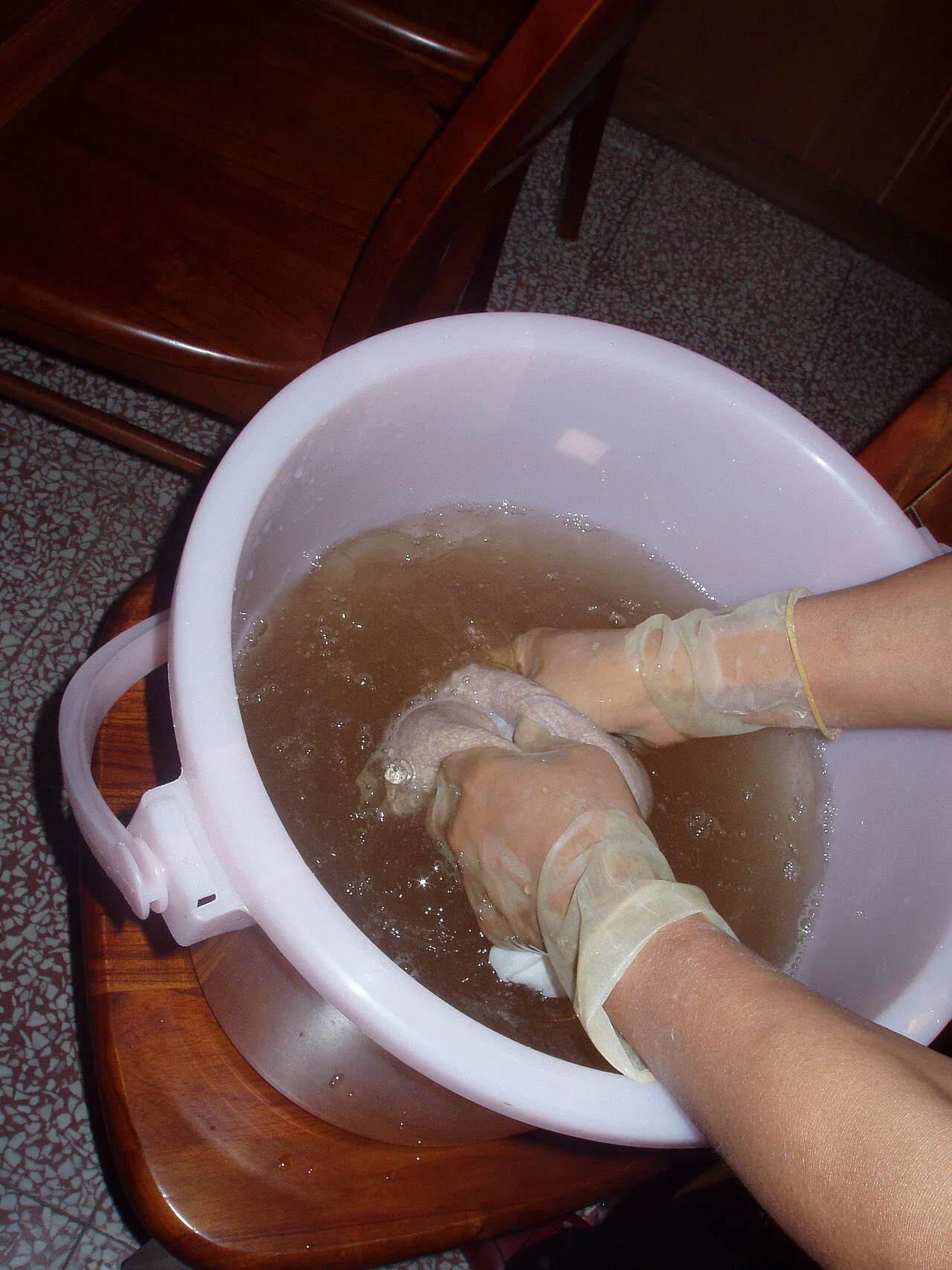
Hand-washing aiyu seeds in a bucket, photographed at Bao-lai 36 Aiyu Ice Shop, October 2005. Photo: Ah Kun Wang kun hung, CC BY 2.0.
30-Second Overview: Aiyu jelly is formed by rubbing aiyu seeds in water, allowing the pectin and enzymes within the seeds to react with divalent ions in the water at room temperature to create a gel. It requires no boiling and no added coagulants12. The most widely circulated written account is found in Lian Heng's General History of Taiwan (Taiwan Tongshi), which states that during the early Daoguang era, a man from Tong'an discovered it by a stream in Hou-dapu, Chiayi; his daughter was named Aiyu3. The seeds of the aiyu plant rely on a specific tiny bee, the aiyu small bee, for pollination to grow4. As wild harvesting has declined annually, the Miaoli District Agricultural Improvement Station introduced two new varieties in 2012 and 2013 that yield approximately three times as much as wild species5.
An educational resource titled "Aiyu" published by the Biodiversity Research Institute of the Ministry of Agriculture in September 2024 includes a "blender version" recipe: combine one gram of aiyu seeds with 40 to 80 times the volume of boiled, cooled water or mineral water; stir at low speed for about two minutes, taking care not to break the seeds. Pour the slurry into a container lined with a cotton cloth bag and squeeze it out; let it sit for ten minutes, and it will fully set into aiyu jelly1.
This recipe involves no fire, no sugar, and no gelatin or agar. Water poured in is liquid, but ten minutes later, it becomes jelly. While most fruit pectins require heating, sugar, and acid to set, aiyu gel forms simply by adding water at room temperature2. How the jelly forms lies hidden within that bag of rubbed seeds.
Enzymes Released from a Handful of Seeds
The primary component of aiyu jelly is a long-chain polysaccharide on the seed surface called polygalacturonic acid. A 2022 report by Academia Sinica's Research Matters describes it this way: the rubbing action extracts macromolecules, enzymes, and metal ions from the seeds into the water. Aiyu's unique pectin methylesterase replaces methyl groups on the long chains with carboxyl groups. Calcium ions in the water then link these carboxyl groups together, moving from temporary cross-linking to point-like connections, and eventually into long, stable linkage zones, causing the jelly to harden6.
This explanation is supported by academic research. A team led by Yeng-Long Chen from the Institute of Physics at Academia Sinica collaborated with the McKinley Laboratory at MIT to publish "Rheo-chemistry of gelation in aiyu (fig) jelly" in Volume 123 of Food Hydrocolloids in 2022. They used rheometers and cryo-electron microscopy to track the gelation process and established a kinetic model for the binding of calcium and pectin. By incorporating the pectin methylesterase's conversion of binding sites into the model, they were able to calculate the inflection points on the elasticity and viscosity curves2. The paper also notes something omitted in popular science reports: their experiments used deionized water, meaning the ions required for gelation come primarily from the seeds themselves; every 100 grams of dry matter contains approximately 0.95 grams of calcium and 5 grams of potassium. When made at home with tap water, the ions in the water act as additional helpers2.
The precautions in the Ministry of Agriculture's educational material are essentially layman's versions of this same mechanism. Stirring must be done at low speed because breaking the seeds will prevent the pectin from being released. Since water quality varies by region, if success rates are low, one can switch to mineral water, as "good water is rich in minerals" and helps the jelly set better1. Real aiyu jelly will contain tiny fragments of seed coat or perianth, making it look cloudy; after about three hours, it will begin to "weep" (release water). Artificially synthesized aiyu is clear and transparent and will not weep even after ten-plus hours1.
The release of water is a sign that the reaction has stopped. The educational material states this directly: aiyu jelly relies on the bonding of enzymes and divalent cations to form a gel, so it cannot be stored for long; once the enzymes lose activity, the bonds disappear, and the jelly structure collapses1. While the seeds can be stored in a cool, dry place, the jelly cannot.
The Daughter of a Tong'an Man in the Early Daoguang Era
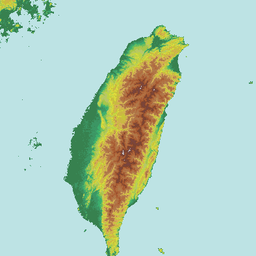
The most frequently cited origin of the name "Aiyu" is found in Volume 27 of Lian Heng's General History of Taiwan. The original text reads: "Aiyu seeds: produced in the mountains of Chiayi. Not recorded in old chronicles." It continues by saying that during the early Daoguang era, a man from Tong'an lived on Mazu Lou Street in the prefectural capital and frequently traveled to Chiayi to procure local goods. One day, while passing through Hou-dapu, he became thirsty from the heat and went to a stream to drink. He found the water surface had turned into jelly; he scooped it up and drank it, finding it incredibly refreshing. Looking closely, he saw seeds in the water; when he rubbed them, they produced a slurry. Thinking this was what the jelly was made of, he brought them home and washed them with water, and they instantly became jelly, which tasted wonderful with sugar. He had a fifteen-year-old daughter named Aiyu who, having nothing to do, began selling it. Customers loved it, "so it came to be called Aiyu jelly." Later, as more people harvested it, it was even transported to Fujian and Guangdong3.
This is a record, not an investigative report; Lian Heng does not state where the information originated. When later generations retell the same story, details often drift. The Ministry of Agriculture's material rewrites it as a Tainan merchant during the late Guangxu era of the Qing dynasty and claims the earliest record of aiyu seeds is Lian Heng's General History of Taiwan from 19211. Looking back at the original book, it specifies "early Daoguang" and a man from Tong'an residing in the prefectural capital3. The retold version is off by one era name; to cite accurately, one must return to the original text.
At the end of this passage, Lian Heng added a note: "Regarding Aiyu seeds, they are peli (creeping fig); their nature is cooling and can relieve heat"3. He treated the aiyu seed as the creeping fig. Modern classification places the two close together, but they are not the same thing: in 1904, Japanese botanist Makino Tomitaro published Ficus awkeotsang in Volume 18 of The Botanical Magazine, Tokyo. In 1960, Corner merged it as a variety of the creeping fig (Ficus pumila), now written scientifically as Ficus pumila var. awkeotsang7. The Ministry of Agriculture's materials call it a Taiwanese endemic variety, distributed in mountainous areas at mid-to-low altitudes between 800 and 1,800 meters1. A feature from Academia Sinica's digital archives reminds readers that the fruit of the creeping fig is smaller than aiyu and contains less extractable pectin, so it will not form jelly; one should not simply pick creeping figs to wash at home8.
One Bee, One Fruit
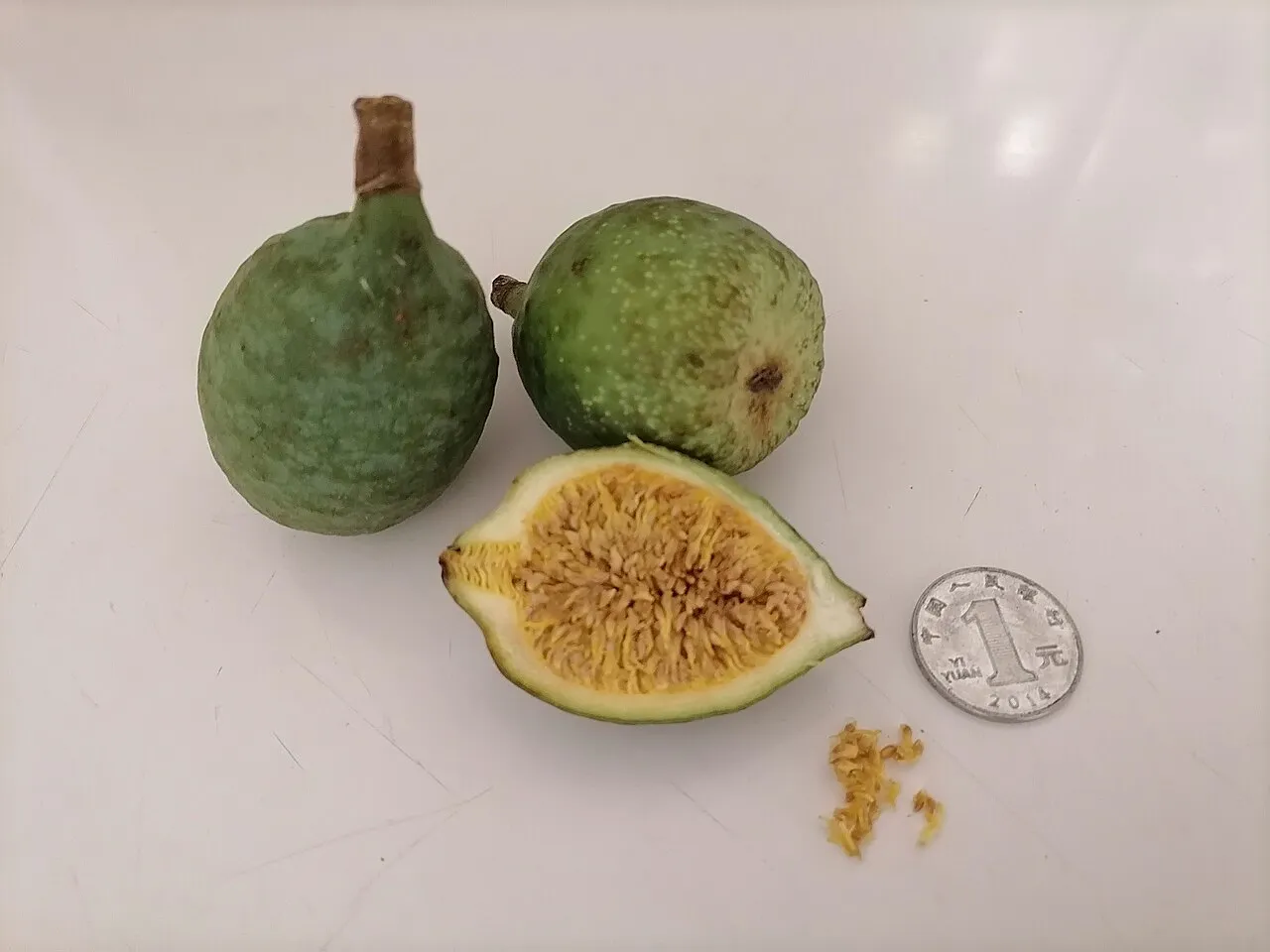
The syconium (hidden flower) of an aiyu seed, shown whole and longitudinally sliced, with a one-yuan coin for scale, October 2022. Photo: Shwabb1, CC BY-SA 2.0.
The flowers of the aiyu plant are hidden inside the fruit. The educational material states that it has a capitulum inflorescence containing unisexual flowers. Female and male flowers grow on different plants15. An article titled "Aiyu Pollination" from the Miaoli District Agricultural Improvement Station says the aiyu small bee (Wiebesia pumilae) is the sole pollinator of the aiyu seed: the adult bee lays eggs in the gall flowers of the male syconia; once the larvae hatch, they parasitize the ovules, and the mature small bees then pollinate the female flowers—a classic example of plant-animal mutualism4.
The process is illustrated in detail in the educational material. The small bee crawls out of the male fruit, inevitably passing through male flowers and becoming covered in pollen. When the female fruit matures, a small hole opens at the tip, releasing a special scent to attract the small bee. Once the bee lands on the female flower, pollination is complete. The pollinated female fruit swells and grows seeds—the very aiyu seeds that are later washed into jelly1. Depending on the size of the fruit and the number of eggs laid, a single male fruit can contain anywhere from several thousand to tens of thousands of small bees. The peak time for these bees to emerge is between 10:00 AM and noon on sunny days; low temperatures and strong winds reduce the number of bees that emerge and their pollination efficiency4.
Thus, making a bowl of aiyu relies on the cooperation of two species: one provides the enzymes and pectin in the seeds, and the other ensures the seeds have the chance to grow. This is also where farmers face challenges. An article from the Miaoli District Agricultural Improvement Station in 2013 notes that farmers often struggle with inconsistent fruit yield and quality due to a lack of understanding regarding the pollination bees or improper cultivation ratios of male and female plants. Excessive use of pesticides for pests and diseases can also harm the aiyu small bees in the orchard, subsequently affecting pollination5. The material also mentions that farmers have attempted to grow aiyu on low-altitude hillsides and flatlands, but suffered from severe fruit drop and unstable quality due to poor variety selection or cultivation management1.
From Forest Land to Orchards
Aiyu was originally gathered from the mountains. The educational material states that in the past, harvesting was primarily done from wild plants in forest lands, but later, due to changes in forest composition and soil conservation efforts, production areas and yields plummeted1. As demand did not decrease, farmers began cultivating it at lower altitudes.
In 2012 and 2013, the Miaoli District Agricultural Improvement Station introduced "Miaoli No. 1" (Plant Variety Protection No. A01379) and "Miaoli No. 2" (Plant Variety Protection No. A01443), respectively, with the goal of replacing wild aiyu seeds5. The station's article lists: Miaoli No. 1 can yield over 20 to 25 kg per plant annually, approximately three times that of general wild species, with an average pectin content of 1.7%—42% higher than wild species. Miaoli No. 2 has a similar yield of about three times the wild variety, but with an average pectin content of 2.1%, which is 75% higher5. The material also records that the station has collected a total of 115 male and female lines, completed cultivation management and pollination bee breeding/conservation technologies, and developed male lines that allow the small bees to inhabit and propagate year-round1.
Lian Heng wrote "produced in the mountains of Chiayi," and two hundred years later, the statistics still place Chiayi at the forefront. The educational material cites average values from the Ministry of Agriculture's Agricultural Commodities Administration reports for the years 109 to 111 (2020–2022): Chiayi County has a cultivation area of 228 hectares and an annual yield of 252 metric tons; Kaohsiung City has 208 hectares and 272 metric tons. Other major production areas include Nantou, Taitung, and Pingtung; among these, Kaohsiung and Taitung have aiyu seed production and marketing cooperatives, with larger scales of intensive artificial cultivation1. These figures are read from charts in the educational material, which do not specify the survey scope for each county or city.
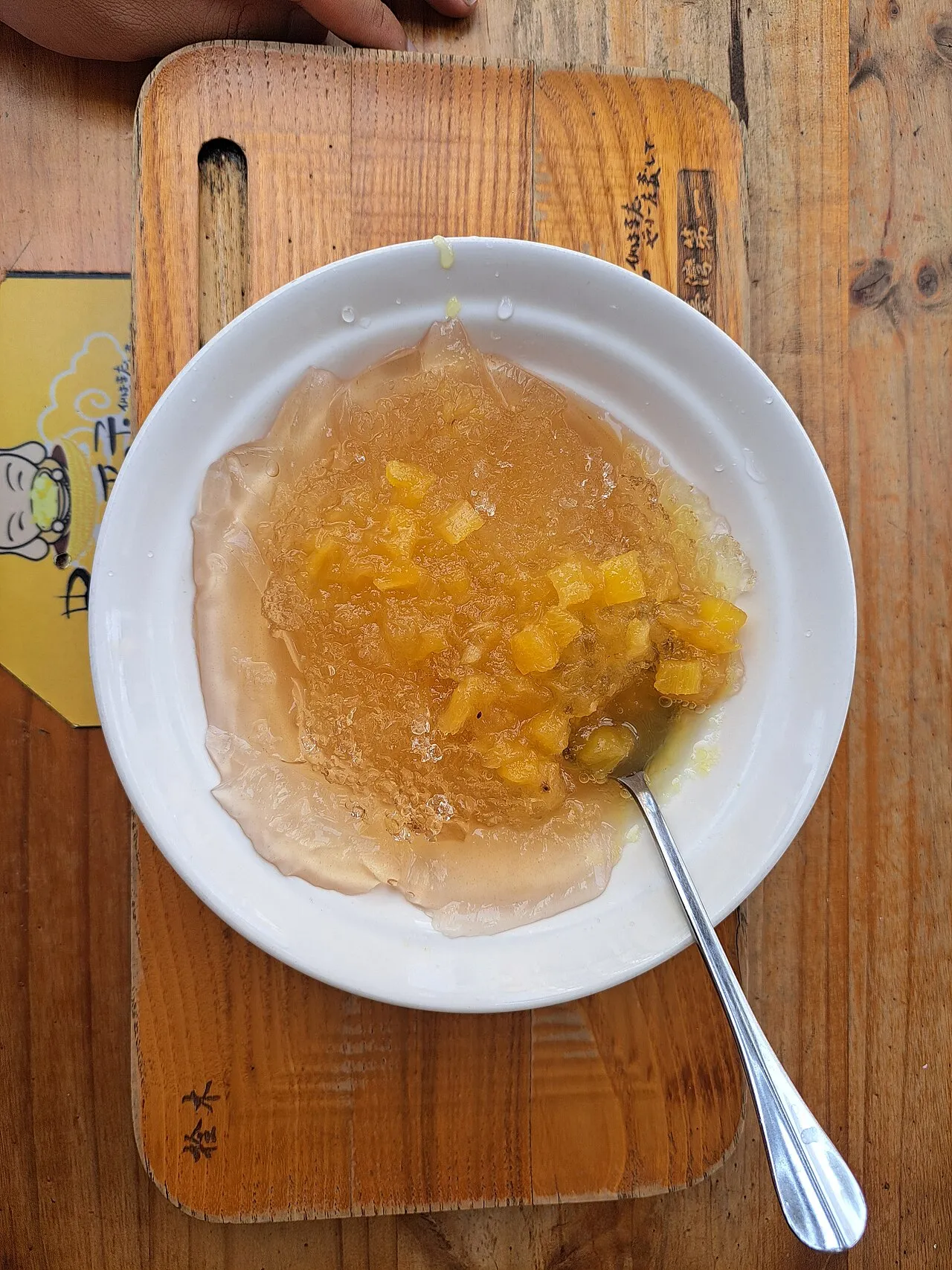
Aiyu jelly with shaved ice, osmanthus, and pineapple, Tainan Fodu Aiyu, March 2026. Photo: GiveMeMollusks, CC0.
Returning to that ten-minute recipe: the reason the jelly cannot be kept for long is that the jelly itself is an ongoing reaction. And what provides the substance for this reaction to work on is a bee so small it is almost invisible. Every bowl of aiyu begins with a hand-wash, and also with a pollination inside a single fruit.
Further Reading
- Taiwanese Ice Product Culture — Aiyu is a common topping at shaved ice stalls
- Taiwanese Snacks — The context of night markets and street food
- Chiayi County — General History of Taiwan records aiyu seeds as "produced in the mountains of Chiayi"; it remains a major production area today
Image Sources
- Making aiyu jelly in the bucket — Photo: Ah Kun Wang kun hung, 2015-10-19, CC BY 2.0
- Ficus pumila var. awkeotsang (creeping fig) — Photo: Shwabb1, 2022-10-09, CC BY-SA 2.0
- Aiyu jelly with Osmanthus and pineapple — Photo: GiveMeMollusks, 2026-03-21, CC0
References
- Domestic Agricultural, Fishery, and Livestock Product Educational Material: Aiyu (Published by the Biodiversity Research Institute, Ministry of Agriculture, September 2024; written by Lin Ying-hsiu) — Verbatim check: Blender recipe (1g seeds with 40–80x water, low speed ~2 mins, sit for 10 mins), "Aiyu jelly forms a gel through the bonding of enzymes and divalent cations," begins weeping after ~3 hours, pollination mechanism, decline in wild harvesting/yield, production area/yield charts (average values from Agricultural Commodities Administration reports, years 109–111). This material retells Lian Heng's story as "late Guangxu era" and "Tainan merchant," differing from the original; see [^3].↩2345678910111213
- Wang, F.-W., Geri, M., Chen, Y.-J., Huang, J.-R., McKinley, G. H., Chen, Y.-L. (2022) Rheo-chemistry of gelation in aiyu (fig) jelly. Food Hydrocolloids 123, 107001 — DOI 10.1016/j.foodhyd.2021.107001; MIT DSpace bibliographic and abstract page. Abstract states aiyu gel is low-methoxyl pectin, cross-linked by divalent ions, forming at room temperature with only the addition of water, with the model including pectin methylesterase. Full text read (publicly available PDF from Academia Sinica Institute of Physics, CC BY-NC-ND; online published July 2021): rheometer and cryo-EM methods, calcium-pectin binding kinetic model, seed dry matter contains ~0.95 g Ca/100 g; use of deionized water in experiments is consistent with the main text.↩234
- Lian Heng, General History of Taiwan, Volume 27 (Wikisource) — Verbatim check: "Aiyu seeds: produced in the mountains of Chiayi. Not recorded in old chronicles. In the early Daoguang era, a man from Tong'an lived on Mazu Lou Street in the prefectural capital and frequently traveled to Chiayi to procure local goods"; "He had a daughter named Aiyu, aged fifteen"; "so it came to be called Aiyu jelly"; "sold to Fujian and Guangdong"; "Regarding Aiyu seeds, they are peli (creeping fig); their nature is cooling and can relieve heat." Cited from the Wikisource electronic version; not cross-referenced with printed originals.↩234
- Aiyu Pollination (Miaoli District Agricultural Improvement Station, Ministry of Agriculture, Agricultural Knowledge Portal, published 2008-10-22, updated 2024-09-20) — The aiyu small bee Wiebesia pumilae is the sole pollinator; adults lay eggs in male fruit galls; thousands to tens of thousands of bees per single male fruit; peak emergence between 10 AM and noon on sunny days; low temperatures and strong winds affect flight.↩23
- New Aiyu Seed Varieties Miaoli No. 1 and No. 2 (Ministry of Agriculture, Agricultural Policy and Situation Issue 255, written by Miaoli District Agricultural Improvement Station, 2013-09-17) — Introduced in years 101 and 102; plant variety protection numbers; yield ~3x wild species; pectin 1.7% and 2.1% (42% and 75% higher than wild); "farmers often suffer from a lack of knowledge regarding the pollination small bee or improper cultivation ratios of male and female plants." The claim that the Miaoli station has collected germplasm since 1996 is from a search summary on the same page, not verbatim checked.↩2345
- Why do aiyu seeds "set" after washing? (PanSci reposting Research Matters, Huang Pin-wei, originally published 2022-02-23) — Rubbing extracts macromolecules, enzymes, and metal ions; three-stage explanation of polygalacturonic acid, pectin methylesterase, and calcium ion cross-linking; report does not mention water hardness.↩
- Ficus pumila var. awkeotsang (Taiwan Plant Information Integration Query System TAI2, National Taiwan University) — Scientific name publication: Corner 1960, The Gardens' Bulletin, Singapore 18: 6; synonym Ficus awkeotsang Makino, 1904, The Botanical Magazine, Tokyo 18: 151.↩
- It is creeping fig, not aiyu! (Academia Sinica Digital Archives Feature, written by Ying-zi and Yang-guang, page undated) — Creeping fig "leaf shape and syconium are both smaller and shorter than aiyu"; extractable pectin is less than aiyu and cannot form jelly.↩