
30-Second Overview: On June 15, 1949, Taiwan exchanged 40,000 old Taiwan dollars for one new Taiwan dollar, attempting to hit the stop button on an out-of-control inflation. Strangely, this currency, which was actually used every day, did not formally become the currency of the Republic of China in law until 2000. The story of the New Taiwan Dollar is therefore not just about exchanging banknotes; it is also a history of how trust, legal names, and daily life caught up with each other.
40,000 Banknotes, Unable to Restore the Original Life
On June 15, 1949, the Taiwan Provincial Government announced the Measures for the Issuance of the New Taiwan Dollar. The exchange rule was straightforward: 40,000 old Taiwan dollars for one new Taiwan dollar. This was not to make accounting simpler, but because the old Taiwan dollar had become too complex to manage. 1
In the early postwar reception period, the Bank of Taiwan first issued Taiwan dollars in 1946, replacing the Taiwan Bank Notes still circulating in the market. The initial denominations were 1, 5, and 10 dollars. Later, the numbers in the market expanded continuously, even appearing as 100,000-dollar time deposit receipts. 2
By the end of May 1949, the prices recorded in national archives no longer resembled daily transactions: 1.6 to 1.7 million dollars for every 100 jin (approx. 60 kg) of rice, and 5,000 dollars for a single duck egg. People were not facing "things getting a little more expensive," but rather their currency was thinning every day. 1
The collapse of the old Taiwan dollar was not an isolated event occurring solely in Taiwan. The fiscal pressure caused by the Chinese Civil War, along with cross-regional exchange and material flows, transmitted the financial chaos of mainland China to Taiwan. Academic research considers the period from 1945 to 1952 as a crucial scope for studying Taiwan's inflation and stabilization. 3 4
📝 Curator's Note: The birth certificate of the New Taiwan Dollar is not a pretty banknote, but a "40,000 to 1" hemostatic sheet.
But "hemostasis" is not the same as being fully healed. Between 1948 and 1949, the currency crisis on mainland China was transmitted to Taiwan through exchange, capital flows, and price linkages. This history later became the subject of study for economists researching Taiwan's inflation and stabilization from 1945 to 1952. 1 3
This perspective is important because it means monetary reform was not like a button pressed unilaterally by a government. Taiwan at that time bore both the fiscal pressure of postwar reconstruction and the exchange consequences connected to mainland China. The New Taiwan Dollar carved out a breathing path between these two forces.
The New Taiwan Dollar Did Not Start from Zero
Before the New Taiwan Dollar, Taiwan had experienced several different types of money. During the Japanese colonial period, Taiwan Bank Notes circulated; after the war, they were first exchanged for Taiwan dollars, and then in 1949, for the New Taiwan Dollar. Each name change involved who could issue it, who guaranteed it, and whether Taiwan would be dragged along by another out-of-control financial order. 1 2
The 1949 New Taiwan Dollar used the US dollar as its calculation benchmark. One new Taiwan dollar was折合 (converted to) 20 US cents, meaning one US dollar exchanged for five new Taiwan dollars. The old Taiwan dollar was converted at 40,000 to one. The government simultaneously limited the total early issuance to 200 million dollars, using gold, silver, and foreign exchange as reserves, attempting to convince the public that the new banknotes would not increase infinitely again. 1
This design revealed a very practical fear: monetary reform itself cannot rely solely on announcement. People who used million-dollar bills for purchases yesterday would not immediately trust the government today just because the banknotes changed color. To restore trust, issuance limits, reserve assets, and exchange deadlines had to be written into the system. 1 2
The day after the New Taiwan Dollar was issued, the Taiwan Provincial Government also stopped the exchange between the New Taiwan Dollar and the Gold Yuan Note and various currencies of mainland China. This decision cut off the channel through which the crisis continued to be imported and redrawn Taiwan's own financial boundaries. The National Archives Administration placed this step in the core context of currency system reform, rather than treating it merely as an administrative notice. 1
One Banknote, Two Names

Image: Carpkazu, CC BY-SA 2.5. See Wikimedia Commons Image Details Page and License Terms.
This building was not the issuing machine for the New Taiwan Dollar, but it is a good entry point in institutional history. Starting in 1946, the Bank of Taiwan handled the issuance business for postwar Taiwan dollars and later the New Taiwan Dollar. The institutional name on the banknotes entered people's daily lives earlier than the legal currency status. 2
The New Taiwan Dollar circulated practically for a long time, but its legal status remained ambiguous. After the government moved to Taiwan at the end of 1949, the Central Bank reduced its organization, entrusting many businesses to the Bank of Taiwan, including banknote issuance. The banknotes bore the name of the Bank of Taiwan, but the monetary authority and responsibility behind them gradually returned to the Central Bank. 5
The Central Bank resumed operations on July 1, 1961, and subsequently continued to entrust the Bank of Taiwan to act as the agent for issuing banknotes. This arrangement gave the same banknote two layers of identity: it was money used daily by Taiwanese people, and also a residual institutional issue where the legal name and central authority had not yet been fully resolved. 5 2
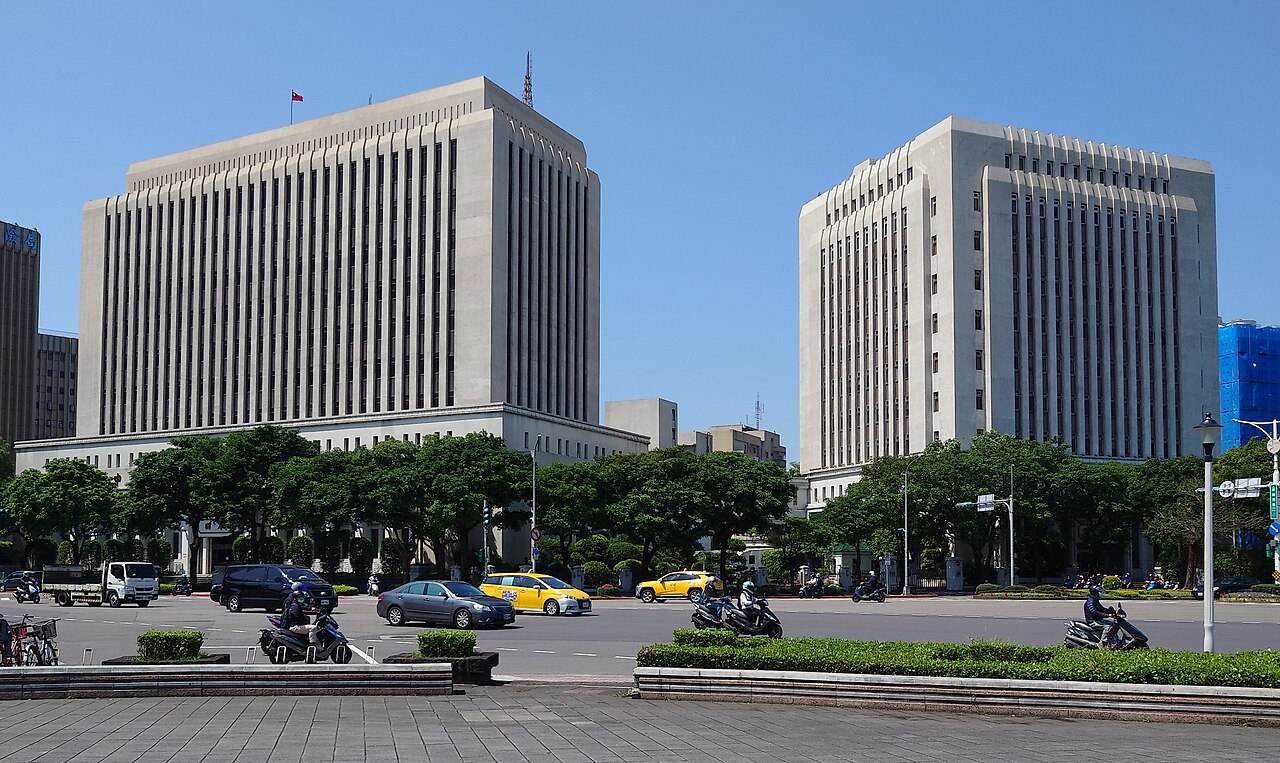
Image: Yu tptw, CC BY-SA 4.0. See Wikimedia Commons Image Details Page and License Terms.
This awkwardness was not something only felt in bureaucratic documents. Historical reports in the English Taipei Times pointed out that for a long time, the New Taiwan Dollar was viewed as a "local currency," even though it had long been the de facto legal transaction tool in Taiwan. After the Central Bank resumed operations in 1961, the arrangement of issuance authority still did not immediately eliminate this name contradiction. 6
In 1991, the silver dollar, originally the legal currency, was abolished, and Taiwan once entered a state where "the New Taiwan Dollar was used in practice, but the legal text had not yet fully caught up." It was not until January 2000 that the Executive Yuan announced relevant issuance regulations, explicitly stipulating that the currency of the Republic of China is the New Taiwan Dollar. In July of the same year, the Central Bank began to directly issue the New Taiwan Dollar. 2 6
📝 Curator's Note: A society may first use a certain money as the national money, and the law only acknowledges years later what everyone already knew.
Kinmen Banknotes Remind You That Currency Also Has Geography
In the 1950s, Kinmen and Matsu were still in a battlefield environment. The Bank of Taiwan therefore printed words such as "Kinmen" or "Matsu" on the New Taiwan Dollar to restrict the circulation scope of the banknotes. These banknotes looked like the same set of currency, but the back stated where they could only be used. 1
They were not oddities noticed only by collectors, but a response of the financial system to geographical reality. Unified issuance and regional circulation gave frontline areas their own transaction tools, allowing the government to leave boundaries between military and exchange controls. It was not until 1979 that this regulation of printing place names was canceled, and the Kinmen and Matsu areas were applied uniformly with the Taiwan mainland. 1 5
Currency is usually imagined as an item universally used nationwide, but the Kinmen restricted-issue banknotes printed another thing on paper: the scope of use is not naturally formed; it is determined by institutions, war, and the market. The place names on banknotes thus became geographical footnotes of the Cold War era.
Banknotes Begin to Depict an Island
Early New Taiwan Dollar banknotes' images were mostly connected to political figures and government agencies. In the 1960s, horizontal banknotes gradually appeared, and scenery such as the Hsilo Bridge, Su-Au Highway, and Eluanbi Lighthouse were also placed into circulating paper money. At that time, a ten-dollar banknote did not only represent purchasing power; it also brought public engineering and transportation construction into everyone's wallet. 5
In 1980, the Central Bank issued 500-dollar and 1,000-dollar banknotes for the first time. In 1988, the 100-dollar banknote was changed to red, and also added Braille, making it easier for the visually impaired to recognize denominations. The red color later connected with the folk custom of weddings where 100-dollar bills are arranged to form the character "Xi" (double happiness). 5
The 2000 new series changed the direction of the images. Data from the Central Bank shows that the denominations of current banknotes include 100, 200, 500, 1,000, and 2,000 dollars, using new anti-counterfeiting technology. The Jade Mountain on the 1,000-dollar bill, the Nanhu Mountain on the 2,000-dollar bill, and the Formosan Blue Magpie and Mount Dabajian on the 500-dollar bill made natural landscapes and species part of the national daily life. 7 8
The Central Bank Currency Museum's explanation of banknote images also explained this change clearly: Banknotes can be like a miniature country, presenting what a place hopes to be remembered through historical architecture, native flora and fauna, and mountains. 8
This does not mean banknotes have detached from politics. The Presidential Office on the 200-dollar bill is still a political building, and the Jade Mountain on the 1,000-dollar bill is not simply a landscape photo. What is chosen to enter the wallet and what is left outside the banknote is inherently a cultural choice. But after 2000, this choice no longer only revolved around political figures; it also began to put ecology, land, and local landscapes on the same banknote. 5 8
📝 Curator's Note: The back of a banknote is not space. It secretly tells you which mountains, which buildings, and which people an era wants to put into everyone's hands.
Trust Is Not a Fixed Denomination
The New Taiwan Dollar started with denominations of 1, 5, and 10 dollars, and later increased to 2,000 dollars, reflecting changes in transaction scale and economic life. The Ministry of Finance's currency history materials point out that the highest denomination was gradually raised in different periods, from 5 dollars early on to 2,000 dollars. 2
Larger denominations do not necessarily mean the currency is out of control. Data from the Central Bank shows that by the end of 2014, the 1,000-dollar bill accounted for 80.22% of the total value of circulating currency, while 500-dollar and 100-dollar bills accounted for 3.99% and 5.30% respectively. These numbers present the public's preference for carrying larger denomination cash as a transaction habit, not evidence used alone to judge price stability. 7
This also explains why banknote revisions always talk about two things at once: usability and trustworthiness. Denominations must keep up with transactions, paper must be identifiable, watermarks and security threads must make counterfeiting difficult. The Central Bank's banknote data lists intaglio printing, color-changing ink, metal security threads, and holograms as part of the anti-counterfeiting design. 2 8
The credibility of currency therefore has a very material side. It is not written abstractly in laws, but is touchable paper, visible watermarks, tactile Braille, and the few seconds to recognize denominations before the cashier. When these details operate stably, the system transforms from documents into habit.
The stability of the New Taiwan Dollar cannot therefore be attributed solely to one banknote exchange. Postwar monetary reform first handled issuance limits and foreign exchange reserves; the US aid and production recovery in the 1950s changed fiscal conditions; the Central Bank's resumption of operations in 1961 reorganized the system; and the 2000 issuance regulations filled in the legal status. These policies at different times allowed a piece of paper to gradually become money that could be trusted in daily life. 1 2 6
After Law Catches Up with Daily Life
The 2000 regulatory changes did not make people suddenly switch to a new money. It changed who was written as the issuer on the banknotes, and how the system describes an already existing daily routine. When law catches up with life, there are usually no street parades. Breakfast shops' change-making continues as usual, and numbers in bank accounts continue to move. 2 6
This "late formal name" also explains why the New Taiwan Dollar is worth looking at from beyond economic history. It has not only prices and exchange rates, but also administrative regions, battlefield management, Central Bank institutions, banknote images, and people's feelings about the authenticity of paper. Every layer answers the same question: What is worthy of being accepted by everyone as a common scale for exchange?
📝 Curator's Note: A currency's nationality is not necessarily decided on the day it was born. Sometimes, it is nurtured into a national currency by the repeated use of an entire generation.
A History Folded Daily
Today, when people make change in breakfast shops or buy vegetables in markets, they usually do not think that the New Taiwan Dollar once had to rely on gold reserves to gain trust, nor do they think that 100-dollar bills once waited for formal issuance for a long time. Currency is most successful when it does not need to remind you of its own existence.
But the history left by the New Taiwan Dollar remains in wallets. The 40,000 to one remembers the life fracture caused by inflation. The Kinmen restricted-issue banknotes remember the battlefield boundaries. The Hsilo Bridge and Eluanbi Lighthouse remember infrastructure. The Jade Mountain, Formosan Blue Magpie, and Presidential Office put nature, politics, and memory into the same set of denominations.
The New Taiwan Dollar did not obtain its legal name until 2000, but was forced to bear the life of an island as early as 1949. It was first an institutional repair in a crisis, and later became something people take out to use without much thought. This may be the hardest job of currency: allowing a history full of controversy to finally lie quietly on the breakfast table.
References
- National Development Council Archives Administration: 40,000 to One: Issuance and Circulation of the New Taiwan Dollar — Uses archives from the Executive Yuan, Bank of Taiwan, and Central Bank to explain the 1949 currency reform, 40,000 to one exchange, issuance limits, hyperinflation, and Kinmen/Matsu restricted-issue banknotes.↩2345678910
- Ministry of Finance Museum: Bank of Taiwan issues New Taiwan Dollar specimen note — Ministry of Finance English historical materials organize the issuance history of Taiwan dollars and New Taiwan Dollars, reserve systems, denomination changes, Central Bank takeover, and anti-counterfeiting printing technology.↩2345678910
- G. E. Makinen: The Taiwanese Hyperinflation and Stabilization of 1945–1952 — RePEc收录 economic journal article details page, recording the bibliography and academic context of Taiwan's 1945–1952 hyperinflation and stabilization research.↩2
- Bank of Taiwan: Bank History — Bank of Taiwan English history page explains its institutional background in the Japanese colonial and postwar financial systems, state treasury, and currency issuance business.↩
- National Development Council Archives Administration: From Vertical to Horizontal: Issuance and Evolution of New Taiwan Dollar Banknotes — Uses national archives to track the system changes of horizontal banknotes, Central Bank resumption, offshore regional issuance, 100-dollar bill design, and direct issuance in 2000.↩23456
- Taipei Times: Taiwan in Time: How the New Taiwan dollar became the national currency — Uses English historical reports to sort out the name controversy of the New Taiwan Dollar from local currency to legal currency, Central Bank resumption, and 2000 legal characterization.↩234
- Central Bank: New Taiwan Dollar Notes and Coins — Central Bank explains the 2000 new series banknotes, denomination composition, coin types, and the proportion of each denomination banknotes in the total circulating value in 2014.↩2
- Central Bank Currency Museum: The Banknote and Its Design Tell a Story — Central Bank Currency Museum explains the mountains, architecture, native species, and anti-counterfeiting images on current banknotes, and provides specific backgrounds for each denomination pattern.↩234