
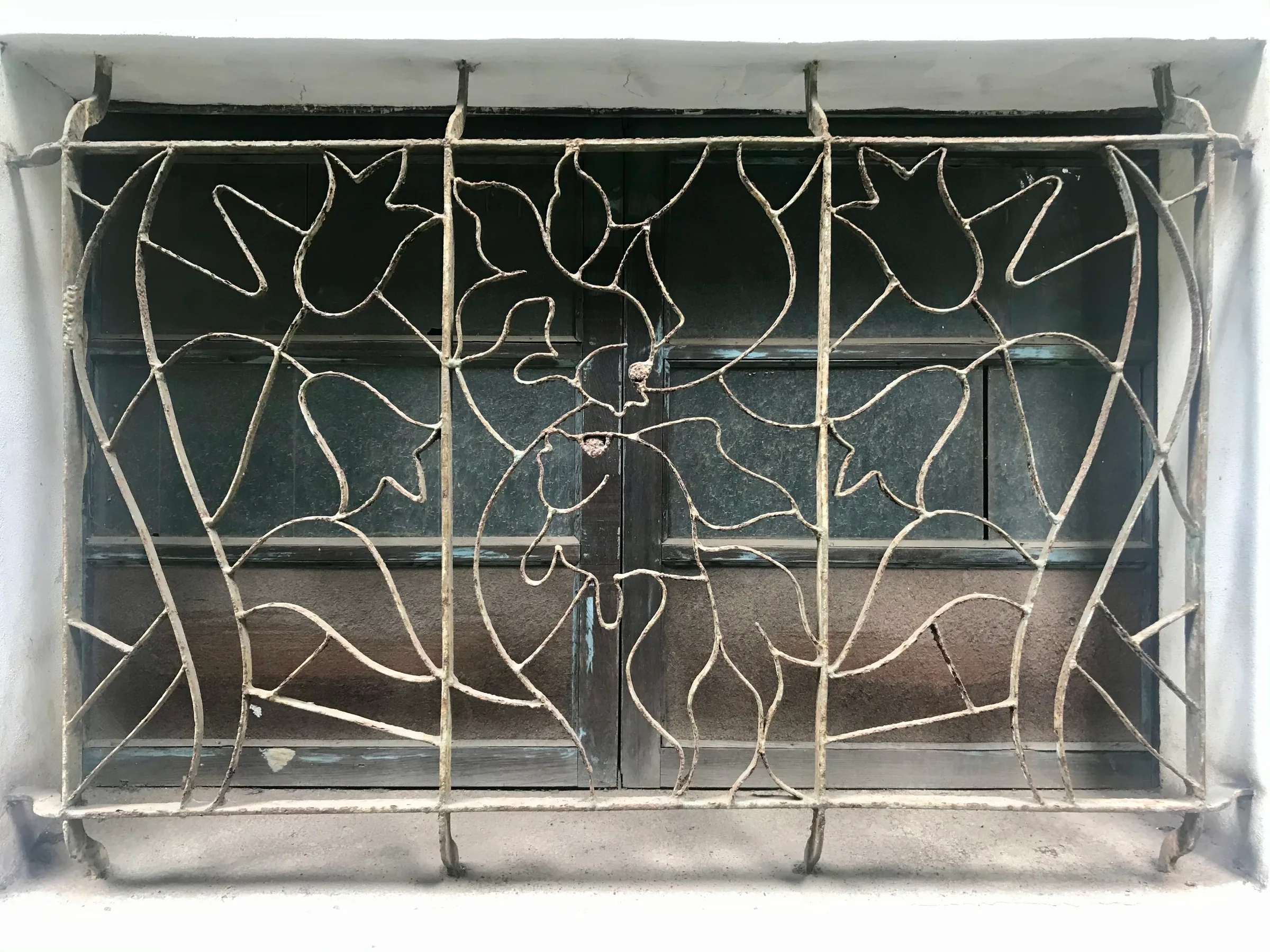
30-second overview: “대만감성 (Taiwanese sensibility)” is the Korean younger generation’s affectionate name for Taiwan’s streetscapes: decorative iron window grilles, arcades, scooters, faded signs. The very things many Taiwanese want to tear down have become, through Korean lenses, one of Asia’s most captivating aesthetic symbols. In 2024, NewJeans and ILLIT came to Taiwan to film music videos, setting off a wave on social media. In 2025, the Seoul International Book Fair welcomed 150,000 visitors with “Taiwanese Sensibility” as its theme. But what the term really names is not Taiwan’s aesthetics, but the “capacity to be moved by Taiwan”: in Korean, “감성” refers to sensibility itself.
Two Thousand Kinds of Decorative Iron Window Grilles
In 2013, Hsin Yung-sheng and Yang Chao-ching set up what they called an “audacious ideal” in Tainan[^1]: they wanted to find out exactly how many kinds of decorative iron window grilles there were in the city.
Hsin studied interior design, and Yang studied information engineering. Both from Kaohsiung, they met in 2011 at the Kaohsiung Container Arts Festival and realized that, without noticing it, both of their camera lenses were always pointed at old houses. They founded the studio Old House Face and drove through the city alley by alley, photographing as they went. Within half a year, they had documented more than two thousand distinct patterns: geometric lines, flowers, birds, fish, insects, and traditional symbols. Every window was a household’s aesthetics and memory.
“Later we realized this was basically an abyss!” Yang said1.
These decorative iron window grilles emerged between the 1960s and 1980s as practical anti-theft devices on Taiwanese homes. Blacksmiths bent iron by hand into the patterns homeowners wanted; no two windows were exactly alike. But as aluminum windows replaced iron ones, urban renewal demolished old houses, and aging blacksmiths passed away one after another, the craft has been disappearing2. What pains Hsin most is not demolition itself: “Even if the decorative iron window grilles are rescued and moved somewhere else, their connection and context with the original homeowners are gone.”1
When Taiwanese see decorative iron window grilles, they think about whether it is time to replace them with aluminum windows. When Koreans see decorative iron window grilles, they photograph them and post them with #대만감성.
📝 Curator’s Note
감성 (gamsong) in Korean is not merely “sensibility”; it is the “capacity to be moved.” 대만감성 is not “Taiwan’s aesthetics,” but “being moved by Taiwan.” The subject is the perceiver, not the place being perceived.
From One Music Video to One Million People
The term “대만감성” appears to have emerged around 2019 in Korean photography and travel communities. That year, Korean indie singer Car, the garden came to Taiwan to film the music video for “Tree.” Its images were railway tracks, scooters, and sheet-metal houses: all scenes of everyday life that Taiwanese people would barely glance at3.
The real explosion came in 2024. In March, HYBE’s new girl group ILLIT came to Taipei to shoot concept photos for their debut album, Super Real Me, with MRT stations, apartments, and convenience stores all appearing in frame4. In May, NewJeans released the music video for “How Sweet.” The circular skybridge at Wanhua’s Huajiang public housing complex, the streets of Minsheng Community, the rice fields and level crossings of Jiaoxi in Yilan: Korean fans identified each location one by one and made pilgrimages to them one by one5.
At the end of the year, HYUKOH lead singer Oh Hyuk and model Hwang Ji-min shot a set of wedding photos in Taipei. Their locations included a Huaxi Street ice fruit shop, the Banqiao 435 Art Zone, and the Heping-Xinsheng pedestrian overpass. This forty-year-old pedestrian bridge had appeared in Edward Yang’s Yi Yi and Ang Lee’s Eat Drink Man Woman. It was demolished in November 20246. Oh Hyuk’s wedding photos became the bridge’s final artistic record.
✦ “The thing being loved is being torn down. The deepest contradiction of Taiwanese sensibility is right here.”
By 2025, Taiwan’s Tourism Administration had invited Super Junior’s Kyuhyun to serve as a tourism ambassador under the theme “Romance Is Close By”7. In June of the same year, Taiwan became the Guest of Honor at the 70th Seoul International Book Fair under the theme “Taiwanese Sensibility”: 23 Taiwanese creators, 85 publishers, 550 books, 63 events, and a 360-square-meter Taiwan Pavilion. Total attendance at the fair exceeded 150,000 people8.
| 1 million+ | 150,000 people |
|---|---|
| Korean visitors to Taiwan in 2024, the third-largest source market | Attendance at the Taiwan Pavilion at the 2025 Seoul International Book Fair, the highest in the fair’s history |
Your Everyday Life Is Someone Else’s Nostalgia
There is a structural reason Koreans are fascinated by Taiwan’s streetscapes: their own have already disappeared.
Beginning in the 1990s, South Korea underwent drastic urban renewal. Large numbers of old buildings were demolished and replaced with orderly high-rises. Because of Taiwan’s land policies and the slower pace of urban renewal, Taiwan has preserved a large share of streetscapes from the 1960s through the 1980s9. Taiwan’s “everyday” is, for Koreans, a “landscape already lost.”
In recent years, Newtro (뉴트로) culture has become popular in South Korea: New plus Retro. But Seoul’s retro cafés and nostalgic shops are often deliberately designed sets. Taiwan’s decorative iron window grilles and terrazzo floors are not sets. They are traces of life that have genuinely remained3. Unintentional nostalgia moves people more deeply than meticulously designed retro spaces.
There is also a difference in rhythm. South Korea’s pressure around schooling, overtime work culture, and intense competition have left the younger generation longing for a chance to breathe. The slower pace of Taiwan’s streets: an a-má (grandmother in Tâi-gí, the Taiwanese language)10 making tea under an arcade, a cat sleeping on a scooter seat, a snack-stall owner calmly frying an danbing (egg crepe), conveys the feeling that “someone is living well”9.
Digging deeper, there is also the groundwork laid by Taiwan New Cinema. Hou Hsiao-hsien’s long takes, Edward Yang’s urban observation, and Tsai Ming-liang’s aesthetics of solitude have long had a foundation among Korean cinephiles. Many Koreans’ earliest imaginings of Taiwan came from these films, and the visual language of Taiwanese sensibility overlaps strongly with those cinematic memories.
📝 Curator’s Note
The appeal of Taiwanese sensibility is not “prettiness,” but “truth.” Decorative iron window grilles were not installed to look good; arcades were not built for photographs. Precisely because they did not exist in order to be seen, they become especially moving when they are seen.
The Pilgrimage Map and Its Shadows
The sites made famous by Taiwanese sensibility bypass traditional tourist attractions and land instead on everyday scenes with a lived-in quality: Wanhua’s Huajiang public housing complex, seen in the NewJeans music video; the Baroque façades of Dihua Street in Dadaocheng; the tree-lined blocks of Minsheng Community; Shennong Street in Tainan; and the level crossings of Jiaoxi in Yilan.
But when “imperfect everyday life” becomes a tourist selling point, tension follows.
In Taipei, the touristification of neighborhoods such as Yongkang Street and Dadaocheng has already changed the look of communities. One café owner in Ximending observed: “You can only find the same kind of shop.”11 The diversity of old neighborhoods is flattened by tourist consumption. French documentary filmmaker Jean-Robert Thomann, while shooting in Taipei, said: “The new buildings are too expensive to rent, and only convenience stores and high-end restaurants can afford them. And the new buildings all look the same; they have none of Taiwan’s character.”11
Dihua Street is a relatively fortunate case. Through a transfer of development rights (TDR) mechanism, the façades of old buildings have been preserved without large-scale demolition12. But this method is not applicable to every neighborhood.
The core contradiction of Taiwanese sensibility is here: the scenes Koreans love through their cameras are precisely the objects Taiwan’s urban renewal seeks to tear down. The Heping-Xinsheng pedestrian overpass where Oh Hyuk shot his wedding photos was demolished one month after the shoot.
Seeing Ourselves Again
The popularity of Taiwanese sensibility in South Korea has also forced Taiwanese people to turn back and look at themselves.
Streetscapes once regarded as “messy,” “old,” and “due for urban renewal” have, through outsiders’ lenses, regained aesthetic value. Designer Aaron Nieh remains clear-eyed about the trend: “Many people say my designs have a strong ‘Taiwanese flavor,’ but I absolutely cannot represent Taiwan.” He presses the question further: “Isn’t the desire to define Taiwanese flavor wholesale rooted in the fear that if we cannot say what Taiwan is, it is as if Taiwan is nothing?”13
Designer Joe Fang takes a similar view: “This is not something that should be completed by me alone, because I cannot define Taiwan’s sense of beauty through a single visual logic and imagination.”13
💡 Did You Know?
In 2024, more than 1 million Korean travelers visited Taiwan, accounting for 12.77% of all international visitors that year and ranking third. In January 2025 alone, the number reached 118,000, a 4% year-on-year increase14.
Writer Lu Hung-chin once made a precise observation: “For Taiwanese people, Taiwanese sensibility is an everyday reality like breathing; it is a gene already dissolved into the blood.”15 You do not notice that you are breathing until someone says your breathing sounds beautiful.
The curatorial program for the 2025 Seoul International Book Fair also sought to push toward a deeper understanding. Its six thematic sections: literature, living, images, land travel, food and entertainment, and historical sensibility, placed the focus on the cultural texture behind these aesthetics8. At the opening of the book fair, Minister of Culture Li Yuan said that Taiwan’s sensibility comes from a small island’s “resilience and inclusiveness,” absorbing outside influences while growing a distinctive cultural depth of its own16.
After visiting countless old houses, Yang Chao-ching once said: “A house is like a container. The drink each household mixes is different; it depends on what kinds of feeling we pour into it.”1
Perhaps the most paradoxical thing about Taiwanese sensibility is this: the streetscapes it points to, the decorative iron window grilles, the bougainvillea on the exterior walls of old apartments, none of them existed in order to be appreciated. They simply came alive. And things that come alive will one day die.
While organizing ten years of photographs of decorative iron window grilles, Hsin Yung-sheng discovered that many he had photographed were already gone. Some had been torn down; in some cases, even the houses were gone. He said that the speed at which he now takes photographs is racing against the speed of demolition2.
The Heping-Xinsheng pedestrian overpass has already become an empty lot. But in Oh Hyuk’s wedding photos, that bridge is still there.
Further Reading:
- Taiwanese Architecture — From the Japanese colonial period to the present, how Taiwanese architecture accumulated layer by layer into its current form
- Taiwanese Cinema — The long takes of Hou Hsiao-hsien, Edward Yang, and Tsai Ming-liang are the cinematic genes of Taiwanese sensibility
- Taiwanese Tea Ceremony and Everyday Aesthetics — Another representative form of Taiwan’s slow living; reading Taiwanese everyday aesthetics through the tea setting
- Taiwan’s Convenience Store Culture — The convenience store glowing late at night is a classic scene of Taiwanese sensibility
- Taiwanese Religion and Temple Culture — Temples are the most intense layer of color and faith in Taiwan’s streetscapes
- Chou Tzu-yu — One of the first Taiwanese faces to appear along Koreans’ path of learning about Taiwan
- Tehching Hsieh — A Taiwanese performance artist who makes “time and life” directly into artworks; another, more extreme version of Taiwanese sensibility
References
- Interview with Old House Face Studio — An in-depth interview from OKAPI Reading Life Magazine, documenting the full course of Hsin Yung-sheng and Yang Chao-ching’s work from founding Old House Face Studio in 2013 to publishing multiple specialist books on decorative iron window grilles, as well as their ideas on preservation.↩23
- Decorative Iron Window Grilles — The Wikipedia entry on “decorative iron window grilles,” summarizing the historical development, craft characteristics, and disappearance crisis of Taiwan’s decorative iron window grilles, with multiple academic and media sources.↩2
- From K-pop to the Book Fair: A Deeper Reading of Taiwanese Sensibility Sweeping South Korea — A 2025 feature report from La Vie, analyzing the full timeline of 대만감성 from its emergence in photography circles to its explosion through K-pop, including Car, the garden’s “Tree” music video and the context of Newtro culture.↩2
- ILLIT Super Real Me — The Wikipedia entry on ILLIT, recording the January 2024 Taiwan shoot for concept photos for the debut EP and the group’s formal debut in March of the same year.↩
- NewJeans "How Sweet" MV filming in Taiwan — A VOCO News report detailing the filming locations for the “How Sweet” music video, including Wanhua’s Huajiang public housing complex, Minsheng Community, and Jiaoxi in Yilan, as well as ADOR’s official statement.↩
- HYUKOH Oh Hyuk’s Taipei Wedding Photo Locations — Bella.tw’s complete list of the locations where Oh Hyuk and Hwang Ji-min shot wedding photos in December 2024, including Taipei’s Heping-Xinsheng pedestrian overpass, Huaxi Street, and the Banqiao 435 Art Zone.↩
- Super Junior’s Kyuhyun Serves as Taiwan Tourism Ambassador — A 2024 Central News Agency report on Kyuhyun being invited to serve as Taiwan tourism ambassador, promoting the theme “Romance Is Close By,” with four new promotional videos filmed in 2025.↩
- Taiwan and Its 'Sensibility': Seoul's 2025 Guest of Honor — An English-language report from Publishing Perspectives detailing Taiwan’s curatorial scale as Guest of Honor at the 2025 Seoul International Book Fair, the design of its six thematic sections, the list of 23 Taiwanese creators, and the results of rights negotiations.↩2
- Why Korean Tourists Are Going Crazy for Taiwan — An English-language analysis from CommonWealth Magazine on Korean tourists’ structural fascination with Taiwan: the differing pace of urban renewal, the extension of Newtro culture, the longing for slow living, and other deeper reasons.↩2
- This site uses the standardized written Tâi-gí form “阿媽” (a-má). In Taiwanese, the standard written character for “grandmother” is “媽”; “嬤” is a later usage from the Mandarin writing system. According to the Ministry of Education’s Dictionary of Frequently Used Taiwan Taigi, the standard written form is “阿媽.”↩
- Modernity, Gentrification, and Café Culture in Taipei — A New Bloom Magazine report on the tensions of touristification and gentrification in Taipei neighborhoods, including observations on community change from a local café owner and a foreign documentary filmmaker.↩2
- Alternative Gentrification at Dihua Street, Taipei — A 2023 Taylor & Francis academic article studying Dihua Street’s urban renewal model of preserving historic building façades through a transfer of development rights (TDR) mechanism.↩
- Aaron Nieh × Joe Fang: What Is Taiwan’s Sense of Beauty? — A La Vie feature presenting an in-depth conversation between two Taiwanese designers on the definition of “Taiwanese flavor,” reflecting on anxiety over cultural definition and plural aesthetics.↩2
- Taiwan Tourism Statistics 2024 — Official English statistics from Taiwan’s Tourism Administration: in 2024, Korean visitors to Taiwan totaled 1,003,086, accounting for 12.77% of international visitors and ranking third.↩
- Lu Hung-chin, “Taiwanese Sensibility” — An essay from United Daily News’s reading channel, comparing Taiwanese sensibility to “a gene dissolved into the blood” and “everyday life like breathing,” using food and memory as clues to interpret the cultural substrate.↩
- Taiwan Participates in the Seoul International Book Fair under the Theme “Taiwanese Sensibility” — Official news from the Taipei Book Fair Foundation, including Minister of Culture Li Yuan’s remarks on the resilience and inclusiveness of Taiwanese culture and the full curatorial plan led by Rex How as curatorial consultant.↩