
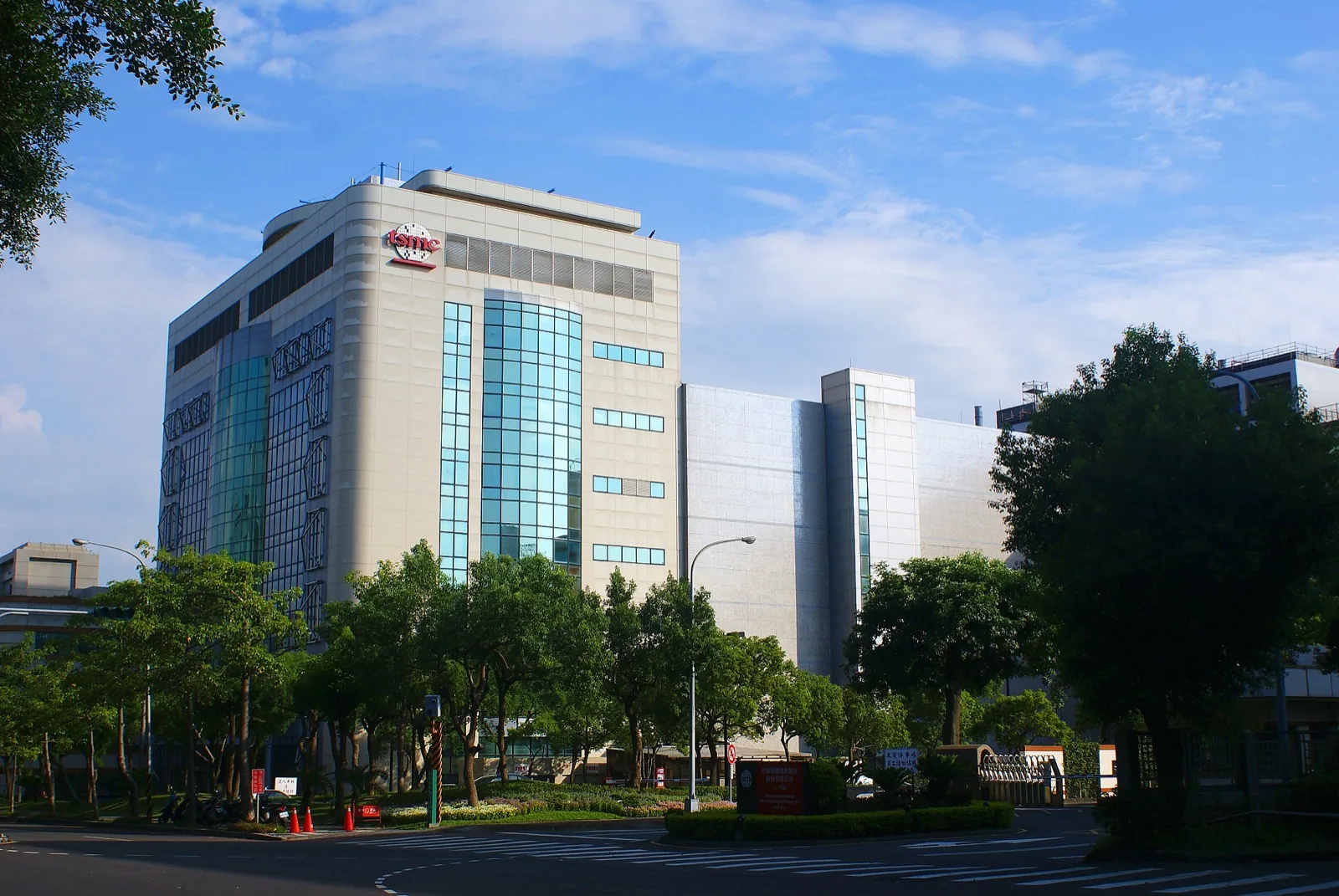
30-second overview: In 1979, a rice field on the eastern outskirts of Hsinchu was bulldozed flat, and Irving Ho, an engineer who had returned to Taiwan from IBM, built Asia’s first science park there. Forty-five years later, the three parks of Hsinchu Science Park, Southern Taiwan Science Park, and Central Taiwan Science Park have surpassed NT$5.8 trillion in annual revenue. The world’s most advanced chips are mass-produced in these three parks, and 2-nanometer processes have already entered production in Hsinchu Science Park and Southern Taiwan Science Park. But what this land wagered went far beyond industry: it bet on whether a resource-poor small island could turn itself around through a gamble no one believed in. Having won, Taiwan became the world’s lifeline; precisely because it won, it also became the world’s chokepoint.
Key figures: Combined 2025 revenue of the three parks reached NT$5.80 trillion, up 21.83% year on year; they employed more than 320,000 people; Southern Taiwan Science Park has surpassed Hsinchu Science Park as the output leader since 2023.
A Man Who Walked Back from IBM to the Rice Fields
In the winter of 1979, when the first bulldozer turned over the rice fields of Jinshanmian on Hsinchu’s eastern outskirts, Taiwan’s per capita income was still below US$2,000, and the three Chinese characters for “semiconductor” sounded to most people like an alien language. The people willing to bet the nation on that rice field were a small group of engineers who had just returned from the United States. One of them was named Irving Ho.
Born in 1921, Ho graduated from Xiamen University, earned a PhD in electrical engineering from Stanford, and then spent nearly twenty years at IBM. In 1974, at the invitation of the National Science Council, he returned to Taiwan and opened a course at National Taiwan University’s Department of Electrical Engineering titled “Design and Applications of Microprocessors,” bringing back to the island what was happening in Silicon Valley. In 1979, he became deputy minister of the National Science Council and concurrently director of the preparatory office for the science-based industrial park. The following year, he became the first director-general of the Hsinchu Science Park Bureau1. “Copying Silicon Valley,” in other words, was a very concrete matter: a group of people like Irving Ho carried Silicon Valley’s experience in their own bodies and walked back with it.
The park landed in Hsinchu because National Science Council minister Shu Shien-Siu made the decision. His reasoning was written into the official record for Hsinchu Science Park’s twentieth anniversary: Hsinchu had National Tsing Hua University, National Chiao Tung University, and the Industrial Technology Research Institute, “possessing scientific and technological R&D capacity and talent resources, comparable to the mutually stimulating development seen in Silicon Valley with universities such as Stanford and Berkeley”2. This was a deliberate site selection: build the park next to universities and national laboratories so that talent, technology, and entrepreneurs would collide within a five-minute drive.
The technological seeds had been planted even earlier. In March 1976, the Industrial Technology Research Institute and the Radio Corporation of America signed a technology transfer agreement, and a group of young engineers was sent to the United States for training. The following year, ITRI built Taiwan’s first integrated circuit demonstration factory in Hsinchu, using three-inch wafers and a 7.5-micron process3. This laboratory later became the matrix of Taiwan’s semiconductor industry: some of the people who left it founded United Microelectronics Corporation, Taiwan’s first semiconductor company, established in 19804; others became the first wave of entrepreneurs in Hsinchu Science Park. On December 15, 1980, the Hsinchu Science-Based Industrial Park officially opened, with Chiang Ching-kuo presiding in person5. In its first year, only a handful of companies moved in, and most people regarded it as a face-saving public works project that wasted taxpayer money.
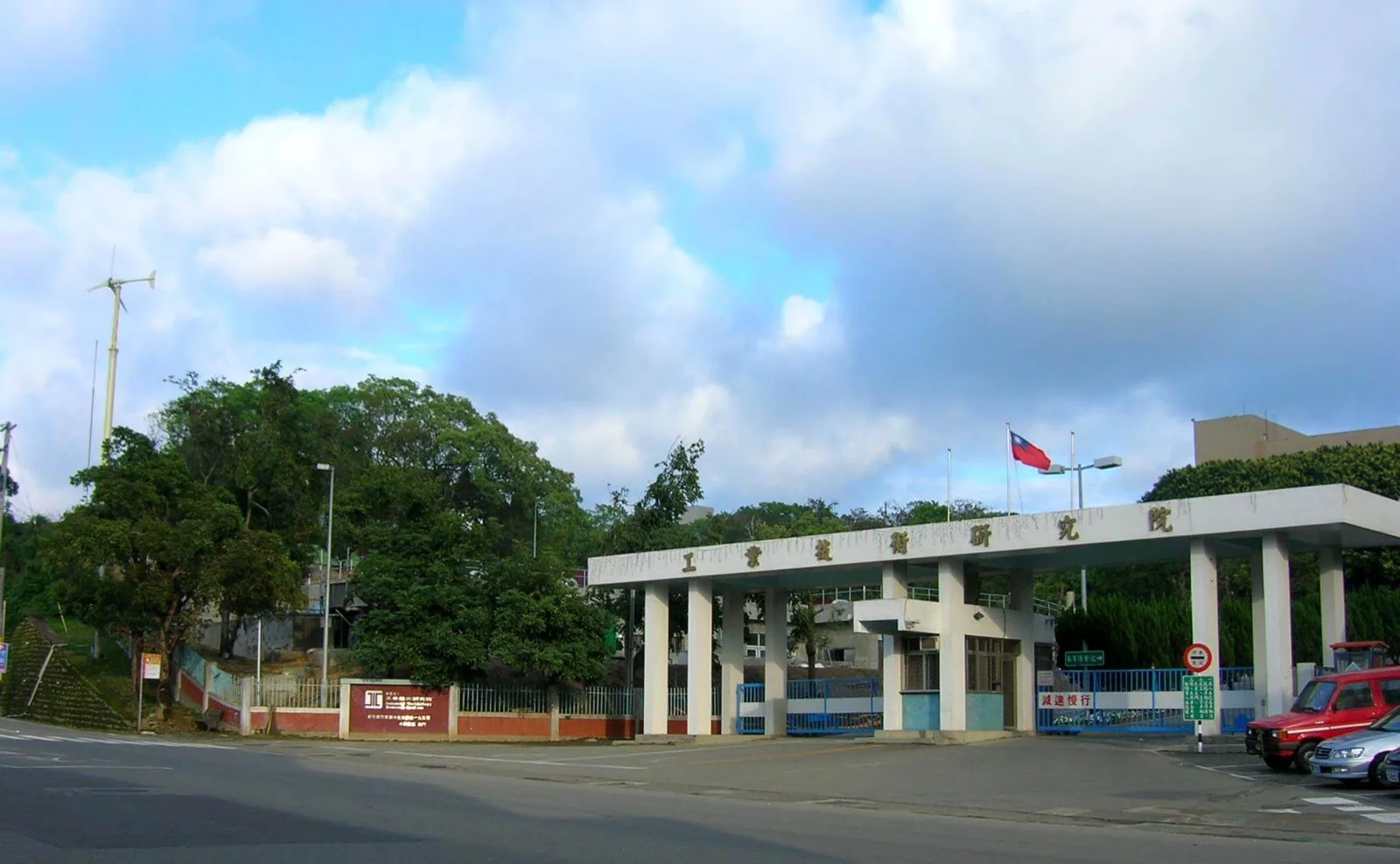
Industrial Technology Research Institute (ITRI). In 1976, ITRI signed a technology transfer agreement with RCA, and the following year it built Taiwan’s first three-inch wafer demonstration factory, becoming the matrix of Taiwan’s semiconductor industry. Photo: briston, 2006 (public domain). Wikimedia Commons.
The real turning point came in 1987. That year, Morris Chang, who had returned to Taiwan to take charge of ITRI, founded TSMC in Hsinchu Science Park and did something the whole world considered impossible: make only wafers for others, without designing chips of his own. The idea in fact had an earlier source. In 1985, K. T. Li, the minister without portfolio known as Taiwan’s “godfather of technology,” asked Morris Chang a question: “If Taiwan were to establish a new semiconductor company, what kind of company should it be?”6 Chang’s answer was a dedicated foundry. More than thirty years later, looking back on the company’s starting point, he put it bluntly: “I just wanted to survive!”7 At the time, no one believed a pure-play foundry model could sustain a company. TSMC grew out of the arithmetic of “survive first.”
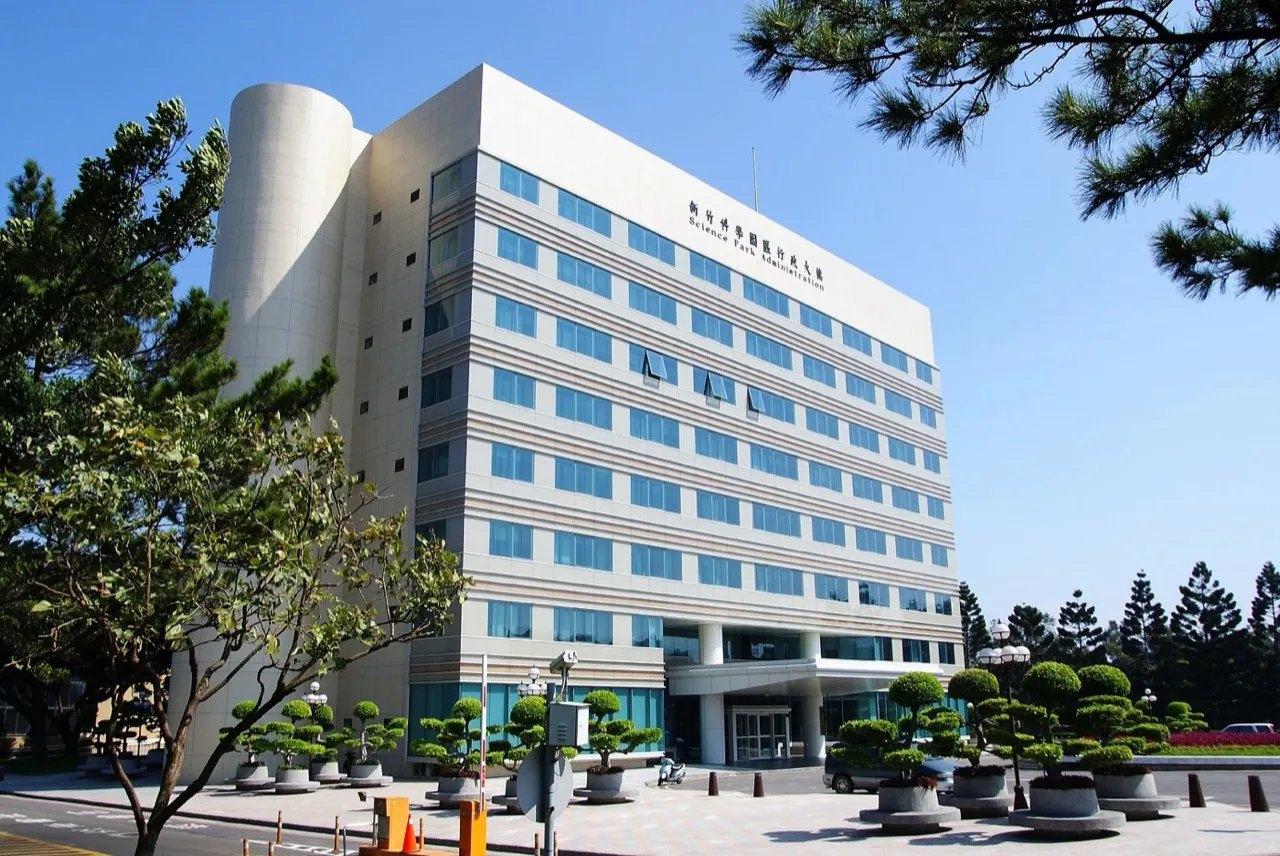
Hsinchu Science Park Bureau. This model, in which the government established a bureau to handle unified investment promotion and infrastructure construction, was later replicated by Southern Taiwan Science Park and Central Taiwan Science Park, becoming the common governance prototype for Taiwan’s science parks. Photo: Peellden, 2010. CC BY-SA via Wikimedia Commons.
📝 Curator’s Note
Today we are accustomed to telling the story of Hsinchu Science Park as a success born of “wise government planning,” but its starting point was in fact a series of uncertain decisions: betting money on semiconductors no one understood, building a park in rice fields, and believing in a foundry model no one looked favorably upon. A wager is a wager precisely because, at the moment the bet is placed, you do not know whether you will win. The forty-five-year story of Taiwan’s science parks, plainly put, is a high-stakes gamble that paid off; and those who win are the most likely to forget that they might once have lost.
A Park Where People Still Queue for Coffee at Eleven at Night
Hsinchu Science Park’s growth resembles a compressed evolutionary history. In the 1980s, it was a training ground for computer peripherals, where Acer and MiTAC assembled personal computers and Taiwanese engineers learned the survival rule of “cheap, fast, and usable.” In the 1990s, the semiconductor supply chain exploded here. From IC design to packaging and testing, a complete industrial chain took shape within a ten-kilometer radius. Nowhere else in the world could a chip move from design to shipment across such a short distance.
By the end of 2024, Hsinchu Science Park already had six satellite parks under it: Hsinchu, Zhunan, Tongluo, Longtan, Biomedical, and Yilan. Together they had more than 600 companies, more than 177,000 employees, and over 1,300 hectares of developed area. Integrated circuits accounted for about 70% of the park’s total output value8. But what those numbers cannot convey is the atmosphere of the park. Walk into a convenience store in Hsinchu Science Park at eleven at night, and engineers are still lined up to buy coffee. Restaurant menus in the park classify dishes by “shipping speed”; a meal served in five minutes is called an “urgent order.” Here, the unit of time is not the hour, but the wafer lot.
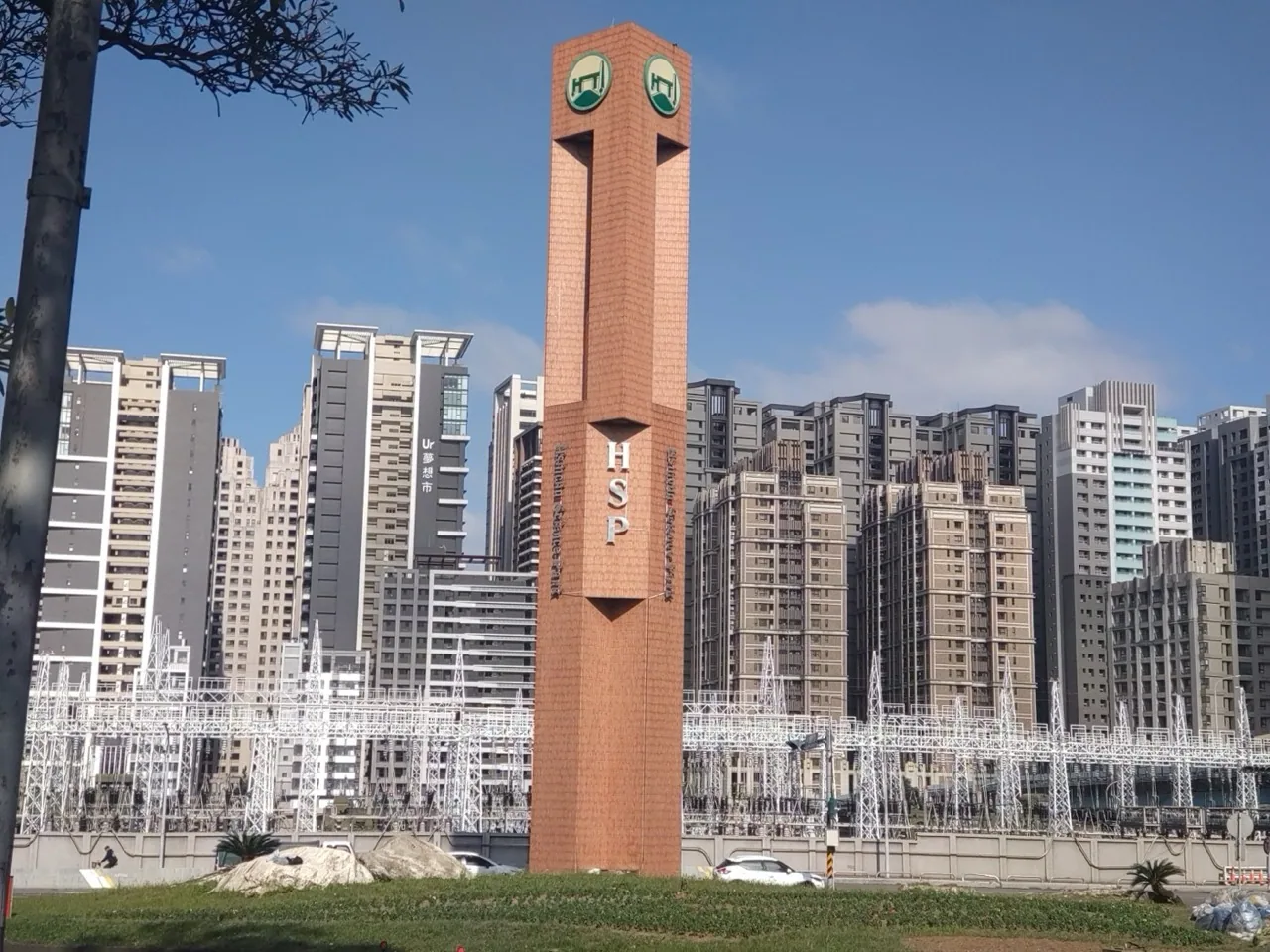
The Guangfu Road entrance to Hsinchu Science Park. From a small city’s wager, Hsinchu Science Park grew into a technology cluster that reshaped the entire urban appearance of Hsinchu. Photo: T Gordon Cheng, 2025. CC BY-SA 4.0 via Wikimedia Commons.
The park rewrote far more than the industrial map; the values of the whole island turned with it. Taiwan has a joke that has circulated for years: “First choice, electrical engineering; second choice, computer science; third choice... consider retaking the entrance exam.” Behind that joke lies the deep remaking of social choices by forty-five years of science parks. The term “technology nouveau riche” emerged in the late 1990s to describe Hsinchu Science Park employees who became wealthy overnight through stock bonuses. Only after employee bonuses were expensed in 2008, requiring companies to recognize bonuses as costs, did the aura around this “new wealth” slowly fade9. But the parks remain the first choice for Taiwan’s science and engineering talent: a senior TSMC engineer can earn more than NT$3 million a year, at the cost of always being on call and living a life converted into wafer lots.
Southern Taiwan Science Park Took the Top Spot
In the early 1990s, Hsinchu Science Park was full, and the Executive Yuan decided to build a second science park in southern Taiwan. The site selection process became a tug-of-war between politics and science. On January 14, 1995, the day of the final selection, nine review committee members inspected Xinshi in Tainan and Luzhu in Kaohsiung, then voted. Xinshi won by a landslide, eight to one, for practical reasons: Tainan had National Cheng Kung University to supply talent, and the land was flat and easy to develop. Luzhu ultimately became a satellite park of Southern Taiwan Science Park, today’s Kaohsiung Park, a kind of consolation prize10. In January of the following year, construction began on the Tainan Park of Southern Taiwan Science Park. No one at the time imagined that, thirty years later, this sugarcane field would become a production base for the world’s most advanced chips.
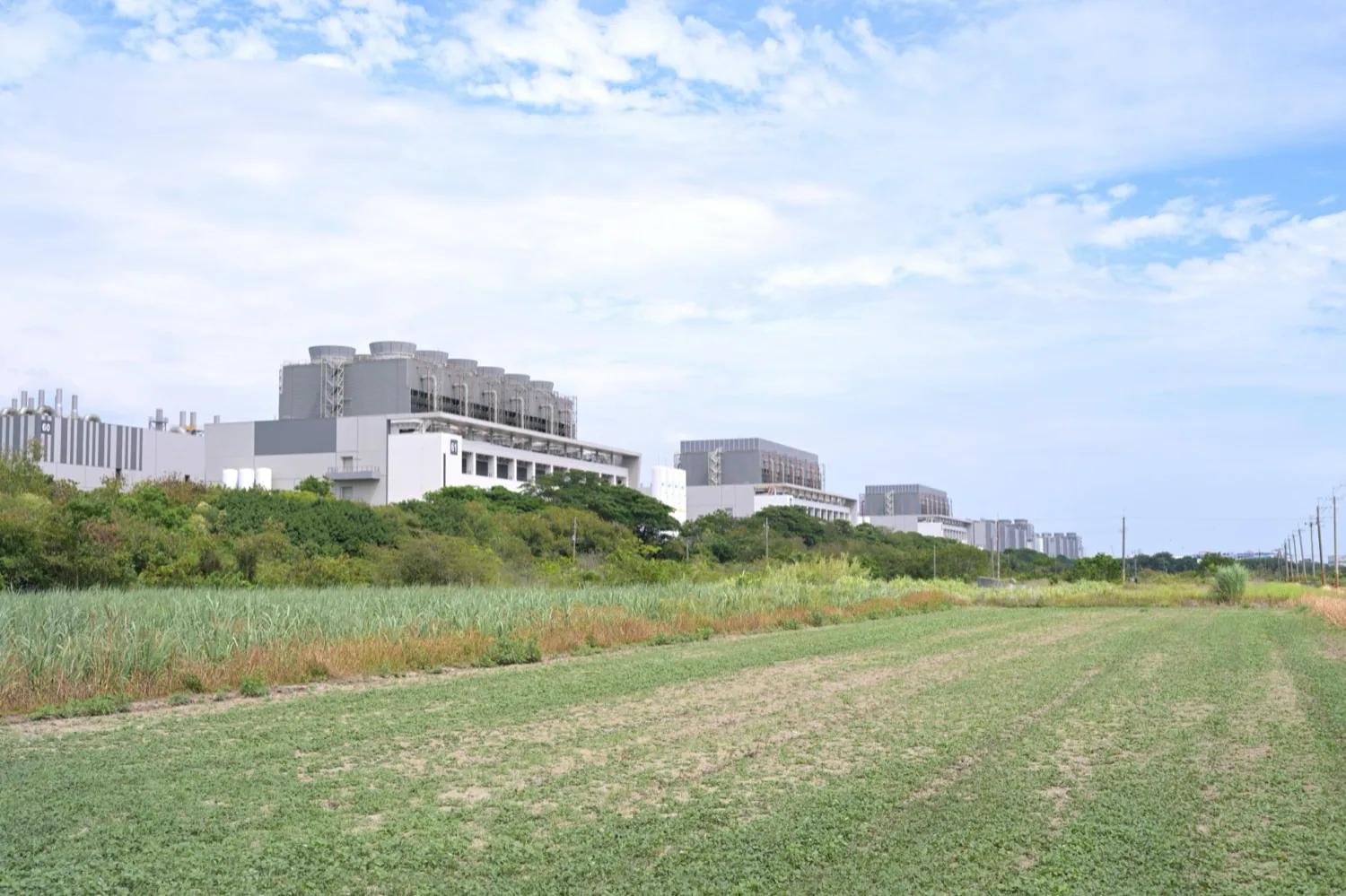
TSMC Fab 18 in Southern Taiwan Science Park, with the factory immediately adjacent to farmland. The 3-nanometer process is mass-produced here, while outside the perimeter wall there is still Tainan farmland: the most realistic contemporary slice of the rice-field wager made forty-five years ago. Photo: 4300streetcar, 2025. CC BY 4.0 via Wikimedia Commons.
The first half of Southern Taiwan Science Park’s life belonged to display panels. Chi Mei Optoelectronics, later merged into Innolux, and ChipMOS Technologies built factories here, and TFT-LCDs were once Southern Taiwan Science Park’s signature. But panel profits slid all the way down like a playground slide. Southern Taiwan Science Park needed a new engine, and that engine came from TSMC. As Hsinchu Science Park’s land and water resources approached their limits, TSMC moved its most advanced processes south. Fabs 14 and 18 landed in Southern Taiwan Science Park; the 3-nanometer process entered mass production here; and the clean rooms housed the largest number of extreme ultraviolet lithography machines in Taiwan, each costing several billion New Taiwan dollars.
Today’s Southern Taiwan Science Park is no longer just “the one in Tainan.” Six parks have grown under the administration bureau. The Tainan Park is the core of advanced processes, with TSMC’s Fabs 14 and 18 located there. The three Kaohsiung satellite parks, Kaohsiung, Qiaotou, and Nanzih, are taking up semiconductors and biomedical technology. Chiayi Park targets CoWoS advanced packaging, pulling the final-mile packaging capacity for TSMC’s AI chips southward. The southernmost Pingtung Park is betting on smart agricultural medicine and space. The eight-to-one site-selection vote thirty years ago was a bet on whether a sugarcane field could nurture technology. Thirty years later, the technology raised by this sugarcane field has grown southward along the high-speed rail into an industrial corridor stretching from Tainan to Pingtung.
Then something happened that many people did not notice. In 2023, Southern Taiwan Science Park, with revenue of more than NT$1.58 trillion, surpassed Hsinchu Science Park for the first time to become the output leader among Taiwan’s three science parks11. This reversal was not simply Southern Taiwan Science Park becoming stronger on its own. That year, Hsinchu Science Park was hit by a global economic downturn, with revenue falling nearly 12%, while Southern Taiwan Science Park grew against the tide thanks to the launch of 3-nanometer production. As one side ebbed and the other rose, the center of gravity of Taiwan’s semiconductor manufacturing quietly shifted south. By 2025, the three parks’ combined revenue had climbed to NT$5.80 trillion: Southern Taiwan Science Park at NT$2.97 trillion, Hsinchu Science Park at NT$1.70 trillion, and Central Taiwan Science Park at NT$1.13 trillion12. The gap is still widening.
Ten Months for a Park to Grow from Paper
If Hsinchu Science Park was the wager and Southern Taiwan Science Park was the overtake, then the keyword for Central Taiwan Science Park is “speed.” In the 2000 presidential election, Chen Shui-bian’s platform included “three thirds”: a third special municipality, a third science park, and a third international airport. After he was elected, preparations for Central Taiwan Science Park began. But what truly set it in motion was not politics, but the market: AU Optronics, a major panel maker, urgently needed a new factory site, and Hsinchu Science Park was already saturated. The government promised AUO it would open a new park in central Taiwan. The moment AUO nodded, Central Taiwan Science Park became real instead of just a plan on paper.
From September 2002, when the Executive Yuan approved preparations, to July 2003, when companies were allowed to move in, Central Taiwan Science Park took less than ten months13. In October 2004, AUO began mass production there, needing only one year and three months from factory construction to shipment. At the time, that speed set a record for Taiwan’s science parks. Today, Central Taiwan Science Park has five parks scattered from Taichung to Changhua, Yunlin, and Nantou. Taichung Park is the home base, with TSMC fabs located there and the second-phase expansion aimed at more advanced processes. Houli Park is the main stage for AUO and Micron. Erlin Park stalled for years because of environmental disputes before ultimately transforming into a precision machinery park. The story of Central Taiwan Science Park is: build the stage first, then let the companies decide what play to perform.
The five-part documentary series Silicon Island: Spring and Autumn, produced by DIGITIMES, uses five solar terms, “Awakening of Insects,” “Seeing the Rainbow,” “Flourishing Life,” “First Harvest,” and “Wild Geese Return,” to record the half-century trajectory of Taiwan’s semiconductor industry from ITRI’s demonstration factory to the “sacred mountain that protects the nation.”
Three Water-Drinking Monsters, One Island That Can Run Short of Water
Place the three parks side by side, and you see an unspoken competition: Hsinchu Science Park, Southern Taiwan Science Park, and Central Taiwan Science Park compete with one another for talent, land, water, and electricity. Together, the three parks absorb more than 320,000 workers, nearly the population of a mid-sized city, but Taiwan’s annual number of science and engineering graduates is fixed. Southern Taiwan Science Park’s expansion makes it harder for Hsinchu Science Park to recruit people; Central Taiwan Science Park’s growth pushes up rents in Taichung. In Taiwan, the word “park” has long been more than an industrial concept. It has reshaped cities: Hsinchu went from a small city to one of the highest-priced housing markets. In the first half of 2024, Hsinchu had the highest rent growth in Taiwan, and presale housing transactions in Baoshan Township had increased more than fivefold over the previous five years14.
The more fragile side is water. Semiconductor manufacturing requires large amounts of ultrapure water, and Taiwan is an island that can run short of water. The 2021 drought, the worst in fifty-six years, exposed that fragility to the world. In February that year, water storage in Hsinchu’s Baoshan Reservoir fell to 26%, and the Water Resources Agency warned that park water supplies would “bottom out in thirty to sixty days.” TSMC alone used 156,000 metric tons of water per day, accounting for more than 30% of science park water use. In the end, water trucks were mobilized to haul water everywhere for emergency use, and the company barely made it through by relying on a process-water recycling rate as high as 86.7%15. In the environmental impact assessment for Southern Taiwan Science Park’s third-phase expansion, water demand was set to increase from 200,000 tons to 250,000 tons per day, all of it coming from agricultural water, becoming the biggest point of controversy16.
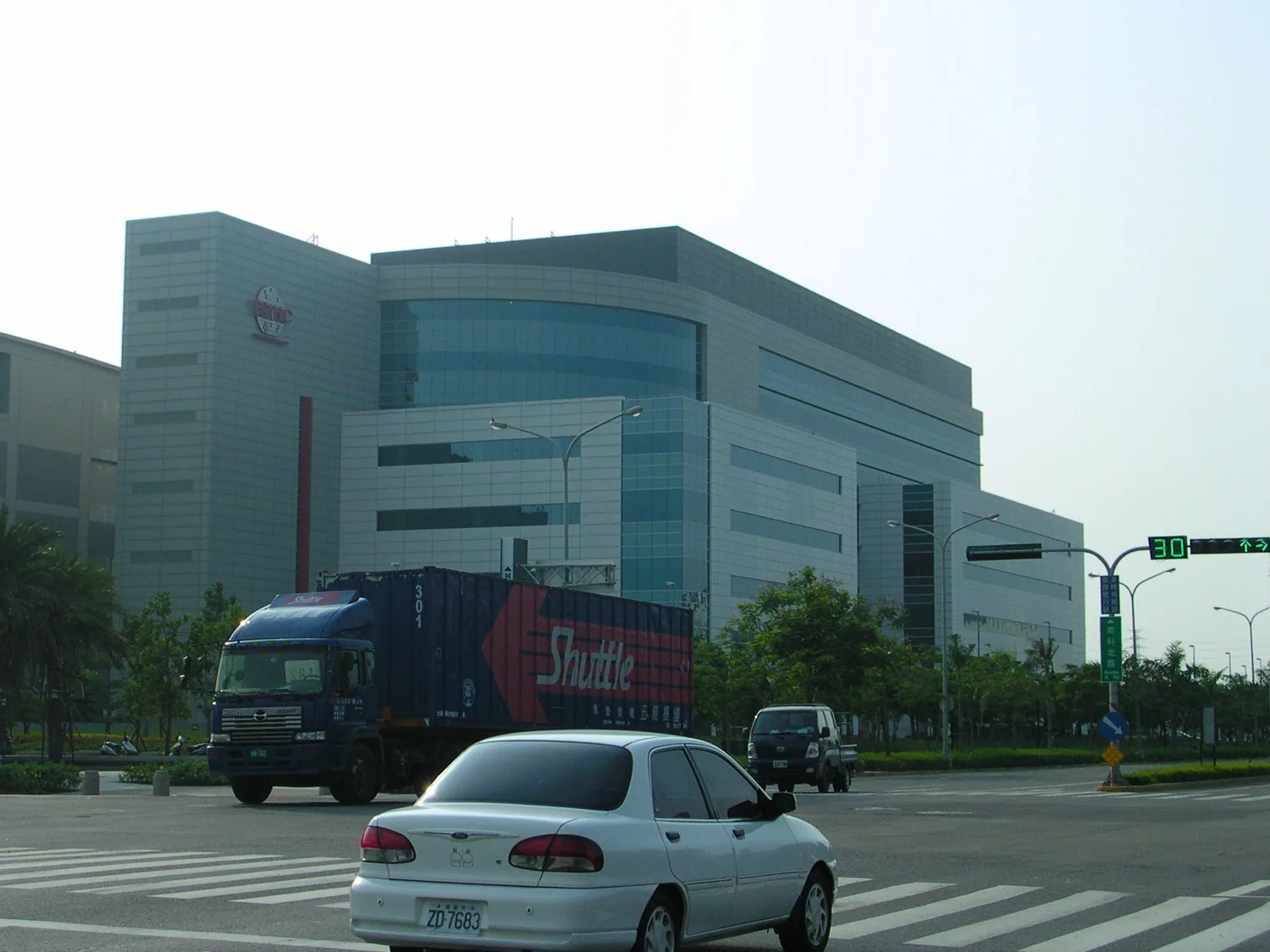
TSMC’s plant area in Southern Taiwan Science Park. Semiconductor manufacturing requires large quantities of ultrapure water and stable electricity. The three parks are like three water-drinking monsters, tying the fate of the entire island to the most basic question of whether “the heavens will send rain.” Photo: koika, 2006. CC BY-SA via Wikimedia Commons.
⚠️ Contested View
Semiconductors consume not only water, but also electricity. Taiwan’s 2030 renewable energy target is 30%, but the buildout of both solar and wind power has lagged behind target. The European Union’s Carbon Border Adjustment Mechanism, or CBAM, formally takes effect in 2026 and covers more than 200 Taiwanese export products17. When the parks’ carbon-neutrality pledges collide with the reality of insufficient green power, whether Taiwan’s chips will be held back by the island’s own energy structure remains an unanswered question.
This is the deepest contradiction of Taiwan’s science parks: on one small island, three monsters that consume water and electricity operate at the same time, propping up the world’s chip supply while tying the fate of the entire island to the most basic questions of whether the heavens will send rain and whether there will be enough electricity.
Talisman, or Bullseye?
In 2001, Australian journalist Craig Addison wrote a book that introduced the concept of the “Silicon Shield.” If China used force against Taiwan, the global chip supply chain would be cut off; from artificial intelligence to automobiles to household appliances, everything would stall within weeks. This kind of “mutually assured economic destruction” would force countries to intervene to protect Taiwan18. For more than twenty years, the Silicon Shield became Taiwan’s most frequently invoked talisman, and its core was precisely the cluster centered on the three major science parks, where the world’s most advanced chip capacity is concentrated within a radius of fifty kilometers.
But by 2025, the story of the Silicon Shield had taken an unsettling turn. The U.S. commerce secretary floated the idea of a “fifty-fifty split” in chip manufacturing, arguing that the United States needed sufficient domestic chip capacity in order to protect Taiwan. Liu Pei-chen, director of the Taiwan Industry Economics Database at the Taiwan Institute of Economic Research, pierced the matter with one sentence: the U.S. side had “changed the definition of the Silicon Shield from something unique to Taiwan into a shared resilience between the United States and Taiwan”19. That shield is being redefined, and the power to define it is slipping from Taiwan’s hands. Taiwan’s government clearly rejected the “fifty-fifty” claim; Vice Premier Cheng Li-chiun stated that it had “not been discussed, and we will not agree to it”19.
Whether the talisman might become a bullseye has also split debate within Taiwan into two camps. The optimistic side believes the Silicon Shield is being upgraded. Legislator Chen Kuan-ting said the Silicon Shield has already shifted “from ‘the world worries Taiwan has no chips’ to ‘global allies cannot do without Taiwan as a core partner,’” and that the key lies in Taiwan retaining the most advanced processes and R&D pilot production20. Former TSMC R&D director Yang Guang-lei offered an even more thought-provoking two-sided answer: on the one hand, he said “technology outflow is a false issue,” because the technology in overseas fabs still belongs to TSMC; on the other, he admitted that “the Silicon Shield effect will indeed weaken,” because pressures for supply-chain resilience will sooner or later force TSMC to set up factories overseas20.
At the core of this debate is a principle called “N minus one”: TSMC keeps the most advanced processes in Taiwan, and the technology exported overseas is always one generation behind. Looking at fab numbers, Taiwan has more than forty fabs, while overseas locations have only single digits. The company has also stated publicly that future capacity expansion will maintain a ratio of “one overseas fab to three Taiwan fabs.” Supporters say this proves that the R&D and decision-making core remains firmly anchored on the island. Skeptics worry that as fabs rise one after another in Arizona, Kumamoto in Japan, and Dresden in Germany, the world’s sense that it “must protect Taiwan” may be worn down bit by bit. MIT Technology Review put it bluntly: Taiwan’s greatest anxiety is that overseas fabs will make the United States and other countries feel Taiwan is “no longer so worth defending”21.
Director Hsiao Chu-chen’s documentary Island of Mountains: A Century’s Wager spent five years interviewing more than eighty semiconductor pioneers, turning this “wager of the century” into images. As TSMC successively builds factories in Arizona, Kumamoto in Japan, and Dresden in Germany, whether overseas expansion dilutes the Silicon Shield or pushes Taiwan toward the core of global specialization is precisely the question the film leaves with its audience.
✦ The same engineer can say, on the one hand, that technology outflow is a false issue and, on the other, admit that the Silicon Shield will weaken. This is Taiwan’s most real situation at this moment: it remains ahead technologically, yet geopolitically it cannot guarantee that this lead will translate into lasting security.
Beside the Clean Room Lies a 5,000-Year-Old Pottery Jar
During the development of Southern Taiwan Science Park, a large number of prehistoric sites were excavated. Archaeologists found beneath this land the 5,000-year-old Tapenkeng culture, the more than 3,000-year-old Niuchouzi culture, and Siraya settlements from several hundred years ago. Across the entire Southern Taiwan Science Park area, sixty-eight archaeological sites were identified, spanning six cultural periods. In October 2019, the Southern Branch of the National Museum of Prehistory, also known as the Southern Taiwan Science Park Archaeology Museum, officially opened. Designed by architect Kris Yao, it is a black cube with white lines, resembling a Rubik’s Cube from above, while the cross-sectional textures on its walls were deliberately made to look like archaeological strata sliced open layer by layer22.
This may be the most surreal scene in the world: beside the clean rooms for 3-nanometer chips stands an archaeology museum displaying 5,000-year-old pottery jars. The same piece of land holds two kinds of time. One is calculated in wafer lots, so fast it is measured by the minute; the other is calculated in millennia, so slow it requires carbon-14 dating. Taiwan’s science parks have not only layered industries together; they have layered time itself.
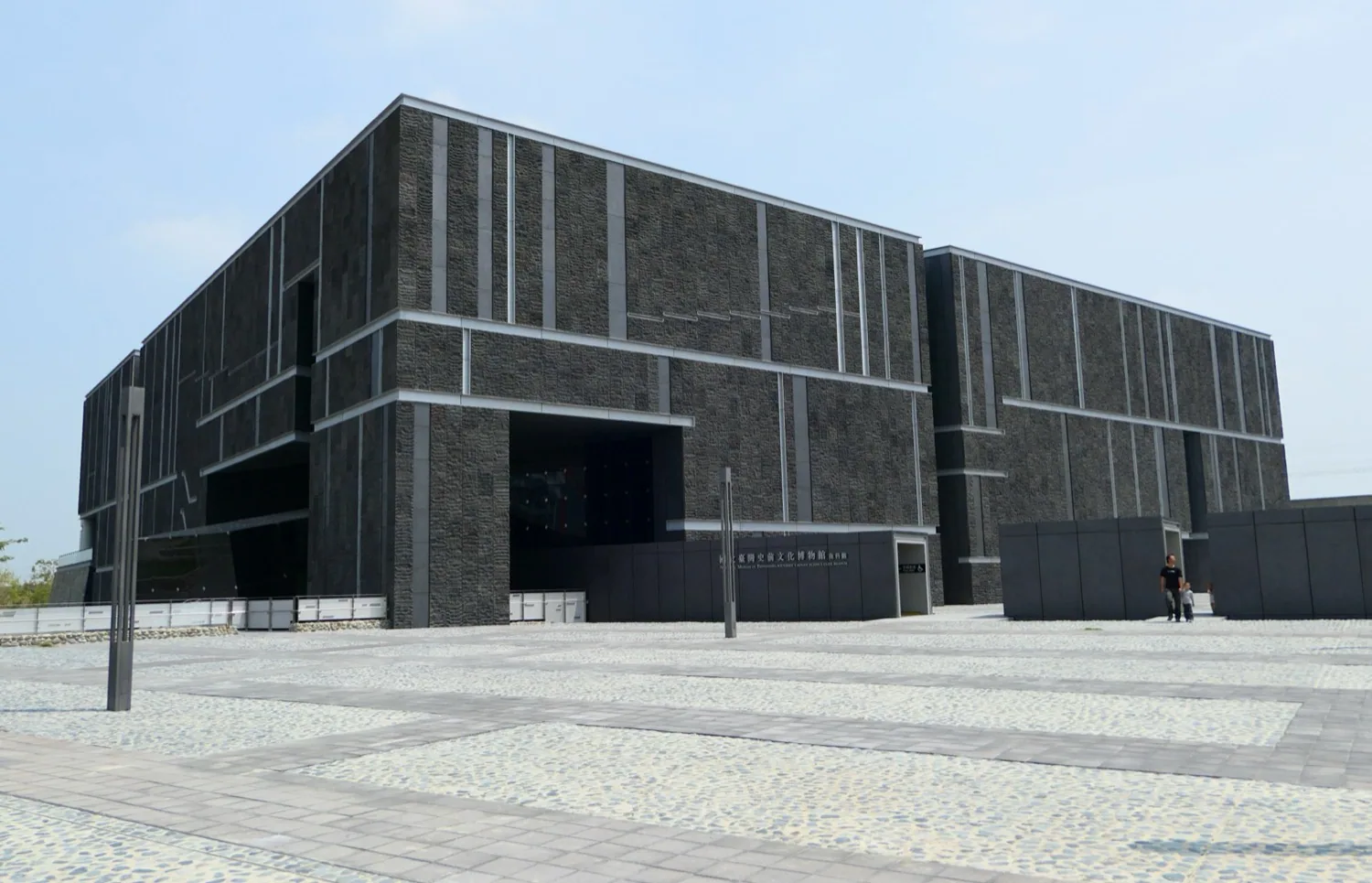
The Southern Taiwan Science Park Archaeology Museum, designed by Kris Yao and opened in 2019. During park development, sixty-eight prehistoric sites were unearthed, including Tapenkeng, Niuchouzi, and Siraya sites: wafer fabs and 5,000-year-old pottery jars are bound together by the same piece of land. Photo: Pbdragonwang, 2019. CC BY-SA 4.0 via Wikimedia Commons.
Pull the camera back to the rice field flattened in 1979. At the time, no one could guarantee the bet would win: the technology was borrowed, the model was unloved, and the site was farmland. Forty-five years later, this island has cultivated the chip capacity on which the world most depends. TSMC’s market capitalization once approached Taiwan’s entire annual gross domestic product, and the taxes it pays amount to a substantial share of the national defense budget23. Taiwan’s strongest talisman has grown into being, but that same irreplaceability has also made it the card everyone at the great-power gaming table wants to hold.
Forty-five years ago, that rice field bet on survival. After the bet was won, this island became the world’s lifeline and also its chokepoint. The next wager, about water, electricity, talent, and the shield now being redefined, has already begun. This time, Taiwan is not the only one seated at the betting table.
Where this story traveled
Further Reading:
- The Semiconductor Industry — The fifty-year materials revolution from RCA technology transfer to gallium nitride and quantum packaging, and how the chips in the parks became the most advanced in the world
- Taiwan’s Top 50 Companies — The “sacred mountain that protects the nation” supports a table, and also supports a single-point-of-failure country: the other side of science park output concentration
- Island of Mountains: A Century’s Wager — Hsiao Chu-chen’s 2025 documentary, built on five years of interviews with more than eighty semiconductor pioneers, turning this wager of the century into film
Image Sources
This article uses seven public-domain or Creative Commons-licensed images, all cached under public/article-images/technology/ to avoid hotlinking source servers:
- TSMC Fab 5 in Hsinchu Science Park — Photo: Peellden, 2010, CC BY-SA 3.0 (hero)
- Main gate of ITRI’s Chung Hsing campus — Photo: briston, 2006, public domain
- Guangfu Road entrance pillar of Hsinchu Science Park — Photo: T Gordon Cheng, 2025, CC BY-SA 4.0
- Hsinchu Science Park Bureau — Photo: Peellden, 2010, CC BY-SA
- TSMC Fab 18 and fields in Southern Taiwan Science Park — Photo: 4300streetcar, 2025, CC BY 4.0
- TSMC plant area in Southern Taiwan Science Park — Photo: koika, 2006, CC BY-SA 3.0
- Southern Branch of the National Museum of Prehistory — Photo: Pbdragonwang, 2019, CC BY-SA 4.0
References
- The Life of Dr. Irving Ho — Irving T. Ho Foundation for Technology Development and Education — A biographical account of Irving Ho (1921-2003) compiled by the memorial foundation, recording his path from Xiamen University and a Stanford PhD in electrical engineering to IBM, his 1974 return to Taiwan, his 1979 appointment as deputy minister of the National Science Council and director of the park preparatory office, and his 1980 appointment as the first director-general of Hsinchu Science Park.↩
- Hsinchu Science Park Twentieth Anniversary Special Issue: The Helmsman of the Science Park — An official special issue from the Hsinchu Science Park Bureau recording National Science Council minister Shu Shien-Siu’s reasoning for insisting that the park be located in Hsinchu, with the original text comparing the mutually stimulating development among Hsinchu’s Tsing Hua, Chiao Tung, and ITRI to that among Stanford, Berkeley, and Silicon Valley.↩
- ITRI Fiftieth Anniversary Historical Materials: The Starting Point of Semiconductors — Official historical materials from the Industrial Technology Research Institute recording the March 1976 technology transfer agreement with RCA, the dispatch of personnel to the United States for training, and the 1977 establishment of Taiwan’s first three-inch wafer, 7.5-micron process demonstration factory.↩
- UMC Milestones — UMC Official Website — UMC’s official milestone page, recording its establishment in May 1980 as a joint venture by ITRI, the Bank of Communications, China Development, and others, making it Taiwan’s first semiconductor company.↩
- Hsinchu Science Park — Wikipedia — Includes indexes and primary-source links on the founding history of Hsinchu Science Park, including the Statute for the Establishment and Administration of Science-Based Industrial Parks, passed by the Legislative Yuan and promulgated by the president in 1979, the establishment of the administration bureau in September 1980, and the opening ceremony on December 15.↩
- Hsinchu Science Park at 40: K. T. Li and Taiwan’s Semiconductors — CommonWealth Magazine — Records how minister without portfolio K. T. Li, known as the “godfather of technology,” asked Morris Chang in 1985 the key question, “If Taiwan were to establish a new semiconductor company, what kind of company should it be?”, as well as Li’s policy role in promoting ITRI and Hsinchu Science Park.↩
- Morris Chang on Founding TSMC — Business Today — An interview with TSMC founder Morris Chang looking back on the company’s early days, directly quoting his statement “I just wanted to survive” and reconstructing the context in which the pure-play foundry model emerged from the calculation of first seeking survival.↩
- Hsinchu Science Park Bureau — The official website of the Hsinchu Science Park Bureau, providing official statistics on the six satellite parks under Hsinchu Science Park (Hsinchu, Zhunan, Tongluo, Longtan, Biomedical, and Yilan), including company counts, employment, developed area, and industrial structure.↩
- Employee Bonus Expensing and the Technology Nouveau Riche — CommonWealth Magazine — Discusses how the “technology nouveau riche” phenomenon originated in the late 1990s as Hsinchu Science Park employees became wealthy through stock bonuses, and how the 2008 implementation of employee bonus expensing affected compensation structures and talent attraction in the high-tech industry.↩
- The Establishment History of Southern Taiwan Science Park — Southern Taiwan Science Park Bureau — The official history of the Southern Taiwan Science Park Bureau, recording the January 14, 1995 final selection, in which nine review committee members voted after inspections and Xinshi defeated Kaohsiung’s Luzhu by eight to one, as well as the January 1996 groundbreaking for the Tainan Park.↩
- Southern Taiwan Science Park’s 2023 Revenue Overtakes Hsinchu Science Park — IEK Industry Intelligence Network — Analysis from ITRI’s Industrial Economics and Knowledge Center recording that in 2023 Southern Taiwan Science Park, with revenue of NT$1.5855 trillion, surpassed Hsinchu Science Park’s NT$1.4201 trillion for the first time, contrasting Southern Taiwan Science Park’s countercyclical growth from 3-nanometer production with Hsinchu Science Park’s nearly 12% decline amid a global downturn.↩
- Science Parks’ 2025 Revenue Reaches NT$5.80 Trillion, Up 21.83% — National Science and Technology Council — An official NSTC press release announcing combined 2025 revenue of NT$5.80 trillion for the three major science parks, including NT$1.70 trillion for Hsinchu Science Park, NT$1.13 trillion for Central Taiwan Science Park, and NT$2.97 trillion for Southern Taiwan Science Park, up 34.26% year on year.↩
- Central Taiwan Science Park — Wikipedia — Includes indexes and primary sources on the Central Taiwan Science Park timeline from Executive Yuan approval of preparations in September 2002 to opening to companies in July 2003, AU Optronics’ entry and 2004 mass production, and the layout of the five parks in Taichung, Houli, Huwei, Erlin, and Zhongxing.↩
- The Semiconductor Talent Gap and Low Birthrate — Global Views Monthly — Reports on Taiwan’s semiconductor industry talent shortage of about 34,000 people, the low-birthrate pressure of births falling to 135,000 in 2023, and the structural challenges of rising housing prices and rents in Hsinchu and other areas driven by science park expansion.↩
- Science Parks’ Sixty-Day Water Crisis During the Drought — TechNews — Reports on the worst drought in fifty-six years in 2021, when storage at Hsinchu’s Baoshan Reservoir fell to 26%, the Water Resources Agency warned supplies would be exhausted in thirty to sixty days, and TSMC responded with daily water use of 156,000 metric tons, water trucks, and an 86.7% process-water recycling rate.↩
- Water-Use Controversy over Southern Taiwan Science Park’s Third-Phase Expansion — Environmental Information Center — Reports on the controversy in the environmental impact assessment for Southern Taiwan Science Park’s third-phase expansion, in which water demand would increase from 200,000 tons to 250,000 tons per day, all of it coming from agricultural water, and on environmental groups’ questions about cross-regional water resource allocation.↩
- How Taiwanese Companies Should Respond to the CBAM Carbon Border Mechanism — EY Taiwan — Analyzes the impact of the EU Carbon Border Adjustment Mechanism, or CBAM, which formally takes effect in 2026 and covers more than 200 Taiwanese export products, as well as the effects of Taiwan’s lagging renewable energy buildout on the semiconductor industry’s carbon-neutrality commitments.↩
- Silicon Shield — Wikipedia — Covers the concept of the “Silicon Shield,” proposed in a 2001 book by Australian journalist Craig Addison, explaining how Taiwan’s critical position in the global semiconductor supply chain creates a deterrent effect resembling “mutually assured economic destruction.”↩
- The Definition of the Silicon Shield Shifts from Taiwan-Unique to U.S.-Taiwan Shared Resilience — TechNews — Reports on the debate over the Silicon Shield definition triggered by the U.S. commerce secretary’s 2025 idea of a “fifty-fifty split” in chip manufacturing, quoting Taiwan Institute of Economic Research analyst Liu Pei-chen’s view that “the U.S. side has changed the definition of the Silicon Shield from something unique to Taiwan into U.S.-Taiwan shared resilience,” as well as Vice Premier Cheng Li-chiun’s official response that it had “not been discussed, and we will not agree to it.”↩2
- Is the Silicon Shield Being Upgraded or Diluted? — United Daily News — Reports on arguments for and against the Silicon Shield effect amid TSMC’s overseas expansion, quoting Legislator Chen Kuan-ting’s upgrade argument that “global allies cannot do without Taiwan as a core partner,” and former TSMC R&D director Yang Guang-lei’s two-sided view that “technology outflow is a false issue” while also admitting that “the Silicon Shield effect will indeed weaken.”↩2
- Taiwan’s Silicon Shield, TSMC, and China’s Chip Manufacturing — MIT Technology Review — A 2025 MIT Technology Review report analyzing concerns that TSMC’s overseas expansion could dilute the deterrent effect of the “Silicon Shield,” noting Taiwan’s worry that overseas fabs could reduce the urgency with which countries see Taiwan as “worth defending,” and summarizing the ratio of Taiwan to overseas fabs and the N-1 principle for process exports.↩
- Southern Branch of the National Museum of Prehistory — Wikipedia — Covers the sixty-eight prehistoric sites unearthed during Southern Taiwan Science Park development, including the 5,000-year-old Tapenkeng culture, Niuchouzi culture, and Siraya settlements, as well as the architecture and history of the Southern Taiwan Science Park Archaeology Museum, designed by architect Kris Yao and formally opened in October 2019.↩
- Analysis of TSMC’s Market Capitalization and Economic Contribution — Economic Daily News — Cites analysis by Quanliang International explaining the scale of TSMC’s market capitalization as a share of Taiwan’s stock market weighting and relative to Taiwan’s gross domestic product, as well as how its business income tax, dividends, and securities transaction tax contributions amount to a substantial share of the national defense budget.↩