
30-second overview: When Taiwanese people say "turn on the tap," they rarely think about how water reaches their homes. Since the Japanese colonial period, waterworks heads (水道頭) appearing across the island have left a visible cross-section of this supply system: water sources, sedimentation basins, slow sand filters, pump houses, and elevated water towers together formed urban infrastructure. They once addressed insufficient well water, infectious disease, and firefighting needs; later, reservoirs and large-scale water treatment plants took over. Today, the water towers have become historic monuments, preserving the idea that "clean water must be collectively built."
A Waterworks Head Is Not Just a Tower
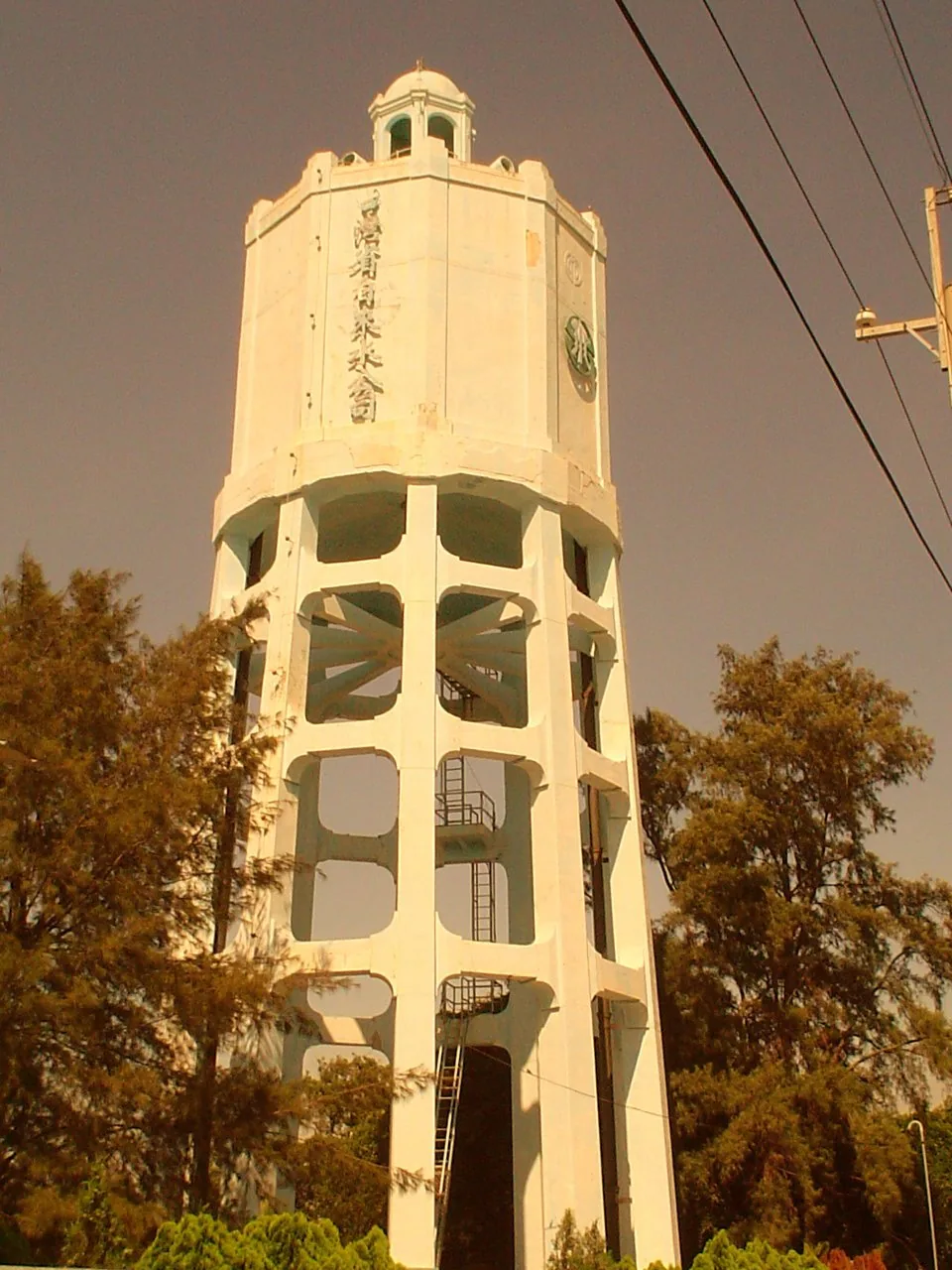
Puzi Waterworks Distribution Tower. Image source: National Cultural Heritage Database 〈Puzi Waterworks Distribution Tower〉, original article page: https://nchdb.boch.gov.tw/assets/overview/monument/20141104000001. Image cached by Taiwan.md at public/article-images/society/. Image usage rights subject to the original page and its competent authority's announcements.
In Taiwan's local context, "waterworks head" (水道頭) is often used to refer to old waterworks plants or distribution towers, but this term points to more than a single building. A complete waterworks system includes water intake, sedimentation, filtration, disinfection, pumping, and distribution. The water tower is merely the most visible part in the cityscape. The Beigang Waterworks Plant's explanation is direct: raw water undergoes sedimentation, filtration, and disinfection, then pumps push it up to the water tower for delivery to homes.1 Water towers are built high to store water and create pressure, letting water flow into neighborhoods by gravity.
This engineering leaves objects of several different scales on the ground: towering distribution towers, low pump houses, filter basins within walls, and pipelines running underground to city streets. Walking into the relatively well-preserved Huwei Waterworks Plant, one sees not just an octagonal water tower, but also a pump room, material warehouse, and staff dormitories. The National Cultural Heritage Database lists it as an industrial heritage site because this area preserves evidence of how the water tower operated together with operations, maintenance, and labor.2
The Order Inside the Water Tower
The water tower's height serves the time lag and pressure differential in the supply system. It temporarily holds both in a single container, which is why it stands out so prominently in photographs. Pumps send treated water up; the storage tank buffers against usage fluctuations; the elevated position then lets water flow downward through pipelines for distribution. The process recorded in Beigang's materials runs from sedimentation, filtration, disinfection all the way to pumps and the water tower. This process explains how "tap water" consists of a chain of interdependent tasks.1
Therefore, the pump house, filter basins, and pipelines beside the water tower cannot be treated as subordinate scenery. Each bears different responsibilities: the pump house pushes water upward, filter basins treat impurities in raw water, the water tower regulates volume and pressure, pipelines deliver the result to neighborhoods. Preserving only a tower without explaining the whole system amounts to saving only the shell of urban convenience while hiding away the labor of maintenance, shift work, inspection, and local payment all over again.
| System Position | Primary Work | Clues Preserved in Cultural Heritage |
|---|---|---|
| Water source & intake facilities | Obtain river, groundwater, or other raw water | Water source location, intake structure & terrain relationship |
| Sedimentation & filtration facilities | Reduce suspended solids & impurities in raw water | Filter basins, sedimentation basins & waterworks layout |
| Pump house & pumps | Send treated water to elevation | Pump room, machinery foundations & maintenance space |
| Distribution tower | Temporarily store water volume, create height needed for distribution | Tower body, columns, tank body & ornamental top |
| Underground pipe network | Distribute water to streets & homes | Routes, connected households & historical records of supply coverage |
Clean Water Was First a Public Health Engineering Project
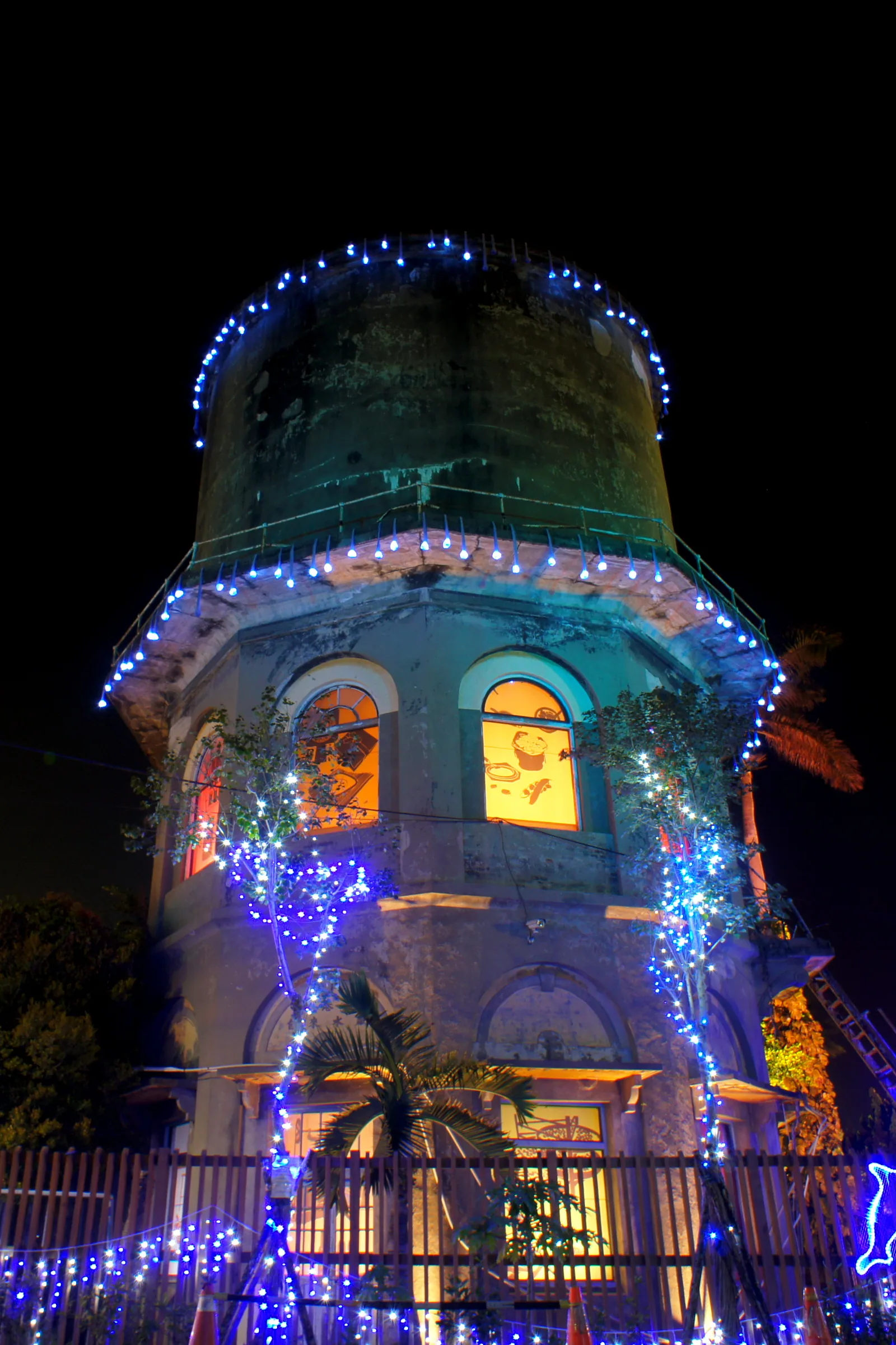
Beigang Waterworks octagonal water tower. Image source: Wikimedia Commons, original file page: https://commons.wikimedia.org/wiki/File:Beigang_Water_Tower(Taiwan. Image cached by Taiwan.md. Please use per the license terms listed on the original file page._
The story of waterworks cannot be written simply as "urban modernization" in four characters. It was first a response to disease and daily risk. The Puzi Waterworks Distribution Tower's cultural heritage data records that the area previously relied on well water, with reduced volume in winter, and dust and sanitation issues left residents facing eye disease, respiratory illness, and fire risk. The locality also needed improved drinking water environments due to infectious disease. The Puzi Waterworks, proposed in 1933 and completed in 1935, emerged under such pressures.3
Huwei's timeline is similar but adds a layer of industrial demand. The Huwei Water Tower, begun in 1929 and completed in 1930, served not only residents but also connected to the sugar factory, government offices, and schools' water needs. Records indicate that waterworks construction was simultaneously driven by population growth, sugar factory expansion, and a cholera outbreak.2 The waterworks thus became an invisible urban order: it gradually rewrote "who could obtain safer water" from the capability of private well owners into a service jointly paid for and jointly maintained by the city streets.
Connecting to the Pipe Is Not Just a Technical Issue
Tap water is often described as a modern service that anyone can connect to and immediately have, but Huwei's cultural heritage data leaves a less smooth early picture: after supply facilities were established, the sugar factory, government offices, public venues, and schools were connected earlier; local gentry and Japanese residents also connected more easily. Rural areas were not within the same supply coverage.2 This record makes the word "public" concrete: the waterworks did expand the possibility of safe drinking water, but how pipelines were laid, which areas were incorporated first, and who bore connection costs remained part of urban distribution.
Taipei began implementing metered supply in 1924, signifying that water was no longer a natural resource drawn from public wells, but a measurable, chargeable, and manageable service.4 Metering let the supply system sustain itself, and formed a new relationship of responsibility between households and government: households paid for water, agencies had to maintain water quality, pressure, and pipelines. The water tower is therefore both an engineering object and an institutional object. It binds the flow of water to the rules of the city.
For supply service to become a shared institution, the work arrangements of intake, metering, billing, and maintenance must first be completed. The Taipei Water Department's organizational history shows that Taipei's public water supply began with well water and filtration/disinfection in the late Qing period, and the 1907 Xindian Creek water source project became the starting point of the modern waterworks enterprise. In 1924, metered supply was implemented.4 Water changed from "drawn from wells" to "a public pipe network billed by volume," behind which lies an entire new set of urban governance.
Why Some Water Towers Look Like Clock Towers, Others Like Pillboxes
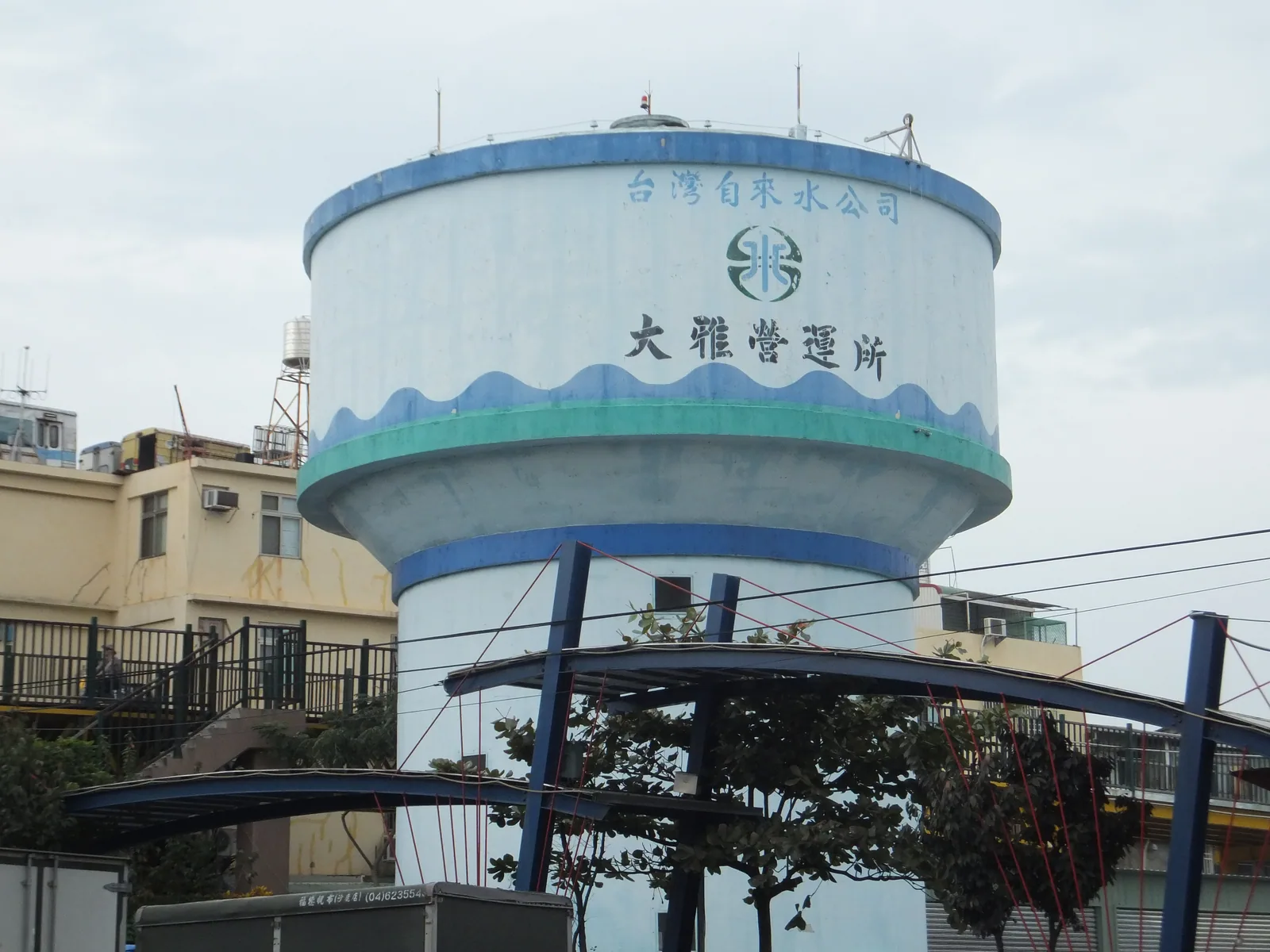
_Taiwan Water Corporation Daya Operation Station water tower. Image source: Wikimedia Commons, original file page: https://commons.wikimedia.org/wiki/File:Water_Tower_of_Daya_Operations_Station,_Taiwan_Water_Corporation_20111112.jpg. Image cached by Taiwan.md at public/article-images/society/. Please use per the license terms listed on the original file page._
Water towers simultaneously play engineering and urban landscape roles. The Puzi Waterworks Distribution Tower adopts a circular tank body, ten columns, and a clock-tower-style ornamental top; its Western-style appearance makes it a city landmark. It can hold 450 tonnes of water, yet is also regarded by locals as a building that identifies the city.3 Taichung's Water Source Elevated Tower has tall arcades, brick walls, washed pebble finish, and classical capitals. When commissioned in 1916, its sedimentation and purification functions were wrapped in a facade that need not be ornate, yet sufficed to represent a new-style public works project.5
Water towers in different localities reflect differences in supply scale, terrain, population, and fiscal conditions; a single "Japanese style" cannot summarize them. The Gangshan Water Tower, built in 1925, responded to population development and military needs; it ceased supply in the 1990s but was preserved as a local landmark.6 The Linbian Water Source High-Pressure Water Tower, built in 1938, was part of the Donggang Waterworks, using gravity supply to serve the airfield, official quarters, and Donggang township. It now preserves a segment of decommissioned facility history and has become a shared memory for Linbian residents to recognize their place.7
Water towers are often photographed as scenery because they lift an originally buried public system into the sky. Citizens never see transmission mains, and rarely know how a water treatment plant operates internally, but recognize from afar that elevated cylinder, octagonal column, or blue tower body. Engineering thereby acquired a landmark's form. The landmark in turn preserves the engineering's name.
The Life Cycle of a Water Tower
The story of waterworks heads can be divided into several stages, but each locality's pace differs. Data from Beigang, Huwei, Puzi, Gangshan, and Linbian show the same type of facility playing different roles in different eras. Some water towers still serve as backup towers, some have ceased their original supply function, some have become local landmarks again through preservation.12367
| Stage | What the City Sees on the Surface | Easily Overlooked Work |
|---|---|---|
| Construction | New tower body, pump house & roads appear simultaneously | Water source survey, engineering permits, land & funding arrangements |
| Operation | Water flows from tap, tower body becomes landmark | Shift duty, pumping, filtration, disinfection, maintenance & metering |
| Expansion | More households & institutions join supply network | Pipeline extension, connection allocation & water billing |
| Transition | Reservoirs, treatment plants or new pipe networks take over | How old equipment is handled, which remain as backup, who maintains them |
| Preservation | Monument, park or symbol of local memory | How to interpret original function, restrict access & preserve surrounding facilities |
From Waterworks Heads to Large-Scale Water Treatment Plants
Waterworks heads were decommissioned after the urban scale expanded, because the supply system had shifted to a new configuration. PTS's "Our Island" interviewed waterworks systems, describing water sources in Tamsui, Caoshan, Puzi, and Tainan: some still supply water, some lost original function due to river pollution or replacement by new systems, leaving buildings that turned into cultural heritage.8 The Taichung Water Source Elevated Tower also records that in the 1980s, supply methods shifted to reservoirs and water treatment plants, and the water tower was later repurposed as offices.5
This transition brings an easily overlooked contradiction. When waterworks heads were still supplying water, they were workplaces needing maintenance, cleaning, and control. After being designated as monuments, society hopes they will be open, visible, and adaptively reused, yet cannot simplify facilities that still have safety restrictions into a mere backdrop photo. The difficulty of cultural heritage preservation lies not in painting the water tower beautifully, but in preserving the complete context of how it once worked, who maintained it, when it lost function, and why it is worth keeping.
The Taipei Water Department's organizational history provides another thread: in 2000, the Museum of Drinking Water and Waterworks Park were opened, followed by an education center, direct-drinking fountains, and disaster-relief water supply facilities.4 This shows water culture need not remain in nostalgia. Old waterworks heads can become entry points for understanding modern water supply, public health, and disaster resilience. They remind people that urban convenience comes from long-term engineering and institutional choices, not natural formation.
The Maintenance and Disaster Prevention Questions Left by Waterworks Heads
The truly difficult part of a supply system is usually not the day it launches, but the decades of sustainment afterward. Water towers need regular inspection of tank body, columns, and pipelines; pump houses need operators; filter basins and sedimentation basins need cleaning. Water quality management likewise requires continuous work. If any link loses function, households may face unstable pressure, outages, turbidity, or life changes forcing alternative water sources.
From Huwei's data, early waterworks simultaneously connected with the sugar factory, government offices, schools, and residents. This multiplicity of users gave the waterworks the nature of a public facility, and made maintenance costs, connection sequence, and supply coverage into local governance issues. Who connected first, who got priority support during shortages, which agencies needed reserved backup volume — these arrangements are reflected in the invisible pipe network and account books.2
Modern cities have handed supply scale to large treatment plants and reservoirs, so waterworks heads exited the daily production line, but they have not lost disaster-prevention education value. The Taipei Water Department's installation of direct-drinking fountains and disaster-relief water supply facilities in the Waterworks Park precisely illustrates how old waterworks can connect to today's resilience issues.4 When people visit a water tower, they can further ask: when the power goes out, where does water come from? When pipelines break, how is zoned supply managed? Can the monument's surroundings still let residents understand evacuation and water collection locations? These questions extend preservation work from facade restoration to urban use.
Cultural heritage preservation therefore needs to preserve the surroundings, not just restore the tower body. Pump houses, filter basins, roads, walls, and trees together explain how the waterworks was embedded in the city. If only the tower body is painted in eye-catching colors and a brief interpretive plaque installed, visitors see a symbol but cannot understand how the equipment operated. A better exhibition should place water flow paths, operating personnel, connected households, and institutional changes in the same narrative, letting architecture, engineering, and life correspond to each other.
Preserving a Tower, Also Preserving a Shared Way of Life
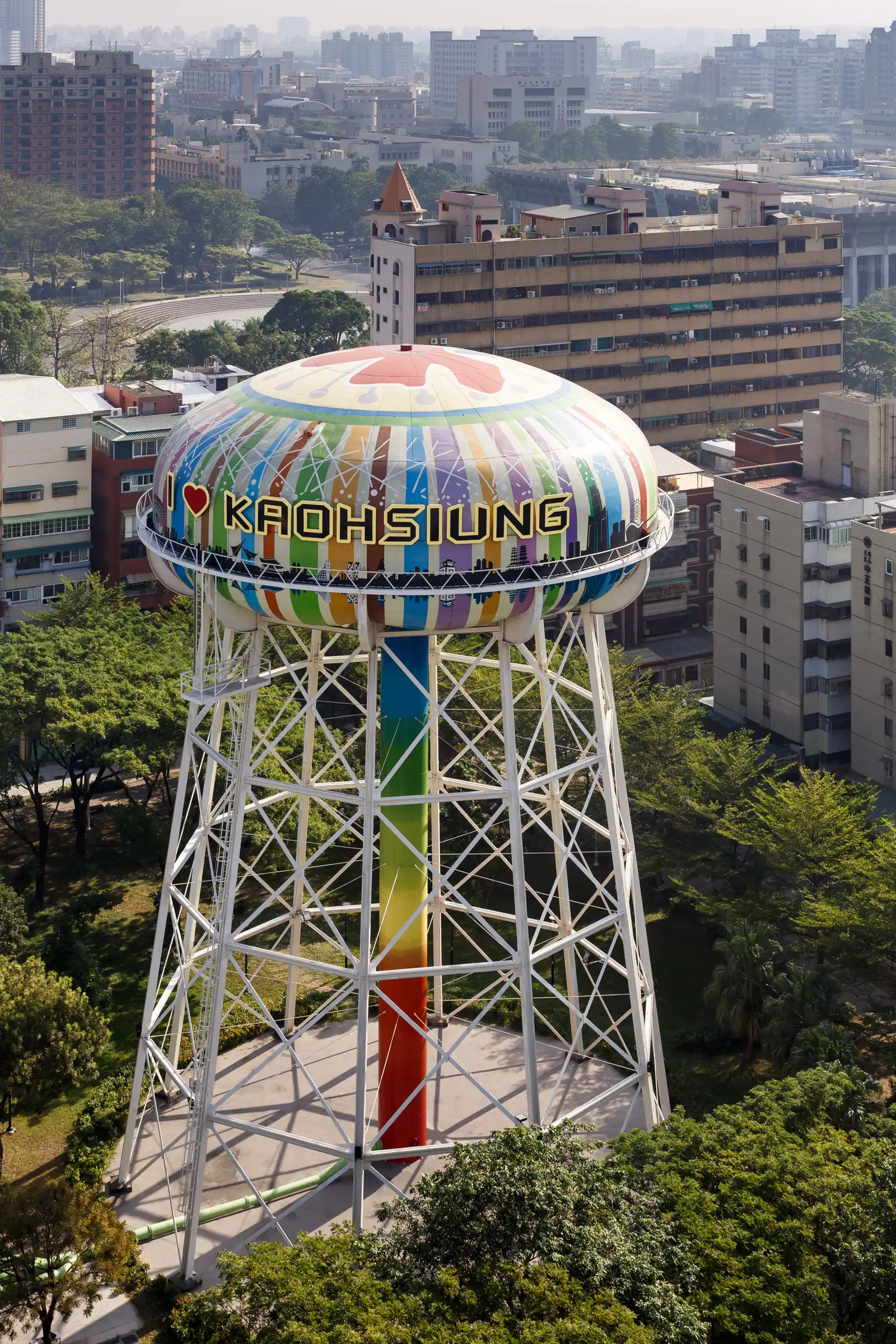
Kaohsiung Water Tower Park water tower. Image source: Wikimedia Commons, original file page: https://commons.wikimedia.org/wiki/File:Kaohsiung_Taiwan_Water-Tower-Park-01.jpg. Image cached by Taiwan.md. Please use per the license terms listed on the original file page.
Standing under the Puzi Waterworks Distribution Tower today, one most easily sees its clock-tower-like ornamental top first. In Huwei, one notices the octagonal tower body and surrounding pump houses. In Linbian, one might regard the high-pressure water tower as part of the local landscape. These differences matter. Taiwan's waterworks heads formed their own local versions in different streets, industries, and disease experiences; they are not replicas of a single central model.
Together they explain one unromantic yet very concrete thing: public life must first have public facilities, and public facilities must have people willing to take long-term responsibility. Waterworks heads once turned well water, stream water, and groundwater into measurable, distributable, manageable urban resources. After retirement, these facilities bring a segment of often-overlooked engineering history back into the streetscape.
Taiwanese people's memory of waterworks heads often starts from "that tower," and only later reaches pipelines, filter basins, pumps, and water quality. This order perhaps precisely reflects urban life's blind spot: we first enjoy the tap's result, then recall the system behind it. Preserving waterworks heads is not to make everyone return to an era without tap water. It lets people see that clean water does not appear out of thin air. It was once slowly sent into Taiwan's daily life by tower after tower, worker group after worker group, and institution after institution.
What to Look for When Visiting a Waterworks Head
Visiting a waterworks head, the first glance is usually drawn to the tower body. If you lower your gaze, you see the joints between columns and ground. Here one can often read traces left by the tower's load-bearing, drainage, and subsequent repairs. Looking further around, the pump house's doors and windows, vents, chimney, or machinery foundations are often closer to actual operations than the tower body. They hint at how pumping, cleaning, inspection, and shift duty once occurred.
The second observation direction is water flow. One can start from the relative positions of water source, sedimentation basin, filter basin, pump house, and distribution tower, imagining how raw water was treated, then sent aloft. If the site still has interpretive plaques or plan drawings, note whether they explain pipeline routing, supply coverage, and equipment changes across periods. Looking only at architectural style easily slots the waterworks head into a vague nostalgia category. Reading along the water flow lets one understand it as a working factory.
The third direction is users. Huwei's data reminds us that the sugar factory, schools, government offices, and residents did not necessarily connect to tap water at the same time.2 Therefore, when visiting, one can look for old roads, dormitories, factories, and market streets, and consider who was closest to the water tower, who needed to pay connection fees, who lay outside the supply coverage. These questions may not get complete answers on site, but they prevent imagining public facilities as undifferentiated service.
Finally, the preservation method. If a water tower retains only its appearance, the city may remember its name but forget its function. A more complete exhibition should simultaneously convey construction era, treatment process, operating personnel, supply targets, decommissioning reasons, and subsequent uses. Cultural heritage pages provide dates and structural data; water supply agencies' organizational histories supplement institutional changes; public media's on-site reporting brings out different water sources' preservation situations. Cross-referencing these three types of data comes closer to a waterworks head's complete life history.
Further Reading
To place waterworks heads back into a larger context, three threads can be followed: the Taipei Water Department's organizational history suits tracing how the modern supply system formed. The National Cultural Heritage Database's Huwei and Puzi cases suit comparing local waterworks' architectural, industrial, and hygiene backgrounds. PTS "Our Island"'s water conservancy construction special provides on-site perspectives of different water sources between decommissioning, preservation, and adaptive reuse. These further readings jointly point to the same question: when water disappears from the streetscape, who can still let people see how it was once delivered to their doorsteps?
Image Sources
This article uses 4 in-text images and 1 cover image, all cached at public/article-images/society/, avoiding hotlinking external image servers. The Puzi Waterworks Distribution Tower image is from the National Cultural Heritage Database case page. The Daya, Beigang, and Kaohsiung water tower images are from Wikimedia Commons case file pages. All images' original pages, author/rights status, and usage restrictions are subject to the latest markings on each image's source page.
References
- Beigang Waterworks Plant (Decagonal Water Tower & Pump House) — See original link for supplementary textual data↩23
- Huwei Waterworks Plant — See original link for supplementary textual data↩23456
- Puzi Waterworks Distribution Tower — See original link for supplementary textual data↩23
- Taipei Water Department: Organizational History — See original link for supplementary textual data↩234
- Water Source Elevated Tower — See original link for supplementary textual data↩2
- Gangshan Water Tower — See original link for supplementary textual data↩2
- Linbian Water Source High-Pressure Water Tower — See original link for supplementary textual data↩2
- 〈Water Conservancy Construction〉 Century-Old Waterworks Heads | Where Does Taiwan's Tap Water Come From? — PTS Our Island Special: PTS Our Island Special↩