
30-Second Overview: Social housing is not a construction project where the government builds houses, conducts a lottery, and then considers the job done; it is a public system that ensures people who lack the ability or willingness to buy homes can still secure stable housing. Since amending the Housing Act in 2017 to establish the legal and institutional foundation for social housing policy, Taiwan has adopted the "8 Years, 200,000 Units" goal as its primary target, integrating government-led direct construction and private-sector leasing management into a single policy framework. 1 However, "unit counts" do not guarantee that all families can actually move in: the location, rent, application documents, quotas for vulnerable groups, lease terms, transportation, childcare, and management quality are what determine whether a policy truly changes lives.
This article uses three questions to help readers understand the policy. First, what different types of housing units and subsidies does the government actually provide? Second, how do the published "unit counts" distinguish between development, completion, leasing, effective contracts, occupancy, and duplicate assistance? Third, once housing policy enters local communities, who is responsible for handling rental stability, repairs, accessibility, care services, neighborhood relations, and appeals? The answers determine whether social housing is a short-term supply project or a public infrastructure that can span stages of unemployment, family formation, child-rearing, disability, and aging.
Why Housing Justice Is More Than Just Housing Prices
When discussing housing issues in Taiwan, the most frequently cited metrics are the housing price-to-income ratio, loan burdens, and property transaction prices. These indicators are important, but they do not cover everyone’s housing experience. For renting families, the problems also include whether lease agreements can be renewed, whether landlords are willing to accept families with children or pets, whether the property has risks of water leakage or fire hazards, whether rents suddenly increase with the market, and whether one can maintain their original work, school, and care networks after moving.
Therefore, housing justice has at least four levels. The first is affordability: rent and management fees must not force families to choose between food, healthcare, education, and housing. The second is stability: families must not be forced to move repeatedly due to short-term leases, landlords selling the property, or changes in usage. The third is quality and accessibility: residences must have basic safety, accessibility, ventilation, lighting, and public services, and must reasonably connect to work, schooling, and care. The fourth is choice and dignity: a vulnerable status should not force someone to live only in remote, poor-quality, or stigmatized locations.
Social housing plays the role of "non-market, but not temporary relief" housing supply within this framework. It does not require every renter to meet minimum income qualifications, nor does it direct all families toward homeownership; instead, it provides long-term, tiered, and affordable rental options through the government or government-regulated institutions. The value of this system lies not in replacing the private rental market, but in preserving a public baseline for those whom the market fails to serve stably.
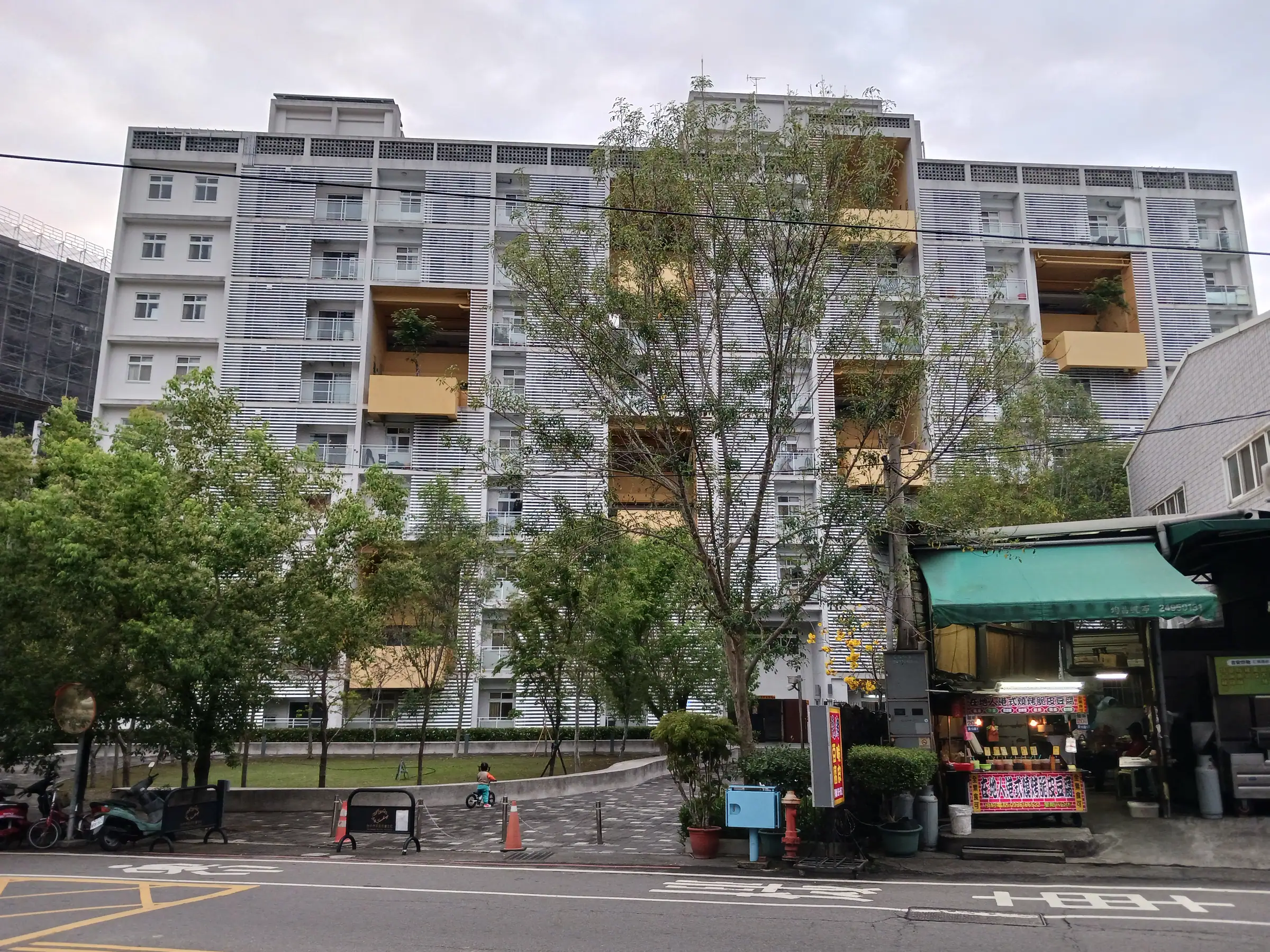
Figure: Guangzheng Social Housing. Social housing must address not just the number of square meters or rooms, but also the block it is located in and what one sees when stepping out the door. Photo by Saimmx / Wikimedia Commons, CC0.
From the Housing Act to "8 Years, 200,000 Units"
The institutional turning point of Taiwan’s social housing policy is closely related to the 2017 amendment of the Housing Act. The Executive Yuan’s policy explanation states that the government amended the Housing Act in January 2017 and approved the Social Housing Development Plan in March of the same year, incorporating direct construction and leasing management as policy tools. 1 The significance of this turning point is that housing policy is no longer limited to home-buyer loans, housing subsidies, or individual vulnerable安置 (placement); it begins to acknowledge that "being able to afford rent and live stably" is itself a public policy goal.
"8 Years, 200,000 Units" is not a single type of housing, but the sum of two supply methods. The government directly acquires land to build or renovate houses, creating a centralized supply that can more long-term control rents, quotas, and public facilities; leasing management utilizes existing private housing, where operators assist landlords in renting, managing, and repairing, allowing the policy to reach dispersed housing sources in the city more quickly. The two differ in time, land, cost, and community impact, and cannot be compared using a single ruler of unit counts.
In 2023, the Executive Yuan explained that the social housing policy then comprised a goal of 200,000 units, consisting of 120,000 units of direct construction and 80,000 units of leasing management, and estimated that by the end of 2023, direct construction and leasing management would total 163,000 units. 2 The "achievement" here includes different stages: some are completed and occupied, some have effective leases, and some are still in development or matching. Therefore, if public communication only states a total number, it is easy for the public to misunderstand it as "the same number of houses are already available for immediate occupancy."
The 2024 policy explanation further extended the focus to 2032, proposing a "Million Rental Household Support" framework consisting of 250,000 units of social housing, 250,000 units of leasing management, and 500,000 units of rental subsidies. 3 This represents the government gradually understanding housing policy as multi-layered support: providing stable tenancy for those who can enter social housing; improving contract and management guarantees for those living in private housing through leasing management; and reducing expenses for those who cannot obtain the first two through rental subsidies.
How the Three Policy Tracks Complement Each Other
| Policy Tool | Main Approach | Advantages | Main Governance Risks |
|---|---|---|---|
| Direct Construction of Social Housing | Constructing public rental housing using state-owned, local, or urban renewal land | Rents, quotas, design, and public services can be planned for the long term | Slow land acquisition, high construction costs, tendency to concentrate in few locations |
| Leasing Management | Operators assist landlords in renting, managing, repairing, and matching tenants | Can quickly utilize existing houses, dispersed in private communities | Housing quality, lease stability, landlord participation, and supervision mechanisms require continuous oversight |
| Rental Subsidies | Directly subsidizing renting families that meet qualifications | Higher application flexibility, can quickly cover a large number of households | May push up rents in some market segments, and subsidies do not necessarily improve housing quality or lease terms |
Clarifying the Metrics of "Units" First
The "unit" in policy data is not a single concept. Direct construction of social housing refers to housing supply developed by the public sector; leasing management usually involves the matching and effective leases of private housing sources; rental subsidies refer to households receiving cash or rental support. If the three are simply added together, the same family may be counted multiple times, and "occupied," "having an effective contract," and "receiving subsidies" may be mistakenly treated as the same outcome. Therefore, policy reports should at least simultaneously present the type of supply, statistical time point, completion stage, whether assisted households are duplicated, and the exit and renewal situations for each tool.
| Data Time Point and Source | Direct Construction | Leasing Management | Rental Subsidies | Key Considerations for Interpretation |
|---|---|---|---|---|
| End of July 2024, Executive Yuan Policy Page | 105,125 units | Cumulative matching: 120,477 units; Effective contracts: 74,606 units | Part of the policy goal | "Cumulative matching" and "effective contracts" cannot be treated as the same number. 1 |
| End of 2025, Ministry of the Interior Data | 122,680 units | 104,803 units | 913,867 units | The three statistical units differ; the Ministry of the Interior also explains the overall assisted scale after deducting duplicates. 4 |
| Central Government’s First Wave of Four Cases Leasing (2025) | 1,470 units | N/A | Can assist with application | This is the leasing volume for these specific four cases, not representing the national stock of social housing. 5 |
This distinction in metrics is not a technical detail, but the core of housing justice. If the government only publishes cumulative matching, renters cannot know if housing sources are currently available; if only development units are published, the public cannot know when houses will be completed or leased; if only subsidy units are published, society cannot judge whether subsidies allow tenants to move to safer, more stable, or work-proximity housing. In the future, a public policy dashboard can be established, separating each unit into stages of "planning, construction, completion, leasing, occupancy, renewal, and exit," with quarterly updates.
Data transparency should also include "those who are not served." For example, the government can publish the number of applications in each county/city, reasons for not meeting qualifications, the proportion giving up after the lottery, reasons for exiting after occupancy, the average handling time for repair appeals, and the actual housing duration for different family types. These indicators are not about disclosing personal data, but about transforming the most easily ignored points of loss in policy into verifiable governance issues: Is there too little housing? Are rents and management fees too high? Is the location unsuitable? Is the application process too complex? Is community support insufficient? If we only track "how many were built" and "how many were subsidized," we cannot know why families leave before entering the system or why they must move again after moving in.
Leasing Management 4.0 shows the government attempting to solve the dual problems of "social housing not being built fast enough" and "private vacancies not entering formal leasing." The Executive Yuan explained at the time that landlords can receive tax incentives, three years of management services, and assistance with repair, notarization, and insurance costs; operators also assist tenants in applying for rental subsidies and relax cross-county/city relocation for the elderly and persons with disabilities. 6 These designs place landlords' transaction risks, tenants' application costs, and the elderly's accessibility needs within the same policy framework.
However, leasing management cannot be simplified as "putting a social housing label on ordinary houses." Its public nature comes from contracts, rents, qualifications, services, and tax incentives being regulated. If only the number of matched units increases, without continuously checking housing quality, lease changes, repair responsibilities, and tenant appeals, the policy may resemble market intermediaries more than housing protection. The government should publish effective contracts, reasons for exit, lease term distributions, housing quality, and the retention of vulnerable households, allowing society to distinguish between "successful matching" and "long-term stable living."
After Unit Counts Increase, Who Actually Gets to Live There?
According to the Ministry of the Interior’s explanation published in 2026, as of the end of 2025, the national direct construction of social housing was 122,680 units, leasing management was 104,803 units, and rental subsidy beneficiaries were 913,867 units; after deducting policy duplicates, over 1.1 million renting households received assistance. 4 These numbers show that the policy scale is already large, and also explain that the statistical units for the three tools are different: direct construction is housing units, leasing management is matching and contract units, and rental subsidies are assisted households. Evaluation cannot mechanically add the three together, nor can it use the growth of one item to infer that others are equally effective.
Moving into directly constructed social housing usually involves facing qualification reviews, application documents, lotteries or point assessments, property viewings, deposits, and lease contracts. The current Ministry of the Interior Regulations on Leasing Social Housing Developed by the Ministry stipulates that applicants must meet conditions such as no own housing, income, and property, and can apply locally due to schooling or employment needs; the regulations also require the announcement of rents, management fees, vulnerable quotas, application methods, lease terms, and decision order. 7 These provisions provide the institutional skeleton for fair competition, but for those without stable internet, incomplete household registration documents, complex family relations, or those needing accessible housing, the application process may still be a barrier.
The National Housing and Urban Renewal Center’s first wave of four cases leasing in 2025 provided 1,470 units, and designed quotas for economic or social vulnerable groups, neighborhood harmony, and grassroots police/firefighters; the announcement also explained that rents include management fees, cross-county/city applications are allowed, and different maximum lease terms are set based on identity. 5 The significance of the quota system is to prevent all houses from being obtained by those with the most information, the best application skills, or the greatest ability to bear moving costs. But quotas are not result guarantees: if housing locations are far from work and schools, rent plus management fees still exceed family affordability, or if winners cannot pay moving and furniture costs, formal qualifications may still not translate into actual occupancy.
Housing Price and Location Are Equally Important
Social housing rents cannot be described solely as "below market." Market rents themselves vary by location, square meters, building age, management fees, furniture, transportation, and housing quality; the same rent in a city center, next to a MRT station, a remote industrial zone, or a location lacking public transport represents completely different living costs. If a family must increase commuting by two hours, childcare drop-offs, or transportation costs for caring for the elderly to get cheap rent, the apparent rent discount may be offset by other costs.
The Ministry of the Interior Regulations on Leasing Social Housing Developed by the Ministry stipulate that rents for centrally developed social housing can be tiered based on cost, appraisal, and the tenant's ability to pay, must not exceed market rent levels, and should be regularly reviewed. 7 This makes rent not just cost recovery, but also a distribution policy. When publishing rents in the future, management fees, parking fees, deposits, furniture/equipment, public facility usage fees, and family income tiers should be published simultaneously; otherwise, "how much the rent is" is still insufficient for applicants to estimate their true expenses after moving in.
Location also determines whether social housing integrates into the city. The Executive Yuan’s policy explanation mentions that social housing can be obtained through state-owned land, urban renewal, and transit-oriented development, and incorporates services such as elderly day care, infant care, childcare, and youth entrepreneurship. 1 This is an important direction: social housing should not just be a housing volume, but should be planned together with schools, medical care, transportation, care, commerce, and green spaces. If public services are insufficient, social housing residents may be forced to bear additional care costs themselves; if services are only provided in large bases, dispersed leasing management households may be excluded from community resources.
Local Governments Are Not Just Implementation Windows
The development, leasing, and management of social housing require joint efforts from the central and local governments. The central government can enact laws, provide land and funds, unify data formats, and set minimum service standards. Local governments are closer to the rental market, social welfare networks, schools, transportation, and community conflicts. Local governments do not end their role after "implementing" central policy; they must adjust the housing mix based on population structure, housing prices and rents, industrial locations, disaster risks, and long-term care needs.
The Ministry of the Interior’s latest policy explanation places central-local cooperation, direct construction, leasing management, and rental subsidies within the same housing support framework, and also points out that different policies have different immediacy, accessibility, and supply progress. 8 This division of labor requires more transparent boundaries of responsibility. For example, who explains to tenants when central subsidies are delayed? Is there a unified appeal deadline when local qualification reviews are rejected? Which level of government can tenants turn to if leasing management operators fail to handle repairs? If the answers only exist in different websites, phone numbers, and case worker experiences, the policy will create inequalities for those with weaker information capabilities.
Local social housing also needs to handle neighborhood relations. Social housing residents are not a homogeneous "vulnerable population"; they may include youth, single-parent families, persons with disabilities, indigenous peoples, the elderly, police/firefighters, newlyweds, and families with children. If the government only emphasizes the identity of occupants, without publicly disclosing community management, public space, noise, garbage, childcare, and care service collaboration mechanisms, neighborhoods may incorrectly attribute daily management problems to resident identities. Good social housing governance should allow residents to participate in regulations and public space decisions, while providing professional social workers, property management, and mediation resources.
Vacancies, Carbon Emissions, and Choices Beyond "How Many Built"
Housing policy has another often-ignored trade-off: how to balance new construction with the activation of existing housing. The Ministry of the Interior has pointed out that there are a large number of vacant houses in Taiwan, some of which have low utilization and possess the potential to be converted into social housing through leasing management, linking vacancy activation, property tax, and rental incentives to rental policy. 4 This does not mean all vacant houses can directly become suitable housing. Vacant houses may be located in areas with few job opportunities, lack elevators and accessibility, require high repair costs, or involve inheritance, property rights, and urban planning restrictions.
But vacancy policy reminds us that social housing does not need to be measured solely by new construction units. Renovating existing buildings can reduce land development, preserve neighborhood life and transportation conditions, and may be closer to decentralized living. New social housing can introduce earthquake resistance, energy efficiency, accessibility, and public services, and provide long-term controllable rental space. The two should be combined according to regional conditions, rather than forming a simplified opposition of "new construction is always progressive, activation is always cheap."
The Ministry of the Interior’s 2026 housing support explanation sets diverse social housing development, leasing management, and rental subsidies as continuously parallel policy tools, and lists newlywed and child-rearing families as subsequent support priorities. 8 For this policy combination to be effective long-term, environmental and social indicators should be added, such as the distance from each housing unit to public transport, the capacity of childcare and day care services, energy expenses, repair response time, lease renewal rate, schooling and employment stability after moving, and the actual occupancy rate of vulnerable quotas. Only then can public discussion avoid being trapped in the single number of "how many units added this year."
A Housing Justice System That Can Be Trusted
First, the government should establish consistent and understandable public data. The "approved, developed, completed, leased, occupied, effective contract, renewed" of different policies must be presented separately, and it must be explained whether the same family is receiving duplicate assistance. The Ministry of the Interior’s August 2026 data further published the number of units for social housing, leasing management, and rental subsidies, as well as the median of rental subsidies as a percentage of rental expenses; such itemized data allows society to better test the policy than a single total unit count. 9
Second, the application system should be designed around "completing occupancy" rather than "submitting an application." The government can provide cross-county/city joint application entrances, phone, and physical assistance, so that the elderly, persons with disabilities, those with insufficient digital devices, and victims of domestic violence do not have to repeatedly explain the same identity. For those who win the lottery but cannot move in immediately, support for deposits, moving, furniture, transportation, and rental adaptation should be provided; otherwise, successful lottery winning may still become an unbearable option.
Third, social housing management must guarantee tenants' lease stability and right to appeal. The government and management operators should publish repair time limits, lease change rules, visitation boundaries, data usage methods, and appeal response times. Tenants should not fear retaliation for renewing their lease if they raise reasonable repair or public facility issues. Vulnerable quotas should not only be identified before occupancy, but also track whether different groups leave faster due to rent, accessibility, care, or community conflicts.
Fourth, direct social housing, leasing management, and rental subsidies should be able to interconnect. When a family’s income increases, they should not suddenly lose all housing support. When the elderly need accessible housing, they should be able to be referred from general rental or leasing management to suitable sources. When families face unemployment, illness, domestic violence, or disasters, there should be temporary rental and social service buffers. If housing policy only judges "qualifies or does not qualify" during qualification review, it cannot respond to the changes in real life.
Ensuring Fair Application Goes Beyond Just the Lottery
Social housing uses lotteries or point assessments to prevent limited housing sources from being monopolized by personal connections, financial power, or information advantages, but the procedures before the lottery may still create gaps. Those who can learn of announcements early, understand income calculations, prepare property data, fill out forms online, and supplement documents within deadlines usually have an advantage over applicants busy with shift work, caring for young children, or caring for disabled family members. This does not mean public lotteries should be canceled, but rather that application assistance should be viewed as part of housing policy. Local governments can set up regular consultations at community centers, household registration offices, libraries, and social welfare centers, providing multi-language, accessible, and paper-based channels, and explaining reasons for rejection in language understandable to the general public.
Fairness also includes responsibility for "hard-to-see" renters. Those without fixed household registration, those just leaving安置 institutions, victims of domestic violence, those separated from family households, or those working in different counties/cities may not fit the general family imagination, but still need stable housing. Regulations have already designed exceptions and protection clauses for application qualifications, vulnerable identities, and family member calculations; in actual execution, it must still be ensured that case workers have sufficient training to not view complex families simply as incomplete documents. For tenants, whether they can obtain clear supplementary document notices, appeal windows, and reasonable waiting times often determines whether the system is trustworthy more than the policy name itself.
Conclusion: Making "Affordable" into "Sustainable"
The next stage of Taiwan’s social housing should not just be replacing "200,000 units" with a larger number, but answering three more difficult questions: Are the houses in the places needed? Do the rental conditions allow families to stay long-term? Are public resources distributed in a transparent, appealable, and non-stigmatizing way? The Executive Yuan’s policy data shows that direct construction, leasing management, and rental subsidies have formed a three-track system of different scales and speeds. 10 The next challenge is to transform these three tracks from a statistical parallel into a continuous support system that families can enter, transition through, and exit at different life stages.
Housing justice does not guarantee that everyone lives in the same type of house, nor does it leave all housing problems for the government to solve alone. It requires the government to acknowledge that housing has a public nature, requires the market to accept basic leasing regulations, and requires local communities to have the ability to jointly manage living spaces. When a person changes jobs, forms a family, has children, becomes disabled, or ages, and can still find a safe, affordable, and dignified residence in a familiar city, social housing truly transforms from a construction project into a public institution.
Image Sources
References
- Promoting Social Housing — Executive Yuan explanation on the Housing Act amendment, "8 Years, 200,000 Units," direct construction, leasing management, and public service planning.↩234
- Social Housing Leasing Management 4.0 Officially Launches — Executive Yuan explanation on Leasing Management 4.0, direct construction and leasing management unit counts, and policy evolution.↩
- 200,000 Units of Social Housing Expected to Meet Targets by End of 2024 — Executive Yuan explanation on social housing target progress, "Million Rental Household Support" framework, and land acquisition directions.↩
- Commitment to Care for One Million Rental Households Remains Unchanged — Ministry of the Interior publishes policy data on direct construction, leasing management, rental subsidies, and vacant house activation.↩23
- Central Government’s First Wave of 4 Cases, 1,470 Units of Social Housing for Lease — National Housing and Urban Renewal Center explanation on leasing units, vulnerable and neighborhood quotas, rent, and lease term arrangements.↩2
- Premier Chen Communicates with Social Housing Leasing Management Landlords and Tenants — Executive Yuan explanation on landlord incentives for leasing management, rental subsidy assistance, and relocation for the elderly and persons with disabilities.↩
- Ministry of the Interior Regulations on Leasing Social Housing Developed by the Ministry — Ministry of the Interior regulation page explaining social housing application qualifications, vulnerable quotas, rent tiering, lease terms, and renewal regulations.↩2
- Moving Toward Diversified Social Housing Supply — Ministry of the Interior Ministry of Land Affairs explanation on central-local cooperation and the division of directions for diverse social housing supply policies.↩2
- Goal to Care for One Million Rental Households Remains Unchanged — Ministry of the Interior publishes data on social housing, leasing management, rental subsidy units, and rent burden statistics.↩
- Goal to Care for One Million Rental Households Remains Unchanged: Central and Local Continuously Cooperate — Ministry of the Interior explanation on the three-track housing policy, central-local division of labor, vacancy potential, and vulnerable care proportions.↩