
30-Second Overview: In 1876, Ding Richang crossed the strait to govern Taiwan, bringing not an isolated project, but a blueprint connecting coastal defense, telegraphs, railways, coal mines, land reclamation, and bureaucratic reform. The telegraph line from Tainan to Qihou (Kaohsiung) and Anping, completed in 1877, marked the beginning of modern communications in Taiwan. Railways and ironclad warships, however, remained unfinished due to funding and institutional constraints. Reading Ding Richang requires looking not just at what he achieved, but at why a cross-departmental plan could only see a small fraction completed within the late Qing administrative machine. 1 2

Image: Wikimedia Commons, 〈Portrait of Ding Richang.jpg〉, author unknown, circa 19th century, page marked as Public Domain. This article uses the Wikimedia Commons hotlink; no separate file download is required.
Image License Note: The portrait file page indicates the author is unknown, circa 19th century, and released under a Public Domain label. Users should still return to the Wikimedia Commons file page to confirm the latest licensing information.
In the winter of 1876, Fujian Governor Ding Richang crossed the strait from Fuzhou, arriving at Jilong (Keelung), then traveling through Su'ao and the "Back Mountain" (Hou Shan) region, before returning to Tainan Prefecture. This inspection was not a routine local survey; it was the Qing court placing an official familiar with Western affairs into Taiwan's most tense post-Mudan Incident situation. 1
| Time | Key Nodes of Ding Richang and Taiwan | Historical Significance |
|---|---|---|
| 1868 | Proposed making Taiwan the center of South Sea coastal defense | Taiwan was placed within the context of Southeast coastal defense, not merely as local administration |
| 1874 | After Japan's military expedition to Southern Taiwan, re-discussed coastal defense | Coastal defense, warships, and Taiwan governance had to be thought of together |
| 1875 | Ordered to serve as Fujian Governor | Ding Richang obtained the formal position to manage Taiwan's political affairs |
| Winter 1876 | Crossed the strait to inspect Jilong, Su'ao, Hou Shan, and Tainan | Used field inspections to supplement the geography of Taiwan described in memorials |
| 1877 | Tainan to Qihou (Kaohsiung) and Anping telegraph line completed | Taiwan entered an era of communications capable of transmitting political and military intelligence in real time |
The focus of this timeline is not to portray Ding Richang as the starting point for all subsequent constructions, but to place his ideas within the decision-making sequence of the time. Coastal defense anxiety came first, leading to a re-evaluation of ports, minerals, and transportation. The telegraph was completed first not because other plans were unimportant, but because it was the most likely to be realized under limited funding. 1 2 3
The following year, the telegraph line from Tainan Prefecture to Qihou (Kaohsiung), and then to Anping, was completed, spanning approximately 95 kilometers. This marked the beginning of Taiwan's introduction to telecommunication technology and was Ding Richang's most visible legacy in Taiwan. 2
But what Ding Richang truly wanted to lay was never just a single line. He wanted to connect telegraphs, railways, coal mines, warships, and land reclamation into a cohesive coastal defense system. What was ultimately completed was the telegraph. The railways and ironclad warships were stalled by money, institutions, and time.
📝 Curator's Note
Ding Richang's story is not simply "Qing China also had modernization," but rather a person who saw the system but could only complete its thinnest thread first. The telegraph, railways, coal mines, and coastal defense were interconnected in his memorials, but at the execution stage, they were split into different yamen (offices), different budget lines, and different priorities. This gap is more worth reading than the word "pioneer."
Viewing Taiwan Through Coastal Defense, Not Local Administration
Ding Richang was born in Fengshun, Guangdong, in 1823 and died in 1882. His uniqueness in the late Qing Self-Strengthening Movement lay not only in advocating the learning of Western technology, but in viewing military, fiscal, transportation, and civil affairs as a single problem. Research monographs published by the Institute of Modern History, Academia Sinica, place his achievements and frustrations within the broader changes of the Self-Strengthening Movement. 4
In 1868, Ding Richang had already proposed the idea of making Taiwan the center of South Sea coastal defense. In 1874, following the Qing court's re-discussion of coastal defense due to the Mudan Incident, he more explicitly advocated stationing ironclad warships in Taiwan and integrating Taiwan into the overall defense line of the southeastern coast. 5
A quote he later left can serve almost as the opening statement for his entire plan: "Only if Taiwan is prepared can the coastal regions be free of worry; if Taiwan is insecure, the entire situation is liable to be shaken." 2
This thinking had its historical context. In 1874, Japan's military expedition to Southern Taiwan led the Qing court to view Taiwan not merely as a frontier, but as a node for maritime traffic and southeastern defense. The Taiwan Ding Richang saw was an island that had to be connected to fleets, minerals, roads, and information networks.
But "seeing the system" does not mean one can control the system. Taiwan's fiscal resources had to be coordinated with Fujian and various South Sea funds; projects required finding personnel familiar with new technologies; and military supplies faced audits from different yamen. Memorials cited in academic papers repeatedly highlight difficulties in raising funds, delays in fund transfers, and competition for funds among railways, mining, and coastal defense. 2
These resistances gave Ding Richang's reforms a paradox of modernization: the more he wanted to create a mutually supportive system, the more he needed to cross boundaries that the administrative machine of the time was least capable of crossing.
Thus, his vision for Taiwan differed from the railway projects of Liu Mingchuan, which are often remembered later. Liu Mingchuan was the one who pushed provincial construction to a larger scale. Ding Richang, however, proposed earlier: without transportation and communication, coastal defense was merely a paper configuration of troops. 6
A Telegraph Line, Shortening the Island First

_Image: Ding Richang's 〈Running Script Seven-Character Couplet〉, Wikimedia Commons, file page, author Ding Richang, created before 1883, page marked as Public Domain. This article uses the Wikimedia Commons original file hotlink._
In late 1876, Ding Richang personally inspected Taiwan. Academic research indicates that he placed Taiwan's coastal defense position and transportation conditions within the same judgment, demanding the establishment of telegraph lines, railways, and mining operations, so that communication, cargo transport, and troop mobilization would no longer be fragmented. 2
The path of the telegraph line was specific: from Tainan Prefecture to Qihou (Kaohsiung), and from Tainan to Anping. The National Archives of Taiwan's historical materials on transportation also list this 1877 project as the beginning of Taiwan's introduction to telecommunication technology. 3
Viewed today, 95 kilometers might not seem like a staggering number. Placed back in 1877, it represented whether orders could reach ports faster, whether news of foreign threats could return to the prefectural capital faster, and whether an island was beginning to possess its own real-time communication.
This line also illustrates Ding Richang's method of operation. He did not wait for a complete modern state to appear before starting construction. He first seized the node that could change the overall rhythm most, then connected that node to military and fiscal matters. The telegraph was not an isolated technological display, but the nerve system of the coastal defense plan.
📝 Curator's Note
The modernity of the telegraph lies not in how it looks like today, but in that it was the first time Taiwan's distance became a manageable problem. The path from Tainan Prefecture to Qihou (Kaohsiung) and Anping connected not only ports but also commands. It meant coastal defense no longer relied solely on the speed of ships or the relay of post stations, but began to rely on a reusable network.
Railways Did Not Disappear, Only Changed Into Another Future
Ding Richang stated in his memorials: "Taiwan must open railways and build telegraph lines for the purposes of communication, cargo transport, and troop mobilization." 2 This sentence placed railways in a very unromantic position: they were not travel scenery, nor merely commercial investments, but a way to place troops, coal mines, ports, and administrative orders on the same operational schedule.
He once advocated moving dismantled materials from the mainland's Songhu Railway to Taiwan for use and consulted engineers on route construction. The Qing Period Taiwan Westernization Historical Materials, compiled by Academia Sinica,收录s Ding Richang's memorials on Taiwan's steamships, mining, and telegraphs, and explicitly points out that he was one of the earliest advocates for Taiwan's railways. 1
However, railways required more than just tracks. They needed money, engineering personnel, stable administrative authority, and long-term maintenance systems. Ding Richang simultaneously faced competition for funds for ironclad warships, fortifications, firearms, telegraphs, and mining. Historical materials compiled by researchers show that while the Qing court acknowledged the importance of these matters, it also faced the fiscal dilemma of "simultaneous execution, at great cost." 2
A sharper contradiction was that Ding Richang later advocated changing the funds originally intended for Taiwan's steamship/railway operations to purchase ironclad warships. Railways could only serve Taiwan, but ironclad warships could support a broader range of coastal defense. Thus, the originally mutually supportive constructions were forced into a list where only one item could be done first. 2
This is not simply "visionary but failed." It is more akin to the most difficult arithmetic of late Qing reforms: every project could be persuasive, but no reliable treasury could pay for all of them simultaneously.
Coal Mines, Taxation, and Civil Affairs Were All Part of the Same War
After arriving in Taiwan, Ding Richang first noted the coal mines in Jilong (Keelung), then included sulfur, kerosene, and iron ore in his inspections. Academia Sinica's historical bibliography shows that he memorialized the Badou coal wells in Jilong and proposed coordinating Taiwan's steamship/railway and mining operations. 1
In his vision, coal mines were not merely an industry. They could supply steamships and machinery, and provide a revenue source for coastal defense. If mining lacked transportation, the extracted goods could not be moved. If railways lacked mining, the construction costs would be even harder to justify to the court.
The same logic appeared in the tax system. Later materials compiling Ding Richang's governance in Taiwan mention that he handled oppressive taxes, bureaucratic reform, and agricultural development. These measures cannot be directly equated with modern welfare policies, but they show he knew coastal defense did not only happen on fortifications; whether the populace was willing to bear tax burdens and administrative costs was equally part of defense. 7
The problem was that these reforms still carried the limitations of Qing bureaucratic governance. Ding Richang's policies of "recruiting settlers," mining, and pacifying Indigenous peoples were still governance projects named, planned, and driven by the government; local society was not a blank sheet waiting to be filled. Research materials also remind us that Ding Richang's time in Taiwan was very short; many plans were limited by insufficient funds and bureaucratic constraints, resulting in limited actual effectiveness. 2
Moreover, the surviving materials are mostly official memorials, official compilations, and later research. They are good at telling us what the government wanted to do, but may not fully present how local residents, Indigenous communities, and those whose resources were mobilized responded. This is a blank space that must be retained when reading Ding Richang: one cannot equate planning with reality simply because the blueprint was precise.
From this perspective, the significance of the telegraph line is even more complex. It indeed shortened the distance for administrative and military messages, but it simultaneously served faster governance and mobilization. Technology does not choose its own use; the people and institutions using it decide for whom it accelerates speed.
Therefore, his plans cannot be written as a straight path to modernization success. A more accurate statement is: he placed many problems that would later be handled separately on the same blueprint for Taiwan for the first time.
📝 Curator's Note: The most difficult moment of reform is often not not knowing what to do, but every thing that needs to be done competing for the same pot of money.
A Six-Month Inspection, Leaving Shadows Longer Than His Tenure
After being appointed Fujian Governor, Ding Richang was responsible for the overall situation in Taiwan. Existing archives show that in the 11th month of the Guangxu Emperor's first year, there were already edicts regarding his appointment as Fujian Governor, stating he would stay in Taiwan during winter and spring to plan Indigenous pacification matters. 8
His time in Taiwan was not long. Academic papers summarize it as traveling to Taiwan in the winter and spring of 1876, and leaving due to illness in 1877. This gives his story a strange proportion: short tenure, large plans, few completed projects, yet many blueprints cited later. 2
The research abstract from the Institute of Modern History, Academia Sinica, states that Li Hongzhang evaluated Ding Richang as "excellent in Western affairs and bureaucratic governance, rare in ability, sufficient to handle contemporary crises," and the same abstract did not shy away from his difficulties and frustrations. 4 This juxtaposition is important because it refuses to place Ding Richang in only one box of "pioneer" or "failure."
He did promote the telegraph, and indeed brought railways and mining into the core discussion of Taiwan's governance. But the ironclad warships did not form a fleet according to his blueprint, and the railways did not form a complete network during his tenure. Compilations from the National Archives also point out that transportation construction during the Qing period was often autonomously driven by local officials, lacking a central managing authority and complete planning, thus resulting in limited development and difficulty in sustainability. 3
This limitation was not a character flaw of Ding Richang personally, but part of the institutional conditions. He could propose cross-departmental plans, but lacked a sufficiently stable administrative machine to turn plans into long-term projects.
Later, when Taiwan became a province, Liu Mingchuan took over larger-scale provincial politics and construction, often written as the completion of Ding Richang's vision. But the two men's positions of power, fiscal conditions, and historical circumstances were not the same. Attributing all later achievements to the foresight of the former person obscures the truly important question: how many institutional transformations must a vision pass through before it can become a road, a telegraph line, or a mine?
A Plaque Reminds Us That Beyond Plans, There Are People
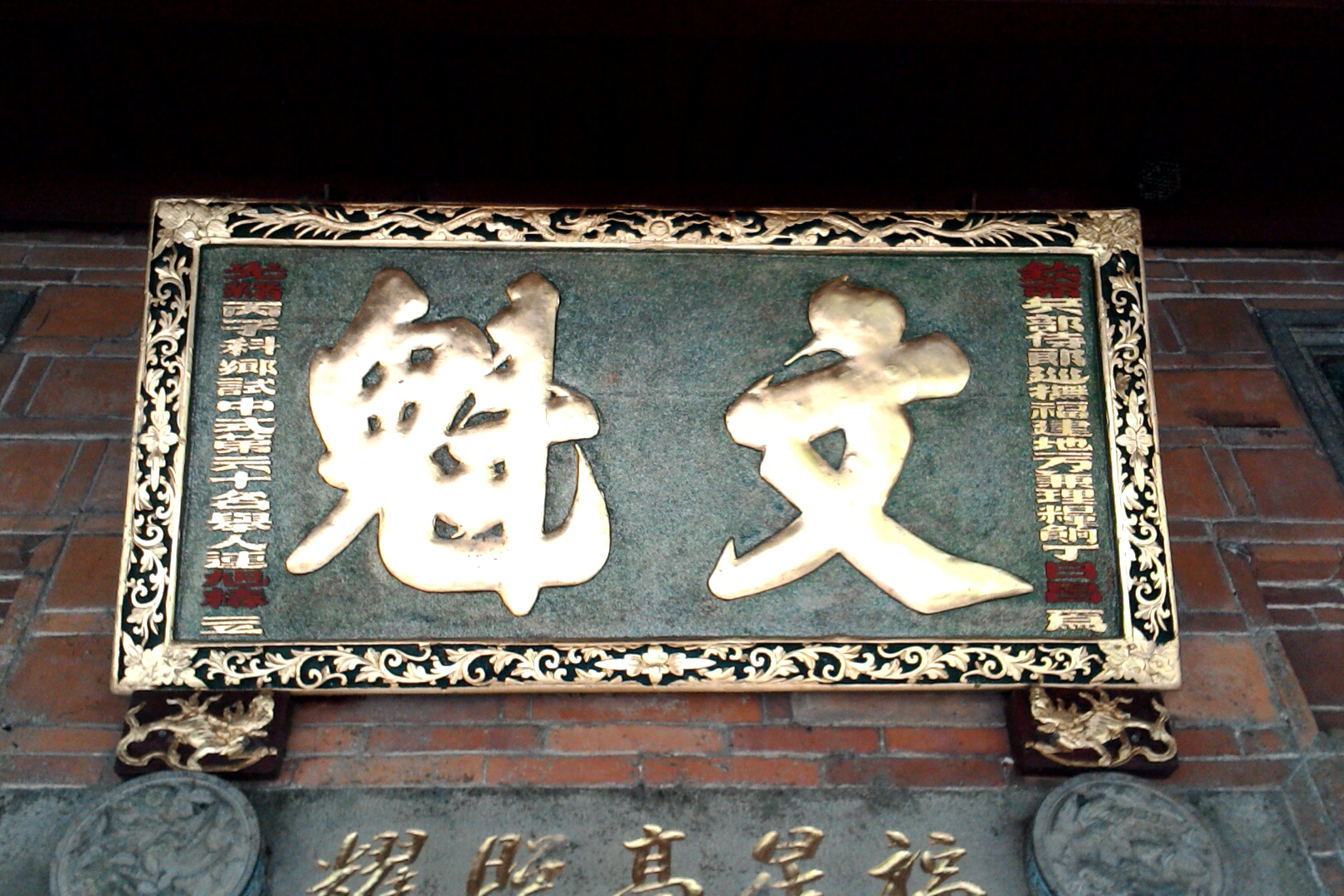
Image: Plaque gifted by Ding Richang at Lian Juren's Residence in Pinglinli, Shuangxi District, New Taipei City, Wikimedia Commons, file page, photographer Temple Person Mengzi, CC BY-SA 4.0. This article uses the Wikimedia Commons original file hotlink.
Ding Richang's name appears not only in memorials, but also in the memories of local architecture and plaques. Such relics cannot directly prove that all governance measures were successful, but they remind us that officials' activities are preserved by local society in different ways. Archives leave administrative language; plaques leave relationships, gifts, and local memory. Placing them together ensures the person is not reduced to just a string of titles. 5
📝 Curator's Note
A telegraph line can be calculated in kilometers, but a plaque cannot be calculated solely by dimensions. The former shows how the state accelerates commands; the latter lets us see how local society places an official into their own space. Ding Richang's history in Taiwan oscillates between these two scales: above, the coastal defense blueprint; below, the traces left by people and places.
Reading an Engineering Imagination from Memorials
What is noteworthy about Ding Richang's memorials is that they are not single-item funding requests. Next to the telegraph appears the railway; next to the railway appears the coal mine; the coal mine interacts with steamships, military industry, and ports. This writing style transforms Taiwan from a place needing officials to manage into an entity requiring measurement, transportation, communication, and investment. 1 2
This engineering imagination also has its dangers. When officials place land, ports, minerals, and population into the same defense calculation, local residents easily become viewed only as tax sources, labor, or objects needing pacification. Therefore, this article does not directly call Ding Richang's Indigenous pacification and settler recruitment "progressive policies," nor does it treat the "civilizing" language in official archives as the self-description of local society. What can be confirmed is that he indeed included these affairs in governance plans, rather than whether the localities changed exactly according to the plan. 2 8
From today's perspective, this distinction is important. Modernization is not just the sum of telegraph lines, rails, and machines; it also includes who has the right to decide where lines pass, who extracts minerals, and which local knowledge is written into official reports. The materials Ding Richang left allow us to see how an official proposed a systemic solution, and also show us the people whom the solution did not write.
Looking Back Today, Pioneers Are Not Another Myth
Ding Richang is often placed between Shen Baozhen and Liu Mingchuan. This position easily creates a neat historical relay: Shen Baozhen starts, Ding Richang continues, Liu Mingchuan completes. But real history is messier. People leave office, funds are interrupted, materials are repurposed, and later construction does not necessarily follow the original design. 1
The most worth-reading aspect of the Qing Period Taiwan Westernization Historical Materials is precisely that it places memorials, edicts, and subsequent engineering together. Ding Richang's suggestions and Liu Mingchuan's later telegraph lines, railways, and machinery bureaus can illuminate each other, but cannot be compressed into "Ding Richang predicted everything." 1
The English Wikipedia article on Ding Richang places his Taiwan governance, diplomacy, military reform, and Self-Strengthening Movement into a single biographical history, and lists the modern Chinese research bibliographies relied upon. This reminds us that reading an official requires not only reading his plans, but also distinguishing what archives directly record from what later people strung together into a single figure. 9
The most powerful image Ding Richang left may not be a completed building, but that telegraph line stretching from Tainan to Qihou (Kaohsiung) and Anping. It is thin, yet it pulls together a whole set of unfinished questions: Who is responsible for Taiwan's security? Who pays for modernization? Is communication for the people, the military, or both simultaneously?
In 1877, the telegraph line arrived at its destination first. The railways, coal mines, and ironclad warships did not. This is not a圆满 (happy) ending, but it is the best entry point to understand Ding Richang: Taiwan's modernization did not begin with completion, but with someone drawing problems that were previously separate on the same map for the first time.
Further Reading
- Academia Sinica Taiwan Literature Full-Text Database: Qing Period Taiwan Westernization Historical Materials
- National Taiwan University of Science and Technology: Ding Richang's Exploration of Taiwan's Coastal Defense - Taking Telegraph and Other Westernization Projects as Examples
- National Archives Administration: Sugar Railways / Construction and Impact of Taiwan's Transportation Network
- Institute of Modern History, Academia Sinica: Ding Richang and the Self-Strengthening Movement
- Academia Sinica Digital Collections: Edict Already Stated Fujian Governor Ding Richang Be Appointed to Taiwan Indigenous Pacification Matters
References
Image Sources: The three Wikimedia Commons images in this article all use original file hotlinks, with no separate downloads. The portrait is by an unknown author, circa 19th century, Public Domain. 〈Running Script Seven-Character Couplet〉 is a work by Ding Richang; the author died in 1882, and the file page is marked Public Domain. 〈Plaque Gifted by Ding Richang at Lian Juren's Residence〉 was photographed by Temple Person Mengzi, and the file page is marked CC BY-SA 4.0. Please use according to the respective Portrait File Page, Calligraphy File Page, and Plaque File Page licensing terms.
- Academia Sinica Taiwan Literature Full-Text Database: Qing Period Taiwan Westernization Historical Materials — Collects memorials from the Guangxu era on Taiwan's telegraph lines, railways, steamships, machinery, coal, and mining, and explains that Ding Richang was the earliest advocate for Taiwan's railways and how his plans were later continued by Liu Mingchuan.↩2345678
- Xie Jikang: 〈Ding Richang's Exploration of Taiwan's Coastal Defense - Taking Telegraph and Other Westernization Projects as Examples〉 — An academic paper from National Taiwan University of Science and Technology, based on memorials, official documents, archives, and research results, analyzing Ding Richang's coastal defense ideas, telegraph lines, railways, mining, and funding dilemmas.↩2345678910111213
- National Archives Administration, National Development Council: Sugar Railways / Construction and Impact of Taiwan's Transportation Network — An official Taiwan transportation historical materials page, explicitly stating that in 1877, Ding Richang sent personnel to build the Tainan to Gaoqiao (Kaohsiung) telegraph line, and explaining the institutional limitations of Qing transportation construction and subsequent development.↩23
- Institute of Modern History, Academia Sinica: Ding Richang and the Self-Strengthening Movement — Research monograph bibliography and abstract, placing Ding Richang's life from 1823 to 1882 within the late Qing Self-Strengthening Movement, and simultaneously presenting his achievements, evaluations, and frustrations.↩2
- Zhonghua Book Company: Ding Richang and Taiwan — Introduces Ding Richang's judgments on Japan and Taiwan's coastal defense, his inspection tour, telegraph, mining, and governance measures based on modern history monograph content, serving as a supplementary source for biographical context.↩2
- National Museum of Science and Technology Digital Telegraph Museum: Collection Artifacts — A portal for telegraph historical materials jointly built by the National Museum of Science and Technology and Chunghwa Telecom, providing the collection context of Qing telegraph development and Taiwan's telegraph history.↩
- He Lin: Middle School History Learning Keyword "Ding Richang" — A historical figure entry for textbook compilation, organizing basic information on Ding Richang's appointments, telegraph, coal mines, agriculture, and bureaucratic reform, for cross-referencing use only.↩
- Academia Sinica Digital Collections Resource Network: Edict Already Stated Fujian Governor Ding Richang Be Appointed to Taiwan Indigenous Pacification Matters, Stay in Taiwan During Winter and Spring to Plan and Balance — An edict archive from the Institute of Modern History, Academia Sinica, dated the 14th day of the 11th month of the Guangxu Emperor's first year, directly preserving the archive metadata of Ding Richang's appointment as Fujian Governor and planning Taiwan affairs.↩2
- Wikipedia: Ding Richang — An English biographical article organizing Ding Richang's official positions, life, reform proposals, and Taiwan governance, and listing the modern Chinese research bibliographies relied upon, used as an English cross-source.↩