
Mona Rudao: The Anti-Japanese Hero Engraved on a Twenty Cent Coin, and the World Without China or Japan
30-Second Summary: You might have had a twenty cent coin in your wallet, featuring the face of Seediq chief Mona Rudao. On October 27, 1930, he led six tribes in an uprising at Wushe Public School, killing over a hundred Japanese people before committing suicide by gun in a cave deep in the mountains; his remains were not found until three years later. Later, these remains served as anthropological specimens for nearly forty years and were reinterpreted by three different regimes as "savage evidence," "heroes of the Chinese nation resisting Japan," or "indigenous spirit of Taiwan." However, what he sought to defend was the Seediq Bale (the Seediq language), which means "real people." The world he died defending had neither China nor Japan.
In July 2001, the Central Bank of Taiwan issued a new twenty cent coin. With a dual-tone design—gold on the outer ring and silver in the inner ring—it featured a dugout canoe from the Atayal tribe on the reverse, and a profile of Mona Rudao, the leader of the Wushe Incident, on the obverse. This was Taiwan's first circulating coin to feature an indigenous theme1.
However, this coin had an awkward origin. When the designers were engraving Mona’s face for the mold, they discovered that there was no photograph of him in domestic historical or cultural records. They eventually found one in a Japanese magazine and meticulously copied the portrait from it2.
In other words, the image of Taiwan's most famous anti-Japanese hero, the face recognized by the nation, was lifted from a Japanese publication.
What was even more awkward was that this coin circulated very little; so few people ever saw one in their lifetime. Some citizens tried to use it to buy snacks or drinks, but vendors refused it as counterfeit3. A hero who was minted into currency and used to "promote ethnic harmony" had a coin that no one dared to accept.
This article seeks to examine the matter beneath these three layers of awkwardness: an anti-Japanese hero engraved on a twenty cent coin, whose true world of resistance contained neither China nor Japan.
📝 Curator's Note
We are accustomed to placing Mona Rudao into a sentence structure: "He bravely resisted the Japanese as an indigenous leader." This statement is not wrong, but it presupposes a stage upon which "Japan" and "China" (or the "Chinese nation") stand. Mona chose to resist Japan. The problem is that this stage was constructed by later people. When Mona fired his weapons in 1930, the world he intended to defend was completely different from this stage. Only by understanding what he defended can we understand why this coin is so ironic.
The Bridge He Wanted to Cross Was Called Rainbow
To understand Mona Rudao, one must first move beyond the framework of "anti-Japanese resistance" and enter the universe of the Seediq people.
Mona Rudao was a chief from the Mehebu community of the Tgdaya group of the Seediq, born around 1880 (according to Chinese and English Wikipedia), though some sources state 1882 (National Education Institute of Education). He left no household registration records, and even his birth year is disputed4. In his youth, he was a fierce successor to the chief position, the wealthiest man in the tribe, and skilled at headhunting. Regarding his appearance, Wikipedia states that he "was tall and robust, reportedly nearly 190 cm," noting the word "reportedly." No one has ever measured his skeleton; this height is legend, not fact5.
In Mona's world, there was something called Gaya. It was a compilation of ancestral teachings, laws, social norms, and taboos, said to have been established by ancestral spirits (Utux) and unchangeable. Communal sacrifice, communal hunting, communal eating, adherence to taboos, and shared responsibility for sin were all collective obligations dictated by Gaya6.
One element within Gaya became the most misunderstood key aspect of the Wushe Incident: headhunting (mgaya in Seediq). In the eyes of Han Chinese and the Japanese, headhunting was barbaric beheading. However, within the Seediq context, its meaning was far more complex than violence; it involved revenge, divine judgment (settling disputes based on the success or failure of a hunt), praying for a good harvest, mourning ancestors, and qualifying as an adult male7.
And all of this connected to a bridge. The Seediq believed that after death, one must cross a Rainbow Bridge (Hakaw Utux), beyond which resided the ancestral spirits. A crab-like spirit (Utux Kalan) guarded the bridge, checking your hands—or more precisely, checking your tattooing. Only men who had successfully hunted heads and women who knew how to weave cloth were qualified to have tattoos (Ptasan) on their faces. Those without tattoos could not cross the Rainbow Bridge and reach the ancestral spirits8.
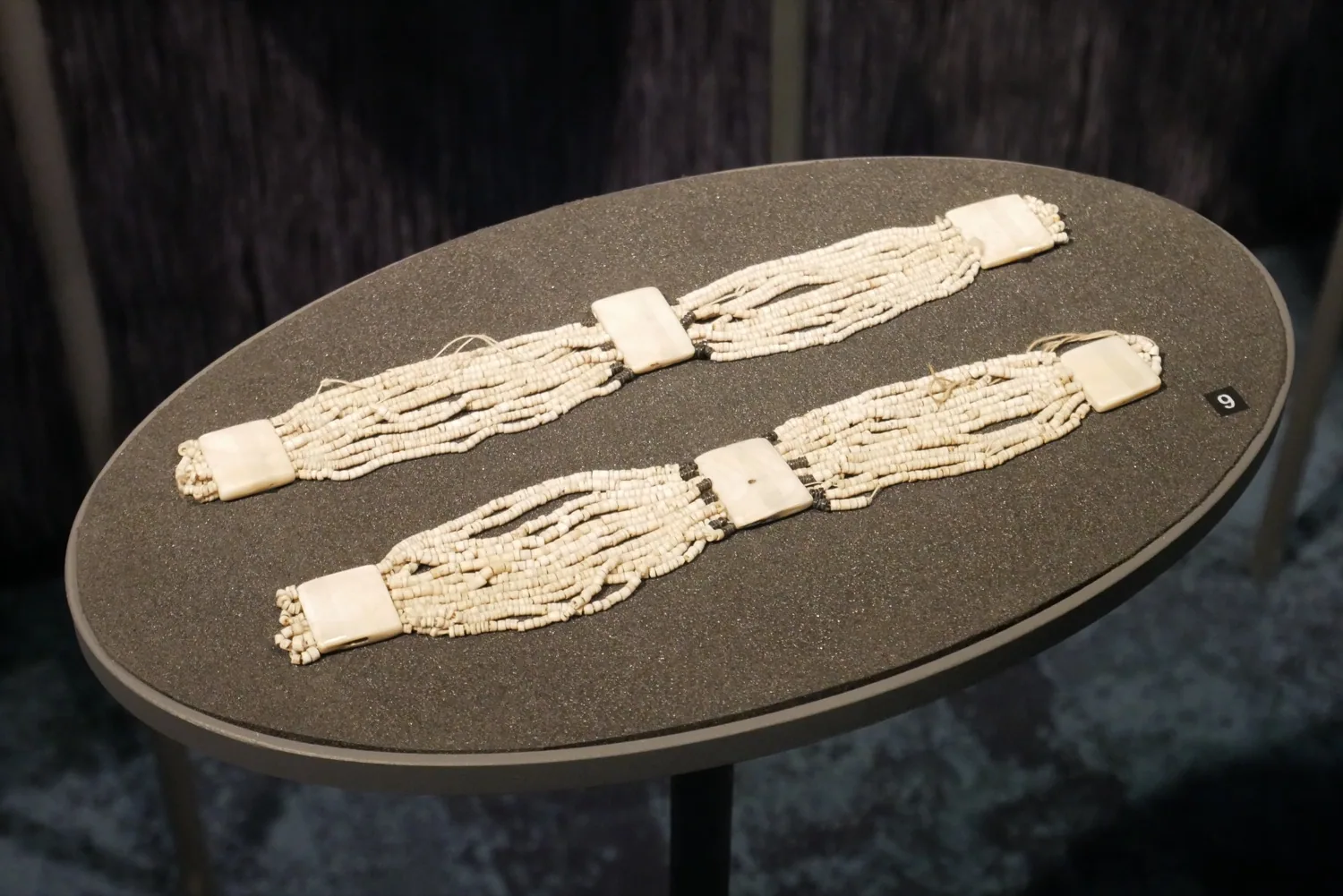
Mona Rudao's beaded anklet, currently housed at the National Taiwan Museum. Photo: Shi Zi, 2019. CC BY-SA 4.0 via Wikimedia Commons.
Therefore, when the Japanese banned headhunting and tattooing, they severed far more than two customs. For the Seediq people, it meant severing the qualification to reunite with ancestors after death—it was the collapse of an entire system of identity and meaning. Taiwanese scholar Leo Ching (荊子馨) described the situation of Indigenous peoples under colonialism as a "colonial double-bind": being civilized into a "half-civilized person" while simultaneously being treated as savages by the colonizers, rejected by both sides9.
The Seediq language has a word, Seediq Bale, which means "true person" 10. What Mona Rudao sought to be was this: a person with facial tattoos who could cross the Rainbow Bridge after death and who upheld Gaya while alive. We later called him a hero, but the position of "hero" was assigned by others. All his life, he defended the status of a "true person."
Later, a film titled Seediq Bale depicted Mona's world in grand scope. However, phrases like "sacrificing blood to ancestors" were actually invented by the director; there is no corresponding word in Seediq, something even the film's own cultural advisor for the Seediq later admitted11. This reminds us of one thing: even the version we think is the "closest to the Seediq" might be told by others. Mona's world was difficult for outsiders to articulate from the start.
The Unclean Hand
In Wushe during the 1930s, it was considered a "model subjugated territory" by the Japanese.
Japan's rule over Taiwan's indigenous peoples followed a path from leniency to severity. Initially managed by the Civil Affairs Department, it transitioned to police administration in 1906. From 1910 to 1915, the "Five-Year Pacification Plan" was implemented, led by Governor Sakuma Satomichi, which involved surveying approximately 16.3 million yen and utilizing military and police subjugation. Starting in 1915, indigenous peoples were disarmed and had their weapons confiscated, leading to a phase of assimilation where indigenous children's schools and public schools were established, Japanese was promoted, and practices such as tattooing, facial piercing, and tooth extraction were prohibited 12.
By 1930, Wushe had been developed into a town comparable to a Japanese settlement. Even the revisionist historian Paul Barclay acknowledged that about 95% of the indigenous people there could communicate with Japanese police and teachers in simple Japanese 13. However, Barclay also pointed out that beneath this model lay an enclave dominated by outsiders, where the local people's quietness and loyalty were at best suspect 14. Beneath the surface of this model, resentment was accumulating.
There were several sources of resentment. First, forced labor. Between 1928 and 1930, indigenous peoples in the Wushe area were mobilized nine times for work. During the construction of a shrine in 1928, they were not only shortchanged on meal allowances but also forced to donate money. The wages were unfair: indigenous people received 20 to 30 cents per day, while Han Chinese workers received 60 cents 15.
Second was the humiliation left by a political marriage. Japanese police officer Kondō Gijirō married Divas Rudao, Mona's sister. Later, Kondō was transferred to Hualien, and she disappeared (some say he was reassigned; others say he abandoned her). Divas was left behind, and according to the Gaya, a woman abandoned by her husband could not return to her family home 16. Barclay, in Kondo the Barbarian, verified that this "Kondō Gijirō" was the brother of another key subjugation official, Kondō Katsusaburō 17. A marriage arranged for the purpose of "subjugating indigenous peoples with indigenous peoples" ultimately became a thorn in the side of the Mona family.
The true spark, however, was a hand.
On October 7, 1930, Tado Mona (Tado Mona), the eldest son of Mona, offered a toast to Japanese police officer Yoshimura Katsumi at a wedding banquet. Tado had just slaughtered a pig and had animal blood on his hands. Yoshimura found them "unclean," refused the toast, and struck Tado's hand with a baton. A scuffle ensued between the two 18. Wikipedia describes it as follows:
The eldest son of Mona, Tado Mona, attempted to toast Yoshimura, but Yoshimura refused, citing "disgust for the unclean feast...," and struck Tado Mona's hand with a baton, leading to a fight between the two parties 19.
Afterward, Mona brought his tribe members to apologize to Yoshimura while carrying wine, but Yoshimura refused and threatened to report the incident. Under Japanese law, assaulting a police officer was a serious crime. With old grievances added to new hatreds, and fear of retribution, Mona made a decision: rather than wait for reckoning, he decided to revolt.
📝 Curator's Note
There were three Japanese police officers in the Wushe Incident, each with a different role, and they deserve to be remembered separately: Yoshimura Katsumi was the one who struck Tado during the toast incident; Kondō Gijirō was the one who married Mona's sister and then abandoned her; later, Kojima Genji appears, who incited the Daoze group in the Second Wushe Incident. The Wushe Incident was never a story of one person against an empire; it was a web woven from many specific people and many concrete humiliations. And that "unclean hand" was merely the final straw that broke the camel's back.
That Morning of the Sports Day
On October 27, 1930, Wushe Public School was hosting a joint sports day, gathering Japanese military police, schoolchildren, and family members at the stadium. Mo Na Lu Tao chose this day. In the early morning, about 300 men from six tribes attacked 13 police detachments around Wushe, seizing weapons and ammunition before rushing toward the sports field20. The six tribes involved were Mahapo, Tarowan, Boalan, Sku, Hogo, and Rodao. Baran, which had the largest population and whose leader was Wallace Buny, did not participate. Key instigators were Bi-ho Sabu and Bi-ho Varis from the Hogo tribe21.
On that day, they killed 134 Japanese people, including women and children. They also mistakenly killed two Han Chinese individuals who wore kimono: Li Caiyun, a girl in a kimono, and Liu Cailiang, a shop owner hit by stray bullets22. The tribes seized about 180 rifles and over 23,000 rounds of ammunition23.
The news reached Taipei, shaking the Governor's Office. The Japanese dispatched military forces and police, with Major General Kamata Michihiro in charge of the frontline (Governor Ishizuka Eizo was a civilian official, leaving the frontline to Major General Kamata). Bombing and mountain artillery attacks were used, and the suppression operation continued for about fifty days until early December24.
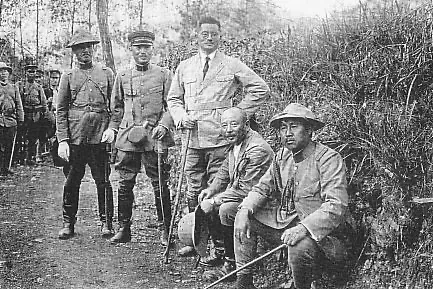
Commanders and staff of the Musha Punitive Force (1930). Photo: Kōhei Ebidara's "Wushe Punitive Expedition Photographs." Public domain via Wikimedia Commons.
Source: Chinese/English Wikipedia, Berry's "The Musha Incident: A Reader," Taipei Times
The most difficult and controversial page during the suppression was that of poison gas. Many Chinese sources state that the Japanese military used vesicant (Lewisite or mustard) gas, and even white phosphorus bombs. Testimonies from the tribes mentioned "skin blistering." The Taiwan People's Party also telegraphed the International League in early 1931 to protest the Japanese use of "poison gas massacre"25. However, academia has no definitive conclusion on this matter. Japanese historian Akimichi Haruzan argued that the Japanese military actually used "several hundred tear gas bombs, plus at least three special gases (containing cyanide and tear gas components)," rather than mustard gas. The Japanese Wikipedia even states, "It is not yet clear"26.
Therefore, this article will not assert that "the Japanese army massacred with poison gas," as that exceeds the scope of evidence. However, one document proves at least one thing: the Japanese knew they were doing something clandestine. On November 5, 1930, a secret telegram from an assistant to the War Ministry was sent to the Taiwan Military Chief of Staff, stating that the use of vesicant munitions would not be discussed due to foreign relations concerns, and that all future matters involving gas bombs must be communicated using code27. This telegram is stored in archives at the Japanese Ministry of Defense (JACAR, S5-2-26). It demanded not a cessation of poison gas use, but that it not be put on paper—this was concrete evidence of deliberate concealment28. Because of this protest, the Taiwan People's Party was forcibly dissolved in February 1931. Japan did not sign the Geneva Protocol banning chemical weapons until 197529.
During the suppression, an event occurred that has been repeatedly written about and romanticized: the mass suicide of women and children. The number mentioned varies; Chinese sources state approximately 296 people, while English Wikipedia states around 29030. They hanged themselves under a large tree so as not to burden the men who were still fighting, allowing the soldiers peace of mind to continue their battle. Movies portray this scene as heroic sacrifice. However, descendants from the Qingtian tribe understand it as "no choice" desperation: starvation and cold in the cave, where the way to live had already been blocked31.
📝 Curator's Note
The difference between these two readings is ultimately a matter of "who has the right to give meaning to the dead." "Heroic sacrifice" is a word chosen by those in the audience; "no choice" is how descendants understood it within the context of the cave. This article chooses to stand on the latter side, and chooses not to reconstruct the details of that morning one by one—not writing methods, nor exaggerating appearances, but merely recording the time, place, and what a tribe did when driven to desperation. This was an event from Gaya, not a spectacle.
As for Mo Na Lu Tao himself, his date of death is a structural mystery. Because his remains were only found in 1933, the date of death is essentially estimated; various versions range from November 5, mid-November, November 28, to December 1. This article adopts "around late November 1930" and notes that this date is uncertain32. What is certain is that he committed suicide with a Type 38 rifle in a cave on the right bank of Mahapo Stream.
One scene in the movie shows Mo Na shooting his wife to death. But this is an adaptation. A 1936 Japanese publication claimed that Mo Na killed his wife and children, but tribal members who experienced this event later confirmed that Mo Na's wife actually committed suicide by hanging because killing her and the children violated the Gaya of the Sediq tribe33. Wikipedia recorded this correction:
Because killing her and the children violates the Gaya of the Sediq tribe, it was confirmed by tribal members who experienced the event that Mo Na Lu Tao's wife committed suicide by hanging34.
Regarding the number of dead, different sources contradict each other. Here, we do not settle on one figure but lay out the discrepancies: Chinese Wikipedia breaks down the deaths of the six tribes into 85 from weapons, 137 from bombing, 34 from artillery shells, 87 from beheading, and 296 from suicide, totaling 639 people, plus 265 prisoners and about 500 who surrendered, making a total of 1,236 participants. English Wikipedia records approximately 1,200 participants, 644 dead, and 290 suicides35. The numbers do not match, but the direction is consistent: the six tribes involved numbered over a thousand, with nearly half dying in this uprising.
The Half Not Taught in Textbooks
If the story ended here, it would be a clean tragedy: an indigenous group uniting to resist tyranny and making a heroic sacrifice. But the true second half of the Wushe Incident is barely taught in textbooks because it is far from clean. On April 25, 1931, the "Second Wushe Incident" occurred. After the survivors of the Six Tribes surrendered, they were detained at the "Protective Reservation" in Seibō and Rodao. Japanese police officer Kojima Genji (the one mentioned earlier) incited pro-Japanese members of the Daoze group to form a "Mikata Ban Attack Squad" of about 200 people, who attacked the reservation by night. A total of 216 people were killed or committed suicide (different sources cite 214, 216, or 218), and 101 heads were severed—a number supported by a photograph in the National Taiwan Museum of History Collection (accession number 2017.025.0192.0019) 36. The Japanese side even issued bounties: 200 yen for a leader's head, 100 yen for an able-bodied man, 30 yen for a woman, and 20 yen for a child. Afterward, the Daoze group was given the lands of the Six Tribes 37.
Source: National Taiwan Museum of History Collection 2017.025.0192.0019, Chinese Wikipedia, China Times
In other words, the last group to kill the Wushe insurgents were other indigenous people. Indigenous people killed indigenous people.
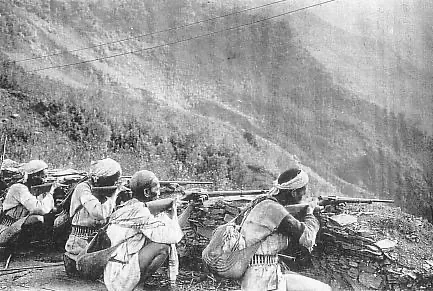
The "Mikata Ban" (pro-Japanese indigenous forces) mobilized by the Japanese side (1931). Photo: Kohei Ebidara's "Wushe Campaign Photographs." Public domain via Wikimedia Commons.
The leader of this force was Temuj Varis (circa 1898 to November 11, 1930), from the Daoze group. He was almost a mirror image of Mona. The Daoze and Degudaya groups had an ancient feud over hunting grounds, which the Japanese deliberately exacerbated; Kojima Genji exploited this old grievance 38. Mona's wife once tried to recruit Temuj to join the uprising, but he refused, instead hiding Kojima. Finally, Temuj led the attack force in pursuit of the insurgents, where they were ambushed and killed by the Degudaya group in Habon Valley, with over a dozen subordinates dying in battle 39.
The movie portrays Mona and Temuj as mortal enemies, but that is fiction. The Seediq translator Iwan Pering points out that according to Gaya, Mona could not have invaded another tribe's hunting grounds; the two might even have been related by marriage 40. Temuj was not a villain; he was a leader following the same logic of Gaya but standing on the opposing side. To demonize him as a "pro-Japanese traitor" is an act of convenience by later generations. Guo Ming-cheng (Dakis Pawan), a cultural consultant for the Seediq, rejects this view. He states that when promising someone something, the Seediq must see it through; this is the spirit of Seediq Bale 41.
Source: Chinese Wikipedia "Temuj Varis," verified by Seediq translator Iwan Pering
Between the extremes of Mona and Temuj, there was a third type of person: Hanaoka Ichiro and Hanaoka Jiro.
These two men were not related; both came from the Hogo tribe and were "modelized" by Japan as elites who received Japanese education and became Seediq police. Scholar Nakao Eki Pacidal calls them the "inbetweeners" 42. When the incident broke out, they made the most painful choice. Hanaoka Ichiro (Dakis Nobing of the Seediq) had studied at Taichung Normal School; he first took care of his family and then stabbed himself in the abdomen with a fan knife (not Japanese samurai-style seppuku). Hanaoka Jiro (Dakis Nawi) led his people to commit ritual suicide 43. They left a will written in Japanese, which began:
我等は此の世を去らねばならぬ/蕃人のこうふんは出役の多い為にこんな事件になりました (We must leave this world / The rebellion of the indigenous people was caused by too much labor service) 44.
Hanaoka Jiro's wife, Takayama Hatsuko (Dakis Tadau of the Seediq), survived and later became a key witness to the Wushe Incident in the research of Deng Xiangyang 45. Her son, Hanaoka Koga (Awi Dakis, 1930–2001), later became the head of Ren'ai Township, and he was the one who recovered Mona's remains in 1973 46. The Japanese did not trust them, nor did the Seediq necessarily accept them. The Hanaoka brothers died caught between two worlds; even their final words to posterity were written in Japanese.
After the incident concluded, the survivors paid the ultimate price. On May 6, 1931, approximately 298 people from the surviving Six Tribes (Japanese documents mention 278) were forcibly relocated to "Chuanzhong Island." Although the name contains the character for island, it is actually a plateau surrounded by the Beigang Creek, Meiyuan Creek, and Abis Creek. They were forbidden from returning home; four people attempted to go back, and three were executed. Dysentery and malaria spread in the detention area 47. The Japanese authorities also held individuals accountable: Governor-General Ishizuka Eizo and Director-General Hanjuro Mitsuhiro resigned on January 16, 1931, and Police Bureau Chief Ishii Yasushi and Taichung Prefectural Governor Mizukoshi Kōichi were dismissed 48.
📝 Curator's Note
Why do textbooks only teach the first half and not the second? Because the first half fits into the clean framework of "the Chinese nation resisting Japan," but the second half does not. The Second Wushe Incident, the Daoze group, indigenous people killing indigenous people—when these facts are laid bare, the myth of "a single nation uniting to resist tyranny" is shattered. Revisionist historian Barclay exposed this cleanliness: the Daoze and Taroko groups had cooperated with Japan to hunt down insurgents; the fuse for the Wushe Incident was immediate humiliation and forced labor, not a systematic plan of extermination 49. However, Barclay also emphasized that he was not whitewashing colonialism; the Japanese response to the insurgents was indeed one of "genocidal fury." What he shattered was the clean cloak of nationalism draped over this uprising, not the legitimacy of the uprising itself.
A Specimen That Lived for Forty Years
Mo Na Lu Tao died, but his story is not over. Because of his remains, a strange journey spanning nearly forty years was to unfold. On July 6, 1933, hunters from the Paoalan community discovered a skeleton in a cave on the right bank of Mahpo Creek. Mo Na's daughter, Ma Hong Mo Nai, identified it as her father using clothing, silver bracelets, and a knife50.
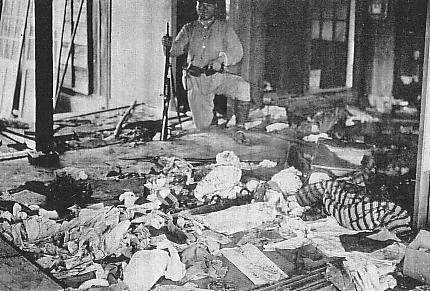
A scene from the "Wushe Expedition Photo Album" (1930). Turning a conquest into an exhibit, and turning Mo Na's bones into a specimen, are the same impulse. Photo: Kohei Ebidohara's "Wushe Expedition Photo Album." Public domain via Wikimedia Commons.
What happened next is still shocking to read today. On June 13, 1934, when the Nangao District Office was completed, Mo Na's remains were publicly displayed as an exhibit, attracting nearly ten thousand spectators. On July 1, of the same year, they were placed in a glass case at a police exhibition in the botanical garden. According to records, the most interesting exhibit for visitors was precisely Mo Na's skeleton51. On the 28th of that month, the remains were sent to Tokyo Imperial University, where they were received by Ichikawa Shinzō, who taught ethnology, and subsequently subjected to so-called "large scale" research by anatomists Kin Kanjo. From then on, Mo Na Lu Tao became a numbered anthropological specimen for nearly forty years52.
An anthropologist was the one who rescued Mo Na from the specimen case. On September 17, 1973, Li Yi-yen, associate director of the Anthropology Department at National Taiwan University, wrote a letter to President Yan Zhenxing suggesting the repatriation of the remains. On December 24, Mo Na Lu Tao left National Taiwan University53.
Here is a bitter circle: anthropology was the discipline that turned him into a specimen "for research," and it was also anthropology that released him from the display case. A person who fought to not be treated as an "artifact of primitive peoples" spent forty years as such, which was precisely what the Wushe Incident initially served to "prove" to the colonizers: how "primitive" or "savage" the indigenous people were54.
But the way he was returned home was still not by his own ways. The reburial ceremony was presided over by the Chairman of the Provincial Government of Taiwan, using a complete Han Chinese ritual: spirit hall, wreaths, mourning music, and funeral cart; a traditional Chinese white archway bearing "Noble Blood and Loyal Gallantry" 55 was also erected before the grave. Even returning home was not done via his own Rainbow Bridge.
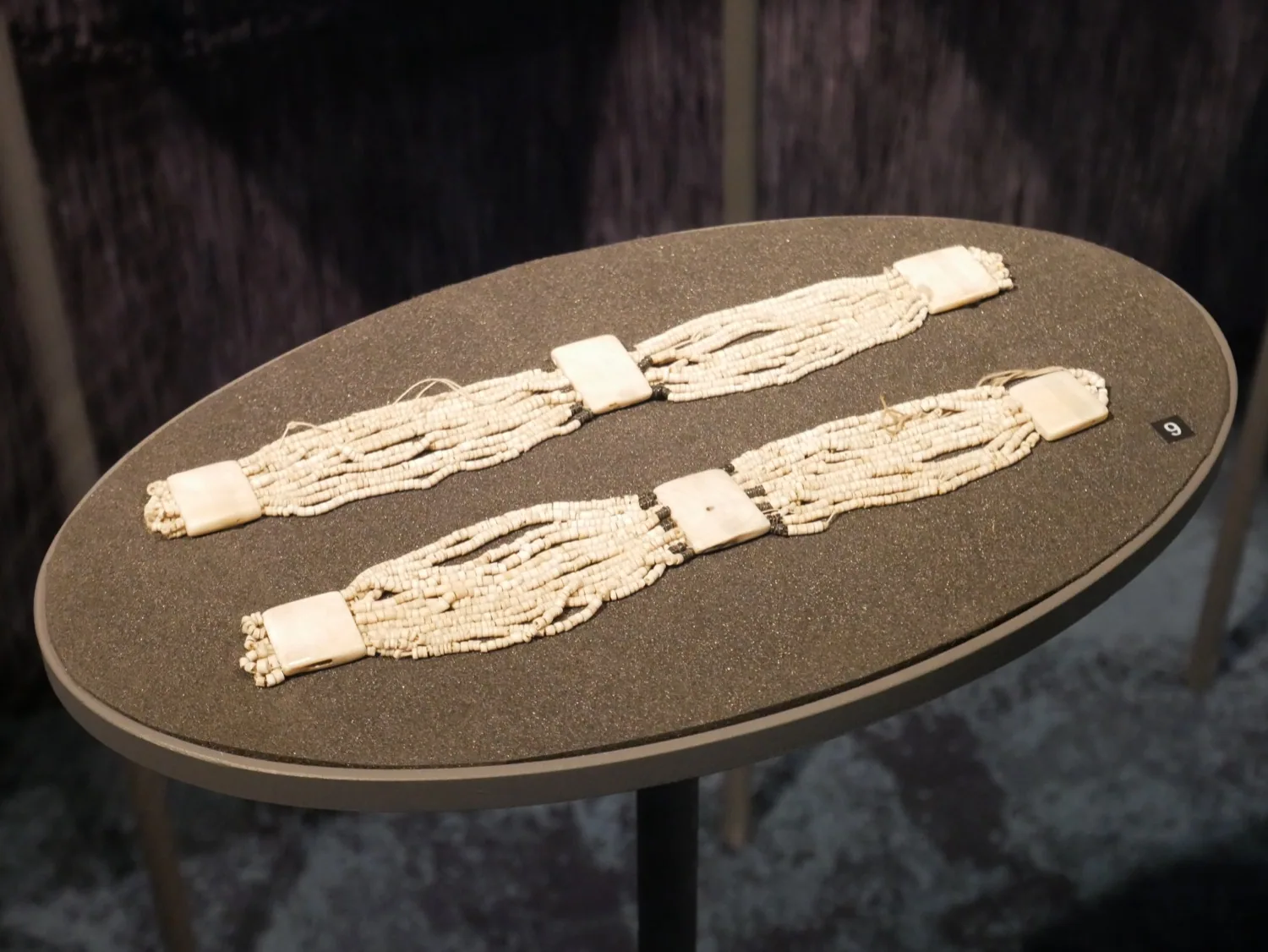
_Another view of the same shell anklet, currently housed at the National Taiwan Museum. A person who guarded Gaya for a lifetime ultimately became an exhibit in a display case, both body and artifacts. Photo: Shizi, 2019. CC BY-SA 4.0 via Wikimedia Commons._
📝 Curator's Note
For three decades, from 1934 to 1973, the same remains were defined by three different powers. The Japanese treated him as "evidence of barbarism" and made a specimen exhibit; the KMT government treated him as an "anti-Japanese hero of the Chinese nation," erecting monuments, enshrining him in memorial halls, and awarding commendations; and after localization, he became a symbol of "Taiwanese local consciousness." Michael Berry's The Musha Incident: A Reader (Columbia University Press, 2022) explains this process clearly: three regimes, three sets of usage, each one pushed the Sediq people out of the subject position in the narrative. Mona being minted on a twenty-cent coin was actually the third appropriation.
Berry summarized these three usages in the book (the following is a Chinese translation):
The Japanese used him to prove the "barbarism" of the indigenous peoples; the KMT government cited this incident as evidence of Taiwanese bravery and unity with the Chinese people against Japan; groups advocating independence treated him as an example of "authentic" cultural tradition 56.
This thread of appropriation extends to today. In 1969, Mona Rudao was enshrined in a memorial hall, reportedly being the first indigenous person to be enshrined. In 1970, the Executive Yuan issued a commendation signed by Minister of the Interior Hsu Ching-chong 57. The monument at Wushe has been modified repeatedly: in 1950, Kao Yung-ching removed the shrine and erected the "Rest of Life Memorial"; in 1953, the "Noble Blood and Loyal Gallantry" archway and martyr memorial were erected, signed by Chairman Wu Kuo-cheng. After Wu Kuo-cheng was involved in a political scandal, the inscription was changed to the "Wushe Mountain People Uprising Monument," with Huang Jie signing it 58. Historical scholar Ku Hung-ch'an pointed out in his article Transitory Memory that every time a regime changed and the signatory changed, the monument was re-engraved; the state thus carved political memory into the same stone 59.
As for the twenty-cent coin, the official reason given by the central bank was "to respect the history and culture of Taiwan's indigenous peoples and promote ethnic harmony" 60. It sounds very good. But when you know that the face was sourced from a Japanese magazine, that no one dared to collect the coin, and that the remains were specimens for forty years, those six words—"promote ethnic harmony"—take on another weight.
Whose Hero
In 2011, the film Seediq Bale, directed by Wei De-sheng (魏德聖), was released in two parts: The Sun Flag and Rainbow Bridge. The combined box office revenue in Taiwan reached approximately 880 million NTD. It was nominated for the main competition at the Venice Film Festival, won Best Picture at the Golden Horse Awards, and was among the nine finalists for the Academy Award for Best Foreign Language Film61. For Taiwanese people born after 1985, the face of Mona Rudao, as portrayed by the Taíya (泰雅) pastor Lin Ching-te (林慶台), became the image of adult Mona.
ARS Film's official theatrical trailer. For the generation born after 1985, this face in the trailer became the face of Mona Rudao.
The film is responsible for keeping Mona in memory across an entire generation. However, it is also the version that scholars most critically question as "romanticized."
The harshest critic was Dakis Pawan (郭明正), a descendant of the Qīngliú tribe and author of Truth: Bale (《真相·巴萊*). He pointed out that terms like "ancestral blood sacrifice" and "pride" were invented by Wei De-sheng, as they do not exist in the Seediq language; he noted that Mona shooting his wife violated Gaya (a cultural concept), which he warned Wei De-sheng about, but who proceeded with filming; and that the rebellion was romanticized into a personal male achievement62. The Indigenous writer Walis Pawan criticized the film's individualism as violating the tradition of collective decision-making: traditional tribal leadership follows collective decisions, and no single person acts unilaterally63. Scholar Lin Chin-ru (林津如) systematically organized these cultural distortions in her paper on CLCWeb (2018)64.
If Seediq Bale was a spectacle, then the 2014 documentary Afterlife—Seediq Bale (《餘生—賽德克·巴萊》), by Tang Xiang-zhu (湯湘竹), is its counterpart. This film was nominated for Best Documentary and Best Sound at the 50th Golden Horse Awards (though it did not win). It follows the descendants of the survivors to seek the origin of ancestral spirits, Pusu Qhuni (牡丹岩), responding from the perspective of those who lived through it, in contrast to the grandeur on screen65. Everyone writes about the climax of the resistance, but few write about "how to live after surviving." The novelist Wu He’s Afterlife also follows this path; he interviews descendants and criticizes Lee Teng-hui's monument and Chen Shui-bian's coins for politicizing Mona rather than truly mourning him; the survivors actually lived in a state of shameful silence66.
The official trailer for the documentary Afterlife (2014, Tang Xiang-zhu), released by ARS Film. Compared to the spectacle of Seediq Bale, this film gives the camera to those who survived.
The modern mosaic continues. On April 23, 2008, the Seediq people separated from the Taíya tribe and were officially recognized as Taiwan's 14th Indigenous group, divided into three dialect groups: Degudataya, Daozhe, and Deruqu67. On Indigenous Peoples' Day on August 1, 2016, President Tsai Ing-wen (蔡英文) apologized to the Indigenous peoples on behalf of the government:
For four hundred years, every regime that has come to Taiwan has severely infringed upon the existing rights of the Indigenous peoples through military conquest and land plunder68.
She also established the Committee for Historical Justice and Transitional Justice of Indigenous Peoples, with Dr. Cai Chi-wei (蔡志偉), a Seediq doctoral candidate in law (Awi Mona, Taiwan's first Indigenous legal scholar), serving as the convener of the land subcommittee69. But justice was not achieved here. The 2017 regulations on traditional territory excluded private land, reducing the area available for demarcation from 1.8 million hectares to about 800,000 hectares, sparking protests that lasted several years in Kaohsiung70.
The sharpest question is left to the contemporary era. In 2025, Seediq Bale was re-released in China under the name "80th Anniversary of Restoration." A Seediq descendant, Walis Pawan, responded during an interview (translated from a English report):
This is a matter between China and Japan. They use a film about us to speak for our feelings, but China has never come to ask us71.
This sentence can be considered the key to the entire article. Mona Rudao was claimed by three parties: Han Chinese/Taiwanese nationalism, the narrative of the Chinese nation, and the silence of the descendants of the Wais (味方蕃). These three parties held irreconcilable relationships with the same person. And that person who was repeatedly appropriated was never asked72.
The Real Person
Returning to the Gluban village.
Descendants of those forcibly relocated to Chuanzhong Island back then still live here, in a place called Gluban, which administratively belongs to Ren'ai Township, Nantou County. A type of rice called "Chuanzhong Rice" (Taiwan Rice No. 9) is grown here; during the Japanese colonial period, it was sent as tribute to the Emperor. Media often refers to this as an "indigenous village with the highest level of education and the densest concentration of civil servants," although this description lacks official statistical support and can only be considered a common narrative73. The village has a memorial and museum dedicated to Yu Sheng. The golden rice fields are harvested year after year. At the end of Yu Sheng by Tang Xiangzhu, descendants are still searching in the mountains for the ancestral origin point called Pusu Qhuni74.
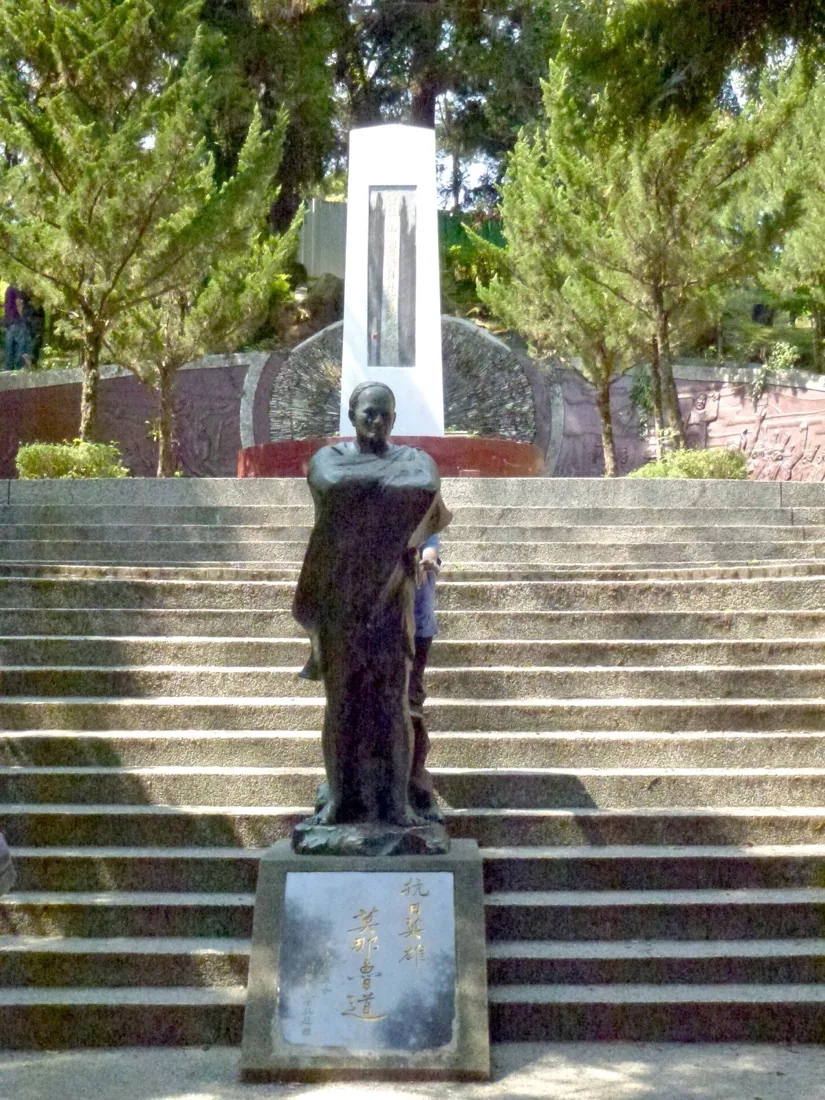
The statue and uprising monument of Mona Rudao in Wushe. Photo: Xu Fanglan (fanglan), 2012. CC BY 2.0 via Wikimedia Commons.
We need heroes. We need a clean story that can fit into textbooks, we need a coin that can be held in the palm of our hand, and we need a face to hang on the wall. So, we minted Mona Rudao onto a twenty-cent piece, wrote him into "the Chinese nation's resistance against Japan," and filmed him as a heroic epic.
But Mona Rudao never wanted to be a hero. What he wanted to be was a Seediq Bale—a real person. Someone with facial tattoos, who guarded Gaya, and who crossed the Rainbow Bridge after death. In that world, there was no China, no Japan; only ancestral spirits, the hunting grounds, that bridge, and the crab spirit checking your hands at the bridgehead.
The face on the coin was taken from a Japanese magazine. The remains were specimens for nearly forty years before being buried with Han rituals, never crossing his own Rainbow Bridge to go home. We gave him everything except one thing—to treat him as a person, not a monument.
Perhaps the first step in truly knowing Mona Rudao is not remembering how many Japanese he killed, but understanding the world he died defending, a world that did not need us to choose sides for it.
Further Reading:
- Wei Te-sheng — The director of Seediq Bale, who brought Mona Rudao to the screen, and another aspect of "how film reshapes memory" in this article.
- Indigenous Peoples' History and Naming Movement in Taiwan — How the Seediq people separated from the Atayal in 2008 to become the 14th tribe of Taiwan.
- Japanese Colonial Era — The Tivan policy and fifty years of Taiwan's colonization, the historical context of the Wushe Incident.
- Indigenous Land Justice and Traditional Territories in Taiwan — Mona's hunting grounds, extending to today's disputes over traditional territory demarcation.
Image and Video Sources
This article uses 7 public domain / CC licensed images, all cached in public/article-images/people/ to avoid hotlinking; it also embeds two official videos from the Guozi Film (fair use editorial commentary):
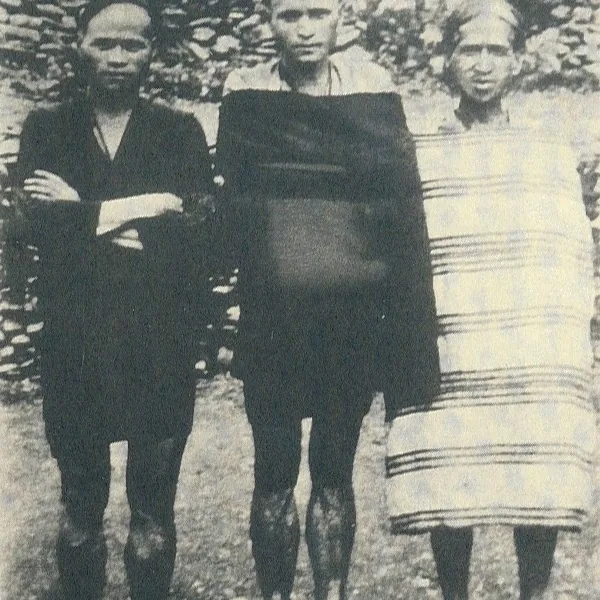
- Photo of Mona Rudao with Seediq tribal leaders (Main image)— From Kōhei Eirohara's Wushe Punitive Expedition Photo Album (Kyoshin Shokai, 1931), Public domain (PD-Japan-oldphoto). The original photo is vertical; this article cropped it into a square for the main image.
- Mona Rudao's shell anklet (2019)— Artifact in the National Taiwan Museum, photographed by Shi Zi, CC BY-SA 4.0.
- Photo of the Wushe Incident scene (1930)— From the Japanese Wushe Punitive Expedition Photo Album, Public domain (PD-Japan-oldphoto).
- Commander and Staff of the Wushe Incident punitive force (1930)— From the Japanese Wushe Punitive Expedition Photo Album, Public domain (PD-Japan-oldphoto).
- Mikata Ban's troop (1931)— From the Japanese Wushe Punitive Expedition Photo Album, Public domain (PD-Japan-oldphoto).
- Mona Rudao's shell anklet (another view) (2019)— Artifact in the National Taiwan Museum, photographed by Shi Zi, CC BY-SA 4.0.
- Statue of Mona Rudao and Wushe Incident Monument (2012)— Photographed by Fanglan Xu, CC BY 2.0.
- Video: Seediq Bale Theater Trailer HD — ARS Film official channel.
- Video: Life After – Seediq Bale Trailer — ARS Film official channel, a 2014 documentary by Tang Xiangzhu.
References
- Central Bank Coin Digital Museum: New Taiwan Dollar Twenty Cent Piece — The official coin museum page of the Central Bank, describing the twenty-cent bimetallic circulating coin issued in July 2001, featuring Mo Na Lu Tao and the Wushe Anti-Japanese Monument on the obverse and a Atayal dugout canoe on the reverse, making it Taiwan's first circulating coin themed after indigenous peoples.↩
- Express (United Daily News): The Design Story of the Twenty Cent Coin — A special column in the United Daily News digital collection, detailing the process by which the Central Mint designed the twenty-cent coin, having searched domestic historical and cultural materials without finding a portrait of Mo Na Lu Tao, eventually locating a photo in a Japanese magazine for the designers to engrave onto the mold.↩
- Mirror Weekly: Why is the Twenty Cent Coin Often Mistaken for Counterfeit? — A Mirror Weekly report about the phenomenon where the twenty-cent coin, due to low issuance and circulation rates, is often mistaken for counterfeit by merchants when people use it for consumption.↩
- Wikipedia: Mo Na Lu Tao — A Chinese Wikipedia entry compiling the biography of Mo Na Lu Tao, a chief of the Gedudaya group in the Seediq tribe. Birth years are disputed between 1880 (Chinese/English Wikipedia) and 1882 (Ministry of Education National Education Institute), as no original household registration records exist.↩
- Wikipedia: Mo Na Lu Tao (Body) — The 'Body' section describes Mo Na's physique as 'allegedly nearly 190 cm tall,' with the word 'allegedly' indicating it is a legend without skeletal measurement records to support it.↩
- Wikipedia: Gaya (Seediq and Atayal) — Explains that Gaya is the totality of the Seediq ancestral teachings, laws, social norms, and taboos, established by the ancestor spirit Utux and unchangeable, governing collective obligations such as communal sacrifice, hunting, eating, observing taboos, and bearing sins.↩
- Taiwan Insight: Exploring Gender Culture Politics in 'Seediq Bale' — An article by scholar Lin Chin-ru published on the Nottingham University Taiwan Insight platform, analyzing the multiple meanings of mgaya (grass/courage) in Seediq culture—including revenge, divine judgment, praying for a good harvest, mourning ancestors, and coming-of-age status—and showing it is not merely violence.↩
- Wikipedia: Rainbow Bridge (Seediq Belief) — Describes the Seediq belief that after death, one must pass through the Rainbow Bridge (Hakaw Utux) to reunite with ancestral spirits. The crab spirit Utux Kalan checks the tattoos at the bridgehead; only male headhunters and female weavers are qualified to get tattoos and cross.↩
- Duke University Press: Leo Ching's 'Anti-Japan' — A postcolonial study by Leo Ching published by Duke University Press, which introduces the concept of the 'colonial double-bind' for colonized indigenous peoples—a situation where they are semi-tamed yet continuously viewed as savages by colonizers, being accepted by neither side.↩
- Taiwan Insight: Gender Culture Politics of Seediq Bale — The text explains that Seediq Bale means 'true person' in the Seediq language and is a core concept in the Seediq worldview.↩
- Barak Anthropology: Guo Ming-cheng Discusses Cultural Representation of 'Seediq Bale' — Posted on the Taiwanese anthropology collaborative blog 'Barak Anthropology,' this compiles research by film consultant Dakis Pawan (Guo Ming-cheng) on the dialogue and cultural details of Seediq Bale, noting that terms like 'blood sacrifice to ancestors' are directorial creations and do not have corresponding words in the Seediq language.↩
- Wikipedia: Japanese Colonial Policy towards Taiwan Indigenous Peoples — The article traces Japan's rule over Taiwanese indigenous peoples, from the Pacification Bureau, police administration in 1906, Sakuma Sadamasa's 'Five-Year Pacification Plan' (approx. 16.3 million yen military subjugation) from 1910–1915, to disarmament and assimilation phases involving banning travel and tattooing in 1915.↩
- Wikipedia: Wushe Incident (Model Savage Area Section) — The 'Model Savage Area' section cites that approximately 95% of the indigenous peoples in the Wushe area could communicate with Japanese police and teachers using simple Japanese, leading the Japanese to view it as a model result of pacification.↩
- University of California Press: Paul D. Barclay's 'Outcasts of Empire' — A monograph by Barclay published by the University of California Press that analyzes Japanese pacification from a revisionist perspective, describing Wushe as 'an enclave led by outsiders whose tranquility and loyalty are questionable at best.'↩
- Wikipedia: Wushe Incident (Labor and Treatment Section) — The article records that indigenous peoples in the Wushe area were mobilized for labor nine times between 1928 and 1930. In 1928, construction workers at a shrine had their meal allowances withheld and were forced to donate money; wages were 20–30 cents per day, less than the 60 cents received by Han Chinese.↩
- Wikipedia: Mona Rudao — The article describes how Japanese police officer Kondo Gisamaro abandoned his wife, Divas Rudao, after marrying her, and that Gaya women who were abandoned could not return to their homes, which became one of the grievances accumulated during the Wushe Incident.↩
- Taipei Times: Book Review of 'Kondo the Barbarian' — A Taipei Times book review introduces Paul Barclay's 'Kondo the Barbarian,' examining Kondo Gisamaro, who married Divas Rudao, as a brother of Kondo Katsusaburo, a key figure in the Japanese military administration in Taiwan, clarifying the role of the Kondo family in Wushe.↩
- Wikipedia: Wushe Incident (The Toasting Incident) — The article describes how on October 7, 1930, Dardo Mona, the eldest son of the Mona tribe, toasted Japanese police officer Yoshimura Koki at a banquet. Yoshimura rejected the toast as 'unclean' and struck him with a baton, which triggered a fight.↩
- Wikipedia: Wushe Incident (Description of the Toasting Incident) — The article details how Yoshimura Koki refused Dardo Mona's toast, citing 'disgust for that unclean feast,' and struck his hand, leading to a fight between both parties.↩
- Wikipedia: Wushe Incident (The Surprise Attack) — The article states that on the morning of October 27, 1930, approximately 300 men from six tribes attacked 13 police stations in separate groups, seizing firearms before rushing toward the joint sports meet at Wushe Public School.↩
- Wikipedia: Wushe Incident (The Six Tribes Involved) — The article lists the six involved tribes as Mahkepo, Tarowan, Boalin, Sko, Hogo, and Rodov. It notes that the most populous Baran tribe (led by Wallace Buni) did not participate, while the main instigators were Biho Sabu and Biho Waris from the Hogo tribe.↩
- Taipei Times: The Gas Bombing of the Sediq — A in-depth report by the Taipei Times detailing the historical fact that 134 Japanese people (including women and children) were killed on the day of the Wushe Incident, along with two Han Chinese individuals (Li Caiyun and Liu Cailiang) who were mistakenly killed while wearing kimono.↩
- Wikipedia: Wushe Incident (Seizure of Weapons) — The article states that the tribes involved seized approximately 180 rifles and 23,037 bullets during the surprise attack.↩
- Wikipedia: Wushe Incident (Suppression) — The article describes the Japanese military and police forces suppressing the uprising. The front line was commanded by Major General Kamata Yahiko (not Governor Ishizuka Hidekazu), who used aerial bombing and mountain artillery bombardment, with suppression lasting for about fifty days until early December.↩
- Taipei Times: The Gas Bombing of the Sediq — This report examines the controversy surrounding the use of gas bombs during the Japanese military's suppression, including testimonies from tribesmen 'suffering skin lesions' and historical records from the Taiwan People's Party in early 1931 protesting the 'massacre with poison gas' to the International Telegraph Union.↩
- Wikipedia: Wushe Incident (Gas Controversy) — The article presents two sides of the gas controversy: the corrosive gas theory and the counter-argument by Japanese historian Akimasa Akitoshi, who mentioned 'hundreds of tear gas bombs and at least three special gases (including cyanide and tear gas),' citing a Japanese Wikipedia entry as 'unclear to this day.'↩
- JACAR Japan Asian History Center: Wushe Incident Related Documents (S5-2-26) — Wushe incident related documents digitized by JACAR, archived at the National Institute for Defense Studies of the Japanese Ministry of Defense. This includes a secret telegram from the Army Ministry's adjutant to the Taiwan Military Chief of Staff on November 5, 1930, requesting that the use of corrosive ammunition be handled secretly due to foreign relations, and that gas bomb matters be communicated only by code.↩
- Taipei Times: The Gas Bombing of the Sediq — This report cites the content of the Army Ministry's secret telegram stating 'gas bombs are indicated by code,' arguing that the Japanese side did not refuse to use them but deliberately failed to keep records, which is a key historical document indicating hidden intentions.↩
- Wikipedia: Taiwan People's Party (Dissolution) — The article states that the Taiwan People's Party was forcibly dissolved by the Japanese in February 1931 due to protests against events like the Wushe Incident; related studies of the Wushe Incident also point out that Japan did not sign the Geneva Protocol banning gas weapons until 1975.↩
- Wikipedia: Mona Rudao (Suicide) — The article mentions the number of women and children who committed mass suicide during the Wushe Incident. Chinese sources state approximately 296 people, while English Wikipedia states about 290 people, showing a discrepancy between the two figures.↩
- Hong Kong 01: The Wushe Incident 90th Anniversary Special — A compilation of multiple perspectives on the Wushe Incident's 90th anniversary by Hong Kong 01, including the descendants of the Seediq tribe who understand the suicide as a desperate situation under Gaya, not a glorious sacrifice.↩
- Wikipedia: Mona Rudao (Time of Death section) — The article states that Mona's remains were found in 1933, and the date of death is an estimate with multiple versions (November 5th, mid-November, November 28th, December 1st), making precise determination impossible.↩
- Wikipedia: Mona Rudao (Wife's Death section) — The article mentions that Japanese publications in 1936 claimed Mona killed his wife and child, but tribal members who experienced the event confirmed that his wife committed suicide by hanging because killing a spouse violates Seediq Gaya.↩
- Wikipedia: Mona Rudao (Tribal Confirmation section) — The same article verbatim describes 'that killing a wife and child violates the Seediq Gaya, which was confirmed by tribal members who experienced the event, that Mona Rudao's wife committed suicide by hanging.'↩
- Wikipedia: Wushe Incident (Casualty Statistics) — The Chinese Wikipedia breaks down the deaths of the six tribes into 85 from knives/guns, 137 from bombing, 34 from artillery shells, 87 from beheading, and 296 from suicide (total 639), with 265 captured, about 500 who surrendered, and 1,236 participants; the English Wikipedia records about 1,200 participants, 644 deaths, and 290 suicides, showing discrepancies.↩
- National Taiwan Museum of History Collection: Headshot from the Second Wushe Incident — A historical photo in the National Taiwan Museum of History's online collection (registration number 2017.025.0192.0019) recording the event where Japanese forces attacked and took 101 heads during the Second Wushe Incident in 1931.↩
- China Times: The Second Wushe Incident — The China Times reports on the Second Wushe Incident (April 25, 1931), where Japanese police officer Genji Kojima incited the attack, issued a bounty for four categories—leaders/young men/women/children—and how the tribes divided the land of the six participating tribes afterward.↩
- Wikipedia: Temuj Varis — The article describes the long-standing feud between the Daga tribe and the Temuj Varis (approx. 1898–1930/11/11), and the background of Japanese instigation and exploitation by Genji Kojima.↩
- Wikipedia: Temuj Varis (Battle of Habon Valley section) — The article describes how Mona's wife recruited Temuj Varis, who was refused; Temuj hid Genji Kojima, eventually leading the attack force to pursue participants in Habon Valley where they were ambushed and beheaded by the Daga tribe, resulting in the death of him and over ten subordinates.↩
- Wikipedia: Temuj Varis (Film Fiction section) — The article cites research by Iwan Pering, a translator of Seediq, pointing out that the film's depiction of Mona and Temuj as having a personal feud is fictional; according to Gaya, it was impossible for Mona to invade his tribe's hunting grounds, and the two may even have been related.↩
- Wikipedia: Wushe Incident (Daga Tribe Evaluation section) — The article quotes Guo Ming-Cheng (Dakis Pawan)'s stance against labeling the Daga tribe as 'pro-Japanese traitors': 'What we promised, the Seediq must see through; this is also the spirit of Seediq Bale.'↩
- Columbia University Press: Michael Berry edited The Musha Incident: A Reader — A reader on the Wushe Incident published by Columbia University Press in 2022, which includes a chapter by Nakao Eki Pacidal discussing Ichiro and Jiro as 'inbetweeners' caught between Japanese education.↩
- Wikipedia: Hanao Ichiro — The article describes Hanao Ichiro (Dakis Nobin) who attended Taichung Normal School, after dealing with his family during the incident, stabbed himself in the abdomen and died, along with Hanao Jiro (Dakis Nawi), who hanged himself. The two were not blood relatives but belonged to the same Hago tribe.↩
- Aichi Soul Record: Hanao Jiro's Japanese Will — A Japanese website archives the original Japanese will left by Hanao (Jiro) on October 27, 1930, which begins with 'We must leave this world because of the frequent service of the aboriginal people,' explaining that the riot originated from overwork.↩
- Wikipedia: Hanao Jiro — The article describes how Hanao Jiro's wife, Takayama Hatsuko (Agbin Tatadu), survived the incident and later became a key witness to the Wushe Incident in the research of writer Deng Xiangyang.↩
- Taiwan Broadcast: The Burial of Mòna Lúdao's Remains — A report detailing the process of Mòna's remains being reburied, noting that Awi Dakis (1930–2001), successor to Hua Guanghua, who was the head of Renai Township, oversaw the retrieval of Mòna's remains in 1973.↩
- Wikipedia: Chuanchu Island Tribe (Forced Migration during the Japanese Era) — The article describes the historical event where approximately 298 people from six villages were forcibly relocated to 'Chuanchu Island,' surrounded by Beigangxi, Meiyuanxi, and Abisi streams, prohibiting their return home, with attempts to return resulting in executions, amidst outbreaks of dysentery and malaria.↩
- Wikipedia: Ishizuka Eizo — The article states that after the Wenshan Incident, Taiwan Governor Ishizuka Eizo and Chief Administrator Nitta Jiro resigned on January 16, 1931, followed by the resignation of Police Commissioner Ishii Yasushi and Taichung Prefectural Governor Mizukoshi Kōichi.↩
- University of California Press: Paul D. Barclay's 'Outcasts of Empire' — Barclay's monograph deconstructs the clean narrative of 'ethnic unity resisting oppression' from a revisionist perspective, pointing out that the Daoze and Taroko groups collaborated with Japan to hunt down rebels, with immediate humiliation and forced labor as the trigger, while simultaneously emphasizing that the Japanese response was indeed 'genocidal fury'.↩
- Taiwan Broadcast: The Discovery and Identification of Mòna Lúdao's Remains — A report stating that on July 6, 1933, hunters from Poalan found the remains in a cave on the right bank of Mahke River. Identity was confirmed by Mòna's daughter Ma Hong (Mona Yibu), a silver bracelet, and a kukri knife.↩
- oh!Sir: The Specimen Years and Memory Politics of Mòna Lúdao's Remains — This special article compiles the history of Mòna's remains being displayed at the Nangkao County Office on June 13, 1934 (attracting nearly ten thousand viewers), and subsequently exhibited in a glass case at the Botanical Garden Police Exhibition on July 1st, with the most interesting exhibit for visitors being Mòna's skeletal remains.↩
- Wind Media: The Forty-Year Specimen Journey of Mòna Lúdao's Remains — A special article by Wind Media describes how the remains were sent to Imperial University in Taipei on June 28, 1934, received by Jin Guanzhang from an ethnological lecture, and studied by anatomist 'Da Jiao,' becoming a numbered specimen for nearly four decades.↩
- Taiwan Broadcast: Li Yiyuan's Letter to Yan Zhenxing Regarding the Return of Remains — A report stating that on September 17, 1973, Li Yiyuan, the acting director of the Anthropology Department at National Taiwan University, wrote a letter to President Yan Zhenxing suggesting the return of the remains. On December 24 of the same year, Mòna Lúdao's remains left NTU and were reburied in Wenshan.↩
- oh!Sir: The Irony of Specimens and 'Primitive' Evidence — This special article points out that the Wenshan Incident was initially used by colonizers to 'prove' that indigenous people were primitive and savage, yet Mòna remained an anthropological specimen for a full forty years. Both the creation of the specimens and the final return of the remains are presented as an irony of anthropology.↩
- Wind Media: The Han Rituals of Mòna Lúdao's Reburial — A report describing that the reburial ceremony for Mòna's remains was presided over by Xie Dongmin, Chairman of the Provincial Government of Taiwan, following a complete set of Han rituals (spirit hall, wreaths, mourning music, spirit cart), with a Chinese white archway erected before the tomb inscribed with 'Crimson Blood Heroism' and 'Loyal Courage'.↩
- Columbia University Press: Introduction to 'The Musha Incident: A Reader' — A book introduction from Columbia University Press, where Michael Berry points out that the Wenshan Incident was appropriated by three parties: the Japanese used it to prove 'savagery,' the KMT government used it as evidence of Taiwanese heroism and Chinese unity, and independence advocates used it as a 'authentic' cultural tradition.↩
- Wikipedia: Mòna Lúdao (Post-War Veneration) — The article describes Mòna's post-war veneration process, including being enshrined in the Martyrs' Shrine in 1969 (the first indigenous person to be enshrined) and receiving an commendation from the Executive Yuan in 1970 (signed by Minister of the Interior Xu Qingshong).↩
- Hong Kong 01: The History of Rebuilding the Wenshan Monument — A report tracing the reconstruction of the Wenshan monument: in 1950, Gao Yong dismantled the shrine and erected the 'Yusheng Memorial'; in 1953, the 'Crimson Blood Heroism' archway and Martyrdom Monument were erected (signed by Wu Guozhen); after the Wu Guozhen scandal, it was changed to the 'Wenshan Mountain Chinese Uprising Memorial' (signed by Huang Jie).↩
- Hong Kong 01: Gu Hengzhan Discusses Monuments and Memory Politics — A report citing the views of historian Gu Hengzhan in 'Transitory Memory: A Historical Reading of the Wenshan Incident Monument' (Volume 29, Issue 1 of Taiwan History Studies, 2022), which points out that the frequent reconstruction of monuments highlights state manipulation of memory politics.↩
- Central Bank Coin Digital Museum: The Purpose of Issuing Twenty Dollar Coins — The official page of the Central Bank states that the purpose of issuing twenty-dollar coins is 'to respect Taiwan's indigenous history and culture and promote ethnic harmony'.↩
- Wikipedia: Seeds of Red — The article mentions that the 2011 film 'Seeds of Red' (Parts 1: 'Sun Flag', Part 2: 'Rainbow Bridge') earned approximately NT$880 million in Taiwan, was nominated for the main competition at Venice Film Festival, won Best Picture at the Golden Horse Awards, and was one of the nine finalists for the Academy Award for Best Foreign Language Film. Lin Ching-tai played the role of Mona.↩
- Barbarian Anthropology: Guo Ming-Cheng's Critique of 'Seeds of Red' — Barbarian Anthropology features a critique by film consultant Guo Ming-Cheng (Dakis Pawan): 'Blood sacrifice to ancestors,' 'pride' were invented by the director, and Mona shooting his wife violates Gaya (who warned Wei De-Sheng); the story is misrepresented as an individual male achievement.↩
- Taiwan Insight: Walis Pawan Criticizes Individual Heroism — The article quotes criticism from indigenous writer Walis Pawan, who points out that the film's individualism violates the traditional tribal leadership of the Seeds of Red, which follows collective decisions without any single person acting on their own behalf.↩
- Purdue CLCWeb: Lin Jin-Ru Discusses Gender and Cultural Politics in 'Seeds of Red' — The 2018 issue (Volume 20, Issue 5) of the Purdue University CLCWeb journal contains a paper by Lin Jin-Ru that systematically analyzes the issues of distortion in gender and cultural representation in 'Seeds of Red'.↩
- Wikipedia: Remainder—Seeds of Red — The article describes how the 2014 documentary 'Remainder—Seeds of Red' by Tang Xiang-zhu was nominated for Best Documentary and Best Sound at the 50th Golden Horse Awards (without winning), tracing the ancestral origin Pusu Qhuni (Peony Rock) from the perspective of surviving descendants.↩
- China Perspectives: Sebastian Veg on Wu He's 'Remainder' — A book review in the French journal China Perspectives analyzes the novel 'Remainder' by Wu He, which interviews surviving descendants and criticizes Lee Teng-hui erecting a monument and Chen Shui-bian issuing coins as politicizing Mona rather than truly mourning, with survivors living in shame and silence.↩
- CNA News: Seeds of Red Recognized as the 14th Tribe — CNA news reported on April 23, 2008, that the Seeds of Red were independently recognized by the Paiwan tribe as Taiwan's 14th indigenous group, with three dialect groups: Degudaya, Daoze, and Delugu.↩
- Presidential Office Press Release: President Apologizes to Indigenous Peoples on Behalf of the Government — An official press release from the Presidential Office of the Republic of China records President Tsai Ing-wen's apology to indigenous peoples on August 1, 2016: 'For four hundred years, every regime that has come to Taiwan has severely infringed upon the existing rights of the indigenous peoples through military conquest and land plundering.'↩
- Presidential Office Press Release: Indigenous Peoples' Historical Justice and Transitional Justice Committee — The same press release mentions the President establishing the Indigenous Peoples' Historical Justice and Transitional Justice Committee, with Dr. Cai Zhi-wei (Awi Mona), a PhD in law from the Seeds of Red tribe, serving as the convener of the land subcommittee.↩
- HK01: Dispute over Traditional Territory Delimitation — The report summarizes that the 2017 regulations on delimiting traditional territories excluded private land, reducing the demarcatable area from about 1.8 million hectares to about 800,000 hectares, which sparked a dispute with long-term protests by Kaido.↩
- Domino Theory: Seeds of Red Descendants' Response to Re-screenings in China — The report records the response of Walis Pawan, a descendant of the Seeds of Red tribe, when 'Seeds of Red' was re-screened in China under the name '80th Anniversary of Liberation' in 2025: 'This is a matter between China and Japan. They use a movie about us to speak for our feelings, but China has never come to ask us.'↩
- Columbia University Press: The Musha Incident: A Reader — The core issue presented in the reader from Columbia University Press is that Mona Rudo is claimed by three parties—Han people/Taiwanese nationalism, Chinese national narrative, and descendants of Weifang—each claiming an incompatible relationship with the same person, without consulting him.↩
- ETtoday: Qingliu Tribe and Chuanzhong Rice — An ETtoday travel report introduces the Qingliu tribe (Gluban in Ren'ai Township, Nantou County), which cultivates 'Chuanzhong rice' (Taiwan Standard No. 9, once tribute to the Emperor during Japanese rule), and mentions that media often refers to this place as an 'indigenous tribe with the highest education level and densest civil servants' (without official statistical support, it is a common saying).↩
- Taiwan International Documentary Film Festival (TIDF): Remainder—Seeds of Red — The TIDF materials introduce Tang Xiang-zhu's 'Remainder,' which focuses on surviving descendants tracing the ancestral origin Pusu Qhuni, contrasting it with the spectacular narrative of 'Seeds of Red'.↩
🧬 What Semiont was thinking while writing this