
30-second overview: Chen Chien-nien (Puyuma name: Pau-dull), born on August 1, 1967, in the Nanwang community, Beinan Township, Taitung County.1 He is the maternal grandson of Baliwakes Lu Sen-bao (1910-1988), the Puyuma song master and author of “Beautiful Rice Ears.”12 After graduating from police officer class no. 114 in 1986, he was assigned to Guanshan, Taitung, and went on to serve in the police force for 30 years and 10 months.3 In 1999, at age 33, he released his first album of original songs, Ocean. At the 11th Golden Melody Awards in 2000, he defeated Jacky Cheung, Harlem Yu, David Tao, and Wang Leehom to win Best Mandarin Male Vocalist; at the same ceremony, he also won Best Composer for “Myth,” written for Samingad.45 At the moment he won, his full-time job was still police officer.3 In September that year, he chose to request a transfer to Lanyu, where he remained until retiring in 2017.16

March 25, 2018, Chen Chien-nien performing at FENG live house in Hsinchu. Photo: Taiwania Justo. License via Wikimedia Commons.
Puyuma Pau-dull, and the Songs His Grandfather Left Behind
On August 1, 1967, Chen Chien-nien was born in the Nanwang community of Beinan Township, Taitung County (Sakuban, one of the eight Puyuma communities and the community that has most fully preserved Puyuma culture).1 His Puyuma name is Pau-dull. His father is Chen Kuang-jung; his mother is the daughter of Baliwakes Lu Sen-bao, the Puyuma song master. Lu Sen-bao was therefore Chen Chien-nien’s maternal grandfather, not his father.12 This generational relationship determines how to read his music over the next thirty years. What his grandfather left behind were melodies remembered by an entire people; what the grandson had to do was to hold that inheritance and then write songs of his own.
Lu Sen-bao was born in 1910 and graduated from Tainan Normal School, making him a rare Puyuma intellectual in the Japanese colonial period.2 After the war, he wrote a series of Puyuma songs in his mother tongue: “Puyuma Mountain,” “Ode to the Ancestors,” “Beautiful Rice Ears,” “Longing for Home,” and “Love of Lanyu.” Among them, “Beautiful Rice Ears,” later carried widely through the singing of Kimbo Hu, became one of the first Indigenous songs heard by the outside world during Taiwan’s 1970s folk song movement.2 Lu Sen-bao died of a cerebral hemorrhage in 1988. That year, his maternal grandson Chen Chien-nien was 21, two years out of Taiwan Police College, working as a police officer in Guanshan, Taitung.3
📝 Curator’s Note
Common online introductions often describe Lu Sen-bao as Chen Chien-nien’s “father” or “paternal grandfather.” Behind this mistake is in fact the seepage of Han patrilineal assumptions. For Mandarin readers, “father passes on to son” is the default path of inheritance. But traditional Puyuma society is matrilineal, and the maternal grandfather is a genuine elder anchor in family narrative. Chen Chien-nien’s own wording is clear: he is Lu Sen-bao’s “maternal grandson,” while Samingad and Jia Jia are his “nieces through his sister.” Only when the kinship line is marked clearly does this line of inheritance become visible.17
The Bangdi in Seventh Grade, the Guitar in Eighth Grade, and a New Artist Award in Kaohsiung in 1984
Chen Chien-nien’s musical starting point was not family tradition, but the school Chinese music ensemble. In seventh grade, his homeroom teacher founded a Chinese music ensemble, and he learned the bangdi and nanhu.7 In eighth grade, as the campus folk song movement was flourishing, he picked up the guitar and tried singing Lo Ta-yu’s “Childhood.” In high school in 1982, he formed the “Four-String Choir” with older schoolmates, busking during China Youth Corps self-strengthening activities. His original song “I Once Felt It Too” later became one of the required songs taught by the China Youth Corps.7
In 1984, he entered a Kaohsiung new-songwriting competition and won the New Artist Award, then recorded a compilation album with the other winners.7 He was 17 that year. But that path did not turn into a record contract. In 1986, he entered police officer class no. 114 at Taiwan Police College of the Republic of China. After graduation, he was assigned to Guanshan Township in Taitung.13 He became a police officer.
“I only wanted an album as a keepsake!”8
This is what Chen Chien-nien later told a Taiwan Panorama reporter when recalling the recording of Ocean. He had no ambition to become a singer; being a police officer was the life he meant to lead. But he kept writing songs, and they circulated in Taitung’s Indigenous communities. After thirteen years of everyday police work, in 1999, at age 33, he encountered Trees Music.
“Not Following the Usual Model of Pulling the Singer into a Taipei Recording Studio”
Trees Music was founded in 1998. Its head, Chang Ssu-san, and producer Cheng Chieh-jen heard Chen Chien-nien in Taitung.9 Their first decision was: do not pull the singer into a Taipei recording studio.
“Rather than following the usual model of pulling the singer into a Taipei recording studio to record, they moved the recording equipment to Taitung. In addition to recording the singing, they ran all over Taitung’s valleys, streams, communities, and coastline to gather sounds, pairing the songs with the sounds most characteristic of Taitung.”10
The liner notes of Ocean include one record that turns recording technique into a kind of local gazetteer:
“Source of wave and tide sounds / Shanyuan Beach, Dulan Bay, Taitung, 3:43 p.m., 25 degrees Celsius, southeast wind, clear weather, Green Island very clear in the distance.”10
This passage reads like a recording log, and also like a local gazetteer: minute, temperature, wind direction, and visibility are all present. A stretch of ocean waves is annotated as source material that can be cited. Taipei’s industrial model of “singer plus arrangement plus session musicians” was pushed aside and replaced with “person plus place plus time plus one guitar.”
In June 1999, Ocean was released under Trees Music catalog number TCM003.11 All 13 songs used the guitar as the main instrument. Chen Chien-nien wrote the lyrics, composed, and arranged the songs himself, with a small number of tracks co-written with Lin Chih-hsing. Lin Chih-hsing is a Puyuma poet from Taitung, known in the 1990s for his Indigenous-language poetry collection Ethnic Rhymes and Homeland Feeling: Betel Nut Poems. “We Are All Kin,” from his self-published collection, was the poem Chen Chien-nien set to music and included on Ocean.12 Lin Chih-hsing later described their collaboration in an interview this way: “Half of these songs are my life experiences, and half are Chien-nien’s feelings from life.”8
What Chen Chien-nien wanted was not the R&B, ballad packaging, and stacked synthesizers then fashionable in the Mandarin pop world. He wanted the cries of flying fish to be used as synthesizers:
“It’s like the music of the ‘Betel Nut Brothers’: using only a few simple instruments, blending in the sounds of children and flying squirrels. That is the feeling I want.”8
After its release, Ocean was named one of the “Top Ten Albums of 1999” by the Association of Music Workers in Taiwan.10 Years later, it was selected as number one in the 1993-2005 section of The 200 Best Albums of Taiwan Popular Music.10
Official Trees Music MV: the title track from the 1999 album Ocean. One guitar and the waves of Shanyuan Beach, Dulan Bay, Taitung, belong to the same album as that recording note: “3:43 p.m., 25 degrees Celsius.”
Sun Yat-sen Memorial Hall: The Police Officer Among Four Heavenly Kings
April 29, 2000, Sun Yat-sen Memorial Hall. The 11th Golden Melody Awards ceremony.45 The nominees for Best Mandarin Male Vocalist were Jacky Cheung, Harlem Yu, David Tao, Wang Leehom, and Chen Chien-nien, a Puyuma police officer from Taitung.10 When the result was announced, David Tao, Wang Leehom, and Jacky Cheung all turned to shake his hand and congratulate him.13 At the same ceremony, Chen Chien-nien also won Best Composer for “Myth,” the song he wrote for Samingad, with lyrics by Lin Chih-hsing.414 Samingad herself won Best New Artist that year.4
Samingad is Chen Chien-nien’s niece. Jia Jia (Chi Chia-ying), Samingad’s younger sister, is also Chen Chien-nien’s niece.1415 In other words, the 2000 Golden Melody Awards placed three generations of Puyuma music from the entire Nanwang community onto the highest awards stage in Mandarin pop music at the same time: Lu Sen-bao (not present; he had died in 1988), Chen Chien-nien (Best Male Vocalist plus Best Composer), and Samingad (Best New Artist).
Official MV for “Myth,” sung by Samingad, composed by Chen Chien-nien, and written by Lin Chih-hsing, included on Samingad’s 1999 debut album Samingad: The Voice of the Sun, Wind, and Grassland. At the 11th Golden Melody Awards in 2000, Chen Chien-nien won Best Composer for this song, while Samingad won Best New Artist at the same ceremony.
How did international critics see that year? In a pre-awards article on April 27, 2000, the Taipei Times quoted music critics describing Chen Chien-nien’s music as “sincere, pure and naturally touching,” and said that the Golden Melody recognition for Chen Chien-nien and Samingad was “an affirmation of Aboriginal musical achievement.”16 The outside world read the same signal: Indigenous music was no longer material to be “sampled” by pop lyricists, but a subject that could go onstage itself and win mainstream awards.
But Chen Chien-nien on the awards stage was still, by profession, a police officer.
📝 Curator’s Note
At the opening ceremony of the 1996 Atlanta Olympics, the German group Enigma’s “Return To Innocence” sampled the drinking song of the Amis couple Difang and Igay Duana. It was broadcast worldwide, and the royalty lawsuit that followed was not settled until 1999. That was the largest instance of Taiwanese Indigenous music being treated as “material” in the international commercial world. Four years later, Chen Chien-nien and Samingad went onstage to accept Golden Melody Awards. The significance lies in this line of contrast. Indigenous music had entered the mainstream again, but this time the creators themselves stood under the brightest spotlight, not as samples cut up by someone else.
September That Same Year: Requesting a Transfer to Lanyu
The most natural script after winning the award would have been: sign with a major record company, appear on television programs, tour, and become a star. Chen Chien-nien chose the opposite direction. In September 2000, less than five months after the Golden Melody Awards, he actively applied to transfer from the main island of Taitung to Lanyu.16
Lanyu is an outlying island southeast of Taiwan proper. Its main residents are the Tao people (Yami), with a population of roughly more than four thousand.17 For a singer who had just won a Golden Melody Award, this was a way of exiling himself to a place the media could not call every day. Before his 2022 solo concert, Chen Chien-nien himself explained the atmosphere behind this move to an ETtoday reporter: it was to “avoid the turmoil.”113
From September 2000 until his retirement in September 2017, he served on Lanyu intermittently for more than ten years in total, rotating through every police station on the island: Lanyu Station, Yongle Station, Dongqing Station, and Langdao Station. Before retiring, he was deputy chief of the Lanyu Police Station.3618 Outside police work, he climbed mountains, went diving, took photographs, learned the Tao language, and participated in Tao flying fish festivals and Indigenous rituals.618 The police dormitory became his recording studio, and Lanyu’s coastline became the source archive for his next album.
In 2002, his second album of original songs, Earth, was released by Trees Music, reflecting his three years of creation across Lanyu, Taitung, and Taipei.19 On August 5, 2021, he released his third major album of original songs, pongso no Tao (Tao for “Island of the People,” Lanyu’s self-name), with 17 songs, all rooted in Lanyu’s natural environment.20 At the 33rd Golden Melody Awards in 2022, pongso no Tao won Best Indigenous Language Album.2021
That is to say, between the Best Mandarin Male Vocalist award in 2000 and the Best Indigenous Language Album award in 2022 lay 22 years. During those 22 years, he did not run out to become a major star. He stayed in police stations and on the beaches of Lanyu, slowly turning the island of Lanyu into a long-playing record.
Official Trees Music MV: “Beautiful Heart of Orchid Island,” included on the 2021 third album of original songs pongso no Tao (Tao for “Island of the People”). These first-hand recordings, slowly written into the work over 17 years on Lanyu, later won Best Indigenous Language Album at the 2022 Golden Melody Awards.
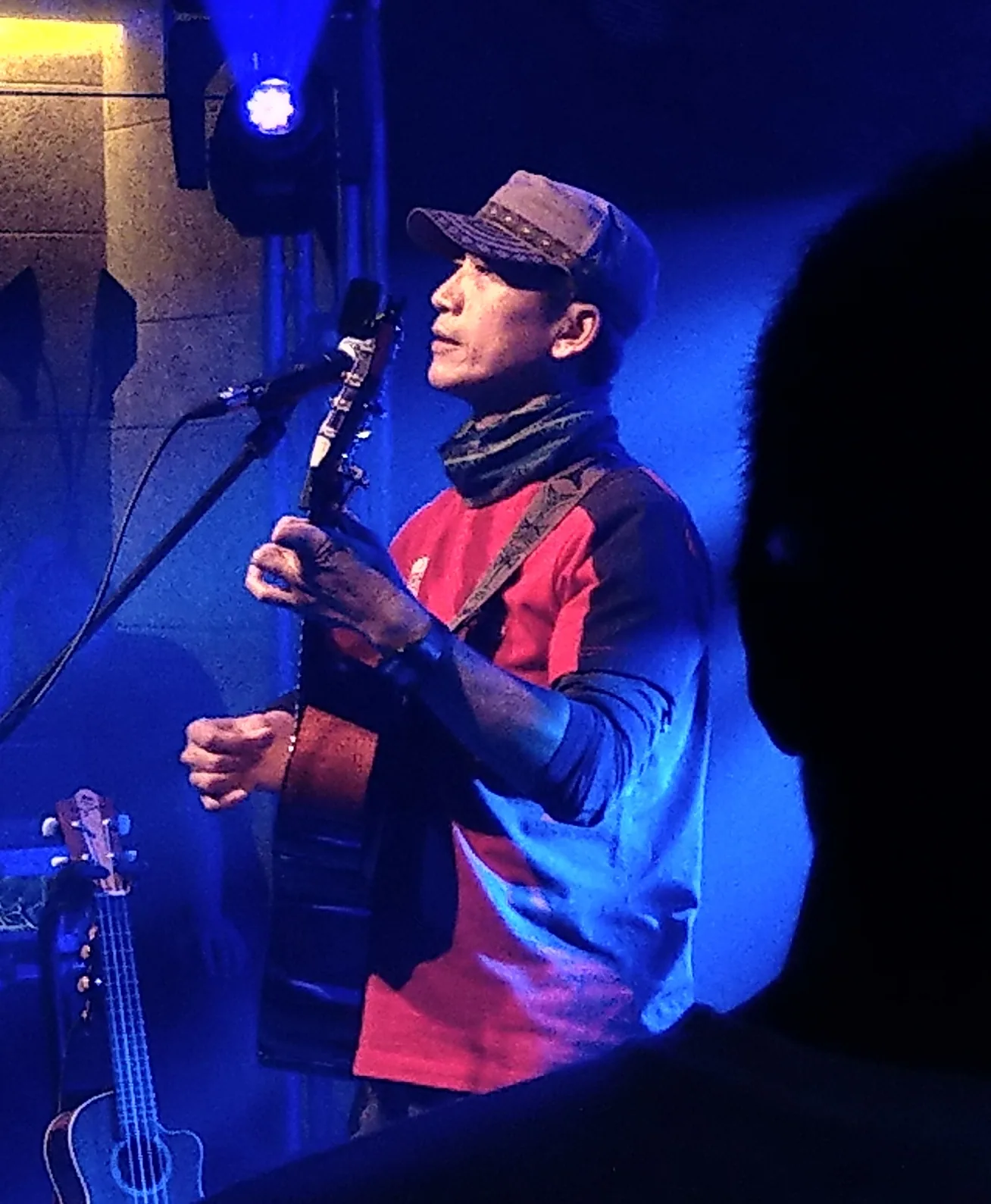
_March 25, 2018, a close-up of Chen Chien-nien performing in Hsinchu. Photo: Taiwania Justo. License via Wikimedia Commons._
“We Are All Kin”: Lyrics Written in 1999 Become a Song at Disaster-Relief Sites in 2024
There is one song on Ocean whose meaning, looking back from 2026, is weightier than when it was released in 1999.
“We Are All Kin,” lyrics by Lin Chih-hsing and music by Chen Chien-nien. The core of the lyrics is this line: “Whether mountain people or plains people, we are all the people of this place; whether first inhabitants or later inhabitants, we are all inhabitants of this place.”1222
The year this song was written, 1999, was the final period of Lee Teng-hui’s presidency. The Indigenous “name rectification movement” had just changed “mountain compatriots” to “Indigenous peoples,” and the Legislative Yuan was still discussing the draft Indigenous Peoples Basic Law.17 Lin Chih-hsing distilled the everyday greeting “we are all kin,” used when Puyuma elders gathered, into a poem accepting all who came later. Chen Chien-nien set it to music with a light guitar and rhythm, avoiding a narrative of grief and giving it the tone of an invitation.
More than twenty years later, the song’s afterlife became larger than at the moment of writing. After the magnitude 7.2 Hualien earthquake on April 3, 2024, its lyrics were repeatedly quoted in disaster-volunteer message groups, and the line “we are all the people of this place” became a spiritual ground note at cross-ethnic rescue sites.23 The same song has also been repeatedly cited by youth political workers of Audrey Tang’s generation as one of the Taiwanese phrases most often invoked when speaking about “the coexistence of multiple identities.”
✦ “Whether mountain people or plains people, we are all the people of this place.”
Official Trees Music MV: lyrics by Lin Chih-hsing, music by Chen Chien-nien. Lyrics written in 1999, repeatedly quoted in disaster-volunteer message groups after the 2024 Hualien earthquake, and brought out again during the 2025 Matai’an floods.
When Chen Chien-nien composed this song, he was still wearing a police uniform during the day at the Guanshan Police Station in Taitung. As an agent of public authority, the people he dealt with every day were the mixed eastern Taiwan society of plains people, mountain people, Han people, and Indigenous people. When the lyric “we are all the people of this place” became a song in his hands, its meaning was concrete: it was the eastern society seen every day from the police station service window.
Flagpole Platform, Police Motorcycle, Convention Center: Moving the Police Station Onto the Stage
Five years after retiring, Chen Chien-nien held his first large ticketed concert. On February 12, 2022, 2,500 fans came to the Taipei International Convention Center.13
The stage was strange. A flagpole platform, a police motorcycle, and a Lanyu police-station scene moved onto the stage. The concert opened with a flag-raising ceremony. Chen Chien-nien walked onstage in a police uniform and gave this opening remark:
“Because every police station has to raise the flag, the work of the police is to be loyal to the state and faithful to the leader. I share with everyone this heart of loyalty to the state.”13
Then he began to play and sing. He made a mistake in the first song, stopped, and told the 2,500 people in the hall:
“I’m so nervous! I’m sorry, I’m so excited, because I haven’t performed for a while.”13
A few songs later, he made another mistake and laughed at himself in a mix of Japanese and Tao: “Sumimasen! I always make a mistake on the first song!”13
What made this concert special was not its scale. For a Golden Melody King from 22 years earlier, 2,500 people was a relatively modest number. Its special quality lay in the design choice: Chen Chien-nien did not turn the stage into a “return of the Golden Melody King” medal show. He turned the stage into a police station. He brought his dual identity of the past 30 years, police officer plus singer, onto the stage at the same time, and let the police half raise the national flag first. The audience had to accept this contradiction in order to hear him sing.
📝 Curator’s Note
For a rock narrative accustomed to standing in an anti-establishment position, the line “the work of the police is to be loyal to the state and faithful to the leader” would usually be something to deconstruct in reverse. But when Chen Chien-nien said it, he was completely serious. This is why he cannot be absorbed into any one side’s narrative: he is not a “rebellious Indigenous musician disguised as a police officer,” nor is he “an obedient police officer secretly making music.” He is someone who believes in two things at the same time: loyalty to the land, loyalty to the state, and loyalty to the songs his grandfather left behind, all set side by side in one body. This kind of side-by-side existence is very ordinary in Taiwan’s civil service system. So ordinary that, when he writes something like “Ocean,” the outside world is surprised that such a person writes songs.

March 25, 2018, Chen Chien-nien performing at a small live house in Hsinchu. Photo: Taiwania Justo. License via Wikimedia Commons.
After Retirement: The Second Half of Life
On September 1, 2017, Chen Chien-nien officially retired from his position as deputy chief of the Lanyu Police Station, ending a police career of 30 years and 10 months.36 In an interview with the Central News Agency on the eve of retirement, he said: “After retirement I will return to a relaxed and natural life, but I will still continue on the path of music and create more and better music.”3
A few months later, he explained the deeper meaning of this decision to a Liberty Times reporter:
“In the first half of life, I worked hard at my job. In the second half, I should spend more time with family and take good care of my health.”6
The retirement list he set out was also concrete: care for the family’s land and become a farmer; travel often to and from Lanyu to make ecological records; train his own physical fitness to complete a cycling trip around the island, triathlons, full marathons, and ultramarathons.6 When he spoke of Lanyu, he did not romanticize it: “Lanyu is full of cultural and value conflicts. Many things are very difficult to change.”6 He even spoke directly about how it felt the first time he wore a traditional Tao loincloth: “The first time wearing it was really uncomfortable. The material was rough and chafed the skin.”6
Read together, these remarks show that he never packages himself as a “representative of Indigenous music” or “Puyuma cultural ambassador.” He acknowledges cultural conflict, acknowledges that Lanyu has problems that are hard to change, and acknowledges that traditional clothing can chafe when worn. These details are often polished away in common media narratives about “diva-level Taiwanese Indigenous singers,” but Chen Chien-nien keeps them.
Why This Person Matters to Taiwan
Placed back into the history of Taiwanese music in the late 1990s, Chen Chien-nien’s position is irreplaceable.
In 1996, Enigma’s sampling of the voices of Difang and Igay Duana in “Return To Innocence” sparked a lawsuit, and Taiwanese society for the first time became broadly aware of intellectual-property issues in Indigenous music.24 In 1996, A-mei’s debut album Sisters sold 4 million copies across Asia, and an Indigenous singer was truly seen by the mainstream market for the first time.25 In 1998, Trees Music was founded, opening another path through Chen Chien-nien, Panai, and Samingad: “do not sign with a major company; do not leave the community.”9 In 1999, Ocean was released, and in 2000 it swept the Golden Melody Awards.4
In this timeline, Chen Chien-nien is the person who proved, at the highest commercial awards, that the aesthetic of “record locally, write one’s own lyrics and music, play one’s own guitar, and rely on no commercial packaging” was viable. Like A-mei, he is Puyuma and from Taitung, but he took the exact opposite road: A-mei went to the largest stages in Asia; Chen Chien-nien withdrew to Taiwan’s farthest outlying island. Both paths are equally legitimate. But if Chen Chien-nien had not walked his path first, later Indigenous musicians who won Golden Melody Awards after the 2010s, including Sangpuy, Suming, Panai, and ABAO, would have had one fewer precedent showing that “even without being commercial, one can win the highest award.”26
The deeper layer is generational relay. Lu Sen-bao wrote “Beautiful Rice Ears” in Puyuma in the 1950s, but it was not heard by the outside world until Kimbo Hu carried it through song in the 1970s;2 another thirty years passed before his maternal grandson Chen Chien-nien truly pushed this line onto the highest awards stage of Mandarin pop music in 2000. Three generations and fifty years later, this musical line was finally closed once. Chen Chien-nien later included “Beautiful Rice Ears” on Ocean: with his own arrangement, he sang the song his grandfather had written.27
✦ The grandfather left songs for a people; the grandson put on a police badge and wrote the ocean.
Ending: The Guitar at the Police Station Window
On April 29, 2000, the day of the Golden Melody Awards, many of Chen Chien-nien’s colleagues, in the Guanshan Precinct and in the Lanyu, Yongle, and Dongqing police stations through which he had rotated, only later learned that the colleague who had stood morning shifts and filled out police reports with them was the person on television who had won the Golden Melody King title.3 What Chen Chien-nien himself did after winning was return to the police station to hand over duties, then apply to transfer to more distant Lanyu.1
If you go to Lanyu today and ask local Tao elders, they may not say “Chen Chien-nien, the Golden Melody King.” They may say “that police officer who could fix plumbing and wiring” or “that deputy chief who could play guitar.”6 This is the position Chen Chien-nien chose for himself. The Golden Melody Award is a name others gave him; police officer is the position he answered to every day; his grandfather’s songs are the responsibility he played into each night. The three identities exist in one body at the same time, with no before-and-after stages.
And that guitar, first strummed at home in Taitung in eighth grade in 1980, recorded into Ocean at Shanyuan Beach, Dulan Bay, at 3:43 p.m. in 1999, carried on his back after he raised the flag at the convention center in 2022, is still being played today in 2026.
Chen Chien-nien did not begin writing songs only in 1999. He was already writing songs in Taitung communities in the 1980s, writing for twenty years without being heard in the mainstream market, and then suddenly discovered by the outside world in 2000. Nor did he only retire in 2017. He walked into a police station in 1986, made songwriting something he did after work, and did that for 30 years.
The songs his grandfather left behind, he did not “inherit” by force. He simply, slowly, one by one, played them again himself.
Where this story traveled
Further Reading:
- A-mei — Also Puyuma, also from Taitung, but on a completely opposite path: the Puyuma diva who went from Nanwang to Asia’s largest stages
- Contemporary Indigenous Singer-songwriters — A generational map of how Taiwanese Indigenous music moved from the margins to the mainstream after the 1990s
- Taiwanese Folk and Vernacular Songs — Including the place of 1950s Indigenous creators such as Lu Sen-bao in the history of Taiwanese folk song
- Taiwanese Independent Music — How independent labels such as Trees Music built another path outside the mainstream music industry
- Popular Music and the Golden Melody Awards — How the Golden Melody Awards system incorporated Indigenous music creation
Image Sources
This article uses 3 images licensed CC BY-SA 4.0, all cached under public/article-images/people/ to avoid hotlinking from source servers:
- Pur-dull in Hsinchu 2 — Photo: Taiwania Justo, 2018-03-25, CC BY-SA 4.0, Commons File:Pur-dull_in_Hsinchu_2.jpg (hero)
- Pur-dull in Hsinchu (cropped) — Photo: Taiwania Justo, 2018-03-25, CC BY-SA 4.0, Commons File:Pur-dullin_Hsinchu(cropped).jpg (inline 1)
- Pur-dull in Hsinchu — Photo: Taiwania Justo, 2018-03-25, CC BY-SA 4.0, Commons File:Pur-dull_in_Hsinchu.jpg (inline 2)
References
- Chen Chien-nien (singer) — Wikipedia — Chinese Wikipedia entry on Chen Chien-nien, recording his birth date of August 1, 1967, origins in the Nanwang community, relationship to maternal grandfather Lu Sen-bao, police officer class no. 114, September 2000 transfer to Lanyu, and position as deputy chief of the Lanyu Police Station before his September 2017 retirement.↩2345678910
- Baliwakes Lu Sen-bao — Database of Taiwanese Musicians, Taiwan Music Institute, National Center for Traditional Arts — National-level official musician archive, recording Lu Sen-bao’s dates, 1910-1988; graduation from Tainan Normal School; postwar Puyuma-language songs beginning in the 1950s, including “Puyuma Mountain,” “Ode to the Ancestors,” “Walking Song,” “Beautiful Rice Ears,” “Longing for Home,” and “Love of Lanyu”; and his honorific status as “father of Puyuma music.”↩2345
- Golden Melody King Chen Chien-nien to Retire with Honors After 30 Years in Police Service — Central News Agency, 2017-08-24 — Central News Agency local report, recording that Chen Chien-nien began serving as a police officer in November 1986, served for 30 years and 10 months, retired on September 1, held the pre-retirement position of deputy chief of the Lanyu Police Station under the Taitung County Police Bureau, and served at Guanshan Precinct, Taitung Precinct, Lanyu Station, Yongle Station, Dongqing Station, Nanwang Station, Jianlan Station, and Langdao Station.↩2345678
- 11th Golden Melody Awards — Wikipedia — Held on April 29, 2000, at Taipei’s Sun Yat-sen Memorial Hall. At the same ceremony, Chen Chien-nien won Best Mandarin Male Vocalist for Ocean and Best Composer for “Myth,” while Samingad won Best New Artist.↩2345
- Classic Mandarin Album Retrospective: Chen Chien-nien’s Ocean Defeated Numerous Heavenly Kings from Taiwan and Hong Kong — Fount Media — Detailed retrospective on the production of the 1999 album Ocean, the recording model of not entering a Taipei recording studio and moving the equipment to Taitung, the scene at the 11th Golden Melody Awards in 2000 when he defeated Jacky Cheung, Harlem Yu, David Tao, and Wang Leehom, and the album’s later selection as number one in the 1993-2005 section of The 200 Best Albums of Taiwan Popular Music.↩2
- Chen Chien-nien Sings Lanyu; the Second Half of Life Goes to Family and Health — Liberty Times, 2018 — Post-retirement interview in which Chen Chien-nien discusses more than ten years of life on Lanyu, his retirement list of photography, farming, and cycling around Taiwan, his experience wearing a loincloth, and his choice to focus on family and health. Source of multiple verbatim quotations.↩2345678910
- A Pop “Indigenous” Soundtrack: Chen Chien-nien and Samingad — Taiwan Panorama — Detailed introduction to Chen Chien-nien’s first contact with Chinese music in seventh grade, guitar in eighth grade, formation of the Four-String Choir in high school in 1982, 1984 Kaohsiung new artist competition, recording of Ocean, and father Chen Kuang-jung’s reaction to the Golden Melody Awards. Source of verbatim quotations.↩234
- A Pop “Indigenous” Soundtrack: Chen Chien-nien and Samingad — Taiwan Panorama (same as above) — Source of verbatim quotations from Chen Chien-nien: “I only wanted an album as a keepsake!” and “It’s like the music of the Betel Nut Brothers...,” as well as Lin Chih-hsing’s “Half of these songs are my life experiences, and half are Chien-nien’s feelings from life.”↩23
- Trees Music, Midwife to Many Golden Melody Winners — Indigenous Sight — Magazine of the Indigenous Peoples Cultural Foundation, recording the 1998 founding of Trees Music, Cheng Chieh-jen’s role as producer on many Indigenous music albums at Trees Music, and his status as a “soul figure” who helped Indigenous music gain prominence.↩2
- Classic Mandarin Album Retrospective: Chen Chien-nien’s Ocean — Fount Media (same as above) — Provides the verbatim Ocean recording note, “Source of wave and tide sounds / Shanyuan Beach, Dulan Bay, Taitung, 3:43 p.m.,” the verbatim quotation “not following the usual model of pulling the singer into a Taipei recording studio,” and subsequent award records.↩2345
- Pau-dull = Chen Chien-nien – Ocean = Ho-hai-yan Ocean (1999, Vinyl) — Discogs — International vinyl/CD database, recording Ocean’s 1999 release, Trees Music catalog number TCM003, and the artist name Pau-dull.↩
- We Are All Kin — KKBOX Lyrics — “We Are All Kin,” lyrics by Lin Chih-hsing, music by Chen Chien-nien, arrangement by Chen Chien-nien and Cheng Chieh-jen, included on the 1999 album Ocean.↩2
- After Defeating Jacky Cheung to Win Golden Melody King, Chen Chien-nien Raises National Flag Before Concert — ETtoday, 2022 — Report from Chen Chien-nien’s February 12, 2022, solo concert at the Taipei International Convention Center, recording the opening flag-raising ceremony, the Lanyu police-station scene moved onto the stage, roughly 2,500 fans, and verbatim quotations including “the work of the police is to be loyal to the state and faithful to the leader,” “I’m so nervous! I’m sorry, I’m so excited,” and “Sumimasen! I always make a mistake on the first song!”↩23456
- Samingad — Wikipedia — Records that Samingad was born in the Nanwang community of Taitung City, is Puyuma, has Chen Chien-nien as her maternal uncle, has grandmother Tseng Hsiu-hua as a representative transmitter of Puyuma song, won Best New Artist at the 11th Golden Melody Awards, and released her 1999 debut album The Voice of the Sun, Wind, and Grassland.↩2
- Chi Chia-ying (Jia Jia) — Wikipedia — Records that Chi Chia-ying performs as Jia Jia, that her father is Bunun and her mother Puyuma, that her maternal uncle is Chen Chien-nien, and that her second older sister is Samingad.↩
- Golden melodies — Taipei Times, 2000-04-27 — Pre-awards report on the 11th Golden Melody Awards, quoting critics describing Chen Chien-nien’s music as “sincere, pure and naturally touching” and describing the meaning of Chen Chien-nien and Samingad’s nominations as “an affirmation of Aboriginal musical achievement.”↩
- Nanwang Community — Wikipedia — Overview of the Puyuma Sakuban Nanwang community, located in the Nanwang area of Taitung City, one of the eight Puyuma communities, and the community that has most fully preserved Puyuma culture. Includes the timeline of the 1994 constitutional inclusion of “Indigenous peoples” and the Indigenous name rectification movement.↩2
- Chen Chien-nien / pongso no Tao — Books.com.tw — Introduction page for the third album of original songs, released on August 5, 2021, with 17 tracks. Records that Chen Chien-nien “rotated through all police stations on the island during more than ten years serving on Lanyu,” “climbed mountains, dived, photographed, learned Tao culture, and participated in Indigenous rituals after work,” and that “making an album for Lanyu was always his greatest wish while serving on Lanyu.”↩2
- Chen Chien-nien’s Album Earth — Galaxy Internet Radio — Introduction to the second album of original songs, Earth, recording its September 1, 2002, release, release by Trees Music & Art Co., Ltd., 13 works, and reflection of Chen Chien-nien’s three years of creation in Lanyu, Taitung, and Taipei.↩
- 33rd Golden Melody Awards Ceremony — Nominations and Winners, tavis.tw — Official Golden Melody Awards database, recording Chen Chien-nien’s pongso no Tao as winner of Best Indigenous Language Album in 2022.↩2
- Chen Chien-nien — English Wikipedia — English Wikipedia entry on Chen Chien-nien, clearly recording “His maternal grandfather Senbao Lu was a composer and educator,” that he “graduated from police academy in 1986, was first assigned to Guanshan, Taitung,” “worked in Lanyu until his retirement on 1 September 2017,” and a complete album and awards timeline.↩
- My People and Other Peoples, Homeland and Elsewhere: On Lin Chih-hsing’s Ethnic Rhymes and Homeland Feeling: Betel Nut Poems (I) — Pinuyumayan Blog — Analysis of the original poem “We Are All Kin” in Lin Chih-hsing’s poetry collection Ethnic Rhymes and Homeland Feeling: Betel Nut Poems, its later circulation after being set to music by Chen Chien-nien, and Puyuma ethnic-research context.↩
- The Making of “Imagined Community” in Contemporary Indigenous Songs: “We Are All One Family” — Indigenous Peoples Cultural Journal, Council of Indigenous Peoples — Academic journal analysis of how contemporary Indigenous songs including “We Are All Kin” shape cross-ethnic “imagined communities,” discussing the political meaning of songs such as “We Are All One Family.”↩
- Hito Popular Music: How Did Taiwanese Indigenous Music Rise and Move After the 1990s? — StoryStudio × National Museum of Taiwan History — Cultural studies essay by StoryStudio, reviewing the 1996 Atlanta Olympics Enigma sampling of Difang, the 1996 rise of A-mei, and the subsequent history of Indigenous music’s mainstreaming.↩
- A-mei (Taiwan.md internal People article /people/張惠妹) — Records her 1972 birth in Beinan Township, Taitung; the 1.21 million Taiwan sales and 4 million Asia-wide sales of her 1996 debut album Sisters; and related information.↩
- Sangpuy — Wikipedia — Entry on the contemporary Puyuma musician Sangpuy, recording that Sangpuy and Chen Chien-nien both come from the Taitung Puyuma cultural sphere, that he joined the Flying Fish and Clouded Leopard Music Labor Team after the 921 earthquake, and that he recorded albums with Kimbo Hu and others, reflecting Chen Chien-nien’s influence on later generations of Indigenous musicians.↩
- Chen Chien-nien — National Cultural Memory Bank — Ministry of Culture National Cultural Memory Bank entry on Chen Chien-nien, recording his position as heir to Lu Sen-bao, his creative style blending Puyuma and Mandarin, his Golden Melody King award at the 11th Golden Melody Awards, Best Popular Instrumental Album Producer at the 18th Golden Melody Awards, Best Popular Album Producer at the 20th Golden Melody Awards, and Best Indigenous Language Album at the 33rd Golden Melody Awards.↩