
30-Second Overview: On December 3, 1966, Taiwan's first Export Processing Zone opened in Qianzhen, which is also cited by the Executive Yuan as the world's first. It layered industrial zone, tax-free zone, and free trade zone functions together, connecting foreign investment, raw materials, factories, and export orders in one location through a single window, tax incentives, and port facilities. Within two years, the park exceeded its original plan and employed over 20,000 people.1
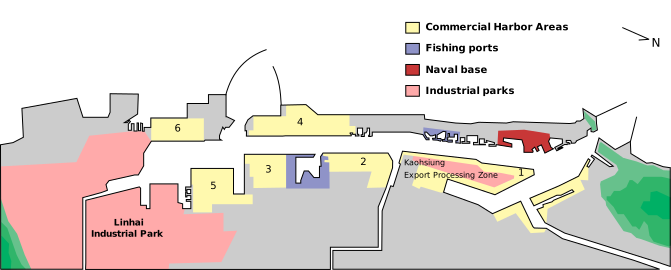
Image 1: Map of Kaohsiung Port, by Luuva, Wikimedia Commons, CC BY-SA 3.0. Image page: https://commons.wikimedia.org/wiki/File:Port_of_Kaohsiung_map.svg.
An Export Gateway That Was "Sealed Off"
When discussing Taiwan's global manufacturing today, many people first think of Hsinchu Science Park, TSMC, or container ports. But earlier, the gateway for Taiwan's international connection was in Qianzhen, Kaohsiung: a park with clear boundaries where goods could enter and exit tax-free, and corporate administrative procedures were centralized.
This design contained an counterintuitive element. The Export Processing Zone placed raw materials, factories, and finished products within a system that was "within the territory yet outside customs," appearing to isolate production on the surface. In reality, it was the first time Taiwan used a set of clear regulations to connect with transnational manufacturing.2
The land where the park is located was not purely vacant. The site selection in Kaohsiung was related to port conditions; the reclaimed land of Zhongdao Hai Pu in Qianzhen was used by dredging waste from Kaohsiung Port, making raw material import and finished product export relatively convenient via sea and air transport.3
The focus here was not just on "good location." The government centralized investment applications, company registrations, import/export visas, and construction permit issuance at the administrative agency level, allowing banks, customs, tax bureaus, postal services, and telecommunications to enter the park. Companies faced an administrative interface that handled centralization and could respond quickly to export demands, without having to shuttle between various scattered official documents.2 4
Institutional Creativity Amid Economic Hardship
In Taiwan in the late 1950s, both capital and industrial technology were insufficient. National archives compiled the background into several pressures: the cessation of U.S. aid, domestic capital shortages, an increasing rural population, and the government's need to find new export revenue. Consequently, labor-intensive light industry and export-oriented policies were prioritized.2
After the establishment of regulations for Export Processing Zones, the Kaohsiung Export Processing Zone was officially established on December 3, 1966. Its institutional goals were clear: expand foreign trade, attract industrial investment, introduce technology, and increase employment. These four things were not just polished slogans added after the economic miracle; they were tasks that the park was required to accomplish from the beginning.2
The scale of the first zone was not massive. When Taiwan Guanghua compiled the history of the park in 2022, it described this industrial space as covering 72 hectares. It reached saturation within two years, forcing the government to accelerate planning for the Nanzi and Taichung Tanzi Export Processing Zones.3
As of June 1976, there were 292 export enterprises approved across three processing zones, with a total investment of approximately $186.55 million. Foreign investment accounted for 67% of capital sources, overseas Chinese capital for 15%, and domestic capital for 18%. A contemporaneous article in Taiwan Guanghua recorded that the annual export value had exceeded $2.2 billion, exported to 92 countries.5
These figures should not be understood as an automatically rising curve. The archival articles on the Kaohsiung Export Processing Zone also noted early criticisms: some worried it would become a revival of a treaty port, a smuggling channel, or merely a place that sold Taiwan's cheap labor. Support and opposition existed simultaneously at the park's founding, forming the political and social debates of the time.2
The Economic Miracle in Blue Uniforms
If one only looks at investment value and export value, the most concentrated production resource of the park—human time—is missed.
The Kaohsiung City Government News Agency compiled local narratives and regional studies, pointing out that over ten years in the Export Processing Zone, female employees accounted for about four-fifths of the workforce. Most of them came from southern rural areas to Qianzhen, entering garment, electronics, knitting, or other labor-intensive production lines.6
These women were the producers of the economic miracle. Every morning, they left home to complete routine and meticulous work, sending part or all of their wages back to their families of origin. For many, working in the city meant leaving agricultural life, earning money for themselves, and having the possibility to rearrange marriage and family.6
The women's dormitories in Qianzhen served functions beyond mere accommodation. Local articles recorded that the dormitories had restaurants, welfare associations, and skills classes. Nearby streets formed a living circle for shopping, beauty treatments, watching movies, and socializing. Factories brought people into the city, and the city, in turn, re-organized life outside the production line.6
The term "female worker" can easily reduce a person to a labor status. Looking at it from another angle, they were also young people who moved across counties, providers of family income, roommates in dormitories, and those establishing new social relationships in Qianzhen. These layers of life do not appear on export statistics tables, yet they constituted the social conditions that allowed the park to operate long-term.
A 2025 feature article from Kaohsiung focused on the Qianzhen community, tracing the life paths of women through dormitories, Ginza Street, and community care.6 It reminds us that after industrial relocation, factories leave behind not only old buildings but also residents who have settled in the city to work and care for others.
From Portable Stereo to Integrated Circuits
Early products from the Kaohsiung Export Processing Zone included garments, knitted goods, leather goods, toys, furniture, and electronic products. These items did not always appear under a Taiwanese brand; they entered the global market as contract manufacturing. "Made in Taiwan" was often just a country of origin mark on the goods, not yet a brand familiar to consumers.2 3
In 2022, Taiwan Guanghua used the park's product exhibition hall as an entry point, listing products exported from Kaohsiung such as CRT televisions, portable stereos, fabrics, and baseball gloves. These items were commonplace; precisely because they were common, the history of the park is not just a history of economic policy, but also a manufacturing history of how Taiwan entered the global household.3
A more significant change occurred in technology. Reviews from the park management unit pointed out that investments by American and Dutch companies provided an early foundation for integrated circuit testing in Taiwan; Japanese electronic companies cultivated the technical talent later needed for the panel industry. Technology does not remain simply because foreign investment arrived; it is gradually formed through years of production, talent training, corporate cooperation, and local supply relationships.3
A study on the Kaohsiung Export Processing Zone from National Taiwan University points out that the starting point of Taiwan's export expansion predates the Export Processing Zone, with many manufacturers in the early textile and electronics industries operating outside the park; the more precise role of the Export Processing Zone was to reduce transaction costs, centralize institutional incentives, and form a model in specific industries and regions. This correction makes the park's importance more credible: it was a critical field, but it does not need to be written as the sole engine.7
A doctoral dissertation indexed by the National Library of Taiwan divides the Export Processing Zone into stages: establishment and rapid growth, maturation of labor-intensive industries, industrial structure adjustment, and moving toward electronics and warehousing/logistics. This periodization better explains how the park changed its institutions and industrial composition in crisis than simply "established in 1966 and later succeeded."8
Success Does Not Mean Without Cost
The success narrative of the Kaohsiung Export Processing Zone is often condensed into the "starting point of the Taiwanese economic miracle." But success also means that more people were drawn to one place: commuter crowds caused traffic congestion, forcing the government to increase bus, train, and ferry services just to keep daily labor mobility going.2
In terms of gender, while female labor brought income and opportunities to leave rural areas, it was also fitted into a labor imagination characterized by meticulousness, obedience, and low cost. A summary from Columbia University places the Kaohsiung Export Processing Zone in the comparative history of global factories, clearly listing labor control, gendered labor, economic dependence, and long-term environmental consequences as core analytical elements.9
The park's achievements should not be overturned because of this; however, "creating jobs" and "how working conditions were arranged" must be viewed together. If only export value is left behind, the producer becomes a denominator; if only criticism remains, one cannot see how a salary changed a family and a city. The historical responsibility is not to choose a single evaluation for the park, but to make results from different levels visible simultaneously.
How the Park Survived Its Own Success
Image 2: Exit 1 of Nanzi Processing Zone, by Longben, 2010, Wikimedia Commons, CC BY-SA 3.0/GFDL. Image page: https://commons.wikimedia.org/wiki/File:%E6%A5%A0%E6%A2%93%E5%8A%A0%E5%B7%A5%E5%8D%80%E7%AB%99_1%E8%99%9F%E5%87%BA%E5%8F%A3_20100124.jpg; Local file: images/nanzih-export-processing-zone-station.jpg.
Labor-intensive industries faced pressure from rising wages, international trade protectionism, and industrial relocation in the 1980s. The Export Processing Zone did not disappear immediately; it gradually introduced electronics, precision manufacturing, logistics, and other higher-tech activities. A doctoral dissertation describes the period after 1986 as one where institutional and market conditions changed simultaneously, noting the park's later transformation toward high-tech electronics and global logistics.8
This transformation also changed how the park was remembered. In 2021, the Kaohsiung Export Processing Zone shed its old name after half a century and became Qianzhen Science Park. The change of name did not erase history; rather, it acknowledged that the original "Export Processing Zone" had become an institutional legacy: the single window, industrial cluster, export orientation, and technological learning continued to leave traces in different industries.3
The administrative buildings, early factories, and other structures within the park thus have a dual identity. On one hand, they are industrial spaces that may still be used; on the other, they are physical evidence of Taiwan's economic history. To regard them only as old buildings is to miss their relationship with factories, female workers, ports, and goods; to regard them only as monuments to success is to overlook the costs of labor and environment.3
One Park, Many Taiwans
The National Cultural Memory Repository currently preserves archival materials titled "Management and Development of Export Processing Zones," sourced from the National Archives, providing links to original data and volume information. The value of this archive page is not in providing a beautiful conclusion for an article, but in letting readers know what administrative documents, agencies, and timeframes were recorded during its "management and development."10
Looking at Taiwan through Qianzhen reveals several intertwined stories: the nation creating export space through institutions; foreign investment and local labor sending goods out of ports; young women moving to cities who changed families and communities with factories; and the park transforming early contract manufacturing experience into technology and industrial clusters after industrial relocation.
None of these stories can represent the Kaohsiung Export Processing Zone alone. Writing it as "successful government planning" erases the female workers and local life; writing it as "exploitation by transnational capital" obscures how institutional design allowed Taiwan to gain technological and export capabilities; and writing it as the "start of MIT" makes the power relations of contract manufacturing, foreign investment, and global division too clean.
Perhaps what is truly important about the Kaohsiung Export Processing Zone is that it concentrated these contradictions within 72 hectares: a closed institutional space connected to an open world market; an industrial opportunity that provided income but also demanded time and bodies from workers; a park that started with low costs, ultimately becoming the precursor to Taiwan's technological upgrading and industrial transformation.
📝 Curator's Note: The Taiwanese economic miracle did not only happen in policy documents; it happened in morning traffic flows, the communal dining tables of women's dormitories, the loading lines next to the port, and the shipments bearing a Taiwanese origin mark but no Taiwanese brand.
Further Reading
- Taiwan Land Reform: Understanding the historical background between rural labor and industrialization.
- The Ten Major Constructions: Comparing the scales of national infrastructure, industrialization, and export orientation policies.
- History of Taiwan Railways: Tracking the transportation networks relied upon by industrial zone human and goods flows.
- Female Figures in Qianzhen Processing Zone: A Blooming Youth Under Blue Uniforms: A special article extending the understanding of female workers and local memory.
References
- Executive Yuan Precious Historical Materials Exhibition: Completion of Kaohsiung Export Processing Zone — Official historical materials page from the Executive Yuan, containing photos of the December 3, 1966 completion, the history of Qianzhen Park, and data on employing over 20,000 people within two years and subsequent park expansion.↩
- National Development Council Archives: Kaohsiung Export Processing Zone—A Prosperous Economy — A special archive article from the National Archives that combines materials from the Export Processing Zone Administration and archival images to explain the policy background, four major goals, single window system, early controversies, and investment/employment data.↩234567
- Taiwan Guanghua: MIT Outpost for Exports—A Detailed Look at the Glory of the Export Processing Zone — A 2022 article from the Ministry of Foreign Affairs' Taiwan Guanghua, interviewing park administrators and industry figures to compile details on the 72 hectares, port site selection, foreign investment, technical talent, park transformation, and renaming.↩234567
- Taiwan Guanghua: The Decade of Success for the Export Processing Zone — A contemporaneous feature article from 1976 that preserves statistics and on-site photos regarding the export enterprises, investment structure, exporting countries, and single window system of the three processing zones at the time.↩
- Taiwan Guanghua: The Decade of Success for the Export Processing Zone — A specific statistical source from the same 1976 historical article, recording the 292 export enterprises, investment amounts, capital sources proportions, export values, and 92 exporting countries; footnotes still point to the detailed article page.↩
- Kaohsiung Magazine: From Export Processing Zone to Qianzhen Community, Their Life Stories — A local feature from the Kaohsiung City Government News Agency that combines female oral histories, Qianzhen community research, and local tours to describe the proportion of female workers, dormitory life, street-level living, and community continuity after industrial relocation.↩234
- Cung Min-hsuan, Tsai Wan-hua: A Study of Taiwan's Export Processing Zone — A study by economists from National Taiwan University that directly examines the role of the Export Processing Zone in Taiwan's export expansion and corrects the singular success narrative using manufacturer distribution, the proportion of electronics, and transaction cost analysis.↩
- Taiwan Graduate Thesis Database: Formation and Transformation of the Economic Governance Structure of the Taiwan Export Processing Zone — A detailed index and abstract from a National Library of Taiwan dissertation that provides the research periodization, institutional changes, and industrial transformation arguments from a 2002 graduate thesis at National Taoyuan University, offering academic analysis beyond official achievement narratives.↩2
- Columbia University Academic Commons: Entangled Assembly — A detailed page and public abstract of a 2025 doctoral dissertation from Columbia University that places the Kaohsiung Export Processing Zone within cross-national comparative studies of global factories, gendered labor, economic dependence, and environmental consequences.↩
- National Cultural Memory Repository: Management and Development of Export Processing Zones — The archive details page of the National Cultural Memory Repository at the National Taiwan Museum, which designates the National Archives as the data source and provides links to original materials, volume dates, and digital object citation information.↩