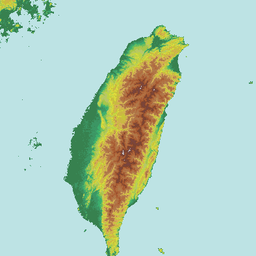
30-second overview: Zhushan Township sits in the southwestern corner of Nantou County, on the south bank of the Zhuoshui River and the east bank of the Qingshui River, covering about 247 square kilometers — Taiwan's second-largest township by area — with a registered population of 49,392 as of September 2026.1 2 In the Qing era it was called Linpidi; when Yunlin County was established in 1886 the county seat was placed here, hence the epithet "First City of the Front Mountains"; the name "Zhushan" (Bamboo Mountain) came only in 1920 because of the abundant bamboo groves nearby.1 This article starts from the name and puts land reclamation, the ferry crossing, Mazu and the Earth God, bamboo weaving, the earthquake, and an old bus station back into the same small town.
The Name Arrived Later Than the Bamboo
Zhushan's earliest Han Chinese place name comes from a person. According to local history compiled on Wikipedia, in 1665 the Ming-Zheng regime implemented military farming; Lieutenant Lin Pi-ti led about 200 farming soldiers in from the Douliumen area to cultivate land, establishing a foothold around today's Zhuwei Village and driving the indigenous Tsou Lufudu people into the mountains; in October 1668 the Tsou launched a night raid, killing Lin Pi-ti and over a hundred farming soldiers; the land subsequently occupied by reinforcements was named "Linpidi".1 Lin Pi-ti's name is still written in multiple forms — 林杞, 林屺, 林圮, 林驥 — and there is no consensus on which is his original name.1
This beginning is often written as "the earliest Han-developed area in Nantou," but the other side of the same history is the Lufudu people losing the hill country of the Qingshui and Zhuoshui river basins.1 To read Zhushan, one must first acknowledge that this place name was obtained through conflict.
From the mid-Qing onward, Linpidi became a gateway to the Central Mountain Range. In 1886 (Guangxu 12) Yunlin County was established and its seat was set at today's Yunlin Village in Zhushan, giving rise to the title "First City of the Front Mountains"; but in 1887 the Zhuoshui River flooded disastrously and the county seat moved to Douliu.1 The county seat left, the market town remained. In 1920 the Japanese adjusted administrative divisions, renaming it "Zhushan" for the dense bamboo groves, and in 1950 it was incorporated into the newly established Nantou County.1
Curator's note: The name "Zhushan" is only a little over a hundred years old, two hundred fifty years younger than Linpidi. But bamboo had already entered the daily life of this town long before the renaming.
One River, Two Ways to Cross
Zhushan is embraced by the Zhuoshui and Qingshui rivers; crossing the river has always been a major matter. The Yongji Yidu Stele erected in 1879 (Guangxu 5) in front of the Zinan Temple at Sheliao records how local gentry donated funds to purchase charity fields, using the rent to pay for ferry boats and boatmen — a public-benefit ferry crossing; the inscription describes the Zhuoshui River as torrential, "momentum like the Yellow River," unfavorable to merchants and travelers.3 The charity ferry rules required the last boat of each day to cross even if carrying only a single passenger; in the dry season a temporary bamboo bridge was built. This service was taken over by the Japanese government in 1911 and ended only when the Jiji Suspension Bridge was completed in 1934.3
Another form of river transport was bamboo rafts. Inside the Lianxing Temple survives a Daoguang 4 (1824) "Stele Strictly Prohibiting Extortion of Bamboo Raft Boatmen," stipulating that boatmen transporting bamboo materials by water must pay a passage fee to the temple.4 A single stele simultaneously explains two things: bamboo was a commodity that had to be shipped out by river in the Qing era, and the business was large enough to require an official stele to set rules.
Mazu in Town, Earth God in Sheliao
Lianxing Temple is the faith center of the Zhushan market town, located on Xiaheng Street, primarily worshipping Mazu. Temple records state it was founded in 1756 (Qianlong 21) through a spirit division from Beigang Chaotian Temple, originally named Tian-shang Temple, and designated a county-level historic site in 2000; other sources record the founding year as 1742.4 1 The temple houses a black-faced Mazu originally from Sheliao, permanently enshrined at Lianxing since 1912, returned to Sheliao only for Mazu's birthday each year; the annual "Zhushan Welcoming the Lantern Festival" on the Lantern Festival sees participants holding "bamboo tube torches" — even the festival torches are made of bamboo.4 1
Northward to the Zhuoshui riverside at Sheliao lies a different incense world. Zinan Temple primarily worships the Earth God (Fude Zhengshen), founded in 1745 (Qianlong 10) by residents of Sheliao and Houtouzi through collective fundraising, famous for "borrowing fortune money": worshippers cast divination blocks to borrow money from the Earth God, up to NT$600, repaying the principal and adding incense oil money after earning profits the following year; "Zhushan Sheliao Zinan Temple Borrowing Money" and "Eating Ding Wine" are both registered as folk cultural assets.5 It is ranked alongside the Nanshan Fude Temple in Zhonghe's Buniao and the Fuan Temple in Checheng, Pingtung as one of Taiwan's "Three Great Earth God Temples".5
The town's Mazu governs the market town and the pilgrimage processions; Sheliao's Earth God governs the capital for doing business. The two temples are separated by Provincial Highway 3, neatly corresponding to Zhushan's two living circles.
Bamboo Becomes a Craft
Taiwan Panorama describes Zhushan as "land true to its name," with bamboo groves spanning five to six thousand jia; from the 1970s to 1980s this was Taiwan's bamboo wholesale distribution center and bamboo product processing stronghold.6 Later factories moved out, plastic and steel products replaced bamboo wares, and Zhushan, like many traditional manufacturing towns, faced an aging population and youth outmigration.6
The reason bamboo could turn from raw material into craft has an institutional starting point: the "Zhushan District Bamboo Craft Training Institute" established in Zhushan during the Japanese era. Bamboo weaving master Huang Tu-shan was born in Nantou in 1926, graduated from Zhushan Public School in 1939 and entered the training institute, staying on as a research student learning bamboo weaving from Japanese masters Ikeda and Futagami; after the war he taught at training classes in Chiayi, Nantou, and Tainan's Guanziling, joining the Nantou Craft Training Institute in 1964 (later reorganized into the National Taiwan Craft Research and Development Institute) until retirement.7 He received the National Craft Achievement Award in 2008, was recognized as a preserver of the important traditional art "bamboo weaving" in 2010, and passed away in 2020 at age 94.7
Curator's note: The main trunk of Taiwan's bamboo weaving craft grew out of this training institute in Zhushan. Zhushan's "bamboo" is not just a place name, but a transmitted technology. For a more complete bamboo weaving craft lineage, see the extended reading "Taiwan Traditional Crafts and Intangible Cultural Assets".
That Night in 1999
The southern end of the Chelungpu Fault from the 921 Earthquake began around Zhushan's Tongtou area and extended northward.8 According to the Zhushan Township 921 Earthquake Chronicle cited by Wikipedia, the entire township suffered 118 deaths, 49 serious injuries, 2,711 houses completely collapsed, 2,973 half-collapsed — the most severe natural disaster in Zhushan's history; houses along the entire Jishan Road were almost entirely destroyed, and about thirty households in Yushan New Village completely collapsed due to slope movement.8
Today the National Museum of Natural Science's Chelungpu Fault Preservation Park stands within Zhushan Township, inaugurated on January 30, 2013.8 The earthquake left more than a park. Taiwan Panorama wrote in a 2019 report that a "pathetic outmigration" appeared in Zhushan after the quake, and a new interchange let tourists bypass the town center, driving straight to Zinan Temple or Shanlinxi.6
A Bus Station's Second Life
The story most often told about Zhushan in the past twenty years begins with a mountain B&B. In 2005, Ho Pei-chun and his cousin Ku Meng-wei personally renovated a derelict century-old sanheyuan courtyard house in Zhushan's Dasanshan area into the B&B "Courtyard of the Sky".9 Ho later said in interviews that he discovered tourist crowds were increasing while Zhushan's residents had dropped from 80,000 to 50,000.6
In 2010 he founded "Small Town Cultural Creative," renting an empty house in town for NT$7,000 a month and inviting young people to "trade expertise for lodging".6 According to his sharing at a 2019 forum, the first year brought 600-plus people, producing 12 micro-films, 4 cultural creative products, and 2 websites.10 He then leased the long-defunct Taishi Bus Station: in 2015 he used 5,500 bamboo strips to weave the ceiling and corridor pillars of the second-floor driver dormitory, transforming it into the "Zhuqingting Cultural Space"; in 2019, buses resumed service to this station, and the first-floor waiting hall opened an ice dessert shop serving shaved ice in bamboo bowls and cups.6 10
This case is not just one person's story. Taiwan Panorama recorded tea farmers returning home to take over the family business, machinery industry retirees turning to farming, and young people moving from neighboring townships to open shops, forming an entrepreneurial cluster around Small Town Cultural Creative.6 The bamboo-woven ceiling connects the memory of a half-century-old bamboo distribution center back to a station with bus service.
A Township's Three-Layer Map
Zhushan can be read as a three-layer map. The bottom layer is river and mountain: the Zhuoshui River, Qingshui River, and vast bamboo groves, determining the ferry crossings, bamboo rafts, and bamboo trade. The middle layer is faith and market town: Lianxing Temple in town, Zinan Temple in Sheliao, the Yidu Stele in front of Zinan Temple. The top layer is the last few decades: the 921 fault, the interchange bypassing the town center, and the station rewoven with bamboo.
The First City of the Front Mountains' county seat lasted only seven years; bamboo has stayed for three hundred. Zhushan's name was well chosen.
Extended Reading
- Nantou County
- Shanlinxi: How a Waterfall Brought a Logging Camp Back to the Forest
- Taiwan Traditional Crafts and Intangible Cultural Assets
References
- Wikipedia: Zhushan Township (Taiwan) — Area approx. 247 sq km, second-largest township in Taiwan; 1665 Lin Pi-ti led 200 farming soldiers to cultivate, killed in October 1668 raid and "Linpidi" naming; multiple spellings of Lin Pi-ti's name; 1886 Yunlin county seat set at Yunlin Village, moved to Douliu in 1887; 1920 renamed Zhushan for dense bamboo; 1950 incorporated into Nantou County; Lianxing Temple listed as founded 1742; Zhushan Welcoming Lantern Festival's bamboo tube torches.↩23456789
- Zhushan Township Household Registration Office, Nantou County — Homepage population statistics: September 2026 (ROC year 115), 28 villages, 476 neighborhoods, 21,087 households, total population 49,392.↩
- Wikipedia: Yongji Yidu Stele — Stele erected in 1879 (Guangxu 5) at Sheliao Zinan Temple and Zhuoshui Fuxing Temple; inscription calls Zhuoshui River "momentum like the Yellow River"; last boat must cross even with only one passenger; temporary bamboo bridge in dry season; taken over by Japanese government in 1911, ended after Jiji Suspension Bridge completed in 1934.↩2
- Wikipedia: Zhushan Lianxing Temple — 1756 (Qianlong 21) spirit division from Beigang Chaotian Temple, originally named Tian-shang Temple; 1824 (Daoguang 4) Stele Strictly Prohibiting Extortion of Bamboo Raft Boatmen; black-faced Mazu permanently enshrined from 1912; designated county-level historic site August 9, 2000.↩23
- Wikipedia: Zhushan Zinan Temple — 1745 (Qianlong 10) founded by Sheliao and Houtouzi residents, primary deity Fude Zhengshen; borrowing fortune money via divination blocks up to NT$600; ranked with Buniao Nanshan Fude Temple and Checheng Fuan Temple as three great Earth God temples; "Zhushan Sheliao Zinan Temple Eating Ding Wine" and "Borrowing Money" listed as folk cultural assets.↩2
- Taiwan Panorama: Seeing Zhushan — Ho Pei-chun's Small Town Revitalization Studies (Tseng Lan-shu, May 2019) — Zhushan five to six thousand jia bamboo groves and 1970–80s bamboo distribution center; Ho Pei-chun notes residents dropped from 80,000 to 50,000, post-921 outmigration and interchange bypassing town center; 2010 founded Small Town Cultural Creative, NT$7,000/month rent for expertise-for-lodging; 2015 used 5,500 bamboo strips to renovate Taishi Bus Station second floor into Zhuqingting; 2019 buses resumed and first-floor ice dessert shop; youth entrepreneurial cluster.↩234567
- Wikipedia: Huang Tu-shan — Born 1926 in Nantou, entered Zhushan District Bamboo Craft Training Institute in 1939, studied under Ikeda and Futagami; from 1964 worked at Nantou Craft Training Institute (now National Taiwan Craft Research and Development Institute); 2008 National Craft Achievement Award, 2010 preserver of important traditional art "bamboo weaving"; passed away December 23, 2020, age 94.↩2
- Wikipedia: 921 Earthquake — Chelungpu Fault extended north from Nantou's Tongtou through Zhushan; citing Zhushan Township 921 Earthquake Chronicle: township-wide 118 deaths, 49 serious injuries, 2,711 completely collapsed, 2,973 half-collapsed, Jishan Road houses entirely destroyed, Yushan New Village approx. 30 households completely collapsed; Chelungpu Fault Preservation Park inaugurated January 30, 2013.↩23
- Global Views Monthly: Taiwan's Most Beautiful B&B — "Courtyard of the Sky" in the Mountains (2014-03-22) — Courtyard of the Sky located in Zhushan's Dasanshan area, founded 2005, former derelict century-old sanheyuan, personally renovated by Ho Pei-chun and cousin Ku Meng-wei.↩
- Future City @ Commonwealth: Old Station Turned Ice Dessert Shop, Attracts 600 People for Mountain Village Expertise Exchange (2019-10-08) — Ho Pei-chun's sharing at Urban Governance Innovation Salon: first year 600+ people for expertise exchange, completed 12 micro-films, 4 cultural creative products, 2 websites; used 5,500+ bamboo strips to renovate station second-floor restaurant, first-floor ice dessert shop; buses returned to station.↩2