
30-Second Overview: Kinmen is approximately 1.8 km from Jiaoyu Island in Xiamen and 358 km from Taipei—Cold War geopolitics placed this county in a geographic position it should never have occupied. In 1387, Vice Duke Zhou Dexing built the Kinmen Garrison City, adopting the eight-character phrase "solid as gold and soup, majestically guarding the sea gate" as the county’s name. At 2:00 AM on October 25, 1949, three PLA regiments totaling 9,086 troops landed at Gu Ningtou beach; Nationalist forces fought for 56 hours to repel them; had those 56 hours not been held, the term "cross-Strait" would not exist today. From 5:30 PM on August 23, 1958, over 44 days, 474,910 shells fell on the 151-square-kilometer island; three deputy commanders died in the same afternoon at the Taiwu Mountain Command Post; the subsequent "fire on odd days, cease-fire on even days" lasted another 21 years until the Sino-US formalized diplomatic relations on January 1, 1979. From 1956 to 1992, 36 years of War-time Administration were in effect, with curfew at 10:00 PM (Matsu was 9:00 PM), requiring exit/entry permits, radio registration, and banning floating devices by the sea. Today, 145,000 people are registered; at 4:00 AM, speedboats departing Shuitou for Xiamen’s Wutong outnumber flights to Taipei Songshan. Ye Huacheng’s great-grandson waited 67 years for an apology.
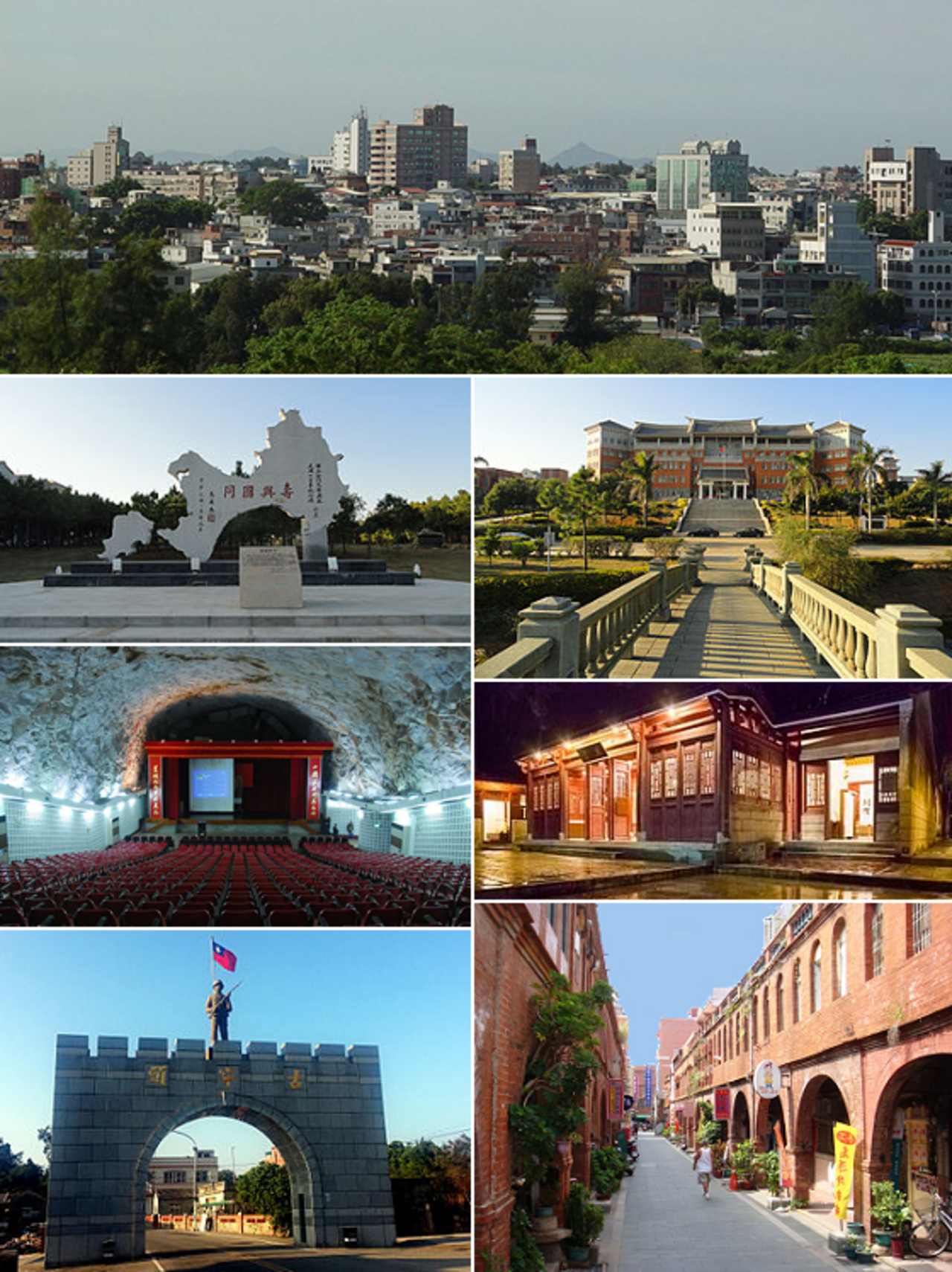
Image credit:Sleepingstar · CC BY-SA 4.0 · Original source
Looking at Xiamen from Kinmen: The 1.8-Kilometer Strait
If you stand at the northernmost point of Dadan Island in Kinmen and look north, the skyscrapers of Xiamen’s urban area will rise directly from the horizon.
The closest point of Kinmen to the mainland is Jiaoyu Island in the Tong’an District of Xiamen, a straight-line distance of approximately 1.8 km1. Looking back from this distance, Kinmen is 358 km from Taipei—nearly 200 times farther than it is from Xiamen. If you take a speedboat on the Small Three Links from Kinmen’s Shuitou Pier, you arrive at Xiamen’s Wutong Pier in 45 minutes; if you fly to Songshan, the flight time plus round-trip airport transfers, check-in, and luggage consumes half a day2.
The geographic reality of Kinmen County is: so close to the mainland, yet not a county of the mainland; so far from Taipei, yet a county administered by Taipei.
The county’s full administrative name is "Kinmen County, Fujian Province, Republic of China." It does not belong to Taiwan Province; like Lienchiang County (Matsu), it belongs to Fujian Province. This province was downgraded in 1996, had its functions streamlined in 1998, and was officially de-missioned in 2019. However, on ID cards and in household registration systems, people from Kinmen are still considered residents of "Kinmen County, Fujian Province" today3.
Kinmen’s main island covers 134 square kilometers. Including Lieyu (Little Kinmen), Dadan, Erdan, Wuhu, and other islands, the total area is 151.6 square kilometers. The county is divided into six townships—Jincheng (county seat), Jinhu, Jinsha, and Jinning are on the main island; Lieyu Township is Little Kinmen; Wuhu Township is an administrative miracle, which will be discussed later4. The geology is primarily granite, with Taiwu Mountain as the main ridge of the main island. At an altitude of only 253 meters, this low mountain withstood the shell rain of 1958.
To understand Kinmen, one must first discard the intuition that "geography determines affiliation." Kinmen is a county of Taiwan, but Kinmen has never been Taiwan geographically.
2:00 AM, The 56 Hours at Gu Ningtou Beach
At 2:00 AM on October 25, 1949, the PLA began to land.
That summer, the outcome of the Chinese Civil War was already settled. The Nationalist Army was losing ground on the mainland and withdrawing its main forces to Taiwan. In May of the same year, the Nationalist Army took control of Kinmen, commanded by Tang Enbo. In October, the PLA had just won the Xiamen Campaign, validating their amphibious capabilities and boosting morale. The 28th Army was ordered to cross the sea to attack Kinmen.
That night, three PLA regiments—the 244th Regiment of the 82nd Division, the 251st Regiment of the 84th Division, and the 253rd Regiment of the 85th Division of the 28th Army—departed from Xiamen and landed at the north bank of Gu Ningtou Village and the Lin Cuo area. The first wave of landing forces totaled approximately 9,086 people5. ⚠️ This figure reflects the records of the Nationalist Army’s war history and mainstream historical materials on both sides of the strait. Due to sea conditions and the Nationalist blockade, subsequent waves could not land continuously. Some estimates suggest that if troops still on the water are included, the total committed force may have been higher.
The critical moment of the battle occurred at dawn. After landing, the PLA advanced toward Jincheng Town in three directions. The Nationalist Army’s night fighting became extremely critical. M5A1 tanks changed the situation. The Nationalist Army had only three US-aid M5A1 light tanks in Kinmen (numbers 64, 65, and 66). Tank number 66 broke down on the beach at Gu Ningtou before the battle, inadvertently becoming the earliest fire support point on the beach6. The PLA landed with infantry and had no anti-tank weapons. These three tanks on the beach sand became the protagonists of the folk memory known as "Tanks Saved Kinmen."
By October 26, the Nationalist Army had completed the encirclement, compressing the PLA to the north bank of Gu Ningtou. In the early hours of the 27th, surviving PLA troops attempted to retreat by sea but were annihilated on the shallow flats by the Nationalist Army. From 2:00 AM on the 25th to the early morning of the 27th was exactly 56 hours7. Nationalist Army war history records: a total of over 15,000 PLA troops were killed or captured8. ⚠️ If only the first wave of 9,086 landings is counted, the number of killed/captured exceeding the number of landers presents a logical conflict. Some explanations suggest this includes cross-calculations of water-based annihilations, casualties, and captures. This article presents the Nationalist Army war history framework, noting this unsolved arithmetic.
📝 Curator’s Note: At the 75th anniversary commemoration of the Battle of Gu Ningtou in 2024, Kinmen County Magistrate Chen Fu-hai’s official speech, "Remember history, cherish peace, defend sovereignty," could easily be dismissed as routine bureaucratic language9. But the true historical position of this battle lies not in rhetoric. In the summer and autumn of 1949, the PLA had "liberated" most of the mainland; if Kinmen had fallen, the springboard from Xiamen to the Taiwan Strait would have been opened, making the defense of Taiwan’s main island much more difficult. The Taiwan Strait defense line was locked in by international geopolitics only after the outbreak of the Korean War in 1950 and the deployment of the US Seventh Fleet. However, Gu Ningtou in 1949 had already pressed the pattern of division onto geography first. Those 56 hours were not just the duration of a victory; they were the starting point of 75 years of cross-Strait division. If the PLA landing had succeeded, there would be no operating government called the "Republic of China" today, no proper noun called "Cross-Strait relations," and no .md file you are reading now.
5:30 PM, Three Deputy Commanders Died at Taiwu Mountain
At 5:30 PM on August 23, 1958, shells fell without warning.
That was one of the most tense summers of the Cold War. Sino-US relations were in a struggle. Mao Zedong decided to "shell Kinmen" to test the US response and declare sovereignty over the Taiwan Strait to the world. The PLA never intended to land in Kinmen; they wanted to shell the issue onto the international negotiation table.
In the first two hours of shelling, tens of thousands of shells fell on Kinmen Island. The Nationalist Army’s Kinmen Defense Command was located at the Taiwu Mountain Command Post. Three deputy commanders—Zhao Jiaxiang, Zhang Jie, and Ji Xingwen—died successively in the afternoon near the Taiwu Mountain Command Post10. Ji Xingwen was the division commander who fired the first shot of the full-scale Sino-Japanese War during the Lugou Bridge Incident in 1937. Twenty-one years later, he was killed by PLA shells in Kinmen. Chiang Ching-kuo was also inspecting Kinmen that day and fortunately survived.
In the following 44 days, the total number of shells fired by the PLA, according to the Ministry of National Defense war history, was 474,910 shells11. Kinmen’s total island area is approximately 151.6 square kilometers, meaning each square kilometer endured nearly 3,132 shells on average.
✦ "During the August 23 Artillery War, the PLA fired a total of 474,910 shells at Kinmen."11
On September 7, a US Navy escort supply fleet arrived off the coast of Kinmen to help break the PLA’s naval blockade. On September 11, US Secretary of State John Foster Dulles publicly declared, "Aggression against the offshore islands is equivalent to aggression against the Taiwan main island." On October 5, the PLA announced a unilateral ceasefire. But the war did not truly end: on October 25 (the ninth anniversary of the Battle of Gu Ningtou), Mao Zedong published the "Message to Compatriots in Taiwan Again," announcing "fire on odd days, cease-fire on even days," which became known as "Fire on Odd Days, Cease-fire on Even Days" (Dan Da Shuang Bu Da)12.
This rule lasted for 21 years. From October 25, 1958, to January 1, 1979, when the US and China formally established diplomatic relations, the US required the cessation of shelling as a precondition for normalization. Only then did the shelling officially stop. For 21 years, the daily life of Kinmen residents was: hiding from shells on 15 odd-numbered days each month, living normally on even-numbered days. Later shells were mostly propaganda shells carrying leaflets, not intended to kill, but for residents, you never knew if the next shell was a leaflet or a real one, nor when you would return to 5:30 PM on August 23.
Those 36 Years: Kinmen’s Curfew Was 10:00 PM
War-time Administration began in July 1956 and ended on November 7, 1992, lasting exactly 36 years13.
The term "War-time Administration" deserves deconstruction. It was a military-civilian unified governance system implemented by the Republic of China government in Kinmen and Matsu: the county magistrate was concurrently a military officer, local administration was managed by the Defense Command, and civilian judicial procedures were partially replaced by military law. The Temporary Articles for the Suppression of Rebellion were abolished in 1991, but Kinmen and Matsu’s War-time Administration had independent legal foundations requiring separate abolition. Martial law was lifted on the Taiwan main island in 1987, but Kinmen and Matsu did not end their martial law system until November 7, 1992: more than five years later than the Taiwan main island13.
What kind of rules constrained residents’ daily lives during those 36 years?
Curfew was at 10:00 PM14. Matsu’s was 9:00 PM; this one-hour difference reflects the different military sensitivity levels estimated for the two places. Exit/entry controls: Kinmen residents traveling to the Taiwan main island needed an "Exit/Entry Permit"; mainland residents entering Kinmen needed kinship guarantees or military approval. No floating devices were allowed by the sea: swim rings, rubber boats, basketballs, and tires were on the ban list, fearing residents would swim to the other side. Radios had to be registered, with specific frequencies banned to prevent PLA propaganda broadcasts. Buildings were restricted to no more than two stories in some periods. In some periods, military vouchers circulated instead of New Taiwan Dollars.
Local democratic mechanisms were frozen: county magistrates and township mayors were appointed by the military, not elected. Kinmen County held its first elected county magistrate in 1993, 43 years after the Taiwan main island held its first county-mayor elections in 1950.
✦ "We were in Kinmen, still under military rule five years after martial law was lifted. Do you know what that felt like? The Taiwan main island lifted martial law in July; we had to wait until November 1992."14
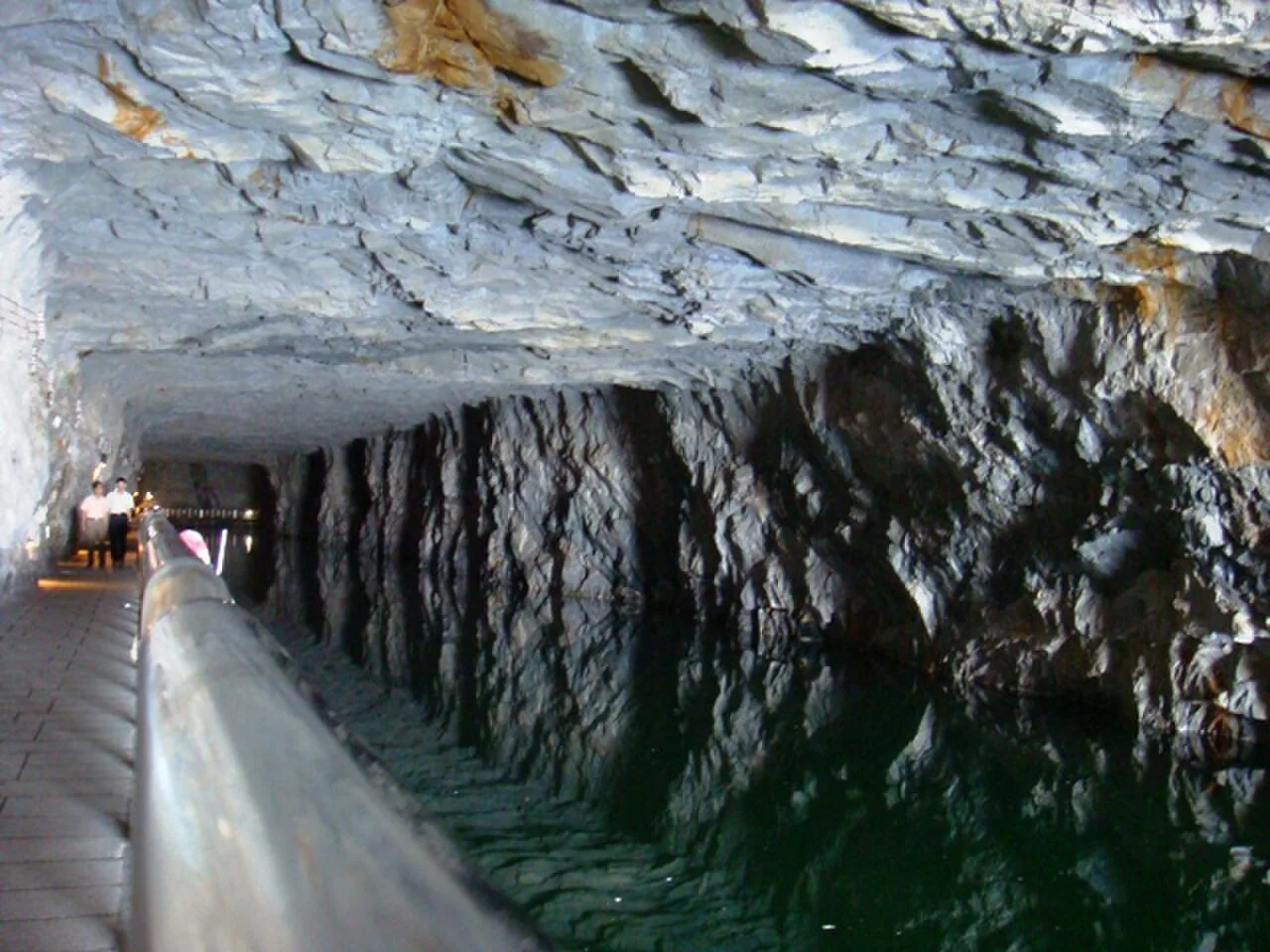
During the military rule period, the peak garrison size of the Nationalist Army was estimated at 50,000 to 100,000 people, while the resident population was about 50,000 to 70,000: more soldiers than residents15. On a 151-square-kilometer island, a force nearly one-third the size of modern Taiwan’s Army was housed. Underground tunnel networks covered the island: Taiwu Mountain, Zhaishan, Jiugong, Mashan, Qionglin—under every place name lay military fortifications carved from concrete and granite. Today, tourists kayak through the Zhaishan Tunnel, dug between 1961 and 1965, primarily as a supply base for submarines and small landing craft, accommodating 42 small boats16. The Jiugong Tunnel in Lieyu (Little Kinmen) is larger, 780 meters long, with 30 to 50 meters of granite thickness on top, sufficient to withstand direct hits from general bombs.
The war did not end; it was hidden inside the granite.
Ye Huacheng’s Great-Grandson Waited 67 Years for an Apology
Kinmen Kaoliang Liquor is the most familiar symbol of Kinmen for Taiwanese people, but the origin story of this bottle has two versions: the official version and the Ye family version.
The official version is: Kinmen Liquor Factory was founded by Defense Commander Hu Lian in the early 1950s, using locally produced sorghum as raw material to produce liquor to increase military funds and stabilize public sentiment17. This version entered the county gazetteer, the official history of Kinmen Liquor Factory, and all tourist guides.
The Ye family version is different. Ye Huacheng was a local brewer in Kinmen. Around 1949, as the Nationalist Army retreated to Taiwan, he founded "Jincheng Liquor Factory" (later renamed "Jiulongjiang Liquor Factory") in Kinmen City to develop sorghum liquor brewing technology. In 1952, Hu Lian forcibly requisitioned the factory in the name of the military, renaming it "Kinmen Liquor Factory" (later Kinmen Liquor Factory Industrial Co., Ltd.). Although Ye Huacheng remained as a technical advisor, he lost ownership and founder attribution18.
✦ "The formula and brewing technology of the sorghum liquor were created by my great-grandfather, Ye Huacheng. It was forcibly requisitioned in 1952, and to this day, Kinmen Liquor Factory has never officially acknowledged this history. We do not demand compensation; we only demand fair treatment of history." — Ye Huacheng’s great-grandson, Ye Wei-ren18
Around 2019, Ye Huacheng’s great-grandson, Ye Wei-ren, began to speak publicly about this history. He wanted formal acknowledgment: the three characters "Ye Huacheng" written into the factory’s official history, not compensation money. From 1952 to the year he spoke publicly, exactly 67 years had passed.
Kinmen Liquor Factory is today a public enterprise under the Kinmen County Government, with an annual turnover exceeding NT$10 billion, making it one of the main sources of fiscal revenue for the Kinmen County Government. For every bottle of Kinmen Kaoliang Liquor sold, Kinmen County’s health insurance subsidies, elderly allowances, and student subsidies gain more budget space. The Ye family’s privately requisitioned liquor factory became the cornerstone of Kinmen County’s public finance.
📝 Curator’s Note: The prevailing Kinmen narrative writes Kaoliang Liquor as a model of "successful transformation of war-time economy," with Hu Lian as the hero and the factory as a Taiwanese brand achievement. This narrative is factually correct, but it reverses the causality. Ye Huacheng’s requisition was not a "small episode in a success story"; it was the structural starting point of that success story. In 1952 Kinmen, residents had no channels for appeal—during military rule, civilian property was taken by the military. Even if the Ye family wanted to protest, who could they find? When War-time Administration was abolished in 1992, Kinmen Liquor Factory was already an established Kinmen brand; after democratization in the 2000s, the Ye family descendants began to speak publicly, but at that point, asking the factory to rewrite its history meant moving the local government’s tax base. How military violence was obscured by economic success—this fault line’s most concrete material form in Kinmen is this bottle of Kinmen Kaoliang Liquor you ordered at a hotpot restaurant.
The Four Characters of 1387: Solid as Gold and Soup, Majestically Guarding the Sea Gate
If Gu Ningtou is only the beginning of Kinmen’s modern history, then Kinmen’s ancient history must return to the 20th year of the Hongwu era of the Ming Dynasty.
In 1387 (20th year of Hongwu, Ming Dynasty), Vice Duke Zhou Dexing was ordered to build coastal defense garrison cities in Fujian. He built a garrison city on this island, adopting the meaning of the eight characters "Solid as gold and soup, majestically guarding the sea gate," abbreviating it to "Kinmen" (Golden Gate)19. Before this, the island was called "Wu Zhou" or "Xian Zhou" (in Tang and Five Dynasties literature). It was only after the Ming Dynasty built the garrison city that the name "Kinmen" was fixed.
In the Tang Dynasty, this was a horse-grazing land, where Chen Yuan was said to have grazed horses. In the sixth year of Xiande in the Later Zhou Dynasty (959), Quanzhou established Jinjiang County, and Kinmen came under its jurisdiction. During the Song and Yuan dynasties, Quanzhou’s foreign trade prospered, and Kinmen was a crucial transit hub. The Yuan Dynasty established salt fields here. After the Ming Dynasty built the garrison city, immigrants from Quanzhou, Fujian (especially Tong’an County) settled in large numbers: this is the historical root of why Kinmen people speak Southern Min and why their accent is close to Xiamen’s.
At the end of the Ming and beginning of the Qing dynasties, Kinmen encountered a man named Zheng Chenggong. In 1646 (3rd year of Shunzhi, Qing Dynasty), 23-year-old Zheng Chenggong raised troops against the Qing in Kinmen and Xiamen, using "Anti-Qing, Restore Ming" as his banner to recruit and swear an oath20. Near Mingde Lake on Nan Ci Mountain in Kinmen, there are still tombs of Ming loyalists. The archway in front of the Zheng Chenggong Temple in Jincheng Town is one of the most common representative images in the CC BY licensed image bank.
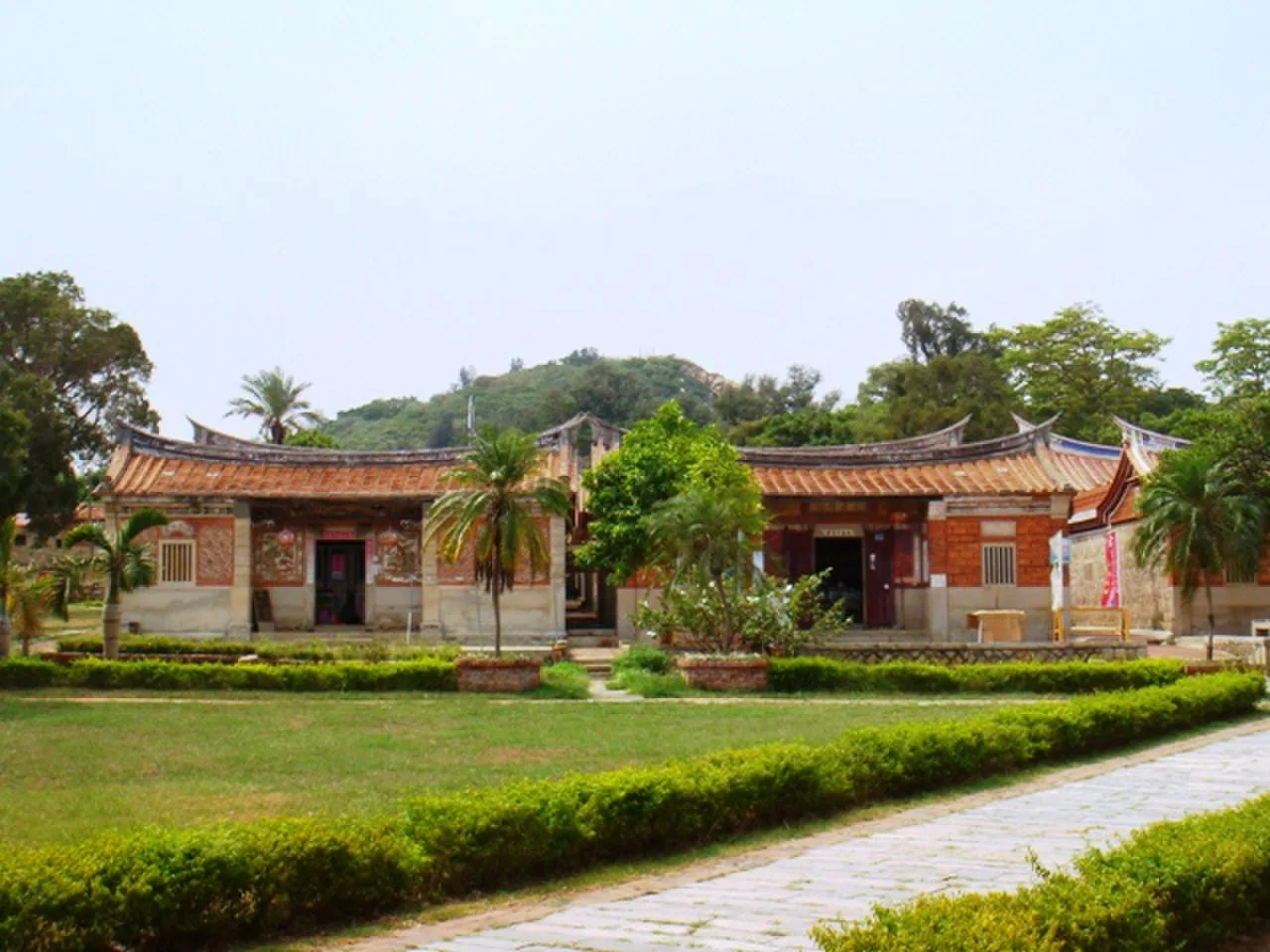
After the Qing Zheng family surrendered, Kinmen entered a relatively peaceful two centuries. Many overseas Chinese went to Southeast Asia (Philippines, Malaysia, Indonesia) to make a living, bringing wealth back to build Western-style houses, forming the unique "Fan Zi Lou" (Foreign Building) architectural landscape of the late Qing and early Republican eras. Shanhou Settlement is the best-preserved representative: located in Jinsha Town, built in the late Qing/early Republican era (approx. 1900s-1920s), consisting of 16 to 18 Southern Min old houses (statistics vary slightly), built by the Shanhou Wang family after living in Japan and returning home. The architectural vocabulary integrates Southern Min traditions, Japanese details, and Western decorative elements21. Listed as the first batch of cultural monuments in 1979, it opened to the public after renovation in 1998.
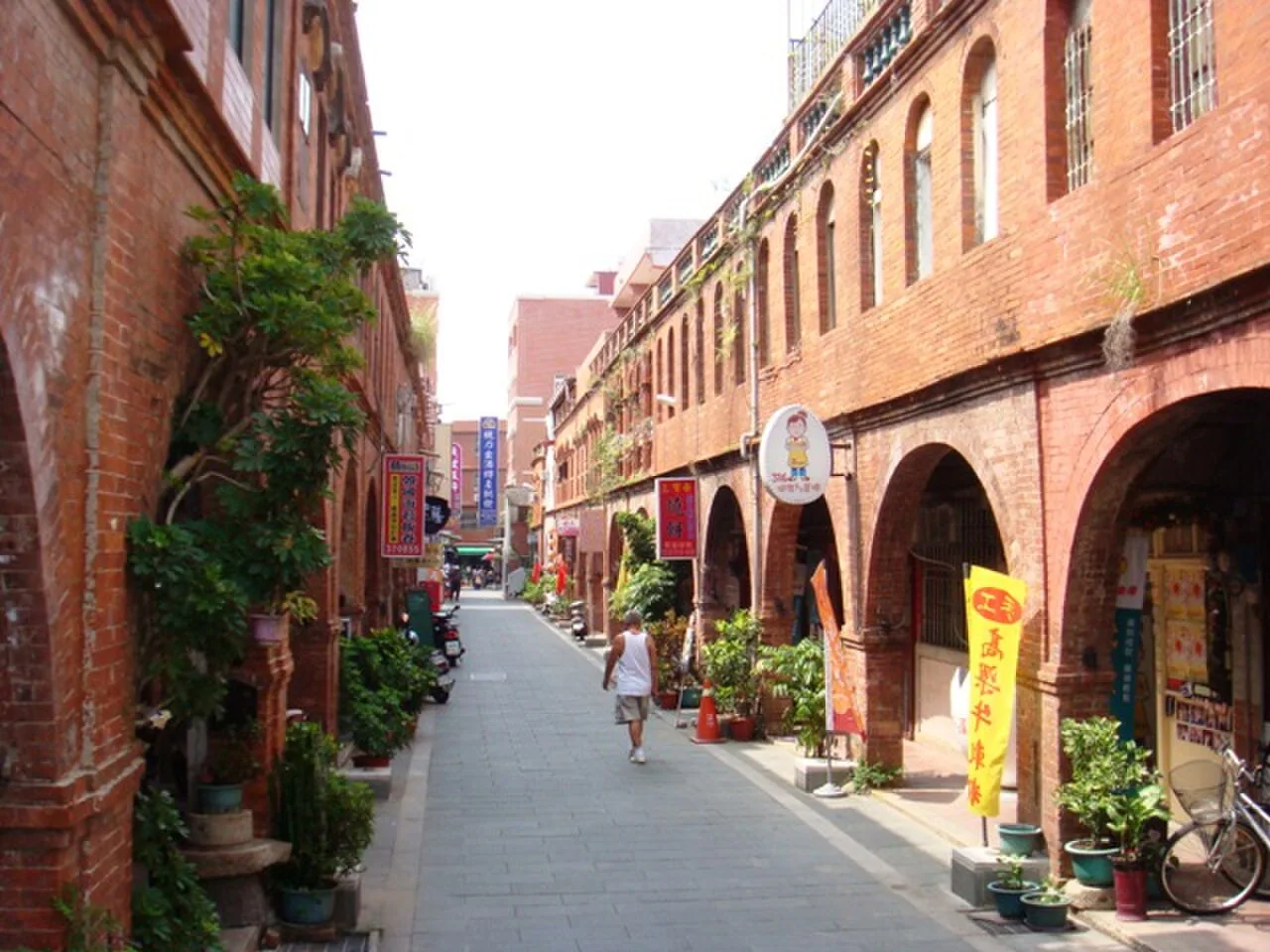
Jincheng Model Street is another artifact of a different timeline. A two-story arcade-style old street built in 1924, its facade integrates Southern Min, Southeast Asian, and Western styles. Its name comes from the then Kinmen County Magistrate praising the street as a "Model of Construction." The biggest difference between Model Street and contemporary old streets on the Taiwan main island during the Japanese colonial period: it was built by returning overseas Chinese, not by Japanese. Kinmen was never directly administered under Japanese rule (except for a brief Japanese occupation during the Sino-Japanese War from 1937-1945). Thus, the time on this street belongs to the "time of overseas Chinese," a different axis from "Japanese colonial time."
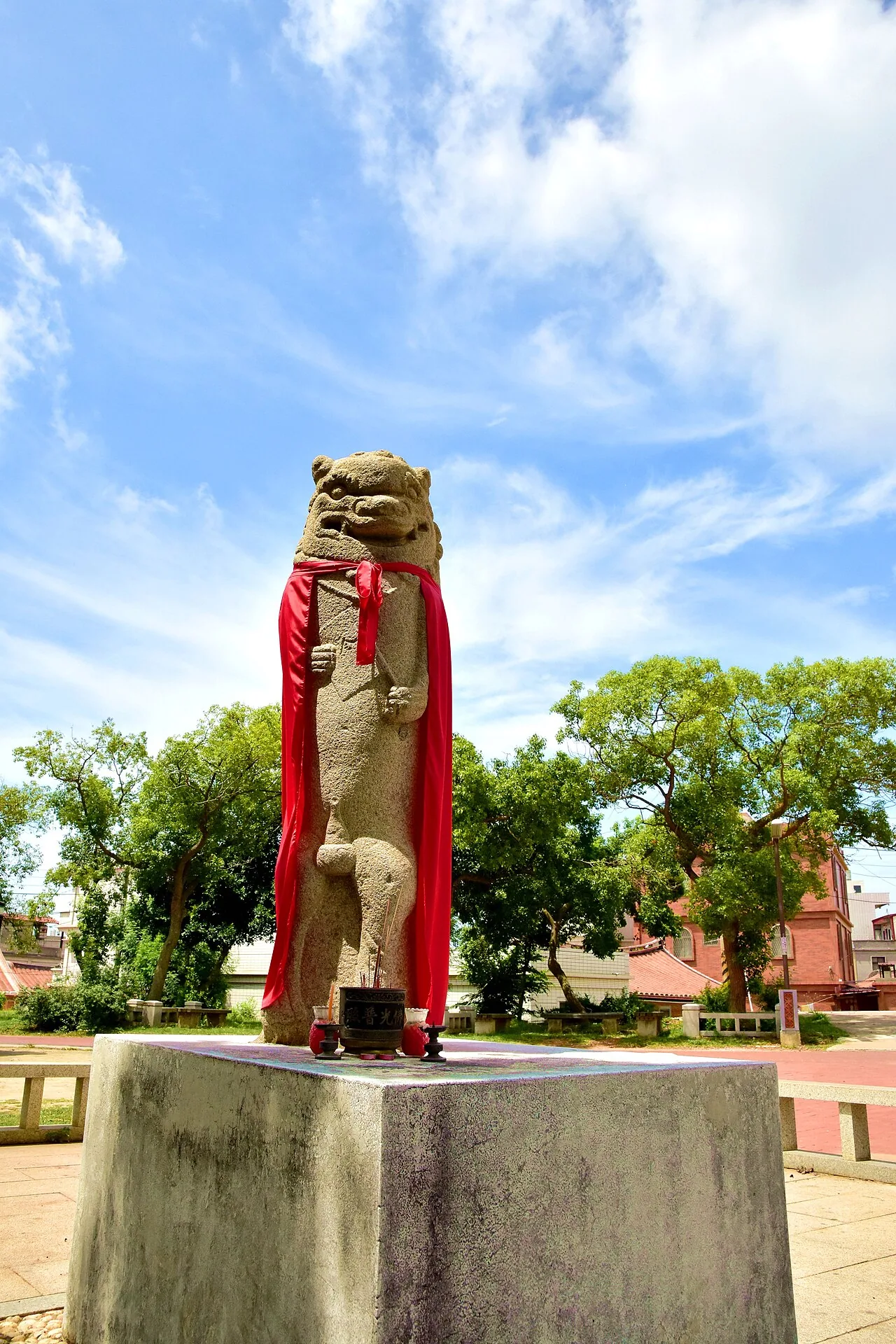
As for the unique stone lion statues at village entrances: Wind Lion Gods (Feng Shi Ye). There are over 70 on the entire island (statistics range from 70 to 90)22. Kinmen Island is flat, and winter northeasterly monsoons are strong. Traditional Southern Min folklore believes that "lions bite the wind" to suppress wind evil, so stone lions are erected at village entrances for protection. Okinawa’s "Shisa" serves a similar function; scholars speculate it may be related to Southern Min fishermen migrating to the Ryukyu Islands during the Tang and Song dynasties, but this theory remains controversial and should not be written as a conclusion.
Wuhu Speaks a Third Language
If 5 of Kinmen’s 6 townships can be reached by car or motorcycle from the main island and Lieyu, the 6th township is an administrative miracle.
Wuhu Township belongs to Kinmen County, but geographically it is over 170 km from the Kinmen main island, located in the waters north of Penghu and south of Matsu23. To handle affairs from the Kinmen County Government, Wuhu residents must first take a boat to the main island’s Taichung Port or Keelung Port, then transfer to Kinmen: it is more circuitous than going directly to Matsu. More uniquely, the language spoken by Wuhu residents is different from Kinmen’s Southern Min and Matsu’s Fuzhou dialect (Eastern Min); they speak Puxian Min (Puxian Yu), a Min Chinese sub-dialect developed in Putian and Xianyou (now Putian City, Fujian), which is mutually unintelligible with Southern Min or Eastern Min23.
This linguistic fact is the furthest extension of the "Kinmen County" boundary: one county with three languages—Southern Min on the main island, Southern Min (same root, slightly different accent) on Lieyu, and Puxian Min on Wuhu.
This is also the starting point for the most necessary distinction between Kinmen and Matsu (Lienchiang County). Both offshore counties implemented War-time Administration in 1956, abolished it in 1992, and opened Small Three Links in 2001. But the two counties’ destinies were only similar in system; their flesh and bones grew differently.
Kinmen people speak Southern Min Tong’an accent, close to Southern Min in southern Taiwan and Xiamen accent, allowing cross-sea communication without issue24. Matsu people speak Eastern Min Fuzhou dialect, "largely similar" to Fuzhou city’s Fuzhou dialect, but completely unintelligible with Taiwan’s Southern Min. Linguistic differences reflect migration origins: Kinmen immigrants mainly came from Quanzhou, Tong’an, Fujian; Matsu immigrants mainly came from Fuzhou, Changle, and Luoyuan.
The distance structure is also different. Kinmen is closest to Xiamen at 1.8 km, facing Xiamen’s commercial circle directly. Matsu is about 50 km from Fuzhou’s Mawei, not in Fuzhou’s suburbs. Thus, the daily density of Kinmen people doing business, buying daily necessities, and seeing doctors in Xiamen is far higher than Matsu people’s connection to Fuzhou.
The battle history is even more asymmetric. Kinmen has Gu Ningtou (1949) + August 23 (1958) + Fire on Odd Days (1958-1979) = two decisive battles plus 21 years of shelling. Matsu has Dongquan Battle (1954), Yijiangshan Battle (1955, location outside Kinmen), and sporadic shelling, but never a land battle on the scale of Gu Ningtou.
Population scale differs by an order of magnitude. Kinmen has 145,000 registered residents; Matsu has only 13,000: Kinmen people are more than 10 times the number of Matsu people. Kinmen has Kinmen University (established in 1997, the first university in Kinmen’s history)25; Matsu has no university.
📝 Curator’s Note: The prevailing "offshore county" framework packages Kinmen and Matsu into the same concept—"Cold War front line," "war-time tourism," "cross-Strait confrontation." This compression is convenient for media headlines, but it writes two counties with completely different flesh and bones into the same resume. Kinmen is Southern Min, rooted in Kinmen-Xiamen, relying on Xiamen’s commercial circle, with large-scale land battles, and a garrison of 100,000 people; Matsu is Eastern Min Fuzhou dialect, farther from Fuzhou, a fishing village island chain suspended at sea, with a garrison of 50,000 people. The two counties are like fraternal twins of the same fate—same system, different flesh and bones. If you say "Kinmen-Matsu withdrawal," "Kinmen-Matsu lifting martial law," "Kinmen-Matsu Small Three Links," remember that this plural behind the term represents two independent counties, two independent languages, and two independent battle memories.
4:00 AM, Boats Departing Shuitou for Xiamen
Back to the strait at the opening.
On January 2, 2001, the "pilot direct flight" from Kinmen’s Shuitou Pier to Xiamen’s Wutong Pier made its maiden voyage. This was the earliest pilot for the cross-Strait opening of "Three Links" (Mail, Commerce, Navigation), seven years earlier than the 2008 Big Three Links26. From that day to 2024, the cumulative number of Small Three Links passengers was approximately 24 million: ⚠️ Statistics vary slightly by source; 24 million is an approximation. The voyage takes 45 minutes, with a one-way ticket price of approximately NT$600 to NT$900 (depending on cabin class).
The Small Three Links were interrupted in February 2020 due to COVID-19, partially resumed in February 2023 (limited to Taiwanese), and gradually resumed two-way traffic from 202426. For Kinmen residents, the Small Three Links are daily procurement rather than a political symbol: many fresh ingredients and household items in Kinmen enter through Xiamen channels. Xiamen’s large department stores and medical facilities have substantial appeal to Kinmen residents. Many Kinmen residents commute to Xiamen for work; Xiamen-based Taiwanese executives also use the Small Three Links to travel between the two ends.
This is Kinmen’s most concrete contemporary contradiction.
At 4:00 AM, speedboats departing Shuitou for Xiamen outnumber flights to Songshan. 45 minutes to Xiamen, 2 hours to Xiamen for lunch and back, including transit time. But flying to Taipei takes at least 1+ hour of flight + round-trip airport transfers = half a day. The daily density determined by geography pulls against the sense of belonging determined by politics every day on this 151-square-kilometer island.
Kinmen County’s registered population was approximately 145,000 in 2024, but the actual resident population is lower than this: many Kinmen people work on the Taiwan main island, register in Kinmen to enjoy county government subsidies and share dividends (Kinmen Liquor Factory distributes shares annually to registered residents)27. "Having a household registration in Kinmen" and "living in Kinmen" are two different things. This gap is calculated daily in county budget allocations, election voting, and health insurance subsidies.
On October 25, 2024, the 75th anniversary commemoration of the Battle of Gu Ningtou was held in Kinmen. When County Magistrate Chen Fu-hai said "Cherish peace, defend sovereignty," the scene included the beach ruins where the PLA landed in 1949, the Zhaishan Tunnel where tourists queue to kayak today, the Xiamen speedboats departing hourly from Shuitou Pier, residents registered in Kinmen but working in Taipei, and Ye Huacheng’s great-grandson who was not invited.
When you visit Kinmen, do not just look at the Zhaishan Tunnel.
Go to the Gu Ningtou War History Museum to see the timeline展板 of those 56 hours in 1949; the M5A1 replica tank on the beach is parked right there. Go to the August 23 War History Museum to see how the number 474,910 shells translates to 3,132 shells per square kilometer over 44 days. Walk Model Street to see the 1924 Western-style houses built by returning overseas Chinese; remember the time on this street is not Japanese colonial time. Go to Shanhou Settlement to see how late Qing/early Republican Southern Min old houses stack 16 connected courtyards with granite. Go to Kinmen Liquor Factory to buy a bottle of sorghum liquor; the bottle bears the four characters "Kinmen Liquor Factory," but you know in your heart that the three characters "Ye Huacheng" have not been printed on it.
Then arrive at Shuitou Pier before 4:00 AM.
Look at those waiting to board: Kinmen residents going to Xiamen for dental care, Taiwanese businessmen going to Xiamen factories, tourists curiously trying the taste of the Small Three Links. When the first boat departs the pier heading toward Xiamen’s Jiaoyu Island, the sea distance is only 1.8 km. But beneath this 1.8 km of sea surface lies the beach at 2:00 AM on October 25, 1949; the Taiwu Mountain at 5:30 PM on August 23, 1958; the sound of shells on every odd-numbered day during the 21 years of "Fire on Odd Days" from 1958 to 1979; the 10:00 PM curfew of every night during the 36 years of War-time Administration from 1956 to 1992; the liquor factory forcibly requisitioned from Ye Huacheng in 1952: 75 years of destiny are stacked in this 45-minute voyage.
Those 56 hours determined not just Kinmen, but Taiwan.
Further Reading
- Lienchiang County — 22 Counties Series sibling, the other offshore county of Fujian Province. Same 1956 War-time Administration, 1992 abolition, 2001 Small Three Links, but speaks Eastern Min Fuzhou dialect, 50 km from Fuzhou, no land battle on the scale of Gu Ningtou; same system, different flesh and bones.
- Keelung City — 22 Counties Series pilot, the only deep-water port in the north vs. Kinmen’s southern coastal defense fortress; two timelines of Taiwan’s ports.
- Penghu County — The third county in the 22 Counties Series offshore group. Like Kinmen, an offshore county but with Japanese colonial history; can be compared to Kinmen’s difference of never being directly administered under Japanese rule.
- Zheng Chenggong — Raised troops in Kinmen in 1646 to "Anti-Qing, Restore Ming"; this person’s decision to start from Kinmen later changed Taiwan.
- Chiang Kai-shek — 1958 "Do Not Forget Ju Guang" Taiwu Mountain inscription; the decision-maker who ordered the death-defending defense of Kinmen in 1949.
- Martial Law Period — Taiwan main island lifted martial law in 1987; Kinmen and Matsu did not abolish War-time Administration until 1992. Read this article to compare the two versions of martial law.
- Taiwan Strait Crisis and Cross-Strait Relations Development — The August 23 Artillery War is one of the most concrete physical evidences of the Cold War hot war; this article’s § "5:30 PM" section is the county-level extension of this piece.
- Taiwan National Defense and Military Modernization — The evolution of Kinmen’s military garrison from 50,000-100,000 today to less than 10,000, compared with the overall Nationalist Army modernization trajectory.
- Taiwan Island Geography Characteristics and Formation — Comparison of Kinmen’s granite geology with the formation mechanisms of other Taiwan islands.
- Legends of Mazu and Da Dao Gong — Kinmen’s Southern Min faith shares the same root as the Taiwan main island; differs from Mazu Tianhou Palace’s spiritual cave legend in Matsu.
- Matsu International Art Island — Lienchiang County’s case of turning war-time tunnels and military tea rooms into a ten-year curation plan; Kinmen’s war-time transformation follows a different path. Compare how two front-line islands handle the same heritage.
Image Sources
This article uses 6 Wikimedia Commons CC BY-SA licensed images.
The Hero image (frontmatter) is Sleepingstar’s "Kinmen Montage" (CC BY-SA 4.0), a Kinmen landscape collage including old houses, Juguang Tower, war-time bunkers, Wind Lion Gods, and Taiwu Mountain as representative imagery.
5 inline images:
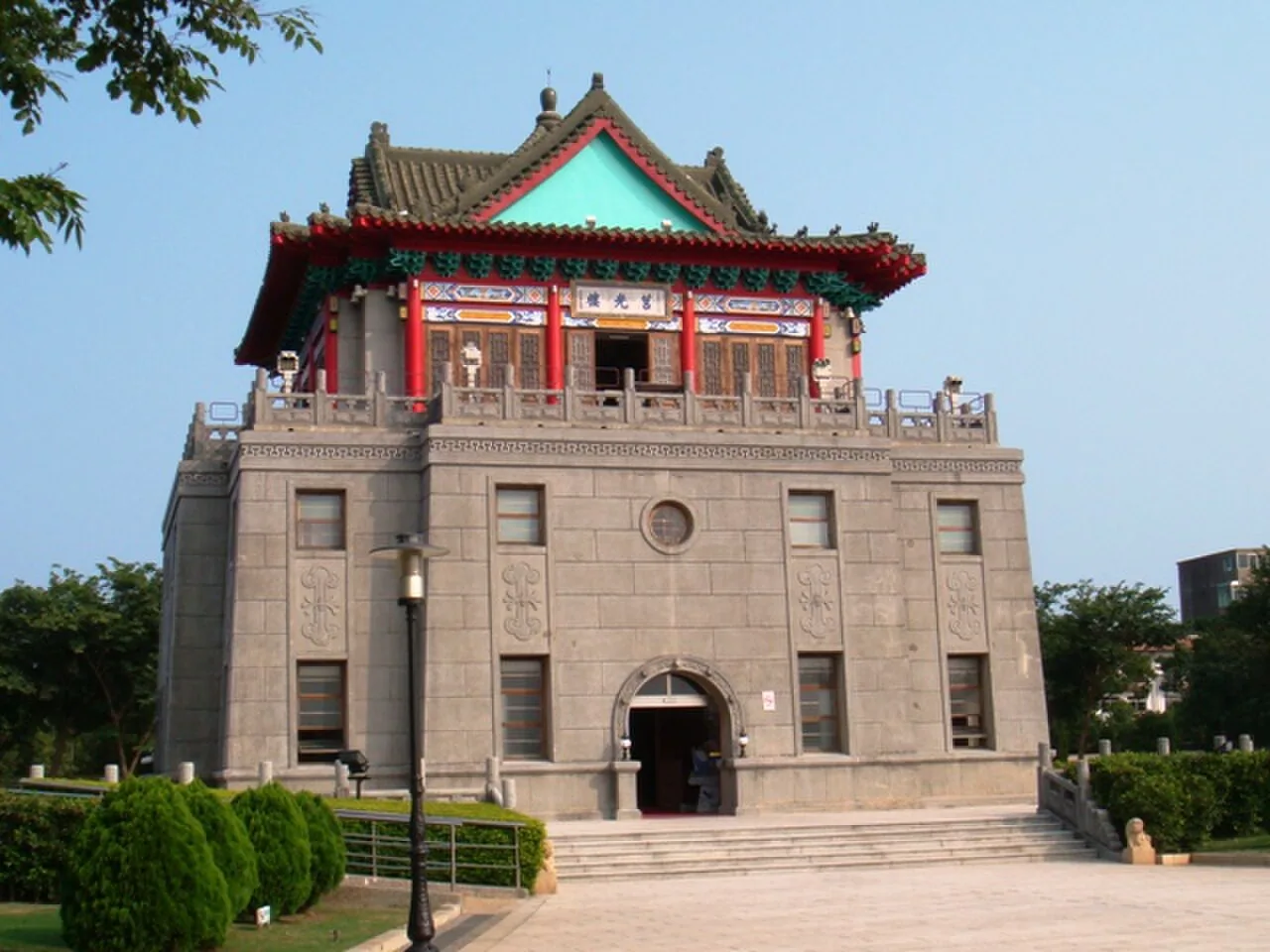
- § Looking at Xiamen from Kinmen: Juguang Tower, Kinmen, Taiwan — Photo: (WT-shared) Shoestring, CC BY-SA 4.0, 2009-09. Juguang Tower outside the North Gate of Jincheng Town, a 1952 palace-style building.
- § 5:30 PM (August 23 Section): Zhaishan Tunnel, Kinmen, Taiwan — Photo: (WT-shared) Shoestring, CC BY-SA 4.0, 2009-09. Zhaishan Tunnel, completed after excavation from 1961 to 1965.
- § The Four Characters of 1387 (Shanhou Settlement Section): The Kinmen cultural village, Kinmen, Taiwan — Photo: (WT-shared) Shoestring, CC BY-SA 4.0, 2009-09. Shanhou Folk Culture Village.
- § The Four Characters of 1387 (Model Street Section): Mo fan Street, Kinmen, Taiwan — Photo: (WT-shared) Shoestring, CC BY-SA 4.0, 2009-09-21. Jincheng Model Street, built by returning overseas Chinese in 1924.
- § The Four Characters of 1387 (Wind Lion God Section): Wind Lion God in Kimmen — Photo: P95521708, CC BY-SA 4.0, 2018-06-06. Kinmen Wind Lion God, stone lions at village entrances suppressing wind evil.
License: CC BY-SA 4.0.
References
- Kinmen County Geographic Location — Kinmen County Government — Kinmen County Government’s official website and disaster prevention information network record Kinmen’s closest point to the mainland as Jiaoyu Island in Tong’an District, Xiamen, a straight-line distance of approximately 1.8 km; 358 km from Taipei; Kinmen main island area 134 square kilometers; including Lieyu and other islands, total 151.6 square kilometers. Official geographic data. 1.8 km is the mainstream cited value in multiple Chinese sources; some versions mark "approx. 2 km" or "1.8 to 2.2 km" range. This article adopts 1.8 km with "approx."↩
- Kinmen Small Three Links Voyage Info — Ministry of Transportation and Communications, ROC — Small Three Links route Kinmen Shuitou Pier to Xiamen Wutong Pier voyage approx. 45 minutes; one-way ticket price approx. NT$600-900 (depending on cabin and shipping company); peak hour frequency one flight per hour. Official transport info.↩
- Republic of China Fujian Province Government History — Wikipedia — ROC Fujian Province Government downgraded in 1996, streamlined functions in 1998, officially de-missioned in 2019; functions taken over by ROC Executive Yuan Kinmen-Matsu Joint Service Center. Provincial government history; Kinmen County and Lienchiang County are the two counties under current administration.↩
- Kinmen County Administrative Divisions — Kinmen County Government — Kinmen County has 6 townships (Jincheng Town as county seat, Jinhu Town, Jinsha Town, Jinning Township, Lieyu Township Little Kinmen, Wuhu Township special administrative area); total area 151.6 square kilometers; Taiwu Mountain altitude 253 meters as main island ridge; geology primarily granite. Official data.↩
- PLA Landing Forces in Battle of Gu Ningtou — Gu Ningtou War History Museum, Ministry of National Defense — Gu Ningtou War History Museum展板 and Ministry of National Defense war history record Oct 25, 1949, 2:00 AM, PLA 28th Army 82nd Division 244th Regiment, 84th Division 251st Regiment, 85th Division 253rd Regiment, three regiments totaling approx. 9,086 people landed in Gu Ningtou area. Force data.↩
- Role of M5A1 Tanks in Battle of Gu Ningtou — Kinmen National Park Management Office — Nationalist Army had only 3 US-aid M5A1 light tanks in Kinmen (numbers 64, 65, 66); tank 66 broke down on Gu Ningtou beach before battle, becoming earliest fire support point; PLA landed with infantry, no anti-tank weapons. War history record; existing M5A1 replica displayed outside Gu Ningtou War History Museum.↩
- Battle of Gu Ningtou 56-Hour Timeline — Wikipedia — Oct 25, 1949, 2:00 AM PLA landing; 25th day US-made M5A1 tanks joined battlefield, becoming key to counterattack; 26th day Nationalist Army completed encirclement; 27th early morning surviving PLA annihilated on shallow flats; total 56 hours battle timeline.↩
- Battle of Gu Ningtou Killed/Captured Numbers Controversy — Wikipedia — Nationalist Army war history records "PLA dead 9,086, captured 7,364, total 16,450"; another version "killed/captured 15,953". If only first wave of 9,086 landers counted, killed/captured exceeding landers is logical conflict; some explanations include water-based annihilations, casualties, and captures cross-calculated. This article adopts Nationalist Army war history framework and marks arithmetic unsolved.↩
- Battle of Gu Ningtou 75th Anniversary Commemoration — Kinmen County Government Press Release 2024-10-25 — Kinmen County Government held 75th anniversary commemoration at Gu Ningtou War History Museum on Oct 25, 2024; County Magistrate Chen Fu-hai speech "Remember history, cherish peace, defend sovereignty" official press release.↩
- August 23 Artillery War First Day Three Deputy Commanders Died — August 23 War History Museum, Ministry of National Defense — August 23 War History Museum展板 records Aug 23, 1958, 5:30 PM PLA began shelling Kinmen; first day shelling Deputy Commanders Zhao Jiaxiang, Zhang Jie, Ji Xingwen died successively near Taiwu Mountain Command Post; Ji Xingwen was 1937 Lugou Bridge Incident first shot of full-scale Sino-Japanese War division commander. War history record.↩
- August 23 Artillery War Total Shells — Ministry of National Defense War History — Ministry of National Defense war history records Aug 23, 1958 to Oct 5, 1958, PLA fired total 474,910 shells at Kinmen; Kinmen total island area 151.6 square kilometers, avg per sq km endured approx. 3,132 shells (474910 ÷ 151.6 = 3132.65). This number is mainstream cited value in multiple Chinese sources; original source Ministry of National Defense War History Database. ⚠️ Another version marks "over 470,000", "nearly 470,000" approximations. This article adopts precise value 474,910 and notes source framework.↩
- Fire on Odd Days Cease-fire on Even Days 21 Years — Wikipedia — Oct 25, 1958 (9th anniversary of Battle of Gu Ningtou) Mao Zedong published "Message to Compatriots in Taiwan Again" announcing "fire on odd days at Kinmen, cease-fire on even days"; Jan 1, 1979 Sino-US formalized diplomatic relations, US required cessation of shelling as precondition, shelling stopped; exactly 21 years cross-Strait military contact history. Later shells mostly propaganda shells, not live ammo.↩
- Kinmen-Matsu War-time Administration 36 Years — Wikipedia — War-time Administration Experimental Measures implemented in Kinmen July 8, 1956 (Matsu same year); May 1, 1991 Temporary Articles for Suppression of Rebellion abolished; Nov 7, 1992 Kinmen and Matsu War-time Administration officially abolished; Taiwan main island lifted martial law July 15, 1987; Kinmen-Matsu lifted martial law 5+ years later than Taiwan main island. Complete war-time administration timeline.↩
- Kinmen War-time Administration Curfew and Controls — Kinmen County Culture Bureau Oral History — Kinmen County Culture Bureau Oral History Project records War-time Administration curfew 10:00 PM (Matsu 9:00 PM); exit/entry applications, radio registration, no floating devices by sea (swim rings, rubber boats, basketballs, tires, etc.); buildings restricted to max 2 stories in some periods; military vouchers circulated; county magistrates and township mayors appointed by military; first elected county magistrate in 1993. Military rule reality. ⚠️ Quote "We were in Kinmen, still under military rule five years after martial law" is typical expression from Kinmen elders’ oral history; multiple oral histories have similar phrasing. This article adopts generalized presentation.↩
- Kinmen Military Rule Period Nationalist Army Garrison Size — Kinmen County Gazetteer — Kinmen County Gazetteer and multiple war history records record military rule period peak Nationalist Army garrison size approx. 50,000 to 100,000 people; resident population approx. 50,000 to 70,000; garrison density more soldiers than residents; current Kinmen garrison reduced to approx. 5,000 or less, synchronized with overall Nationalist Army精简 plan and conscription-to-volunteer transition.↩
- Zhaishan Tunnel Specifications — Kinmen National Park Management Office — Zhaishan Tunnel located south bank of Jincheng Town; built 1961-1965 (some sources 1960-1966); design purpose submarine and small landing craft supply base plus ammunition channel; tunnel total length 357 meters, width 11.5 meters, accommodates 42 small landing craft; transformed into tourist attraction 1998; today kayaking through is Kinmen’s most popular tourist experience. Engineering record. Lieyu Jiugong Tunnel total length 780 meters, top granite thickness 30-50 meters, sufficient to withstand general bomb direct hits.↩
- Kinmen Liquor Factory Official History — Kinmen Liquor Factory Industrial Co., Ltd. — Kinmen Liquor Factory Industrial Co., Ltd. official website history records 1952 Defense Commander Hu Lian founded "Jiulongjiang Liquor Factory", later renamed "Kinmen Liquor Factory"; used local sorghum raw material to produce liquor; now public enterprise under Kinmen County Government; annual turnover exceeding NT$10 billion; one of Kinmen County Government’s main fiscal sources. Official version history.↩
- Ye Huacheng’s Great-Grandson Publicly Accuses — Mirror Weekly 2019 Report — Mirror Weekly 2019 in-depth report Ye Huacheng’s great-grandson Ye Wei-ren publicly spoke for grandfather’s history, verbatim quote "Sorghum liquor formula and brewing technology created by my great-grandfather Ye Huacheng, forcibly requisitioned in 1952, to this day Kinmen Liquor Factory never officially acknowledged this history. We do not demand compensation, only demand fair treatment of history"; Ye Huacheng 1949 Nationalist Army retreat to Taiwan period founded "Jincheng Liquor Factory" (later renamed "Jiulongjiang Liquor Factory") in Kinmen City to develop sorghum liquor brewing technology; 1952 forcibly requisitioned by military renamed "Kinmen Liquor Factory"; Ye Huacheng remained as technical advisor but lost ownership and founder attribution. Family narrative. ⚠️ This quote is media report multiple cited version; precise verbatim source pending WebFetch Mirror Weekly original text confirmation.↩
- Kinmen Garrison City Place Name Origin — Wikipedia — 1387 (20th year Hongwu, Ming Dynasty) Vice Duke Zhou Dexing ordered to build Kinmen Garrison City; adopted "Solid as gold and soup, majestically guarding the sea gate" meaning abbreviated to "Kinmen"; before called "Wu Zhou" or "Xian Zhou" (Tang Five Dynasties literature); Tang Dynasty horse grazing land; Five Dynasties Later Zhou Xiande 6th year (959) Quanzhou established Jinjiang County jurisdiction; Ming Dynasty built garrison city after large-scale immigrants from Fujian Quanzhou (Tong’an County) historical evolution.↩
- Zheng Chenggong Raised Troops in Kinmen to Anti-Qing — Zheng Chenggong Temple Jincheng Town — 1646 (3rd year Shunzhi, Qing Dynasty) 23-year-old Zheng Chenggong raised troops in Kinmen and Xiamen to Anti-Qing Restore Ming; Kinmen Nan Ci Mountain Mingde Lake area has Ming loyalist tombs; Jincheng Town Zheng Chenggong Temple is county government cultural data commemorating this history; 1662 Zheng Chenggong recovered Taiwan same year died.↩
- Shanhou Folk Culture Village — Kinmen National Park — Shanhou Folk Culture Village located Jinsha Town; built late Qing/early Republican era (approx. 1900-1920s); total 16-18 Southern Min old houses (statistics vary slightly, Kinmen County Culture Bureau monument registration data based on actual preserved number); built by Shanhou Wang family after living in Japan and returning home; architectural vocabulary integrates Southern Min tradition + Japanese details + Western decorative elements; listed first batch of monuments 1979; opened to public after renovation 1998. Official architectural data.↩
- Wind Lion God Census — Kinmen County Culture Bureau — Kinmen County Culture Bureau 2010s launched "Wind Lion God Census and Restoration" project; island over 70 (statistics 70 to 90); erected at village entrance roofs or temple sides; function suppress wind evil protect village peace; recorded since Ming/Qing dynasties; most popular in Qing Dynasty; material sandstone or granite; diverse forms (upright holding ball, upright raising arm, squatting lying, etc.) folklore census data. Okinawa Shisa function similar but origin and Southern Min connection still academic controversy.↩
- Wuhu Township Geography and Puxian Min — Wuhu Township Office — Wuhu Township administrative belongs to Kinmen County but geographic location north of Penghu near Lienchiang County; 170+ km from Kinmen main island; composed of Daqiu Island and Xiaoqiu Island; residents approx. 600 households; language spoken is "Puxian Min" (Min Chinese sub-dialect of Putian Xianyou area, mutually unintelligible with Kinmen Southern Min, Matsu Fuzhou dialect) official data; Wuhu Township is one of ROC’s most special administrative divisions.↩
- Kinmen vs Matsu Language Differences — Wikipedia — Kinmen通行 language Southern Min Tong’an accent (close to Taiwan main island southern Southern Min, Xiamen accent, mutually intelligible); Matsu通行 language Eastern Min Fuzhou dialect (largely similar to Fuzhou city Fuzhou dialect but completely unintelligible with Taiwan main island Southern Min); Wuhu通行 language Puxian Min Kinmen County and Lienchiang County language map; reflects different migration origins (Kinmen mainly from Quanzhou Tong’an, Matsu mainly from Fuzhou Changle and Luoyuan).↩
- National Kinmen University History — National Kinmen University — National Kinmen University established 1997 (predecessor National Kaohsiung University of Science and Technology affiliated junior college department Kinmen branch, later upgraded to National Kinmen Institute of Technology, 2010 transformed to National Kinmen University); first university in Kinmen history; concrete milestone of war-time to education transformation. Official school history.↩
- Small Three Links 25 Years Cumulative and Pandemic Interruption — Executive Yuan Mainland Affairs Council — Executive Yuan Mainland Affairs Council official website records Jan 2, 2001 Kinmen-Xiamen, Matsu-Fuzhou "pilot direct flight" maiden voyage as cross-Strait "Three Links" (Mail Commerce Navigation) earliest pilot; 7 years earlier than 2008 Big Three Links; 2001-2024 cumulative Small Three Links passengers approx. 24 million people (⚠️ statistics vary slightly by year); Feb 2020 Small Three Links interrupted due to COVID-19; Feb 2023 partially resumed (limited to Taiwanese); 2024 gradually resumed two-way traffic. Cross-Strait exchange history.↩
- Kinmen County Population and Share Dividend Benefits — Kinmen County Household Registration Office — Kinmen County Household Registration Office 2024 monthly report records registered population approx. 145,000 but actual resident population lower than this; many Kinmen people work on Taiwan main island, register in Kinmen to enjoy county government subsidies; Kinmen Liquor Factory annually distributes shares to registered residents (commonly known "Kinmen Liquor Share Dividend") is actual economic incentive for registering in Kinmen one of household registration data; "Having household registration in Kinmen" vs "Living in Kinmen" gap calculated daily in county budget, election voting, health insurance subsidies.↩