
30-second overview: Bangka is a phonetic rendering of the Ketagalan word for “dugout canoe.” In 1709, the Chen Lai Zhang land reclamation enterprise obtained an official permit and entered Dajiala. In 1738, people from the three Quanzhou counties of Jinjiang, Nan’an, and Hui’an jointly funded the construction of Longshan Temple; from that moment on, this street became the core of Taipei. The saying “First Tainan, Second Lukang, Third Bangka” refers to the three great commercial ports of Qing-era Taiwan, with Bangka ranked third. In 1853, the third year of the Xianfeng reign, the “Ding-Xia Jiao Conflict” broke out: the Sanyi people borrowed a route through Qingshui Zushi Temple and set fire to Bajiazhuang, where the Tong’an people lived. The defeated Tong’an people, led by Lin Youzao, fled to Dadaocheng carrying the statue of Xiahai City God and opened another commercial port there. That armed conflict determined northern Taiwan’s divergence over the next two centuries: after Tamsui opened as a port in 1860, Dadaocheng became a center for tea exports, while Bangka’s ferry landing gradually fell silent as silt accumulated in the Tamsui River. In 1920, under Japanese rule, the Taiwanese pronunciation of “Bangka” was replaced with the Buddhist-scripture-derived characters “Wanhua.” Wanhua District was established in 1990, and in 2010 Doze Niu made the film Monga. By the end of 2025, people aged 65 and above accounted for 26.43% of Wanhua District’s population, and its aging index was 320.78%, the highest among Taipei City’s administrative districts. What this article wants to say is this: to outsiders, Wanhua is the snake-shop signage of a tourist night market and old people who have spent their whole lives sitting in front of the temple. The Bangka lived by Bangka people is a temple forecourt that has not left for 288 years, and a ferry landing that is never in the story.
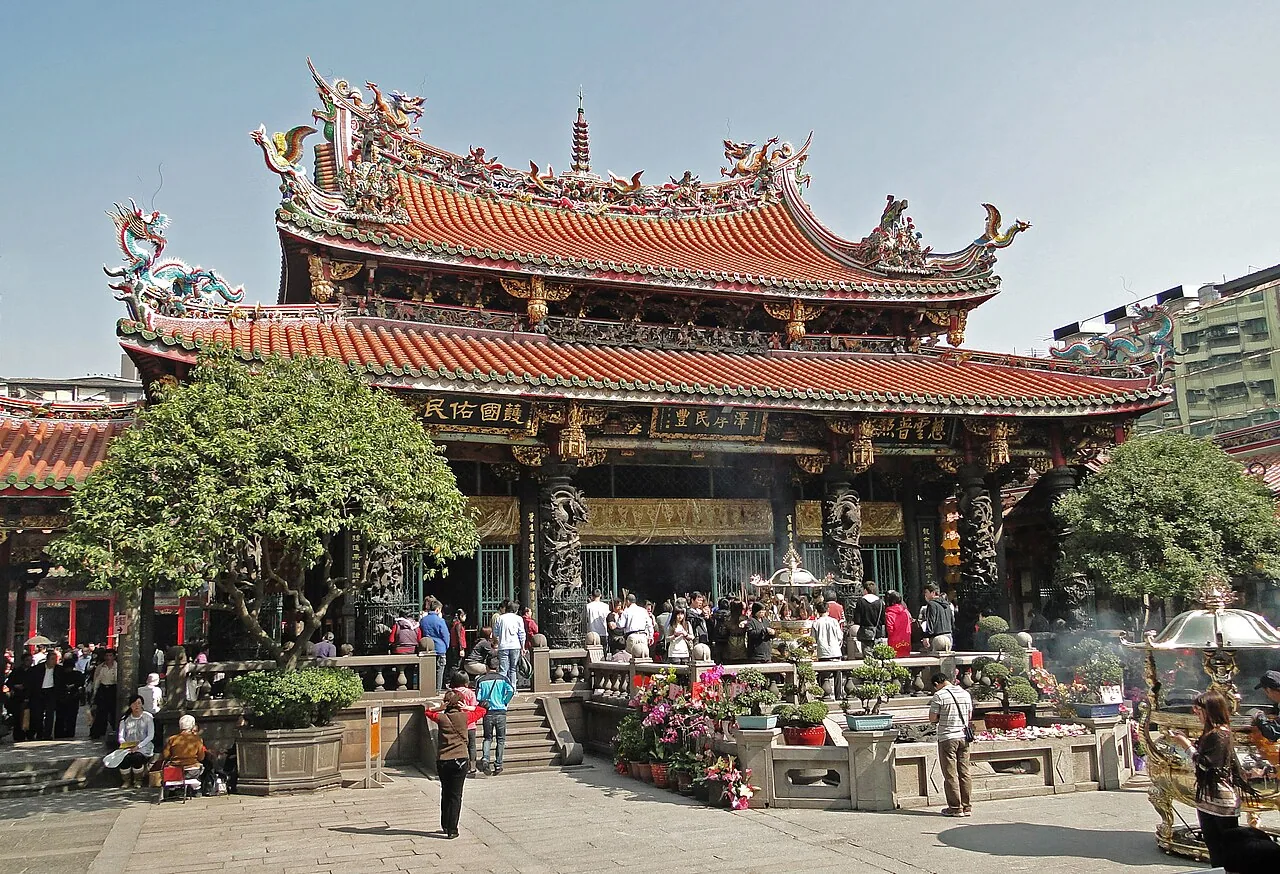
The front hall of Bangka Longshan Temple. Photo: Bernard Gagnon, CC BY-SA 3.0 via Wikimedia.
Six in the Morning, the First Incense Stick in the Temple Forecourt
Longshan Temple opens at six in the morning1. If you are coming from the Xinyi 101 end of the city at daybreak, the Bannan Line takes 23 minutes from Taipei City Hall Station to Longshan Temple Station, just in time.
On the left and right sides of the temple forecourt are the Purifying-Heart Waterfall and a fountain pool. Most people who come in at this hour are older residents living nearby. Some use canes, some ride electric mobility scooters, and some simply walk slowly. They first pass around the Purifying-Heart Pond, worship Guanyin Bodhisattva in front of the Sanchuan Hall2, and then proceed in order to the rear hall to worship the Heavenly Holy Mother Mazu, Wenchang Dijun, the Old Man Under the Moon, Zhusheng Niangniang, and Guansheng Dijun. One temple, seven deities, belonging to three systems: Buddhism, Daoism, and popular religion3.
They have done this their entire lives.
If they moved here in the 1970s, they have worshipped here for 50 years. If they came north with their families from central Taiwan after the war to make a living, they have worshipped here for 70 years. If they are second-generation mainlanders brought by the Nationalist government in 1949, they have worshipped here for 75 years. But the temple has worshipped longer still. The Guanyin Bodhisattva enshrined in Longshan Temple’s main hall was brought here in 1738 as a divided spirit from Anhai Longshan Temple in Jinjiang, Quanzhou4; in 2026, it turns 288 years old.
Outside the temple forecourt, the shops on Guangzhou Street have not opened yet. Two hours later, Liang Xi Hao, founded in 1921, will lift its metal shutters and sell squid thick soup, and Zhouji Meat Porridge at No. 104 Guangzhou Street will set out its first pot5. A few hours after that, tourists from across Taipei and then from around the world will flood in.
But at six in the morning, it has not reached that point yet. This moment belongs to the people kneeling on the prayer cushions. Each is one of Wanhua District’s 167,815 residents at the end of 20256, and in this district people aged 65 and above account for 26.43% of the population, with an aging index of 320.78%, the highest among Taipei City’s administrative districts6.
📝 Curator’s note: Conventional tourist brochures describe Longshan Temple as “Taipei’s oldest temple” and stop there. But the point of the year 1738 is not that it is “old”; it is that it precedes every official version of this city. The Qing court did not establish Taipei Prefecture until 1875, the Japanese did not establish Taipei City until 1920, and the Nationalist government did not begin operating in Taipei until 1949. Longshan Temple predates all of those administrative decisions by more than a century. Today, the 26.43% elderly population in front of the temple forecourt is, like the temple itself, Taipei’s oldest “present.” They constitute Taipei’s longest-running contemporary life, not a museumized past.
Where the Name Came From: From Bangka to Wanhua
The two Chinese characters “艋舺” are a phonetic transcription. In the language of the plains-dwelling Ketagalan people, “dugout canoe” was called Bangka, also recorded as Banka or Vanka; the Atayal called a dugout canoe Bnkaʔ7. When Han Chinese settlers opened this area, they saw large numbers of dugout canoes moored at the ferry landing where the Tamsui River and Xindian River meet, and used Taiwanese Hokkien to write that sound as the two Chinese characters “艋舺,” pronounced Báng-kah.
The name “Wanhua” was given by the Japanese in 1920. That year, the Governor-General’s Office carried out a major administrative reorganization, consolidating Taiwan’s administrative levels from twelve prefectures into five prefectures and two subprefectures, and establishing Taipei City at the same time8. The Japanese thought the Taiwanese pronunciation Báng-kah resembled “Manka,” the reading of “万華(萬華)” in Buddhist scriptures, and adopted those characters, which carried connotations such as “ten-thousand-year prosperity” and the “Flower Garland world of myriad virtues”7.
The problem was: by 1920, Bangka was no longer prosperous.
Go back further in time. In 1709, the 48th year of the Kangxi reign, five Quanzhou men, Chen Fengchun, Lai Yonghe, Chen Tianzhang, Chen Xianbo, and Dai Tianshu, jointly applied to Zhuluo County to reclaim Dajiala, also written Dajiarui. The permit specified the territory as follows: “east to the two communities of Leili, now southern Wanhua, and Xiulang, now Zhonghe; west to Bali’fen, now Bali, and Gandou, now Guandu; south to the foot of Xingzhi Mountain, now Xinzhuang; north to Dalongdong Ditch, now Yuanshan”9. The three characters “Chen Lai Zhang” do not refer to any real person, but to the name of the reclamation enterprise formed from the surnames of the five shareholders9. One sheet of paper, five shareholders, half the Taipei Basin.
Twenty-nine years later, in 1738, the third year of the Qianlong reign, in the fifth lunar month, Quanzhou migrants on this land had become numerous enough to need a shared temple. “People from the three counties therefore jointly funded the construction of Longshan Temple in the third year of the Qianlong reign of the Qing dynasty (1738)”4, dividing the spirit of Guanyin Bodhisattva from Anhai Longshan Temple in Jinjiang County, Fujian Province, their native place. This is the earliest written evidence of Bangka as a Han Chinese city. From the moment the temple was built, Longshan Temple was not only a center of faith; “matters such as deliberation and litigation were all brought before the gods for judgment”4. It was the political, social, and defensive core of the entire settlement.
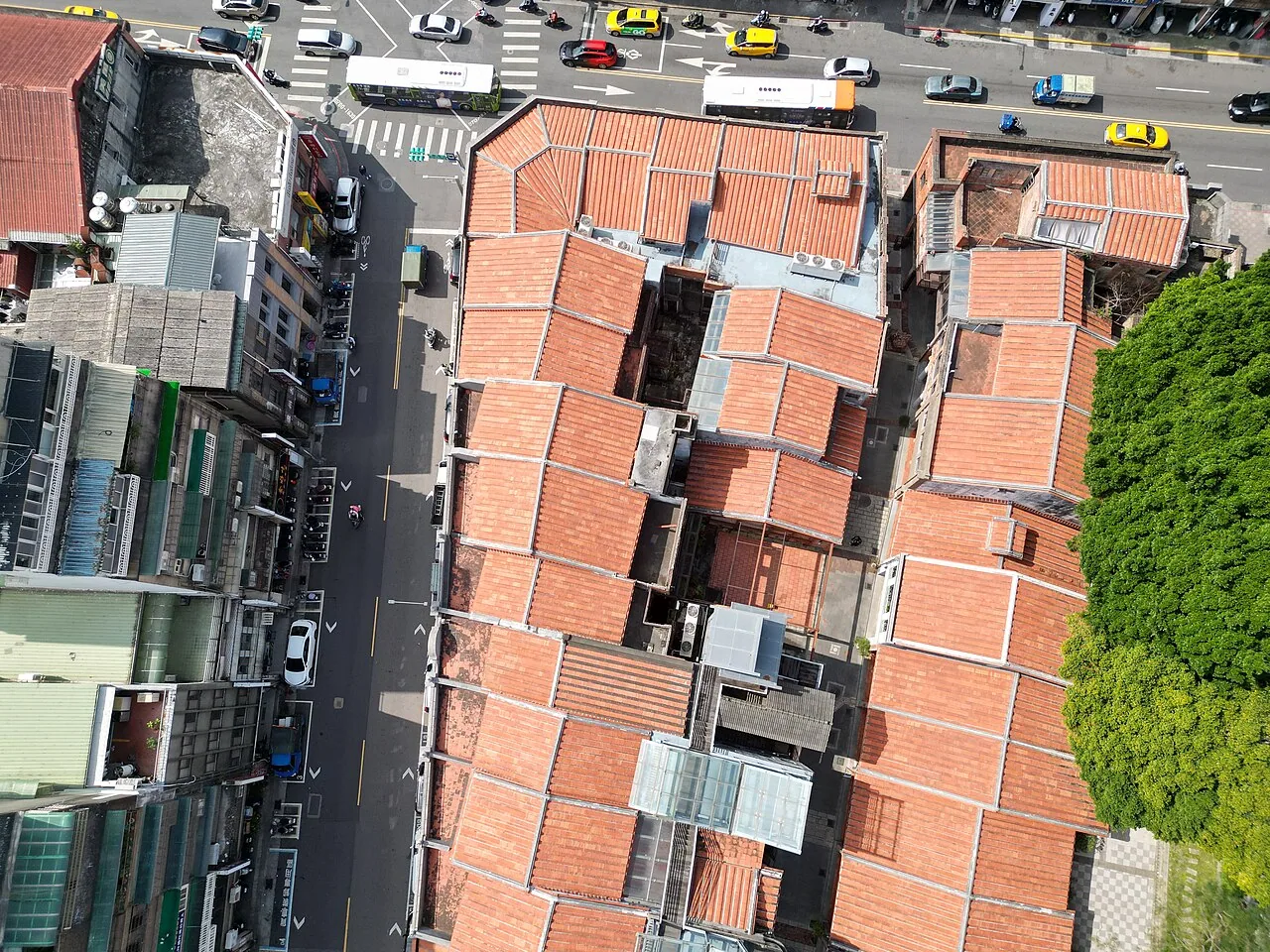
_Bopiliao Historic Block. Photo: Wikimedia Commons contributor, CC BY-SA via Wikimedia._
Two blocks east of Longshan Temple is Bopiliao, a place name even harder to explain than Wanhua. In the 28th year of Qianlong (1763), the name “Beipiliao Street” appeared in Bangka land deeds10. Different Qing documents also wrote it as “Fupiliao Street” or “Fudiliao Street,” and only in 1895, the 28th year of Meiji, was it renamed “Beipiliao 1-chome, 2-chome, and 3-chome”10. Scholars have three competing theories for the origin of the characters “bopi,” literally “peeling skin.”
The first is the fir-bark peeling theory: Bangka’s timber yards were a distribution center for timber from the upper Tamsui River. Fir was shipped from Fujian, stacked along the Tamsui River near the timber yards, and then dragged by animal power to Beipiliao Street for bark stripping and processing. But A Study of the Historical Value of Bopiliao Old Street points out that there is no record of a “bark peeling” trade among the industries of Beipiliao Street, the street space was limited, and the claim about animal-powered hauling is also implausible10.
The second is the animal-hide peeling theory: Taipei City Gazetteer records that “Bangka had Beipiliao Street, and behind Beipiliao there was a pond, likely a place for slaughtering animals and making leather”10. But neither interviews nor documents can confirm that the pond was actually used for skinning.
The third is the phonetic transformation theory: during the Japanese period, “Fupiliao” in Japanese was pronounced fukuhiryō, while “Beipiliao” was pronounced hokuhiryō; fuku and hoku sounded similar. In Taiwanese, “Beipiliao” also resembled “Bopiliao”10. This theory currently lacks documentary evidence.
In other words, this oldest street in Taipei has a name whose reason no one knows anymore10.
1853: An Armed Conflict Pushed the Tong’an People to Dadaocheng
Bangka’s Qing-era heyday ran from the mid-18th century to the early 19th century. During the Qianlong and Jiaqing reigns, the saying “First Tainan, Second Lukang, Third Bangka” took shape, describing the ranking of Qing Taiwan’s three great commercial ports: first Tainan Prefectural City, second Lukang in Changhua, third Bangka in Taipei’s Wanhua11. What the three cities had in common: all depended on shipping, and all had ports.
But Bangka was never a monolith.
The Minnan migrants who reclaimed this area mainly fell into three ancestral-origin groups: the Sanyi people, from the three counties of Jinjiang, Nan’an, and Hui’an, centered their faith on Longshan Temple; the Tong’an people, also under Quanzhou Prefecture but from a different county, centered their faith on Xiahai City God; and the Anxi people centered theirs on Qingshui Zushi Temple12. The three groups shared one Tamsui River wharf and the same market, but revered different gods.
In 1853, the third year of Xianfeng, the Sanyi people, who had arrived in Bangka earlier, and the Tong’an people, who arrived relatively later and gathered in Bajiazhuang, around today’s Laosong Elementary School, erupted into a major armed conflict over berthing rights at the wharf and commercial interests. It is known in history as the “Ding-Xia Jiao Conflict,” also written “Ding-Xia Jiao Armed Conflict,” Taiwanese Romanization Tíng-ē-kau-piànn13. Wikipedia records the two sides as follows: “One side in the armed conflict was the Quanzhou Jiao and North Jiao, known as the Upper Jiao, mainly composed of people from Jinjiang, Nan’an, and Hui’an counties under Quanzhou Prefecture; the other was the Lower Jiao or Xia Jiao, mainly composed of people from Tong’an County under Quanzhou Prefecture”13.
There was a turning point on the battlefield, and it had to do with a temple.
To attack the Tong’an people in Bajiazhuang from the Longshan Temple area, the Sanyi people had to cross marshland. But Qingshui Zushi Temple stood in the way, and that temple belonged to another ancestral-origin group, the Anxi people. The Sanyi people therefore approached the Anxi leader Bai Longfa to negotiate, requesting to “borrow the route” and burn down Qingshui Zushi Temple in exchange for an attack path, promising to rebuild it afterward14.
After the battle, the Sanyi people prevailed. The Tong’an people “who fled in defeat had no choice but to abandon their territory at the Bangka wharf; led by Tong’an elder Lin Youzao, they fled to Dadaocheng and opened a new commercial port”13. They rescued the statue of Xiahai City God from the fighting and temporarily enshrined it at the Jintongli pastry shop in Dadaocheng, operated by Chen Haoran. In 1856, the sixth year of Xianfeng, they raised funds to build a temple, which was completed on the 18th day of the third lunar month in 1859, the ninth year of Xianfeng. This is today’s Xiahai City God Temple at the entrance to Dihua Street in Dadaocheng15.
As for the Sanyi people’s promise to rebuild Qingshui Zushi Temple for the Anxi people? According to Wikipedia, “while pressing their forceful attack, the Sanyi people also burned down all of the Tong’an people’s houses”13, but they did not fulfill the promise to Qingshui Zushi Temple after the fighting, donating only a pair of dragon columns. The Anxi people ultimately raised 25,000 silver dollars themselves, with Bai Longfa presiding, and completed the reconstruction of Zushi Temple only in 1867, the sixth year of Tongzhi14.
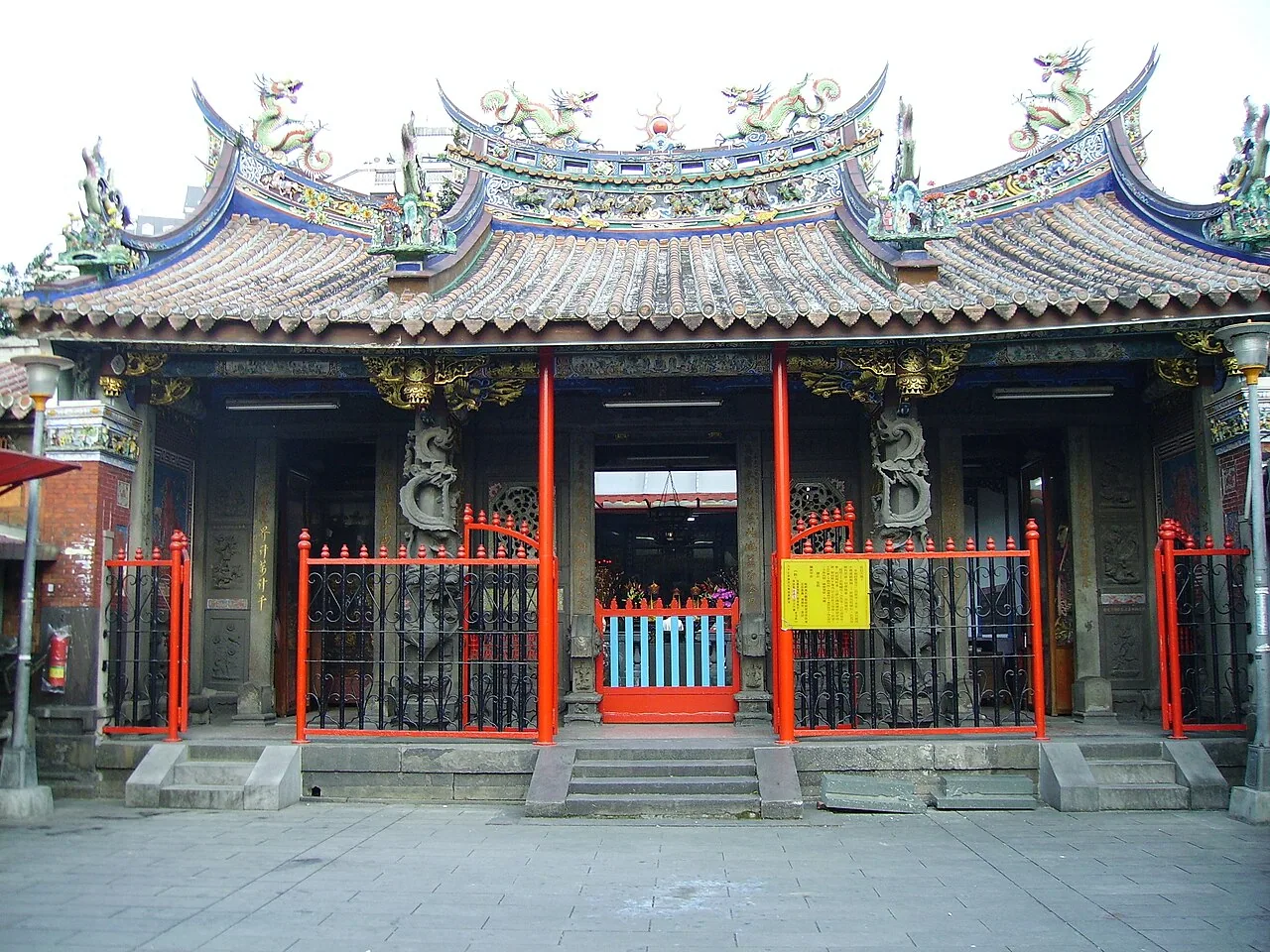
Bangka Qingshuiyan Zushi Temple. Photo: Wikimedia Commons contributor, CC BY-SA via Wikimedia.
The conventional account describes the Ding-Xia Jiao Conflict as a “classification armed conflict”: Minnan people from the same province but different counties fought over commercial interests. That is not wrong, but it reverses cause and effect. The true consequence of the Ding-Xia Jiao Conflict was not in Bangka, but in Dadaocheng.
The Tong’an people defeated in 1853 carried a deity statue and fled. Tong’an people from Bangka had already opened shops in Dadaocheng’s Middle Street in 1851, including Du family shops and Lin Youzao’s tea shop15, but what truly transformed Dadaocheng into a trading hub came after the armed conflict. In 1860, the Treaty of Tianjin came into effect, Tamsui became a treaty port, and the British merchant John Dodd came to Taiwan intending at first to establish a tea factory in Bangka. “But Bangka residents were exclusionary and conflict broke out, forcing Dodd to set up a tea factory instead in Dadaocheng, north of Bangka”16. At the same time, “because the Bangka harbor silted up with river sand, its functions were gradually replaced by Dadaocheng, where the Tong’an people had gathered”17. One side faced sedimentation, the other communal exclusion; after the 1860s, the center of northern Taiwan’s external trade shifted north and south.
In other words: the Tong’an people who lost the 1853 conflict did not disappear. They brought the statue of Xiahai City God, their networks, and their ability to do business in the streets all to Dadaocheng. In 1869, Formosa oolong tea was shipped from Tamsui Harbor to New York on its first vessel16. That was the beginning of Dadaocheng tea, and Bangka’s farewell to Taipei’s economic map.
📝 Curator’s note: Conventional Taipei history writes Bangka as a one-way decline: rising under Qing rule, falling under Japanese rule. But this narrative misses one verb: leaving. The Tong’an people in 1853 were not destroyed; they left. From a historical perspective, the verb “to leave” has more explanatory power than “rise” or “decline”: it created Dadaocheng. Northern Taiwan’s economic history after the 20th century is a juxtaposed history of “the winners stayed in place” plus “the losers rebuilt three kilometers away.” Bangka and Dadaocheng still have two entirely different atmospheres today. Eight hundred meters in a straight line contains 172 years.
From “First Tainan, Second Lukang, Third Bangka” to the District with the Oldest Average Age
After the 1860s, Bangka’s decline did not happen overnight.
In 1884, the 10th year of Guangxu, during the Sino-French War, French forces occupied Shiqiuling in Keelung. Bangka residents organized a volunteer corps with Longshan Temple as its command headquarters to resist the French, working with volunteer forces coming north from central Taiwan to repel the French at Tamsui. The Guangxu Emperor bestowed the plaque “Cihui Yuanyin,” meaning benevolent radiance reaching far4. This was the last time Bangka appeared in imperial historical records as a mobilizing entity, and the body that shouldered that mobilization was Longshan Temple, not Bangka’s street market itself.
In 1907, the Japanese colonial government began filling parts of the Tamsui River channel and improving the riverbanks, and the function of Bangka’s ferry landing essentially disappeared. The 1920 “urban improvement” widened streets and regulated building façades, transforming Bangka’s street houses from Qing-era Minnan shop styles into Japanese-period Taiwanese Baroque. Nos. 123-125 and 135-137 Guangzhou Street still preserve the arcades and red-brick façades of that period18. The same year, Bangka was renamed Wanhua7.
War came suddenly.
On May 31, 1945, the United States launched the largest air raid in Taipei’s history, known as the Taipei Air Raid. Bombers dropped incendiary bombs, and “Longshan Temple’s main hall and left corridor were destroyed by bombing”19. The entire main hall structure, the shrine inside, and the worship altar were destroyed. But one thing did not burn: “the main statue of Guanyin Bodhisattva, the principal deity, was not damaged”19. The Guanyin statue sat on its lotus throne amid the rubble of the main hall.
After the war, livelihoods were devastated, and Longshan Temple was not rebuilt to its original scale until 1955, the 44th year of the Republic20. In 1985, the Ministry of the Interior designated Longshan Temple a national Grade II historic site21, and on November 12, 2018, the Ministry of Culture upgraded it to a national monument22. This was a correction, delayed by 21 years, for a “direct-controlled-municipality-designated omission” left behind in the 1997 amendment to the Cultural Heritage Preservation Act.
But the streets beside the temple were not the temple, and they were not so fortunate.
After the war, in 1953, licensed brothels began legally operating on Bangka’s western side, around today’s Xiyuan Road and Wuzhou Street23. In 1972, the Taipei City Regulations for the Management of Prostitutes came into effect, concentrating licensed prostitution in Wanhua’s Baodou neighborhood, today’s Huaxi Street area23. At its peak, hundreds of tea rooms, elderly-men’s bars, and karaoke shops lined the streets. In September 1997, then Taipei mayor Chen Shui-bian announced the abolition of licensed prostitution: “Taipei City Council passed the abolition of the Taipei City Regulations for the Management of Prostitutes”23. The licensed prostitutes’ movement that year triggered Taiwan’s first collective protest by sex workers, with the Wenmeng Building protest movement centered in this area. On March 27, 1999, licensed prostitution briefly resumed for two years23, but after its formal abolition in 2001, this area’s tea-room culture transformed into “elderly-men’s bars” and “tea-table shops,” which still operate around Lane 212, Section 1, Xiyuan Road today24.
At the same time licensed prostitution was being abolished, another thing began to change: the population structure.
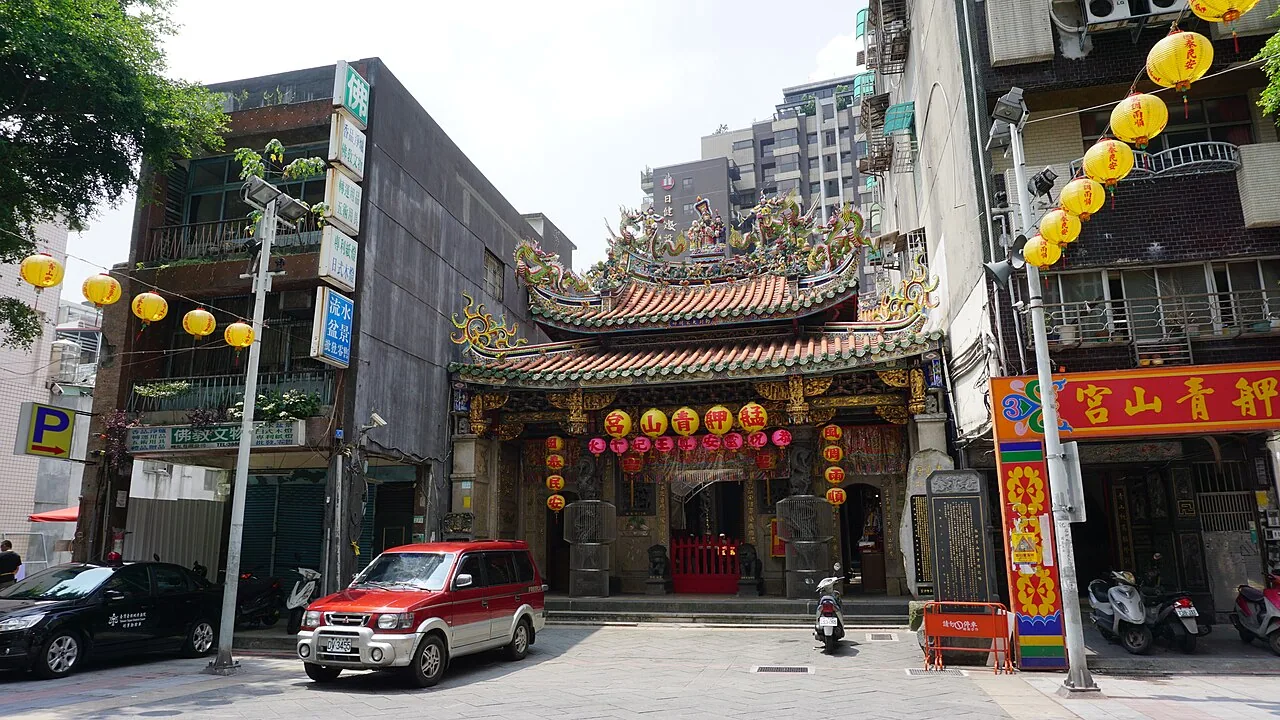
Bangka Qingshan Temple. Photo: Wikimedia Commons contributor, CC BY-SA via Wikimedia.
In April 2026, Wanhua District had a population of 167,815 people in 81,386 households6. At the end of 2025, its population structure looked like this: people aged 0 to 14 accounted for 8.24%, those aged 15 to 64 for 65.33%, and those aged 65 and above for 26.43%. The aging index was 320.78%, making it the administrative district with the highest degree of population aging in Taipei City6.
Compared with 2013, when Wanhua District had 172,692 people25, its population growth rate over the past decade was -10.3%. In other words, when you stand in Longshan Temple’s forecourt in 2026, the district’s total population has fallen by 5,000, while the proportion of people aged 65 and above has soared.
The older people who come to offer incense at six in the morning are not “atmosphere” in the eyes of tourists. They are the real population structure of Wanhua District made visible in the temple forecourt.
The Material Layer: Red Brick, Arcades, and the Walls of Bopiliao
If you want to see Bangka’s earliest material layer, go to Bopiliao.
The Bopiliao Historic Block is bounded as follows: “Laosong Elementary School to the north, Kunming Street to the east, Guangzhou Street to the south, and Kangding Road to the west”10. This block enclosed by four streets is the only historic district in Taipei’s urban area that simultaneously preserves the original appearance of street houses from the Qing, Japanese, and postwar periods. In 1988, Taipei City Government expropriated this land to expand Laosong Elementary School, and original residents moved out successively from 1988 to 199726. On December 9, 1997, the city government issued a notice that “compulsory demolition of surface structures was scheduled for May 1, 1998”26. But after intervention by cultural figures, the area was preserved: the eastern side was restored in 2006 and became the Taipei City Heritage and Culture Education Center, and the western side was completed and formally opened on June 19, 20091026.
Laosong Elementary School itself is a piece of history.
On May 21, 1896, the 29th year of Meiji, the “Second Affiliated School of the Taiwan Governor-General’s National Language School” was founded inside Bangka’s Xuehai Academy27, making it one of Taiwan’s earliest elementary schools under Japanese rule. In 1907, it was renamed “Bangka Public School” and moved to its current site by Lotus Pond. In 1920, its school buildings were remodeled into their present appearance. In September 1966, the school had 158 classes and 11,110 students, setting a world record for both class count and student enrollment27. At that time, Bangka was still one of Taipei’s most densely populated areas. Today, Laosong Elementary School has only 458 students left27.
Loop back to the temple.
Beside Longshan Temple is an exceedingly short lane called Herb Alley, at Lane 224, Xichang Street28. The earliest medicinal herb shops can be traced back more than a century. “During Bangka’s early reclamation period, disease was common; residents usually relied on orally transmitted folk remedies or medicine lots from Longshan Temple. People therefore went to nearby herb shops to buy herbs for treatment, and the street was also called ‘Life-Saving Street’”28. During the Japanese period, shopkeepers gathered medicinal herbs themselves; today Herb Alley’s supplies come from all across Taiwan, fresh from the north and sun-dried from the south28. In 2015, Taipei City Government listed Herb Alley’s historic building cluster as historic buildings28.
When you walk in, you smell a thick, strong scent of green herbs. Black nightshade, Spanish needle, hibiscus, gotu kola, plantain, mulberry, vervain, mugwort, Rhinacanthus, Taiwanese fig, and rows upon rows of herbs are tied into bundles and hung for sale. Today’s customers are mostly wellness-minded shoppers and foreign tourists, but 50 years ago the customers were real patients who came here to treat diarrhea, red eyes, or postpartum recovery.
On the other side of the temple forecourt is Qingshan Temple, built in 1856, the sixth year of Xianfeng29, one of Bangka’s three great temples, the other two being Longshan Temple and Zushi Temple. Qingshan Temple’s principal deity, “King Ling’an,” is said to have been the Three Kingdoms-period general Zhang Kun. Every year on the 20th and 21st days of the 10th lunar month, there are two consecutive nights of “secret patrols,” followed by the main procession on the 22nd. This is what Taipei people call the “Bangka Grand Worship”29. The secret patrol takes place because Qingshan Wang, in addition to warding off plague, is also responsible like a City God for judicial affairs in both the worlds of the living and the dead, and must bring his subordinates out at night to catch ghosts29. In 2010, Taipei City Government registered the “Bangka Qingshan Temple Secret Patrol and Procession” as a city-designated folk cultural asset29. Together with Dadaocheng Xiahai City God’s secret patrol and Xinzhuang Dizang’an’s secret patrol, it is known as one of the Taipei Basin’s three great secret patrols29.
Doze Niu’s Bangka vs. Local People’s Bangka
During the Lunar New Year season of 2010, director Doze Niu’s film Monga was released30.
The film is set in Bangka in 1986. The three major factions are controlled by Geta’s Temple Front, Masa’s Back-Wall House, and the mainlander-affiliated Gray Wolf30. Taipei audiences were suddenly told about a corner of Taipei they did not know at all: a place with a different timeline, a different power structure, and a different code of brotherhood. Many of the film’s locations were drawn from the Bopiliao Historic Block and Zushi Temple30, and the crew even booked the Shuiyuan Expressway to shoot motorcycle racing scenes30.
The box office was astonishing. Taiwan box office on the first day reached NT$18 million, and NT$60 million over the first three days of the opening week30, breaking the opening-week box office record for a domestic Taiwanese film. Its final Taiwan box office reached NT$260 million30. The Hollywood film in the same release window that year was Avatar, whose first-day box office was surpassed by Monga30.
But official reactions were very different. “Republic of China Minister of Education Wu Ching-ji believed the film would have extremely negative effects on adolescents’ minds and bodies; National Police Agency Director-General Wang Cho-chiun felt the film would have a major impact on public security”30. At the same time, local Bangka residents were divided in their reactions to the film: some thought it was a romanticized brotherhood narrative wrapped in a youth film, some felt it captured one real facet of 1986, and others believed it deepened Wanhua’s stereotypes by another layer.
📝 Curator’s note: For a place to be represented by a film is both a blessing and a burden. Doze Niu’s Monga made NT$260 million and pushed Wanhua back into the center of Taiwanese popular culture, but it also fixed the framing “Bangka = faction bosses = brothers” in public memory. In reality, Bangka in 1986 was a complex working-class, immigrant, commercial, and religious district; faction bosses were only a small part of it. But once a framing hardens, it shapes how later visitors look at the place, and even how local residents tell their own stories. When Taiwan.md writes about Bangka, it reminds itself: this district had already been there for 288 years before the film, and it will still be there after the film.
After the film ended, Bopiliao’s red-brick arcades and Zushi Temple’s bronze dragon columns remained where they were.
Places Locals Would Take You: Bangka Beyond the Temples
If you come to Bangka and only visit Longshan Temple, Bopiliao, and Huaxi Street Tourist Night Market, you are seeing the Bangka recommended by the tourism bureau.
Locals would recommend three more places.
The first is the herb rice cakes and herb tea in Herb Alley: the first shop as you enter, the century-old Sizhi Herb Shop, has a stove by the entrance simmering bitter herbal tea28. The second-generation owner might say to you, “You have diarrhea? This prescription, five qian.” You are not drinking a beverage; you are filling a Chinese medicine prescription.
The second is Liang Xi Hao on Guangzhou Street (founded in 1921, No. 245 Guangzhou Street) and Zhouji Meat Porridge (No. 104 Guangzhou Street)5. Liang Xi Hao’s signature dish is squid thick soup. The third-generation owner’s grandfather began cooking this pot of soup in 1921, and the recipe has been passed down for 103 years. The fourth generation is already learning it now.
The third is the tea-table shops on Section 1, Xiyuan Road24. Do not confuse them with elderly-men’s bars. Tea-table shops are pure teahouses, without female attendants sitting with customers. Older people come here to play chess, listen to the radio, and chat; one pot of tea can last an entire afternoon. This culture has almost vanished elsewhere in Taipei, and Xiyuan Road is one of the few remaining spaces where it still operates.
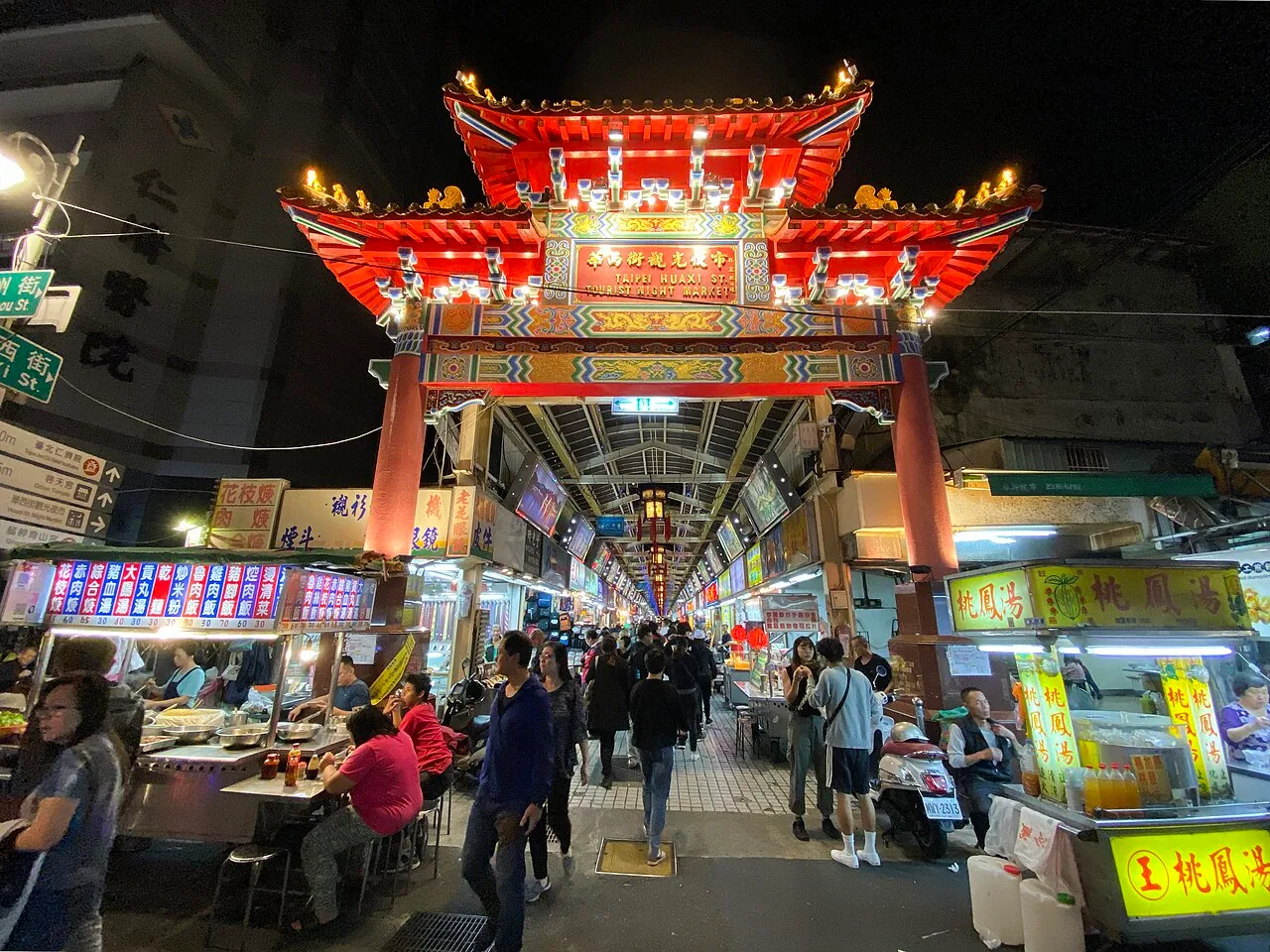
Huaxi Street Tourist Night Market. Photo: Wikimedia Commons contributor, CC BY-SA via Wikimedia.
As for Huaxi Street Tourist Night Market, the snake-shop signs are still there, but only two shops actually still sell snake soup31. Before the 1990s, Huaxi Street was one of the few night markets in Taipei where customers could see live snakes killed on the spot and gallbladders extracted, attracting large numbers of Japanese, Hong Kong, and Macau tourists. After 2000, animal protection awareness rose, and after the abolition of licensed prostitution the customer base changed. The entire night market transformed into one centered mainly on snacks, and snake shops gradually disappeared31. Today, when you go to Huaxi Street, you will see a typical Taiwanese tourist night market, but you will also see the signs that have held on for 40 years still hanging there. The typefaces and light tubes of the snake shops look more like historical remnants than business signs.
The Plaza in Front of Longshan Temple: A Shared Stage for Unhoused People, the Temple, and the Elderly
The last section I want to write is about Bangka Park, the square plaza directly across from Longshan Temple at the entrance to Guangzhou Street.
During the day, older people gather in the park to chat, play chess, exercise, and stretch32. They walk over from nearby lanes and alleys; most have lived in this district all their lives. After night falls, unhoused people use cardboard as mattresses and spend the night beside benches32. Taipei City Government planned to renovate the park in 2025, with reductions to the covered walkway expected to affect unhoused people’s movement routes.
A September 2024 survey collected 168 questionnaires, including 74 from members of the general public, 33 from nearby shops, and 94 from unhoused people. It showed that “as many as 60% of unhoused people said they were ‘unwilling’ to live in publicly run homeless shelters”, citing restrictions such as curfews, distance from workplaces, and couples not being allowed to stay together32. “Nearly 60% of shops supported a ‘nearby management’ strategy”32. In a 2024 interview, Wanhua District legislator Wu Pei-yi said she was coordinating with central government agencies to add a “chapter on unhoused people” to the Social Assistance Act32.
“Displacement has been proven ineffective.” This is another conclusion of the survey32.
Unhoused people, temple worshippers, and older people playing chess in the plaza share the same square space, and have shared it for at least 20 years. Tourists come and go; they remain there.
📝 Curator’s note: Wanhua’s narrative of “marginalization” is like a mirror. What it reflects is actually where Taipei’s other districts concentrate and dump the things they do not want. Social welfare resources, unhoused people’s placement, the tea rooms left after prostitution was abolished, the elderly population, low-income families: all of these are issues for Taipei City as a whole, but physically they are concentrated in Wanhua District. When 60% of unhoused people in Bangka Park refuse publicly run shelters, what they are really saying is, “the existing form of help does not suit me.” This plaza in front of a temple founded in 1738 now carries a role in 2026 that far exceeds the temple forecourt itself. It is Taipei City’s most honest exhibition space for the structure of social welfare.
Six in the Morning, He Worships from 1738 to 2026
Return to Longshan Temple at six in the morning.
The older person offering the first incense stick enters the Sanchuan Hall, crosses the threshold, and first worships Guanyin Bodhisattva. Guanyin Bodhisattva is the same deity whose spirit was divided from Anhai Longshan Temple in Jinjiang in 1738. On May 31, 1945, American bombing destroyed the entire main hall, but “the main statue of Guanyin Bodhisattva, the principal deity, was not damaged”: the same statue. In 1985, the Ministry of the Interior listed it as a Grade II historic site, and in 2018 the Ministry of Culture upgraded it to a national monument. The temple has gone through one renovation plan after another, but the statue in the center has not been replaced.
After the older person finishes worshipping and comes back out, he circles past the Purifying-Heart Waterfall and walks to Guangzhou Street outside the temple forecourt. A few hours later, tourists from around the world will flood in, Liang Xi Hao next door will set out today’s first pot of squid thick soup, and Bopiliao’s red-brick arcades will be used as film locations and wedding-photo backgrounds.
But at six in the morning, it has not reached that point yet.
Two hundred eighty-eight years ago, in that fifth lunar month of 1738, on the day the first group of Sanyi people finished building the temple, someone also offered incense at this spot4. On the day in 1853 when the Tong’an people carried Xiahai City God out of this street, they did not imagine as they left that they would build a new temple three kilometers away in Dadaocheng, much less that more than 100 years later Taipei would split into two cities: one being the Wanhua they left behind, the other the Dadaocheng where they settled15. In 1884, during the Sino-French War, this temple became the command post for volunteer troops and “received from the Guangxu Emperor the plaque ‘Cihui Yuanyin’”4. The Guanyin statue seated on its lotus throne in the rubble in 1945. The name “Wanhua District” officially replacing “Longshan District” and “Shuangyuan District” in 1990. Doze Niu’s film in 2010. The figure of 26.43% of the population aged 65 and above at the end of 2025.
All of these things happened in the same place. The spot that was there in 1738 is still that spot in 2026.
To outsiders, Wanhua is a tourist night market, the gray zone after prostitution was abolished, and a 2010 film. But the Bangka lived by Bangka people is a district older than the city itself. It predates Taipei Prefecture, predates Taipei City, predates the Republic of China, and today, at 288 years old, its first incense stick is still burning.
Further Reading:
- Taipei City — A basin-wide panorama across three moments: Longshan Temple in 1738, Dadaocheng in 1885, and Xinyi 101 in 2004
- Taiwanese Old-Street Culture and Commercial Districts — A historical map of 10+ old streets across Taiwan, from Qing-era ports to Japanese-period Baroque
- Taiwanese Religion and Temple Culture — The faith structure of 15,000 temples across the island, where Wangye, Mazu, Buddhism, and Daoism share the same roof
- Qing Rule Period — Taiwanese society, classification armed conflicts, and migration networks from 1683 to 1895
- Sino-French War — The 1884-1885 French incursion into northern Taiwan, the mobilization of volunteer troops at Bangka Longshan Temple, and the victory at Tamsui
- Dadaocheng — The commercial port opened by the defeated Tong’an people who fled from Bangka’s Bajiazhuang after the 1853 Ding-Xia Jiao Conflict, another timeline branching out from Bangka
- Ximending — A sibling in the same batch 1 historic-district series; the entertainment district planned by the Japanese west of Bangka in 1896, forming a Qing-era vs. Japanese-era contrast with Bangka’s main streets
- Dalongdong — The first refuge for the Tong'an people who retreated from Bangka's Bajiazhuang after losing the 1853 Ding-Xia Jiao Conflict; Baoan Temple became the defensive center, before they relocated again to Dadaocheng
- Shilin — The 1859 Zhang-Quan conflict and Bangka's 1853 Ding-Xia Jiao Conflict were two different armed clashes; together they form two ethnic-conflict landscapes in northern Taiwan under Qing rule
Image Sources
This article uses five CC BY-SA licensed Wikimedia Commons images, all cached in public/article-images/geography/ to avoid hotlinking source servers:
- File:Longshan Temple, Taipei 01.jpg — Front hall of Bangka Longshan Temple, photographed by Bernard Gagnon, CC BY-SA 3.0
- File:Bopiliao Historic Block 剝皮寮歷史街區.jpg — Red-brick arcade of the Bopiliao Historic Block, CC BY-SA
- File:Chin S Temple in Taipei.JPG — Bangka Qingshuiyan Zushi Temple, CC BY-SA
- File:2017-06-29 Bangka Qingshan Temple, Wanhua District, Taipei.jpg — Bangka Qingshan Temple, CC BY-SA
- File:Huaxi Street Tourist Night Market 2019.jpg — Huaxi Street Tourist Night Market, CC BY-SA
References
- Bangka Longshan Temple official website — Visitor Information — Longshan Temple opening hours are 6:00-22:00, open year-round. Daily morning and evening chanting is held at 6:00 a.m. and 3:45 p.m.; group chanting is also held at 8:00 a.m. Address: No. 211 Guangzhou Street, Wanhua District, Taipei City.↩
- Bangka Longshan Temple official website — Introduction to Longshan Temple — The main hall enshrines Guanyin Bodhisattva, whose divided spirit was brought to Taiwan in 1738 from Anhai Longshan Temple in Jinjiang County, Fujian Province. The rear hall enshrines Mazu, Wenchang Dijun, the Old Man Under the Moon, Zhusheng Niangniang, Guansheng Dijun, and other deities. It is a representative Taiwanese temple where “the unity of the three teachings is not philosophy but spatial arrangement.”↩
- Bangka Longshan Temple — Taiwan Religious Culture Map — Official page of the Ministry of the Interior religious cultural heritage database, recording Longshan Temple’s Guanyin Bodhisattva in the main hall, Mazu and Wenchang Dijun in the rear hall, and the Old Man Under the Moon, Zhusheng Niangniang, Guansheng Dijun, and more in the side halls, with seven or more deities belonging to the three systems of Buddhism, Daoism, and popular religion.↩
- Bangka Longshan Temple official website — Introduction to Longshan Temple (construction and history) — Official temple text: “People from the three counties therefore jointly funded the construction of Longshan Temple in the third year of Qianlong in the Qing dynasty (1738)”; “in the 10th year of Guangxu (1884), during the Sino-French War, French forces occupied Shiqiuling in Keelung, and local residents organized volunteer troops, using Longshan Temple to issue documents to government offices and help repel the French”; “received from the Guangxu Emperor the plaque ‘Cihui Yuanyin.’”↩23456
- Klook Blog — 2026 Wanhua Food Recommendations — Records founding years and locations of long-established Guangzhou Street eateries including Liang Xi Hao, founded in 1921, at No. 245 Guangzhou Street, known for century-old traditional squid thick soup; Zhouji Meat Porridge at No. 104 Guangzhou Street; and Longdu Ice Dessert Parlor, founded in 1920.↩2
- Wanhua District — Wikipedia — Wikipedia text: “Population (April 2026) (81,386 households) • Total 167,815 people”; “At the end of 2025, among Wanhua District’s total population, people aged 0 to 14 accounted for approximately 8.24%, those aged 15 to 64 for approximately 65.33%, and those aged 65 and above for approximately 26.43%; the aging index was approximately 320.78%, making it the administrative district with the highest degree of population aging in Taipei City.”↩234
- Bangka — Wikipedia — Research on the origin of the Ketagalan and Atayal sounds Bangka / Bnkaʔ for “dugout canoe,” and records of the 1920 Japanese-period renaming to “Wanhua.” Original text: “During the Japanese period in Taiwan, because the Taiwanese pronunciation of ‘Bangka’ resembled the Japanese pronunciation ‘Manka’ of ‘万華〔萬華〕’ in Buddhist scriptures, ‘Bangka’ was therefore changed by the Japanese to ‘Wanhua.’”↩23
- Wanhua District — Wikipedia (administrative history) — Official record that “in 1990, Longshan and Shuangyuan districts (except Xia’an Village), together with parts of Guting and Chengzhong districts, were merged to establish Wanhua District”; in 1920, the ninth year of Taishō, the “urban improvement,” Taipei Prefecture, and Taipei City were established at the same time, and Bangka was officially renamed “Wanhua.”↩
- Chen Lai Zhang — Wikipedia + The reclamation permit of the Chen Lai Zhang enterprise — National Museum of Taiwan History — In 1709, the 48th year of Kangxi, Chen Fengchun, Lai Yonghe, Chen Tianzhang, Chen Xianbo, and Dai Tianshu formed a joint-share enterprise named “Chen Lai Zhang” and applied to Zhuluo County to reclaim Dajiala. The permit’s territory covered most of the Taipei Basin, from today’s southern Wanhua to Yuanshan and from Bali to Xinzhuang.↩2
- Bopiliao — Wikipedia — Research on four theories for the Bopiliao place name, including peeling fir bark, peeling animal hides, Fupiliao, and phonetic transformation from Beipiliao; “in the 28th year of Qianlong (1763), the name ‘Beipiliao Street’ already appeared in Bangka land deeds”; block boundaries “Laosong Elementary School to the north, Kunming Street to the east, Guangzhou Street to the south, and Kangding Road to the west”; records that the western side’s restoration was completed and formally opened on June 19, 2009.↩2345678
- First Tainan, Second Lukang, Third Bangka — Wikipedia — Research on the origin of the Qing-era Taiwanese Hokkien saying “First Tainan, Second Lukang, Third Bangka,” describing the ranking of the three great commercial ports of Qing Taiwan from the mid-18th century, during the Qianlong and Jiaqing reigns: first Tainan Prefectural City, second Lukang in Changhua, third Bangka in Taipei’s Wanhua.↩
- A Bangka Brawl a Century Ago: Faction Incidents in History — Digital Archives and e-Learning National Science and Technology Program portal — Official National Science Council digital archives material recording the historical distribution of Bangka’s three major ancestral-origin groups, Sanyi, Tong’an, and Anxi, and their corresponding centers of faith: Longshan Temple, Xiahai City God, and Qingshui Zushi Temple.↩
- Ding-Xia Jiao Conflict — Wikipedia — Wikipedia text: “occurred in Bangka in 1853 (the third year of Xianfeng in the Qing dynasty)”; “One side in the armed conflict was the Quanzhou Jiao and North Jiao, known as the Upper Jiao, mainly composed of people from Jinjiang, Nan’an, and Hui’an counties under Quanzhou Prefecture; the other was the Lower Jiao or Xia Jiao, mainly composed of people from Tong’an County under Quanzhou Prefecture”; “the Tong’an people who fled in defeat had no choice but to abandon their territory at the Bangka wharf; led by Tong’an elder Lin Youzao, they fled to Dadaocheng and opened a new commercial port”; “while pressing their forceful attack, the Sanyi people also burned down all of the Tong’an people’s houses.”↩234
- Bangka Qingshuiyan — Wikipedia — Detailed historical records of Bangka Qingshui Zushi Temple: founded in 1787, the 52nd year of Qianlong; in the 1853 Ding-Xia Jiao Conflict, the Sanyi people borrowed the route through Zushi Temple to attack the Tong’an people; Anxi leader Bai Longfa raised 25,000 silver dollars from Anxi migrants; and in 1867, the sixth year of Tongzhi, Zushi Temple was rebuilt.↩2
- Dadaocheng Xiahai City God Temple — Wikipedia — “After the Ding-Xia Jiao Conflict in the third year of Xianfeng (1853), the defeated Tong’an people temporarily enshrined the Xiahai City God statue at the Jintongli pastry shop in Dadaocheng operated by Chen Haoran, son of Chen Jinrong”; “in the sixth year of Xianfeng (1856), residents of Dadaocheng Street jointly donated funds to build Xiahai City God Temple on South Street”; “the temple was completed on the 18th day of the third lunar month in the ninth year of Xianfeng (1859).”↩23
- Dadaocheng — Tamsui Wiki — Historical records that after Tamsui opened as a port in 1860, British merchant John Dodd came to Taiwan originally intending to set up a tea factory in Bangka, but because Bangka residents were exclusionary he was forced to move to Dadaocheng; and that in 1869 the first shipment of Formosa oolong tea was sent from Tamsui to New York.↩2
- Bangka — Wikipedia (decline section) — Wikipedia text stating that “after the 1860s, because the Bangka harbor silted up with river sand, its functions were gradually replaced by Dadaocheng, where the Tong’an people had gathered,” recording two structural factors in Bangka’s shift from Qing-era flourishing to Japanese-era decline: sedimentation and resident exclusion.↩
- Wanhua District / Guangzhou Street — Wikipedia — Guangzhou Street previously used names including Shuyuanbian Street, Yuyingtangbian Street, and Longshan Temple Street, and was officially named Guangzhou Street in 1947; materials on Japanese-period red-brick street-house façades and arcade architecture preserved to the present at Nos. 135-137 and 123-125 Guangzhou Street.↩
- Bangka Longshan Temple — Tamsui Wiki / 1945 air raid section — Original text: “On May 31, 1945, the United States launched the largest air raid on Taipei; the main hall and left corridor of Bangka Longshan Temple were destroyed by bombing”; “the main statue of Guanyin Bodhisattva, the principal deity, was not damaged, and this has been passed down to the present as a cherished story among believers.”↩2
- Bangka Longshan Temple — Taiwan Religious Culture Map — Ministry of the Interior “Taiwan Religious Scenes” page recording that Longshan Temple was rebuilt after World War II in the 44th year of the Republic (1955): “because livelihoods after the war were devastated, it was not rebuilt to its original scale until the 44th year of the Republic (1955).”↩
- Bangka Longshan Temple official website — Historic-site grading history — Official temple text: “In the 74th year of the Republic, the Ministry of the Interior announced Bangka Longshan Temple as a Grade II historic site,” the 74th year of the Republic being August 19, 1985.↩
- Ministry of Culture — press release on Bangka Longshan Temple’s upgrade to national monument + National Cultural Heritage Database — Bangka Longshan Temple — On November 12, 2018, the Ministry of Culture announced that Bangka Longshan Temple and Dalongdong Bao’an Temple were upgraded to national monuments, correcting the omission of six direct-controlled-municipality-designated historic sites that were not upgraded at the same time after the 1997 amendment to the Cultural Heritage Preservation Act.↩
- Defending the Right to Survival to the Death: The Abolition of Licensed Prostitution in Taipei City (1997.09-1999.03) — National Museum of Taiwan History, Women in Taiwan — Official historical records that in September 1997, then Taipei mayor Chen Shui-bian announced the abolition of licensed prostitution; on July 30, Taipei City Council passed the abolition of the Taipei City Regulations for the Management of Prostitutes; on March 27, 1999, licensed prostitution briefly resumed for two years; and in 1972 licensed prostitution was concentrated in Wanhua’s Baodou neighborhood, the Huaxi Street area.↩234
- Wanhua Tea-Room Culture Old Street (Xiyuan Road) — Taipei Travel — Taipei City Department of Information and Tourism introduction to the century-old tea-room culture around Lane 212, Section 1, Xiyuan Road, including tea-table shops and elderly-men’s bars, and the historical context and current status of its postwar transformation from a red-light district into tea-room culture.↩2
- Wanhua District (Taipei City) 2023 Population Structure — BPM — Statistical records that Wanhua District had a population of 172,692 people and 78,358 households in 2023, with a population growth rate of -10.3% over the past ten years.↩
- Bopiliao Historic Block — Department of Cultural Affairs, Taipei City Government — Official Department of Cultural Affairs introduction to the Bopiliao Historic Block, recording the complete timeline: expropriation from 1988 onward for the expansion of Laosong Elementary School, the December 9, 1997 city government announcement of compulsory demolition of surface structures in May 1998, preservation after intervention by cultural figures, and the June 19, 2009 completion and formal opening of the western side’s restoration.↩23
- Taipei Municipal Laosong Elementary School, Wanhua District — Wikipedia — Full history: founded on May 21, 1896, the 29th year of Meiji; in September 1966, the school had 158 classes and 11,110 students, setting a world record; today the once ten-thousand-student elementary school has declined to 458 students.↩23
- Herb Alley (Taiwan) — Wikipedia — Historical background of Herb Alley at Lane 224, Xichang Street: “During Bangka’s early reclamation period, disease was common; residents usually relied on orally transmitted folk remedies or medicine lots from Longshan Temple. People therefore went to nearby herb shops to buy herbs for treatment, and the street was also called ‘Life-Saving Street’”; in 2015, Taipei City Government listed the Herb Alley historic building cluster as historic buildings.↩2345
- Bangka Qingshan Temple Secret Patrol and Procession — Taiwan Religious Culture Map — Ministry of the Interior official page on religious cultural assets recording Bangka Qingshan Temple, built in 1856; its secret patrol and procession, the “Bangka Grand Worship,” on the 20th to 22nd days of the 10th lunar month; its 2010 registration by Taipei City Government as a folk cultural asset; and its status, together with Dadaocheng Xiahai City God and Xinzhuang Dizang’an, as one of the Taipei Basin’s three great secret patrols.↩2345
- Monga (film) — Wikipedia — Box office information for Doze Niu’s 2010 Lunar New Year film Monga, including NT$18 million on the first day, NT$60 million in the first week, and final Taiwan box office of NT$260 million; filming locations including Bopiliao, Zushi Temple, and the Shuiyuan Expressway; and official reactions, including criticism from Minister of Education Wu Ching-ji and National Police Agency Director-General Wang Cho-chiun.↩2345678
- Snake Alley (Taipei) — Wikipedia — The English Wikipedia entry on Huaxi Street, or Snake Alley, records the full transformation process of Huaxi Street Tourist Night Market, from the snake-shop boom of the 1990s to the rise of animal protection after 2000, the shift in customers after licensed prostitution was abolished, and the market’s transformation into one centered mainly on snacks.↩2
- “Urban Coexistence 1-3” Bangka Park Renovation: Phased Construction and Reduced Walkways Affect Unhoused People; More Than Half of Users Actually “Have Homes” — Right Plus, September 4, 2024 — Full report on a September 2024 civic group survey with 168 questionnaires, including 94 from unhoused people, 74 from the general public, and 33 from nearby shops, on views of the Bangka Park renovation. It records reasons why 60% of unhoused people refused publicly run shelters, that 60% of shops supported a “nearby management” strategy, and legislator Wu Pei-yi’s push to add a chapter on unhoused people to the Social Assistance Act.↩23456