
In 1949, at No. 325 Zhongshan Road beside the Chiayi Fountain roundabout, Lin Tien-shou sliced a piece of chicken, laid it over white rice, and poured braising sauce on top1. What he used at the time was broiler chicken. In those years, Taiwanese people ate chicken only during festivals and holidays; chicken rice was a luxury1.
After the war, the U.S. military stationed in Taiwan moved into Chiayi’s Shuishang Air Base and brought large numbers of turkeys to Taiwan. Because the birds were larger and the cost was comparable, the Lin family later replaced chicken with turkey, and “Fountain Chicken Rice” evolved into today’s “turkey rice”1. The rice beneath that bowl was “Penglai rice,” first tested by Iso Eikichi at Zhuzihu on Yangmingshan in 19252. The braising sauce poured over it belonged to Taiwan’s soy sauce genealogy: Minnan migrants brought sauce-brewing techniques in the Qing period; before Japanese rule, “inyu,” brewed locally in Taiwan from black soybeans, was the mainstream; after 1895, Japanese people introduced yellow-soybean soy sauce, and the two traditions have remained intertwined to this day3. With one spoonful of rice, you are eating rice from the Japanese colonial period, meat brought by the postwar U.S. military, and Qing-era Minnan sauce-brewing craft, all sharing the same stage across generations.
More than seventy years later, the Agriculture and Food Agency held a vote for “Taiwan’s Ten Signature Rice Dishes,” and this bowl of Fountain Chicken Rice took first place4. No one sees the word “mixed-race” in this bowl, but every spoonful is exactly that.
30-second overview: Taiwanese food is not a cuisine; it is the process by which an island cooks outside foods into its own way of eating. In 1925, Iso Eikichi tested Penglai rice at Zhuzihu; in 1949, Lin Tien-shou opened the first chicken rice shop in Chiayi; after the war, the U.S. military stationed in Taiwan brought turkeys into Chiayi’s Shuishang Township; in 1949, 1.21 million mainland Chinese migrants brought the eight great Chinese cuisines; U.S. aid flour left soy milk and youtiao under Yonghe Bridge; in 1986, Chun Shui Tang added tapioca pearls to milk tea. Today, the 2025 Michelin Guide includes 419 restaurants in Taiwan, of which 144 are street-food establishments5. No dish is purely Taiwanese, and every dish is Taiwanese to the core.
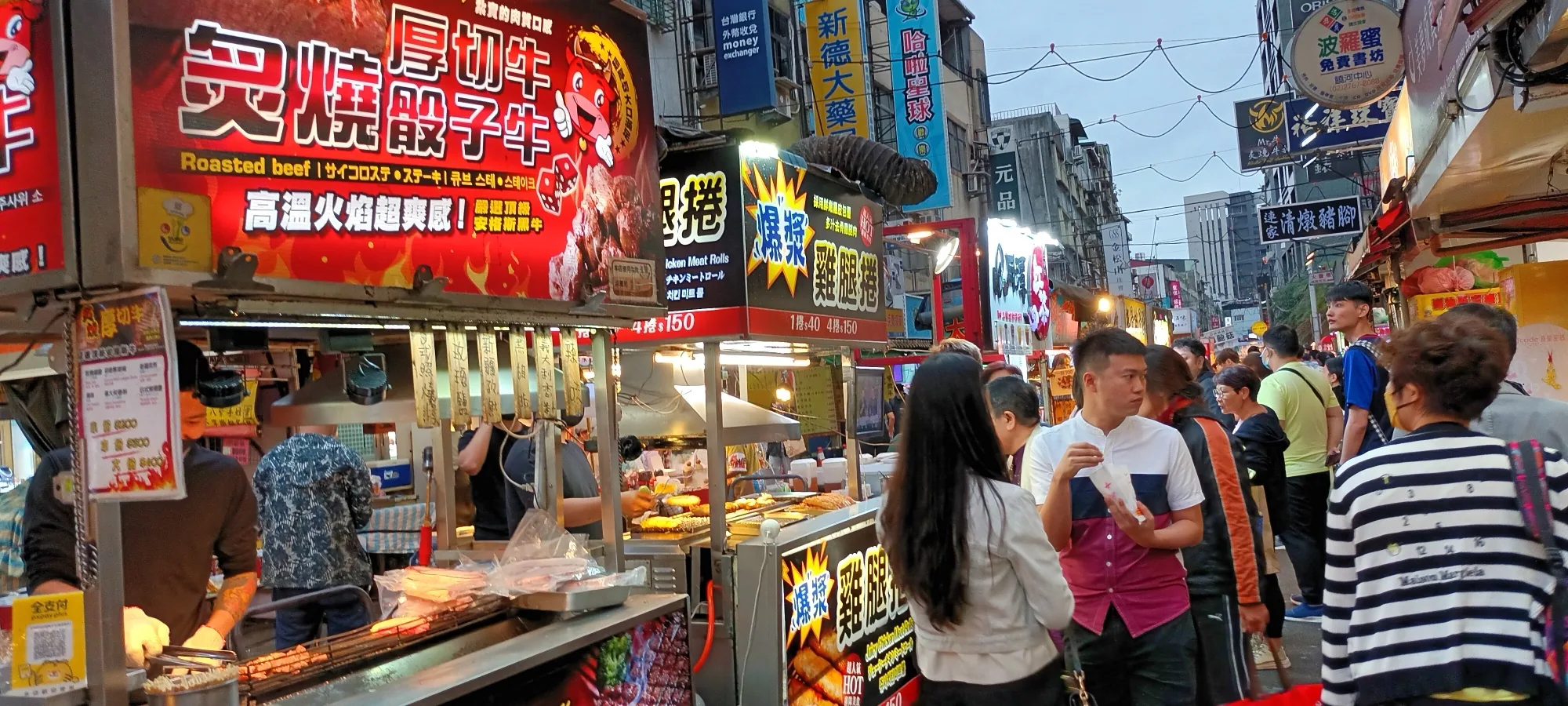
Night at Raohe Street Tourist Night Market, the most representative “night” scene of Taiwanese food. Photo: KClinla, 2023, CC BY-SA 4.0 via Wikimedia Commons.
Mountains, Oceans, and Family Migrations: Three Foundational Layers from Indigenous Peoples, Minnan, and Hakka
To see the base layer of Taiwanese food, one has to look back to an era when no passport existed on the island.
The deepest layer is Indigenous. Each of the sixteen officially recognized peoples has its own way of eating, but what they share is “in place”: where the mountains are, where the sea is, and which foods belong to which season. The Amis call themselves “the people who eat grass,” with more than two hundred edible wild vegetables; their “ten-heart vegetable” dish uses the tender stems of seven plants: rattan heart, pandanus heart, betel nut palm heart, silvergrass heart, shell ginger heart, sugarcane heart, and coconut heart6. The Paiwan dish “cinavu” wraps millet and pork in shell ginger leaves and false physalis leaves; it is festival food. They also developed “slate-grilled meat,” using the even heat of schist slabs to grill wild boar7. In summer, the Puyuma drink binaleng, a sour-spicy soup made by fermenting wild cherry tomatoes with bamboo shoots8. The Atayal spice maqaw, or mountain pepper, looks like black peppercorns after drying and combines the aromas of black pepper, ginger, and lemon. In 2018, the Michelin Guide included it among “five Taiwanese Indigenous ingredients you should know”9.
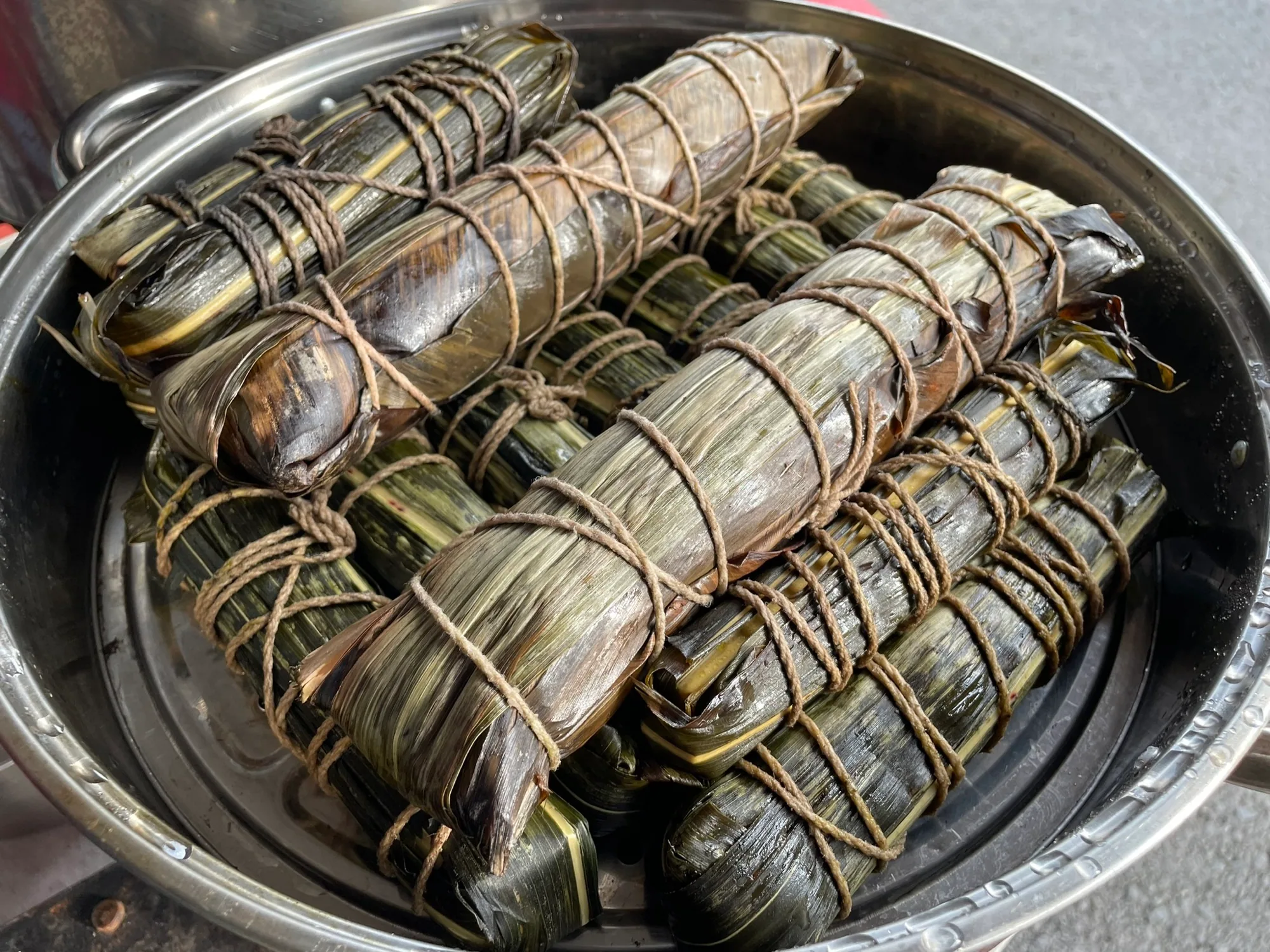
Cinavu is festival food among the Paiwan, Rukai, and Puyuma, sealing memories of mountain and sea inside shell ginger leaves. Photo: Sin-siōng, 2024, CC BY-SA 4.0 via Wikimedia Commons.
Above that layer are Minnan and Hakka people who crossed the sea from Fujian and Guangdong during the Qing period.
Minnan people brought the foodways of coastal harbors: oysters were cultivated in the intertidal zones of the west coast and turned into oyster omelets and oyster vermicelli. They also brought soy sauce, which would later reappear again and again on every bowl of lu rou fan, minced pork rice, braised pork rice, chicken rice, and braised egg in a bento10. The term “lu rou fan” appeared officially only after the war: Minnan-language dictionaries from the Qing and Japanese colonial periods contain only “lu rou” (pork braised in soy sauce), not “lu rou fan.” Researchers infer that the dish was a product of poverty in the early postwar period: people who could not afford whole cuts of pork asked butchers for scraps, fat, and pork skin, chopped them up, braised them in soy sauce, and poured them over white rice11. As it moved between north and south, it also changed names: in the north it is called lu rou fan; in the south, rou zao fan. A whole slab of pork belly served with rice is called kong rou fan in the north, and the Ministry of Education’s standard written form is “kang rou fan”12.
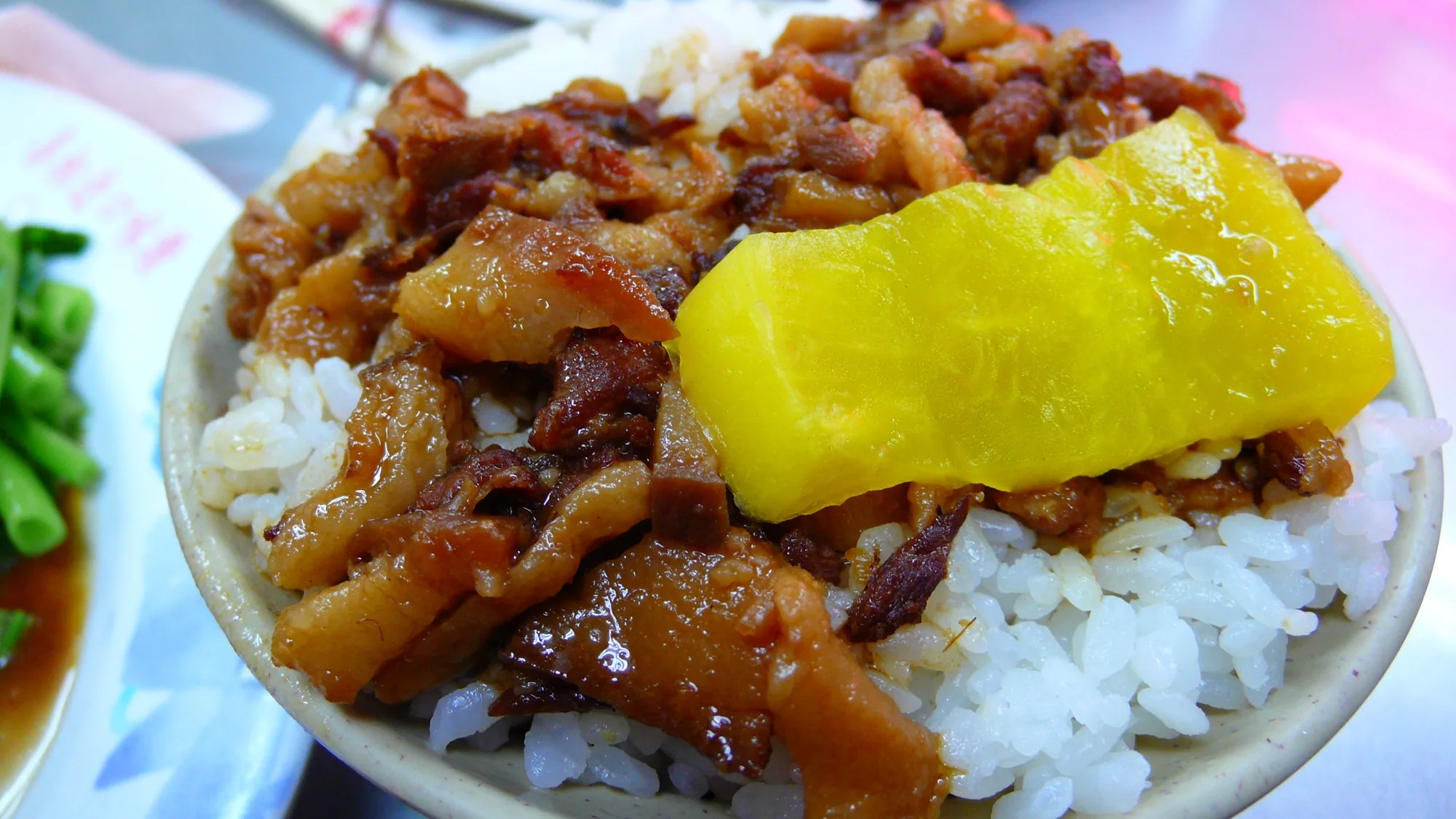
Lu rou fan: beyond bento shops, schools, and offices, the greatest common denominator of Taiwanese meals. Photo: udono, 2007, CC BY 2.0 via Wikimedia Commons.
Hakka people lived in hills and mountains, and along migration routes they had to rely on salt to preserve food. Their cuisine is summarized as “fatty, salty, aromatic”: “fatty” resists hunger, “salty” goes with rice, and “aromatic” stimulates appetite13. Among the traditional “four stews and four stir-fries,” “Hakka stir-fry” was originally called “stir-fried meat”: shredded pork belly, dried squid, celery, scallions, and chili are flash-fried over high heat. The word “Hakka” in the name was given by Minnan people or other groups outside the Hakka community14. “Stir-fried pork intestines with shredded ginger” uses large quantities of pork intestines; pork offal was an important source of nutrients for early Hakka people15. “Lei cha,” also known as “three-raw soup” (raw tea, raw ginger, raw rice), was brought to Taiwan after World War II by Hakka migrants from Hepo in Jiexi, Guangdong. During material shortages in the early Republican period, Hakka people even used lei cha as a substitute staple for infants whose mothers lacked breast milk16.
📝 Curator’s Note
Jiao Tong, the food writer who turned Taiwanese flavors into a trilogy, once said: “Sichuan does not have Sichuan-style beef noodles, Mongolia does not have Mongolian barbecue, Fuzhou does not have Fuzhou noodles ... This is a homeland memory assembled, reconstructed, and misplaced.17” The remark was originally about the nostalgia of mainland Chinese migrants after 1949, but seen in reverse, it is also the meta-rule at the base of Taiwanese food: every group brings its own memories; the island’s ingredients and climate recalibrate them once; and in the end they become “Taiwanese flavor.” The pickled mustard greens Hakka people brought are not quite the same as those in Guangdong; the soy sauce Minnan people brought is not quite the same as soy sauce in Fujian. Geography is not scenery. Geography turns back and changes food.
The fifty years of Japanese rule (1895-1945) added a layer of refinement over this foundation. In 1865, the Scottish merchant John Dodd had already introduced oolong tea seedlings from Anxi, Fujian, to Tamsui, Sanxia, and Daxi. In 1869, under the “Formosa Oolong” brand, he shipped 213,000 catties of tea to New York, where it achieved major success. Tea was Taiwan’s first food with an international brand18. During Japanese rule, Japanese agronomists improved local rice. In 1925, Iso Eikichi and Suenaga Hitoshi chose Zhuzihu on Yangmingshan for its cool climate and bred new rice varieties there. In 1926, at the “Greater Japan Rice Grains Association” meeting at the Taipei Railway Hotel, Governor-General Izawa Takio formally named the “Nakamura variety” Penglai rice19. The white rice in your bowl today is almost all descended from this lineage. Japanese people also introduced sukiyaki, miso, katsuobushi, sake, and yoshoku restaurants, serving dishes such as tonkatsu, omurice, and curry rice that flowed outward from Ginza’s Rengatei; all of these would later become part of “old Taiwanese flavor”20.
The 1.21 Million People of 1949 Later Used Taiwanese Soybeans to Make Sichuan Chili Bean Paste
In 1949, the Nationalist government relocated to Taiwan, bringing large numbers of soldiers and civilians from many Chinese provinces. In a 2015 interview, Jiao Tong gave the figure as “1.21 million migrants from Chinese provinces poured in, bringing the eight great cuisines of Chinese cooking”21.
These 1.21 million people moved into military dependents’ villages, their woks facing unfamiliar island ingredients. In their memories there was Sichuan numbing spice, Hunan heat, Shandong noodles, Jiangsu-Zhejiang sweetness, and Cantonese clarity, but the island had no fava beans, the body of Sichuan chili bean paste; no hard northern wheat; and no Shanghai-style salted pork.
So they rewrote those dishes.
The most famous example is “Sichuan-style beef noodles.” They did not actually come from Sichuan. Food writer Wang Hao-yi says that “Taiwan’s first bowl of Sichuan-style beef noodles was in Kaohsiung.” After the government relocated to Taiwan, Sichuanese veterans stationed in Gangshan, Kaohsiung, seasoned chili bean paste according to the tastes of home and added it to beef soup, creating the classic flavor of Sichuan-style beef noodles. Most dependents had followed them from Sichuan, and Sichuanese military-village cooks used Taiwanese soybeans to replace the fava beans in Pixian chili bean paste22. In the mid-1950s, braised beef noodles spread to northern Taiwan, and more than a dozen “Sichuan-style” braised beef noodle shops gathered on Taoyuan Street in Taipei. The so-called “Sichuan style” actually originated in Taiwan; Sichuanese people cannot find this bowl of noodles in Chengdu.
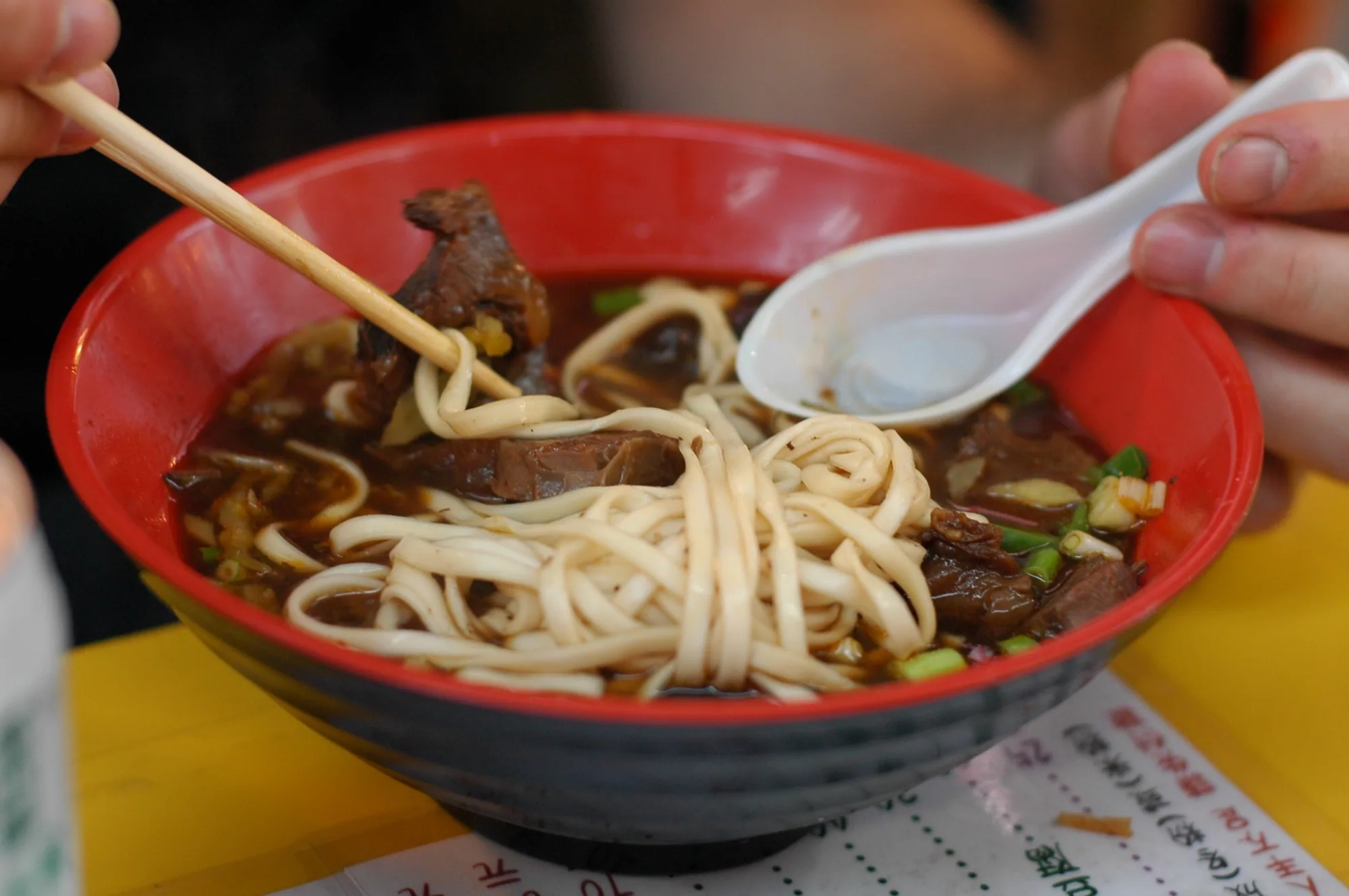
Beef noodles: the marriage certificate of military-village Sichuan chili bean paste and Taiwanese noodles. Photo: Jpatokal, 2007, CC BY-SA 4.0 via Wikimedia Commons.
Mainland Chinese military dependents’ villages also gave Taiwan xiaolongbao, shaobing with youtiao, and northern steamed buns. In 1958, Shanxi migrant Yang Bing-yi opened “Din Tai Fung Oil Shop” on Linyi Street near Taipei’s Dongmen; at the time it only sold cooking oil23. In 1972, Tang Yongchang, owner of the Shanghai restaurant Fuxingyuan, suggested subleasing part of the storefront to sell xiaolongbao and thousand-layer cakes. In 1974, Din Tai Fung formally transformed into a restaurant. In 1995, Yang Bing-yi retired and his son Yang Ji-hua took over, standardizing xiaolongbao production and developing the “eighteen-fold” technique. Yang Ji-hua once said: “A media reporter once asked me exactly how many folds seal a xiaolongbao. I answered eighteen. From then on, that number became our xiaolongbao’s public secret.24” In 1996, Din Tai Fung opened its first overseas branch at Takashimaya in Shinjuku, Tokyo, sparking a xiaolongbao boom in Japan. Today it has more than 160 overseas locations, and CNN ranked it the “world’s second-best chain restaurant”25.
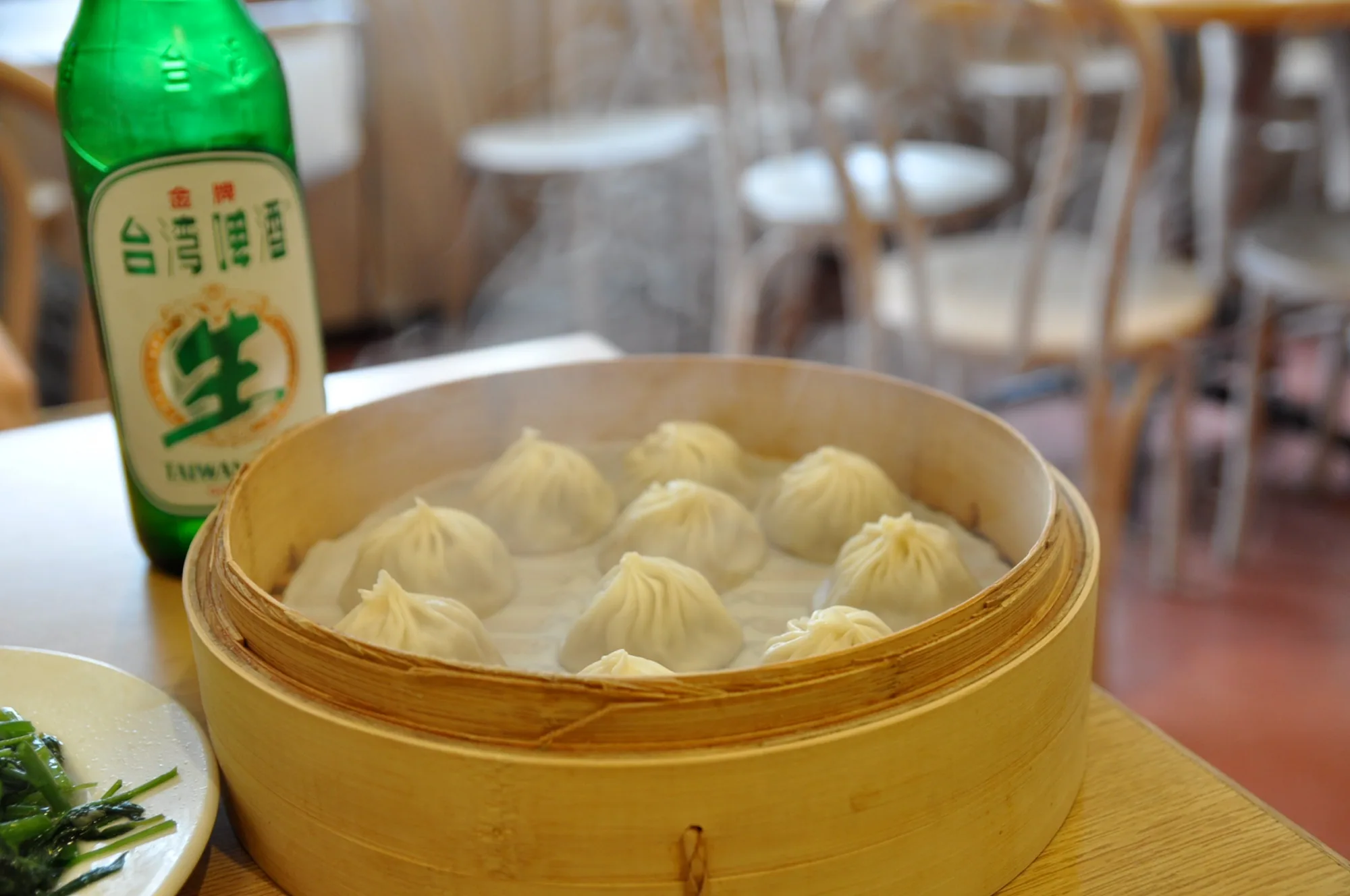
Din Tai Fung: turning Jiangsu-Zhejiang snacks into a Michelin brand, then exporting Taiwan from Xinyi Road to 16 countries. Photo: Banzai Hiroaki, 2009, CC BY 2.0 via Wikimedia Commons.
Jiao Tong also said something that pins this layer of narrative in place: “They became the ‘hometown dishes’ spoken of by mainlanders back then, but what they ate was not necessarily the flavor of their original hometowns; nevertheless, fermented by homesickness, they became the nostalgic taste of collective memory.26”
This is a precise description of the post-1949 mainlander context. It does not apply to Indigenous food or to the earlier Minnan and Hakka foundations; those are earlier narratives. But for the layer of military-village cuisine, “nostalgia” is the core motive, and “misplacement” is the inevitable result.
The Consequences of U.S. Aid Flour: Soy Milk Under Yonghe Bridge and the Shaobing Revolution
Beginning in the 1950s, another outside force changed the way Taiwanese people ate: U.S. aid.
The essence of U.S. aid was structural dietary transformation, far beyond simple grain relief. The government at the time imported wheat at low prices, had flour mills grind it into flour, and then exchanged it for edible rice for export to earn foreign currency27. Miao Yuxiu, from Shandong, advised the Minister of Economic Affairs to switch U.S. aid to wheat; he later founded Lien Hwa Flour Mill and earned the title “Father of Flour.” The Food Bureau even recruited students from National Taiwan Normal University’s Department of Home Economics to hold “noodle cooking demonstrations,” showing more than forty ways to prepare noodles. This was a state-level movement to “replace rice with noodles”28.
U.S. aid also brought large quantities of soybeans. Soybeans became soy milk, tofu, and the main raw material for soy sauce. This was the chemical starting point of Taiwanese breakfast.
In 1955, under Zhongzheng Bridge on the Yonghe side in New Taipei, several soy milk stalls formed a “soy milk king” cluster. At the time, Zhongzheng Bridge was undergoing repeated construction work. Workers ate soy milk before starting their shifts and shared it after the work was done, helping soy milk shops become popular29. Later, “Yonghe soy milk” became a generic term; almost every 24-hour Chinese breakfast shop has used this signboard at some point.
💡 Did You Know?
Global Views Monthly puts the rise of wheat-based foods in postwar Taiwan very clearly: “The postwar popularity of wheat foods in Taiwan was related not only to the arrival of people from Shandong and other northern Chinese provinces, where wheat foods were originally staples, but also inseparable from the large quantities of wheat allocated to Taiwan through postwar U.S. aid.30” In other words, two forces sit on the Taiwanese breakfast table: the nostalgia of military-village veterans, plus American flour. The set of soy milk, youtiao, and shaobing is the product of the two variables “mainlander” and “U.S. aid.”
By the 1980s, “Western-style chain breakfast shops” such as Mei & Mei, Ju Lin, Ruilin, and Good Morning Beach City began expanding. Lin Kun-yen opened a shop on Bade Road in Taipei, selling Western-style breakfasts that were cheap and novel: egg crepes, sandwiches, burgers, and milk tea31. Today Taiwan has about 18,000 breakfast shops, the highest density in the world; Western-style chain breakfast shops have surpassed 10,000 locations, with annual output value around NT$200 billion, more than convenience stores32. Good Morning Beach City has about 1,400 branches across Taiwan; Ruilin Mei & Mei reached 2,800 franchised locations in 2004; Ju Lin Mei & Mei surpassed 1,100 franchises in 199233.
Convenience stores also joined this race. 7-Eleven began officially selling tea eggs in 1987, and the price of NT$10 per egg remained unchanged for decades34. In 1997, the same year President Chain Store Corporation listed its shares, Hsu Chung-jen added “onigiri” and “oden” items. Together with tea eggs, these later became the “three sacred food items” of Taiwanese convenience stores35.
An Accidental Cup at Chun Shui Tang in 1986: After Tapioca Pearls Fell Into Milk Tea
If one had to choose a single moment to represent “Taiwan cooking outside foods into its own,” it would be an afternoon in 1986 at Chun Shui Tang on Siwei Street in Taichung.
There are two versions of the story. Chun Shui Tang claims that in 1986, inside Liu Han-chieh’s teahouse, store manager Lin Hsiu-hui added tapioca pearls to milk tea and accidentally invented bubble tea. Hanlin Tea Room claims that after Tu Tsong-he opened his shop in Tainan in 1986, he saw tapioca pearls being sold at Yamuliao Market and tried adding them to milk tea; because the cooked pearls were “white and translucent,” resembling pearls, he named the drink “pearl milk tea”36. The two shops fought a ten-year lawsuit over “who invented it first.” The court ultimately held that, because of the passage of time and because bubble tea is a new type of beverage rather than a patented product, any shop could make it. The court did not confirm either side as the true inventor37.
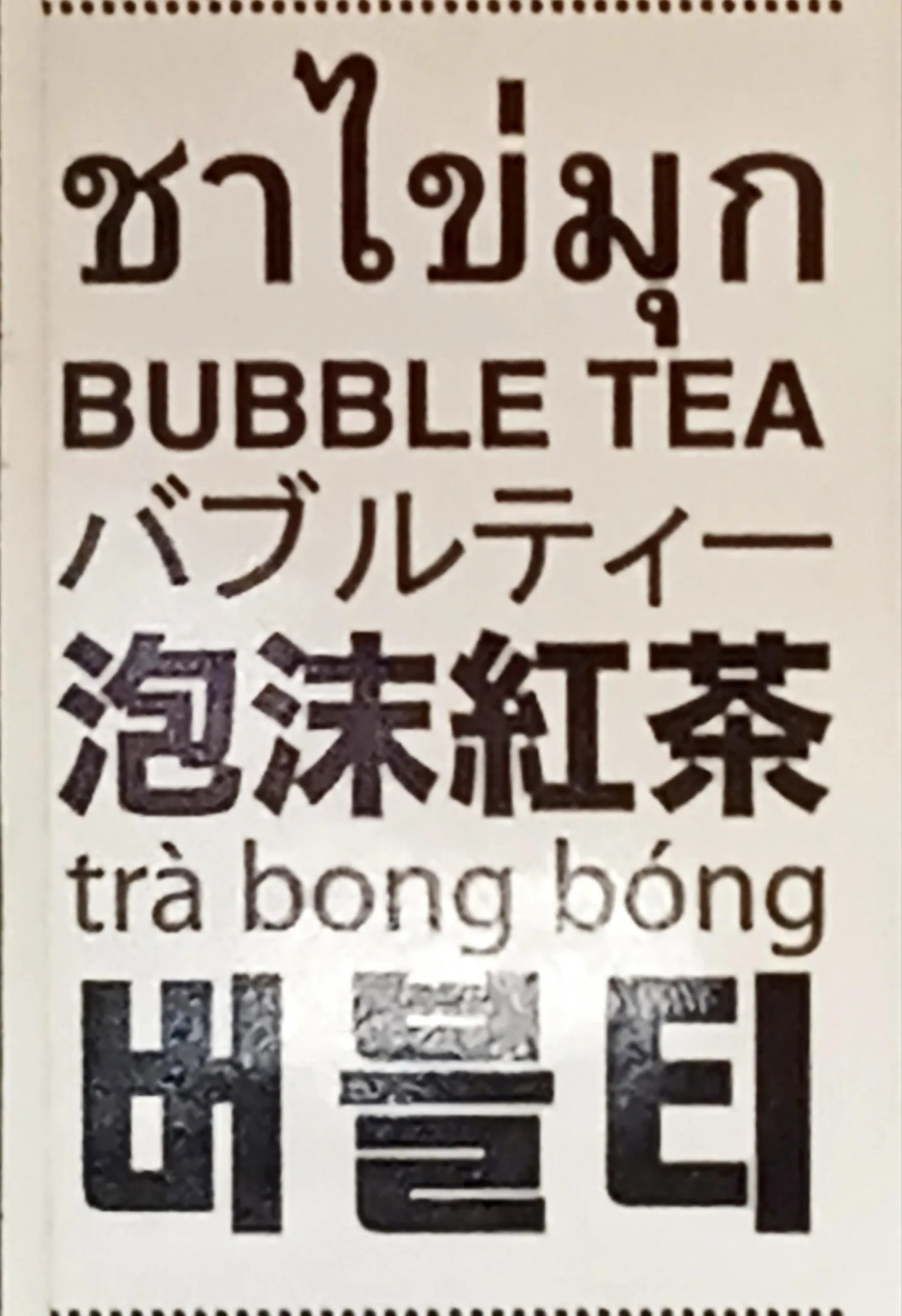
Bubble tea: invented by Taichung’s Chun Shui Tang in 1986, and by the 2020s Taiwan’s strongest soft-power export. Photo: Hippietrail, 2019, CC0 (Public Domain) via Wikimedia Commons.
This dispute has lasted so long that it makes people forget the central fact: neither of the drink’s two core elements is “native to Taiwan.” Tea comes from Minnan, Indian, and British colonial tea-drinking traditions; the “starch” in tapioca pearls is cassava starch, whose place of origin is Brazil. But after these two things met in Taichung in 1986, they produced a beverage no one in the world had seen before.
CNN and National Geographic have both listed the drink as one of Taiwan’s most representative cultural exports38. International Bubble Tea Day is April 30, launched in 2018 by the U.S. brand Kung Fu Tea, which was founded in New York in 2010 by three entrepreneurs from Taiwan39. Today Taiwanese people drink 1.02 billion cups of hand-shaken tea drinks each year, 44 cups per capita, generating NT$50 billion in revenue; the global bubble tea industry is projected to reach US$4.3 billion, about NT$129 billion, by 202740. Taiwanese tea drink shops have spread to more than 40 countries and 300 cities worldwide, with 50 Lan, Gong Cha, Chun Shui Tang, CoCo, and Milksha opening one by one in New York, London, Johannesburg, Sydney, Seoul, Shanghai, Singapore, Manila, Kuala Lumpur, and Bangkok41.
✦ “This was the first time Taiwan conquered the world through ‘invention’ rather than ‘copying.’”
The Ministry of Foreign Affairs calls hand-shaken drinks a “diplomatic tool”42. Compared with semiconductors and chips, bubble tea may be the first gateway through which more people come to know Taiwan.
Night Markets and Bando: Two Ways Taiwanese People Gather to Eat
Taiwanese people have two typical scenes for gathering to eat: one is the night market, and the other is bando, the Taiwanese roadside banquet.
The night market is the freest space of ordinary life. Taiwan has more than 300 night markets. In a 2025 poll, Shilin, Fengjia, Garden, Raohe, Liuhe, Ningxia, Yizhong Street, Ruifeng, Shida, and Luodong ranked as the top ten by popularity43. Most night market histories connect to the Japanese colonial period: Ningxia Night Market originated from the Japanese-era roundabout, and after the roundabout was redeveloped, vendors moved to Ningxia Road, where many stalls have operated for more than fifty years; Liuhe Night Market originated in the early 1950s and once won the title of “Taiwan’s most charming night market”; Raohe Night Market was Taiwan’s second tourist night market after Huaxi Street; the site of Taipei’s Nanjichang Night Market was converted from a Japanese Army training ground44.
The three great representatives of the night market are beef noodles, oyster omelet, and salty crispy chicken. Oyster omelet has multiple origin stories: brought by Minnan fishermen, invented to stave off hunger during Zheng Zhilong’s naval battles, or used as military provisions when Koxinga recovered Taiwan. It flourished in Taiwan because the island is surrounded by sea and its oyster-farming industry prospered45. Salty crispy chicken has two origin camps: one says it began with “Taiwan’s First Salty Crispy Chicken” in Taipei’s Ximending in 1975, although that name actually belonged to a seasoning powder wholesaler; the other says it began in 1979 with “Youai Salty Crispy Chicken” at the intersection of Ximen Road and Youai Street in Tainan, which cut large pieces of American-style fried chicken into small chunks, skewered and fried them, sprinkled them with pepper salt, and added the distinctive aroma of fried Thai basil46. Ba-wan, or Taiwanese meatballs, first appeared as disaster-relief food invented by Fan Wanju of Beidou, Changhua, during the 1898 Wuxu flood: he soaked sweet potatoes, kneaded them into balls, added cauliflower, and cooked them for disaster victims47. Later, the second generation improved the dish by deep-frying it and adding bamboo shoots to make it savory; the third generation made the skin from sweet potato starch and indica rice slurry and filled it with lean pork, establishing the final form of Beidou ba-wan. North of Changhua, deep-frying is dominant; in the south, steaming in bamboo steamers is dominant. This is the origin of “steamed in the south, fried in the north”48.
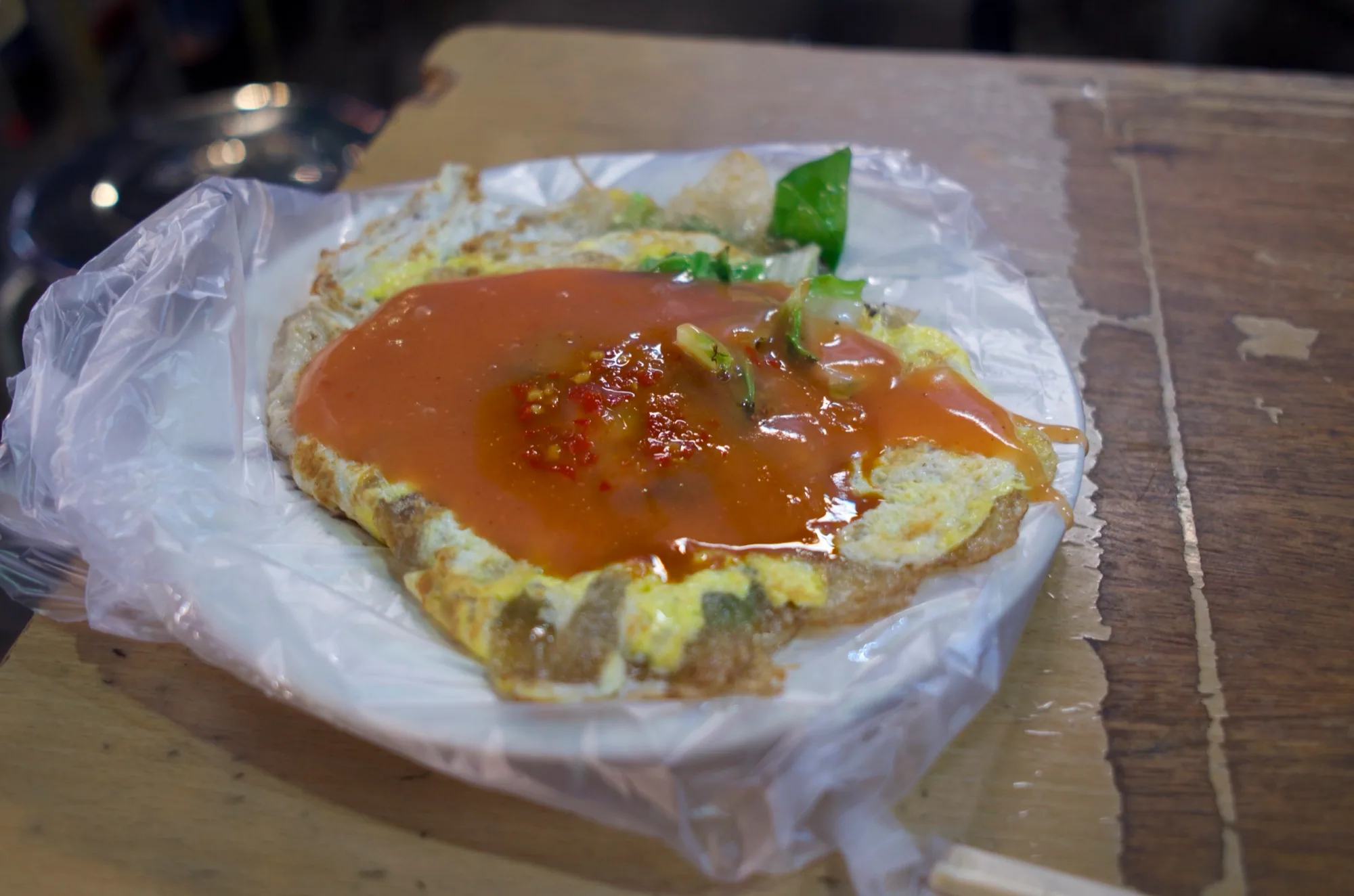
Oyster omelet: one of the three great night-market representatives, alongside beef noodles and salty crispy chicken; every stall’s sweet-chili sauce is the vendor’s code. Photo: Morgan Calliope, 2015, CC BY 2.0 via Wikimedia Commons.
On another side of the night market are the Indigenous stalls at Keelung’s Miaokou Night Market, where wild boar and millet wine walk from mountain communities into the urban night. This is also a feature of Taiwan’s night markets: you may think they are spaces of “ordinary Han people,” but on closer inspection, Indigenous, Hakka, and new immigrant stalls are all inside.
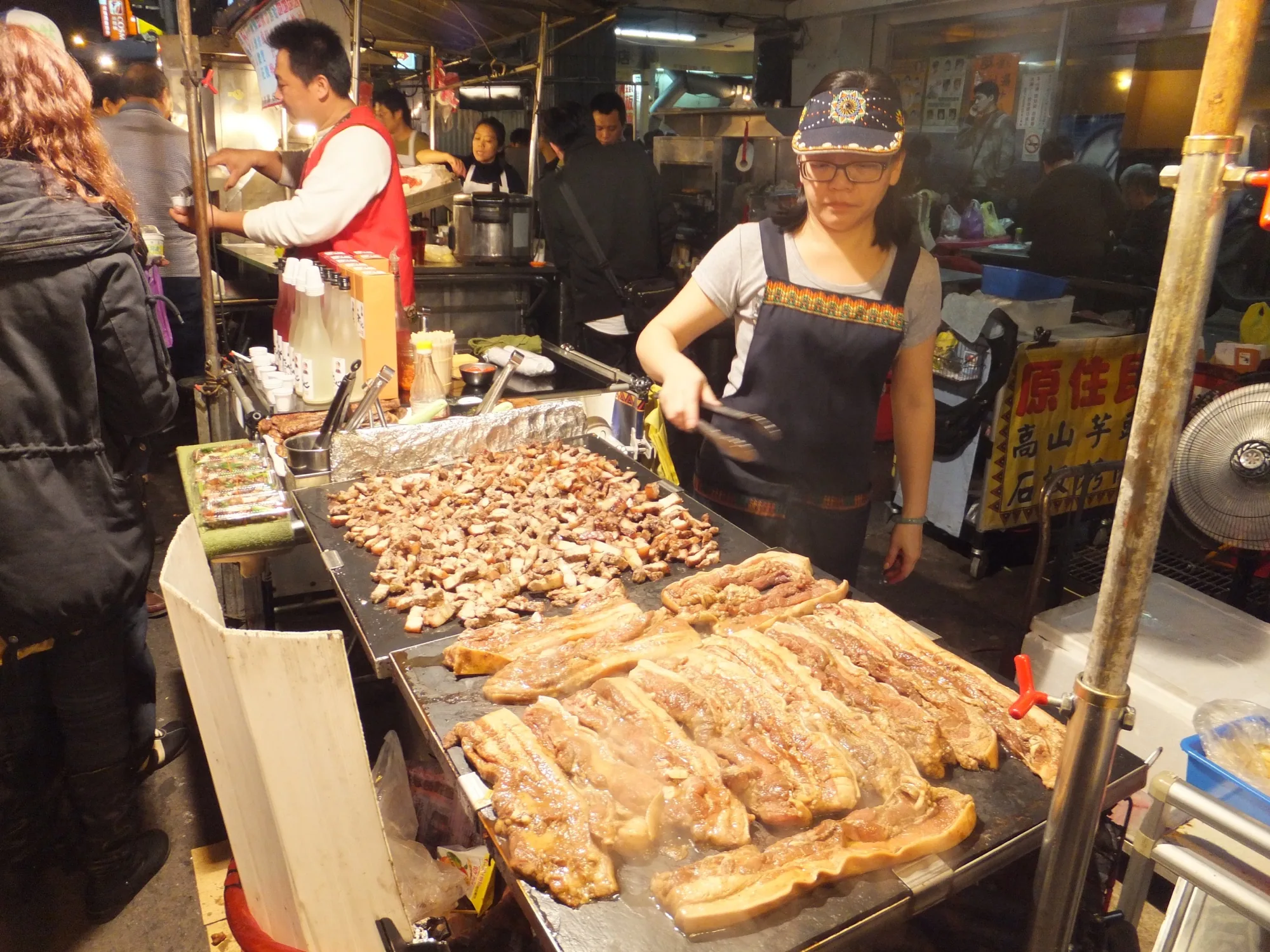
An Indigenous stall at Miaokou Night Market: wild boar and millet wine walking from the community into the urban night. Photo: 玄史生, 2012, CC BY-SA 3.0 via Wikimedia Commons.
At the other extreme from the night market is bando.
Bando is Taiwan’s outdoor catering culture, held for weddings and celebrations, temple festivals, funerals, birthdays, and longevity banquets. National-treasure chief banquet chef Lin Ming-tsan, nicknamed “Master A-tsan,” began following his father Lin Tien-sheng to cater bando in Nangang, Taipei, at age 12, working 28 days a month, three to four events a day. He formally took over at age 40. With more than forty years of experience, he has catered at least 20,000 bando banquets. He was once invited to prepare a birthday banquet for the king of Thailand and served as consultant for the 2013 film Zone Pro Site49. His father Lin Tien-sheng was called the “founding master” and “living dictionary of Taiwanese bando,” and was the only chief banquet chef in Taiwan to have prepared a “heavenly emperor banquet,” an eight-hour feast offered to the Jade Emperor.
The historical curve of bando is very clear. Master A-tsan said: “Bando was at its peak in Republic Year 65 (1976), and in the early 80s (1991) the custom began to decline and shrink”50. Low birth rates, hotels, and wedding banquet halls each took one quarter of the market; bando now remains at only one quarter of its former scale. The pandemic in 2020 made things worse. Master A-tsan told The Reporter: “The number of outdoor catering banquet tables has shrunk by at least 90 percent from Lunar New Year until now. 921 hurt outdoor catering a little; SARS hurt more than half; this year’s pandemic may turn bando into a declining industry. We worry not only about this year, but even more that people will get used to not inviting bando.51”
He also explained why old-style dishes are disappearing: “First, they are labor-intensive; second, tastes change from generation to generation. Older chefs started from the basics, doing everything themselves from slaughtering pigs and chickens to making pudding and cake for dessert. Now there are outsourced suppliers and frozen foods, and apprentice chefs can’t learn much.52”
A bando table usually serves “twelve dishes.” The drama title Song of the Twelve Bowls comes from the old Taiwanese sung narrative The New Song of the Twelve Bowls, whose original story is about a woman carefully arranging a “bando feast” to entertain her beloved; each dish carries an allusion to human feeling, righteousness, ritual, or propriety. Master A-tsan said that “in Chinese astronomy and calendars, the number 12 is used throughout, and 12 also represents an auspicious number”53.
📝 Curator’s Note
Master A-tsan actually left behind a more central definition: “Modern people imagine bando as an occasion where everyone gathers to eat. But the meaning of bando should be a gathering for life rituals or seasonal observances.54” This sentence can be applied to the core tension of all Taiwanese food. The dishes can be borrowed, mixed, or only have appeared in 1949, but “why we eat together” has always belonged to this island. Weddings and funerals, deities’ birthdays, ancestors’ death anniversaries, election rallies, temple festivals, harvests, the start of work: Taiwanese people gather around tables according to their own ritual logic. Food here is only the medium.
Michelin Arrived in 2018: Of 419 Restaurants, 144 Are Street Stalls
On March 14, 2018, the Michelin Guide entered Taiwan, marking Taiwan’s formal entry into the international evaluation system for dining.
By the eighth edition of the guide in 2025, Michelin had included 419 restaurants: 3 three-star restaurants, 7 two-star restaurants, 43 one-star restaurants, 144 Bib Gourmand selections, and 7 Green Stars for sustainable restaurants55.
All three three-star restaurants have retained the distinction for multiple consecutive years: Le Palais in Taipei, serving Cantonese cuisine; Taïrroir in Taipei, serving modern Taiwanese cuisine; and JL Studio in Taichung, serving Singaporean and modern cuisine. Le Palais has held three stars for eight consecutive years since the first Taiwan guide in 2018, Taiwan’s longest-running three-star record. But there is a turn: Le Palais’s former chef Chan Wai-Keung, born in Macau in 1970, left Le Palais in 2024 and went to Kaohsiung to create a new Cantonese restaurant, Gen56. A restaurant with eight consecutive years of three stars saw its central figure go elsewhere; this is precisely the fragility of top-tier dining.
RAW, by André Chiang, has closed. Chiang announced that RAW would cease operations on December 31, 2024, a farewell on its tenth anniversary57. After the 2018 spotlight, Taiwan’s fine dining has passed through another decade of decisions of its own.
But the most noteworthy part of the Michelin Guide is actually the Bib Gourmand category, which specifically recognizes “good food at moderate prices.” Tainan alone had 31 Bib Gourmand restaurants in 2024, many of them famous local snack shops58. This means Michelin has recognized Taiwan’s popular taste: a roadside bowl of NT$70 beef soup can stand on equal footing with a Michelin-starred kitchen. CNN directly called Tainan “Taiwan’s food capital”59.
📊 Michelin Taiwan 2025 Data
| Indicator | 2024 | 2025 |
|---|---|---|
| Total selections | 343 | 419 |
| Three stars | 3 | 3 |
| Two stars | 5 | 7 |
| One star | 41 | 43 |
| Bib Gourmand | 126 | 144 |
| Green Stars (sustainability) | 6 | 7 |
Another dimension of fine dining is tea. Taiwan’s high-mountain tea has traveled from teahouses onto the tea lists of Michelin restaurants. Alishan, Lishan, Shanlinxi, and Taimali high-mountain teas grow on mist-wreathed slopes above 1,000 meters, from Tsou communities to the rims of cups in top restaurants. John Dodd’s act of introducing oolong seedlings from Fujian to Tamsui in 1865 is still shaping Taiwan’s map of taste 160 years later.
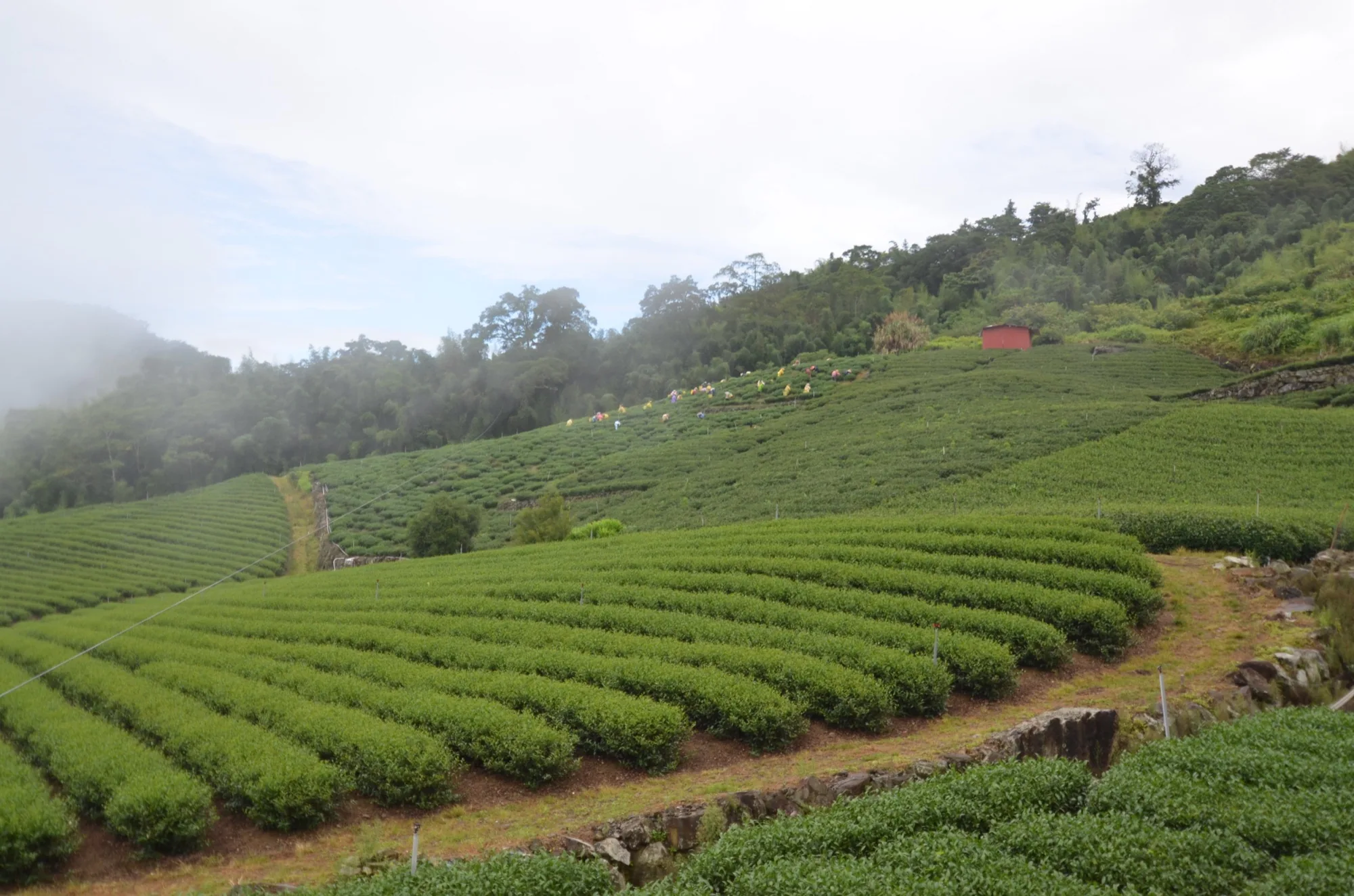
Alishan high-mountain tea: from Tsou communities to the tea lists of Michelin-starred restaurants, grown out of mist above 1,000 meters. Photo: Hughon-zxl, 2011, CC BY-SA 3.0 via Wikimedia Commons.
The Next Mouth: New Immigrants, Sustainability, Delivery, and the World’s Third-Largest Vegan Population Share
If Indigenous, Minnan-Hakka, mainlander, and U.S. aid influences are the four foundational layers of Taiwanese flavor, then the fifth layer is now underway.
The new immigrant population surpassed 1.87 million in 2025, and Southeast Asian cuisines are forming a new foodscape in Taiwan. According to 2022 Ministry of Education statistics, foreign students in Taiwan included 18,755 from Vietnam, 16,426 from Indonesia, 12,510 from Malaysia, and 2,831 from Thailand60. The fall of South Vietnam in 1975 and Taiwan’s severing of relations with Thailand indirectly helped produce Taipei’s first Southeast Asian street in Gongguan in the late 1970s. At the time, there was already a private kitchen in the lanes around Roosevelt Road Section 4, run by a couple who had worked at the Vietnamese embassy and served pho61. Today, “Little Manila” on Zhongshan North Road Section 3 in Taipei, Huaxin Street or “Burma Street” in Zhonghe, New Taipei, the Southeast Asian restaurant district on Zhongyang West Road in Zhongli, Taoyuan, and the area around Taichung First Square are invisible world maps.
Vegan and vegetarian food offer another number that surprises the world. Taiwan’s vegetarian population share is about 14%, roughly 3.2 million people, third in the world after India and Mexico. Taiwan has nearly 5,000 vegetarian restaurants, with more than 600 each in Taipei and New Taipei alone and more than 500 in Kaohsiung62. In 2017, CNN listed Taiwan among “the world’s ten most vegetarian-friendly cities”63.
Sustainable dining is also sprouting. The 2025 Michelin Green Stars went to seven restaurants: Tu Pang, newly awarded; Thomas Chien; Mountain and Sea House; EMBERS; Yangming Spring; Little Tree Food; and Hosu. What they share is attention to ethics and environmental protection, cooperation with sustainable suppliers and producers, waste reduction, and avoidance of plastic and other unrecyclable materials64. On April 19, 2022, the Legislative Yuan passed the Food and Agricultural Education Act on its third reading: government agencies, state-run enterprises, administrative corporations, and schools should give priority to locally produced agricultural products65. This is the state legally binding “what we eat” to “the land.”
Food delivery platforms are the least visible transformation. foodpanda Taiwan’s 2025 GMV was about US$1.8 billion, with a 79.6% market share; Uber Eats had 60.8%. At the end of December 2024, the Fair Trade Commission blocked Uber Eats’ acquisition of foodpanda Taiwan, which would have produced a combined market share above 90%. Grab later acquired foodpanda Taiwan for US$600 million, nearly 40% less than Uber’s offer66. A smartphone screen has reorganized the act of “eating.” The instant one opens an app, Taiwanese people’s relationship to food is already different from that of Master A-tsan’s generation.
⚠️ Controversial Viewpoint: Taiwanese food narratives rarely discuss laborers. Taiwan’s distant-water fishing industry occupies a hegemonic position globally, but the exploitation of fishers is an important source of profit. Most workers on vessels are foreign migrant workers hired “offshore,” and Taiwan’s government has consistently refused to let them be covered by the Labor Standards Act67. Every milkfish, mahi-mahi, or slice of tuna we eat has an invisible supply chain behind it. Food is cultural soft power, but the supply chain is a real political issue.
Nor should we forget how three food-safety incidents in the 2010s punctured Taiwanese society’s trust in food:
2011 Plasticizer Incident — The Department of Health’s Food and Drug Administration detected abnormal signals while testing probiotic powder, uncovering that Yu Shen Chemical Company had illegally added the plasticizer DEHP to clouding agents. Yu Shen had added plasticizer for more than 15 years, selling a total of 102 metric tons of clouding agents and flavoring sauces to 17 downstream companies. The Supreme Court sentenced Yu Shen’s responsible persons to 15 and 12 years in prison68.
2013 Tatung Chang Chi Adulterated Oil Incident — The incident broke on October 16, 2013. Tatung Chang Chi mixed low-cost sunflower oil and cottonseed oil into olive oil and added copper chlorophyllin for color. On July 24, 2014, company head Kao Chen-li was sentenced to 12 years in prison69.
2014 Gutter Oil (Chang Guann) Incident — Chang Guann produced “Chuan Tung Fragrant Lard Oil” using 33% inferior oil and 67% lard, a 1:2 ratio. The scandal affected major companies including Chimei Foods, Sheng Hsiang Jen, 85°C, Ve Wong, Wei Chuan, and Black Bridge. On July 24, 2015, the Pingtung District Court sentenced chairman Yeh Wen-hsiang and Tai Chi-chuan to 20 years each and fined them NT$50 million70.
After these three incidents, Taiwanese people’s demand for “local,” “small farmer friendly,” and “food and agricultural education” rose. Sustainable dining, the Food and Agricultural Education Act, and Michelin Green Stars are all compensatory collective memories after plasticizer, gutter oil, and copper chlorophyllin, emerging from Taiwanese society’s reverse effort to repair its collapsed trust in food.
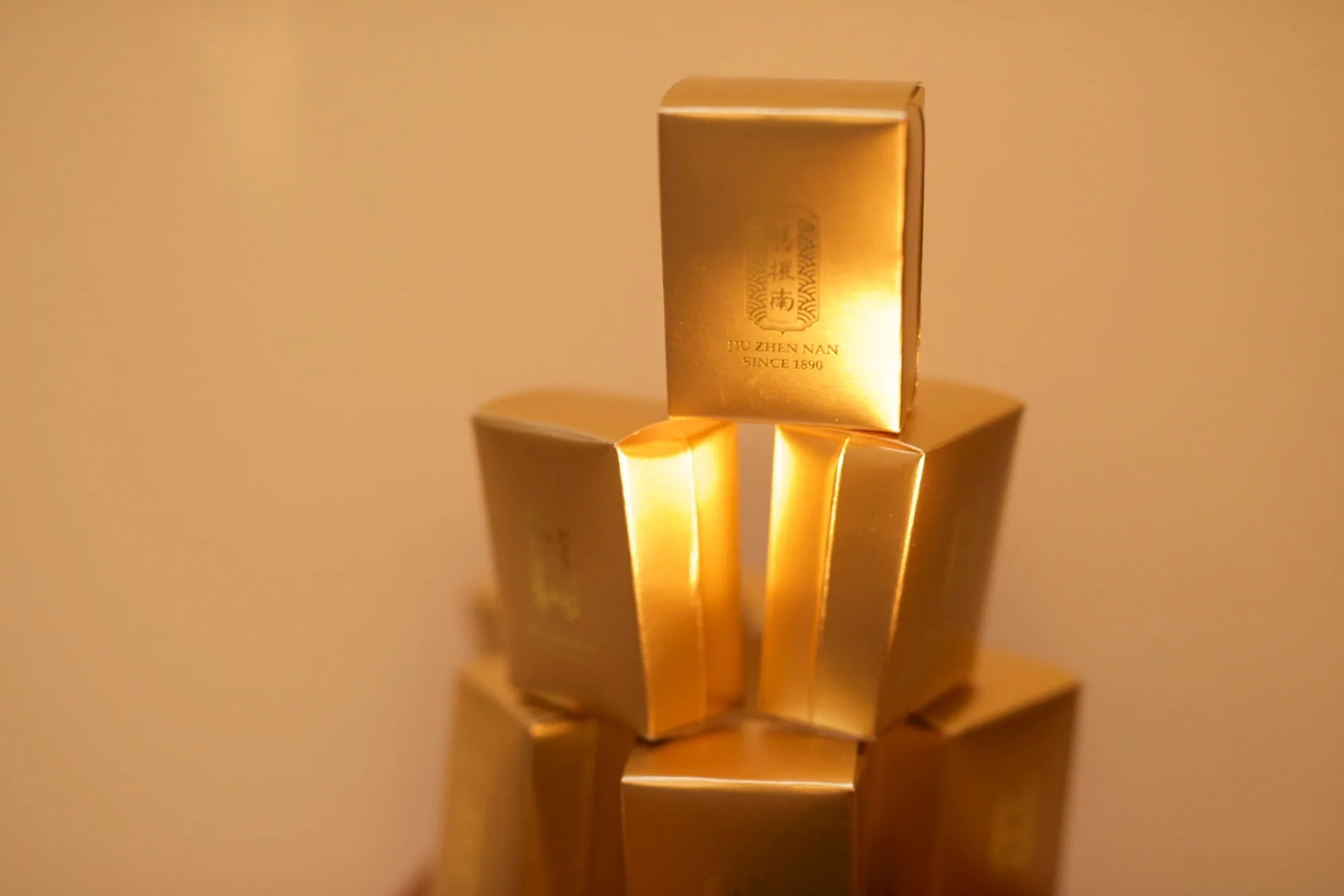
Pineapple cake: the modern footnote to the four characters “Taiwanese souvenir,” from Chia Te and SunnyHills to 7-Eleven. Photo: Karl Thomas Moore, 2016, CC BY-SA 4.0 via Wikimedia Commons.
Back to the Fountain: Turkey Rice in Its Eightieth Year
Return to No. 325 Zhongshan Road beside the Chiayi Fountain roundabout in 1949. Lin Tien-shou sliced a piece of chicken, laid it over Penglai rice, and poured braising sauce on top: a base formed by Taiwan’s black-soybean inyu plus the yellow-soybean soy sauce tradition added after Japanese rule. After the postwar U.S. military stationed in Taiwan brought turkeys into Chiayi’s Shuishang Township, this bowl of chicken rice evolved into turkey rice. One mouthful contains four hundred years: rice varieties from the Japanese colonial period, turkeys brought by the postwar U.S. military, and sauce-brewing craft brought by Qing-era Minnan migrants.
More than seventy years later, in the Agriculture and Food Agency’s vote for “Taiwan’s Ten Signature Rice Dishes,” this bowl took first place. No one sees the word “mixed-race” in this bowl, but every spoonful is exactly that.
Master A-tsan said: “Modern people imagine bando as an occasion where everyone gathers to eat. But the meaning of bando should be a gathering for life rituals or seasonal observances.”
Perhaps the secret of Taiwanese flavor is the same: the dishes are borrowed, but “why we eat together” has always belonged to this island.
The next time you sit on a plastic stool at a night market and bite into an oyster omelet; or stand in front of the office microwave waiting for your bento to ding; or sit at a bando round table listening to the auntie next to you talk about where the neighbor’s daughter married. The mouthful you are eating is evidence of four hundred years of an island cooking outside foods into its own way.
No dish is purely Taiwanese. Every dish is Taiwanese to the core.
Further Reading
Island Foundations:
- Taiwanese Indigenous Food Culture — Each of the 16 peoples has its own way of eating, from slate-grilled meat to binaleng sour-spicy soup
- Hakka Food Culture — “Fatty, salty, aromatic” and the preservation wisdom of migration routes
Migrant Mixtures:
- Taiwanese Military-Village Cuisine — The eight great cuisines brought by the 1.21 million people of 1949, recalibrated by the island
- Beef Noodles — Spicy bean paste from Sichuanese veterans in Gangshan military dependents’ villages, plus Taiwanese soybeans
Everyday Popular Food:
- Lu Rou Fan — Meat scraps and fat from early postwar poverty, poured into a national rice dish
- Night Market Culture — Taiwan’s 300 night markets, and the taste map of Shilin, Ningxia, Raohe, Liuhe, and Fengjia
- Taiwanese Snacks — A complete collection of lane-and-alley flavors, from oyster omelet to salty crispy chicken
Liquid Revolution:
- Bubble Tea — One afternoon at Chun Shui Tang in 1986 changed the world’s beverage map
- Taiwanese Hand-Shaken Drink Culture — 50 Lan, Gong Cha, and CoCo expanding to more than 40 countries
- Tea Culture — From John Dodd’s oolong tea in 1865 to today’s Alishan high-mountain tea
Ritual and Refinement:
- Taiwanese Bando Culture — Lin Tien-sheng, Lin Ming-tsan, and the human feeling, righteousness, ritual, and propriety of twelve dishes
- Taiwan Michelin and Fine Dining — The trajectory from Michelin’s 2018 arrival in Taiwan to 419 selections in 2025
- Taiwanese Breakfast Culture — From soy milk under Yonghe Bridge to 24-hour chain breakfast shops
Plural Extensions:
- Taiwanese New Immigrant Food Fusion — The Southeast Asian map brought by 1.87 million new immigrants
- Taiwanese Vegetarian Culture — The world’s third-largest vegetarian population share
- Taiwan, Kingdom of Fruit — The island’s fruit map, from high-mountain peaches to tropical sugar apples
- Food Hub — Overall food category index
Image Sources
This article uses 9 public-domain / CC-licensed images, all cached under public/article-images/food/ to avoid hotlinking source servers:
- Raohe Street Tourist Night Market 173356 — Photo: KClinla, 2023-04-26, CC BY-SA 4.0
- Cinavu Paiwan beiyeh — Photo: Sin-siōng, 2024-01-02, CC BY-SA 4.0
- Lurou fan by udono — Photo: udono (Shuets Udono), 2007-10-26, CC BY 2.0
- Beef noodle soup Shilin — Photo: (WT-shared) Jpatokal, 2007-08-22, CC BY-SA 4.0 (multi-license)
- Xiaolongbao Din Tai Fung Taipei — Photo: Banzai Hiroaki, 2009-03-21, CC BY 2.0
- Bubble tea six languages — Photo: Hippietrail, 2019-09-16, CC0 (Public Domain)
- Oyster omelette Shilin Night Market — Photo: Morgan Calliope, 2015-04-29, CC BY 2.0
- Aborigine roast pork millet wine Miaokou 2012 — Photo: 玄史生, 2012-02-05, CC BY-SA 3.0
- Alishan YUYUPAS tea garden — Photo: Hughon-zxl, 2011-01-21, CC BY-SA 3.0
- Pineapple Cake — Photo: Karl Thomas Moore, 2016-09-19, CC BY-SA 4.0
References
- Chiayi City Travel — The Origin of Turkey Rice — Official information from Chiayi City’s tourism authority, recording local accounts of postwar turkey farming in the Chiayi area and the origins of chicken rice, whose history exceeds 70 years.↩
- Nippon.com — Iso Eikichi, the “Father of Taiwanese Agriculture” Who Bred Penglai Rice — A detailed account of the full historical process by which Iso Eikichi and Suenaga Hitoshi tested rice varieties at Zhuzihu on Yangmingshan in 1925 and formally named Penglai rice in 1926.↩
- Shih Hsin University Little World — Xiluo, Taiwan’s Soy Sauce Capital: A Century of Black Soybean Soy Sauce Aroma + News & Market — The Black Soybean Dream of Xiluo’s Ageless Farmers — Full historical account of “before the Japanese colonial period, Taiwan had only soy sauce brewed from black soybeans,” “Minnan and Hakka migrants who followed Koxinga to attack Taiwan brought sauce-brewing techniques,” “1888 Xiluo Chen Yuan Ho Soy Sauce,” and “after Japanese rule, Japanese people brought yellow-soybean soy sauce into Taiwan, opening Taiwan’s flourishing soy sauce landscape.” Black soybeans and yellow soybeans are different varieties of the same soybean species, Glycine max; differences in seed-coat color produced divergent brewing flavors. A 2026-05-27 reader callout by @ericten0704, “What does Taiwan’s soy sauce have to do with the Qing dynasty? At the time Taiwan used black soybeans, China used yellow soybeans,” prompted the addition of this footnote, and the article revised “based on soy sauce brought by Minnan people from the Qing period” to “Qing-era Minnan sauce-brewing techniques + Taiwan’s local black-soybean inyu + the dual tradition of yellow-soybean soy sauce after Japanese rule.”↩
- StoryStudio — Why Does Chiayi Have Turkey Rice? — A curated historical account by the StoryStudio content platform of Chiayi turkey rice, recording that Fountain Chicken Rice was founded by Lin Tien-shou in 1949 and later won first place in the Agriculture and Food Agency’s “Taiwan’s Ten Signature Rice Dishes” vote.↩
- Michelin Guide — Complete 2025 Taiwan List — Michelin Guide’s official release of the complete 2025 eighth edition Taiwan guide: 419 total selections, 3 three-star restaurants, 7 two-star restaurants, 43 one-star restaurants, 144 Bib Gourmand selections, and 7 Green Stars.↩
- Taiwan Panorama — Indigenous Cuisine, Wild Taiwanese Flavor — A foreign-facing cultural magazine published by Taiwan’s Ministry of Foreign Affairs, recording details of traditional Amis dishes including “ten-heart vegetables,” more than two hundred edible wild vegetables, and warrior soup.↩
- JIBAO — Paiwan Foodways — A multimedia cultural database documenting the preparation of the Paiwan traditional food cinavu, made with shell ginger leaves, false physalis leaves, millet, and pork filling, as well as the slate-grilling tradition.↩
- FoodNEXT — Distinctive Indigenous Foods — A deep survey by the food media outlet FoodNEXT of Taiwan Indigenous traditional foodways, including detailed introductions to Puyuma binaleng sour-spicy soup and abay, millet and pork dumplings.↩
- Michelin Guide — 5 Indigenous Ingredients From Taiwan — A 2018 official Michelin Guide feature on Taiwanese Indigenous ingredients, formally introducing maqaw, red quinoa, malan, pigeon pea, and fatsi to an international audience.↩
- Chen Yu-chen, A Cultural History of “Taiwanese Cuisine”: The Embodiment of the Nation in Food Consumption — Linking Publishing — An academic monograph by Chen Yu-chen, professor in National Taiwan Normal University’s Department of Taiwanese Language and Literature, recording the emergence of the concept of “Taiwanese cuisine” in Japanese-era restaurants and the soy sauce and coastal food traditions brought by Qing-era Minnan Han migrants.↩
- Liberty Times Opinion — The Past and Present of Lu Rou Fan — A Liberty Times supplement commentary column that cites Qing and Japanese-era Minnan dictionaries to infer that “lu rou fan” as a term and dish appeared only after the war.↩
- Ministry of Agriculture Food and Agricultural Education Platform — Differences Among Kong Rou Fan, Lu Rou Fan, and Rou Zao Fan — The Ministry of Agriculture’s official Food and Agricultural Education platform, explaining regional differences and standard written forms for “lu rou fan” in the north, “rou zao fan” in the south, and “kong rou fan” or “kang rou fan” made with pork belly.↩
- FoodNEXT — The Definition of Hakka Cuisine Is No Longer Vague — FoodNEXT’s in-depth explanation of the three characteristics of Hakka food, “fatty, salty, aromatic,” recording the food logic shaped by Hakka migration, hilly or mountainous life, and salt preservation.↩
- Hakka Stir-Fry — Wikipedia (Chinese) — The Chinese Wikipedia entry’s detailed account of Hakka stir-fry, originally called “stir-fried meat,” citing Hakka scholars who note that the word “Hakka” was added by other groups.↩
- Liberty Times — Stir-Fried Pork Intestines with Shredded Ginger — A Liberty Times food column introduction to the history of stir-fried pork intestines with shredded ginger, recording that pork offal, including intestines, lungs, and stomach, was an important source of nutrients for early Hakka people.↩
- Lei Cha — Wikipedia (Chinese) — The Chinese Wikipedia entry’s detailed history of lei cha, or “three-raw soup” made from raw tea, raw ginger, and raw rice, recording its arrival in Taiwan after World War II through Hakka migrants from Hepo, Jiexi, Guangdong, and its use in the early Republican period as a substitute staple for infants.↩
- Taiwan Awakening News — Food Comes from Homesickness: Jiao Tong Explains Taiwanese Flavor — A verbatim transcript of a May 25, 2015 interview with Jiao Tong, distinguished professor in National Central University’s Department of Chinese Literature, including the core quotation “Sichuan does not have Sichuan-style beef noodles, Mongolia does not have Mongolian barbecue” and the figure of “1.21 million migrants bringing the eight great cuisines.”↩
- John Dodd, Lee Chun-sheng, and the Great Era of Taiwanese Tea — Digital Archives — A curated exhibition by Academia Sinica’s Digital Archives and e-Learning program, recording the full commercial history of John Dodd introducing oolong seedlings from Anxi, Fujian, in 1865 and exporting 213,000 catties of refined tea to New York under the “Formosa Oolong” brand in 1869.↩
- Penglai Rice — Wikipedia (Chinese) — The Chinese Wikipedia entry’s full account of the history of Penglai rice breeding, recording the 1925 trials at Zhuzihu on Yangmingshan, the 1926 naming at the Taipei Railway Hotel rice grains meeting, and the 1929 development of Taichung No. 65.↩
- Agriharvest — “History Through Dishes”: Western Flavors in the Japanese Colonial Period — Agriharvest’s account of the historical process by which Japanese cuisine and yoshoku, including tonkatsu, omurice, and curry rice, were introduced to Taiwan during Japanese rule, including specific records of gentry-class fondness for sukiyaki.↩
- Taiwan Awakening News — Food Comes from Homesickness: Jiao Tong Explains Taiwanese Flavor — Jiao Tong’s verbatim interview statement: “In 1949, 1.21 million migrants from various Chinese provinces poured in, bringing the eight great cuisines of Chinese cooking.” A first-hand Chinese transcript.↩
- Super Taste — Food Writer Wang Hao-yi: Taiwan’s First Bowl of Sichuan-Style Beef Noodles Was in Kaohsiung — An in-depth TVBS food channel report on Wang Hao-yi’s argument that Sichuan-style beef noodles originated in Gangshan military dependents’ villages in Kaohsiung, including the historical context of Sichuan veterans seasoning chili bean paste according to hometown tastes and Sichuanese military-village cooks replacing Pixian chili bean paste’s fava beans with Taiwanese soybeans.↩
- Din Tai Fung — Wikipedia (Chinese) — The Chinese Wikipedia entry’s full history of Din Tai Fung: Yang Bing-yi founding an oil shop on Linyi Street near Taipei’s Dongmen in 1958, shifting to xiaolongbao in 1972, fully transforming into a restaurant in 1974, and expanding overseas to Takashimaya in Shinjuku, Tokyo, in 1996.↩
- NOWnews — The Inside Story of Din Tai Fung’s Golden 18 Folds — A NOWnews interview report with Din Tai Fung chairman Yang Ji-hua, including the verbatim “eighteen folds” public-secret quotation and recording Yang’s 1995 succession and his development of standardized xiaolongbao techniques with chefs.↩
- CNN — Taiwan’s 40 Best Foods and Drinks — A CNN Travel survey of 40 of Taiwan’s best foods and drinks, ranking Din Tai Fung as the world’s second-best chain restaurant and noting readers’ selection of Taipei as one of the world’s best food destinations.↩
- Taiwan Awakening News — Food Comes from Homesickness: Jiao Tong Explains Taiwanese Flavor — Jiao Tong’s verbatim interview statement: “They became the ‘hometown dishes’ spoken of by mainlanders back then, but what they ate was not necessarily the flavor of their original hometowns; nevertheless, fermented by homesickness, they became the nostalgic taste of collective memory.”↩
- Academia Historica — U.S. Aid, the JCRR, and Dietary Nutrition Measures in 1950s Taiwan — An Academia Historica scholarly PDF documenting in detail the scale and policy logic of U.S. aid supplies including large quantities of soybeans, wheat, raw cotton, tobacco, and milk powder.↩
- City GVM — The Story of Shandong Noodles in Taiwan — A Global Views Commonwealth “City” column recording Shandong migrant Miao Yuxiu’s suggestion to the Minister of Economic Affairs that U.S. aid be shifted to wheat, and his later founding of Lien Hwa Flour Mill, earning the title “Father of Flour.”↩
- Liberty Times — A Look at the Evolution of Taiwanese Breakfast — A Liberty Times food column tracing the evolution of Taiwanese breakfast culture, including the concrete origin story of the “Yonghe Soy Milk King” cluster forming under Zhongzheng Bridge in Yonghe, New Taipei, in 1955.↩
- Global Views Monthly — Seeing History Through Food — A Global Views Monthly feature with the verbatim quotation: “The postwar popularity of wheat foods in Taiwan was related not only to the arrival of people from Shandong and other northern Chinese provinces, where wheat foods were originally staples, but also inseparable from the large quantities of wheat allocated to Taiwan through postwar U.S. aid.”↩
- Breakfast Shop — Wikipedia (Chinese) — The Chinese Wikipedia entry’s full history of Taiwan’s breakfast shop industry, including Lin Kun-yen opening a Western-style breakfast shop on Bade Road in Taipei and the subsequent timeline of chain franchise expansion.↩
- Business Today — Western-Style Chain Breakfast Shops Surpass 10,000 Locations — Business Today’s survey of Taiwan’s breakfast shop industry, giving specific statistics of about 18,919 breakfast shops, annual output value of about NT$200 billion, and the world’s highest density.↩
- Breakfast Shop — Wikipedia (Chinese) — Statistics on franchise scale for chain brands: Good Morning Beach City with about 1,400 locations across Taiwan, Ruilin Mei & Mei reaching 2,800 franchises in 2004, and Ju Lin Mei & Mei surpassing 1,100 in 1992.↩
- How President Chain Store Became the Convenience Store Leader — UDN Reading — A United Daily News Reading in-depth account of the history of President Chain Store, including 7-Eleven’s official sale of tea eggs beginning in 1987 and the historical record of NT$10 per egg.↩
- How President Chain Store Became the Convenience Store Leader — UDN Reading — The historical record of Hsu Chung-jen adding onigiri and oden items in 1997, the same year President Chain Store listed its shares.↩
- The Origin of International Bubble Tea Day — KidsMedia — A detailed account of the two origin claims for bubble tea, Chun Shui Tang versus Hanlin Tea Room, including the two versions of independent invention in 1986 and the subsequent court dispute timeline.↩
- SET News — Chun Shui Tang and Hanlin Tea Room’s 10-Year Lawsuit — SET News report on the 10-year lawsuit between Chun Shui Tang and Hanlin Tea Room over the invention rights to bubble tea, and the final court ruling that bubble tea is a new beverage rather than a patented product, without confirming either side as inventor.↩
- National Geographic — Origins and Cultural Impact of Boba Tea — A National Geographic report providing international media support for bubble tea’s birth in 1980s Taiwan and its status as “one of Taiwan’s most representative cultural exports.”↩
- Tatler Asia — National Bubble Tea Day — Tatler Asia’s record of International Bubble Tea Day on April 30 being launched in 2018 by the U.S. brand Kung Fu Tea, which was founded in New York in 2010 by three Taiwanese entrepreneurs.↩
- Global Views Monthly — A Cup of Bubble Tea Shakes Out Taiwan’s New Economic Miracle — Global Views Monthly’s bubble tea economy feature, including market data that Taiwan sells 1.02 billion cups annually, 44 cups per capita, with NT$50 billion in revenue, and that the global bubble tea industry is projected to reach US$4.3 billion, or NT$129 billion, by 2027.↩
- Ministry of Foreign Affairs NSPP — The Craft of a Drink: Taiwanese Hand-Shaken Drinks Sweep the World — The Ministry of Foreign Affairs New Southbound Policy Portal’s official account of Taiwanese hand-shaken drinks’ global expansion: more than 40 countries and 300 cities, with specific expansion timelines for 50 Lan, Gong Cha, Chun Shui Tang, and others.↩
- Ministry of Foreign Affairs NSPP — The Craft of a Drink: Taiwanese Hand-Shaken Drinks Sweep the World — The Ministry of Foreign Affairs’ official framing of hand-shaken drinks as a “diplomatic tool,” recording the policy positioning of hand-shaken drinks as an export of Taiwanese cultural soft power.↩
- Super Taste — 2026 Taiwan Night Market Guide — A TVBS food channel survey of more than 300 night markets across Taiwan and the 2025 top ten popular night markets vote: Shilin, Fengjia, Garden, Raohe, Liuhe, Ningxia, Yizhong Street, Ruifeng, Shida, and Luodong.↩
- Taiwan Night Markets — Wikipedia (Chinese) — The Chinese Wikipedia entry’s full historical account of Taiwan night markets: Ningxia Night Market’s origin in the Japanese-era roundabout, Liuhe Night Market’s origin in the early 1950s, Raohe as the second tourist night market, Nanjichang Night Market’s former use as a Japanese Army training ground, and more.↩
- Smile Taiwan — Oyster Omelet — CommonWealth Magazine’s Smile Taiwan account of the multiple origin stories for oyster omelet: brought by Minnan fishermen, emergency food during Yan Siqi and Zheng Zhilong’s naval battles, and Koxinga’s military provisions.↩
- Salty Crispy Chicken — Wikipedia (Chinese) — The Chinese Wikipedia entry’s detailed account of the two origin claims for salty crispy chicken, 1975 Ximending “Taiwan’s First” versus 1979 Tainan “Youai Salty Crispy Chicken,” including the Thai basil feature and evolution from American-style fried chicken.↩
- Changhua Beidou Ba-wan — National Cultural Memory Bank — Official Ministry of Culture National Cultural Memory Bank information recording that during the 1898 Wuxu flood, Fan Wanju of Beidou, Changhua, soaked sweet potatoes, kneaded them into balls, added cauliflower, and cooked them for disaster relief victims, forming the prototype of Beidou ba-wan.↩
- every little d — How Did “Steamed in the South, Fried in the North” Arise? — A food culture media account of the historical basis for the regional difference of Taiwanese ba-wan, “steamed in the south, fried in the north,” recording the concrete distribution logic of frying north of Changhua, including Beidou and Changhua, and steaming in the south.↩
- Mirror Media — King of Chief Banquet Chefs Lin Ming-tsan — Mirror Media’s in-depth profile of national-treasure chief banquet chef Lin Ming-tsan, including specific career records such as following his father to bando at age 12, catering at least 20,000 banquets, serving as consultant for the 2013 film Zone Pro Site, and being invited to prepare a birthday banquet for the king of Thailand.↩
- Agriharvest — Chief Banquet Chefs Discuss Bando: Lin Ming-tsan × Chen Chia-mo — Agriharvest’s professional dialogue record with Lin Ming-tsan and Chen Chia-mo on bando, including the historical curve of bando peaking in Republic Year 65 (1976), beginning to decline in the early Republic Year 80s (1991), and shrinking to one quarter of its former scale.↩
- The Reporter — One of the Old Flavors Disappearing After the Pandemic — The Reporter’s in-depth interview with Lin Ming-tsan, including direct quotations such as “outdoor catering banquet tables have shrunk by at least 90 percent,” “921 hurt outdoor catering a little, SARS hurt more than half, this year’s pandemic may turn bando into a declining industry.”↩
- The Reporter — One of the Old Flavors Disappearing After the Pandemic — Lin Ming-tsan’s verbatim explanation of “why old-style dishes are disappearing”: “First, they are labor-intensive; second, tastes change from generation to generation. Older chefs started from the basics, doing everything themselves from slaughtering pigs and chickens to making pudding and cake for dessert.”↩
- United Daily News — Song of the Twelve Bowls — United Daily News’s cultural account of the old Taiwanese sung narrative The New Song of the Twelve Bowls and the bando tradition of “twelve dishes,” including Lin Ming-tsan’s verbatim interview on the traditional meaning of the number 12.↩
- Agriharvest — Chief Banquet Chefs Discuss Bando: Lin Ming-tsan × Chen Chia-mo — Lin Ming-tsan’s verbatim interview on the true meaning of bando: “Modern people imagine bando as an occasion where everyone gathers to eat. But the meaning of bando should be a gathering for life rituals or seasonal observances.”↩
- Michelin Guide — Complete 2025 Taiwan List — Michelin Guide’s official release of the 2025 eighth edition Taiwan guide: 419 total selections, 3 three-star restaurants, 7 two-star restaurants, 43 one-star restaurants, 144 Bib Gourmand selections, and 7 Green Stars.↩
- Central News Agency — Complete 2025 Taiwan Michelin Guide List — Central News Agency’s official report on the 2025 Michelin Taiwan guide announcement, including the three-star list, Le Palais, Taïrroir, and JL Studio, their consecutive retention records, and the personnel change of former Le Palais chef Chan Wai-Keung leaving Le Palais in 2024 to build “Gen” in Kaohsiung.↩
- Michelin Guide — Complete 2024 Taiwan List — Michelin Guide’s official record of the 2024 seventh edition Taiwan guide, including the timeline record of RAW, by André Chiang, closing on December 31, 2024, as a tenth-anniversary farewell.↩
- CNN — Tainan Is Taiwan’s Food Capital — A CNN Travel report on Tainan as “Taiwan’s food capital,” including the specific statistic that Tainan alone had 31 Michelin Bib Gourmand restaurants in 2024, 19 of them famous street-food establishments.↩
- CNN — Tainan Is Taiwan’s Food Capital — CNN directly calls Tainan “Taiwan’s food capital,” recording 19 street-food Bib Gourmand restaurants.↩
- VERSE — Taoyuan Zhongli Food Map: Four Authentic Southeast Asian Restaurants Recommended by New Immigrants — VERSE magazine’s in-depth report on Taiwan’s new immigrants and the expansion of Southeast Asian cuisines, including 2022 Ministry of Education statistics of 18,755 Vietnamese, 16,426 Indonesian, 12,510 Malaysian, and 2,831 Thai foreign students.↩
- Smile Taiwan — Thai, Burmese, Vietnamese, and Indonesian Restaurants Gather in Taipei’s Gongguan — Smile Taiwan’s historical account of the formation of Taipei’s Gongguan Southeast Asian food street, including the fall of South Vietnam and Taiwan’s severing of relations with Thailand in 1975, the first Southeast Asian street forming in the late 1970s, and the specific history of a Vietnamese pho private kitchen on Roosevelt Road Section 4.↩
- Newtalk — Taiwan’s Vegetarian Population Share Is Third in the World — Newtalk’s report on a 2023 World of Statistics survey showing Taiwan’s vegetarian population share at about 14%, roughly 3.2 million people, third in the world after India and Mexico.↩
- Newtalk — Taiwan’s Vegetarian Population Share Is Third in the World — Records CNN’s 2017 international media recognition of Taiwan as one of “the world’s ten most vegetarian-friendly cities.”↩
- Central News Agency — Mountain and Sea House Among 7 Green Star Restaurants in 2025 — Central News Agency’s official report on the seven 2025 Michelin Green Star restaurants, Tu Pang, Thomas Chien, Mountain and Sea House, EMBERS, Yangming Spring, Little Tree Food, and Hosu, and the Green Star selection criteria.↩
- United Daily News — Food and Agricultural Education Act Passed on Third Reading by the Legislative Yuan — United Daily News’s official record of the Food and Agricultural Education Act passing its third reading in the Legislative Yuan on April 19, 2022, recording the legal provision that government agencies, state-run enterprises, administrative corporations, and schools should prioritize locally produced agricultural products.↩
- CommonWealth Magazine — Grab Acquires foodpanda at a 40% Discount — CommonWealth Magazine’s in-depth report on Taiwan’s food delivery platform acquisition case, including foodpanda Taiwan’s 2025 GMV of about US$1.8 billion, 79.6% market share, Uber Eats’ 60.8%, and the Fair Trade Commission’s December 2024 decision to block Uber Eats’ acquisition of foodpanda Taiwan.↩
- Events in Focus — Taiwan’s Foreign Distant-Water Fishers — Labor issues media outlet Events in Focus’s in-depth report on disputes over working conditions for foreign migrant workers hired offshore in Taiwan’s distant-water fishing industry, including the policy background of the government’s refusal to let them be covered by the Labor Standards Act.↩
- Environmental Information Center — Reviewing the 2011 Food Safety Storm — Environmental Information Center’s in-depth review of the 2011 plasticizer incident, including the Department of Health’s Food and Drug Administration detecting abnormalities in probiotic powder, Yu Shen Chemical Company illegally adding DEHP to clouding agents for more than 15 years, selling 102 metric tons of clouding agents and flavoring sauces, and the Supreme Court sentencing responsible persons to 15 and 12 years in prison.↩
- Environmental Information Center — 2013 Oil Safety Incident — Environmental Information Center’s detailed record of the October 16, 2013 Tatung Chang Chi adulterated oil incident, including the company mixing low-cost sunflower oil and cottonseed oil into olive oil, adding copper chlorophyllin for color, and company head Kao Chen-li being sentenced to 12 years in prison on July 24, 2014.↩
- 2014 Taiwan Inferior Oil Products Incident — Wikipedia (Chinese) — The Chinese Wikipedia entry’s full account of the 2014 Chang Guann gutter oil incident, including Chang Guann producing “Chuan Tung Fragrant Lard Oil” using 33% inferior oil and 67% lard, a 1:2 ratio; the scandal affecting major companies such as Chimei, Sheng Hsiang Jen, 85°C, and others; and the Pingtung District Court sentencing chairman Yeh Wen-hsiang and Tai Chi-chuan to 20 years each and NT$50 million fines on July 24, 2015.↩