
30-Second Overview: The Lanyu outrigger canoe (Tatara) is not a vehicle completed merely by nailing planks together. It requires knowing which tree species are suitable for the keel, which wood provides buoyancy, how wooden pegs expand when wet, when hull eyes, wave patterns, and human figures can be carved, and which ritual formally integrates a new boat into the relationship between the tribe and the sea. The outrigger canoe is important not only because it carries people out to sea, but because it assembles forest resources, family memory, fishing group order, the flying fish season, and navigational judgment into a mobile system of knowledge. In June 2026, more than 200 people from six communities used traditional methods to build a 20-person large boat, the Ovayan Golden Friendship, which crossed the Bashi Strait to reach Batan Island in the Philippines, reopening a maritime ancient route interrupted for 300 years. This brought this system of knowledge back into the international spotlight in the form of "navigation" rather than "display."
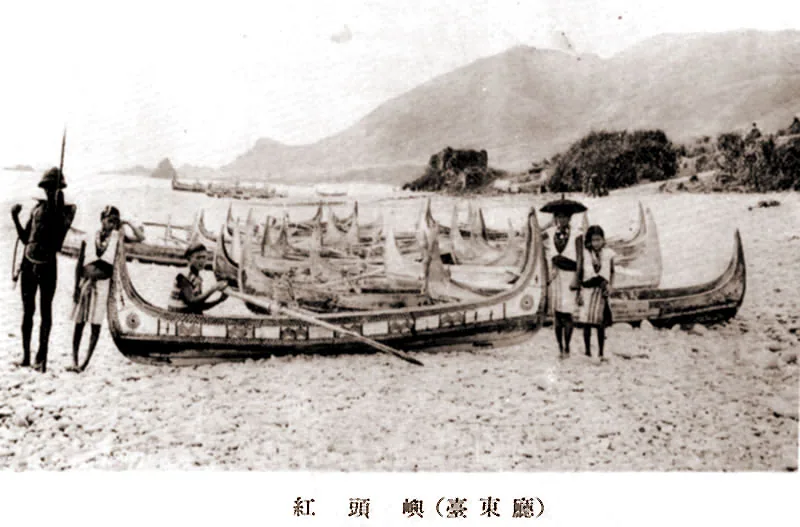
A large outrigger canoe and Tao people in traditional clothing at the center of the frame on a beach in Lanyu (formerly Red Head Island, Taitung Prefecture) during the Japanese colonial period, circa 1931. The photo is scanned from a publication of the Japanese colonial government. Photo: Unknown author. License via Wikimedia Commons.
Deconstructing "Outrigger Planks" First
The Chinese name "outirgger canoe" (拼板舟) easily leads people to first think of the construction method: plank after plank joined together to form a long, slender hull. But understanding it solely from the number of planks still fails to reveal its role as the core of the Tao people's maritime life. The National Cultural Heritage Network has registered the Yami (Tao) people's large boat launch ceremony as a folk cultural asset, indicating that large boat construction, fishing group organization, and the flying fish season rituals are interconnected. The outrigger canoe is not an independent craft artifact; it is an object situated within a system of seasonal, kinship, labor, and belief orders1.
There is not just one type of boat shape. Cultural heritage data distinguishes between the large Chinurikuran and the small Tatala: large boats are used by fishing group crews, with a maximum capacity of 10 people. Small Tatala boats serve individuals or families going out to sea, with a maximum capacity of 3 people. The National Taiwan Memory Bank's collection description refers to the outrigger canoe as Tatara, recording differences in plank count, hull structure, dyes, and patterns between large and small boats. It notes that ten-person large boats are jointly owned by several families, while one-person small boats are essential for every family2. The National Museum of Prehistory's collection introduction also explains that large boats are composed of 27 planks and small boats of 21 planks, with different woods selected for each plank based on its position and function in the hull3. The use of different terms like Tatala, Tatara, and Chinurikuran reminds us not to treat a single romanization as the sole standard answer for the entire culture. They may reflect differences in boat types, word transliteration, or the context of data organization.
The hull consists of the bow, keel, stern, and side planks; it is not simply a matter of fixing flat planks with nails. Reports from the Ocean National Park Management Office on canoe building record that large boats can be composed of 27 planks, while small boats may consist of 21 planks. Joining methods include wooden pegs, mortise and tenon joints, lashing, and adhesive bonding. The National Museum of Marine Science and Technology's exhibition explanation also points out that hull planks are joined using wooden pegs made from the heartwood of the small-leaf mulberry, which expands when wet; a single boat may use thousands of such pegs. This structure is not a "modern version of an ancient boat," but rather the result of long-term observation of how materials change when exposed to water45.
This island boat, composed of 21 to 27 planks, has its origins foreshadowed in the Tao people's creation myth. The creation legend recorded by the Ministry of the Interior's Taiwan Religious Culture Map for the Yami (Tao) people's large boat launch ceremony states that the Heavenly God gave birth to the Stone-born and Bamboo-born ancestors within a rock and bamboo. In the Hongtou (Red Head) tribe's legend, descendants of the ancestors each invented boats, but each had flaws; after rowing for a short time, they leaked and sank to the seabed. It was only after accidentally discovering kapok while searching for sheep on a mountain that they found a method to seal the plank seams, thus inventing the outrigger canoe. In the Dongqing tribe's legend, the younger brother of the ancestral brothers visited the underworld and learned the method of making outrigger canoes, fishing group organization, and launch rituals from the underworld people. Some scholars believe that Lanyu's boat-building technology preserves the context and relics of Austronesian maritime culture6. These legends and myths remind us that the outrigger canoe in Tao society is not only a craft technology but also an ancestral culture, governed by spirits and taboos.
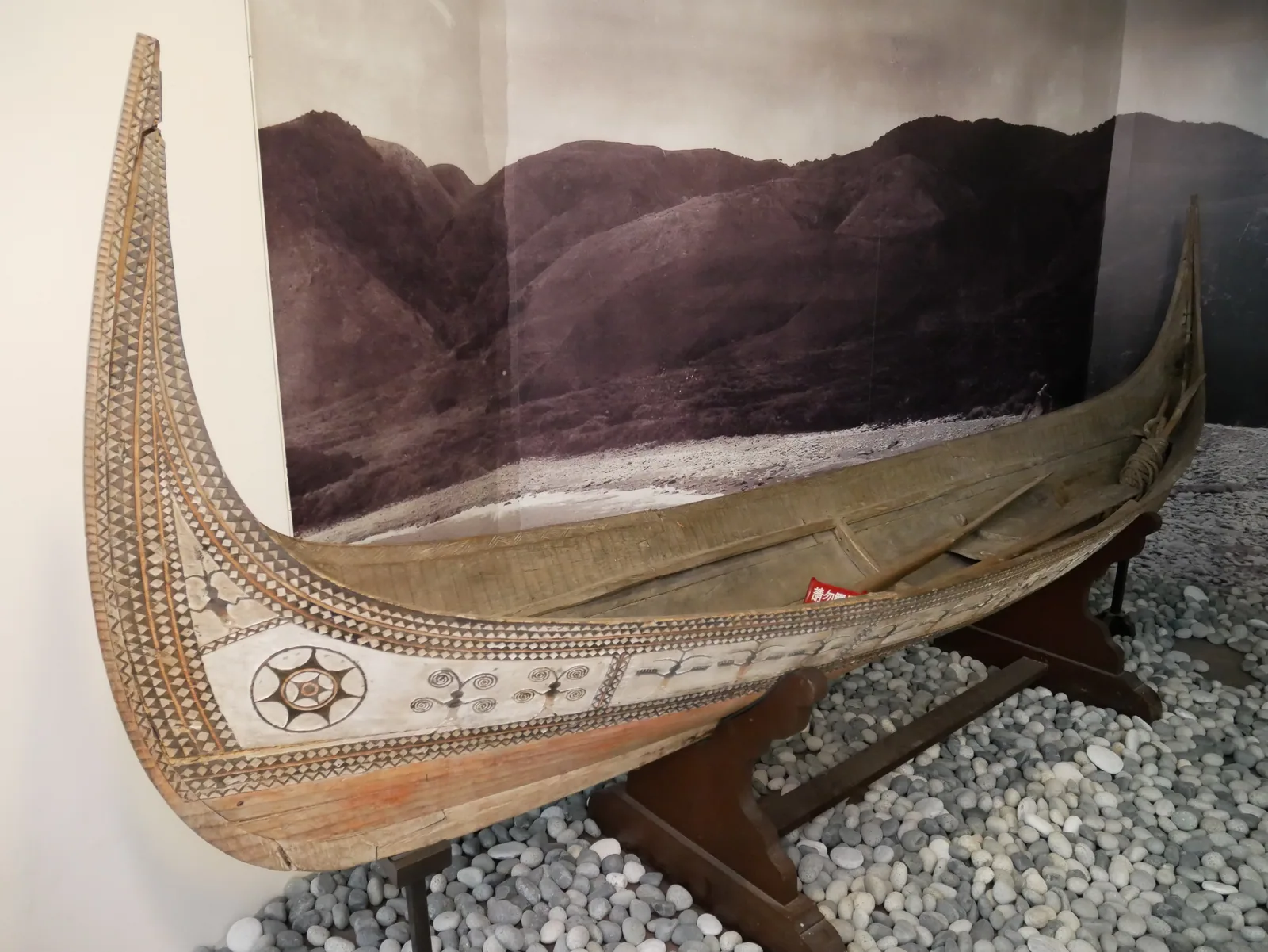
Close-up of a Tao outrigger canoe in museum collection: the wooden outrigger hull is based on a keel, with high, curved bow and stern joined at the ends; side planks each feature three layers of hull eyes and human/wave patterns. Photo: 氏子 (Shishi), 2019. License via Wikimedia Commons (CC BY-SA 4.0).
The Forest Precedes the Boat
The first question in canoe building is not "what patterns to draw," but "which tree can bear which position." The Marine Science and Technology Museum's exhibition explanation states that the keel requires hard, rot-resistant, and wear-resistant Syzygium buxifolium (Taitung boxwood) wood, while the gunwale planks can use lightweight, buoyant Artocarpus altilis (breadfruit) and Ficus microcarpa. Different parts have different needs, so the boat is not made from a single type of wood5. The Ocean National Park Management Office's report also lists wear resistance, buoyancy, hardness, anti-rot, and anti-insect properties as selection criteria, recording that Lanyu's wood is certified by family marks: the bow and stern use Barringtonia asiatica (Taitung boxwood) or Syzygium buxifolium; the keel uses Syzygium buxifolium, Syzygium cumini (Lanyu red nanmu), and Ficus variegata (Lanyu fuku); and the side planks use Ficus microcarpa and breadfruit4.
This distances the outrigger canoe from the general imagination of "woodworking." In woodworking, one can buy standardized lumber from a material store and process it according to blueprints. Canoe building, however, must face the island's forests, tree sizes, availability, and seasons. The academic paper Structural Materials of Yami Outrigger Canoes on Lanyu measured 132 existing boats and conducted a quantitative analysis of plank data from 191 boats, pointing out significant differences in boat length and paddle length between the Front Mountain (Yuyuan, Yuren, Hongtou) and Back Mountain (Langdao, Dongqing) tribes. The study also found that plank materials are concentrated in six tree species, accounting for approximately 85.45% of all materials, including Barringtonia asiatica, Diospyros morrisiana, breadfruit, Ficus variegata, Syzygium buxifolium, and Syzygium cumini. These species constitute the main forest stands of Lanyu under the deliberate management of the Yami people7.
Source: Zheng Hanwen et al., "Structural Materials of Yami Outrigger Canoes on Lanyu," *Research on Eastern Taiwan*, Issue 7 (2002)
The significance of these numbers is not to establish a fixed recipe for "tradition," but to show that canoe-building knowledge is refined to the level of tribe, plank, and function. Research from the Bowers Museum on its collection of Tao Fishing Canoe (Taratara) further supplements the material taboos before construction: only wood from living trees is used; dead wood is considered taboo. Construction begins by carving three keels—the central straight keel and the curved bow/stern keels—then inserting wooden pegs into the acute angles of the keels and mortise-joining the large planks onto them. The precise measurement of the hull's length and width is done using wood chips and reeds, not standardized measuring tools8.
| Hull Position or Requirement | Material/Judgment Recorded by Sources | What Cannot Be Directly Inferred |
|---|---|---|
| Keel | Requires hardness, rot-resistance, wear-resistance; Marine Science Museum uses Syzygium buxifolium as example; Bowers Museum records three-keel opening structure58 | Cannot claim all boats in all eras necessarily use the same tree species |
| Gunwale Plank | Values lightweight and buoyancy; Marine Science Museum uses Ficus microcarpa and breadfruit as examples5 | Cannot treat exhibition cases as the sole material list for the entire island |
| Joining Pegs | Small-leaf mulberry heartwood expands when wet, aiding joint; thousands of pegs per boat5 | Cannot interpret this as a permanent joint requiring no maintenance |
| Hull Surface | White, red, black colors and human, wave, sun patterns; natural pigment sources from red clay, shell ash, and charcoal58 | Cannot simplify all patterns into a single "decoration" or universal symbol |
| Bow and Stern | Slender shape related to drag reduction; bow/stern carvings commemorate the boat-building god Magamaog58 | Cannot rename its cultural significance solely using modern fluid dynamics |
The forest is therefore not the background for canoe building. It is the boat's first material database and part of the tribe's judgment, taboos, and land relations. Academic research quantifies wood statistics, allowing us to see the composition of planks. But statistics themselves do not replace the canoe builder's ability to identify a tree in the mountains. As forests decrease and roads and tourism change the way materials are sourced, what is affected is not a single plank, but the entire chain of learning opportunities from identifying species, felling, transporting, drying, to processing.
Building a Boat, First Building a Fishing Group
The outrigger canoe has never been the work of a single individual. The Tao language term for fishing group organization (kakavay) is an organization established by Lanyu men when fishing, formed annually in each village during the flying fish season (March to July) and dissolved after the season. Members are all adult males, who net fish, build boats, hold rituals, and share catches together. Young men aged 16 or 17 can join the boat crew as预备 (reserve) crew members; those aged 20 become candidate crew members, with opportunities to become formal crew members only when vacancies arise. The number of crew members in a boat is regulated at six (three pairs of paddles, Atlo so avat), eight (four pairs of paddles, Apat so avat), or ten (five pairs of paddles, Alima so avat), with the ten-person large boat being the standard. Each position on the boat has specific duties: the captain steers at the stern, the vice-captain holds double paddles at the bow, and all positions cannot be arbitrarily swapped9.
The fishing group and the large boat are two sides of the same institutional coin. Cultural heritage registration data indicates that large boats can carry a maximum of 10 people; building boats for more than 10 people is taboo. Therefore, the number of fishing group members is also limited to 10; those exceeding this limit can only serve as candidate crew members. Fishing group members must jointly participate in building the large boat, preparing for the launch ritual, and the four-month-long flying fish season fishing work, which requires overnight stays at sea. The division of labor in boat building, fishing, and catch distribution is arranged according to the age and status of crew members within the group6. Building the large boat is the key link in maintaining the fishing group organization: from construction to first use, a new boat must undergo two launch rituals, often taking years. This tests the entire crew's teamwork and patience. Completing the large boat launch ritual symbolizes both the start of the new boat's use and the entry of the fishing group organization into a new stage6.
However, this system is facing structural changes. The Chinese Wikipedia's summary of the current state of fishing group organizations points out that with the popularization of motorized boats, Tao society rarely uses large boats to catch flying fish; taro and pigs are mostly purchased from Taiwan's main island; ritual preparation time has gradually shortened; the operation of fishing group organizations has begun to loosen and become less practical, instead becoming a symbol of Tao community identity, and has recently been gradually replaced by fishing net organizations9. Cultural heritage registration data also records that the Dongqing Xie Guolin fishing group completed the completion ceremony of the carved large boat in 2008 (Republic of China Year 97), and the Yeyin Zhang Shunyong fishing group did so in 2009 (Republic of China Year 98)—such cases adhering to tradition still exist, but overall, the number of fishing groups is not as high as in the past6. The 2026 voyage plan of a 20-person large boat built by more than 200 people, in a certain sense, re-mobilized this ancient fishing group logic on a new collective scale10.
Plank Joining Is Also Body Memory
The outrigger canoe is most easily photographed as a beautiful picture: white hull, red and black patterns, neatly arranged planks. But the difficulty of canoe building lies not in the silhouette after completion, but in the series of calibrations before joining. Plank thickness, curvature direction, joint positions, and hull weight constrain each other. If a joint is not tight, it may become a leakage and structural problem after going out to sea. In a documentary interview before the 2026 first voyage, canoe builder Xie Zhenxiong said, "If the surface is not flat, protruding here and there, the resistance of seawater will be much greater"—this statement is not directed at tourist displays, but at a large boat about to cross the Bashi Strait11.
The Ocean National Park Management Office breaks down the canoe-building process into material selection, planing, joining, carving, painting, and launch-related rituals. The Marine Science and Technology Museum places plank joining, carving, painting, and wood division in the same exhibition context. Both official narratives remind us that canoe building is not about having an abstract blueprint first and then filling in the wood, but about materials, gestures, and the hull mutually correcting each other during the work process45. The preparation period for building a large boat is especially long: reports from the Park Management Office record that building a large boat requires three years of preparation, including going up the mountain to find usable wood and clearing taro fields to prepare ceremonial taro for the completion ritual4.
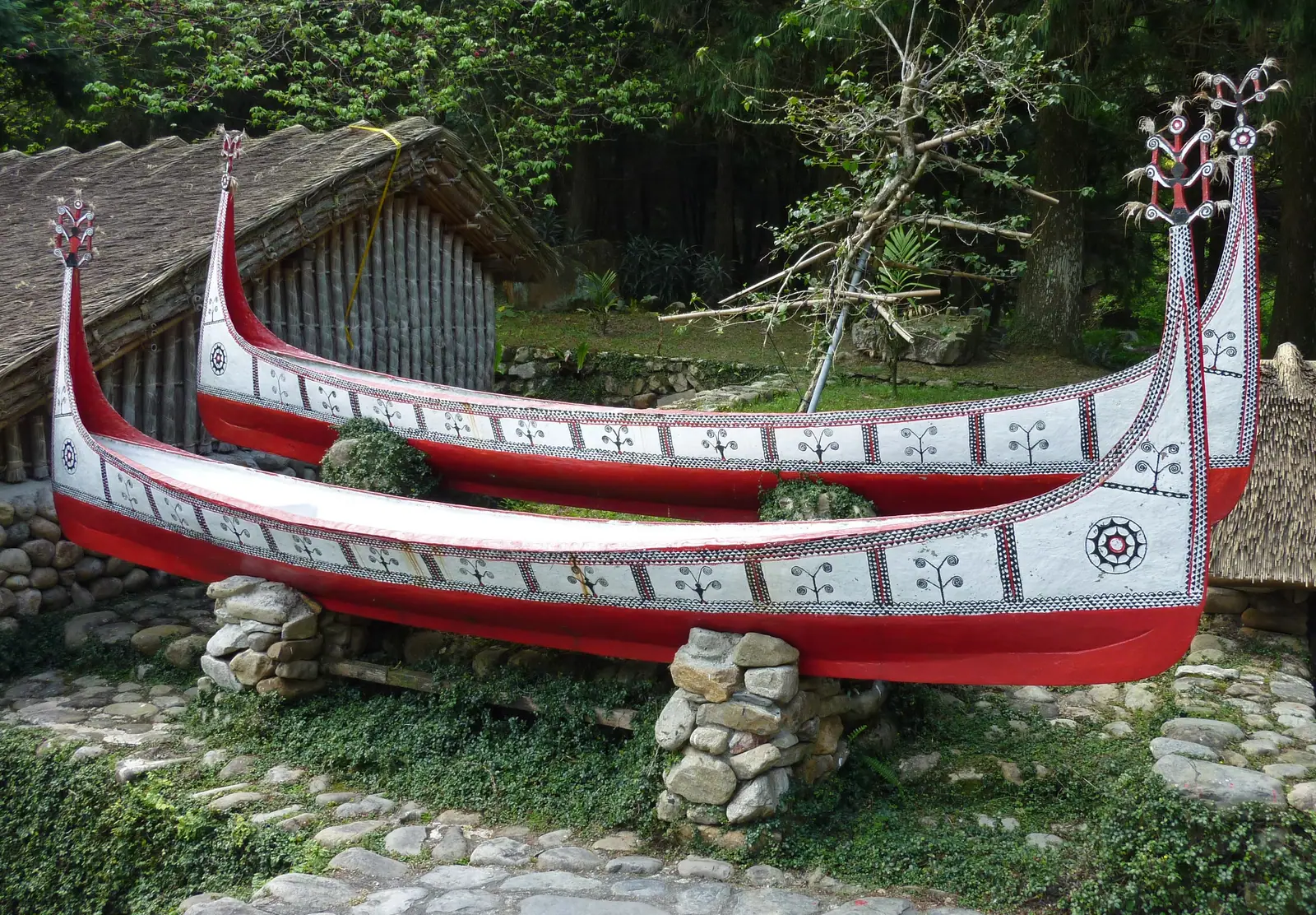
Two Tao outrigger canoes (ipanitika / balangay type) exhibited at the Formosan Aboriginals Culture Village in Nantou, with clear red-white-black color schemes and carvings, high prow and stern, placed side by side on stone bases. Note that these are display boats in the park, not boats in use in Lanyu tribes. Photo: Bernard Gagnon, 2011. License via Wikimedia Commons (CC BY-SA 3.0).
An interview with Syaman Misrako (Zhang Shikai) provides another scale. Reports record that he and his father, Zhang Maqun, built the canoe, requiring long-term accumulation from material selection, rough shaping, carving to shell ash and red clay painting. He stated that completing a boat alone might take half a year to a year. This is not a uniform schedule for all canoe builders, nor does it replace institutional data, but it allows us to see that "skill inheritance" is not an action completed in one class, but a life arrangement where family, farming, boat groups, and personal time yield to each other12.
The work of canoe builders also includes more than just making boats. To teach others, one must also know when to stop, which plank can no longer be shaved, which pattern can be carved, and which stage requires waiting. Such judgments are often difficult to write into standard operating procedures, so inheritance requires long-term joint work. Reports mention that in the 1980s, a gap in inheritance appeared; young people flowed out to Taiwan's main island, leaving a generation that said, "My friends are all elders, I have no young friends." When traditional crafts are shortened into tourist experiences, what disappears most easily is precisely this part of waiting, observing, and taking responsibility12.
Patterns Are Not the Boat's Stickers
The outrigger canoe's painting and carving are often extracted by tourist images into "Lanyu style." But the hull eye patterns, human figures, wave patterns, sun patterns, and the configuration of red, white, and black recorded in official data are not universal patterns that anyone can arbitrarily move onto commodities. The National Taiwan Memory Bank records that gear-shaped eye patterns are the boat's eyes, having an evil-averting function. The Marine Science and Technology Museum's exhibition panel explains that human figures commemorate ancestors who taught canoe building, wave patterns represent sea waves, and hull eyes guide tribe members to fishing grounds. The configuration rule of white paint in concavities, black paint in convexities, and vermilion on the four waterline planks, combined with three traditional pigments: red clay, shell ash made from burning night-shells, and charcoal2512. Research from the Bowers Museum on its collection also points out that two sets of concentric circles at the bow and stern represent the boat's eyes, the hull's carvings commemorate the hero Magamaog from Tao legends who taught the tribe agriculture and canoe-building methods, and the three-dimensional carvings at the bow and stern are decorated with real feathers8. These patterns appear together with the boat's identity, launch rituals, family, and maritime relations; they cannot be cut out separately from the hull and social context.
The National Taiwan Museum's 2025 online exhibition Path of the Hunter, Way of the Seafarer places selecting wood, mortise-and-tenon craftsmanship, hull eye patterns, wave patterns, human figures, launch rituals, the Kuroshio Current, the flying fish season, and star navigation in the same "Way of the Seafarer" exhibition area13. This exhibition method is noteworthy: it does not just treat the outrigger canoe as an object for viewing, but presents canoe building, navigation, oral tradition, prayers, and environmental knowledge together.
But the museum's integrated narrative cannot replace internal tribal differences. Different tribes, families, boat types, and rituals may have different words, norms, and practices. For knowledge bases, the correct way to write is not to translate all patterns into a beautiful symbol, but to clearly state "which source describes what in what context." If data only says hull eye patterns appear on display boats, do not expand it to claim all boats on the island must be so. If an interview describes one practice, do not rewrite personal life experience into a consensus for the whole tribe.
The Launch Ritual Turns the Boat into a Social Member
When a boat's structure is complete, it does not mean it has completed its social life. The description of the Yami (Tao) people's large boat launch ceremony on the National Cultural Heritage Network includes ritual processes such as mapabosbos, Manwaway, Mapatotalaw, and Mangavang, and stipulates that any boat with carved patterns must undergo a completion ceremony. The registered preservation groups cover six community development associations: Yeyin, Langdao, Yuyuan, Yuren, Hongtou, and Dongqing1. These names and processes should not be simplified into a tourist program schedule. They indicate that a new boat must enter the order of the tribe and the sea through collective action.
Activity reports from the Ocean National Park Management Office and the Ministry of the Interior's Taiwan Religious Culture Map record more detailed ritual structures: the day before the completion ceremony mapabosbos, taro must be harvested and relatives/friends invited; the first day involves piling taro to welcome guests and holding an all-night celebration song gathering; the second day involves distributing taro and pork, Manwaway (accumulating strength), Mapatotalaw (throwing the boat ritual), and Mangavang (test navigation for speed); the third day involves a banquet and rowing to a fixed point to receive lucky millet sent by the captain's wife. The launch link also includes taro-pile boat, distributing ceremonial meat (pork belly, blood, lungs, abdomen, stomach, intestines, etc.), Manawei, throwing the boat, and launch test rowing. Less known to outsiders is the distinction between ordinary launch ceremonies and completion ceremonies: ordinary launch ceremonies are held for large boats without carved patterns (ioiroaun); after carving (ipanitika), a special and grand completion ceremony is held. After carving, three preparations must be completed: harvesting taro (Mangap so soli / Mangap so ora), inviting guests (Mapatoyon / Manayid), and piling taro (Mapadpon), before the completion ceremony can be held46. The test navigation process is also full of symbolism: crew members slowly push the new boat into the sea to test stability; members on shore slaughter sacrificial chickens and pluck feathers; the speed of feather plucking symbolizes the new boat's navigation speed. After the new boat reaches its destination, the bow crew must catch fish and crabs; if crabs or octopuses are caught, it represents good luck for the new boat6. Reports also explain the norms for crew positions and test fishing actions: the Panavilaken steering at the stern must be tall, able to distinguish sea currents and observe weather; the first species of fish caught is interpreted as the boat's future fortune—grouper represents having fortune, cardinalfish represents wealth14. Here, rituals are not an added performance after boat building is complete, but a procedure that rearranges the boat, crew, food, family, and maritime actions. For a boat to navigate, it naturally needs a physical structure. For a boat to be recognized by the tribe, it needs a social structure.
This boat's social life is closely linked to the flying fish season rituals. The article Flying Fish Legends, Fishing Stories, and the Religious and Social Life of Tao Seafarers published in Indigenous Peoples Literature points out that flying fish in Tao culture are not only an important food source, but are respected as friends and viewed as divine cosmic beings: in the creation legend, the Heavenly God was sad because tribe members discarded flying fish, so in a dream, the Black-winged Flying Fish God (mavaeng so panid) revealed to the Stone-born ancestor the norms for catching, processing, and eating fish, and required tribe members to hold the Fish-Calling Ritual (mivanoa) annually to welcome the flying fish schools. The festival starts from late January to the end-food festival in early October; during this period, men must sleep indoors the night before going out to sea, relatives/friends cannot visit homes, women cannot do cooking work, and when walking, one must not step on others' houses. Strict taboos constitute the social order of the flying fish season14. The flying fish rituals, lasting several months each year, are the annual memory shared by all six Lanyu tribes, and the outrigger canoe is the indispensable protagonist in this ritual system—without boats, there is no night fishing during the flying fish season. Without fishing groups, there are no boats. This explains why "putting an outrigger canoe into a museum" and "preserving outrigger canoe culture" are not the same thing. Museums can preserve wood, carvings, paintings, and images, but cannot alone preserve how a boat is used in launch rituals, the flying fish season, fishing groups, and tribal relations. The best preservation strategy must simultaneously record objects, technology, words, people, seasons, and usage norms. Otherwise, what remains may only be the boat's appearance, not the entire system of knowledge that makes it a boat.
Avavang Reminds Us Not to Confuse Boats
Lanyu's traditional wooden small dugout canoe, avavang, is an important identification case. The Traditional Intellectual Property Protection Information Network for Indigenous Peoples records that avavang is carved from a single piece of wood, possibly from wood left over after making outrigger canoes. Oral history also mentions using it as a children's toy, a practice model for canoe carving, or a tourist souvenir15. In documents for this case, Hsiao Bi-khim (Xia Man Lanboan) stated that making avavang "besides being a toy for children, also hopes to arouse children's longing for outrigger canoes, inspiring their future interest in canoe building"15. This case was granted exclusive rights for traditional intellectual property in June 2023; the applicant is the Yami Tao (owned by the whole tribe, representative Zhang Maqun), and it compiles interviews from six tribes and claims of joint ownership15.
The difference between avavang and Tatara cannot be erased by "both are small boats." The former is a traditional wooden small dugout canoe carved from a single piece of wood; the latter is an outrigger canoe composed of multiple planks. The former's uses and inheritance stories include children's toys, carving practice, and souvenirs; the latter is deeply linked to fishing groups, the flying fish season, going out to sea, rituals, and crew order. The two can be linked in material remnants, father-son learning, and children's imagination, but they are not the same type of boat.
This case also brings cultural preservation to the issue of rights. When the outrigger canoe's hull eyes, patterns, proportions, or avavang shapes are mass-reproduced into commodities not made by tribe members, external viewers may only see "very Lanyu style," and not see the community, oral history, and usage norms behind it. Traditional intellectual property protection is not against all exchange, but requires exchange to first acknowledge who has the right to explain, make, and authorize. This is especially important for designers, museums, schools, and the tourism industry.
2026: Reopening a Route Interrupted for Three Centuries
The public energy of the outrigger canoe reached a new scale in June 2026. The "Lanyu–Batan 300-Year First Voyage Project" was hosted by the Council of Indigenous Peoples, organized by the Foundation for Indigenous Culture Affairs, and supported by the Ministry of Culture, the Ocean Commission, and the Ministry of Foreign Affairs. Six tribes and more than 200 participants spent three years preparing, using traditional methods to build the largest modern 20-person outrigger canoe, the Ovayan Golden Friendship (chinedkeran), approximately 12 meters long. The name Ovayan means "men's golden chest ornament" in the Tao language1016. This boat was completed in March, test-rowed on April 28, held the traditional large boat launch ceremony on June 9, departed from Longmen Port, Lanyu on June 15, with 60 rowers from the six tribes taking turns in relay, and arrived at Batan Island, Philippines on the evening of June 16, reopening the maritime ancient route interrupted for nearly 300 years1016. CNN's English report further records that this was a journey of approximately 111 nautical miles, relying on star navigation, against the strong currents of the Bashi Strait; the hull once took on severe water, finally completing the journey relying on rowers' rotation and the support of the escort fleet11.
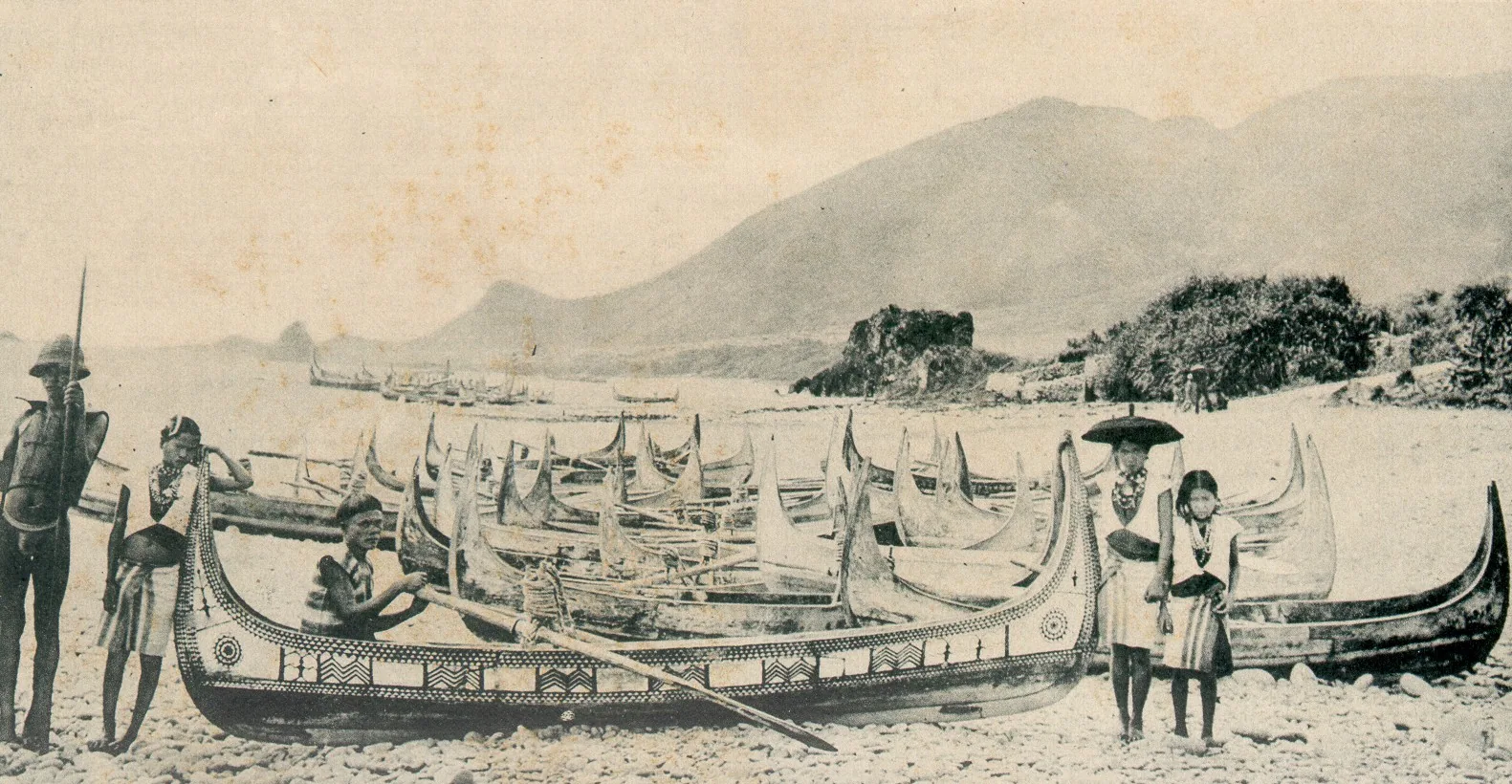
Image of Red Head Island from Taiwan Railway Travel Guide (published circa 1935): a large number of beautifully carved large outrigger canoes parked on the beach, island people and boat groups constructing the historical scene of Lanyu's maritime life. Photo: Unknown author. License via Wikimedia Commons.
The historical context of this route is deeper than general tourist discourse knows. The Tao and the Ivatan people of the Batan Islands belong to the Austronesian language family, showing long-term high similarity in language, boat-building skills, maritime knowledge, and life culture. For hundreds of years, both sides frequently traveled back and forth by traditional boats, maintaining trade, marriage, and cultural interaction. Travel reports compiling historical documents point out that oral history recorded by Dominican missionary Thomas Sanchez in 1801 mentions that residents of Itbayat Island once attacked a visiting boat, with only one survivor; after this, direct contact between the two places was interrupted, and the connection between Lanyu and Batan continued only through oral stories, ancestral memory, and sporadic documents16. Therefore, when the Ovayan Golden Friendship docked, the Tao rowers shouting together "Kakteh do cinai" (We are brothers and sisters of the same intestine) was not just a ritual slogan, but a public response to a specific history of interruption. Hundreds of Ivatan residents welcomed them with drums and dance, jointly lifting the outrigger canoe ashore, and marching in procession to the welcome venue1116.
This event also changed "how the world recognizes the outrigger canoe." Past international visibility came from museum collections and research literature—for example, the Bowers Museum used its collection of outrigger canoes to explain that the Tao and Philippine balangay share the "lashed lug" construction method; past reports on the Tao by international media like CNN were mostly focused on static culture8. The 2026 voyage was the first time this system of knowledge appeared in the form of "technology in use": the canoe builder's engineering judgment on surface flatness, the rowers' navigation practice of the Kuroshio Current and stars, the 60-person rotation organization, and the decision to gift the boat to Batan Island upon arrival, all pushed the outrigger canoe from an "object being watched" to a "system still solving problems"1110.
Source: CNA, Foundation for Indigenous Culture Affairs, TTN Travel Report (June 2026 reports)
Tourism Makes the Boat More Visible, But May Also Make the Boat Thinner
After the outrigger canoe entered exhibitions, images, online panoramas, and cultural experiences, it was indeed easier for people in other parts of Taiwan and international audiences to see. The National Taiwan Museum's exhibition placed Hsiao Bi-khim's interviews, tribal language prayers, outrigger canoe scenes, the Kuroshio Current, and star navigation into a multilingual panoramic exhibition. This allowed parts of the content that originally required being on Lanyu to be accessed by more people through digital forms13. Visibility itself is not the problem; the problem is whether the display turns culture into a decontextualized background image.
Syaman Misrako's interview also presents another form of publicness: the canoe builder, through crossing the sea, cultural promotion, and tourist activities, brought outrigger canoe technology into larger public discussions. At the same time, the report preserved the tension between traditional taboos, tribal life, and tourist experiences—he mentioned that during the flying fish season, experiences are not open; traditionally, women are prohibited from boarding the boat (tribe members worry it affects fishing); and cultural experiences allow women to actually contact the outrigger canoe, which is the balance he seeks between traditional norms and tourist demands. The number of experience boats on the island has grown from 5 or 6 to nearly 2012. Academic research on the tourism of outrigger canoes warned earlier: Cai Weixuan's 2009 master's thesis observed the tourism phenomenon of Lanyu outrigger canoes, pointing out that when taboos and traditions gradually melt away, and outrigger canoe experiences are pulled into the tourist field as another form of economic production, the outrigger canoe culture will undergo great transformation. The study suggested that experience activities should add depth of cultural context17.
This tension cannot be wrapped up with the phrase "conflict between tradition and modernity." For canoe builders, tourism may bring income, apprentices, and display opportunities. For the tribe, if tourists only demand quick photos, short experiences, or purchase replicas, the boat may also be reduced to a consumption symbol. Therefore, cultural guiding must at least clarify three things. First, who made, used, or commissioned the boat before your eyes. Second, which content belongs to public display, and which involves rituals, taboos, or tribal rights. Third, whether the audience's photography, touching, imitation, and purchasing behaviors are allowed. This is not adding inconvenience to travel, but making "understanding culture" not just stop at having a photo.
The Object of Preservation Is Not a Perfect Boat
The most common misunderstanding of outrigger canoe preservation is thinking that preserving a complete boat equals preserving the canoe-building culture. A complete boat is certainly important, but it is only the result of a point in time. To let later people understand this boat, one still needs to know where the wood came from, who was responsible for selecting materials, how long canoe building took, which work was shared by family and boat groups, which ritual launched it, and how it was maintained after use.
Academic research material statistics, cultural heritage registration ritual descriptions, museum structure explanations, and canoe builders' life stories just provide evidence at different levels. Research tells us that plank and tree species have comparable differences. Cultural heritage data tells us about rituals and preservers. The museum translates structure into public understanding. Interview subjects make schedule, learning, family, and gaps concrete. No single source can replace others.
This is the depth that Taiwan.md should record: not writing again "the outrigger canoe is a symbol of Tao traditional culture," but deconstructing "symbol" into verifiable relationships. Which wood supports which structure? Which source records which boat type? Which rituals are supported by which cultural heritage page? Which claims are only a canoe builder's life narrative? Which rights are the joint claims compiled by the traditional intellectual property protection application? When these layers are separated, the article will not turn indigenous culture into a beautiful adjective without authors, without time, without tribal differences. This writing method also allows readers to see how knowledge is produced: researchers measure, curators archive, tribes apply, canoe builders practice—each layer has its own evidence.
The Outrigger Canoe Is Still Answering a Modern Question
The modern significance of the outrigger canoe is not that it is more "pure" than fiberglass boats, nor that it is automatically worth preserving because it is ancient. It is important because it demonstrates a way of binding environment, technology, and society together: the forest is not a material warehouse, the sea is not a blank channel, the boat is not a neutral transport tool, and rituals are not performances added after completion. Every canoe building re-confirms how people obtain wood, how work is distributed, how one becomes a crew member, how one enters the flying fish season, and who has the qualification to describe this boat.
The 2026 voyage pushed this question to a more open position. The boat has been given to Batan Island, the route has been reopened, and Lanyu's canoe builders and the Philippines' Ivatan people have begun discussing subsequent language revitalization, craft exchange, and youth exchanges10. If only the boat's appearance is preserved, more and more things "like outrigger canoes" may appear in the future, but fewer and fewer people will know why planks are joined this way, why trees are selected this way, when patterns can be carved, and when boats can be launched. Conversely, if preservation work simultaneously supports canoe builders, tribal organizations, apprentices, researchers, and museums to establish long-term cooperation, the outrigger canoe does not need to be fixed in an imagined past. It can use digital records, enter new exhibitions, dialogue with environmental education, and continue to be built, rowed, and explained within the boundaries decided by tribe members.
What is most worth leaving of the Lanyu outrigger canoe is not the conclusion of "a very special boat," but a more difficult, more practical question: when a society connects forest knowledge, maritime experience, kinship relations, ritual norms, and aesthetic judgment into a boat, do we have the ability, when viewing it, not to mistake any part of it for decoration?
Further Reading
- Lanyu Ecosystem: Understand the island forest, coast, and ecological environment on which the outrigger canoe depends.
- Map of 16 Indigenous Cultures in Taiwan: Supplement ethnic distribution, names, and cultural context; does not replace this article's outrigger canoe topic.
- Taiwan Coastal Topography and Marine Landscape: Understand Taiwan's island and maritime life from a landscape scale.
References
Image Sources
This article uses 4 public domain or CC-licensed images, all cached in public/article-images/culture/ with EXIF personal information removed, avoiding hotlinking to source servers:
- Lanyu Outrigger Canoe and Tao People (circa 1931) — Photo: Unknown author (scan from Japanese colonial government publication), circa 1931, Public domain, Commons file
Ponso_no_Tao.jpg - Formosan Aboriginals Culture Village Tao Outrigger Canoe Display (2011) — Photo: Bernard Gagnon, 2011-05-19, CC BY-SA 3.0/2.5/2.0/1.0, Commons file
Yami_ipanitika.jpg - Red Head Island Beach Outrigger Canoe Group (circa 1935) — Photo: Unknown author (Taiwan Railway Travel Guide 1935 published image), circa 1935, Public domain (PD-Japan-oldphoto), Commons file
Tao_people_and_their_boats_circa_1935.jpg - Tao Outrigger Canoe Collection Close-up (2019) — Photo: 氏子 (Wikimedia Commons uploader), 2019-10-21, CC BY-SA 4.0, Commons file
雅美族伊瓦達斯社拼板舟.jpg
- National Cultural Heritage Network: Yami (Tao) People's Large Boat Launch Ceremony — Folk cultural asset registered in 2010, explaining the distinction between large boat Chinurikuran and small boat Tatala, completion ritual processes from mapabosbos to Mangavang, and six-tribe preservation groups.↩23
- National Taiwan Memory Bank: Outrigger Canoe (Tatara) — Collection record of the National Taitung Life Art Museum, describing Tatara plank count, wooden peg joining, three-color dyes, and hull eye patterns, citing 1930s Eastern Taiwan Outlook island-wide boat statistics.↩2
- National Museum of Prehistory: 10 Stories of Museum Collection Artifacts—Tao Silver Helmet and Outrigger Canoe — Taiwan Prehistory Cloud collection introduction, recording tatala large and small boats composed of 27 and 21 planks respectively, and principles of selecting materials based on hull position.↩
- Ministry of the Interior, National Parks Administration, Ocean National Park Management Office: Canoe Building Culture—Lanyu Large Boat Building and Crossing the Kuroshio Series Activity Reports — 2011 official activity report, detailing canoe material division, three-year preparation, launch rituals, and crew norms.↩23456
- National Museum of Marine Science and Technology: Outrigger Canoe Exhibition Guide (Exhibit Panel 08) — Marine Science Museum panel explanation, structuring knowledge of Syzygium buxifolium keel, Ficus microcarpa and breadfruit gunwales, small-leaf mulberry pegs, and painted patterns.↩23456789
- Ministry of the Interior Taiwan Religious Culture Map: Yami (Tao) People's Large Boat Launch Ceremony — Folk cultural asset registration data, recording Stone-born and Bamboo-born creation legends, ioiroaun and ipanitika two launch ceremonies, taboo of large boats carrying 10 people, and details of fishing group organization operation.↩23456
- Zheng Hanwen, Wang Guiqing, Liao Shengfu, Shi Nabo: "Structural Materials of Yami Outrigger Canoes on Lanyu," Research on Eastern Taiwan, Issue 7 — 2002 academic paper, measuring 132 boats, analyzing plank data of 191 boats, quantifying the material structure of six tree species accounting for 85.45% and differences between tribes.↩
- Bowers Museum: Magamaog's Lashed Logs: Yami Canoes of Orchid Island — 2020 English collection research, explaining three-keel structure, wooden peg mortise joining, three-color natural pigments, and Magamaog pattern canoe knowledge.↩23456
- Chinese Wikipedia: Fishing Group Organization — Summary of fishing group organization (kakavay) member norms, boat crew numbers and paddle position systems, priest rotation, and contemporary evolution.↩2
- CNA: Lanyu Outrigger Canoe in Taitung Rows to Batan on 6/15, Recreating the Maritime Ancient Route — June 2026 news, recording Ovayan Golden Friendship canoe schedule, 300-year first voyage plan, and Council of Indigenous Peoples chairman's speech.↩2345
- CNN: Using the stars and paddles, indigenous Taiwanese recreate risky sea journey of Great Pacific Migration — June 2026 English report, recording 111-nautical-mile star navigation journey, hull water crisis, and Austronesian migration context.↩234
- Home Run Taiwan: Interview with Canoe Craftsman Zhang Shikai—"The Outrigger Canoe Is My Foot on the Sea!" — 2020 profile interview, recording canoe builder Zhang Shikai's family inheritance, schedule experience, 1980s inheritance gap, and balanced practice of tourist experiences.↩234
- National Taiwan Museum: Follow the Outrigger Canoe and Hunter's Hut to Explore! NTM's Latest Online Panoramic Exhibition News — 2025 Path of the Hunter, Way of the Seafarer online panoramic exhibition news, integrating canoe building, navigation, Kuroshio Current, and star knowledge in the same exhibition area.↩2
- Indigenous Peoples Commission Indigenous Peoples Literature Issue 28: Shi Jingyi "Flying Fish Legends, Fishing Stories, and the Religious and Social Life of Tao Seafarers" — 2016 journal article, analyzing Black-winged Flying Fish God dream legend, flying fish season taboos, and six-tribe shared memory, citing Hsiao Bi-khim's observation of the disappearance of outrigger canoes.↩
- Traditional Intellectual Property Protection Information Network for Indigenous Peoples: Yami Tao avavang (Traditional Wooden Small Dugout Canoe) — 2023 IP protection case granting exclusive rights, compiling oral history from six tribes, claims of joint ownership, and avavang production norms.↩23
- TTN Travel Report: Tao Outrigger Canoe Arrives at Batan Island, Philippines, Crossing Bashi Strait to Reopen 300-Year Route — June 2026 news, recording arrival ceremony, meaning of "Kakteh do cinai," and route interruption history described in 1801 Thomas Sanchez documents.↩234
- Cai Weixuan: Lanyu Outrigger Canoe Tourism Phenomenon and Its Changes Master's Thesis (National Taiwan Normal University) — 2009 academic research, using interviews and observation to discuss the tourism transformation of outrigger canoe experience activities and suggestions for cultural value-added.↩