
Image display from the National Museum of Science and Technology, "The Beauty of Taiwanese Nephrite." Photo: National Museum of Science and Technology. The image is embedded directly from the source page; it was not downloaded by this article. See "Image Sources" at the end for the image source page.
30-Second Overview: Taiwan chatoyancy is not a nickname for gold-green cat's eye jade in Taiwan, but rather a visual variety of Taiwanese nephrite found in the Fengtian area of Hualien. The parallel fibers within the stone allow the surface, cut into an arc shape, to capture a bright band that moves with the light. 1 However, this seemingly natural marvel must be seen through geological processes, correct orientation, long-term grinding, and a history composed of miners, home artisans, and local memory.
📝 Curator's Note
Taiwan chatoyancy is easily reduced to a beautiful noun: Hualien, green, cat's eye, rare. But these four words together still fail to tell the reader how a ray of light came into being. I want you to first follow the light, and then look back at the fibers in the stone, the mining in the mountains, and the jade grinding sounds in the villages. What truly needs preservation is not just that moving bright band, but also the people and place that allow the band to be seen.
The Gaze First Caught by a Ray of Light
When polished Taiwan chatoyancy is placed under light, the human eye naturally follows the bright line rather than inventorying the color first. As the stone slightly rotates, the bright line glides left and right across the green surface like an unfixable eye. It is not painted on the surface, nor is it a reflection artificially created by a shop's lighting. What truly concentrates the light is the internal structure of the stone.
In gemology, this single bright band is called chatoyancy in English. The Smithsonian National Museum of Natural History notes that light is reflected by microscopic hollow tubes or fibrous crystals arranged parallel within the gemstone. When the stone is cut into a convex-top, flat-bottom arc surface, the reflected light is concentrated into the surface's bright band. 2 Therefore, chatoyancy is not determined solely by "whether a certain mineral exists," but also involves fiber orientation and cutting geometry.
This principle gives Taiwan chatoyancy a character well-suited to Taiwan: it is both an order left deep underground and the result of humans translating that order into vision. The ore vein will not deliver the bright line to human eyes on its own. Artisans must first discern which texture in the rough material might become the light band, then allow tools, grinding wheels, and water to slowly reveal that direction. What we ultimately see is a joint signature of the stone and the person.
Clarifying the Name: It Is Not Gold-Green Jade
"Cat's eye stone" easily becomes a generalized term in the market, as if all green stones with bright lines belong to the same gem category. Here, three terms must be separated: chatoyancy is an optical effect, nephrite is a mineral classification, and Taiwan chatoyancy refers to the material exhibiting the chatoyancy effect among Taiwanese nephrites. These three cannot be interchanged.
| Name | What it answers | Correct placement in a Taiwan Chatoyancy article |
|---|---|---|
| Chatoyancy Effect | Why is there a moving bright band on the surface? | Describes an optical phenomenon, not a mineral name. |
| Nephrite | What category of jade does this material belong to? | The mineralogical name for Taiwanese jade, belonging to the pyroxene group. |
| Taiwan Chatoyancy / Cat's Eye Nephrite | Which type of Taiwanese nephrite has this effect? | Refers to the variety of material from the Fengtian area of Hualien after processing. |
| Gold-Green Cat's Eye | What is another famous cat's eye gem? | Used for comparison, not a synonym for Taiwan chatoyancy. |
The National Museum of Science and Technology refers to Taiwanese nephrite as Taiwanese jade or Fengtian jade, noting that the parallel crystalline structure of some nephrites produces the chatoyancy effect when ground, hence it is called cat's eye nephrite. 1 The significance of this statement is that it grounds "Taiwan chatoyancy" in a verifiable material condition, rather than leaving it as a romantic name on a jewelry counter.
Gemological Institute of America (GIA) reports also use cat’s-eye nephrite to describe nephrites with the chatoyancy effect and record that most related deposits in Taiwan are largely exhausted. 3 This does not mean Taiwan chatoyancy no longer exists, but it reminds us: a finished product still visible on the market is different from a mine capable of continuously supplying raw materials. The stone can remain, but the supply chain may retire first.
The Geological Origin of the Light
The story of Taiwan chatoyancy begins at the contact zone rocks in eastern Hualien. The National Museum of Science and Technology points out that Taiwanese nephrite is mainly produced in the serpentine and black slate contact zones of the Fengtian area of Hualien, formed through hydrothermal alteration, and often co-exists with minerals like asbestos and talc. 4 This is not a green stone lying alone in the mountains waiting to be discovered. It is a seam left by the rock body, hot water, pressure, and time working together.
Research conditions compiled on the same museum display page list the alteration temperature at approximately 300 to 420 degrees Celsius, pressure around 2.2 to 3.5 kilopascals, corresponding to a depth of about 8 to 13 kilometers beneath the surface, with a formation time of about 3.3 million years ago, with an error range of plus or minus 1.7 million years. 5 These numbers should not be written as a magnificent geological myth. They truly change the scale of observation: the chatoyancy in the palm of one's hand is not from decades, nor is it from a craftsman's workshop, but from a rock cycle far longer than human history.
An article from the Taiwan Prehistoric Culture Museum published by Science and Technology Grand Garden supplements the material quality from a mineralogical perspective: nephrite belongs to the pyroxene group, mainly composed of clinopyroxene and diopside, forming an interwoven fibrous structure with a hardness of about 5.5 to 7 degrees. Taiwanese jade has a relatively high iron content, with colors ranging from emerald green to dark green. 6 The common name "soft jade" is therefore often misleading. It is a mineral classification relative to hard jade and does not mean the material crumbles when squeezed. The interwoven fibers actually give nephrite toughness.
If we zoom in further, the NMNS display page provides a more concrete material scale. Nephrites are often found as translucent bodies or deformed plastic breccias in the contact zones of black slate and serpentine. The thickness of general ore bodies is usually 10 to 50 cm, reaching up to 1.5 to 2 meters locally, extending about 20 to 30 meters, and even within the same area and stratum, color, transparency, thickness, and size can differ significantly. 7 These differences explain why "the same production site" cannot directly equal "the same finished product quality."
The same page also compiles physical and chemical clues for nephrites: most nephrites have a Mohs hardness of about 6.0 to 6.5, and a specific gravity of about 2.9 to 3.1. The Mg/(Mg+Fe) ratio of Fengtian nephrite generally ranges between 0.81 and 0.93, belonging to the range of clinopyroxene to diopside. When iron content increases, the color can change from light green to dark green, and it may lean towards emerald green when chromium content is higher. 7 Therefore, color can be an entry point for observation, but it should not be taken as sole proof of origin.
Image display from the National Museum of Science and Technology, "The Appearance of Taiwanese Nephrite." Photo: National Museum of Science and Technology. The image is embedded directly from the source page; it was not downloaded by this article. See the end for the image source.
The raw stone surface does not yet show chatoyancy. What you see might be dark green, grayish-green, or yellowish-green, or perhaps intertwined with white host rock and black cleavage. What truly needs to be found is whether the fiber arrangement can form concentrated reflection after processing. This is why cat's eye cannot be judged solely by "beautiful color." Color is the first glance; fibers are the interior of the material; the bright band is the moment the process turns the interior into the surface.
The Waste Rock Gets Renamed
The modern jade history of Fengtian, Hualien, does not begin with a mine opened for jade. A newsletter from the National Taiwan Prehistoric Culture Museum records that Japanese people discovered asbestos in Lao'nao Mountain, Fengtian, Hualien, in the 1930s while hunting. During World War II, asbestos was extensively mined for insulation purposes, and the Taiwanese nephrite found alongside it was often treated as useless waste rock. It wasn't until 1956 that Liao Xuecheng, then a university student, noticed the "waste rock" next to the asbestos mine during geological surveys, and Taiwanese jade re-entered human sight. 8
"Re-entering sight" is more accurate than "being discovered." The stones in the mountains were always there; what changed was how people classified them: yesterday they were obstacles that had to be moved when quarrying asbestos; today they became materials that could be cut, ground, and exported. The stone did not suddenly become beautiful; society began to look at it with a different set of values.
A curatorial note from the Hualien County Archaeological Museum places this turning point into the local history of Fengtian: Taiwanese nephrite was discovered and identified in 1956, reaching its peak production in 1975. The museum did not just write about the ore veins and output; it included mining, transport, processing, and residents' memories in the exhibition. A mine's history thus belongs not only to mining companies but also to those who climbed the mountain, carried stones, and ground jade at home. 9
This history also explains why the name "Fengtian Jade" carries weight. It is not merely a place label, but a designation that binds the mountains and the villages together. When the stone was carried down from the mountain, it did not just enter the market; it entered a family's workbench, a corner familiar to a child, and an old photograph preserved many years later.
The Path of Transport and the Household Factory
A black-and-white photo from 1966 shows miners carrying raw stones down a stream-valley rubble slope using shoulders, carrying frames, and human power. The photo does not tell us how much each stone ultimately sold for, but it gives weight back to an industry often flattened by the four words "local specialty." Jade did not walk out of the mountain into the shop on its own.
The exhibition recorded by the Hualien County Archaeological Museum divides the industry from the 1950s to the 1960s into seven themes: "Jade, Asbestos, and Mountains," "Taiwanese Jade in a White Veil," "Making Taiwanese Jade Shine," "Carrying Stones Up the Mountain for Livelihood," "The Home as a Factory," "The Prosperity of the Jade Street," and "Fading Light." 10 This set of titles is like a cross-section of local life: first, the ore in the mountains; next, the bodies of the miners; then, the processing sounds in the households; finally, the space and memory left after industrial decline.
"The Home as a Factory" is particularly worth pausing at. When jade material was cut into processable shapes, the industry no longer happened only in the mine pit. It entered private homes, townhouses, and small workspaces. Family members shared different processes; the jade core and grinding dust on the table became part of daily scenery, and children might treat the jade cores left from grinding as toys. Local economy here is not an abstract production curve, but who worked an extra night at home, who knew a certain sound of a grinding wheel, or who decided whether to keep or discard a piece of material.
Historical photo of workers from China Stone Mining Company transporting raw stones in 1966. Photo: Ms. Zhou Suyun. The image is embedded directly from the source page; it was not downloaded by this article. See the end for the original source.
The path of carrying stones in the photo and the chatoyancy in the display case today are not similar, but they are actually the front and back ends of the same process. Without the upstream collection, sorting, and transport, there is no material to be ground downstream. Without the downstream judgment of fibers and shape, the stone carried down upstream will only continue to be called a stone. The "treasure" is not endowed at one moment, but established gradually across an entire chain of labor.
Skill Is Not Just Polishing the Stone Bright
The easiest misunderstanding of chatoyancy is that the finished product looks quiet: a small arc, a clear bright line, no mine noise, and you cannot see how much material was removed by the grinding wheel. But the cutting and polishing work is not about "making the stone beautiful"; it is about making a choice based on directions already existing within the material.
If the arc direction does not align with the fiber arrangement, the light may scatter into a blur, the bright band unclear, or only ordinary polish remaining. If cut too deeply, the material might expose cracks. If overall stability is sacrificed to pursue the bright line, the finished product may not be worth keeping. The artisan's judgment is not just in the final polishing stroke, but whether they can read what it might become from a raw stone that has not yet spoken.
The NMNS display classifies Taiwanese nephrite into three types: ordinary nephrite, luster nephrite, and chatoyancy nephrite, while also exhibiting mining history and jade carving techniques. 11 This classification shows us that chatoyancy is not the standard answer for all Taiwanese jade, but a result of the intersection between internal material conditions and processing methods. In other words, the origin itself does not guarantee that every stone has chatoyancy. "Taiwan" provides the lineage; fibers, orientation, and technique jointly determine the final expression.
Data compiled by Science and Technology Grand Garden also lists several physical clues for Taiwanese jade: hardness of about 6.5 degrees, specific gravity of about 3, refractive index of about 1.62, and a glassy luster on the surface. 6 These numbers are not simple formulas for readers to appraise the jade at home, but they separate "looking similar" from "what the material is." Similar-looking green nephrites cannot be judged by sight alone. The National Taiwan Prehistoric Culture Museum also records that researchers from the Academia Sinica examined Taiwanese jade's chromium iron ore using scanning electron microscopy and energy spectrum analysis, finding zinc content as a basis for identifying Taiwanese jade. 12
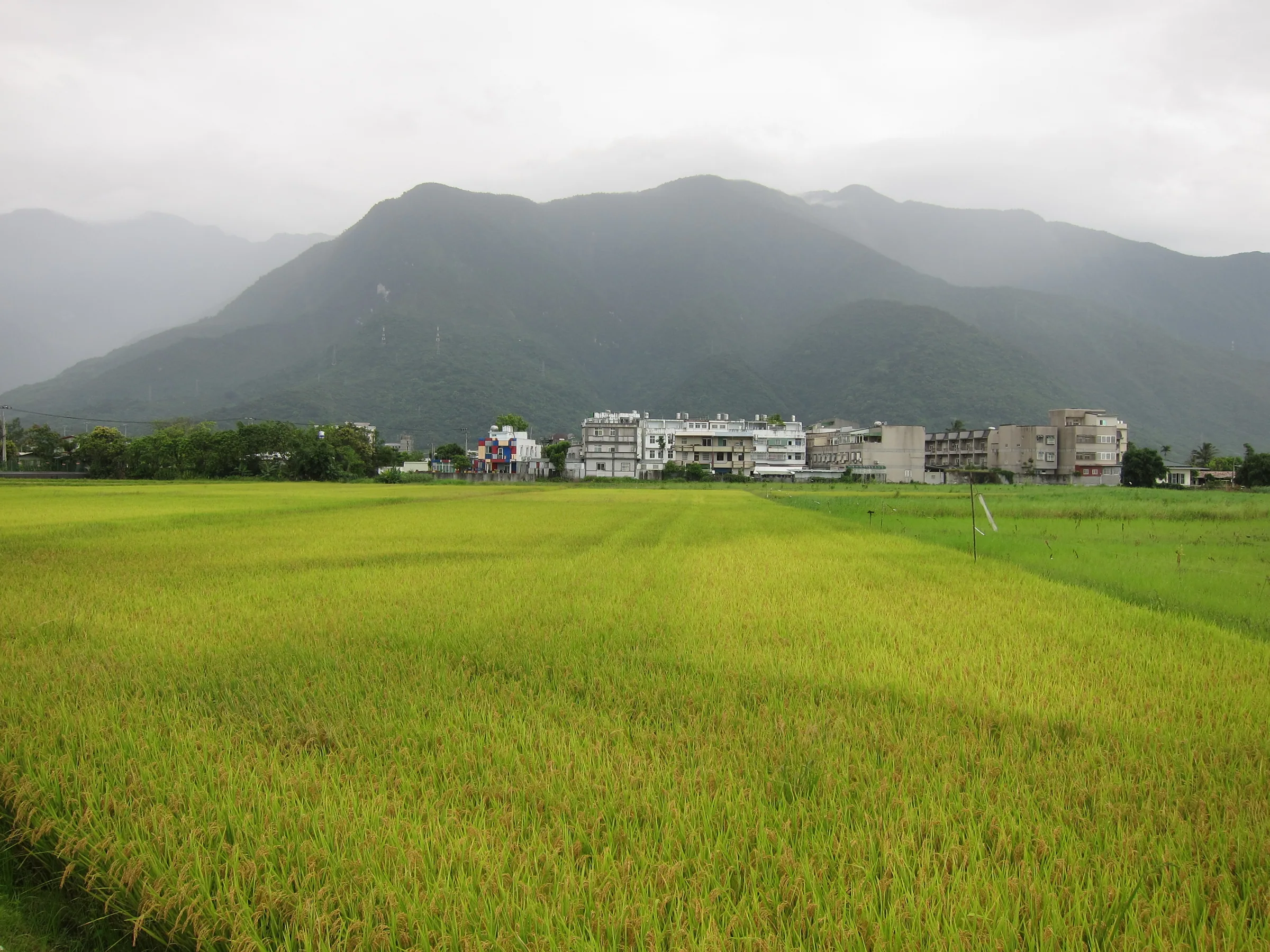
Hualien County landscape, serving as the visual backdrop to the Fengtian Jade context, is not a mine location map. Photo: Ken Marshall. Wikimedia Commons, CC BY 2.0. Image page.
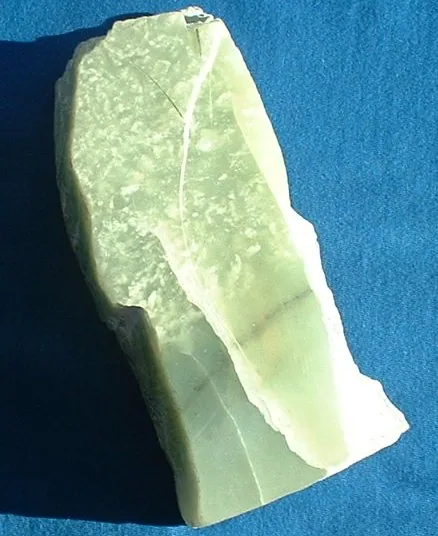
An example of a freely licensed jade raw stone used to contrast that "jade" and "chatoyancy effect" are not the same concept. Photo: Immanuel Giel. Wikimedia Commons, CC BY-SA 3.0. Image page.
Jade grinding tools exhibited by the Hualien County Archaeological Museum. Photo: Hualien County Archaeological Museum, self-taken. The image is embedded directly from the source page; it was not downloaded by this article. See the end for the original source.
The photo of the tools brings this matter back to the body: grinding is not an abstract "technique," but the accumulation of how fingers grip the material, how eyes track the texture, and how ears listen to the contact state between the grinding wheel and the stone. Every scratch might be a judgment, or it might be a mistake. Turning over a raw stone every time is re-evaluating the relationship between the bright band, weight, cracks, and usable area.
Therefore, a beautiful chatoyancy should not just be described as "naturally formed." If this sentence is only half true, it hides the labor of the artisan. A more accurate statement is: the fiber arrangement that forms the chatoyancy effect comes from natural geology, but the visible bright band is the result of cooperation between natural structure and artificial cutting. Nature is not the opposite of human hands; human hands are the interface through which natural structures are understood, used, and preserved by society.
When the Light Fades, It Doesn't Mean the Stone Disappears
The modern industrial peak of Taiwanese jade did not last indefinitely. An article from Science and Technology Grand Garden records that after 1965, Taiwanese jade was heavily mined and processed for over a decade. Later, indiscriminate blasting reduced material yield and quality, increasing mining costs, coupled with improper sales methods and competition from similar Canadian jade imports, causing the market force to gradually decline, with mines sequentially closing around 1980. 13
This decline cannot be simplified as "everyone suddenly disliked Taiwanese jade." It encompasses changes in mining methods, material quality, cost, sales, and international supply. When an industry prioritizes speed over material judgment, it may deliver more stones down the mountain in the short term, but in the long run, it can grind away yield, quality, and trust. The market's ebb tide is both external competition and the consequence of internal production methods.
GIA’s report on cat's eye nephrite reminds us to separate mine status from market acceptance. The article describes, on one hand, that most chatoyancy nephrite deposits in Taiwan are exhausted, and on the other hand, points out that the acceptance of cat's eye nephrite in the jewelry market is still in an early stage. 14 These two things together are closer to reality than "rare means expensive": limited material supply does not mean every market has understood its value. A small market does not mean local craftsmanship is meaningless.
The curatorial note from the Hualien County Archaeological Museum mentions that residents provided old photos, jade carrying boards, cut jade pieces, grinding tools, and oral histories, preventing the industry from remaining only in official timelines. 15 After the industry retired, these objects served another function: they were not tools on a production line, but evidence allowing people to recount "how we lived."
A mine stopping large-scale extraction does not mean the local story is sealed. It simply shifts from a production problem to a preservation problem: which tools should be kept? Which processes should be taught to the next generation? Which narratives need re-verification? Which materials can be displayed, and whose rights must be confirmed for certain images? When museums place jade cores, old photos, and grinding tools in the same space, what is preserved is not just the jade, but how the jade entered human life.
The Prehistoric Jade Path Makes Modern Stories Longer
If we only write about Taiwanese jade starting from 1956, it is easy to portray it as a modern local specialty that suddenly appeared. In reality, before modern mining, the jade materials in Fengtian, Hualien, were already part of a longer prehistoric cycle of use and exchange. The exhibition report from the National Museum of Science and Technology points out that Taiwanese jade was used by ancestors as early as the Neolithic period, about 5,000 years ago. The exhibition places "ancient use" and "modern material" on the same cultural line through archaeological artifacts, mining history, and jade carving techniques. 16
The article from Science and Technology Grand Garden further records that jade materials in the Fengtian area of Hualien circulated via sea or land routes; Taiwanese jade artifacts have been excavated at over a hundred sites across Taiwan, and related artifacts exist in Penghu, Green Island, and Lan Ta. 17 This does not mean every piece of jade used by prehistoric people was chatoyancy nephrite, nor does it mean the people at that time understood the material using modern gemological classifications. It shows that this eastern ore vein was long more than just a resource in the mountains; it was brought into a network of tools, decorations, exchange, and community relations.
A curatorial response from the National Taiwan Prehistoric Culture Museum is highly suitable to place alongside this history: "No! Quite the opposite; through jade, we see the history of Taiwan." 18 Through jade, we see not just who owned a beautiful ornament, but also how transportation occurred, how materials were identified, how artisans specialized, and how an island interacted with other places at sea.
This also allows "chatoyancy" to avoid bearing all the historical weight. Chatoyancy nephrite is a special manifestation of modern material and technique; prehistoric jade artifacts provide a longer cultural background. Both can meet in one article, but they cannot be mixed as objects from different eras. Good local writing does not stack up all the lights, but allows each ray to maintain its own source and time.
Letting a Ray of Light Remain
Looking at Taiwan chatoyancy today, perhaps what is most worth preserving is not the word "rare." It compresses various types of work into one small bright band: geologists describe how the rock formed, miners carry the raw stone out of the mountain, artisans judge the fibers and facets, households turn processing into income, researchers use microscopes to find lineage clues, and museums reorder tools, photos, and oral histories so that the next person knows this green stone did not appear from nowhere.
The database of the Ministry of Economic Affairs' Geological Survey and Mining Management Center still preserves the bibliographic record of Preliminary Study of Fengtian Jade Mine from 1975, listing authors, journals, volumes, issues, and pages, but it also clearly marks that the full text is not yet available online. 19 This small detail of "not yet available" is important. It reminds us that preserving local knowledge is not just about writing more numbers in an article, but knowing which data has been seen, which only exists as a bibliography, and which still needs to be inquired about from preservation institutions.
So, what Taiwan chatoyancy truly needs is a mode of viewing finer than advertising. First, identify it as the chatoyancy effect; do not mistake the optical phenomenon for a mineral name. Then, confirm that it belongs to Taiwanese nephrite; do not call all green jade "Taiwanese jade." Next, trace the raw materials, techniques, and origins, and finally, place it back into the industry and memory of Fengtian.
When you see that ray of light again, it is no longer just "like a cat's eye." It is also like a fine thread extending from deep within the earth, passing through the miner's shoulders, the household workbench, the dust left by the grinding wheel, the museum display case, and finally stopping in the reader's line of sight. At that moment, the stone did not speak, but the place has finished telling its own story.
Image Sources
Both images in this article are freely licensed and have been incorporated into the project public/article-images/culture/, without using external hot links.
- Wikimedia Commons: File:Landscape in Hualien County Taiwan.jpg —
hualien-jade-landscape-2011.webp, Photo: Ken Marshall, CC BY 2.0. - Wikimedia Commons: File:Jadestein.jpg —
nephrite-jade-stone-specimen.webp, Photo: Immanuel Giel, CC BY-SA 3.0.
Images from the National Museum of Science and Technology's "The Beauty of Taiwanese Nephrite" and the Hualien County Archaeological Museum's "Searching for Lost Jade Mine Memories Beneath Asbestos Mountains" were not included: the source pages did not specify reusable license terms, and the site policy requires that images be archived and licenses must be verifiable. Both exhibition pages are listed below in further reading and references.
Further Reading
- National Museum of Science and Technology: The Beauty of Taiwanese Nephrite — Suitable for first understanding the material itself, from mineral formation to chatoyancy effects and conditions for Taiwanese nephrite formation.
- Hualien County Archaeological Museum: Searching for Lost Jade Mine Memories Beneath Asbestos Mountains — Preserves the memories of miners, household processing, and local oral history through special exhibition curation.
- National Taiwan Prehistoric Culture Museum: Seeing Taiwan's History Through Taiwanese Jade — Understands how asbestos mining, modern jade industry, and prehistoric jade culture met.
- Science and Technology Grand Garden: Taiwanese Jade Spanning Thousands of Miles Over Millennia — Extended reading on the mineral characteristics, mine closures, and prehistoric exchange networks of Taiwanese jade.
References
- National Museum of Science and Technology: Unit Three: The Beauty of Taiwanese Nephrite — Official educational page for the Taiwanese nephrite special exhibition, describing nicknames, environmental origins, and conditions for chatoyancy nephrite formation through parallel fiber arrangement.↩2
- Smithsonian National Museum of Natural History: Cat's Eyes — Description from Smithsonian GeoGallery explaining how chatoyancy is formed by parallel fibers or hollow tubes and how curved grinding concentrates the bright band.↩
- GIA: Cat’s-Eye Nephrite Jade from Washington State — A professional article in GemNews by the Gemological Institute of America that uses the term cat’s-eye nephrite and records that most related deposits in Taiwan are largely exhausted.↩
- National Museum of Science and Technology: Unit Three: The Beauty of Taiwanese Nephrite — Official exhibition data compiling information on serpentine, black slate contact zones, hydrothermal alteration, and the co-existence of asbestos and talc.↩
- National Museum of Science and Technology: Unit Three: The Beauty of Taiwanese Nephrite — The same official educational page compiles the alteration temperature, pressure, depth, and formation time for Taiwanese nephrite; this article retains the error range from the page's research compilation.↩
- Science and Technology Grand Garden: The Mysteries of Taiwan's Prehistoric Culture: Taiwanese Jade Spanning Thousands of Miles Over Millennia — An article by authors of the National Taiwan Prehistoric Culture Museum published in a national science popularization platform, explaining the pyroxene composition, fibrous structure, hardness, and color of Taiwanese jade.↩2
- National Museum of Science and Technology: Unit Three: The Beauty of Taiwanese Nephrite — The official display pages "The Appearance of Taiwanese Nephrite" and "Nephrite Characteristics and Chemical Composition," which explain the ore body appearance, size differences, Mohs hardness, specific gravity, Mg/(Mg+Fe) ratio, and color formation.↩2
- National Taiwan Prehistoric Culture Museum: Seeing Taiwan's History Through Taiwanese Jade — A curatorial article from the Prehistoric Museum newsletter that records the history of asbestos mining in the 1930s, WWII extraction, and Liao Xuecheng noticing associated jade in 1956.↩
- Hualien County Archaeological Museum: Searching for Lost Jade Mine Memories Beneath Asbestos Mountains — A local museum's curatorial note that records the identification as Taiwanese nephrite in 1956, reaching peak production in 1975, and the background of reconstructing industrial history through residents' memories.↩
- Hualien County Archaeological Museum: Searching for Lost Jade Mine Memories Beneath Asbestos Mountains — The article lists seven themes that reconstruct the mining, transport, processing, and local prosperity from the 1950s to the 1960s in the exhibition, supporting the narrative of miners and household factories in this article.↩
- National Museum of Science and Technology: National Museum Gem Exhibition "Jade Stories: The Legend of Taiwanese Jade" Opening — An official press release from the NMNS introducing the display of ordinary nephrite, luster nephrite, and chatoyancy nephrite, as well as the mining history and jade carvers of Taiwanese jade.↩
- National Taiwan Prehistoric Culture Museum: Seeing Taiwan's History Through Taiwanese Jade — An article quoting a researcher from the Academia Sinica who examined Taiwanese jade's chromium iron ore using scanning electron microscopy and energy spectrum analysis, using zinc content as an identification basis.↩
- Science and Technology Grand Garden: The Mysteries of Taiwan's Prehistoric Culture: Taiwanese Jade Spanning Thousands of Miles Over Millennia — An article that explains heavy mining and processing after 1965, the reduction in yield and quality due to indiscriminate blasting, competition from Canadian jade, and the sequential mine closures around 1980.↩
- GIA: Cat’s-Eye Nephrite Jade from Washington State — A GIA report that provides both international background on chatoyancy nephrite deposits and market acceptance; this article only uses content directly related to the status of Taiwanese deposits and the market stage.↩
- Hualien County Archaeological Museum: Searching for Lost Jade Mine Memories Beneath Asbestos Mountains — A curatorial note describing residents providing old photos, jade carrying boards, cut jade pieces, grinding tools, and oral histories, explaining how these objects became carriers of local memory.↩
- National Museum of Science and Technology: National Museum Gem Exhibition "Jade Stories: The Legend of Taiwanese Jade" Opening — An official exhibition report tracing the use of Taiwanese jade back to the Neolithic period, about 5,000 years ago, and placing archaeology, mining, and jade carving techniques within the same exhibition context.↩
- Science and Technology Grand Garden: The Mysteries of Taiwan's Prehistoric Culture: Taiwanese Jade Spanning Thousands of Miles Over Millennia — An article by authors of the National Taiwan Prehistoric Culture Museum that compiles the archaeological distribution of Fengtian jade materials in various parts of Taiwan, outlying islands, and surrounding seas.↩
- National Taiwan Prehistoric Culture Museum: Seeing Taiwan's History Through Taiwanese Jade — A curatorial article from the Prehistoric Museum newsletter that proposes the curatorial viewpoint "seeing Taiwan's history through jade," quoting this text in the article.↩
- Taiwan Geological Knowledge Service Network: Preliminary Study of Fengtian Jade Mine — The official bibliographic page of the Ministry of Economic Affairs' Geological Survey and Mining Management Center, which preserves the author, journal name, volume, issue, and pages of the 1975 Metallurgy paper, and clearly states that the full text is not yet available online.↩