
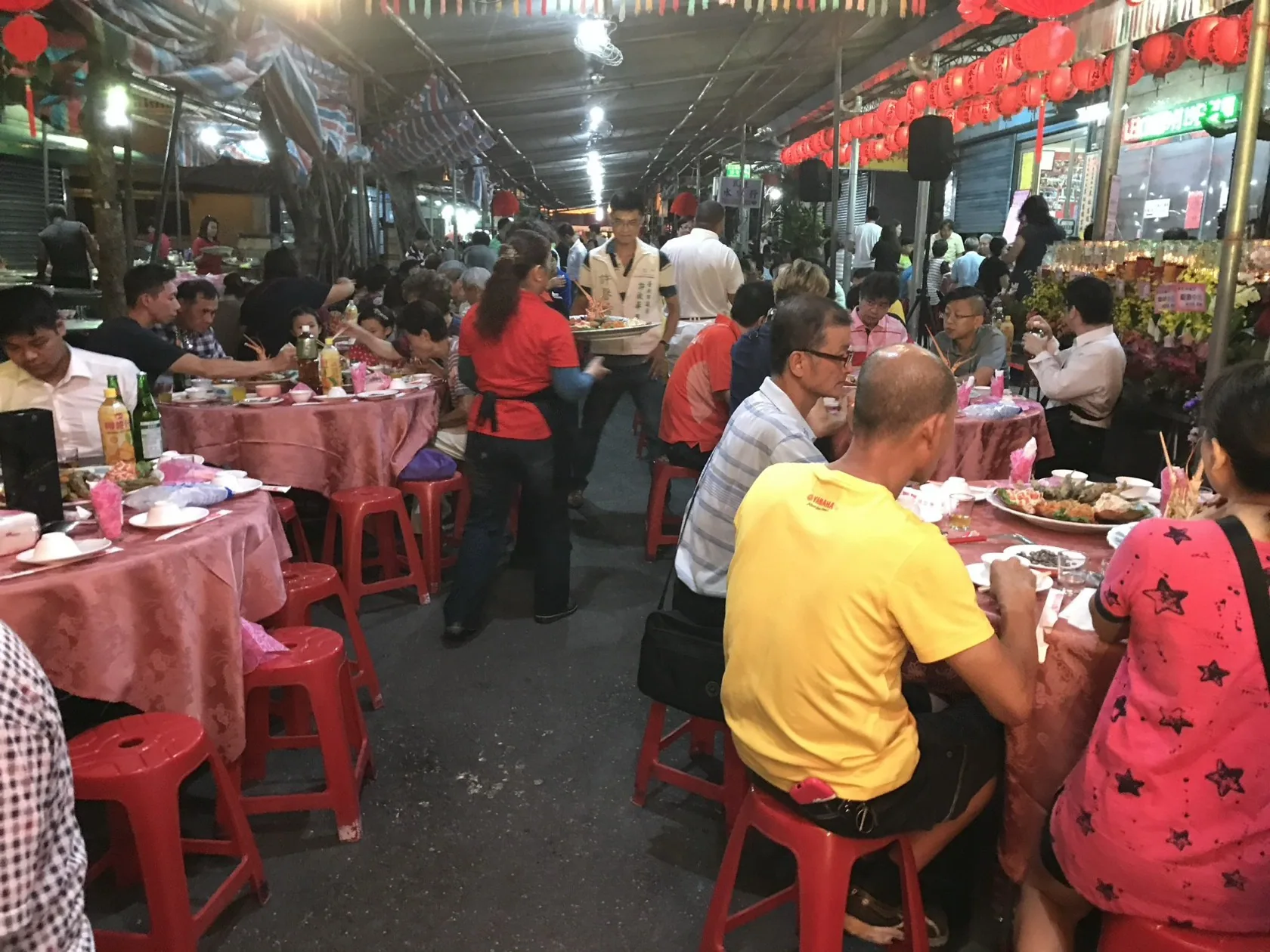
30-Second Overview: Bando is not a modern invention; the Taiwan County Gazette from the late Kangxi reign of the Qing Dynasty recorded that Taiwanese people "feast lavishly for family celebrations and seasonal festivals" 1. In Neimen, Kaohsiung, a mudstone badland where even crops struggle to grow, there were approximately 150 groups of Master Chefs among a population of 14,000 at its peak, making it the densest cluster in Taiwan 2. But today, this craft is bifurcating: Bando dishes enter five-star hotels and Michelin stars, even returning to overseas markets 3; yet the ritual knowledge involving the whole village, with the master chef acting as a folkloric consultant across the human, divine, and ghost realms, is quietly disappearing due to a lack of successors 4. What is truly disappearing is not the flavor, but the tacit understanding behind it.
The evening rain came fast and furious, and the water quickly rose to calves.
This was a 120-table banquet taken on by Wang Yi-yong, a senior Master Chef from Tainan, just as the seating was about to begin. The skeleton of the canvas tent was bent by the rain, stoves were extinguished one by one, pots and pans floated on the water surface, and even the trout ready for the pot swam out of the basin, with over ten escaping at once 5. For anyone else, this event would likely have been called off.
Wang Yi-yong arrived to inspect the site and did not call it off. He asked staff to cut the tent fabric to drain the water, moved all kitchenware under the eaves, rolled up his sleeves, and waded into the water to catch fish first. That night, only one trout was missing, and the shortfall was made up with ingredients from the reserve table. Every guest had something to eat 5.
For 300 years, Bando has operated roughly like this: as long as the host doesn't call it off, the tables must open. This discipline of mission accomplishment has supported all important moments for Taiwanese people, from birth to death, from worshipping gods to respecting ghosts. And now, it is moving in two directions simultaneously—one upward, one downward.
Restaurants are the "Literary Field"; Bando is the "Martial Field"
There is a common metaphor in the industry: Chefs cooking in fixed locations with air conditioning and complete kitchen workflows are in the "Literary Field" (Wenchang); carrying equipment to the roadside, temple squares, or activity centers to set up temporary tables is in the "Martial Field" (Wuchang) 5.
The difference between the Literary Field and the Martial Field is not the level of culinary skill, but uncertainty. In a restaurant, the location, stoves, and staff are the same every day; in Bando, the location, time, and personnel are all fixed. The same Master Chef might host a deity's birthday in a Tainan temple square this week and hold a funeral in a mountain clan hall next week. The tent must be rebuilt, the fire re-lit, and the kitchen assistants (shuijiao) redeployed. From a management perspective, this is the most difficult catering model: a complete Bando event requires the Master Chef to simultaneously act as executive chef, event director, and logistics coordinator—managing canvas tents, tables and chairs, tableware, ingredient suppliers, and the labor force 5.
Therefore, culinary skill is merely the basic foundation of this profession; crisis management is the core competitiveness.
✦ "I fear guests waiting in pain the most; the moment they get home, they rush to the phone." — Xue Meng-hui, Neimen Master Chef, on the night of the 88 Flood 6
On the night of the 88 Flood, Xue Meng-hui was cooking for a peace banquet for a deity's birthday in Fengshan. The wind was strong and the rain heavy; the canvas tent was blown down, and an iron frame hit a chef's head. Only then did the host decide to cancel the event 6. As he sent the kitchen assistants back to Qiuwei and Shanlin one by one, he found his way back to Neimen blocked by broken bridges. He was trapped in a 7-ELEVEN all night, watching the torrent of the Nanzi Xian River roll by like a sea 6. What kept him up all night was the thought of those guests waiting in pain for the tables to open—the moment he got home, he rushed to make phone calls. And the next day, he still had a banquet for Guanyin Bodhisattva's birthday to host 6.
Regardless of strong winds, heavy rain, broken bridges, or collapsed roads, as long as the host does not cancel, the Master Chef must find a way to serve the dishes. Mission accomplishment is the true threshold of this industry for 300 years, far preceding culinary skill.
In a Place Where Only Thorny Bamboo Can Survive, a Kingdom of Master Chefs Grew
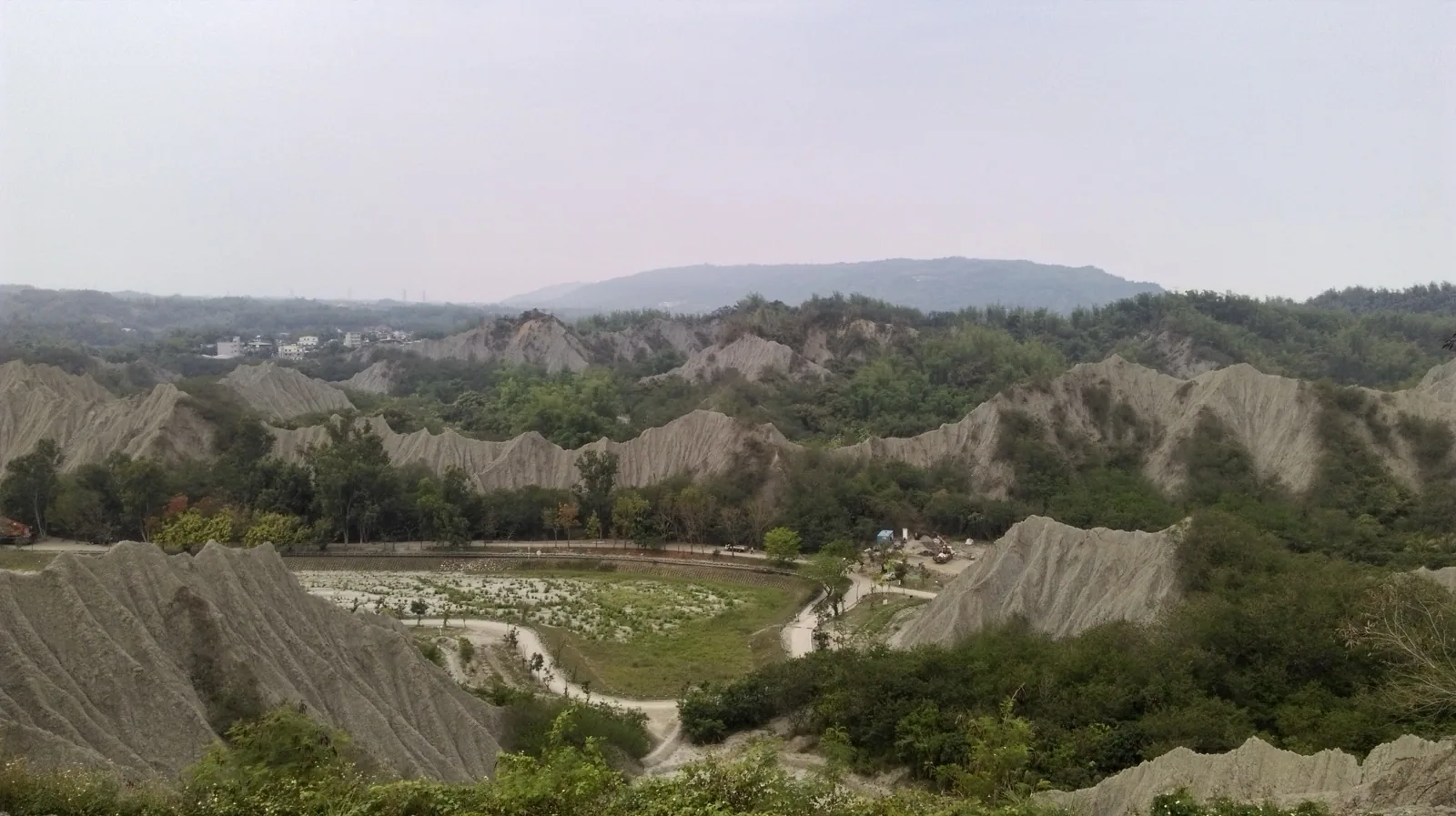
The mudstone badland of the Gutingkeng Formation in the Kaohsiung area, commonly known as the "Moon World." Neimen is located on the edge of this landscape where even crops struggle to grow. Photo: StevenK234, 2019. CC BY-SA 4.0 via Wikimedia Commons.
To understand how this martial field discipline was forged, one must first look at a land that is difficult to farm.
The place with the densest concentration of Taiwanese Master Chefs is Neimen, Kaohsiung. Neimen is located on the mudstone badland of the Gutingkeng Formation—the landscape commonly known as the "Moon World," with gray-white slopes that are barren. Taiwan Kwanghsa Magazine describes this geology: "The cementation and permeability of mudstone are low; it softens into mud when wet and cracks and peels when dry. Coupled with the high salinity of marine sedimentary soil, plant growth is difficult" 7. On these barren slopes where even crops struggle to grow, only drought-resistant thorny bamboo can survive; mangoes and bananas can only be grown in areas with thicker cretaceous soil, and because they grow slowly, they are sweeter 7.
When the land cannot sustain people, people must seek other ways out. There are two prevailing theories for why Neimen became the hometown of Master Chefs, each with its own source.
One theory comes from The Reporter's interview: In early days, Neimen people made bamboo baskets for livelihood, supplying banana farmers in Qishan for export packaging; when paper boxes took over the market in the 1960s, the bamboo weaving industry declined. Coinciding with the rise of Bando, many craftsmen switched to cooking 8. The other theory comes from local officials and cultural workers: Neimen has many temples and troupes; the Songjiang Array is a local signature, and every festival requires feeding large numbers of participants. This repeated demand for "providing meals" gave rise to professional Master Chefs 9. Whether it was bamboo weavers switching trades or temple festivals requiring feeding, both lines point to the same thing—this land forced people to develop a profession relying on craft for survival.
At its peak, Neimen had a population of about 14,000, yet there were about 150 groups of Master Chefs. Almost every 5 households had one household relying on Bando for livelihood, capable of cooking over 20,000 tables simultaneously 2. This is the densest cluster of Master Chefs in Taiwan. (This figure comes from research compiled by Chang Yu-hsin in 2007 and Tang Yu-ning in 2016 at I-Shou University, not from a recent census 2.)
The inheritance of this craft relies on the master-apprentice system. Once kitchen assistants accumulate enough experience, they can graduate; second and third chefs then establish their own households. In the early days, apprenticeship was passed down like "Soup Pork Knuckle"—master takes apprentice, apprentice takes apprentice—spreading Bando technology across Taiwan generation by generation 8. The key step that turned Neimen from a group of craftsmen into an industry occurred in 1976: Xue Qing-ji formed a "Four-in-One" company with several partners (including Deng Zheng-ping, as well as meat and vegetable vendors), integrating ingredient supply, cooking, and table/chair rental. Bando became a business with a complete supply chain, handling everything from ingredients to cooking to tables and chairs in one go 8.
Today, Xue Meng-hui estimates that Neimen has only about 30 to 40 Master Chefs left, about one-quarter of its peak 8. The kingdom remains, but the people are scattering.
In Ledgers from 300 Years Ago, "Hire a Master Chef for Bando" Was Already Recorded
Many people think Bando is something that emerged in post-war Taiwan. It is not. Its roots can be traced back to the Qing Dynasty.
The Taiwan County Gazette (compiled by Chen Wen-da in 1720) from the late Kangxi reign already recorded that Taiwanese people "feast lavishly for family celebrations and seasonal festivals"; by the Changhua County Gazette (compiled by Zhou Xi in 1835) during the Daoguang reign, it described the grandeur of banquets where "dishes exhaust the mountains and seas" 1. In 1902, an article titled "Miscellaneous Notes on Banquets and Dishes" in the early Japanese colonial period formally included the term "Bando" in literature, explaining it clearly: "Preparing tables, organizing wine and food, and setting up banquets is called 'Bando'" 10. This article comes from Records of Taiwanese Customs—a monthly journal published by the Taiwan Customs Research Society (note: this is a different institution from the "Temporary Taiwan Customs Investigation Commission" of the same period, often confused) 10.
So, when did the business of "Bando" actually start?
Zeng Pin-cang, Deputy Researcher at the Institute of Taiwan History, Academia Sinica, points out based on Qing Dynasty ledgers and diaries that Taiwanese people in the Qing Dynasty already commissioned professional chefs for Bando during weddings, funerals, and sacrifices 11. The evidence lies in the ledgers: ledgers of the Wufeng Lin family in the late Qing Dynasty clearly record entries like "Hire 'Zongpu' (Master Chef) for Bando, cost per table" 11. Zeng Pin-cang infers that this habit of commissioning professional chefs for banquets can be traced back to the Kangxi period 11. Looking further to the source, the origin of Bando lies in Min-Yue (Fujian and Guangdong)—the banquet culture traditionally called "Bao Jiu" (Organizing Wine) or "Dao Hui" (Cooking Out) in Fujian and Guangzhou areas, which crossed the sea to Taiwan with Qing Dynasty immigrants 12.
However, from the Qing Dynasty to before the 50th year of the Republic of China (1960s), Bando was very different from what it is today. In cities, restaurants provided catering; in rural areas, people mostly relied on villagers with slightly better cooking skills to work part-time. The dishes were limited, and ingredients were often prepared by the host themselves; wealthier families had dedicated "Kitchen Women" (Zaoxia Fu) to help manage 13. True professionalization began around the 1960s—the 50th year of the Republic of China. When villagers discovered that "the profit from part-time Bando exceeded farming," this craft gradually became professional, peaking in the 1970s and 80s 13.
💡 Did You Know: The Hokkien pronunciation of Bando is pān-toh, and Master Chef is tsóng-phòo-sai. The character "Shi" (Master) is a term of respect in Taiwanese folklore for professional craftsmen 14—just like "Tu Shui Shi" (Plumber/Mason) or "Mu Shi" (Carpenter). It is evidence that this craft is respected as an "art."
출처: *Records of Taiwanese Customs*, Zeng Pin-cang research, The Reporter, Ministry of Economic Affairs, TaiwanPlus
The Sequence of Twelve Dishes Hides a Whole Set of Invisible Knowledge
If the martial field discipline is the bone of Bando, then what follows is its soul.
A standard Bando usually has 12 to 14 dishes, with a sequence of beginning, development, turn, and conclusion: Cold plates are served first to open the appetite while waiting for guests to sit; then soup warms the stomach; then the climax of main dishes—the most luxurious seafood or meat, such as lobster, red crab, or Buddha Jumps Over the Wall, appear here, divided into "commoner version" and "noble version" based on each table's budget; after the climax, a palate-cleansing soup is served, followed by re-opening the appetite with heavy-flavor bamboo shoot braised pork or pork ribs; the final dish is chicken soup to conclude, with dessert and fruit to finish 15. (This dish sequence is a consensus accumulated by Master Chefs and food media over years.)
It is worth noting that lobster is not actually a "traditional" Bando dish. It only became the protagonist after the Ten Major Construction Projects and economic takeoff in the 1960s; earlier Bando tables more commonly featured stir-fried rice noodles, white-cut chicken, celery squid soup, and meatball soup—for many people, Bando was one of the few occasions to eat meat back then 16. Even the most majestic Buddha Jumps Over the Wall was originally called "Fu Shou Quan" (Longevity and Fortune Complete), originating from a family banquet of a Fuzhou official during the Guangxu reign of the Qing Dynasty 17.
But the truly unique aspect of Bando lies behind the dishes: these dishes are placed into a communal eating cosmology. Research from the National Museum of Taiwan History divides Bando communal eating into three types, which form the theoretical skeleton for understanding Bando's "soul" [^15]:
The first is Human-Divine Communal Eating. Banquets for seasonal festivals are where humans and deities share offerings together; Taiwanese call this "Receiving Divine Blessings through Eating" 15. The second is Human-Ghost Communal Eating. Gatherings for ancestral associations, sacrificial trusts, and Zhongyuan (Ghost Festival) banquets are where humans eat with ancestors and "good brothers" (ghosts), thereby remembering ancestors and establishing harmony with beings in another world 15. The third is the Host-Guest Communal Eating we are most familiar with—banquets for life rituals celebrating various stages of life, and association gatherings consolidating interpersonal relationships 15. A single Bando event may span the human, divine, and ghost realms simultaneously.
This is why the Master Chef is simultaneously the host's folkloric consultant. As described by practitioners in The Reporter's interview: "How to prepare for a full-month ceremony? How to arrange offerings? Which foods cannot be served on specific occasions? Ask them, and they know best" 5.
📝 Curator's Note
It is easy to think of Bando as "a larger-scale meal," but this framework misses its most critical element. What Bando truly sells is a correspondence between timing and meaning—which table matches which life moment, which dishes are auspicious, inauspicious, or taboo for which occasion. This correspondence is not written in any recipe; it exists in the Master Chef's mind and in the muscle memory of one event after another. When we later see "Bando dishes entering five-star hotels," remember: hotels can buy recipes, but they cannot buy this correspondence. What is disappearing is the latter.
What does this correspondence look like specifically? The meticulousness of it can be seen in the compilation by folkloric researcher Zhang Yun-shu [^18]: Full-month tables use whole chickens, taking the meaning of "completeness" to symbolize perfection (although the true core of the full-month ceremony is actually oil rice, chicken wine, and red eggs); funeral banquets must have an odd number of dishes, 7 or 9, with a "triangular meat" (sann-kak-bah) with a missing corner on the table, using the shape's imperfection to symbolize the loss in the bereaved family's heart, while avoiding ingredients with specific homophones or meanings like lotus seeds, bitter melon, and pineapple; wedding banquets must have chicken (starting a family), fish (surplus), braised pork (promotion), and pork stomach (wishing the bride "big belly"), and red crab rice cake must specially select female crabs with many eggs, seeking the auspicious meaning of "having noble children early" 18.
⚠️ Controversial Viewpoint: Some Bando taboos circulating in the folk are actually unfounded. For example, "Funeral banquets must have刈包 (Hulao/Tiger Bites Pig)"—Hulao (Tiger Bites Pig) is actually a custom for the Last Day of the Year (December 16th lunar calendar), symbolizing biting away the year's bad luck, having nothing to do with funeral banquets; another saying, "Moving house avoids round balls because 'ball' sounds like 'finished'," has weak origins and directly contradicts the custom of using tangyuan (glutinous rice balls) to symbolize completeness in moving banquets 19. When writing about Bando, even taboos must be verified—because if written incorrectly, it damages the credibility of this knowledge.
The other side of the soul lies after the banquet ends. After the Bando, the Master Chef mixes the leftovers of each dish into "Vegetable Tail Soup" (also called Mixed Vegetable Soup) and sends it to neighbors who came to help to take home 20. This is not disposing of leftovers; it is a symbol of cherishing fortune and gratitude—Taiwan Panorama describes it as a symbol of reciprocity 20. A Bando event is the business of the whole village from start to finish; the host never does it alone. And the Vegetable Tail Soup itself is also on the verge of disappearing 20.
The "Black Forest Grand Hotel" on Auspicious Lunar Days
Older generations of masters often use presidential terms to remember the industry's ups and downs.
The 12 years from 1988 to 2000, when Lee Teng-hui served as President, are considered the golden age of Bando. This was not only the era of the traditional "Eight Celebrations and One Funeral"—engagement, marriage, full-month, returning to natal home, opening business, birthday, moving house, death—but also the era where even children getting PhDs or winning pigeon racing prizes would host a banquet 21. On auspicious lunar days, the temple square and roadside were full of "Black Forest Grand Hotels." The origin of this name is very Taiwanese: early canvas tents were often provided by beverage companies, printed with Black Forest soda advertisements; over time, "Black Forest Grand Hotel" became a synonym for Bando 21.
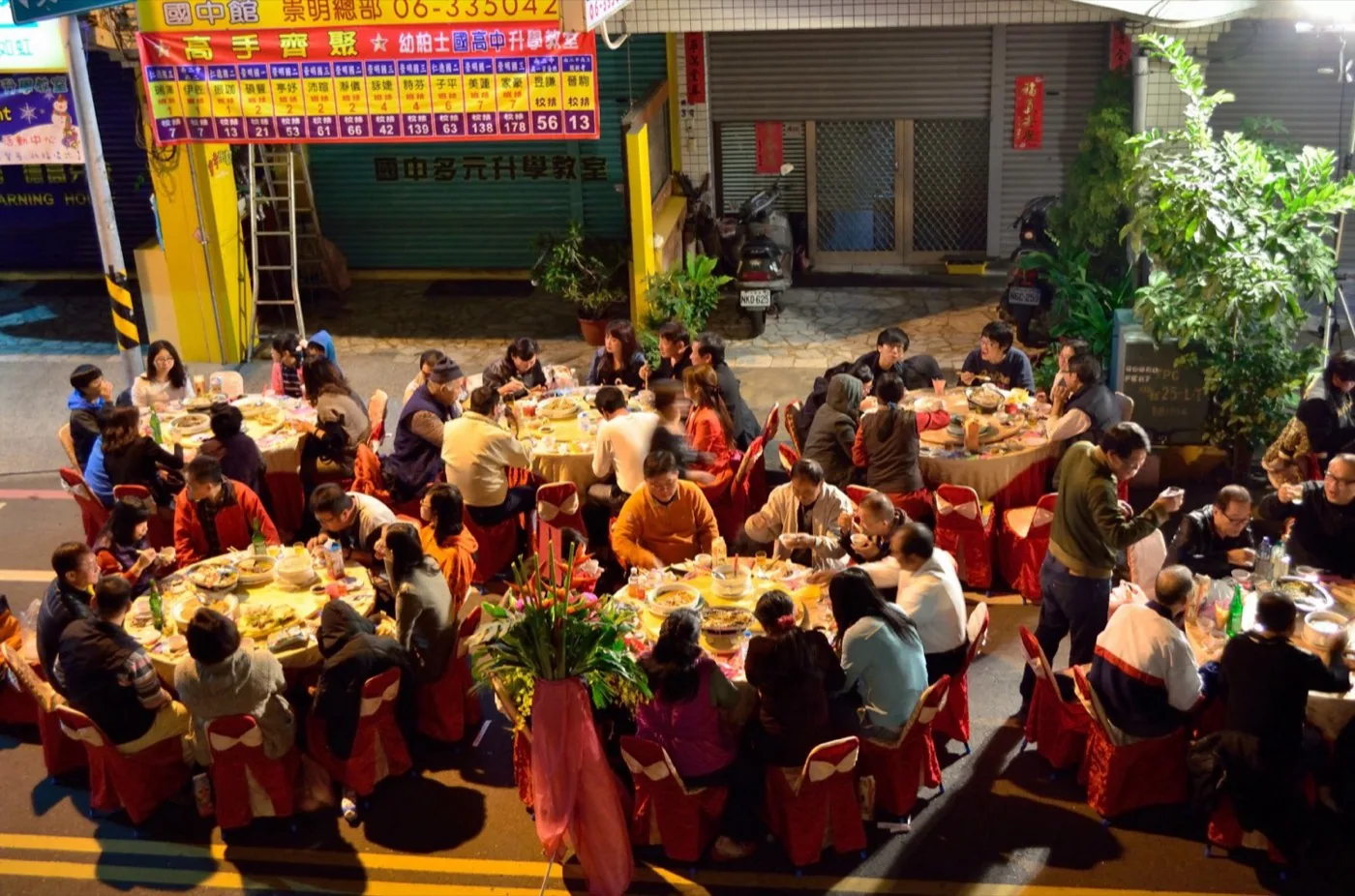
A Bando held directly on the street in Tainan in 2014. Blocking the road, setting up tables, and starting the feast is the most everyday appearance of the "Black Forest Grand Hotel." Photo: Ce Jingzhe, 2014. CC BY-SA 2.0 via Wikimedia Commons.
How prosperous that era was is best remembered by Xue Meng-hui through the work diary left by his father, Xue Qing-ji.
✦ "The entire yearbook is written full, hosting 25,000 tables in a year." — Xue Meng-hui recalling his father Xue Qing-ji's work diary 21
In Xue Qing-ji's era, even in slow months, the average was still 1,000 tables 21. In contrast, in Xue Meng-hui's pre-pandemic period, hosting 500 tables in a peak month was already something to be grateful about, with only a few thousand tables annually 21—between one generation, the scale has shrunk several times over.
The turning point was around 2003 (the third year of Chen Shui-bian's presidency). Taiwan's industry moved west in large numbers, and small and medium enterprise clients decreased one by one. An old client didn't hire Bando for two consecutive years; upon inquiry, it turned out the company had gone bankrupt 21. The tail end of the golden age began with unanswered phone calls.
Forty Years Old is Considered Young: A Fading Generational Gap
The shrinking of an industry can be due to economic cycles, waiting for the next cycle. But what Bando faces is something harder to turn back—the generational gap in succession.
Li Jun-xiang, a Master Chef from New Taipei, speaks plainly: "For catering chefs, 40 years old is considered young; mostly, they take over because of family connections. Among 30-year-old chefs, you can't find 2 out of 10; kitchen assistants are generally aging" 22. Another Master Chef, Jiang Yi-yong, offers a more specific observation: Only about 2% of culinary school graduates ultimately enter catering 23. The reason is understandable—"For noon banquets, departure is at 3:30 AM, long working hours, hot stoves" 23. If young people have choices, they prefer working in air-conditioned restaurants.
Talent is draining, and the craft is breaking with it. Older masters did everything from slaughtering pigs and chickens to making pudding and baking cakes; now, with outsourced frozen foods, apprentices in the kitchen cannot learn the complete picture, and those most labor-intensive "hand-road dishes" (shoulou cai) are disappearing one by one 24.
The legendary "Chicken-Pork Stomach Turtle" in the movie The Master Chef is the best example—stuffing a softshell turtle into a native chicken's stomach, then stuffing the whole chicken into a pig's stomach, slow-cooking for 3 hours. The process is so cumbersome that almost no one is willing to do it 25. The "Chestnut Chicken" popular 40 years ago is already unknown to young chefs; others like Bone-Changing Penne Eel, Bag Chicken, and Five-Silk Branch are also on the verge of disappearing 24. (However, it should be noted: Braised pork and red crab rice cake, although labor-intensive, are still very common and not considered disappearing.) The one who left the most records for these dishes is Huang Wan-ling, the Godmother of Taiwanese cuisine—she was the food director for the movie The Master Chef, spending over ten years going to the countryside to visit and preserve those disappearing Taiwanese dishes 25.
📝 Curator's Note
Note an unspoken choice here. The market actually gave the Bando industry an easy path: using frozen meal packs and semi-finished products, one can still serve 12 dishes, and guests probably won't notice. Taking this path allows the industry to survive longer. But the cost is that those hand-road dishes requiring oral transmission and hand-teaching between master and apprentice will quietly die on this path—not because no one likes to eat them, but because no one needs to learn them. Crafts are rarely eliminated by new things; more often, they are bypassed bit by bit by "good enough."
The Longest Winter
If the generational gap is a chronic disease, then the 2020 pandemic was an acute illness.
The Reporter interviewed nearly 10 Master Chefs from north and south at the time. The consensus was: the number of catering tables shrank by at least 90% starting from the Lunar New Year (this is a consensus from interviews, not official statistics) 26. Xue Meng-hui alone had over 500 tables canceled in the lunar months of February and March; a second-generation heir from a Bando family, who usually used a large spatula for stir-frying big pots, had to switch to holding a small soup spoon to pack bento boxes for survival 26.
Official numbers also couldn't hold up. Ministry of Economic Affairs statistics show that in April 2020, the revenue of the "Catering and Group Meal Contracting Industry" decreased by 32.3% year-on-year, with monthly revenue of about NT$2.5 billion 27. However, this number must be read carefully: it was mainly dragged down by air catering (airline meals), and a large number of open-air Bando events have no business registration and are not within the statistical scope—so for open-air Bando, this number actually underestimates the impact it suffered 27.
Beyond the pandemic, Bando in the north faces a more structural dilemma—space. Li Jun-xiang describes that in the north, Bando requires blocking roads and applying for road rights, and is often reported by neighbors: "Even when we are frying things, neighbors downstairs scold us and report us to the Environmental Protection Bureau for air pollution. Aggressive ones even throw things from upstairs to drive us away" 28. Activity centers and elementary school auditoriums in Taipei City are almost never lent for hosting banquets 28. In land-scarce urban areas, it is becoming increasingly difficult to find a legal place to set up tables for open-air Bando.
Are all these pressures bad things? Cultural worker Yan Zhen-yu has a different view. He believes the pandemic is both a blow and a stimulus, forcing Master Chefs to improve hygiene standards and seriously consider transformation 29. But the deepest fear of interviewed Master Chefs is something else: "We worry not just about this year, but more about everyone not hiring (Bando) becoming a habit" 29. The Reporter's conclusion is calm: Bando is tightly linked to the economy, and it is difficult to warm up in the short term 29.
The Dishes Remain, the Soul Scatters
But if the story stops here, it would be terribly wrong.
Because looking back from 2025, Bando is not dying in a single direction. It is actually bifurcating—as "dishes" and "brand," it is going up; as a "whole-village ritual," it is sinking down.
This upward branch is impressive. The Michelin Guide Tainan incorporated Bando dishes into its formal discourse; three restaurants serving Bando dishes—A-Xia Restaurant, Xin Xin Restaurant, and Dong Shang Taiwanese Cuisine—were all selected for Bib Gourmand 30. Palais de Chine Hotel in Taipei launched "Taiwanese Bando," directed by Chef Lin Ming-can, with a table costing NT$22,800 plus a 10% service fee, claiming to be the first five-star hotel in Taiwan to formally pay tribute to Bando culture 31. The next generation is also taking over: TaiwanPlus reported in August 2025 with the title "Bando Is Back," showing how the new generation uses "Next-Gen Marketing × Parental Craft" to bring Bando back—such as Tofu Master Chef Huang Mao-yuan with his daughter Huang Jia-yu, and Master A-Long with his son A-Xiang 32. The English report writes: "Once fading from Taiwan's cultural fabric, this legendary banquet tradition is making a dynamic comeback…" 32
Even overseas is seeing a回流 (return flow). The restaurant Good To Eat in Emeryville, California, has Taiwanese chef Tony Tung (who and her partner Angie Lin are a wife-wife team) treating Bando as a love letter to Taiwan, with the menu named jan ba bae (Bando) 33. On January 4, 2025, she invited Neimen Master Chef A-Càn (Master A-Càn) to Taipei to host a traditional Bando for over 400 people, attracting diners from California to fly back to Taiwan specifically to experience it 33.
Looking at these two branches together, the shape of the bifurcation is clear. What is reviving is the "dish" and the "brand"—they can enter five-star hotels, Michelin tables, and California restaurants; what is disappearing is that ritual knowledge. Five-star hotel banquet halls can replicate a pot of Buddha Jumps Over the Wall, but they cannot replicate the tacit understanding of "whole village mobilization, Master Chef as folkloric consultant, vegetable tail soup shared with neighbors." Scarcity has turned Bando dishes into a cultural pilgrimage; California diners are willing to fly half the globe back to Taiwan to eat a meal—but the object of that pilgrimage is losing its habitat: the badland that raised Master Chefs, those temple festivals one after another, that village that calls all neighbors to help.
Air-conditioned restaurants can grow dishes, but cannot grow a soul.
That Yearbook Filled with Writing
Back to Xue Qing-ji's yearbook filled with writing.
That is the object Xue Meng-hui treasures most, and also the most authentic archaeological site of this industry 21. The dense orders on the diary—celebration banquets for pigeon racing wins, gratitude seats for PhD graduates, peace banquets for Mazu's birthday at the temple square—record a whole set of things that Taiwanese people once jointly recognized: which moments are worth gathering people away from their tasks, what to eat at that moment, who hosts it, and how to say goodbye properly.
The dishes have proven they can enter five-star hotels, fly to California, and be certified by Michelin. What about the tacit understanding written in that yearbook—which table matches which moment, which dish is auspicious or inauspicious for which occasion, which neighbors who helped should receive the vegetable tail—how many people still remember, how many can still take it over?
Further Reading:
- Taiwanese Hand-Road Dishes
- Hulao (Tiger Bites Pig)
- Taiwanese Seafood Culture
- Night Market Culture
- Chen Yu-Hsun
Image Sources
This article uses 3 public domain / CC licensed images, all cached in public/article-images/food/ to avoid hotlinking to the source server:
- Bando after Zhongyuan Ghost Festival (hero) — Photo: Xuan Shi Sheng, 2017-09-19, CC0 1.0
- Mudstone Badland of Gutingkeng Formation in Kaohsiung (Moon World) — Photo: StevenK234, 2019-04-01, CC BY-SA 4.0
- Street Bando in Tainan — Photo: Ce Jingzhe, 2014-12-07, CC BY-SA 2.0
References
- Bando (Wikipedia) — Records Bando etymology, Qing Dynasty Taiwan County Gazette (1720) and Changhua County Gazette (1835) documentation of Taiwanese "feasting lavishly for family celebrations and seasonal festivals" and "dishes exhaust the mountains and seas" banquet customs, and the historical context of Bando professionalization.↩2
- Bando (Wikipedia) — Records Neimen Master Chef cluster scale data: peak period approx. 14,000 people, approx. 150 Master Chef groups, 1 in 5 households relying on Bando for livelihood, capable of cooking over 20,000 tables simultaneously, figures compiled from Zhang Yu-hsin (2007) and Tang Yu-ning (2016 I-Shou University Master's Thesis) research.↩23
- Bando Is Back: Taiwan's Roadside Banquet Tradition Makes a Comeback (TaiwanPlus, 2025) — August 2025 report on the phenomenon of Taiwanese Bando culture reviving under Michelin, five-star hotels, and new generation succession.↩
- After the Pandemic, the Fading Taiwanese Flavor—Roadside Bando Culture (The Reporter) — The Reporter's 2020 in-depth report, interviewing nearly ten Master Chefs from north and south, recording the crisis of disappearing ritual knowledge in Bando and the generational gap.↩
- After the Pandemic, the Fading Taiwanese Flavor—Roadside Bando Culture (The Reporter) — Records Tainan Master Chef Wang Yi-yong catching fish in the rain for 120 tables, the metaphor of restaurant "Literary Field" vs. Bando "Martial Field," and the multiple roles of Master Chef as executive chef, event director, logistics coordinator, and folkloric consultant.↩2345
- After the Pandemic, the Fading Taiwanese Flavor—Roadside Bando Culture (The Reporter) — Records Neimen Master Chef Xue Meng-hui cooking in Fengshan on the night of the 88 Flood, tent collapse and iron frame injury, bridge broken and trapped in 7-ELEVEN, and the oral history "I fear guests waiting in pain the most, the moment I get home I rush to the phone."↩234
- Taiwan Kwanghsa Magazine: Mudstone Badland Related Reports — Describes the geological characteristics of the mudstone badland of the Gutingkeng Formation in Kaohsiung (Moon World): "The cementation and permeability of mudstone are low; it softens into mud when wet and cracks and peels when dry. Coupled with the high salinity of marine sedimentary soil, plant growth is difficult," and the crop distribution where only thorny bamboo is drought-resistant on badland slopes, and mangoes and bananas can be grown in cretaceous soil areas.↩2
- After the Pandemic, the Fading Taiwanese Flavor—Roadside Bando Culture (The Reporter) — Records Neimen bamboo weaving supplying Qishan banana farmers, the origin of switching to Bando after paper boxes took over the market in the 1960s, master-apprentice system "Soup Pork Knuckle" style spreading across Taiwan, 1976 Xue Qing-ji forming "Four-in-One" company for industrialization, and the estimate that Neimen now has only about 30-40 Master Chefs.↩234
- Neimen District Office Official Website — Kaohsiung City Neimen District official information, recording the local cultural theory that Neimen has many temples, troupes (Songjiang Array) are prevalent, and the need to feed participants in festivals gave rise to the demand for Master Chefs; cultural worker Chen Cong-xian also holds this view.↩
- pān-toh Bando: Taiwanese Banquet Culture (Story Studio) — Records the earliest literary definition of "Bando" in the 1902 article "Miscellaneous Notes on Banquets and Dishes" as "Preparing tables, organizing wine and food, setting up banquets is called Bando," sourced from the monthly journal Records of Taiwanese Customs published by the Taiwan Customs Research Society.↩2
- pān-toh Bando: Taiwanese Banquet Culture (Story Studio) — Records Academia Sinica Institute of Taiwan History Deputy Researcher Zeng Pin-cang's research based on Qing Dynasty ledgers (such as the late Qing Wufeng Lin Family ledger recording "Hire Master Chef for Bando") and diaries, pointing out that Taiwanese people in the Qing Dynasty already commissioned professional chefs for Bando during weddings, funerals, and sacrifices, and inferring it can be traced back to the Kangxi period.↩23
- Bando (Wikipedia) — Records the origin of Bando in Min-Yue, the historical background of the banquet culture traditionally called "Bao Jiu" or "Dao Hui" in Fujian and Guangzhou areas crossing the sea to Taiwan with Qing Dynasty immigrants.↩
- Bando (Wikipedia) — Records that before professionalization (Qing Dynasty to before the 50th year of the Republic of China), cities relied on restaurant catering, rural areas relied on part-time villagers, ingredients were often prepared by hosts, wealthy families had "Kitchen Women," and from the 1960s villagers discovered Bando profits exceeded farming leading to professionalization, peaking in the 1970s-80s.↩2
- Ministry of Education Taiwan Hokkien Common Dictionary: Bando — Ministry of Education official dictionary, recording the entry definition and Hokkien phonetic notation for "Bando" (pān-toh); Master Chef Hokkien pronunciation is tsóng-phòo-sai, "Shi" is a term of respect in folklore for professional craftsmen.↩
- Communal Eating in Bando Culture (National Museum of Taiwan History, Lin Xiang-yi) — National Museum of Taiwan History research article proposing the three-type framework of Bando communal eating: Human-Divine Communal Eating (Seasonal Festivals "Receiving Divine Blessings through Eating"), Human-Ghost Communal Eating (Ancestral Associations and Zhongyuan Ghost Festival), Host-Guest Communal Eating (Life Rituals and Association Gatherings), and explaining the connection between Bando dish sequence and life rituals.↩234
- Bando (Wikipedia) — Records that high-end seafood like lobster only became the protagonist of Bando after the economic takeoff of the Ten Major Construction Projects in the 1960s; early Bando tables commonly featured stir-fried rice noodles, white-cut chicken, celery squid soup, meatball soup, which were one of the few occasions to eat meat back then.↩
- Bando (Wikipedia) — Records that Buddha Jumps Over the Wall was originally called "Fu Shou Quan" (Longevity and Fortune Complete), originating from a family banquet of a Fuzhou official during the Guangxu reign of the Qing Dynasty.↩
- Tainan Community University: Wedding Bando and Life Ritual Dish Symbolism (Zhang Yun-shu) — Folkloric researcher Zhang Yun-shu compiles the dish symbolism of life ritual Bando: Full-month uses whole chicken for "completeness," funeral banquets have odd number of dishes and missing-corner "triangular meat" (sann-kak-bah), avoiding lotus seeds, bitter melon, pineapple; wedding banquets must have chicken (starting family), fish (surplus), braised pork (promotion), pork stomach (big belly), red crab rice cake selecting female crabs (having noble children early).↩
- pān-toh Bando: Taiwanese Banquet Culture (Story Studio) — Folkloric verification of Bando taboos; Hulao is a "Tiger Bites Pig" custom for the Last Day of the Year (December 16th lunar calendar) not a funeral dish, the saying "Moving house avoids round balls" contradicts the custom of using tangyuan to symbolize completeness in moving banquets, both lack support in Bando folklore sources.↩
- Taiwan Panorama Magazine: Bando and Vegetable Tail Soup Culture — Reports on Bando "Vegetable Tail Soup" (Mixed Vegetable Soup) as a symbol of cherishing fortune and gratitude after mixing leftovers from each dish and sending them to neighbors who helped for free, a reciprocal community culture, itself facing disappearance.↩23
- After the Pandemic, the Fading Taiwanese Flavor—Roadside Bando Culture (The Reporter) — Records the golden age of Bando during Lee Teng-hui's term "Eight Celebrations and One Funeral," the origin of "Black Forest Grand Hotel" canvas tents provided by beverage companies, Xue Qing-ji's work diary "hosting 25,000 tables in a year" and "average 1,000 tables in slow months," and the turning point of client loss after the industry moved west in 2003.↩234567
- After the Pandemic, the Fading Taiwanese Flavor—Roadside Bando Culture (The Reporter) — Records New Taipei Master Chef Li Jun-xiang's oral history "For catering chefs, 40 years old is considered young, out of 10 chefs aged 30, can't find 2, kitchen assistants are generally aging," reflecting the generational gap in the Bando industry.↩
- After the Pandemic, the Fading Taiwanese Flavor—Roadside Bando Culture (The Reporter) — Records Master Chef Jiang Yi-yong's observation that only about 2% of culinary school graduates enter catering, and the labor condition description "For noon banquets, departure is at 3:30 AM, long working hours, hot stoves."↩2
- After the Pandemic, the Fading Taiwanese Flavor—Roadside Bando Culture (The Reporter) — Records older masters doing everything from slaughtering pigs and chickens to making pudding and cakes themselves; outsourced frozen foods prevent apprentices from learning hand-road dishes; Chestnut Chicken, Bone-Changing Penne Eel, Bag Chicken, Five-Silk Branch and other hand-road dishes are on the verge of disappearing.↩2
- After the Pandemic, the Fading Taiwanese Flavor—Roadside Bando Culture (The Reporter) — Records the cumbersome process of "Chicken-Pork Stomach Turtle" (softshell turtle stuffed into native chicken, chicken stuffed into pig stomach, slow-cooked for 3 hours) in the movie The Master Chef, and the deeds of Taiwanese cuisine Godmother Huang Wan-ling (food director for the movie) spending over ten years going to the countryside to visit and preserve disappearing Taiwanese dishes.↩2
- After the Pandemic, the Fading Taiwanese Flavor—Roadside Bando Culture (The Reporter) — Interviews with nearly 10 Master Chefs from north and south reflecting that catering tables shrank by at least 90% starting from the Lunar New Year (interview consensus, not official statistics); Xue Meng-hui had over 500 tables canceled in lunar months 2 and 3; second-generation heir from a Bando family switched to holding small soup spoons to pack bento boxes.↩2
- Ministry of Economic Affairs Statistics Division: Wholesale, Retail, and Catering Industry Revenue Statistics (April 2020) — Ministry of Economic Affairs statistics, April 2020 "Catering and Group Meal Contracting Industry" revenue decreased by 32.3% YoY, approx. NT$2.5 billion; this number was mainly dragged down by air catering, and a large number of unregistered open-air Bando events are not within the statistical scope, actually underestimating the impact on open-air Bando.↩2
- After the Pandemic, the Fading Taiwanese Flavor—Roadside Bando Culture (The Reporter) — Records Li Jun-xiang describing the spatial politics of northern Bando: requiring blocking roads and applying for road rights, being reported by neighbors for air pollution, even people throwing things from upstairs to drive them away; Taipei City activity centers and elementary school auditoriums are almost never lent for hosting banquets.↩2
- After the Pandemic, the Fading Taiwanese Flavor—Roadside Bando Culture (The Reporter) — Records cultural worker Yan Zhen-yu's view that the pandemic is both a blow and a stimulus (forcing Master Chefs to improve hygiene, consider transformation), and the deepest fear of interviewed Master Chefs (fearing "everyone not hiring Bando" becoming a habit) and The Reporter's conclusion that "Bando is tightly linked to the economy, difficult to warm up in the short term."↩23
- Michelin Guide Tainan: Bando Dishes and Bib Gourmand — Michelin Guide Tainan incorporated Bando dishes into discourse; three restaurants serving Bando dishes—A-Xia Restaurant, Xin Xin Restaurant, Dong Shang Taiwanese Cuisine—were selected for Bib Gourmand.↩
- Palais de Chine Hotel: Taiwanese Bando — Taipei Palais de Chine Hotel launched "Taiwanese Bando" (roadside banquet), directed by Chef Lin Ming-can, NT$22,800 per table plus 10% service fee, claiming to be the first five-star hotel in Taiwan to formally pay tribute to Bando culture.↩
- Bando Is Back: Taiwan's Roadside Banquet Tradition Makes a Comeback (TaiwanPlus, 2025) — August 2025 report on the new generation bringing Bando back with "Next-Gen Marketing × Parental Craft" model (Tofu Master Chef Huang Mao-yuan with daughter Huang Jia-yu, Master A-Long with son A-Xiang), original text says "Once fading from Taiwan's cultural fabric, this legendary banquet tradition is making a dynamic comeback."↩2
- Roadside Banquet in Taiwan (Good To Eat) — California Emeryville restaurant Good To Eat, Taiwanese chef Tony Tung and partner Angie Lin treat Bando as a love letter to Taiwan (menu name jan ba bae), on January 4, 2025 invited Neimen Master Chef A-Càn (Master A-Càn) to host a traditional Bando for over 400 people in Taipei, attracting California diners to fly back to Taiwan specifically.↩2