
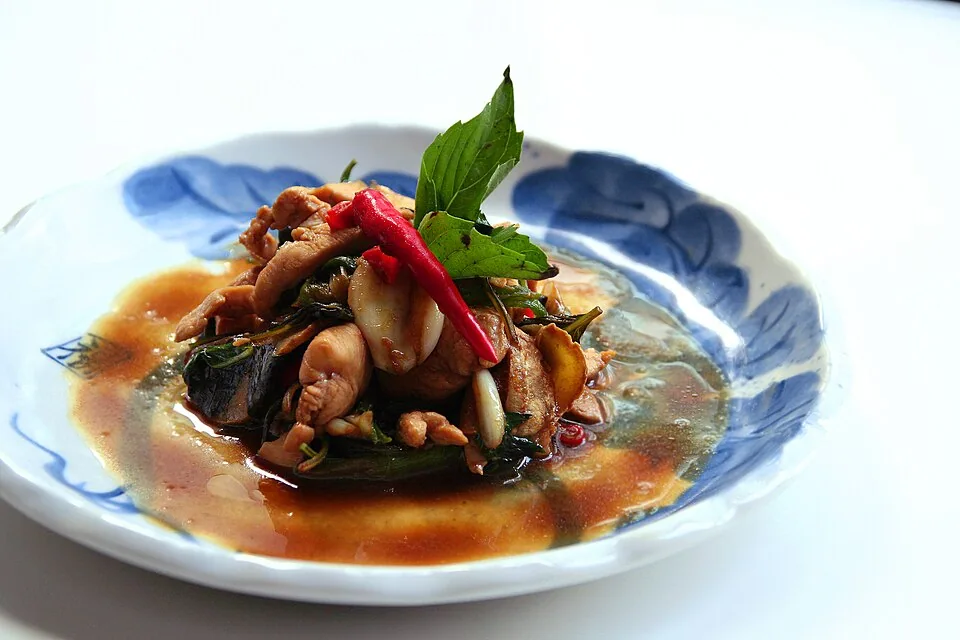
Taiwanese Handcrafted Cuisine: Meaning, Origins, and the 'Signature Dishes' of Banquet Culture

Handcrafted cuisine (Teochew: tshiú-lōo-tshài) means 'signature dishes.' The white chalk soil of Neimen, Kaohsiung, cannot grow crops, yet it nurtured the township with the highest density of banquet chefs (zongpushi) in Taiwan—during its golden age, one company hosted 25,000 tables a year, with monthly revenues reaching 12 million. A pot of 'leftover soup' requires four to eight hours to prepare; if the flavor balance is off, the entire village will know the next day.

30-Second Overview: "Handcrafted cuisine" (手路菜) is a Teochew term for "signature dishes" 1, referring to those requiring true skill, lacking standard recipes, and passed down orally from master to apprentice. Its most concentrated exhibition field is the "banquet" (辦桌)—a Taiwanese banquet tradition where tents are erected by the roadside and stoves are lit on-site. Neimen, Kaohsiung, due to its barren land, accidentally became the township with the highest density of banquet chefs (zongpushi) in Taiwan. In its golden age, one banquet company hosted 25,000 tables a year. However, from hotel weddings to the COVID-19 pandemic, banquet orders shrank by 90% over twenty years, taking with them not just the taste of the food, but the neighborly mutual aid of "returning the leftover soup."

In the spring of 2020, several brand-new flags were erected in the temple courtyard of Zizhu Temple in Neimen, Kaohsiung. Printed on them were braised pork, shark fin soup, and eight-treasure meatballs—not banquet advertisements, but street stalls set up by banquet chefs. 48-year-old Xue Menghui stirred "Ants Climbing a Tree" while explaining to a The Reporter journalist: "Even without banquets now, people still need to survive!" 2

The Xue family is a "banquet master lineage" in Neimen. Xue Menghui began following his father, Xue Qingji, to host banquets in high school. Two generations accumulated over fifty years of experience. Flipping through his father's work logs from those days, the entire agricultural almanac was filled with entries: 25,000 tables a year, rushing through more than ten events on major days. Chefs left at dawn, finished at noon to rush to evening events, and whether they slept for four hours was unknown 2.

But the 2020 pandemic froze all of this. The annual revenue of the external catering and group meal contracting industry dropped by 32.3% 3, and banquet orders shrank by 90%. Xue Menghui had over 500 tables canceled in the second and third lunar months, forcing him to work part-time at a friend's bento shop.

This is not the first crisis the banquet industry has faced, but it may be the last.

Banquets: The Roadside is the Banquet Hall

Banquets (pān-toh) are a banquet tradition of Minnan culture, brought to Taiwan with immigrants, with records dating back to the Qing Dynasty 4. Weddings, funerals, temple festivals, and construction rituals—host families invite banquet chefs to the temple courtyard, school playgrounds, or roadside to erect tents and light stoves on-site, from chopping vegetables to serving dishes in one go. Unlike restaurants, banquets have strict etiquette: the choice of dishes, the order of serving, and seating arrangements all have specific讲究 (requirements).

A typical banquet consists of about twelve dishes, emphasizing "introduction, elaboration, transition, and conclusion" [^5]: Cold plates open the meal, allowing guests to take their seats; soups warm the stomach; the middle section features heavyweight main dishes—red crab with rice, steamed grouper, Buddha Jumps Over the Wall—ending with chicken soup, desserts, and fruit, symbolizing completeness. Every dish is a "handcrafted cuisine": Red crab with rice requires controlling the steaming time so the crab roe seeps into the rice; Buddha Jumps Over the Wall requires processing more than twenty ingredients separately before sealing the jar and simmering; braised pork requires even fat-to-lean ratio, melting in the mouth but not falling apart.

📝 Curatorial Perspective: People often describe restaurants as "civilian fields" (文場) and banquets as "martial fields" (武場). The test for banquet chefs lies not only in culinary skills—regardless of strong winds, heavy rain, broken bridges, or collapsed roads, as long as the host family hasn't canceled, they must fulfill their mission.

Wang Yi Yong, a senior banquet chef from Tainan, once hosted 120 tables in a school auditorium in Kaohsiung. At 5 PM, a rainstorm struck, flooding the water up to the calves, extinguishing the stoves, and making pots and pans float on the water. Even the trout prepared for cooking swam away. Wang Yi Yong immediately cut the canvas tent to drain the water, moved the kitchenware under the eaves, rolled up his sleeves, and caught the fish. In the end, one trout was missing, but it was made up for by ingredients from the reserve table, and all guests ate 2.

Neimen: The Hometown of Banquet Chefs on Barren Land

Neimen, Kaohsiung, is surrounded by mountains on all sides. The soil is alkaline white chalk, unsuitable for farming, with only drought-resistant bamboo surviving. Before the 1960s, residents survived by weaving bamboo baskets for Qishan banana farmers to package their produce. After low-cost cardboard boxes took the market, the bamboo weaving industry declined 2.

But precisely in that era, Taiwan's economy took off, and the demand for banquets surged. The people of Neimen, who could not grow anything on the land, found a new way out—cooking banquets for others.

Neimen has dense temples and powerful folk performance troupes. Every celebration creates a demand for banquets, keeping the business of banquet chefs booming. Xue Menghui's father, Xue Qingji, along with apprentices, chicken vendors, and pig vendors, each contributed 20,000 yuan to establish a "Four-in-One" company, providing a one-stop service for ingredient supply, cooking, and table/chair rental 2. After second and third chefs accumulated experience and set up their own businesses, the banquet energy in Neimen grew like a snowball, becoming the township with the highest density of banquet chefs in Taiwan, known as the "Hometown of Banquet Chefs" 5.

📝 Curatorial Perspective: Neimen's story is a common "turning disadvantages into advantages" narrative in Taiwan: Because the land was barren and there were no other choices, it forced the emergence of an industrial cluster. Banquets supported countless families, and residents from the Shanlin District, half an hour away by car, also came to work as laborers.

The golden age was roughly between 1988 and 2000. Xue Menghui recalled that during Lee Teng-hui's presidency, not only traditional "eight celebrations and one funeral" required banquets, but children getting PhDs or winning money from pigeon racing also had reasons to host banquets. On auspicious days marked in red in the almanac, the temple mouth and roadside were full of "Heineken Grand Hotels"—early banquet canvas tents were provided by beverage companies, printed with Heineken soda advertisements, becoming a synonym for banquets 2.

Leftover Soup: The Final Exam for Banquet Chefs

Among all banquet handcrafted cuisines, the one with the highest status is not Buddha Jumps Over the Wall, nor Red Crab with Rice—it is the final dish, "Leftover Soup" (菜尾湯).

Many people think leftover soup is just leftover food. Huang Wanling, the "Godmother of Taiwanese Cuisine," spent thirty years clarifying this misconception. "As the name suggests, the chef's last dish, the one they can only leave after finishing, is called leftover soup. Sixty years ago, no one questioned that leftover soup was leftover food; it was even a major dish testing the chef's skill." 6

A authentic leftover soup requires reserving part of the ingredients from seven classic banquet dishes in advance: braised soup, sweet and sour fish, braised pork, bamboo shoot and sour cabbage pork rib soup, dried fish and Chinese cabbage braised dish, white radish and pork stomach soup, and fish ball soup 7. From the moment guests eat the first dish, the banquet chef is silently calculating—how much to save, when to put it in the pot, and how to balance the proportions.

The Teochew word "jie" (結), means to harmonize and blend. Making leftover soup takes four to eight hours. During the process, continuous stirring, tasting, and adjusting are required, with real-time judgment of temperature, humidity, heat, and ingredient status. Huang Wanling herself took on the challenge and tested it once, spending six days 6.

💡 Did You Know? "Returning the leftover soup" is the most human-touching segment of banquets. After the banquet, the host family sends strong men to carry the leftover soup door-to-door to neighbors who helped. "Return" is pronounced in the third tone, carrying the respect of bowing and curtsying. After neighbors receive it, they can cook it again, adding Chinese cabbage to make two pots. If the leftover soup is not harmonized well, the whole village will know the next day, directly affecting the banquet chef's business for the next year 8.

Huang Wanling said: "Almost all Taiwanese dishes have immigrant characteristics, except for leftover soup. It is a dish adapted to local conditions on this land for over three hundred years, the root of Taiwan." 6

Twenty Years of Decline

The crisis of the banquet industry did not start with the pandemic. Zhong Yuechun, Secretary of the Chiayi City Catering Industry Union, used three disasters to mark the scale: "The 921 earthquake hurt a little, SARS hurt more than half, and this year's pandemic may make banquets a declining industry." 2

A more fundamental reason is the change in lifestyle. Hotel weddings replaced roadside banquets; young people are unwilling to learn the physical labor of banquet skills; small and medium-sized enterprises in the export processing zones closed as industries moved westward—Xue Menghui said that some old clients haven't hired him for their year-end parties for two years in a row, and upon inquiry, they had already closed down 2.

"We are not only worried about this year, but more worried that people not hosting (banquets) becomes a habit." — Cai Yufeng, Tainan banquet operator 2

This sentence reveals the deepest fear of the banquet industry. The disappearance of banquets is not just a business, but an entire social operating system: Temple festivals drive banquet demand, banquet chefs support laborers and suppliers, and "returning leftover soup" maintains neighborhood relations. When this cycle breaks, it is not just the industrial chain that breaks.

The People Fighting to Save It

Some are desperately trying to keep these flavors alive.

Huang Wanling initially only wanted to be a feature writer, interviewing old banquet chefs to write stories. But the old masters, seeing her powerless appearance, suddenly shed tears—because no one else was willing to learn. That tear changed her life direction: She started as a laborer, followed multiple banquet chefs for over a hundred banquets, and practiced weightlifting to sustain her physical strength 6. Since 2011, she has successively published Banquet Chef's Banquet, Grandma's Kitchen, Old Taiwanese Cuisine, Hundred-Year Old Taiwanese Early Flavors, and The True Flavor of Taiwanese Cuisine, preserving the methods and local stories of old Taiwanese cuisine in text 9.

Another form of rescue is commercial transformation. Neimen's Master A Long turned braised pork and Buddha Jumps Over the Wall into frozen vacuum packs for e-commerce 10; some banquet chefs transformed into making sacrificial offerings, because even without large events, worshiping gods will not decrease 2. But the experience of roadside tents, on-site stoves, and the twelve-dish introduction, elaboration, transition, and conclusion of banquets cannot be replicated by frozen packaging.

The cruelest thing about handcrafted cuisine is here: It is a living skill, passed from person to person. How many grams is a handful of salt, when to turn high heat to low heat, what color "the right color" is—these mnemonics only exist in the hands and eyes of the masters. When the people are gone, the dishes are gone.

Xue Menghui flips through the agricultural almanac filled with his father's handwriting, the characters on it being the scale of an industrial golden age. He does not know that this diary records not just menus and table counts—it records how a whole era of Taiwanese people celebrated, how they expressed gratitude, and how they connected the whole village with one pot of soup.

Further Reading:

  • Taiwanese Banquet Culture — The most concentrated exhibition field of handcrafted cuisine: From the barren land of Neimen nurturing the kingdom of banquet chefs, to a complete set of banquet ritual knowledge spanning the human, divine, and ghostly realms.
  • Chen Yu-Hsun — Director of The Grandmaster, bringing endangered kung fu dishes like chicken, pork stomach, and softshell turtle to the big screen.
  • Taiwanese Seafood Culture — The red crab, lobster, and steamed fish on the main banquet table, behind which lies the Taiwanese seafood flavor context.

References

  1. Handcrafted Cuisine — Ministry of Education Taiwan Teochew Common Word Dictionary — See original link for supplementary content data
  2. The Longest Winter for Banquet Chefs and Laborers — The Reporter — (2020)
  3. Ministry of Economic Statistics — Revenue of External Catering and Group Meal Contracting Industry — (2020)
  4. Banquet — Wikipedia — Wikipedia entry
  5. One Banquet Company, Fragrance for Ten Thousand Families — The Legend of Neimen Banquets — See original link for supplementary content data
  6. Huang Wanling's The True Flavor of Taiwanese Cuisine Keeps the Classic "Leftover Soup" Fragrant — 500 Times — (2021)
  7. Leftover Soup ≠ Leftovers — Godmother of Taiwanese Cuisine Teaches How to Cook Classic "Leftover Soup" — United Daily News Orange Generation — (2021)
  8. Classic "Leftover Soup" is Not Leftovers! 7 Independent Dish Ingredients Simmered for 4 Hours — ETtoday — (2021)
  9. Taiwanese Hero — Godmother of Taiwanese Cuisine Huang Wanling — Liberty Times Net — (2022)
  10. Neimen Master A Long Banquet — Rakuten — See original link for supplementary content data
이 기사에 대해 이 기사는 커뮤니티와 AI의 협력으로 작성되었습니다.
Taiwanese Cuisine Traditional Cooking Banquets Handcrafted Cuisine Banquet Chefs Food Culture
공유

관련 기사

함께 읽으면 좋은 글

음식

대만 원주민 음식 문화

AKAME의 불꽃부터 아미족의 야채 우주까지 — 대만 원주민 음식이 3,000년 후 어떻게 세계의 주목을 다시 받게 되었는가

閱讀全文
음식

Taiwanese Bando: The Martial Field That Opens Tables Amidst Torrential Rain, and the Fading Human-Ghost-Divine Trinity

In a 120-table banquet, evening rain flooded up to calves and trout swam away by the dozen. Master Chef Wang Yi-yong rolled up his sleeves, waded into the water to catch fish, and ended up missing only one. For 300 years, this has been the nature of Bando: as long as the host doesn't call it off, the tables must open. Today, this craft is bifurcating: dishes enter five-star hotels and Michelin stars, returning to overseas markets; yet the ritual knowledge involving the whole village, with the master chef acting as a folkloric consultant across the human, divine, and ghost realms, is quietly disappearing due to a lack of successors. What is truly disappearing is not the flavor, but the tacit understanding behind it.

閱讀全文
음식

타이완 면 음식 문화: 미국 원조 밀가루에서 국민 음식까지의 70년 서사시

전쟁 후 군인촌에서 국제 무대까지, 타이완 면 음식이 70년간 미국 원조 밀가루에서 출발해 성(省)의 기억과 현지 혁신을 융합하며 이민과 고향의 음식 역사를 써내려간 이야기

閱讀全文
문화

Taiwan's Religious Beliefs: An Empire of Faith Grown from Fear

On the island with the highest density of temples in the world and the second-highest ranking for religious freedom in Asia, the historical origins of its two largest faiths—King Yeh (Wangye) and Mazu—are both linked to plague and death. From the 17th-century military immigrants carrying statues across the Black Water Strait to the 2025 Freedom House report awarding Taiwan a score of 94; from the 1953 ban on I-Kuan Tao and its legalization as the first religion after the 1987 lifting of martial law, to the four major Buddhist mountains and the Presbyterian Church taking different paths in church-state relations—Taiwan's faith is not found in scriptures, but in the incense at every corner.

閱讀全文