
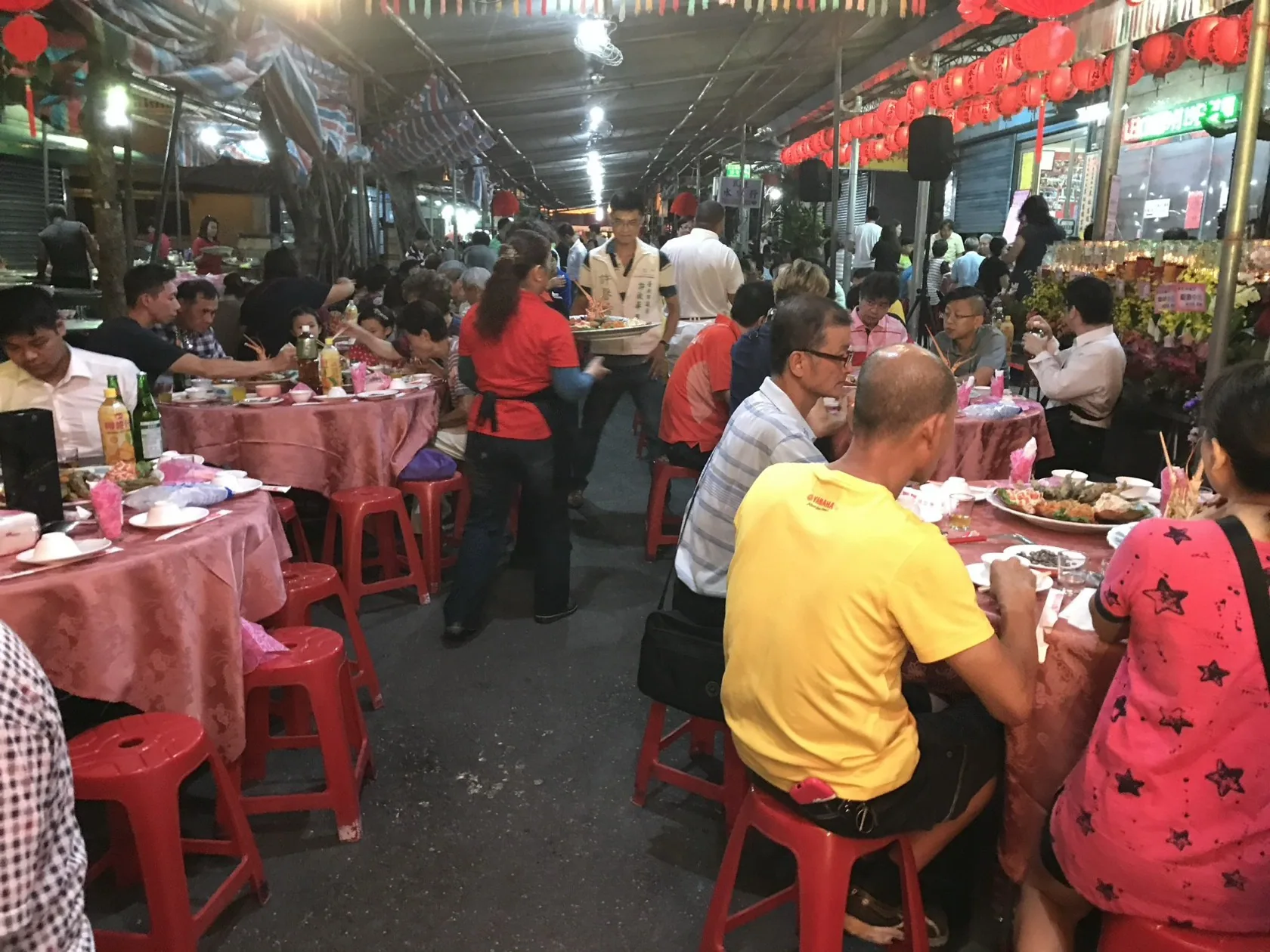
Ban-toh en Taiwán: un campo de batalla que sigue sirviendo mesas bajo la tormenta, y un sistema de rituales entre humanos, dioses y espíritus que se desvanece
Resumen en 30 segundos: El ban-toh no es un invento moderno; el 《臺灣縣志》 (Anales del Condado de Taiwán) de finales del reinado de Kangxi ya registraba que los taiwaneses, «ante las alegrías familiares o las festividades estacionales, siempre ofrecían banquetes abundantes»1. En Neimen, Kaohsiung —una zona de tierras áridas de marga de nodular mudstone donde incluso los cultivos tienen dificultades para crecer—, en su apogeo, de una población de 14.000 personas surgieron unos 150 grupos de zongpushi (maestros cocineros), siendo el asentamiento más denso de Taiwán2. Sin embargo, hoy este oficio se bifurca: los platos del ban-toh han entrado en hoteles de cinco estrellas, en guías Michelin e incluso han vuelto con fuerza al extranjero3; mientras tanto, ese conjunto de conocimientos rituales que involucra a todo el pueblo, donde el zongpushi actúa como consultor folclórico y conecta los tres reinos de humanos, dioses y espíritus, se está perdiendo silenciosamente ante la falta de sucesores4. Lo que desaparece realmente no es el sabor, sino el entendimiento tácito que hay detrás de él.
La tormenta del atardecer llegó de forma repentina y violenta; el agua acumulada pronto alcanzó la altura de las pantorrillas.
Era un banquete de 120 mesas que el veterano zongpushi de Tainan, Wang Yi-yong, había aceptado y que estaba a punto de comenzar. La estructura del toldo de lona se doblaba bajo el peso del agua, los fogones se apagaban uno tras otro y las ollas flotaban en la superficie; incluso las truchas preparadas para cocinar escaparon de sus recipientes, perdiéndose más de una decena de golpe5. Cualquier otra persona probablemente habría cancelado el evento.
Wang Yi-yong inspeccionó el lugar y no canceló. Ordenó al personal hacer cortes en la lona para drenar el agua acumulada, trasladó todos los utensilios de cocina bajo los aleros y, subiéndose las mangas, se metió al agua para atrapar los peces. Esa noche solo faltó una trucha, que fue compensada con ingredientes de las mesas de reserva. Todos los invitados tuvieron qué comer5.
Durante trescientos años, el ban-toh ha funcionado más o menos así: mientras el anfitrión no cancele, la mesa debe servirse. Esta disciplina de «misión cumplida» ha sostenido todos los momentos importantes de la vida de los taiwaneses, desde el nacimiento hasta la despedida final, y desde el culto a los dioses hasta el respeto a los espíritus. Y ahora, este sistema avanza simultáneamente en dos direcciones: una hacia arriba y otra hacia abajo.
El restaurante es el campo literario, el banquete de carretera es el campo marcial
En la industria existe una metáfora común: dirigir un restaurante con local fijo, aire acondicionado y una línea de cocina completa es el «campo literario» (文場). Llevar todo el equipo a la orilla de una carretera, al patio de un templo o a un centro comunitario para montar carpas temporales y servir mesas es el «campo marcial» (武場) 5.
La diferencia entre el campo literario y el marcial no radica en el nivel de destreza culinaria, sino en la incertidumbre. En un restaurante, la ubicación, los fogones y el personal son los mismos cada día. En un banquete de carretera (bando), ni el lugar, ni la hora, ni el personal son fijos. Un mismo zǒngpūshī (maestro de banquetes) puede estar esta semana en el patio de un templo en Tainan celebrando el cumpleaños de una deidad y la próxima semana en un salón ancestral en una zona montañosa para un funeral; esto implica volver a montar las carpas, reconectar los fogones y reasignar a los shuǐjiǎo (ayudantes de cocina) 5. Desde el punto de vista de la gestión, este es el modelo de catering más complejo: en un banquete completo, el zǒngpūshī actúa simultáneamente como chef ejecutivo, director de eventos y coordinador logístico; él es el único responsable de coordinar las carpas de lona, el mobiliario, la vajilla, los proveedores de ingredientes y todo el equipo humano 5.
Por ello, la técnica culinaria es solo la base de esta profesión; la gestión de crisis es su verdadera ventaja competitiva.
✦ «Lo que más temo es que los clientes esperen desesperadamente y, en cuanto lleguen a casa, se lancen al teléfono». — Xue Menghui, zǒngpūshī de Neimen, hablando sobre la noche del tifón Morakot 6
La noche del tifón Morakot, Xue Menghui estaba en Fengshan dirigiendo un banquete de celebración para el cumpleaños de una deidad. El viento era feroz y la lluvia torrencial; las carpas fueron derribadas por el viento y una estructura de hierro golpeó la cabeza de un cocinero, momento en el que el anfitrión decidió cancelar el evento 6. Tras enviar a cada uno de los shuǐjiǎo de vuelta a Qimei y Shanlin, cuando intentaba regresar a Neimen, descubrió que todos los puentes habían colapsado. Pasó la noche atrapado en un 7-ELEVEN, viendo cómo las inundaciones del arroyo Xianxi en Nanzi rugían como si fueran un mar 6. Lo que no pudo dejar de pensar durante toda la noche fueron aquellos clientes que esperaron sin poder comer: en cuanto llegaron a casa, se lanzaron a llamar por teléfono. Y al día siguiente, todavía tenía que organizar un banquete para el cumpleaños de Guanyin 6.
Sin importar los vientos huracanados, las lluvias torrenciales o la destrucción de puentes y carreteras, mientras el anfitrión no cancele, el zǒngpūshī debe encontrar la manera de servir los platos. El cumplimiento del deber es la verdadera barrera de entrada de esta industria durante trescientos años, situándose muy por delante de la propia habilidad culinaria.
Donde solo el bambú espinoso sobrevive, ha florecido un reino de maestros de banquetes
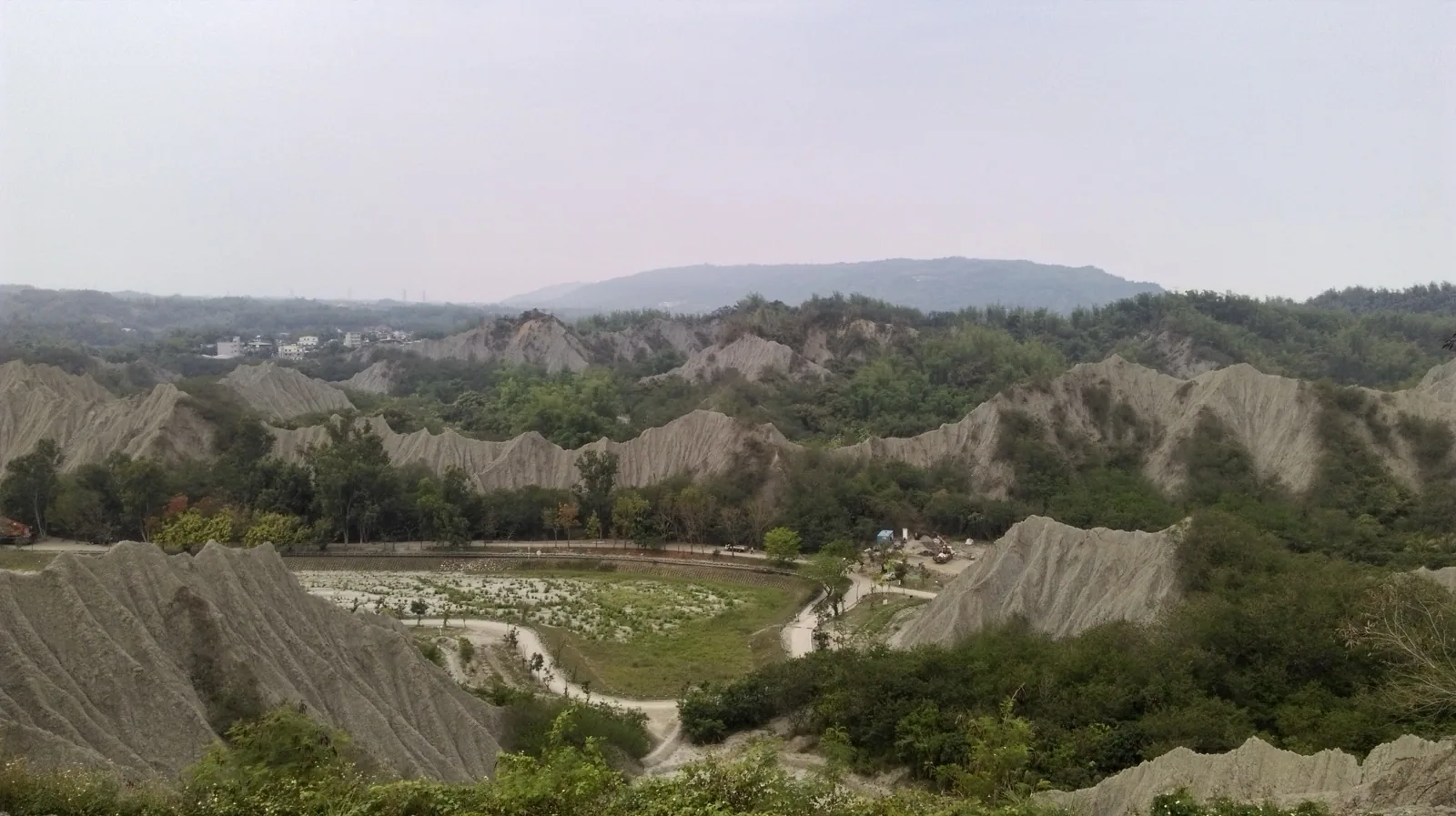
El terreno baldío de marga de la formación Gutingkeng en la zona de Kaohsiung, conocido popularmente como el «Mundo de la Luna». Neimen se encuentra situado junto a este paisaje donde incluso los cultivos tienen dificultades para crecer. Photo: StevenK234, 2019. CC BY-SA 4.0 via Wikimedia Commons.
Para entender cómo se forjó esta disciplina profesional, primero hay que observar una tierra donde es muy difícil cultivar nada.
La zona con mayor densidad de zǒngpùshī (maestros de banquetes) en Taiwán es Neimen, en Kaohsiung. Neimen se asienta sobre el terreno baldío de marga de la formación Gutingkeng: ese paisaje conocido como el «Mundo de la Luna», con laderas grisáceas y desnudas que se extienden por las zonas de Neimen, Tianliao y Yanchao. La revista Taiwan Guanghua describe esta geología de la siguiente manera: «La cementación y la permeabilidad de la marga son bajas; al contacto con el agua se ablanda y se vuelve fangosa, y al secarse se agrieta y se desprende; sumado a que los sedimentos de la formación marina tienen una alta salinidad, el crecimiento de las plantas es difícil».7 En estas laderas desnudas donde ni siquiera los cultivos prosperan, casi solo el bambú espinoso, resistente a la sequía, logra sobrevivir. Solo en las zonas donde la tierra blanca es más espesa se pueden cultivar mangos y plátanos que, debido a su crecimiento lento, resultan incluso más dulces7.
Cuando la tierra no alimenta a la gente, esta debe buscar otro camino. Existen dos teorías sobre por qué Neimen se convirtió en la cuna de los zǒngpùshī, y ambas tienen sus fuentes.
Una versión proviene de una entrevista de The Reporter: en los primeros años, la gente de Neimen sobrevivía fabricando cestas de bambú para abastecer a los agricultores de plátanos de Qishan para su empaquetado y exportación. En la década de 1960, cuando las cajas de cartón ocuparon masivamente el mercado, la industria del tejido de bambú decayó, coincidiendo precisamente con el auge de los banquetes tradicionales (bànzhuō), lo que llevó a un gran número de artesanos a cambiar de oficio hacia la cocina8. La otra versión es la de las autoridades locales y los estudiosos de la historia y cultura: Neimen tiene muchos templos y muchas procesiones; solo el grupo Sòngjiāng es ya un emblema local, y en cada festividad se debe alimentar a una gran cantidad de participantes. Esta demanda recurrente de «servicios de comida» impulsó la aparición de los zǒngpùshī profesionales9. Ya sea por la transición del tejido de bambú o por el suministro de comida para festivales de templos, ambas líneas apuntan a lo mismo: esta tierra obligó a la gente a desarrollar un oficio basado en la destreza manual.
En su apogeo, con una población de unos 14.000 personas en toda la zona de Neimen, había aproximadamente 150 grupos de zǒngpùshī; casi una de cada cinco familias vivía de los banquetes, y simultáneamente eran capaces de gestionar más de 20.000 mesas2. Este es el asentamiento de zǒngpùshī más denso de toda Taiwán. (Esta cifra proviene de la recopilación de investigaciones de las tesis de maestría de Chang Yu-hsin en 2007 y Tang Yu-ning en 2016 de la Universidad I-Shou, y no es un censo reciente2).
La transmisión de este oficio se basa en el sistema de maestro y aprendiz. Una vez que un ayudante acumula suficiente experiencia, puede graduarse; luego, el segundo y tercer cocineros pueden establecer sus propios negocios. Antiguamente, mediante un sistema de aprendizaje al estilo «tāngzhūjiǎo» (donde el maestro toma aprendices y estos a su vez toman otros), la técnica del bànzhuō se difundió generación tras generación por todo Taiwán8. El paso clave que convirtió a Neimen de un grupo de artesanos en una industria ocurrió en 1976: Hsueh Ching-chi y varios socios (incluyendo a Deng Zheng-ping, además de carniceros y vendedores de verduras) formaron una empresa «cuádruple» que integró el suministro de ingredientes, la cocina y el alquiler de mesas y sillas. Desde entonces, el banquete se convirtió en un negocio con una cadena de suministro completa, encargándose de todo, desde los ingredientes y la cocina hasta el mobiliario8.
Hoy en día, Hsueh Meng-hui estima que en Neimen solo quedan entre 30 y 40 zǒngpùshī, aproximadamente una cuarta parte de lo que eran en su apogeo8. El reino aún existe, pero la gente se está dispersando.
Los libros de contabilidad de hace trescientos años ya registraban el «encargo de un banquete a la cocina principal»
Muchos piensan que el bando (banquete tradicional) es algo que surgió en Taiwán después de la posguerra. No es así. Sus raíces se pueden rastrear hasta la dinastía Qing.
El 《臺灣縣志》 (Crónica del condado de Taiwán, escrita por Chen Wen-da en 1720), a finales del reinado de Kangxi, ya registraba que los taiwaneses, «ante acontecimientos familiares alegres o durante las festividades estacionales, siempre ofrecían banquetes abundantes para sus invitados». Para la época de Daoguang, el 《彰化縣志》 (Crónica del condado de Changhua, escrita por Zhou Xi en 1835), se describía la magnificencia de los banquetes con la expresión «los manjares agotaban las montañas y los mares»1. En 1902, durante los inicios del periodo de dominio japonés, un artículo titulado 〈Miscelánea sobre banquetes y platos〉 incluyó formalmente el término 「辦桌」 (bando) en la literatura y lo explicó con claridad: «Preparar mesas, organizar comida y bebida o montar un banquete se denomina 『辦桌』».10 Este artículo pertenece a 《臺灣慣習記事》, una revista mensual publicada por la Asociación de Investigación de las Costumbres de Taiwán (nótese que esta es una institución distinta de la «Comisión de Investigación de las Antiguas Costumbres de Taiwán» de la misma época, y a menudo se confunden)^10.
Entonces, ¿cuándo empezó realmente este negocio del bando?
Tseng Pin-tsang, investigador asociado del Instituto de Historia de Taiwán del Academia Sinica, ha señalado tras investigar diarios y libros de contabilidad de la dinastía Qing que los taiwaneses ya encargaban banquetes a chefs profesionales para bodas, funerales y rituales durante ese periodo11. La evidencia se encuentra en los libros de cuentas: por ejemplo, los registros de la familia Lin de Wufeng a finales de la dinastía Qing anotan claramente partidas como «encargo de banquete a la 『cocina principal』 (總鋪), coste de una mesa»11. Tseng infiere que esta costumbre de contratar chefs profesionales para organizar banquetes puede remontarse a la época de Kangxi11. Si buscamos el origen más remoto, las raíces del bando se encuentran en la cultura de Fujian y Guangdong: la tradición de organizar banquetes conocida como 「辦酒」 (ban-tsiu) o 「到燴」 (to-hui) en esas regiones viajó al mar hacia Taiwán junto con los inmigrantes de la dinastía Qing12.
Sin embargo, desde la dinastía Qing hasta la década de 1960, el bando era muy diferente a como es hoy. En aquel entonces, en las ciudades se dependía de los restaurantes para el servicio de catering, mientras que en las zonas rurales la mayoría solo podía recurrir a aldeanos con algo de destreza culinaria para realizar trabajos temporales; los platos eran limitados y, a menudo, incluso los ingredientes debían ser preparados por la propia familia anfitriona. Las familias más acomodadas contaban con una 「灶下婦」 (mujer de cocina) especializada para ayudar con los preparativos13. La verdadera profesionalización comenzó aproximadamente en la década de 1960 (es decir, la década de los años 50 de la República de China). Cuando los aldeanos descubrieron que «el beneficio de organizar banquetes temporales era mayor que el de la agricultura», este oficio comenzó a profesionalizarse paso a paso, alcanzando su apogeo entre las décadas de 1970 y 198013.
💡 ¿Sabías que...? En taiwanés, bando se pronuncia pān-toh, y el jefe de la cocina principal (tsóng-phòo-sai) se dice tsóng-phòo-sai. El uso del carácter 「師」 (shi, maestro) es un honorífico para los artesanos profesionales en las costumbres populares de Taiwán14 —al igual que con los «maestros de la carpintería» o «maestros de la madera», es una prueba de que este oficio se respetaba como una verdadera «arte».
Fuente: 《臺灣慣習記事》, investigación de Tseng Pin-tsang, The Reporter, Ministerio de Economía, TaiwanPlus
El orden de los doce platos esconde todo un sistema de conocimiento invisible
Si la disciplina del wuchang (el área de cocina) es el esqueleto de un banquete bando, lo que vamos a explicar ahora es su alma.
Un banquete bando estándar suele constar de entre 12 y 14 platos, con una secuencia que tiene un inicio, un desarrollo, un clímax y un desenlace: primero se sirven platos fríos para abrir el apetito mientras los invitados terminan de sentarse. Luego, una sopa caliente para reconfortar el estómago; después llega el clímax con los platos principales: los mariscos o carnes más lujosos, como langosta, cangrejo rojo o fo-tiao-qiang (sopa de dioses saltando un muro), que aparecen aquí y se dividen en una «versión popular» o una «versión aristocrática» según el presupuesto de cada mesa. Tras el clímax, se sirve una sopa para limpiar el paladar, seguida de platos con sabores intensos como carne de cerdo en conserva con bambú o costillas de cerdo para reavivar el apetito; finalmente, una sopa de pollo cierra la comida y se termina con postres y fruta15. (Este orden de servicio es un consenso acumulado durante años entre los maestros cocineros y los medios especializados en gastronomía).
Cabe mencionar que la langosta no es, en realidad, un plato «tradicional» del bando. No se convirtió en protagonista hasta la década de 1960, tras el inicio de los Diez Grandes Proyectos de Construcción y el despegue económico; en los primeros años, lo más común en las mesas de bando eran fideos salteados, pollo hervido (baizhanji), sopa de apio con calamar o sopa de albóndigas de cerdo (gongwan). Para mucha gente, el bando era una de las pocas ocasiones en las que podían comer carne16. Incluso el majestuoso fo-tiao-qiang tenía originalmente el nombre de «Fushouquan» (Plenitud de Fortuna y Longevidad), originado en un banquete familiar de un funcionario de Fuzhou durante el reinado de Guangxu en la dinastía Qing17.
Pero lo que hace que el bando sea verdaderamente único es lo que hay detrás de los platos: estos se integran en una cosmovisión de consumo comunitario. La investigación del Museo Nacional de la Historia de Taiwán divide el consumo comunitario del bando en tres tipos, lo cual constituye el marco teórico para entender su «alma»15:
El primero es el consumo compartido entre humanos y dioses. En los banquetes de festivales estacionales, las personas disfrutan de las ofrendas junto a las deidades; los taiwaneses lo llaman «comer las bendiciones de los dioses» (yi shen shi fu): lo que se ingiere es la protección divina15. El segundo es el consumo compartido entre humanos y espíritus. Los banquetes de reuniones de asociaciones de ancestros o de gestión de templos, sumados a los banquetes del Festival de los Fantasmas Hambrientos, son momentos en los que las personas comen junto a sus antepasados y a los «hermanos buenos» (hao xiongdi), para así honrar a los difuntos y establecer una armonía con los seres de otro mundo15. El tercero es el que nos resulta más familiar: el consumo compartido entre anfitriones e invitados, donde los banquetes de ritos de paso celebran las distintas etapas de la vida y las reuniones de asociaciones consolidan las relaciones interpersonales15. Un solo banquete bando puede abarcar simultáneamente los tres reinos: humanos, dioses y espíritus.
Es por esto que el maestro cocinero es, al mismo tiempo, el consultor de costumbres populares del anfitrión. En una entrevista con The Reporter, un profesional describió este papel así: «¿Cómo preparar el banquete de un mes de nacido? ¿Cómo disponer las ofrendas? ¿Qué alimentos no pueden servirse en determinadas ocasiones? Ellos son quienes mejor lo saben».5
📝 Nota del curador
Es fácil pensar en el bando simplemente como «una comida a gran escala», pero ese enfoque nos haría perder su elemento más crucial. Lo que el bando vende realmente es una correspondencia entre momentos y significados: qué tipo de banquete corresponde a cada momento de la vida, qué platos son de buen augurio o de mal augurio en cada ocasión, y cuáles son tabúes. Esta relación no se escribe en ninguna receta; reside en la mente del maestro cocinero y en su memoria muscular tras años de práctica. Cuando más adelante leamos que «los platos de bando han entrado en hoteles de cinco estrellas», debemos recordar: el hotel puede comprar la receta, pero no puede comprar esta correspondencia de significados. Lo que se ha perdido es precisamente esto último.
¿Cómo es concretamente esta correspondencia? El trabajo del investigador de costumbres populares Chang Yun-shu muestra su minuciosidad18: en un banquete para celebrar el primer mes de un bebé se usa un pollo entero para simbolizar la «integridad» y la perfección; en los banquetes funerarios, el número de platos debe ser impar (7 o 9) y debe incluir un trozo de carne con una esquina faltante (sann-kak-bah), cuya forma incompleta simboliza el vacío en el corazón de la familia doliente; asimismo, se evitan ingredientes como semillas de loto, melón amargo o piña debido a sus connotaciones o juegos de palabras específicos. En cambio, en las bodas debe haber pollo (que simboliza el inicio de un hogar), pescado (abundancia), carne en conserva (ascenso social) y estómago de cerdo (para desear a la novia una «panza grande»/fertilidad); además, en el pastel de arroz con cangrejo rojo se deben elegir específicamente hembras con muchos huevos para atraer la buena suerte de «tener hijos pronto»18.
⚠️ Punto de controversia: Existen algunos tabúes del bando que circulan popularmente pero que carecen de base folclórica. Por ejemplo, el mito de que «en los banquetes funerarios debe haber guabao (pan con cerdo)» es incorrecto: el guabao (estilo «cerdo mordido por el tigre») es en realidad una costumbre del banquete de fin de año (weiya, el 16 de diciembre del calendario lunar), que simboliza morder y retener la mala suerte del año, sin relación alguna con los funerales. Otro ejemplo es el dicho de que «en las mudanzas se evitan las albóndigas porque su nombre suena a 'terminado'»; esta afirmación tiene escasa base y contradice directamente la costumbre de usar bolas de arroz (tangyuan) en banquetes de mudanza para simbolizar la plenitud19. Al escribir sobre el bando, incluso los tabúes deben ser verificados, porque un error puede dañar la credibilidad de todo este sistema de conocimiento.
La otra cara del alma se encuentra tras el final del banquete. Una vez terminado, el maestro cocinero junta los restos de los diversos platos para cocinar una «sopa de restos» (caimei tang, también llamada sopa de verduras mixtas) y la reparte entre los vecinos que vinieron a ayudar para que se la lleven a casa20. No se trata de gestionar sobras, sino de un acto de gratitud y de valorar lo recibido; Taiwan Panorama lo describe como un símbolo de reciprocidad20. Un banquete bando es, de principio a fin, un asunto de toda la aldea; el anfitrión nunca lo organiza solo. Y la sopa de restos, por sí misma, está en peligro de desaparecer20.
El «Gran Hotel Heisong» en los días propicios del calendario lunar
Los maestros de la vieja escuela suelen utilizar los mandatos presidenciales para recordar los altibajos de la industria.
Los 12 años entre 1988 y 2000, durante el mandato de Lee Teng-hui como presidente, se consideran la era dorada de los bando (banquetes tradicionales). No era solo una época de las tradicionales «ocho celebraciones y un funeral» (compromiso, boda, luna llena, regreso a casa tras el primer mes, inauguración de negocio, banquete de cumpleaños, mudanza y fallecimiento); era una época en la que incluso si un niño aprobaba un doctorado o si alguien ganaba dinero en las carreras de palomas, se organizaba un banquete21. Cuando llegaban los días propicios del calendario lunar, las entradas de los templos y los bordes de las carreteras se llenaban del «Gran Hotel Heisong». El origen de este nombre es muy taiwanés: antiguamente, los toldos de lona solían ser proporcionados por las empresas de bebidas, con anuncios de la soda Heisong impresos en ellos; con el tiempo, el «Gran Hotel Heisong» se convirtió en un sinónimo de los banquetes de carretera21.
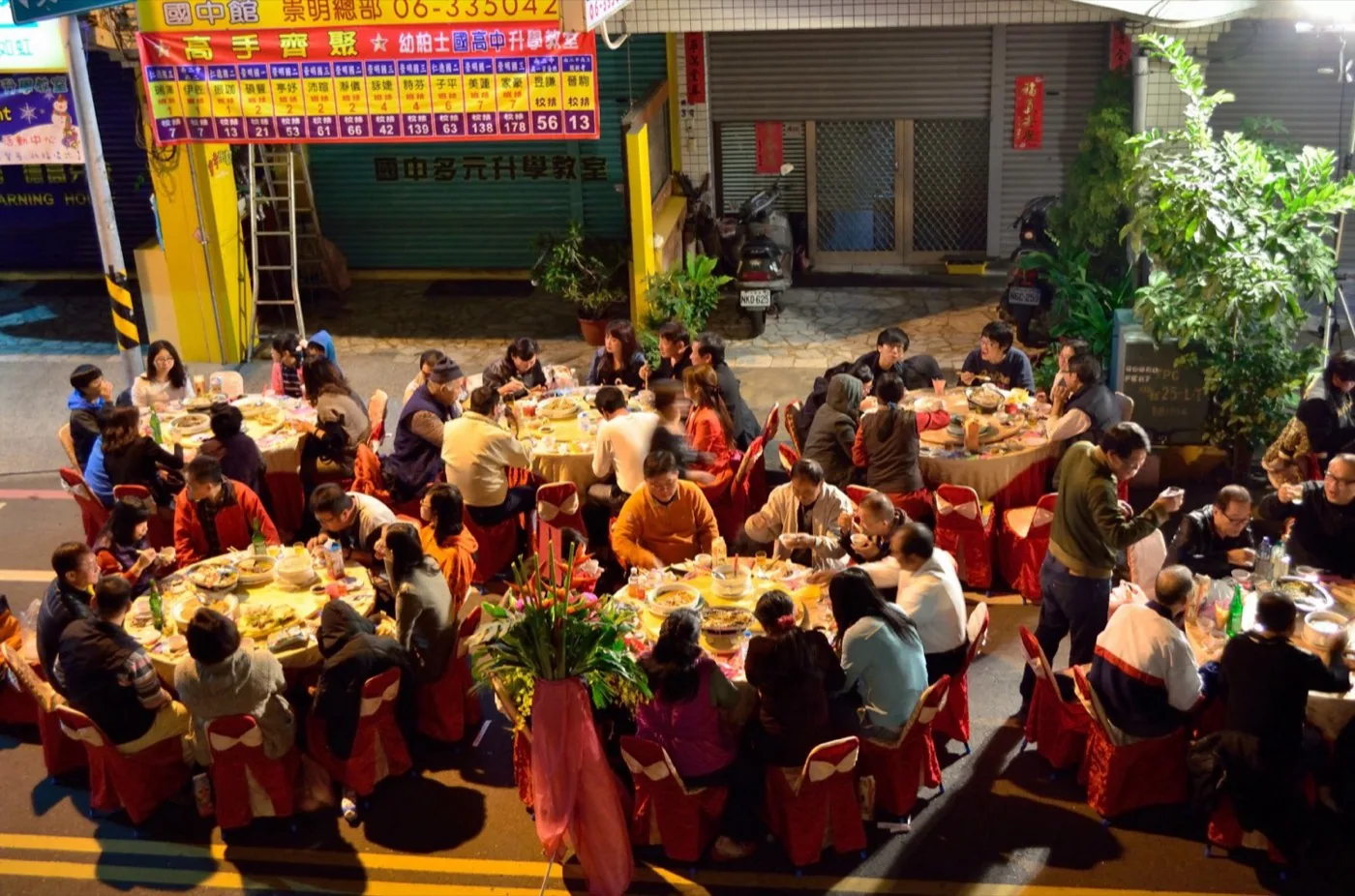
2014 en Tainan, un banquete organizado directamente en la calle. Cerrar la calle, montar las mesas y servir el festín: así es la apariencia más cotidiana del «Gran Hotel Heisong». Photo: 測鏡者, 2014. CC BY-SA 2.0 via Wikimedia Commons.
薛孟輝 (Xue Meng-hui) recuerda con mayor claridad cuán próspera fue esa época a través del diario de trabajo que le dejó su padre, Xue Qing-ji.
✦ «El calendario anual estaba lleno; se organizaban 25.000 banquetes al año». — Xue Meng-hui recuerda el diario de trabajo de su padre, Xue Qing-ji21
En la época de Xue Qing-ji, incluso en un mes flojo, el promedio era de unos 1.000 banquetes21. En contraste con la etapa previa a la pandemia de Xue Meng-hui, poder organizar 500 banquetes en un mes muy activo ya se consideraba un éxito, y el total anual no superaba los miles21: entre una generación y otra, la escala se ha reducido varias veces.
El punto de inflexión ocurrió aproximadamente en 2003 (el tercer año del mandato de Chen Shui-bian). La industria de Taiwán se desplazó masivamente hacia China continental, y los clientes de las pequeñas y medianas empresas disminuyeron uno tras otro. Algunos clientes habituales no volvieron a contratar un banquete durante dos años seguidos; al preguntar, descubrieron que sus empresas habían quebrado21. El final de la era dorada comenzó con una serie de llamadas telefónicas que nunca llegaron a completarse.
Cuarenta años es ser joven: una brecha generacional en proceso de ruptura
Que una industria se contraiga puede deberse a problemas económicos, y eso esperará al próximo ciclo. Pero lo que enfrenta el sector del banquet catering (辦桌, bando) es algo mucho más difícil de revertir: una brecha generacional en el relevo generacional.
Li Chun-hsiang, un maestro cocinero de New Taipei, lo dice sin rodeos: «Para un chef de catering, tener 40 años es ser joven; la mayoría solo asume el negocio si tiene raíces familiares. De cada diez chefs de 30 años, no puedes encontrar ni a dos; el personal operativo está envejeciendo de forma generalizada». 22 La observación de otro maestro cocinero, Chiang Yi-yung, es aún más específica: de los graduados en escuelas de gastronomía, solo alrededor del 2% termina dedicándose al catering. 23 La razón no es difícil de entender: «Si organizas un banquete para el almuerzo, hay que salir a las 3:30 de la mañana; las jornadas son largas y el calor de los fogones es intenso». 23 Si los jóvenes tienen opciones, preferirán trabajar en un restaurante con aire acondicionado.
A medida que el talento se pierde, la técnica también se rompe. Los maestros de la vieja generación lo hacían todo ellos mismos: desde sacrificar cerdos y pollos hasta hacer pudines o hornear pasteles; hoy en día, con la existencia de alimentos congelados subcontratados, los aprendices no aprenden el proceso completo en la cocina, y esos platos artesanales (shoulu cai) que requieren más trabajo van desapareciendo uno a uno. 24
El legendario plato «Jaizai Zhudu Bie» (soft-shell turtle stuffed in chicken, which is stuffed in pig stomach) de la película 《總舖師》 es el mejor ejemplo: se rellena una tortuga en el estómago de un pollo de granja, y luego se mete todo el pollo dentro de un estómago de cerdo para estofarlo a fuego lento durante tres horas; el proceso es tan complejo que casi nadie está dispuesto a hacerlo. 25 El «Pollo con Castañas», que era popular hace 40 años, ya no lo saben preparar los chefs jóvenes; otros platos como la anguila con pasta de hueso, el pollo budai o las cinco ramas de vegetales (wuliuzhi) también están al borde de la extinción. 24 (Cabe aclarar que platos como el fengrou o el arroz con cangrejo rojo, aunque requieren mucho trabajo, siguen siendo muy comunes y no están en peligro de desaparecer). Quien ha dejado el mayor registro de estos platos es la «madrina de la cocina taiwanesa», Huang Wan-ling; ella fue la directora gastronómica de la película 《總舖師》 y dedicó más de diez años a viajar por el campo para buscar y preservar esos platos taiwaneses que estaban a punto de desaparecer. 25
📝 Nota del curador
Fíjate que aquí hay una opción que no se menciona explícitamente. El mercado, en realidad, le ha dado al sector del catering un camino fácil: usar paquetes de comida congelada o productos semielaborados; con eso también se pueden servir los 12 platos habituales y la mayoría de los clientes ni siquiera notarán la diferencia. Siguiendo este camino, la industria puede sobrevivir más tiempo. Pero el precio es que aquellos platos artesanales que solo se aprenden mediante la transmisión oral y práctica entre maestro y aprendiz morirán silenciosamente en este proceso; no porque a la gente no le guste comerlos, sino porque ya nadie siente la necesidad de aprender a hacerlos. Las técnicas rara vez son eliminadas por algo nuevo; la mayoría de las veces, son desplazadas poco a poco por la mentalidad de «con que sea suficiente es bastante».
El invierno más largo
Si la brecha generacional es una enfermedad crónica, la pandemia de 2020 fue un cuadro agudo.
En aquel momento, The Reporter entrevistó a casi diez maestros cocineros (zǒngpùshī) del norte y el sur, y el consenso fue claro: desde el Año Nuevo Lunar, el número de mesas de catering se había reducido en al menos un 90 % (este es el consenso obtenido mediante entrevistas, no una estadística oficial) 26. Solo en los meses segundo y tercero del calendario lunar, Hsüeh Meng-hui vio canceladas más de 500 mesas; incluso hubo descendientes de familias dedicadas al ban-toh que, acostumbrados a usar grandes palas para saltear comida en ollas gigantes, tuvieron que cambiar sus herramientas por pequeñas cucharas para servir bentos individuales y así sobrevivir 26.
Las cifras oficiales tampoco logran reflejar la magnitud del problema. Según las estadísticas del Ministerio de Economía, en abril de 2020, la facturación del sector de «servicios de catering y comidas colectivas» cayó un 32,3 % interanual, con una facturación mensual de aproximadamente NT$ 2.500 millones 27. Sin embargo, hay que leer este dato con cautela: se vio afectado principalmente por el sector de la cocina de vuelo (comida para aviones), y una gran cantidad de los banquetes al aire libre (ban-toh) ni siquiera tienen registro comercial, por lo que quedan fuera del alcance estadístico. Por tanto, para los banquetes al aire libre, esta cifra en realidad subestima el impacto sufrido 27.
Fuente: Entrevistas de *The Reporter* a maestros cocineros (reducción del 90 % en mesas) + Estadísticas del Ministerio de Economía (caída interanual del 32,3 % en el sector de catering y comidas colectivas en abril de 2020) + Observación de Chiang Yi-yung sobre la proporción de graduados en gastronomía 232627
Más allá de la pandemia, los banquetes en el norte enfrentan un problema estructural adicional: el espacio. Li Chün-hsiang describe que, en el norte, para organizar un ban-toh primero hay que cerrar calles y solicitar permisos de circulación, además de que es común recibir denuncias de los vecinos: «Incluso cuando estamos friendo algo, los residentes de al lado empiezan a insultarnos y amenazan con denunciarnos ante la Oficina de Protección Ambiental por contaminación atmosférica. En los casos más extremos, incluso nos lanzan objetos desde los pisos superiores para echarnos» 28. Además, los centros comunitarios y los auditorios de las escuelas primarias en la ciudad de Taipéi casi nunca se alquilan para celebrar banquetes 28. En una metrópolis donde el suelo es extremadamente caro, cada vez es más difícil encontrar siquiera un pequeño espacio legal donde poder montar las mesas al aire libre.
¿Son todas estas presiones algo negativo? El investigador histórico Yen Chen-yü tiene una perspectiva distinta. Él considera que la pandemia fue tanto un golpe como un estímulo que obligó a los maestros cocineros a elevar sus estándares de higiene y a reflexionar seriamente sobre su transformación 29. Sin embargo, el miedo más profundo de los cocineros entrevistados es otra cuestión: «No solo nos preocupa este año, sino que nos preocupa que la gente se acostumbre a no contratar banquetes» 29. La conclusión de The Reporter es pragmática: el ban-toh está estrechamente ligado a la economía y será difícil que se recupere en poco tiempo 29.
Los platos permanecen, pero el alma se desvanece
Pero si la historia se detiene aquí, estaríamos cometiendo un error garrafal.
Porque mirando hacia atrás desde 2025, el ban-toh no está muriendo de forma unidireccional. En realidad, se está bifurcando: como «platos» y «marca», está ascendiendo; como «ritual en el que participa todo el pueblo», está decayendo.
La rama que asciende tiene un impulso impresionante. La Guía Michelin ha incluido los platos de ban-toh en su discurso oficial; tres restaurantes especializados en cocina de banquete —Ah-Hsia Hotel, Hsin Hsin Restaurant y Tung Shang Tai-Chai— han sido seleccionados para la categoría Bib Gourmand 30. En Taipéi, el Palais de Chine Hotel lanzó un «banquete al estilo taiwanés» dirigido por el chef Lin Ming-tsan, con un precio de NT$22,800 por mesa más un 10 % de cargo por servicio, presentándose como el primer hotel de cinco estrellas en Taiwán que rinde un homenaje formal a la cultura del ban-toh 31. La nueva generación también está tomando el relevo: en agosto de 2025, TaiwanPlus publicó un reportaje titulado «Bando Is Back», mostrando cómo los jóvenes están revitalizando el ban-toh mediante un modelo de «marketing de la generación joven × destreza de la generación mayor», como es el caso del maestro de tofu Huang Mao-yuan con su hija Huang Chia-yu, o el maestro A-Long con su hijo A-Siang 32. El reportaje en inglés lo describe así: «Once fading from Taiwan's cultural fabric, this legendary banquet tradition is making a dynamic comeback…» 32.
Incluso desde el extranjero hay un retorno. En Emeryville, California, el restaurante Good To Eat, dirigido por la chef taiwanesa Tony Tung (quien junto a su pareja Angie Lin forman un equipo de esposas), trata al ban-toh como una carta de amor escrita para Taiwán, y su menú se llama jan ba bae (ban-toh) 33. El 4 de enero de 2025, invitó al maestro de Neimen, Master A-Càn, para organizar un banquete tradicional para más de 400 personas en Taipéi, lo que atrajo a comensales de California que volaron específicamente a Taiwán para vivir la experiencia 33.
Fuente: Basado en la Guía Michelin, reportajes del Palais de Chine y TaiwanPlus, así como observaciones sobre la mano de obra de los maestros 2223303132
Al observar ambas ramas juntas, la forma de esta bifurcación queda clara. Lo que se está recuperando son los «platos» y la «marca»: estos pueden entrar en hoteles de cinco estrellas, mesas Michelin o restaurantes en California; lo que se está perdiendo es el conjunto de conocimientos rituales. El salón de banquetes de un hotel de cinco estrellas puede replicar una olla de Buddha Jumps Over the Wall, pero no puede replicar la sintonía de «todo el pueblo movilizándose, el maestro actuando como consultor folclórico y la distribución de los platos finales entre los vecinos». La escasez ha convertido la cocina del ban-toh en una especie de peregrinación cultural; comensales de California están dispuestos a cruzar medio mundo para volver a Taiwán y disfrutar de un banquete, pero el objeto de esa peregrinación está perdiendo el hábitat que le permite sobrevivir: ese terreno rústico que cría a los maestros, esas ferias de templos sucesivas y ese pueblo donde se llama a todos los vecinos para ayudar.
Un restaurante con aire acondicionado puede producir platos, pero no puede criar el alma.
Ese calendario agrícola lleno de anotaciones
Volvamos al diario del calendario agrícola de Hsueh Ching-chi, repleto de palabras.
Es el objeto más preciado de Hsueh Meng-hui y, al mismo tiempo, el sitio arqueológico más auténtico de esta industria21. Esas densas anotaciones de pedidos en el diario —banquetes para celebrar las ganancias en las carreras de palomas mensajeras, cenas de agradecimiento por haber obtenido un doctorado, banquetes de paz por el nacimiento de Mazu en la entrada del templo— registran todo un conjunto de valores que los taiwaneses solían reconocer colectivamente: qué momentos merecen que todos dejen lo que están haciendo para reunirse, qué se debe comer en ese instante, quién debe presidir y cómo despedirse adecuadamente.
Los platos ya han demostrado que pueden entrar en hoteles de cinco estrellas, volar hasta California y recibir la certificación Michelin. Pero, ¿qué queda de esa sintonía escrita en aquel calendario agrícola? ¿Cuántos recuerdan aún qué tipo de mesa corresponde a cada momento, qué plato es de buen o mal augurio según la ocasión, o a qué vecinos que ayudaron se les debe repartir los restos de la comida tras el banquete? ¿Cuántos son capaces todavía de mantener viva esa tradición?
Lecturas adicionales:
- Cocina tradicional taiwanesa
- Guabao
- Cultura del mar en Taiwán
- Cultura de los mercados nocturnos
- Chen Yu-hsun
Fuentes de las imágenes
Este artículo utiliza 3 imágenes de dominio público / con licencia CC, todas almacenadas en caché en public/article-images/food/ para evitar el hotlinking desde los servidores de origen:
- Bando (banquetes callejeros) en el patio de un templo tras el festival de Zhongyuan (hero) — Foto: 玄史生, 2017-09-19, CC0 1.0
- Tierras baldías de marga de Nodular Mudstone en Guteng, Kaohsiung (Mundo de la Luna) — Foto: StevenK234, 2019-04-01, CC BY-SA 4.0
- Bando en las calles de Tainan — Foto: 測鏡者, 2014-12-07, CC BY-SA 2.0
Referencias
- Ban-toh (Wikipedia) — Recopila la etimología de ban-toh, registros documentales en las crónicas de los condados de Taiwán (1720) y Changhua (1835) sobre la costumbre taiwanesa de ofrecer banquetes abundantes con 'manjares de montaña y mar' durante celebraciones familiares o festividades, así como el contexto histórico de su profesionalización.↩2
- Ban-toh (Wikipedia) — Recopila datos sobre la escala del asentamiento de maestros cocineros (Zongpoushi) en Neimen: en su apogeo contaba con aproximadamente 14,000 personas, unos 150 grupos de maestros cocineros, y 1 de cada 5 hogares se ganaba la vida con banquetes, siendo capaces de preparar más de 20,000 mesas simultáneamente; cifras extraídas de las investigaciones de Chang Yu-hsin (2007) y Tang Yu-ning (tesis de maestría de la Universidad I-Shou, 2016).↩23
- Bando Is Back: Taiwan's Roadside Banquet Tradition Makes a Comeback (TaiwanPlus, 2025) — Reportaje de agosto de 2025 sobre el resurgimiento de la cultura del banquete callejero en Taiwán impulsado por estrellas Michelin, hoteles de cinco estrellas y las nuevas generaciones.↩
- Tras la pandemia, el sabor de Taiwán que desaparece gradualmente: La cultura del banquete callejero (The Reporter) — Reportaje profundo de The Reporter en 2020, con entrevistas a casi diez maestros cocineros del norte y sur, documentando la crisis de pérdida de conocimientos rituales y la brecha generacional en la tradición de los banquetes.↩
- Tras la pandemia, el sabor de Taiwán que desaparece gradualmente: La cultura del banquete callejero (The Reporter) — Incluye el registro de campo de Wang Yi-yong, un maestro cocinero de Tainan, capturando la pesca en medio de una tormenta para 120 mesas; la metáfora entre el 'campo académico' de los restaurantes frente al 'campo de batalla' de los banquetes callejeros; y el rol multifacético del maestro cocinero como chef ejecutivo, director de eventos, coordinador logístico y consultor folclórico.↩23456
- Tras la pandemia, el sabor de Taiwán que desaparece gradualmente: La cultura del banquete callejero (The Reporter) — Incluye el relato de Xue Meng-hui, un maestro cocinero de Neimen, sobre su experiencia durante el tifón de agosto en Fengshan, donde las estructuras colapsaron y quedó atrapado tras la ruptura de un puente cerca de un 7-ELEVEN, junto con su declaración: 'Lo que más temo es que los clientes esperen demasiado; en cuanto llego a casa, corro directo al teléfono'.↩234
- Revista Taiwan Guanghua: Reportajes sobre el terreno de marga de Nodular Mudstone — Describe las características geológicas del terreno de marga de Nodular Mudstone (Mundo Lunar) en Gutingkeng, Kaohsiung: 'La cohesión y permeabilidad de la marga son bajas; se ablanda y se vuelve lodosa con el agua, pero se agrieta y se desprende al secarse; sumado a la alta salinidad del suelo sedimentario marino, dificulta el crecimiento de las plantas', así como la distribución agrícola donde solo el bambú espinoso tolera la sequía en las laderas desnudas, mientras que las zonas de tierra blanca permiten cultivar mango y plátano.↩2
- Tras la pandemia, el sabor de Taiwán que desaparece gradualmente: La cultura del banquete callejero (The Reporter) — Recopila teorías sobre el origen en Neimen, como el tejido de bambú para los agricultores de plátanos de Qishan o la transición al negocio de banquetes tras la competencia de las cajas de cartón en la década de 1960; el sistema de aprendizaje tipo 'cerdo con patas en sopa' que difundió la tradición por Taiwán; la industrialización mediante la formación de la empresa '4 en 1' por Xue Qing-ji en 1976, y la estimación actual de que solo quedan entre 30 y 40 maestros cocineros en Neimen.↩234
- Sitio web oficial de la Oficina del Distrito de Neimen — Información oficial del distrito de Neimen, Kaohsiung; registra la perspectiva histórica local que sostiene que la abundancia de templos y la prevalencia de procesiones (como la formación Songjiang) generaron la necesidad de banquetes para alimentar a los participantes, teoría respaldada por el historiador Chen Cong-hsien.↩
- pān-toh Ban-toh: La cultura del banquete de los taiwaneses (StoryStudio) — Incluye la definición documental más temprana de 'ban-toh' en 1902, bajo el título 'Miscelánea sobre banquetes y platos', que indica 'preparar mesas, organizar comida y vino, y desplegar un banquete se llama ban-toh', extraída de la revista mensual 'Registros de Costumbres de Taiwán'.↩2
- pān-toh Ban-toh: La cultura del banquete de los taiwaneses (StoryStudio) — Recopila la investigación de Tseng Pin-tsang, investigador asociado del Instituto de Historia de Taiwán de la Academia Sinica, quien mediante libros de contabilidad de la dinastía Qing (como los de la familia Lin de Wufeng que registran 'contratar un maestro cocinero para el banquete') y diarios, señala que los taiwaneses ya contrataban chefs profesionales para bodas y funerales en la era Qing, sugiriendo que la práctica podría remontarse a la época del emperador Kangxi.↩23
- Ban-toh (Wikipedia) — Recopila el trasfondo histórico de cómo el banquete ban-toh tiene sus raíces en las regiones de Min y Yue, y cómo la cultura de banquetes tradicional de Fujian y Cantón, conocida como 'ban-jiu' o 'dao-hui', llegó a Taiwán con los inmigrantes de la dinastía Qing.↩
- Ban-toh (Wikipedia) — Registra la evolución antes de su profesionalización (desde la dinastía Qing hasta la década de 1960), cuando las ciudades dependían del catering de restaurantes y las zonas rurales de aldeanos que trabajaban a tiempo parcial, con los ingredientes soliendo ser provistos por el anfitrión y las familias ricas contando con 'mujeres de cocina'; y cómo desde la década de 1960 los aldeanos notaron que los beneficios superaban a la agricultura, iniciando su profesionalización y alcanzando su apogeo en las décadas de 1970 y 1980.↩2
- Diccionario de términos comunes del taiwanés de Taiwán del Ministerio de Educación: Ban-toh — Diccionario oficial del Ministerio de Educación; incluye la definición y la transcripción en Tâi-lô de 'ban-toh' (pān-toh); el término para maestro cocinero es tsóng-phòo-sai, donde 'sai' es un honorífico popular para artesanos profesionales.↩
- El comer comunitario en la cultura del banquete (Museo Nacional de Historia de Taiwán, Lin Xiang-bi) — Artículo de investigación del Museo Nacional de Historia de Taiwán que propone una estructura de tres tipos de comensalidad en los banquetes: comunión entre humanos y dioses (rituales estacionales para 'compartir la bendición divina'), comunión entre humanos y ancestros (sociedades de linaje y festivales de los fantasmas), y comunión entre anfitriones e invitados (ritos de paso y reuniones sociales), explicando la relación entre el servicio secuencial de los platos en el banquete y las costumbres vitales.↩2345
- Ban-toh (Wikipedia) — Registra que los mariscos de lujo, como la langosta, se convirtieron en protagonistas del banquete Ban-toh solo después del despegue económico de los Diez Grandes Proyectos de Construcción en la década de 1960; en los inicios, lo común era servir fideos salteados, pollo hervido, sopa de apio con calamar y sopa de albóndigas, siendo una de las pocas ocasiones en que se podía comer carne.↩
- Ban-toh (Wikipedia) — Recoge la anécdota de que el nombre original del plato Buddha Jumps Over the Wall era 'Fu Shou Quan' (Felicidad y Longevidad Completas), originado en los banquetes oficiales de Fuzhou durante el reinado del emperador Guangxu de la dinastía Qing.↩
- Universidad Comunitaria de Tainan: Simbolismo de los platos en los banquetes de bodas y rituales de vida (Chang Yun-shu) — El investigador de folclore Chang Yun-shu recopila el simbolismo de los platos en los banquetes de rituales de vida: para el banquete de luna llena se usa un pollo entero para representar la 'integridad'; en los funerales, el número de platos debe ser impar y se evita la 'carne triangular' (sann-kak-bah) con esquinas faltantes, así como semillas de loto, amargos, pepino amargo y piña; en las bodas es imprescindible tener pollo (prosperidad), pescado (abundancia), carne de cerdo estofada (ascenso de rango), estómago de cerdo (gran fortuna) y pastel de arroz con cangrejo rojo (seleccionando la hembra para simbolizar la pronta llegada de hijos).↩2
- pān-toh Ban-toh: La cultura de los banquetes de los taiwaneses (StoryStudio) — Referencia para el estudio folclórico de los tabúes en los banquetes; el bao de cerdo (gua bao) pertenece a la costumbre del 'cerdo mordido por el tigre' en las cenas de fin de año (16.º día del 12.º mes lunar) y no es un plato de funeral; la idea de que 'se evitan las albóndigas al mudarse' contradice el uso de tangyuan para simbolizar la plenitud en las celebraciones de mudanza, y ambas carecen de apoyo en las fuentes folclóricas de los banquetes Ban-toh.↩
- Taiwan Panorama: La cultura del banquete Ban-toh y la sopa final de platos — Informa sobre la 'sopa de platos finales' (sopa mixta) como un símbolo de gratitud y ahorro, donde se mezclan los restos de los diversos platos del banquete para ser repartidos a los vecinos que ayudaron voluntariamente; es una cultura comunitaria de reciprocidad que actualmente enfrenta el riesgo de desaparecer.↩23
- Después de la pandemia, el sabor de Taiwán que desaparece gradualmente: La cultura de los banquetes callejeros (The Reporter) — Recopila relatos sobre la era dorada de los banquetes durante el mandato de Lee Teng-hui con sus 'ocho celebraciones y un funeral', el origen de los toldos de lona proporcionados por empresas de bebidas en el 'Gran Hotel Heisong', el diario de trabajo de Xue Qing-ji ('25,000 banquetes al año', 'promedio de 1,000 banquetes al mes'), y el punto de inflexión tras la migración de la industria hacia China continental en 2003.↩234567
- Después de la pandemia, el sabor de Taiwán que desaparece gradualmente: La cultura de los banquetes callejeros (The Reporter) — Incluye el testimonio del maestro de cocina de Nueva Taipei, Li Jun-xiang: 'A los 40 años un chef de catering aún es joven; de cada diez chefs de 30 años, no se encuentran dos', reflejando el envejecimiento de la mano de obra en la industria de banquetes.↩2
- Después de la pandemia, el sabor de Taiwán que desaparece gradualmente: La cultura de los banquetes callejeros (The Reporter) — Recopila la observación del maestro de cocina Jiang Yi-yong sobre cómo solo cerca del 2% de los graduados de escuelas de gastronomía se dedican al catering, además de descripciones de las condiciones laborales: 'se trabaja en el turno del mediodía y hay que partir a las 3:30 a. m., con jornadas largas y frente al calor intenso de los fogones'.↩234
- Después de la pandemia, el sabor de Taiwán que desaparece gradualmente: La cultura de los banquetes callejeros (The Reporter) — Registra cómo los maestros experimentados preparaban desde el sacrificio de cerdos y pollos hasta pudines y pasteles de forma artesanal; actualmente, el uso de alimentos congelados externos impide que los aprendices aprendan las técnicas tradicionales, poniendo en peligro platos artesanales como el pollo con castañas, la anguila con pasta de calabaza, el pollo Bu-dai y el salteado de cinco vegetales.↩2
- Después de la pandemia, el sabor de Taiwán que desaparece gradualmente: La cultura de los banquetes callejeros (The Reporter) — Recopila el complejo proceso del plato 'pollo con estómago de cerdo y boba' (un pollo de granja relleno de boba estofado durante 3 horas) visto en la película 'Master Chef', así como la labor de Huang Wan-ling, la madrina de la cocina taiwanesa (directora gastronómica de la película), quien ha pasado más de diez años recorriendo el campo para preservar la cocina taiwanesa en peligro de extinción.↩2
- Después de la pandemia, el sabor de Taiwán que desaparece gradualmente: La cultura de los banquetes callejeros (The Reporter) — Entrevistas a cerca de 10 maestros de cocina del norte y sur reflejan que el número de banquetes de catering ha disminuido al menos un 90% desde el Año Nuevo Lunar (consenso de las entrevistas, no estadística oficial); Xue Meng-hui vio cancelados más de 500 banquetes en los meses 2 y 3 del calendario lunar, y la segunda generación de familias dedicadas a los banquetes ahora se limita a servir cajas de comida con cucharas pequeñas.↩23
- Departamento de Estadística del Ministerio de Economía: Estadísticas de ventas al por mayor, al por menor y de catering (Abril de 2020) — Según el Ministerio de Economía, en abril de 2020, las ventas del sector 'catering y servicios de comida para grupos' disminuyeron un 32.3% interanual, aproximadamente 2,500 millones de NTD; esta cifra se vio afectada principalmente por la caída de las cocinas fantasma, y los numerosos banquetes al aire libre no registrados no están incluidos en las estadísticas, lo que subestima la realidad de los banquetes callejeros.↩23
- Después de la pandemia, el sabor de Taiwán que desaparece gradualmente: La cultura de los banquetes callejeros (The Reporter) — Incluye la descripción de Li Jun-xiang sobre la política espacial de los banquetes en el norte: es necesario solicitar permisos para cerrar calles, enfrentar denuncias de vecinos por contaminación del aire o incluso ser expulsado por gente que lanza objetos desde edificios; los centros de actividades y auditorios de escuelas primarias en la ciudad de Taipei casi nunca se alquilan para estos banquetes.↩2
- Después de la pandemia, el sabor de Taiwán que desaparece gradualmente: La cultura de los banquetes callejeros (The Reporter) — Recopila la opinión del historiador Yan Zhen-yu, quien considera que la pandemia es tanto un golpe como un estímulo (obligando a los maestros a mejorar la higiene y pensar en la transformación), así como el temor más profundo de los maestros entrevistados (que el hecho de que 'la gente deje de contratar banquetes' se convierta en un hábito) y la conclusión del reportero de que 'los banquetes están ligados a la economía y será difícil que se recuperen rápidamente'.↩23
- Guía Michelin Tainan: Platos de Banquete y Recomendaciones Bib Gourmand — La Guía Michelin incluye los platos de banquete en su discurso, seleccionando tres restaurantes que ofrecen cocina de banquete para la recomendación Bib Gourmand: Restaurante Axia, Restaurante Xinxin y Dong Shang Tai-菜.↩2
- Palais de Chine Hotel: Banquete al estilo taiwanés — El Palais de Chine Hotel de Taipei presenta el «banquete de carretera» (roadside banquet), dirigido por el chef Lin Ming-can, con un precio de 22,800 TWD más un 10% de cargo por servicio; se autodenomina como el primer hotel de cinco estrellas en Taiwán en rendir un homenaje formal a la cultura del banquete tradicional.↩2
- Bando Is Back: La tradición del banquete de carretera de Taiwán regresa (TaiwanPlus, 2025) — Un reportaje de agosto de 2025 sobre cómo la nueva generación está reviviendo los banquetes tradicionales mediante el modelo de «marketing de la descendencia × artesanía de los padres» (el maestro de tofu Huang Mao-yuan con su hija Huang Chia-yu, y el maestro A-Long con su hijo A-Xiang); el original afirma: «Once fading from Taiwan's cultural fabric, this legendary banquet tradition is making a dynamic comeback».↩23
- Banquete de carretera en Taiwán (Good To Eat) — El restaurante Good To Eat en Emeryville, California, donde el chef taiwanés Tony Tung y su socia Angie Lin presentan el banquete tradicional como una carta de amor a Taiwán (nombre del menú: jan ba bae); el 4 de enero de 2025 invitaron al maestro de Neimen, Master A-Càn, para organizar un banquete tradicional para más de 400 personas en Taipéi, atrayendo a comensales de California que viajaron especialmente a Taiwán.↩2