
30-second overview: Taiwan's volunteer firefighters evolved from residents who rushed to help ad hoc into a local disaster-response force organized, trained, assessed, and placed under fire command under the Fire Services Act. Its history traces back to the Japanese-era shōbō-gumi (消防組); today it has differentiated into specialized roles in mountain search and rescue, water rescue, emergency medical services, and fire prevention education. What makes the volunteer firefighters most worth understanding is that they place "volunteerism" inside a formal system, and bring fire safety back into the living circle around every squad.
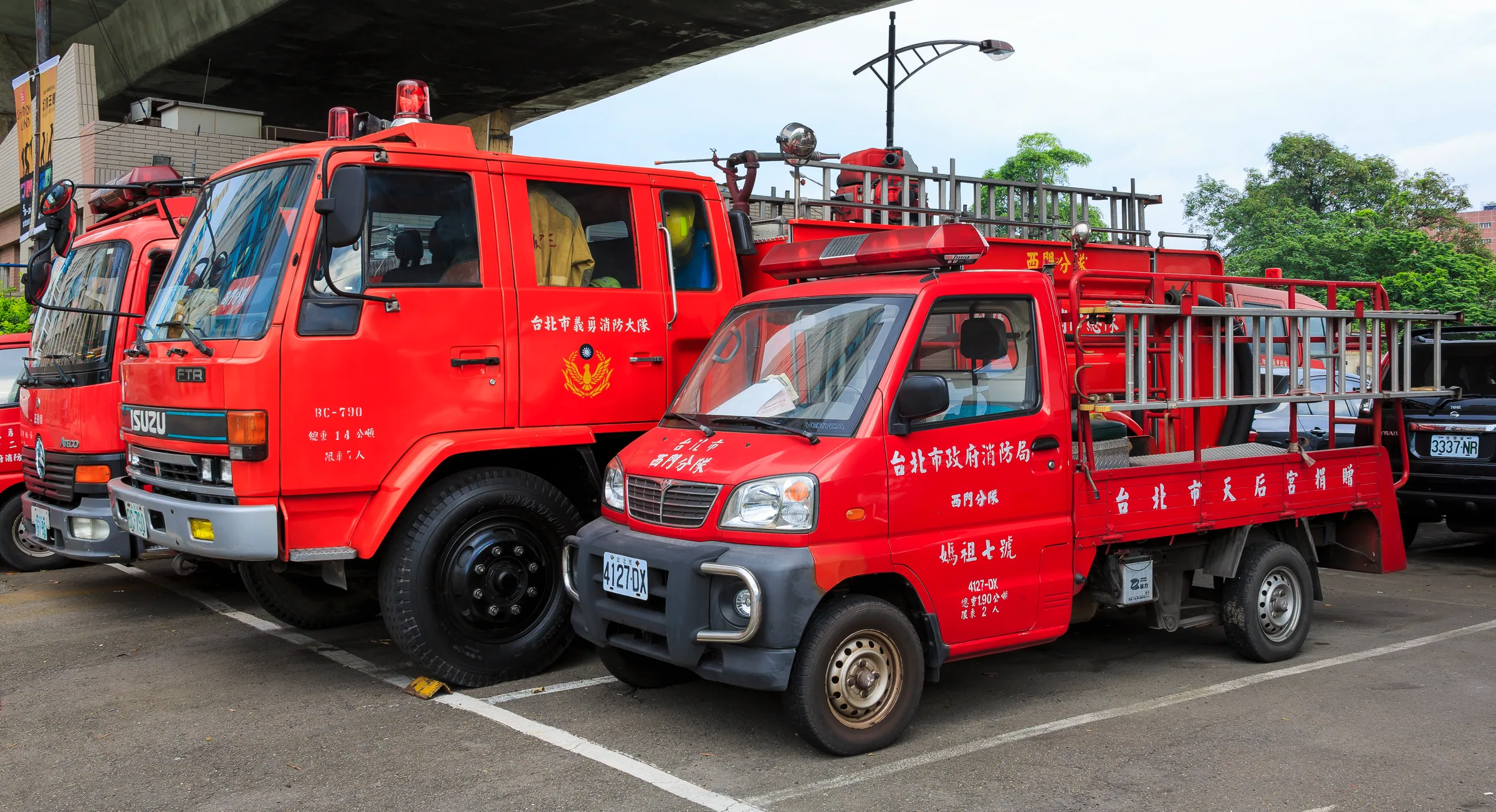
Image: Taipei City Fire Department fire truck, Photo by CEphoto, Uwe Aranas, CC BY-SA 3.0. Source: Wikimedia Commons.
Before the Sirens Sound, the Uniform Is Already Waiting
After major disasters, Taiwan's disaster governance began to pay more attention to how local governments, fire agencies, and civil organizations work together. Research on local fire brigades notes that volunteer organizations are not ad-hoc outside aid that appears only during disasters, but collaborative relationships that the local disaster-prevention system needs to cultivate in peacetime.1
But the story of volunteer firefighters predates these systems. After Japan took control of Taiwan in 1895, Japanese settlers established shōbō-gumi based on experience from their homeland. From 1902, local authorities assisted Japanese in forming shōbō-gumi; in 1921 the Government-General promulgated the "Taiwan Fire-Fighting Association Rules," and the legal basis and organization of the shōbō-gumi gradually unified.2
In the early Japanese period, fire-fighting actually ran on two parallel tracks: in cities, shōbō-gumi were mostly composed of Japanese; in Taiwanese settlements, the baojia (保甲) able-bodied men often undertook firefighting duties. Those people had their own jobs day to day; only when a fire alarm sounded did they put on uniforms, grab equipment, and rush to the scene.3
This scene remains familiar today. Volunteer firefighters may be at construction sites, clinics, factories, shops, or at home on any given day. When the call comes, they must leave their ordinary lives, report to the designated location, and then be deployed into disaster operations by the fire command system.
📝 Curator's Note: The first counter-intuitive thing about volunteer firefighters is that "volunteer" does not equal "casual." The closer to the fireground, the more the system must first draw safety boundaries around good intentions.
Volunteer Status, Statutory Force
The National Fire Agency (NFA), Ministry of the Interior, defines volunteer fire organizations clearly: special municipalities and county/city governments organize local residents under the Fire Services Act, provide professional training and regular assessment, with missions including disaster rescue, emergency medical services, and fire prevention education.4
The current "Regulations on the Organization, Training, Drills, and Service of Volunteer Firefighting Organizations" Article 2 stipulates that volunteer firefighters shall obey the orders of fire commanders and assist in fire work. Local governments establish a general brigade (總隊), and may establish battalions (大隊), companies (中隊), and platoons (分隊) as operational needs require, and shall insure their volunteer firefighters with disaster accident insurance.5
Entry has thresholds. New members must be at least 18 years old, reside locally, and not simultaneously participate in other volunteer or civil defense organizations. Foreign nationals and residents from Mainland China, Hong Kong, and Macau may also join if they meet residency requirements, but are not included in the manpower mobilization roster for military support duties.5
Training hours show this is not just a volunteer vest. New members receive at least 48 hours of basic training, at least 24 hours of specialized training, and at least 24 hours of annual ongoing training each year. Upon receipt of a duty notification, volunteer firefighters shall promptly report to the designated location and wear prescribed clothing and equipment per regulations.5
Fire coats, helmets, boots, raincoats, self-contained breathing apparatus or protective gear, and forcible entry tools are all collaborative equipment listed in regulations. They show that volunteer firefighter work is not merely cheering from outside the fireground. It must, under conditions of command, division of labor, and risk management, become a link in the rescue chain.5
From One Force into Several Specialties
As of January 1, 2026, the NFA lists 23 general brigades, 158 battalions, 267 companies, and 1,169 platoons nationwide, totaling 50,328 personnel. Besides traditional rescue volunteer firefighters, this includes fire prevention volunteers, emergency medical volunteers, and specialized volunteer firefighters for mountain search and rescue, water rescue, construction, and information and communications established in response to local disaster characteristics.4
This number does not mean 50,328 people can deploy simultaneously every day. It is an organizational headcount, not directly convertible to the number dispatchable for a given disaster. Volunteer firefighters have their own jobs and families; actual deployable strength is affected by time, distance, duty type, training level, and on-scene command. The NFA's statistical datasets also list county/city fire bureaus and headcounts separately, providing 2021 data for download, reminding readers that "total quantity" and "real-time available quantity" are not the same thing.6
Academic research describes this gap more coolly. A 2022 National Chengchi University master's thesis using the New Taipei City volunteer fire organization as a case study noted that volunteer firefighters face aging manpower, insufficient equipment and expertise, and that recruitment, training, and service management are simultaneously affected by government, managers, organizational characteristics, and social change.7
English-language research focuses on "mobilization." A dissertation studying local fire brigade commanders in Taiwan found that prior civic engagement and communication quality are positively correlated with the ability of fire commanders to mobilize volunteer organizations during emergencies. Fire brigades do not meet volunteers for the first time when disaster strikes; how they communicate in peacetime affects whether they can cooperate in disaster.8
📝 Curator's Note: The value of volunteer firefighters lies not only in "how many people," but in whether peacetime has already mapped people, equipment, skills, and local roads onto the same chart.

Image: Taipei City fire drill, photo by Fred Hsu, CC BY-SA 3.0/GFDL. Source: Wikimedia Commons.
One Set of Numbers, Reading the Scale of the Volunteer Firefighter System
| Indicator | Official Data | How to Read It |
|---|---|---|
| Total volunteer firefighters | 50,328 (January 1, 2026) | Organizational registered total, not equal to simultaneously deployable headcount4 |
| Organizational levels | 23 general brigades, 158 battalions, 267 companies, 1,169 platoons | Formal organization linking upward from local platoons45 |
| New member basic training | At least 48 hours | Common foundation for entering the volunteer firefighter system5 |
| Specialized training | At least 24 hours | Starting point for training differentiated by duty and specialty5 |
| Annual ongoing training | At least 24 hours per year | Ensuring capability does not stop at the qualification upon entry5 |
This set of numbers breaks "lots of volunteer firefighters" into several verifiable questions. Headcount answers organizational scale; levels answer how command and contact flow; training hours answer how much time one must invest after joining. They cannot substitute for each other. If only the fifty-thousand-plus figure is cited, readers will not see that training and local platoons are the actual operating units.
Disaster Prevention Is Not an Accessory of the Fireground
When people think of volunteer firefighters, they first think of laying hose lines, forcing doors, and moving equipment. But the women's fire prevention squads recorded in Fire Monthly reveal another kind of work: going door to door to check household fire, electricity, and gas use; inspecting escape routes; promoting residential fire alarms.
Su Hsiu-luan (蘇秀鑾), platoon leader of the Tainan City Volunteer Fire General Brigade, joined the fire prevention squad because her husband was a retired volunteer firefighter. She and her squad members have gone door to door explaining the effectiveness of residential fire alarms, and encountered three-generation households where elders refused to listen, but elementary-school children actively asked questions and finally agreed to ask their families to buy alarms.9
Chen Yu-feng (陳玉鳳), company commander of the Taipei City Volunteer Fire General Brigade, joined the fire prevention squad in 2002 (ROC year 91) and became company commander in 2011 (ROC year 100), leading teams into Wenshan District communities and homes to inspect electricity, gas, and evacuation routes.9
This work is hard to edit into heroic clips. Its results may be just a fire alarm mounted on a wall, a cluttered corridor cleared out, or a family finally knowing where to go when a fire breaks out at night. The disaster not happening is often its best outcome.
Another Fire Monthly interview records Taipei City fire prevention volunteer Cheng Mei-pang (鄭美胖). She has visited communities since 1997 (ROC year 86), and after the NFA formally established the volunteer fire organization in 2002 (ROC year 91), she continued serving for over twenty years. The article also explains that volunteer fire organizations possess regional and community characteristics, organized in four levels: general brigade, battalion, company, and platoon.10
The Real Hard Problems Are Not Whether There Is Enough Enthusiasm
The volunteer firefighter system is easiest to write as a moving story, but its real hard problems are concrete: whether manpower can be replenished, whether training can keep up, whether equipment is suitable, whether local fire agencies can place volunteers in the right positions.
The NFA's 2022 (ROC year 111) Fire Personnel Casualty Analysis Report categorizes fire duties into fire suppression, emergency medical services, disaster rescue, training and drills, other duties, and traffic accidents, and analyzes volunteer firefighters and alternative service personnel separately. The report requires fire agencies to investigate casualties and near-miss events and propose improvement recommendations.11
This is important. If volunteer firefighters are treated as "free labor," training and safety get pushed to the back. If treated as completely untouchable outside volunteers, localities lose a force familiar with the community, roads, and residents. The system's job is to draw the line between where assistance is needed and where risks should not be taken.
The New Taipei City volunteer firefighter management study states the problem more directly: after social structure changed and disaster types became more complex, organizations previously sustained by acquaintances and enthusiasm must face the redesign of recruitment, training, professionalization, and management processes.7
Local figures' stories also reflect this transition. The Pingtung County Fire Bureau records that Hengchun Volunteer Fire Battalion Commander Huang Ming-dian (黃明典) joined in 1994 (ROC year 83) and in the 2022 (ROC year 111) Dashanmu Mountain incident rushed to the scene to assist in forming search teams. Volunteer firefighters appear not only in residential fires, but may also enter mountain rescue, medical cooperation, and professional advisory networks.12
The same page records Fangliao Volunteer Fire Platoon Commander Wang Chao-chi (王朝旗)'s reason for joining: he once witnessed fire rescue when his family encountered a fire; later while working elsewhere he heard his hometown's sirens, grabbed his fire coat, and rushed back to the scene. This story connects one person's family memory to the local system.12
📝 Curator's Note: The hardest part of volunteer firefighters is giving those who join sufficient training, safety equipment, and reasons to stay for the long haul.
Beyond the Disaster Scene, There Is a Whole Daily Collaboration

Image: Chiayi Minxiong Fire Station, photo by Tbatb, CC BY-SA 4.0. Source: Wikimedia Commons.
Volunteer firefighter duties do not only happen on the duty roster. Regulations separate basic training, specialized training, officer training, and ongoing training, indicating that local fire agencies must place different competency levels into different courses, and cannot judge whether a person is fit for the scene with just one drill. Training is not only equipment operation; it also involves command relationships during service, equipment donning, assembly methods, and post-incident review.5
The NFA's organizational description divides volunteer firefighter functions into several intersecting paths. Traditional rescue volunteer firefighters handle fire and disaster rescue; emergency medical volunteers support EMS and pre-hospital care; fire prevention volunteers bring fire knowledge into communities; functional volunteer firefighters supplement mountain, water, construction, or information capabilities as local needs require. This is not training everyone into the same kind of firefighter, but letting localities possess professional nodes that can hand off to each other.4
These nodes require daily contact. English-language research notes that whether local fire commanders can mobilize volunteer organizations correlates with prior civic engagement and communication quality. In other words, waiting until disaster strikes to ask "who can drive a boat," "who knows the mountain trails," "who can handle collapsed buildings" is already too late. Good local collaboration should complete rosters, training, and role confirmation on days without disasters.8
The Pingtung case makes this concept concrete. The local fire bureau records that during Huang Ming-dian's tenure at Hengchun Volunteer Fire, he recruited professionals from different fields as advisors, promoted regular small-team training, and coordinated civil rescue groups to support duties. This role is not simply increasing headcount, but connecting medical, mountain, civil groups, and fire agencies in the same local disaster response.12
Fire prevention also requires the same long-term collaboration. Cheng Mei-pang's interview shows that fire prevention volunteers must translate relatively rigid policies into living language residents understand, and repeatedly enter communities. Chen Yu-feng's visits focus on electricity, gas, and evacuation routes. Neither job has flames as a visual center, yet both directly affect pre-fire conditions.910
Therefore, volunteer firefighters should not only be seen in disaster statistics. When a platoon knows its jurisdiction's alleys, factories, mountain paths, rivers, and elderly households, this local knowledge is the part of the fire map not easily replaced by central databases. Its value cannot be measured only by "how many people saved," but also includes letting commanders know before disaster who to call, and letting residents know after disaster who to ask for help.
Volunteer Firefighter Roles Are Not a Hierarchy, But Different Local Interfaces
| Role | Main Work | Examples and Limits in This Article |
|---|---|---|
| Rescue volunteer firefighters | Assist fire and disaster rescue under fire command | Require basic, specialized, and ongoing training; enthusiasm cannot substitute for on-scene qualification45 |
| Emergency medical volunteers | Support EMS and pre-hospital care | Must maintain skills continuously; duty risks include traffic and patient handling1112 |
| Fire prevention volunteers | Home visits, residential fire alarm promotion, fire and electricity safety | Results are often disasters that did not happen; hard to present with a single deployment number910 |
| Functional volunteer firefighters | Supplement mountain, water, construction, or info-comm capabilities per local needs | Professionalization raises collaboration value, but also increases training and equipment management burden47 |
This table also explains why "volunteer firefighter headcount" cannot directly equal "available fire manpower." Different roles have different training content, deployment conditions, and command positions; platoons must also verify each person's work hours, family care, and commute distance. If annual reports only pursue impressive headcounts, the details that truly determine deployment quality are easily overlooked.
Volunteer firefighter safety boundaries likewise need to be stated clearly. The NFA's accident analysis includes volunteer firefighters in the investigation of casualties and near-miss events, meaning the system acknowledges that volunteer service also generates occupational safety risks. For volunteer firefighters, declining tasks unsuited to oneself is not retreat, but letting the command chain know what capability the scene still lacks. For fire agencies, providing equipment, training, insurance, and post-incident review is what treats volunteer service as part of the public safety system.511
A Fire Brigade That Grows in Local Memory
The Taitung County Fire Bureau's profile interviews record Changbin Volunteer Fire Platoon Commander Wen Jung-feng (溫榮豐), who joined in 2003 (ROC year 92) and after reaching retirement age still describes his relationship with the volunteer firefighters as "body retired, heart not retired." Another disaster prevention volunteer Chen Mei-lien (陳美蓮) joined in 2008 (ROC year 97) and has served over fifteen years.13
These stories cannot prove all volunteer firefighters stay twenty years, nor can they cover up aging manpower and training burdens. What they can illustrate is: the organizational lifespan of volunteer firefighters is often built on local relationships, family support, and generational technical transmission.
From the Japanese-era shōbō-gumi members who had day jobs and only put on uniforms when fire alarms sounded, to today's volunteer firefighters regulated by law and differentiated into multiple specialties, the system has changed, but the core scene has not completely disappeared: a person is living their own life; when the siren sounds, they must decide whether to put on that uniform.
Taiwan's fire safety is therefore not just a story of a national agency, but also a story of how a local society puts time, skills, trust, and risk together. Volunteer firefighters are not a romantic solution to insufficient fire manpower. They are more like a bridge that needs continuous maintenance: one end connects to the formal fire system, the other end connects to the community where everyone still lives after work.
Further Reading
- 921 Jiji Earthquake — How the disaster changed Taiwan's disaster prevention system and collective memory.
- Social Movements and Civic Participation — Understanding Taiwan's public participation through volunteer service.
- Taiwan Urban Development and Urban-Rural Gap — How local resource disparities affect disaster response.
Image Sources
This article uses 1 CC-licensed image as the main image, cached at public/article-images/society/ to avoid hotlinking the source server:
- Taipei City Fire Department fire truck — Photo: CEphoto, Uwe Aranas / Wikimedia Commons, CC BY-SA 3.0
References
- Wu, Chang & Collins: Mobilizing Voluntary Organizations in Taiwanese Emergency Response — 2015 Journal of Contemporary Eastern Asia study explaining the post-Jiji earthquake disaster governance architecture and conditions for local fire brigade mobilization of volunteer organizations.↩
- National Taiwan Library: "Taiwan Studies Newsletter" No. 90 / Fire Protection — National Taiwan Library 2015 fire protection special page, organizing 1895, 1902, 1921 historical nodes of Taiwan's modern fire system and volunteer fire associations.↩
- Tsai Hsiu-mei: From Standing Firefighters to Special Fire Bureau — National Taiwan Normal University History Journal paper analyzing the dual-track development of fire-fighting associations, baojia able-bodied men, and standing fire system in the Japanese period.↩
- Ministry of the Interior National Fire Agency: Volunteer Fire Organizations — NFA official system description providing volunteer firefighter missions, organizational levels, professional types, entry conditions, and January 2026 headcount data.↩234567
- Ministry of the Interior Regulatory Query System: Regulations on the Organization, Training, Drills, and Service of Volunteer Firefighting Organizations — Current regulations amended August 5, 2025 (ROC year 114), stipulating article by article volunteer firefighter command, organization, qualifications, training, duties, equipment, and insurance.↩234567891011
- Government Open Data Platform: National Volunteer Firefighter Statistics — NFA-provided national volunteer firefighter statistical dataset, listing county/city and headcount fields, and providing 2021 data resource download.↩
- Chou Pei-shan: Exploring Disaster Prevention Volunteer Management — A Case Study of New Taipei City Volunteer Fire Organization — National Chengchi University 2022 master's thesis analyzing volunteer firefighter institutional dilemmas in manpower, equipment, expertise, recruitment, and training from a volunteer management perspective.↩23
- Wu, Chang & Collins: Mobilizing Voluntary Organizations in Taiwanese Emergency Response — English academic article DOI page studying the relationship between Taiwan local fire commanders, communication quality, prior civic engagement, and volunteer organization mobilization.↩2
- Fire Monthly: Fire Prevention 20 Years Like One Day — Ministry of the Interior NFA monthly personnel report recording Su Hsiu-luan and Chen Yu-feng entering homes, promoting residential fire alarms, and inspecting home evacuation safety in practical scenarios.↩234
- Fire Monthly: Wind and Rain Cannot Stop the Mission, Entering Homes to Implement Fire Prevention Education — NFA monthly interview with Cheng Mei-pang, recording the long-term community service of fire prevention volunteers and the four-level volunteer fire organization structure.↩23
- Ministry of the Interior National Fire Agency: 2022 Fire Personnel Casualty Detailed Statistical Analysis Report — NFA-commissioned safety database analysis report, including volunteer firefighters in categorized statistics of accidents, duties, training, and traffic risks.↩23
- Pingtung County Government Fire Bureau: Honor Roll / Profile Interviews — Local fire bureau personnel data recording Hengchun and Fangliao volunteer firefighters' joining motivations, mountain rescue and fire rescue, and professional training and local collaboration.↩234
- Taitung County Fire Bureau: Profile Interviews — Taitung County Fire Bureau civil strength garden, collecting Changbin volunteer firefighters, disaster prevention volunteers, and local models' service years and insights.↩