
30-Second Overview: Eswatini (renamed from "Swaziland" in 2018) is Taiwan's sole remaining diplomatic ally in Africa. It established relations with the Republic of China in September 1968, marking 58 years by 2026. King Mswati III was born in April 1968; five months later the country gained independence and established relations with Taiwan on the same day — his life has overlapped almost entirely with the history of Taiwan-Eswatini relations. As of 2024, he has visited Taiwan more than 17 times1. After Burkina Faso severed ties in May 2018, Eswatini became Taiwan's only diplomatic ally in Africa2. On May 2, 2026, Lai Ching-te visited Eswatini; originally scheduled to depart on April 22, the trip was delayed after Seychelles, Mauritius, and Madagascar revoked flight permits without warning under Chinese pressure. Mswati then dispatched Eswatini's Airbus A340 special mission aircraft with Deputy Prime Minister Thulisile Dladla to Taipei to fetch him, and Lai arrived in Mbabane via direct flight from Taipei on May 23. On May 1 of the same year, China granted zero-tariff treatment on 98% of tariff lines to 53 African countries — pointedly excluding Eswatini4. The greatest variable for this diplomatic lifeline is whether Mswati's successor can persuade a generation facing 56% youth unemployment to continue viewing Taiwan as a friend — a harder question than "how much money China will spend."
The President Borrows a Plane
Did you know? At 9:00 a.m. on May 2, 2026, Lai Ching-te stepped off the Airbus A340 special mission aircraft loaned to him by King Mswati III of Eswatini, touching down at Mbabane Airport3.
This A340-313 is not a Taiwan aircraft. It belongs to the Eswatini royal household. The originally scheduled visit was set for departure from Taipei on April 22, but on April 21 it was abruptly cancelled — Seychelles, Mauritius, and Madagascar simultaneously revoked special flight permits without warning. Analysis points directly to China pressuring these three African island nations through economic coercion, creating an "aerial blockade"5.
Mswati's move was decisive: he sent his Deputy Prime Minister Thulisile Dladla aboard the royal household's own aircraft from Mbabane to Taipei, and on May 2, before dawn, they picked up Lai Ching-te and flew back to Eswatini, arriving at 9:00 a.m. that morning.
"Eswatini King Loans Plane to Taiwan President to Break Through Chinese Blockade" — that is the visit itself. The Wall Street Journal framed it as a "surprise visit"; Al Jazeera's headline read "despite China's attempts to block trip"6. The Central News Agency (CNA) also documented the process of arriving in Eswatini aboard the special mission aircraft via official channels.
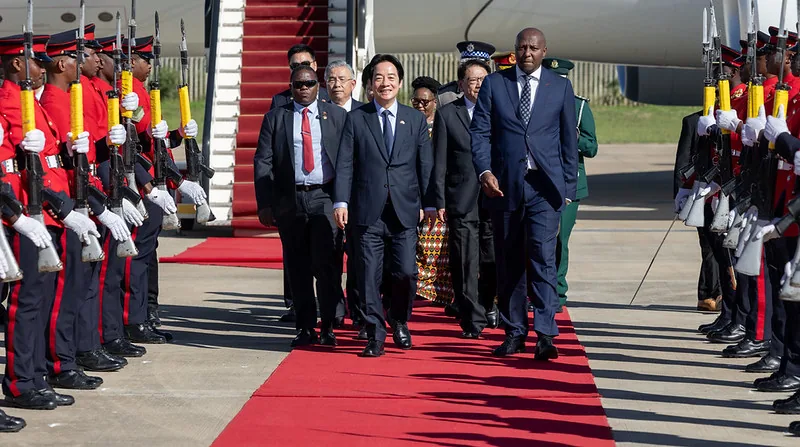
May 2, 2026: President Lai Ching-te receives military honors from Eswatini at Mbabane Airport. Photo: Presidential Office, Republic of China (Taiwan). OGDL via Presidential Office Official Press Release.
The arrival scene was simple but weighty: Prime Minister Russell Dlamini, Minister of Foreign Affairs and International Cooperation Pholile Shakantu, Taiwan's Ambassador to Eswatini Liang Hung-sheng (Jeremy H.S. Liang), and Eswatini Chief of Protocol Khandlela Mdluli personally greeted the plane. Lai Ching-te received military honors and exchanged greetings one by one with embassy staff and families of Taiwan technical mission members7. CNA's official channel recorded the full process of President Lai Ching-te's state visit to the Kingdom of Eswatini.
The political subtext of this airport scene connects to another September in 1968.
A Shared Birth Year
Mswati III, born Makhosetive Dlamini, entered the world on April 19, 1968, in what was then the British protectorate of Swaziland. Five months later — September 6 — Swaziland gained independence, the same year establishing diplomatic relations with the Republic of China18.
In other words, this now 58-year-old king has lived a life that almost perfectly overlaps with the history of Taiwan-Eswatini relations. When he was born, the relationship did not yet exist; by the time he came of age, it was already a fact; upon his accession (April 25, 1986, at 18 years and 6 days old, the world's youngest reigning monarch9), he became the personification of this relationship.
The frequency of his visits to Taiwan is also staggering. According to records from the Embassy in Eswatini and the Ministry of Foreign Affairs, as of May 2024 Mswati III had visited Taiwan more than 17 times[^1]: October 1989, October 1997, October 1998, May 2000, July 2001, May 2004, June 2006, September 2007, May 2008, July 2010, October 2012, May 2013, May 2015, May 2016, June 2018, October 2022, May 2024 — averaging once every two years. No other foreign leader visits Taiwan with comparable frequency.
Professor Yang Hao of the Graduate Institute of East Asian Studies at National Chengchi University put the key point in a BBC Chinese interview: "Precisely because the king himself holds real power, as long as he wishes to maintain diplomatic ties, there won't be much domestic noise."10
Put differently, Taiwan's last diplomatic lifeline in Africa hangs on a single person. This is both its stability and its fragility.
Deliberately Skipping Eswatini
On May 1, 2026 — the day before Lai Ching-te's visit to Eswatini — China announced zero-tariff treatment on 98% of tariff lines for 53 African countries. Eswatini alone was excluded411.
This was a "deliberate skip."
One country missing from 53 is mathematically just 52/53, but politically it is a naked declaration: "Standing with Taiwan comes with the cost of isolation." Storm Media, citing BBC Chinese analysis, laid bare this operational logic11. BBC News Chinese's official channel also provided in-depth analysis of the cross-Strait wrestling behind Lai Ching-te's visit to Eswatini.
China's poaching efforts go beyond this one move. Over the past 30 years, 10 African countries have switched recognition from Taiwan to Beijing; the most recent two were São Tomé and Príncipe (2016) and Burkina Faso (2018)2. In the same month Burkina Faso severed ties, Tsai Ing-wen made her first visit to Eswatini, and Mswati publicly reaffirmed his commitment to the diplomatic relationship12. That was April 17–20, 2018.
In 2023, a subsidiary of China's Power Construction Corporation won the bid for Eswatini's Pekisila Dam at US$146 million. Storm Media, citing BBC Chinese analysis, assessed this as a public probe of "infrastructure for diplomatic ties"11. Mswati did not waver.
But what is the real pressure behind those four words "did not waver"? On January 15, 2024, Nauru — a Pacific microstate with a population of roughly 10,000 — announced it was severing ties with Taiwan, the main reason being China's promise of long-term financial aid13. It was the third day after Taiwan's presidential election; Lai Ching-te had just been elected but not yet inaugurated. The moment Nauru broke relations, the Ministry of Foreign Affairs changed the diplomatic ally count from 13 to 12.
Eswatini became the last remaining piece of the puzzle in Africa.
Red-Fleshed Guavas Enter SUPERSPAR
At his May 3 press conference, Lai Ching-te opened with a fruit as a hook: "Red-fleshed guavas bear witness to Taiwan-Eswatini friendship."14
This guava was not rhetoric.
The TaiwanICDF (International Cooperation and Development Fund) agricultural technical mission in Eswatini has operated since 1969, initially an early experiment in Taiwan's agricultural technical diplomacy, now known as the "Taiwan-Africa Vegetables Initiative (TAVI)" and the "Emerging Fruit Tree Production and Marketing Guidance Plan"15. The concrete work: bringing Taiwan's fruit varieties (red-fleshed guava, dragon fruit, strawberry, papaya) and cultivation techniques to Eswatini, enabling local farmers to master localized production.
In March 2024, Taiwan-variety red-fleshed guavas officially entered the shelves of Eswatini's largest supermarket chain, SUPERSPAR, at its Mbabane and Ezulwini branches15. A fruit traveled from a technical cooperation agreement (the first aid agreement in 19691) to supermarket shelves — a journey of 55 years.
Lai Ching-te brought this guava to the press conference podium. What he wanted to say was: "This is what cooperation looks like" — concrete, edible, entering commercial distribution channels.
Viewed from this angle, the evolution of aid projects is easier to understand. 1969 technical cooperation → 1984 agricultural technical cooperation → 2007 medical cooperation MOU → 2016 maternal and infant health → 2018 economic cooperation agreement (effective December that year) → 2019 women's economic empowerment MOU → 2023 women's entrepreneurship microcredit revolving fund (personally signed by Tsai Ing-wen during her 2023 visit) → 2026 customs mutual assistance agreement17. Each agreement is a cross-section of its era's theme: the 1980s were agriculture, the 2000s entered healthcare, the 2010s were women's empowerment and trade institutions, the 2020s push toward industrial innovation and supply chains.
This cooperative entity has evolved slowly alongside both countries' circumstances, transcending the static layer of "diplomatic gifts."
27% Prevalence Rate
But beyond agriculture and education, healthcare is the heaviest and most concrete face of this relationship.
Eswatini's adult (ages 15–49) HIV prevalence rate is 27.2%, the highest in the world16. Behind this number is a nation where, without antiretroviral therapy (ART), an entire generation would be erased.
To understand Taiwan's medical aid only through the framework of "medical diplomacy" is too thin. The Taipei Medical University (TMU) system-led resident medical team covers physicians, nurses, pharmacists, and administrative staff, with scope spanning clinical services, personnel training, public health, medical education, and smart healthcare introduction15. Concrete achievements: assisting Eswatini in establishing a national physician licensing examination system and a general practitioner training system; completing Eswatini's first neurosurgery; TMU physicians serving long-term as the only cardiology specialist at Eswatini's public hospitals; medical services exceeding 10,000 patient-visits annually. These are real actions with names, surgical records, and inpatient numbers — transcending the abstract layer of "aid."
In April 2025, the Ministry of Foreign Affairs announced the donation of a CT scanner, fundus camera, and patient monitoring simulator to Mbabane Government Hospital; starting in 2026, assistance in building Eswatini's version of HIS (Hospital Information System, benchmarked to Taiwan standards) and FIRE (Fast Healthcare Interoperability Resources)15.
The most concrete story is from January 2021. Mswati III contracted COVID-19; the Tsai Ing-wen government sent antiviral medication to Eswatini through diplomatic channels (foreign media speculated remdesivir, but Mswati himself did not name it). He later publicly thanked them: "Before I could even announce my hospitalization, I had already recovered."17
"Diplomatic medicine" ceased to be abstract from that moment. This 58-year relationship includes a concrete life-saving event.
It is also because of these accumulated long-term multilateral efforts — PEPFAR, Global Fund, Taiwan, and others — that Eswatini in 2020 became one of the first African countries to achieve the UNAIDS 95-95-95 targets (95% of people living with HIV diagnosed, 95% of diagnosed on treatment, 95% of those treated virally suppressed)18.
Military Honors at Mandvulo Grand Hall
On the morning of May 3, Lai Ching-te held bilateral talks with Mswati III at the Mandvulo Grand Hall of Lozitha Royal Palace7.
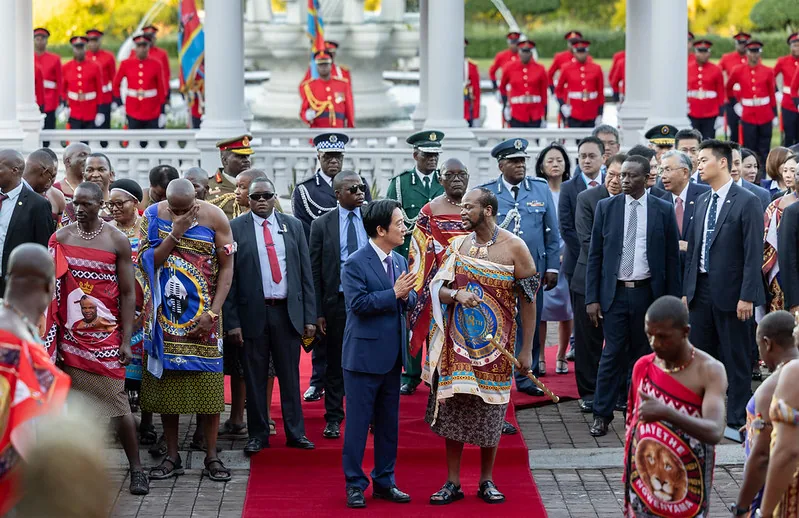
May 3, 2026: President Lai Ching-te and Mswati III hold bilateral talks at the Mandvulo Grand Hall, Lozitha Royal Palace. Photo: Presidential Office, Republic of China (Taiwan). OGDL via Presidential Office Official Press Release.
The ceremony included both national anthems, inspection of the Eswatini honor guard, a gun salute, and traditional dance performances. After the meeting, two key documents were signed:
- Joint Communiqué: Reaffirming "deep friendship, mutual trust, and shared values"
- Customs Mutual Assistance Agreement: Signed by Foreign Minister Lin Chia-lung and Eswatini Foreign Minister Pholile Shakantu7
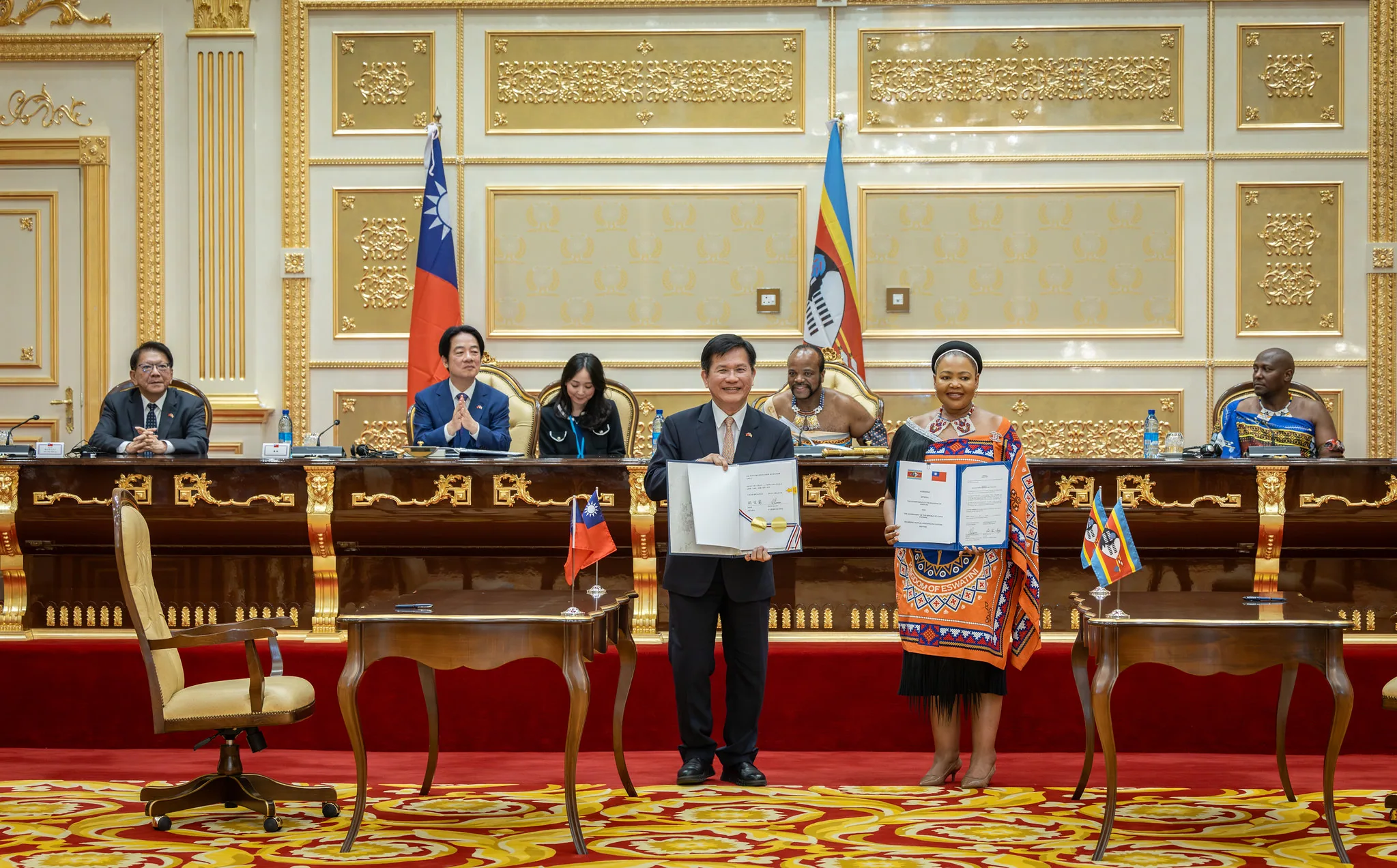
May 3, 2026: Both sides sign the Customs Mutual Assistance Agreement and Joint Communiqué at Mandvulo Grand Hall. Photo: Presidential Office, Republic of China (Taiwan). OGDL via Presidential Office Official Press Release.
CNA's official channel fully recorded the process of Taiwan and Eswatini signing the Joint Communiqué to deepen cooperation.
Lai Ching-te's core remarks (from the Presidential Office English press release):
"The Republic of China (Taiwan) is a sovereign country that belongs to the world."
"No country has the right, nor should it obstruct Taiwan's contributions to the world."
"Taiwan and Eswatini are steadfast allies, who have together weathered many ups and downs."7
Mswati III's response:
"We would like to assure you, as well as the government and people of Taiwan, that the Kingdom of Eswatini stands ready to support all the achievements Taiwan seeks, including its participation in the international community."7
The weight of these remarks lies in who spoke them. When an absolute monarch, in his own palace, publicly says "sovereign country" to the head of state of another democratic nation, that semantic content is a direct counter-witness to China's narrative that "a sovereign Taiwan does not exist." China's Ministry of Foreign Affairs subsequently called Lai Ching-te a "rat" and labeled the trip "sneaky transit-style foreign travel" and an "international laughingstock" (cited by NBC News)19. The U.S. State Department's response was simpler: "Taiwan is a trusted and capable partner" and "should not be politicized"20.
That afternoon, Lai Ching-te visited the Royal Science and Technology Park to inspect two flagship bilateral cooperation projects: the Strategic Oil Reserve and the Taiwan Industrial Innovation Park (TIIP), briefed by the Overseas Investment & Development Corporation and CECI Engineering Consultants21. Lai Ching-te defined these two as "the largest-scale, most strategically significant cooperation projects since the establishment of diplomatic relations between our two countries." "The Strategic Oil Reserve represents energy security and national resilience in the face of risk and crisis; the 'Taiwan Industrial Innovation Park' represents industrial layout and developmental hope for the future — the former guards stability, the latter creates growth"22.
This passage gave Lai Ching-te's visit a concrete narrative structure. CNA's official channel also featured a special report on Taiwan-Eswatini's largest cooperation: Strategic Oil Reserve and TIIP hold strategic significance.
The 46 Lives of 2021
But this 58-year relationship has a heavy piece of reality that must be faced squarely.
On May 17, 2021, a law student in Eswatini, Thabani Nkomonye, was allegedly killed by police, triggering nationwide protests. On June 20, about 500 youth took to the streets in Manzini demanding democratic reform; on June 25, the acting prime minister issued an order banning protests and petitions; from June 28 to July 4, nationwide riots erupted — buildings burned, helicopters circled, gunfire day and night. Human Rights Watch (HRW) confirmed at least 46 deaths; civil society estimates exceed 10023.
As of October 2025, HRW's latest report confirms that no security force members have been held accountable24.
This is the sharpest price of "absolute monarchy," and a value contradiction Taiwan cannot avoid. Our sole remaining diplomatic ally in Africa is Africa's last absolute monarchy, and this regime suppressed its own people in 2021.
Writing this fact will not harm diplomatic ties, but it makes this article honest. Taiwan readers have the right to know that our "last friend" is a real country whose governance record includes violent suppression, an HIV tsunami, and 56% youth unemployment (2023 figure25). The diplomatic phrase "friendly small nation" cannot contain it.
Mswati's personal life is another structural contradiction. He and the Queen Mother Ntfombi are among the roughly 12 absolute monarchs remaining globally. Constitutionally, he holds veto power over all branches of government and immunity from prosecution. Private jets, Rolls-Royce motorcades, contrasted with 30% of the population living below the poverty line — a longstanding focus of international media criticism9.
We can hold two things simultaneously: first, Taiwan's aid has genuinely saved lives (HIV treatment, agricultural cooperation, medical teams); second, Eswatini's governance problems are not "internal affairs of another country" that we should ignore.
After Mswati
The greatest variable for the future of Taiwan-Eswatini relations is not how much money China spends.
It is whether Mswati's successor can persuade a generation with 56% youth unemployment, a generation that no longer endorses absolute monarchy, to continue seeing Taiwan as a friend.
Over the past 30 years, China has poached 10 African diplomatic allies from Taiwan; every termination was a combination of "financial inducement" and "local political needs." But Eswatini differs from other allies in one respect: it is not on the core battlefield of UN resolutions (unlike Pacific island states directly tied to U.S.-China competition); its foreign relations' political cost is relatively borne by the king personally, and Mswati's personal will has been strong enough to withstand all pressure so far.
But this strength has a ceiling. Mswati was born in 1968; in 2026 he is 58. Succession will happen (not "whether" but "when"), and the successor will face an internal political environment completely different from the one Mswati faced when he ascended in 1986.
After the 46 lives of 2021, Eswatini's younger generation has far less patience for "royal glory" than their fathers' generation; HIV still consumes the health budget; wages are squeezed by South Africa; youth unemployment nears 60%. These are ongoing internal pressures, not just "future predictions."
Lai Ching-te's return route after the visit also reveals something about the current tension. On May 4, departing Mbabane, the aircraft deliberately disabled its identification, taking a southern Indian Ocean route via Indonesia and the Philippines back to Taiwan, avoiding proximity to Chinese airspace and sensitive South China Sea areas, arriving at Taoyuan Airport at 10:40 a.m. on May 526.
The circuitous route shows how tight the environment is. But the journey was completed.
One Guava and One Question
Back to that red-fleshed guava.
It traveled from the 1969 technical cooperation agreement to SUPERSPAR's supermarket shelves in 2024. In between lay 55 years, at least seven Taiwan presidents (Chiang Ching-kuo, Lee Teng-hui, Chen Shui-bian, Ma Ying-jeou, Tsai Ing-wen, Lai Ching-te), and Mswati III growing from 5 months old to 56.
It is concrete, edible, priced at roughly a few dozen New Taiwan dollars each.
This guava, the military honors at Mandvulo Grand Hall, the 46 lives of 2021, China's precise operation on May 1 granting zero tariffs to 53 countries while pointedly excluding Eswatini, and the A340 special mission aircraft Mswati sent from Taipei to fetch the president — these are different points on the same narrative line.
What they tell us: diplomatic ties reside in the concrete cooperative entity accumulated over 58 years, transcending the abstract level of a memorial tablet; but they also tell us that when the day after Mswati arrives, whether Taiwan has accumulated enough "relationship thickness not dependent on one person" to keep this guava's supply chain from disappearing along with one person's position — that question has no answer yet. But the existence of the question itself is Taiwan's most honest posture in 2026 facing its "last ally."
"The Republic of China (Taiwan) is a sovereign country that belongs to the world." — Lai Ching-te at Mandvulo Grand Hall, May 3, 2026.
Africa's last diplomatic lifeline hangs on one person. This is both its most moving aspect and the homework Taiwan diplomacy must prepare for over the next decade.
Where this story traveled
Further Reading:
- Taiwan's Diplomatic Allies and International Diplomacy — A three-layer structure of 12 diplomatic allies vs. 113 overseas missions vs. 177 visa-free destinations; Eswatini is the most critical African piece
- Lai Ching-te — From Tainan physician to President of the Republic of China; the evolution of Lai Ching-te's external relations discourse since taking office
- Tsai Ing-wen — The president who visited Eswatini twice; 2018 and 2023 correspond to two phases of Taiwan-Eswatini relations
- Sunflower Student Movement — How the 2014 streets became the confidence behind the 2024–2025 institutional external discourse
- 2026 KMT-CCP Meeting and Cross-Strait Decade Reunion — Contemporary cross-Strait dynamics; understanding the larger context of China's pressure on Taiwan
- Cognitive Warfare — A more systematic framework for China's linguistic operations like "rat" and "sneaky transit-style foreign travel"
- Paraguay and Taiwan — South America's sole diplomatic ally; another relationship sustained under Chinese pressure through long-term cooperation
Image Sources
This article uses 3 official photographs from the Presidential Office, Republic of China (Taiwan), all cached in public/article-images/society/ to avoid hotlinking the source server. License: Government Open Data (OGDL — Open Government Data License).
- taiwan-eswatini-military-honor-2026.jpg (hero) — May 2, 2026: President Lai Ching-te receives military honors from Eswatini at Mbabane Airport. Photo: Presidential Office, Republic of China (Taiwan).
- taiwan-eswatini-mandvulo-summit-2026.jpg — May 3, 2026: President Lai Ching-te and Mswati III hold bilateral talks at the Mandvulo Grand Hall, Lozitha Royal Palace. Photo: Presidential Office, Republic of China (Taiwan).
- taiwan-eswatini-joint-communique-2026.jpg — May 3, 2026: Both sides sign the Customs Mutual Assistance Agreement and Joint Communiqué at Mandvulo Grand Hall. Photo: Presidential Office, Republic of China (Taiwan).
References
- Wikipedia: Republic of China–Eswatini Relations — Complete timeline of bilateral diplomatic relations from 1968, including Mswati III's 17 visits to Taiwan, annual bilateral agreement signing dates, and MOFA CountryInfo cited data.↩234
- Up Media: Taiwan-Burkina Faso Severance, 4 Countries Switch to Beijing Within 2 Years — Up Media in-depth report on the timeline and political context of 10 African countries switching from Taiwan to Beijing over the past 30 years, including key severance events: São Tomé and Príncipe (2016) and Burkina Faso (2018).↩2
- Presidential Office, Republic of China (Taiwan): President Lai Ching-te Arrives in the Kingdom of Eswatini — May 2, 2026 Presidential Office English press release, documenting President Lai Ching-te's arrival in Mbabane via direct flight from Taipei aboard Eswatini's Airbus A340 special mission aircraft, military honors ceremony, greetings with embassy staff, and official photos.↩2
- Central News Agency: President Lai Meets King of Eswatini — May 4, 2026 CNA official report recording Lai Ching-te and Mswati III bilateral talks, Joint Communiqué signing, and the contrasting background of China's zero-tariff treatment for 53 African countries excluding Eswatini.↩2
- PTS News: Flight Permits Cancelled, Lai Ching-te Visit Postponed — PTS report on the April 21, 2026 emergency cancellation of the originally scheduled April 22 visit, detailing the revocation of flight permits by Seychelles, Mauritius, and Madagascar and analysis.↩
- Al Jazeera: Taiwan leader visits Eswatini despite China's attempts to block trip — May 3, 2026 Al Jazeera international media report, including surprise visit framing, the historic moment of the King loaning his plane, China's reaction, and international perspective.↩
- Presidential Office, Republic of China (Taiwan): President Lai Ching-te Holds Bilateral Talks with King Mswati III of Eswatini — May 3, 2026 Presidential Office English press release, including full record of bilateral talks at Mandvulo Grand Hall, Lozitha Royal Palace, signing of Joint Communiqué and Customs Mutual Assistance Agreement, core remarks by both heads of state, and official photos.↩23456
- Wikipedia: Eswatini–Taiwan Relations — English-language entry on bilateral relations, including establishment date, annual signed agreements, aid project evolution, and Chinese poaching pressure timeline in English research data.↩
- Wikipedia: Mswati III — Mswati III personal biography, including April 19, 1968 birth date, April 25, 1986 accession as world's youngest reigning monarch, absolute monarchy constitutional powers, co-reign with Queen Mother Ntfombi as surviving absolute monarchs, and Taiwan visit records.↩2
- Storm Media (citing BBC Chinese): US$146 Million Infrastructure Temptation and the Key to Taiwan-Eswatini Relations Under Absolute Monarchy — Storm Media platform republishing BBC Chinese in-depth report, including Professor Yang Hao's analysis of "Mswati's personal will upholding diplomatic ties," China's economic operations toward Eswatini, and impact of absolute monarchy on foreign policy decisions.↩
- Liberty Times: BBC Exposes Key to Diplomatic Ties — Liberty Times report recording China's May 1, 2026 zero-tariff treatment on 98% of tariff lines for 53 African countries excluding Eswatini — naked economic coercion — and the 2023 China Power Construction Corporation's US$146 million bid for Eswatini's Pekisila Dam as "infrastructure for diplomatic ties" operation.↩23
- Presidential Office, Republic of China (Taiwan): President Tsai Ing-wen 2018/2023 Eswatini Visit Special — Presidential Office official page for Tsai Ing-wen's two Eswatini visits, including April 17–20, 2018 first visit and September 5–8, 2023 second visit celebrating 55th anniversary of diplomatic relations, with bilateral statements and signed agreements.↩
- CommonWealth Magazine: Nauru Severs Ties with Taiwan, Diplomatic Allies Drop to 12 — Official record and background analysis of Taiwan's diplomatic ally count changing from 13 to 12 after Nauru's January 15, 2024 severance, including context of China's long-term financial aid to Nauru.↩
- United Daily News: Red-Fleshed Guava Bears Witness to Taiwan-Eswatini Friendship — United Daily News report on President Lai Ching-te's May 3, 2026 Eswatini press conference, including his use of "red-fleshed guava enters SUPERSPAR" as a concrete hook for the 40+ year achievements of the resident agricultural technical mission, cooperation channels, and localized production details.↩
- Focus Taiwan: Lai visits Royal Science and Technology Park, agriculture and medical aid — Focus Taiwan (CNA English) in-depth report, including comprehensive inventory of TaiwanICDF resident agricultural technical mission, Taipei Medical University system medical team, Strategic Oil Reserve, and Taiwan Industrial Innovation Park briefings.↩234
- Wikipedia: HIV/AIDS in Eswatini — Complete Eswatini HIV epidemiological data, including 27.2% adult prevalence as world's highest, gender gaps, geographic distribution, detailed age-group figures, and multilateral international aid organization intervention records.↩
- Al Jazeera: Eswatini king recovers from COVID-19, takes drugs sent by Taiwan — February 20, 2021 Al Jazeera report on Mswati III contracting COVID-19, Tsai Ing-wen government sending antiviral medication via diplomatic channels to assist recovery, including Mswati's public thanks quote.↩
- The Global Fund: Eswatini meets global 95-95-95 HIV target — Global Fund September 14, 2020 report recording Eswatini as one of the first African countries to achieve UNAIDS 95-95-95 HIV treatment targets, including contribution analysis of PEPFAR, Global Fund, Taiwan, and other multilateral aid combination.↩
- NBC News: Taiwan president defiant in Eswatini visit, China calls him 'rat' — NBC News international report on China's Ministry of Foreign Affairs reaction after Lai Ching-te's May 2026 Eswatini visit, including English record of linguistic operations like "rat," "sneaky transit-style foreign travel," and "international laughingstock."↩
- Liberty Times: U.S. Responds to Lai's Eswatini Visit: Taiwan is a Trusted Partner — Liberty Times report on U.S. State Department official response to Lai Ching-te's Eswatini visit, including "Taiwan is a trusted and capable partner" verbatim and "should not be politicized" stance toward China.↩
- Central News Agency: Strategic Oil Reserve + Taiwan Industrial Innovation Park Briefing — CNA report on President Lai Ching-te's May 3, 2026 afternoon inspection of two flagship projects at the Royal Science and Technology Park: Strategic Oil Reserve and Taiwan Industrial Innovation Park (TIIP), including briefing details from Overseas Investment & Development Corporation and CECI Engineering Consultants.↩
- United Daily News: Lai Ching-te Defines Eswatini's Largest Cooperation — United Daily News report on Lai Ching-te's positioning remarks for Strategic Oil Reserve and TIIP: "largest-scale, most strategically significant cooperation projects since establishment of diplomatic relations," "former guards stability, latter creates growth" — complete official discourse.↩
- Wikipedia: 2021 Eswatini Protests — Complete timeline of May–July 2021 Eswatini democratization protests, including triggering event of law student Thabani Nkomonye, 500 youth taking to Manzini streets, June 25 acting prime minister's ban order, June 28–July 4 nationwide riots, HRW confirmed 46 deaths, civil society estimates exceeding 100.↩
- Human Rights Watch: Eswatini — No Justice for June 2021 Security Force Violence — Human Rights Watch October 30, 2025 latest report confirming no security force members held accountable for June 2021 violence as of October 2025, including family interviews, stalled investigation procedures, and international community responses.↩
- International Monetary Fund: Eswatini 2025 Article IV Consultation — IMF 2025 Eswatini Article IV Consultation Report, including GDP, unemployment rate (overall 34%, youth 56–58%), poverty rate, SACU revenue sharing, sugarcane industry structure, and complete economic analysis.↩
- United Daily News: Lai Ching-te Return Route Avoids Chinese Sensitive Airspace — United Daily News report on May 4–5, 2026 return journey details, including aircraft deliberately disabling identification, southern Indian Ocean route via Indonesia and Philippines, arrival at Taoyuan Airport at 10:40 a.m. on May 5.↩