
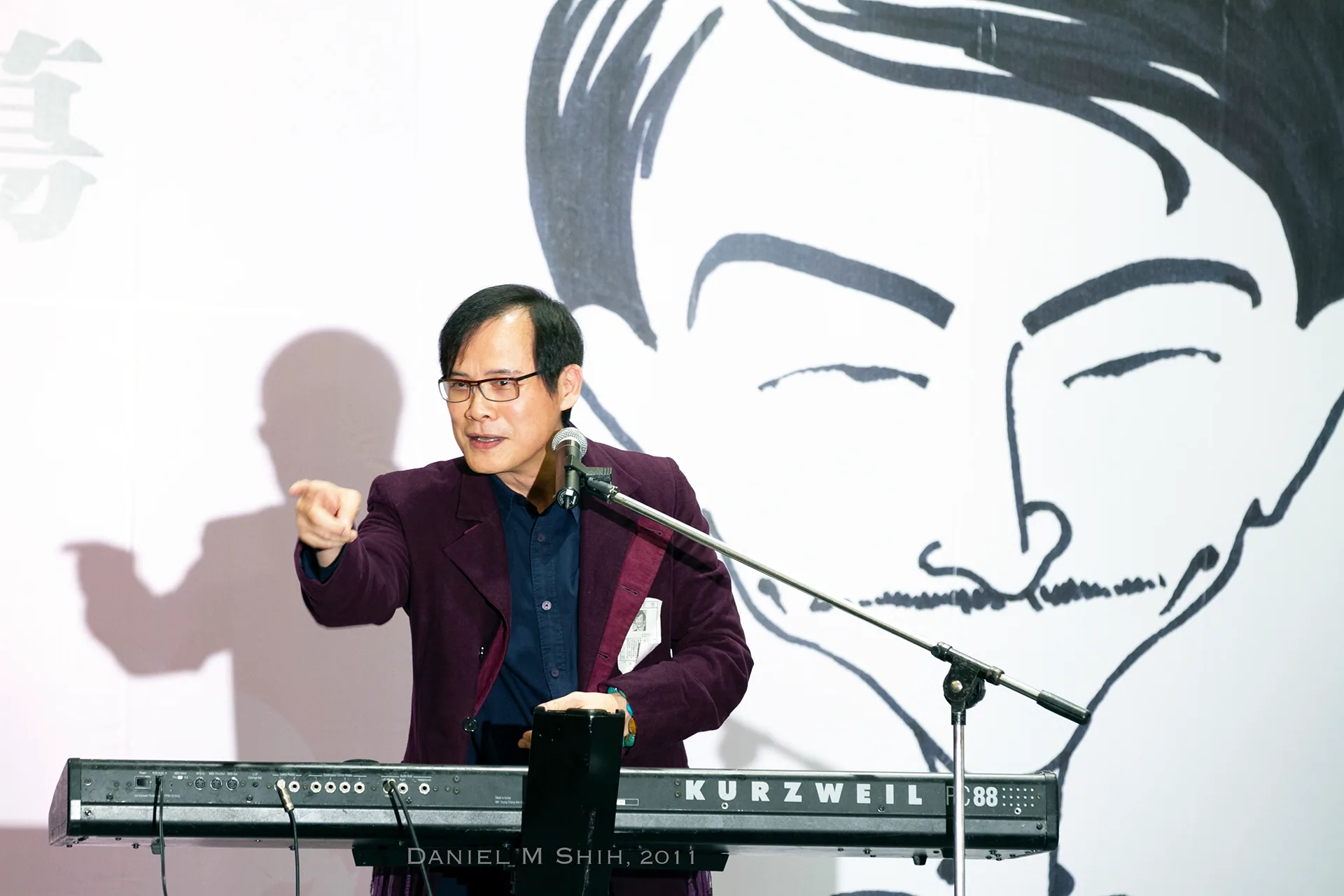
30-Second Overview: Lo Ta-yu (born 1954) is a singer-songwriter who trained as a radiologist. His 1982 album Zhi Hu Zhe Ye transformed pop lyrics from emotional ornament into something capable of carrying an argument; Taiwanese music critics later ranked it first among the hundred greatest classic albums. He wrote the rootlessness of “Lukang, the Little Town,” the isolation of “Orphan of Asia,” and the estrangement of “Pearl of the Orient,” asking “Who am I?” along the way. The irony is that this man who sang Taiwan’s drifting so completely himself wandered from Taipei to New York, Hong Kong, and Beijing; researchers have calculated that he moved nineteen times in twenty-nine years. At seventy, he returned to Taiwan, stood onstage, and said that among musicians of his generation, “at least 70 percent were eliminated,” and those who remained were all remarkable survivors.
Taichung, the 1970s. In the gross anatomy room of China Medical College, the smell of formalin was so sharp that most students could not stay there long. Yet one medical student liked to slip inside, not to study, but to sing.
“Fewer people went there, and the echo was very good, and no one would know I was singing.”1
That student was Lo Ta-yu. More than a decade later, his songs would spread across the Sinophone world; the melodies he once hid away to sing, afraid of being heard, would become the shared memory of a generation. But during those years in the anatomy room, he was simply the child of a medical family, secretly practicing something his family did not want him to do.
This is the deepest fissure in Lo Ta-yu: he would later spend his life singing Taiwan’s rootlessness and the unanswered question “Who am I?” Yet he himself was the most thorough drifter within that very question.
No One Knew He Was Singing
To understand why Lo wrote songs this way, one must first know what kind of person he was originally supposed to become.
He was born in Taipei on July 20, 1954,2 into a typical medical family: his parents and elder siblings all worked in medicine or nursing. In such a family, studying medicine was almost the default, and Lo himself has said that as a child he was “very rule-abiding.” He did indeed follow the prescribed track: he entered the medical department of China Medical College, graduated around 1980 to 1981,3 and later became a radiologist.
But this rule-abiding medical student kept music hidden inside him. He himself has told the story of the gross anatomy room: it was the quietest, least visited corner of the school, with good acoustics, suitable for practicing alone.1 A future doctor, in a room for working with cadavers, was practicing something that had nothing to do with saving lives.
His family did object. Lo later described himself as having “betrayed the family” by going into music, and said it took roughly ten years for them to truly accept it.4 Ten years is a long reconciliation. He and his father had an agreement: first obtain his medical license, prove that he was capable of following the medical path, and only then could he take the path he had chosen for himself. He secured a position in radiology, thereby fulfilling his promise, and only then turned and left.
📝 Curator’s Note
Lo chose radiology, not surgery. Years later, he said something worth pausing over: writing and surgery are alike in that both require you to open your heart and lungs, “but you don’t have to actually make that cut. That’s what’s good about creation!”5 He chose a position of “diagnosis”: to see clearly where the lesion is and say it aloud, without having to cut it out by hand. This radiological perspective later became his method of songwriting. His anger seldom depends on shouting; it depends on stating a society’s lesion with such clarity that you see it for yourself.
His own explanation of this choice was calm: “Among so many doctors, there is no need for one more Lo Ta-yu; but in music, there is still a lot of room for development.”6 This was a judgment made after calculation: the world would not be changed by one fewer doctor, but in music there was still something he could do. There was none of the tragic fervor of a hot-blooded youth.
The Cut He Did Not Have to Make
On April 21, 1982, Lo Ta-yu released his first solo album, Zhi Hu Zhe Ye.7 With sunglasses, a mass of curly hair, and black clothing, the image of “black Lo Ta-yu” clashed sharply with the gentle warmth of the campus folk songs then in vogue.
The album was later ranked first in Taiwan’s 100 Best Pop Albums,7 and its status has become nearly unshakable. What lifted it to that position was something Mandarin pop songs rarely did at the time: it treated lyrics as arguments, as things capable of carrying a point of view. The young man in “Lukang, the Little Town,” who goes from the countryside to Taipei to make a living only to discover that he cannot return to his hometown either, sings the rootlessness of an entire age of industrialization. “Phenomenon 72 Changes” is almost a social observation report. It turned out that a pop song, too, could be a radiologist’s diagnostic report on society.
Lo Ta-yu’s “Lukang, the Little Town,” official MV. Rock Records official channel. It sings the rootlessness of the industrializing era, when people left the countryside for Taipei to struggle for a living, only to find that they could no longer go home.
But in Taiwan in 1982, speaking clearly came at a price. This was the martial-law era: songs had to be submitted for review, and censorship was like an invisible net. Lo’s way of dealing with that net was to hide the truth inside clever disguises.
The title track of Zhi Hu Zhe Ye was a direct act of mockery. The original lyrics plainly wrote, “Song censorship: will it pass or not?” openly satirizing censorship itself. When submitted for review, the line was changed to “Open one eye, breathe through your mouth...” and finally landed on the phrase “everyone is delighted.”8 On the surface it was harmless; at its core, it was a cold laugh at the entire system.
A False Subtitle for a True Statement
The most famous disguise was “Orphan of Asia.”
The song’s title came from Wu Zhuoliu’s novel of the same name, and it wrote of Taiwan’s isolation in the crevices of history, wanted by no one and claimed by no one. In martial-law Taiwan, this was an extremely sensitive metaphor. To get it through review, Lo added a subtitle: “Red Nightmare: To the Refugees of the Indochinese Peninsula.”9
That subtitle cleverly shifted the song’s target from “Taiwan’s own orphaned condition” to “refugees from the Indochinese Peninsula.” Censors saw a song sympathizing with refugees from Vietnam and Cambodia, which fit the anti-communist atmosphere of the time. But everyone who truly understood it knew that the orphan of Asia was Taiwan itself. One false subtitle bought space for a truth that could not be said directly.
💡 Did You Know?
The line in “Orphan of Asia,” “a yellow face with red mud,” has long been read as a code for Cross-Strait relations and identity. But the subtitle Lo left then, “To the Refugees of the Indochinese Peninsula,” is itself a specimen of the martial-law era. It tells you that for creators of that age to deliver one sincere sentence to listeners’ ears, they first had to prepare a story the censor would be willing to believe. The song did not change; what changed was the label pasted outside the song.
This was what made early Lo Ta-yu so compelling: he was not someone standing in the street shouting slogans. He was the one who used subtitles, puns, and one eye open and one eye closed to smuggle unsayable things into millions of ears. The precision of a radiologist was applied to a game of hide-and-seek with censorship.
A Song That Was Stolen
Lo did not win every encounter with the system.
In 1985, a song called “Tomorrow Will Be Better” was born. It was a grand charity song, inspired by the American “We Are the World,” that brought together more than sixty singers. Lo wrote the melody, but the lyrics were co-written by seven people: Lo Ta-yu, Chang Ta-chun, Hsu Nai-sheng, Lee Shou-chuan, Chiu Fu-sheng, Sylvia Chang, and Chan Hung-chih; the arrangement was by Chen Chih-yuan.10 In other words, this national hit that many assume was “written and composed by Lo Ta-yu” was actually only half his work: he was responsible for the melody.
What pained him more was what later happened to the song. More than one hundred characters of the original lyrics of “Tomorrow Will Be Better” were altered, and it was taken by the then-ruling Kuomintang as an election campaign song.10 A charity song written for society became a tool of political mobilization. According to many reports, it is one of the works Lo has been most unwilling to discuss again; he watched a creation he had participated in be appropriated and rewritten, yet was powerless to stop it.
If “Orphan of Asia” was the creator defeating the system through wit, “Tomorrow Will Be Better” was the same creator being harshly taught by the system. A person may hide the truth inside a false subtitle, but cannot prevent others from moving his song elsewhere and making it say what they want to say. This incident, together with all the constraints martial-law Taiwan placed on creation, became one of the background sounds of his later departure.
From Taipei to Beijing in Search of Roots
On March 9, 1985, Lo Ta-yu left Taiwan for New York.11 This was the beginning of more than twenty years of drifting.
The figure cited by English Wikipedia is astonishing: in the life that followed, he moved nineteen times in twenty-nine years, from New York to Hong Kong to Beijing.12 He was not going on tour or burnishing his résumé; he truly lived in each city, and then left. Most ironically, the songs he wrote at each stop were almost all about “hometown,” about how an outsider looked at the place where he was temporarily residing.
Sources: English Wikipedia entry for Lo Ta-yu, Baidu Baike entry for Music Factory, and Sina’s 2002 on-site report from Beijing.
The second stop was Hong Kong. In 1987 he settled there (Chinese-language sources record 1987; English Wikipedia says 1986, a one-year difference).13 In 1990, he and Rock Records jointly established “Hong Kong Music Factory,”14 turning his creative lens toward Hong Kong as it counted down to the handover. The representative work is “Queen’s Road East,” released in January 1991. The melody was by Lo, the lyrics by Lin Xi, and it was sung by Lo and Ram Chiang.15 Lo later explained the pun in the title: “The road is the path life should take... When it comes to the East, it becomes Queen’s Road East, which is Hong Kong.”15 This was a Taiwanese person, from a subtly outsider perspective, writing down Hong Kong’s collective anxiety on the eve of the handover.
That outsider’s gaze is even clearer in “Pearl of the Orient.” The song first appeared in a Cantonese version in 1986, composed by Lo, with lyrics by Cheng Kwok-kong and sung by Michael Kwan; only in the 1991 Mandarin version did Lo write new lyrics himself.16 One critic compared the two versions and said “Cheng’s lyrics are plain and grounded, while Lo’s are airy and insubstantial.”16 The difference lies exactly there: the solidity of a Hong Kong lyricist writing from within Hong Kong, versus the somewhat literary distance of a Taiwanese creator writing about Hong Kong. However deeply he wrote with feeling, it was still an outsider’s feeling.
The third stop was Beijing. In 2000, his songs were unbanned in China, and he began a Century Tour, performing in Shanghai, Hangzhou, Nanchang, and Kunming.17 In 2002, Hong Kong Music Factory moved to Beijing;17 that same year, at a press event at Beijing’s Confucius Temple, he made a remark that vividly captured that era of upheaval: “This is a great city... I felt the ground beneath my feet shaking, because everything is changing!”17
Even the ground beneath his feet was shaking. This is almost the most honest confession of Lo’s half-life of drifting. A man who left Taipei and moved nineteen times among New York, Hong Kong, and Beijing felt, wherever he stood, that the ground could move. In a 2004 interview, he put it even more clearly: he said that traveling back and forth among China, Hong Kong, and Taiwan might look like wandering, but in fact he was seeking his roots.18
📝 Curator’s Note
Here is a fact easily overlooked. A 1993 academic article in the University of Cambridge’s The China Quarterly wrote that Lo Ta-yu, “despite never performing on the mainland, his work remained widely popular.”19 That is to say, many years before he actually set foot on Chinese soil, his songs had arrived there first. A person’s songs can reach a place earlier than the person himself, and be received by its people earlier as well. Perhaps this is a kind of compensation for the drifter: the body is always on the road, but the songs have already gone ahead and settled in.
The Songs He Wrote, and the Songs He Wrote for Others
To talk about Lo Ta-yu is almost inevitably to talk about one question: which songs, exactly, did he write?
Lo’s songs are often misattributed. Sorting them out one by one instead reveals a more complete version of him. He was a prolific creator who not only sang his own songs, but also wrote for many major stars of the Sinophone music world. In 1981, he wrote “Childhood” and “The Story of Time” for Sylvia Chang’s album Childhood, and also served as the album’s producer; these two songs actually debuted in 1981, not in 1982 as many people remember.20 Even earlier, between 1977 and 1978, he wrote “The Shining Days” for Liu Wen-cheng.21 In 1983, he wrote “Wild Lily Also Has Spring” for Michelle Pan.22 “Dream Chaser,” from 1990, was written for Fong Fei-fei. “Like an Old Friend Returning,” sung by Anita Mui in 1991, was composed by him, but the lyrics were by Lin Xi.23
💡 Did You Know?
There are several songs that almost everyone assumes Lo Ta-yu “wrote and composed single-handedly,” but he did not. The lyrics of “Four Rhymes of Nostalgia” were written by the poet Yu Kwang-chung; Lo only set them to music. The lyrics of “Queen’s Road East” and “Like an Old Friend Returning” were both by Lin Xi; Lo was responsible for the melodies. And the sweeping “A Laugh in the Sea” was in fact both written and composed by James Wong; Lo merely sang one of its Mandarin versions and was not himself the creator.24 Why sort these out one by one? Because what a creator wrote, and what he did not write, is itself part of who he is.
Another song often counted under Lo’s name is “Red Dust.” The facts are these: both music and lyrics were by Lo Ta-yu, the first singer was Sarah Chen, and the writer Sanmao was the screenwriter of the film of the same name, not the lyricist or composer of the song.25 As for “Your Face,” it was included on the 1988 album Comrade Lover, not on 1984’s Home as some sources say.26
When you sort these songs out one by one, you discover something: Lo Ta-yu’s creative territory spans the whole of 1980s and 1990s Sinophone pop music. His songs flowed through the voices of Sylvia Chang, Liu Wen-cheng, Michelle Pan, Fong Fei-fei, and Anita Mui, as well as through his own slightly hoarse voice. A radiologist ultimately became the author of half a history of Sinophone pop music.
The Price of Edge
If an article only said how great Lo Ta-yu was, it would not be honest. His path was not entirely smooth, nor was he always so sharp from beginning to end.
Already during his Hong Kong period, some felt he had changed. Some critics argued that after Lo went to Hong Kong, his “edge diminished and he moved closer to commerce,” because a large portion of Music Factory’s output during that period consisted of film scores.27 From a critical singer battling censorship in martial-law Taiwan to a commercial musician writing theme songs for Hong Kong cinema, there was indeed a gap; fans of early Lo Ta-yu did not necessarily accept it.
More direct criticism came from his later work. In 2009, a profile in Southern People Weekly said his songs were “not incisive; rather, they lack sharpness and have an excess of meanness,” and also “lack aftertaste.”28 The man who had once been able to hit the era’s lesion with a single song was seen as having lost a certain precision.
📝 Curator’s Note
The common account is that “Lo Ta-yu got old, stopped being angry, and compromised with commerce.” But that account may invert cause and effect. The power of a person who writes songs from a “diagnostic” perspective comes from his distance from a specific lesion. In martial-law Taiwan, that lesion was clear and present. When he left Taiwan and drifted to cities without that system of censorship, cities where he himself was also an outsider, what he lost was not only anger, but the position from which he could make a precise cut. Those who criticized him as “not sharp enough” may not have noticed that sharpness has always been tied to land. If the ground is always shaking, the blade cannot find its exact point of entry.
This, too, is one of the costs of drifting. “Pearl of the Orient” was criticized as “airy,” his Hong Kong period as “commercial,” his later work as “blunt.” Behind these criticisms lies the same thing: someone who has lost fixed coordinates finds it difficult to maintain the same precision that once struck the vital point. To write this is not to undermine him. It is precisely the truest other side of the central theme of “the drifter.”
A Remarkable Survivor
After returning to Taiwan from Beijing, Lo Ta-yu did not stop. In 2008, he formed a time-limited supergroup, Superband, with Jonathan Lee, Wakin Chau, and Chang Chen-yue. Four people who could all have lived off old songs went on tour together and released two albums, before disbanding in early 2010.29
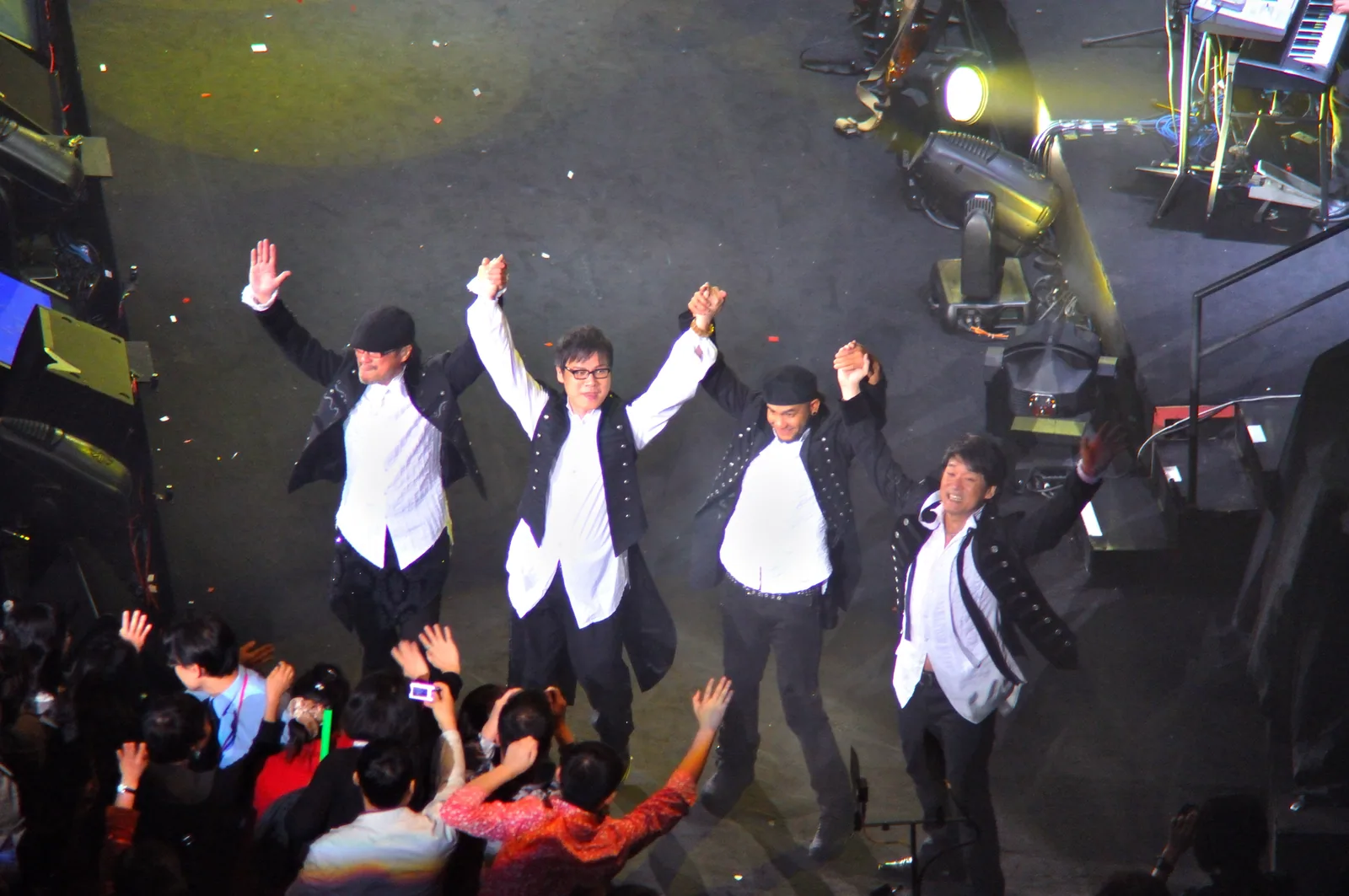
Superband’s 2009 world tour, a time-limited group composed of Lo Ta-yu, Jonathan Lee, Wakin Chau, and Chang Chen-yue. Photo: Tat Lau, 2009. CC BY-SA 2.0.
In 2024, seventy-year-old Lo Ta-yu stood on the concert stage. He sang more than twenty songs and played several piano pieces.30 In the audience sat listeners spanning several generations: elders who had heard him sing unsayable words under martial law, middle-aged people who had used his songs as the soundtrack of youth, and young people who came to know him through covers and streaming.
The student who once hid in the gross anatomy room, afraid of being heard, was now seventy, and the entire venue was listening to him sing.
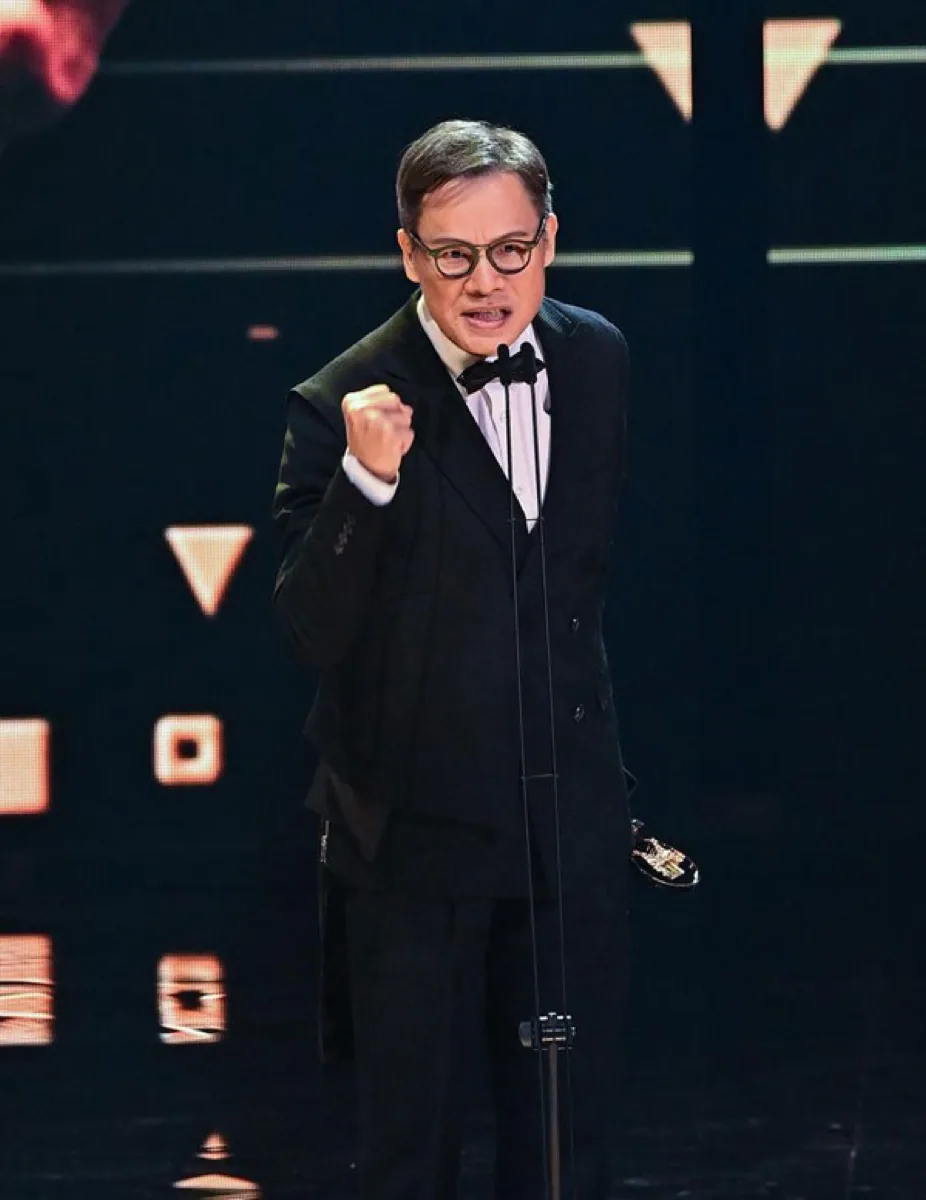
In 2021, Lo Ta-yu received the Special Contribution Award at the 32nd Golden Melody Awards. The jury citation described him as having “the stature of a thinker.” Photo: 化城再来人, 2021. CC BY-SA 4.0.
But he did not speak of himself as especially great. What he said onstage was this: “At least 70 percent of musicians were eliminated; those on this stage today are all remarkable survivors!”30 He did not say he was a godfather or a legend. He said he was simply someone who had survived. Compared with those peers eliminated by the times, he was merely lucky, still standing.
How, after drifting for most of his life, did Lo Ta-yu reconcile himself with the question “Who am I?” The answer may be hidden in a very ordinary scene. At fifty-eight, he became a father. Of the small daily matter of taking his daughter to school, he said it was “incredibly satisfying.” Then he said something that gathered his whole drifting life back together: “Life is a cycle. When it becomes a circle, nothing is particularly difficult.”5 He added one more line: it depends on whether you are willing to return to the starting point.
Beginning in an anatomy room in Taipei, passing through New York, Hong Kong, and Beijing, moving nineteen times, singing the rootlessness and orphanhood of an island, this drifter finally seemed to have found the answer he had sung toward all his life on a morning when he was holding his daughter’s hand on the way to school. It was not that one particular place was his root, but that “returning to the starting point” itself was. When life circles back into a round shape, the ground no longer shakes.
With a lifetime of drifting, he asked the question of Taiwan, “Who am I?” on behalf of an entire generation. And still standing onstage at seventy, singing, is itself the most honest answer to that question so far.
Further Reading:
- Taiwanese Pop Music: From Nakasi to Jay Chou, How an Island Made Song Its Own Voice — Lo Ta-yu is the key figure connecting what came before and after in this general history
- Taiwan Campus Folk Movement: How “Sing Our Own Songs” Rewrote Taiwanese Pop Music — the wave before Lo Ta-yu’s rise; to understand him, one must first understand this era
- Pop Music and the Golden Melody Awards: How Taiwan Uses One Award to Define Sinophone Music — Lo Ta-yu received the Special Contribution Award at the 32nd Golden Melody Awards in 2021
- Sylvia Chang: From Ingenue to Golden Horse Best Actress, a Dual Legend of Taiwanese Cinema and Music — the 1981 album Childhood first introduced Lo Ta-yu’s “Childhood” and “The Story of Time”
- Sanmao: A Generational Legend of Wandering Literature — screenwriter of the film Red Dust (the song’s lyrics and music were in fact by Lo Ta-yu)
Image Sources
This article uses three CC-licensed images, all cached in public/article-images/people/ to avoid hotlinking source servers; the video is an official YouTube embed:
- Lo Ta-yu performing in 2011 (hero) — Photo: Daniel M Shih, 2011, CC BY-SA 2.0
- Superband 2009 — Photo: Tat Lau, 2009, CC BY-SA 2.0
- Lo Ta-yu, 2021 Golden Melody Awards Special Contribution Award — Photo: 化城再来人, 2021, CC BY-SA 4.0
- Video: “Lukang, the Little Town,” embedded from the official Rock Records YouTube channel
References
- ETtoday: Lo Ta-yu leaves medicine for music, memories of practicing singing in the gross anatomy room — Reports Lo’s own account of practicing singing in the gross anatomy room during medical school, preserving the famous line, “the echo was very good, and no one would know I was singing” (note: another udn version titles it as “practicing guitar,” while the body text says “practicing singing”; this article uses the more conservative wording from the body text, “practicing singing/practicing music”).↩2
- Wikipedia: 羅大佑 — Records Lo Ta-yu’s full biography, including his birth in Taipei on July 20, 1954, medical-school background, move to Hong Kong in 1987, Beijing development in 2000, founding of Music Factory in 1990, and the Special Contribution Award at the 32nd Golden Melody Awards in 2021.↩
- China Medical University alumni profile: Lo Ta-yu — Official alumni record from his alma mater, documenting Lo’s studies in the medical department, graduation around 1980/81 (academic year 69), obtaining a license, and joining Rock Records in 1981.↩
- United Daily News: Lo Ta-yu discusses leaving medicine for music and ten years of reconciliation with his family — Reports Lo’s own account of “betraying the family” by changing careers to music, and of his family taking roughly ten years to truly accept it (original page no longer available; cited from report summary).↩
- 50+ (Fiftyplus): Interview with Lo Ta-yu, becoming a father at fifty-eight and “life is a circle” — In-depth late-life interview in which Lo discusses the difference between creation and practicing medicine (“you don’t have to actually make that cut”), becoming a father at fifty-eight and taking his daughter to school, and his realization that “life is a cycle; when it becomes a circle.”↩2
- Fount Media: Lo Ta-yu’s decision to leave medicine for music — Reports Lo’s explanation of why he gave up a medical career for music, preserving his statement that “among so many doctors, there is no need for one more Lo Ta-yu; but in music, there is still a lot of room for development.”↩
- Newton Wiki: 之乎者也 — Records the release of Zhi Hu Zhe Ye on April 21, 1982, the division of arrangement work between Minoru Yamazaki and Lo Ta-yu, and the album’s ranking as number one in Taiwan’s 100 Best Pop Albums.↩2
- StoryStudio: Taiwan’s banned-song history and the censorship-dodging lyrics of “Zhi Hu Zhe Ye” — Surveys the song-censorship system during the martial-law era, recording how the original line in “Zhi Hu Zhe Ye” satirizing censorship, “Song censorship: will it pass or not?” was changed during submission to “everyone is delighted.”↩
- The Epoch Times: Subtitle of “Orphan of Asia” and song censorship — Records the strategy of adding the subtitle “Red Nightmare: To the Refugees of the Indochinese Peninsula” so that “Orphan of Asia” could pass censorship, and the song’s relationship to Taiwan’s identity condition.↩
- Wikipedia: 明天會更好 — Records that the melody of “Tomorrow Will Be Better” was by Lo Ta-yu; the lyrics were co-written by Lo Ta-yu, Chang Ta-chun, Hsu Nai-sheng, Lee Shou-chuan, Chiu Fu-sheng, Sylvia Chang, and Chan Hung-chih; the arrangement was by Chen Chih-yuan; and notes the controversy over more than one hundred characters of the original lyrics being altered and the song’s appropriation by the Kuomintang as a campaign song.↩2
- Fount Media: Lo Ta-yu’s trajectory of drifting — Records the chronology of Lo’s departure for New York on March 9, 1985, and his settlement in Hong Kong in 1987, as well as the formation of his “Who am I?” theme of drifting.↩
- Wikipedia: Lo Ta-yu — English Wikipedia entry recording that Lo moved nineteen times among New York, Hong Kong, and Beijing over twenty-nine years, as well as his founding of Music Factory in 1990.↩
- Wikipedia: 羅大佑 — Chinese-language sources record Lo Ta-yu settling in Hong Kong in 1987 (English Wikipedia gives 1986; the two differ by one year, and this article follows the Chinese version while noting the discrepancy).↩
- Baidu Baike: 音樂工廠 — Records the founding of Hong Kong Music Factory as a joint venture between Rock Records and Lo Ta-yu in 1990, and its closure in 1999; it was Lo’s creative base during his Hong Kong period.↩
- Baidu Baike: 皇后大道東 — Records the January 1991 release of “Queen’s Road East,” composed by Lo Ta-yu, with lyrics by Lin Xi, arrangement by Fabio Carli, and vocals by Lo Ta-yu and Ram Chiang, as well as Lo’s explanation of the title’s pun on “the road life should take.”↩2
- Wikipedia: 東方之珠(羅大佑曲作) — Records the differences between the 1986 Cantonese version of “Pearl of the Orient” (music by Lo Ta-yu, lyrics by Cheng Kwok-kong, sung by Michael Kwan) and the 1991 Mandarin version (Lo’s own lyrics), as well as the critical assessment that “Cheng’s lyrics are plain and grounded, while Lo’s are airy and insubstantial.”↩2
- Sina News: Lo Ta-yu’s Music Factory moves to Beijing and Confucius Temple press event — First-hand 2002 report documenting Music Factory’s move to Beijing, the Century Tour after his songs were unbanned in China in 2000, and Lo’s on-site remark at the Beijing Confucius Temple press event: “I felt the ground beneath my feet shaking.”↩23
- The China Project: Lo Ta-yu, "Hong Kong, Pearl of the Orient" — English music criticism quoting Lo’s 2004 interview statement that his drifting among Taiwan, Hong Kong, and China was in fact “seeking my roots,” and analyzing the pre-handover anxiety of “Pearl of the Orient.”↩
- Cambridge, The China Quarterly: Gold, "Go with Your Feelings" (1993) — Peer-reviewed academic article analyzing the influence of Hong Kong and Taiwan popular culture in Greater China, noting that Lo Ta-yu’s work “despite never performing on the mainland, his work remained widely popular.”↩
- Douban: Sylvia Chang’s Childhood album — Records that “Childhood” and “The Story of Time” first appeared on Sylvia Chang’s September 1981 album Childhood, with Lo Ta-yu as lyricist-composer and first producer, correcting the common mistaken date of 1982.↩
- KKBOX: 閃亮的日子 — Records “The Shining Days” as written and composed by Lo Ta-yu, originally sung by Liu Wen-cheng, used as a 1977 film theme song, and released on an album in 1978.↩
- Mojim: 野百合也有春天 — Records “Wild Lily Also Has Spring” as written and composed by Lo Ta-yu, sung by Michelle Pan, and released in 1983; also clarifies that “天天天藍” had lyrics by Hsieh Tsai-chun and music by Lee Shou-chuan, and was not a Lo Ta-yu work.↩
- Wikipedia: 似是故人來 — Records the detailed division of creative labor for “Like an Old Friend Returning,” composed by Lo Ta-yu, with lyrics by Lin Xi, sung by Anita Mui, and released in 1991.↩
- Wikipedia: 滄海一聲笑 — Records that both lyrics and music of “A Laugh in the Sea” were by James Wong, with arrangement by Joseph Koo; Lo Ta-yu only participated in singing the Mandarin version and was not the creator, correcting a common misattribution.↩
- Newton Wiki: 滾滾紅塵 — Records “Red Dust” as written and composed by Lo Ta-yu and first sung by Sarah Chen, and clarifies that the writer Sanmao was the screenwriter of the film of the same name, not the lyricist or composer of the song.↩
- LINE MUSIC: 你的樣子 — Records “Your Face” as included on the 1988 album Comrade Lover and as the ending theme of the film All About Ah-Long, correcting the common mistaken attribution to the 1984 album Home.↩
- Fount Media: Lo Ta-yu’s transformation during the Hong Kong period — Discusses the view that Lo Ta-yu’s “edge diminished and he moved closer to commerce” during the Hong Kong Music Factory period, noting that the main output of this period was film music.↩
- Sina: Southern People Weekly 2009 special feature on Lo Ta-yu — 2009 People Weekly commentary stating that Lo’s later works were “not incisive; rather, they lack sharpness and have an excess of meanness” and “lack aftertaste,” a representative criticism of the weakening of his creative edge.↩
- Wikipedia: 縱貫線(樂團) — Superband was a time-limited supergroup formed in 2008 and disbanded in January 2010, composed of Lo Ta-yu, Jonathan Lee, Wakin Chau, and Chang Chen-yue; it released two albums, Northbound Train and Southbound Line, and held a world tour.↩
- HK01: Lo Ta-yu’s seventieth-birthday concert and “remarkable survivors” — Reports Lo’s seventieth-birthday concert, where he performed twenty-seven songs plus five piano pieces, and quotes his onstage remark: “At least 70 percent of musicians were eliminated; those on this stage today are all remarkable survivors.”↩2