
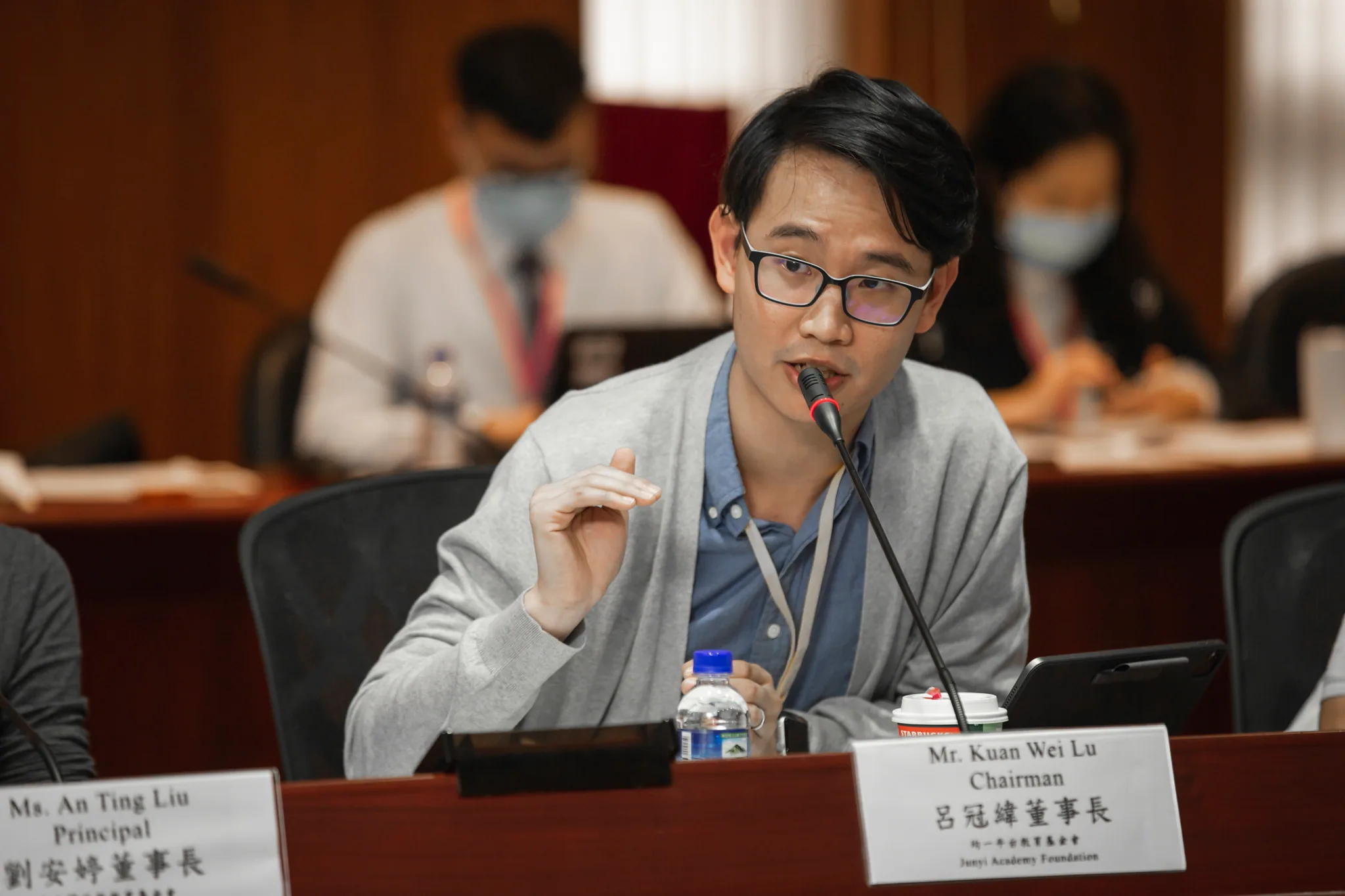
30-second overview: In 2012, Lu Kuan-wei was a seventh-year medical student at National Taiwan University, interning at the Yunlin Branch of National Taiwan University Hospital. There he met a young girl raised by her grandparents: her primary caregiver had fallen ill, and she had to accompany the patient. He asked himself: if I were this girl today, could I have become the person who got into NTU's medical school? The next year, he passed the medical licensing exam, but instead of entering residency training, he went to record math videos for Junyi Academy, founded by Fang Hsin-chou. He wanted to use online self-directed learning to narrow Taiwan's educational divide. But the global academic evidence points almost unanimously the other way: these tools help most the children who already have devices, self-discipline, and parental support. Twelve years later, no independent controlled study has shown that he reversed this dynamic. He is the first to admit it himself: "The use of digital tools does not equal the arrival of digital transformation."
He held a medical license in his hand. Yet he did not become a doctor.
Lu Kuan-wei completed the full seven-year medical program at National Taiwan University and passed the general medical licensing exam. In most people's eyes, that was already the most stable path a life could take. But he did not enter residency training, and he did not put on that white coat1. Through the unfinished act of "not putting on the white coat," Lu defined the next twelve years of his life.
To understand why he let go of a profession whose outcomes can be counted one by one, we have to return first to that hospital corridor in Yunlin.
The Question in the Hospital Corridor
In 2012, Lu was a seventh-year student at NTU's medical school, interning at NTU Hospital's Yunlin Branch2. It was one of the most exposed sites of Taiwan's urban-rural divide: many of the people coming for care were from grandparent-led households, economically disadvantaged families, or situations where "even when someone is sick, the granddaughter still has to take leave from school to come along." He met a young girl whose primary caregiver had fallen ill, so the responsibility of care had fallen to her. A reporter later paraphrased the question Lu asked himself in that moment: if this young girl had grown up in the environment he had grown up in, could she have become the Lu Kuan-wei who got into NTU's medical school and was now standing there3?
The question carried weight because it turned the medical site into a mirror, and what it reflected was educational inequality. A doctor could treat her caregiver's illness, but not the family into which she had been born.
Around the same time, he was on duty in a hospice ward. People at the end of life showed him something else. He later wrote: "I found that what people care about most before they leave this world comes down to two things: 1. whether their relationships with important others are complete 2. whether their unfinished wishes can be fulfilled"4. Medicine can extend the length of life, but it may not change how a person lives that life. The latter is often determined much earlier, much further upstream.
What finally pushed him to decide was an observation about cram schools. In Taiwan, a large share of learning resources is held by cram schools, or private after-school tutoring businesses, and their business logic is simple. He put it directly: "We can only serve people who can afford high cram-school fees"5. Before him lay a profession that saved lives, alongside a gap he saw as earlier, larger, and yet unaddressed.
📝 Curator's note: The usual account is that Lu Kuan-wei "gave up medicine" to work in education, a framing that turns the choice into a sacrifice. But closer to his own context is this: in the hospital, he saw a way of saving people that he felt was "too late, too slow, one person at a time," so he went looking for something "earlier and at greater scale." The difference is not a romantic choice between paths. It lies in how he saw "the cycle of disadvantage" as a cause of illness further upstream than disease itself, and that was a cause the white coat could not treat.
He described this turning point in plain terms. In a graduation message for Junyi, he said: "In the hospital, I saw the cycle of disadvantage, and I also realized that doctors have to save people one by one. So I kept thinking about whether there was an earlier, larger-scale way to help more people"6. No grand declaration, only the fatigue of "saving one person at a time" and a longing for something "earlier and larger-scale."
Nor did he describe the decision as a fearless leap from which there was no return. He set himself a stop-loss point: "I set a three-year deadline. If I devoted myself to education for three years and achieved nothing, then I would go back to the hospital and become my classmates' junior colleague"7. With his parents, he did not demand understanding, only promised not to burden them: "I spent a great deal of time thinking, praying, and having many conversations with my parents, letting them know that I would support myself and would not trouble them"8. This was someone who had counted the cost, not someone swept away by a sense of mission.
A Phone Call Before Surgery
In July 2013, after completing his military service as a navy second lieutenant medical officer, Lu formally joined the Chengzhi Education Foundation. His title was project teacher, which in plain terms meant he recorded videos9. He was in his twenties, doing work that, to outsiders, seemed hard to connect with "NTU medical school": explaining math problem after math problem to a camera.
What truly moved him from "a young person good at recording videos" toward the center of the organization was a phone call in September 2013. Fang Hsin-chou, founder of Chengzhi and Junyi and an entrepreneur who had built a successful networking and communications business before turning to education, had been diagnosed with lung adenocarcinoma and was about to undergo surgery. Before the operation, he called Lu, who had joined only half a year earlier.
📝 Curator's note: This phone call is the pivot of the whole story because it reveals a fact often covered over by individual-hero narratives: Junyi was not founded by Lu Kuan-wei. It had an earlier founder who, at a moment when he might not make it off the operating table, entrusted an organization that had not yet grown up to a young doctor with six months of experience. What Lu took on was a tree someone else had planted.
On the phone, Fang said something Lu later recorded word for word: "If I cannot come back from this surgery, please continue Junyi Academy's work for at least ten years, all right? I believe in you"10. In another article commemorating Fang, Lu wrote down a more direct version of the same entrustment: "Work hard at Junyi for 10 years, because only after 10 years is there a chance for education to change"11.
"Ten years" was not a casual time frame. It was almost Fang's worldview about education: educational outcomes do not jump out within a quarter or a year for you to inspect; one has to wait ten years before there is a chance to see change. This is the opposite of medicine, where outcomes are often quantifiable in the moment, whether lives saved or indicators lowered. Educational outcomes are long, slow, and difficult to prove. What Lu accepted was something measured in "ten years," and not necessarily countable with clarity.
The trust itself also struck him. He wrote: "It turned out that in Brother Fang's eyes, I was not merely a project teacher who was very good at recording videos, but a young person with development potential. This kind of trust was something I had almost never encountered from elders"12. Fang's surgery succeeded. But the phrase "at least ten years" became the ruler by which Lu would measure himself.
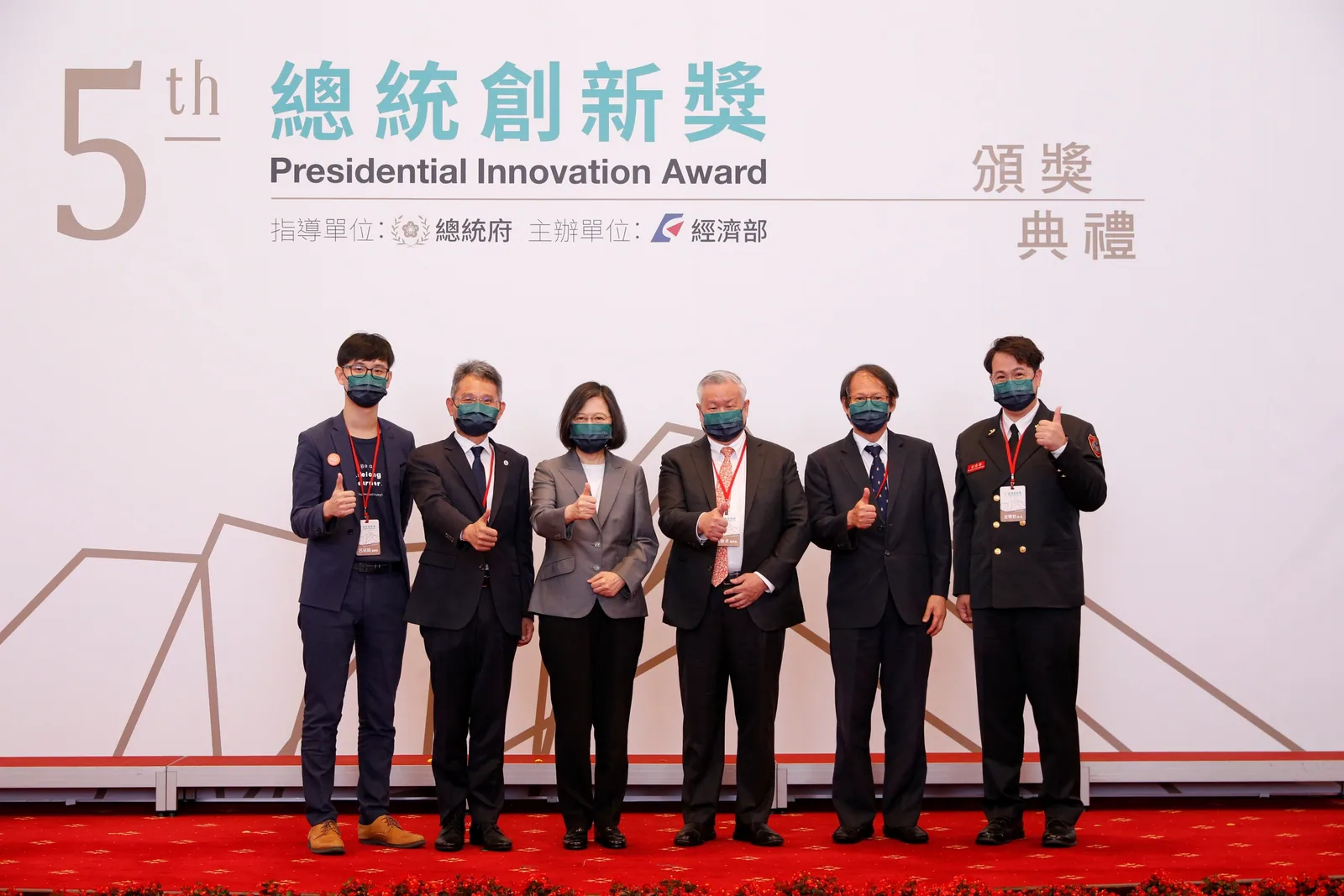
In 2022, Lu Kuan-wei (first from left) received the 5th Presidential Innovation Award as Junyi's representative, standing with President Tsai Ing-wen (center), Macronix chairman Miin Wu, and other winners. The tree Fang Hsin-chou entrusted to him had, nine years later, grown all the way to the Presidential Office. Image source: Department of Industrial Technology, Ministry of Economic Affairs; Government Website Open Information Announcement.
His titles kept rising. In 2014 he became CEO. On January 1, 2018, the platform spun out from the Chengzhi Foundation and established the Junyi Academy Foundation, with Lu serving concurrently as chair and CEO13. Adding the title "chair" changed how it felt entirely. He said: "In the past, no matter how much authority I was given, someone else still carried the responsibility... But now, I am the chair. I am legally responsible. It feels completely different"14. The tree Fang entrusted to him now hung under his name, legally and morally.
The Four Characters "Equal and First-Rate" Were Borrowed
What exactly is Junyi? The answer begins with its name.
"Junyi" comes from the phrase "equal and first-rate," meaning that educational resources should be equal, while quality remains first-rate15. The four Chinese characters were borrowed from Stanley Yen: Yen had founded Junyi School of Innovation in Taitung, and Lu's generation of education workers took up the name and applied it to an online platform15. A figure from the tourism industry who turned to rural education, and a figure from medicine who turned to online learning, shared the same aspiration under the same name.
Junyi's technological origin came from the other side of the world. At first, it was Taiwan's localized version of Khan Academy. In 2012, Junyi began by translating more than a thousand Khan Academy videos, with volunteer Lee Heng and others joining the effort16. But this was not an exclusive commercial licensing relationship. Khan Academy's content was released under a CC BY-NC-SA open license, and Junyi even directly forked Khan Academy's exercise system, Perseus, on GitHub for its own use17. In other words, Junyi stood on the shoulders of a giant that had deliberately opened itself up.
Why, then, did Taiwan need its own version? The answer lies in the limits of "translation." Translation can solve language, but it cannot solve curriculum standards. Taiwan's math sequence, natural-science subject divisions, and exam scope differ from those in the United States. In 2014, Junyi began producing its own content aligned with Taiwan's curriculum standards, and Lu also visited Khan Academy founder Sal Khan that year18. Only when Junyi moved from "translating Khan Academy" to "growing its own curriculum" did it become a Taiwanese platform rather than a translation project.
💡 Did you know? Junyi's website footer still says "derived originally from Khan Academy." It has not erased its own origins. A platform trying to serve Taiwanese education openly acknowledges that its seed came from an American nonprofit. In Taiwan's technology narratives, which often emphasize "independent R&D," that is an uncommon kind of honesty.
Five Million Accounts, and No Way to Know How Many People Are Really Learning
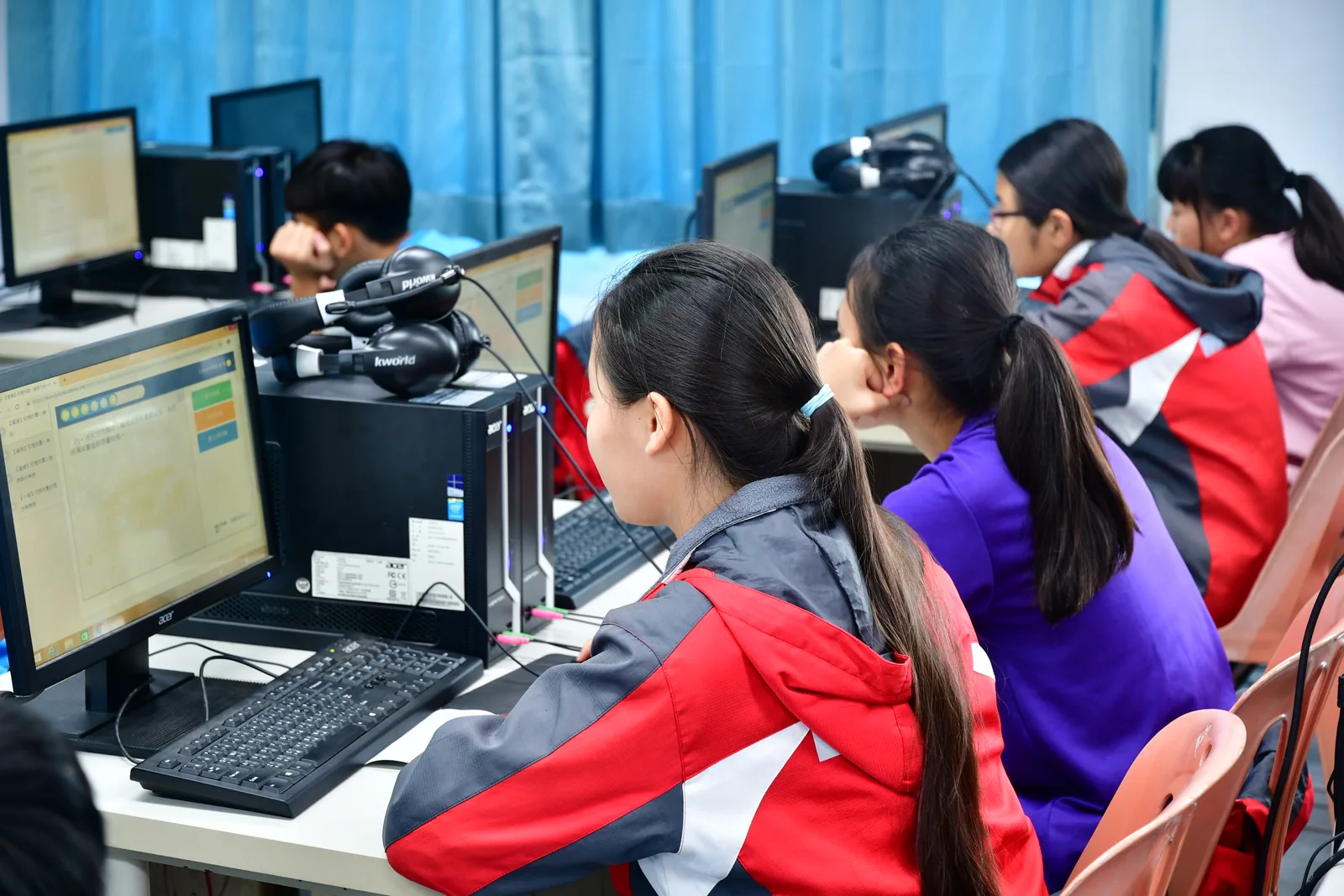
Students at Baozhong Junior High School in Yunlin County use Junyi in class. These are the children the platform wants to serve. But "how many people use it this way" and "how many accounts have been created" are two different things. Image source: Baozhong Junior High School Cloud Network (Flickr), CC BY 2.0.
The figures most often cited about Junyi are its numbers. And numbers are exactly what need to be read most carefully.
According to Junyi's 2024 annual impact report, audited by KPMG Taiwan, the platform had accumulated 5,289,000 registered accounts19. This figure is often described as "5.28 million users," but its precise meaning is "accounts created up to the present," not "people still using it now." In the same annual report, monthly active users were about 271,000, and weekly active users about 86,00019. More than five million accounts and 270,000 people who "opened it this month" are two different things.
The video count also deserves correction. In recent years, Junyi's public-facing materials at one point claimed "more than 40,000 videos," but the 2024 report lists 29,16219. Junyi has not publicly explained the discrepancy across reporting periods. The honest way to put it is "about 29,000 videos" or "nearly 30,000," not 40,000.
Source: Junyi Academy Foundation 2024 Annual Impact Report (audited by KPMG)
As for Junyi's frequent self-positioning as "Taiwan's largest free K-12 digital learning platform," that "largest" is currently a self-description, not a finding from a third-party institution20. This does not mean it is fabricated. In terms of cumulative account numbers, it is indeed one of Taiwan's leading online learning platforms. But there is no independent referee behind the word "largest," and readers deserve to know that.
📝 Curator's note: A nonprofit that survives on donations has to use start-up-like numbers such as "five million" and "largest" to prove to funders that it deserves support. Yet those same numbers are exactly what skeptics trust least. Presenting cumulative accounts as active users, or turning self-description into fact, is the kind of rhetoric most likely to emerge in this position. Junyi's numbers support the scale of a large platform. But "scale" is not the same as "effectiveness." The next question is the truly difficult one: among those five million accounts, how many belong to the children it most wants to help?
That AI Fox-Cat Is Not as Miraculous as You Think
In recent years, what Junyi has talked about most often is its AI tools. But on AI, the marketing is loud while the underlying technology is less miraculous than the signboard suggests.
The most concrete example is Jutor, an AI English-speaking tutor launched in 2023. Under the hood, it connects to OpenAI's GPT models and uses Socratic dialogue to help students practice speaking21. Chih-ching, a student at one of Taiwan's top-choice high schools, described the feeling of using Jutor this way: "In the future, if I want to practice speaking, I won't necessarily have to enroll in a cram school😍... It's like having a teacher who is always available, quietly staying beside me as I practice"22. In 2024, Junyi also launched a learning companion character called the "AI Fox-Cat."
Junyi Academy official channel: a demonstration of Jutor's English-speaking practice. One can see how it converses with a student, and also see that its essence is a conversational tool connected to a large language model, not some mind-reading personalization engine.
But we need to be careful not to inflate the term "AI adaptive learning" into a kind of miraculous personalization that reads minds. Junyi's so-called intelligent diagnosis is, in technical substance, large-language-model question generation plus a rule-based knowledge tree, with natural-language processing used for question recommendation, built on Google Cloud BigQuery21. It is not "Knowledge Tracing" as the educational technology field uses the term, meaning deep learning that continuously models each student's knowledge state. Junyi has not published this type of academic paper21. The often-promoted "10-minute diagnosis" is essentially a batch report for teachers after a round of testing, not a real-time adaptive dialogue between teacher and student21.
In other words, AI is a useful tool inside Junyi, but the "adaptive learning" signboard is louder in marketing than the technology can support. That honest distinction matters because it leads directly to the article's hardest contradiction.
Technology Helps Most Precisely Those Who Need It Least
Lu Kuan-wei's wager was this: an online self-directed learning platform can narrow educational gaps.
But global academic evidence points almost unanimously in the opposite direction. In Failure to Disrupt, education technology scholar Justin Reich repeatedly argues that free online learning resources are often used better by people who already have resources23. Education researcher Mark Burns put it more bluntly in 2023: the real effect of online education is often "the educationally rich getting richer while the educationally poor get poorer"24. This is what educators call the Matthew effect: to use online self-directed learning tools well, one needs devices, a stable internet connection, self-discipline, and parents supervising nearby. These are precisely what disadvantaged children are most likely to lack. During the pandemic, research in the Netherlands found that children from families with lower levels of education suffered learning losses about 60% greater than other children25. Completion rates for massive open online courses, or MOOCs, have long remained below 13%, and those who complete them are divided along socioeconomic and geographic lines26.
⚠️ Contested view: Education technology critic Audrey Watters offers an even sharper critique. She argues that the selling point of "free" is itself a trap: when a resource claims to be free and open to everyone, what it often expands in practice is the gap between those already capable of using it and everyone else27. In 2023, UNESCO even used the phrase "Ed-Tech Tragedy" to describe the consequences of hasty digitization during the pandemic28. These voices are not aimed at Junyi personally, but they represent the structural headwinds that platforms like Junyi are born having to bear.
Taiwan's own numbers also support the reality of those headwinds. According to the 2022 Programme for International Student Assessment, or PISA, Taiwan's urban and rural students differed by 54 points in mathematics, equivalent to roughly 2.7 school years; the gaps were 49 points in reading and 44 in science29.
Source: PISA 2022 (OECD), Taiwan urban-rural student score gaps across three subjects (points)
There is, however, a turn here that is often overlooked. Huang Min-hsiung and other scholars at Academia Sinica have pointed out that Taiwan's learning gaps do not occur only between "city and countryside" or "school and school." Deeper gaps are actually hidden within the same school, even within the same classroom. Moreover, most low-achieving students are concentrated in cities and towns, not in the most remote rural areas30. This finding complicates the convenient label of "urban-rural divide": the gap is real, but its shape is more fragmented and harder to make up with one platform applied uniformly to everyone.
The most concrete headwinds appear in the rural scenes documented by The Reporter. During pandemic school closures, Sanmin Junior High School in Yuli had 29 of its 112 students borrowing computers from the school, meaning nearly a quarter of its students had no usable device at home31. The Zhenxing Branch of Wan'an Elementary School had only a 2M ADSL connection, not enough to run online videos, so students had to walk to the community activity center to get online32. Wang Yi-chien, a teacher at Alishan Junior and Elementary School, once said a line that makes people fall silent: "The other third are old friends we consistently cannot reach. We are all chasing that one third"33. Liu An-ting, founder of Teach For Taiwan (TFT), also said that in these areas, perhaps only one-tenth of the challenges caused by full school closures could be answered with relatively simple solutions; "the other 90% of problems still have no answers"34.
No matter how good a platform is, there first have to be computers, sufficiently fast internet, and someone accompanying children as they use it. The Matthew effect is very concrete here: it is the 29 borrowed computers in Yuli, the network in Wan'an that cannot run video, and the one third that Wang Yi-chien says are "consistently unreachable." What Lu Kuan-wei is betting on is a fight against that wind.
Junyi Academy official channel: Lu Kuan-wei's "Remote Taiwan" talk at the 2030 Education AI Annual Conference, addressing precisely these rural headwinds and his claim that rural communities do not need pity, but to be seen.
How He Fights That Wind, and the Wall He Honestly Acknowledges
Junyi is not blind to these headwinds. Its way of fighting them is precisely to acknowledge that the premise of "self-directed learning" can fail for disadvantaged children.
Junyi's core equity mechanism is "learning assistance." The key is that this does not mean leaving children to go online and learn by themselves; teachers lead them through it35. Junyi gives this group of children a precise description: "neither mountain nor city," meaning schools that are neither in the most remote mountain areas nor in resource-rich cities, and are often the truly overlooked rural classrooms35. To ensure teachers know how to guide students, Junyi runs teacher training for disadvantaged after-school tutoring programs, among teachers 87% of whom had not previously used any digital learning platform, and it has also trained 265 rural seed teachers, 80% of whom are Indigenous36. It knows that without teachers, a tablet is just a glowing piece of plastic.
What about results? Junyi's self-assessment is positive. Its 2024 annual report tracked more than 6,000 children using learning assistance. The figures were: among those using Junyi, the pass rate was 27%, compared with 23% in the control group, a difference of 4 percentage points; in "neither mountain nor city" schools, that gap widened to 32% versus 25%, a difference of 7 percentage points37. That sounds like good news.
But here we have to be extremely honest: a search of public materials finds no independent third-party randomized controlled trial (RCT) or peer-reviewed efficacy study of Junyi38. By comparison, Khan Academy, Junyi's source, has had RCTs involving 11,000 people in Toronto and 5,500 in India, producing clear effects measured in fractions of a standard deviation39. Junyi has not. And the 4% difference in pass rates above may itself involve selection bias: children who actively use Junyi may have higher learning motivation to begin with. So that figure can support the claim that "Junyi's intervention has a positive effect," but not that "Junyi has already proven it narrowed the urban-rural gap." Junyi also has not publicly disclosed retention or attrition rates among rural children38. Attrition, after all, is precisely where the Matthew effect is most likely to occur.
📝 Curator's note: This is the point where the whole article most needs to pause. A person who wagered a profession with visible outcomes to do this work has spent twelve years on it, yet still does not have an independent piece of evidence that would let him say, with full confidence, "I succeeded." The tension of the article has never been "Did he succeed?" That question cannot now be answered. The tension lies in how he chooses to speak when facing "cannot be proven."
And Lu Kuan-wei's way of speaking is not to exaggerate.
As early as 2021, he wrote a sentence that is almost anti-marketing: "The use of digital tools does not equal the arrival of digital transformation"40. When the government promoted the "tablets for every student" policy and budgeted more than NT$20 billion, he publicly pointed out the problem: most of the budget was still being spent on hardware procurement, while the real key was people. His argument was that children from high-socioeconomic-status families have parents who regulate and guide how tablets are used; children from low-socioeconomic-status families, by contrast, are harder to prevent from using tablets to scroll social media. Therefore, "tablets for every student" must be paired with "a teacher for every student" to ensure an equitable learning environment41. A person selling online tools publicly saying that tools are insufficient and that teachers are necessary is not the kind of thing marketing rhetoric usually says.
He is even willing to admit he does not have the answers. In an article about Junyi's future vision, he wrote: "I often think about how I should lead an organization as rich and diverse as Junyi. To be honest, I do not yet have all the answers"42.
💡 Did you know? Junyi has a "three noes" principle: no profit-making, no advertising, and no competing for government tenders. Why not even take government tenders? Junyi's official explanation is: "As a private-sector organization, Junyi needs to play a role of oversight and collaboration on education issues. Once it has dealings with the government over tenders, potential conflicts of interest may arise, making it impossible to properly play the role of oversight"43. It chose to give up a stable source of revenue in order to preserve its position to speak truthfully about government education policy.
Behind this principle is a rather clean set of finances. In 2024, Junyi's total revenue was about NT$96.92 million, of which 98.87% came from donations, with government subsidies at zero44. Its donors include companies such as Google, TSMC, ASML, and DBS Bank. TSMC ran the three-year "TSMC for Education" project and the course "My Semiconductor Adventure"; Google.org gave a two-year grant of about US$1 million in 2019, the first of its kind in Taiwan45. And Fang Hsin-chou, the person who before surgery entrusted Lu with "at least ten years," became Junyi's "founding partner" after its independence, and also provided the first year of operating funds46.
The Wall That Still Has No Answer
If the Matthew effect is the wall Lu Kuan-wei has faced over these twelve years, an even larger wall is now rising before him.
That wall is called declining birthrates multiplied by AI. At an education forum at National Chengchi University in 2024-2025, Lu laid out the numbers: "Last year, Taiwan had only 107,000 newborns. This February, there were only more than 6,000. This is not a distant trend. It is happening now"47. Taiwan's newborns have fallen from 400,000 a generation ago to just over 100,000. And the arrival of AI, he judges, will intensify M-shaped inequality: the strong will get stronger and the weak weaker, because children who know how to use AI and have someone to guide them can turn it into a super tutor, while children without guidance will only fall further behind.
His response is a claim so bold it is almost radical: "The problem of intellectual education can really be handed over to AI, 90%"48. What he means is that the transmission of knowledge, such as memorizing formulas, solving problems, and remembering dates, can be turned over to AI in nine out of ten cases, so that the precious time inside schools can be returned to moral education, social education, aesthetic education, and other things that "only humans can do." In his vision, AI is not here to replace teachers, but to free teachers from repetitive labor so that they can do what machines cannot.
When he says these things, he carries an urgency he has himself described: "Taiwan has no time left to wait. We need education experiments at scale. Start now. Because the longest compounding effect belongs to education"49.
Junyi Academy official channel: Lu Kuan-wei discusses the double pressure of declining birthrates multiplied by AI, arguing that "90% of intellectual education can be handed over to AI," returning school time to the things only humans can do.
This claim, of course, also has its shadow. In a 2022 report, the international human rights organization Human Rights Watch included Junyi among the education technology products it examined, pointing out that Junyi's website contained Google Analytics and DoubleClick trackers that could involve the collection of children's data. Junyi did not publicly respond50. A platform that wants to protect children also stands inside the difficult question of how data is used. He does not have all the answers, and he is the first to admit it.
✦ In the Bunun community of Pananhua in Namasia, Kaohsiung, Indigenous Bunun children used Junyi's Jutor to practice spoken English. Later, when an international visiting group arrived, these children were able to use English to tell visitors from afar the traditional stories of their own community51. That scene grew because teachers were beside them, guiding and accompanying them, not because children learned alone in front of a screen. But perhaps it is the closest version of Lu Kuan-wei's wager coming true: a child from a rural community using a tool that came from the United States and grew in Taiwan to tell the world about their own roots.
He passed the medical licensing exam and did not put on the white coat. Twelve years later, the thing he wagered on, using technology to narrow educational gaps, still lacks an independent piece of evidence that can stamp it as "done." He could, like many others, shout "five million," "largest," and "AI adaptive learning" as loudly as possible, since few people can check clearly anyway. But he chooses to say that "tablets do not equal transformation," and "I do not yet have all the answers."
A person who wagered a profession with visible outcomes in order to do something structurally difficult and almost impossible to prove does not, in the end, leave behind a victory bulletin. What he leaves is "I do not yet have all the answers": the most honest sentence someone who has worked for twelve years can offer. That honesty is more worth remembering than what he gave up.
Image Sources
This article uses 3 publicly licensed images and 3 official Junyi videos. All images are cached in public/article-images/people/ to avoid hotlinking source servers; videos are embedded from Junyi's official YouTube channel:
- Portrait of Lu Kuan-wei (hero) — Presidential Office / photo by Mori, 2020-11-23, CC BY 2.0
- Baozhong Junior High School students using Junyi — Baozhong Junior High School Cloud Network (Flickr), 2019-04-10, CC BY 2.0
- Group photo from the 5th Presidential Innovation Award — Department of Industrial Technology, Ministry of Economic Affairs, 2022-04-29, Government Website Open Information Announcement (author attribution required)
- Videos: Jutor: Every Child, Regardless of Background, Can Have an English-Learning Environment, Lu Kuan-wei: REMOTE TAIWAN, Can 90% of Intellectual Education Be Handed to AI? On Education in the Age of Declining Birthrates and AI — Junyi Academy official YouTube channel
Further Reading
- Yeh Ping-cheng: PaGamO turned homework into monster-fighting, another path of gamified educational innovation
- Huang Kuo-chen: Pinxue Tang and Reading Comprehension turned "knowing how to read" into a teachable craft
- Liu An-ting: Teach For Taiwan (TFT), the two-year program sending young people into rural classrooms
- Stanley Yen: From tourism godfather to rural education advocate, the person from whom Junyi borrowed its name
References
- Lu Kuan-wei: To New NTU Medical Students — Lu Kuan-wei's 2015 blog post, in which he states that he "completed seven years of medical training, passed the general medical licensing exam, but did not enter residency training"; the most direct first-hand source for "not putting on the white coat."↩
- Profile of Fang Hsin-chou: Giving Young People Opportunities — Written by Lu Kuan-wei on Junyi's official website; records the timeline in which he interned at NTU's Yunlin Branch as a seventh-year medical student, was inspired by Khan Academy, and joined Chengzhi after military discharge.↩
- Future Family: Lu Kuan-wei Takes Up the Baton — An interview by Future Family under Global Views-Commonwealth Publishing Group; the reporter paraphrases Lu's encounter at the Yunlin Branch with a girl patient from a grandparent-led household and his question of whether he could have become who he is today if he had been in her circumstances.↩
- Lu Kuan-wei: Why I Left Medicine for Education — Lu's Medium essay, recording verbatim his hospice-ward realization that what people care about most before dying is relationships and unfinished wishes.↩
- Lu Kuan-wei: Why I Left Medicine for Education — The same essay, recording his observation that cram schools "can only serve people who can afford high cram-school fees."↩
- Junyi 2022 Graduation Message — Lu's message to graduates, with the verbatim line that "doctors have to save people one by one... earlier and at greater scale"; used in place of an older unattributed quotation.↩
- Lu Kuan-wei: Why I Left Medicine for Education — The same essay, recording the stop-loss deadline he set for himself: if three years in education produced no results, he would return to the hospital.↩
- Lu Kuan-wei: Why I Left Medicine for Education — The same essay, recording his conversations with his parents and his verbatim promise that he "would support myself and would not trouble them."↩
- Profile of Fang Hsin-chou: Giving Young People Opportunities — Junyi's official website records that Lu joined the Chengzhi Education Foundation in July 2013 after military discharge as a project teacher.↩
- Profile of Fang Hsin-chou: Giving Young People Opportunities — Written by Lu on Junyi's official website; records Fang's verbatim pre-surgery phone call in 2013 after his lung adenocarcinoma diagnosis: "please continue... at least ten years, all right? I believe in you."↩
- Commemorative Article for Fang Hsin-chou — Junyi's official memorial article for Fang, recording his entrustment: "Work hard at Junyi for 10 years, because only after 10 years is there a chance for education to change."↩
- Profile of Fang Hsin-chou: Giving Young People Opportunities — The same article, recording Lu's verbatim response to Fang's trust: "It turned out... [I was] a young person with development potential."↩
- Junyi FAQ — Junyi's official explanation of its organizational history: on January 1, 2018, it spun out from the Chengzhi Foundation to establish the Junyi Academy Foundation, with Lu Kuan-wei serving as chair and CEO.↩
- Junyi 2018 Interview: From CEO to Chair — Junyi's official interview, recording Lu's verbatim state of mind after becoming chair: "legally responsible; it feels completely different."↩
- Wikipedia: Junyi Academy — Records that "Junyi" comes from "equal and first-rate" and that the name was borrowed from Stanley Yen's Junyi School in Taitung (requires cross-checking with first-hand sources).↩2
- Wikipedia: Junyi Academy — Records Junyi's early history: launching in October 2012 and beginning with translations of more than a thousand Khan Academy videos.↩
- junyiacademy/perseus (GitHub) — Junyi's GitHub fork of Khan Academy's Perseus exercise system, supporting the technical connection under CC BY-NC-SA open licensing rather than an exclusive agreement.↩
- Wikipedia: Junyi Academy — Records that from 2014 Junyi began producing content aligned with Taiwan's curriculum standards and that Lu visited Khan Academy founder Sal Khan.↩
- Junyi 2024 Annual Impact Report — Annual report audited by KPMG Taiwan; the single source of truth for figures: 5,289,000 cumulative registrations, 271,000 monthly active users, 29,162 videos, and 121,539 practice questions.↩23
- Junyi 2024 Annual Impact Report — Junyi's self-positioning as "Taiwan's largest free K-12 digital learning platform"; no third-party institution has certified this, so it must be marked as self-described.↩
- iKala: Junyi Academy Technical Case Study — Records that Junyi's intelligent diagnosis is built on Google Cloud and uses natural-language processing for recommendations; in technical substance, LLM-generated questions plus a rule-based knowledge tree, not the academic field's knowledge-tracing model.↩234
- Junyi Jutor Student Story — Junyi's official website records the verbatim reflection of Chih-ching, a student at a top-choice high school, after using Jutor for speaking practice.↩
- Justin Reich, Failure to Disrupt (Stanford Digital Education) — A representative work by an educational technology scholar arguing that technology alone cannot transform education and that free resources are used better by those who already have resources.↩
- How the Other Half Learns Online (UKFIET, Burns 2023) — Mark Burns on equity issues in online education, presenting the Matthew effect in which "the educationally rich get richer while the educationally poor get poorer."↩
- Dutch Learning-Loss Gap Study (arXiv 2509.22136) — Academic study indicating that during the pandemic, children from families with lower levels of education suffered learning losses about 60% greater.↩
- Does Online Education Amplify Inequality? (ScienceDirect) — Academic paper examining the inequality-amplifying effects of online education, including evidence that MOOC completion rates are below 13% and split along socioeconomic and geographic lines.↩
- Audrey Watters: The Inequalities of Online Education — Education technology critic discussing how "free" resources often widen the gap between those already able to use them and everyone else.↩
- UNESCO: Ed-Tech Tragedy — UNESCO's examination of the consequences of hasty digitization during the pandemic under the phrase "Ed-Tech Tragedy."↩
- CMMedia: PISA 2022 Taiwan Urban-Rural Gap — Cites OECD PISA 2022 data showing Taiwan's urban-rural student gap: 54 points in mathematics (about 2.7 school years), 49 in reading, and 44 in science.↩
- PanSci: Huang Min-hsiung on Learning Gaps — Academia Sinica researcher Huang Min-hsiung's work emphasizing that Taiwan's learning gaps are more deeply hidden within schools and even classrooms, and that most low-achieving students are concentrated in cities and towns rather than remote rural areas.↩
- The Reporter: Inequality of Educational Opportunity During the Pandemic — The Reporter's rural field reporting, documenting that 29 of 112 students at Yuli's Sanmin Junior High School needed to borrow computers.↩
- The Reporter: Inequality of Educational Opportunity During the Pandemic — The same article, documenting that the Zhenxing Branch of Wan'an Elementary School had only 2M ADSL and students had to go to the community activity center to connect to the internet.↩
- The Reporter: Inequality of Educational Opportunity During the Pandemic — The same article, recording Alishan Junior and Elementary School teacher Wang Yi-chien's verbatim line: "The other third are old friends we consistently cannot reach. We are all chasing that one third."↩
- The Reporter: Inequality of Educational Opportunity During the Pandemic — The same article, recording Teach For Taiwan founder Liu An-ting's verbatim line that "the other 90% of problems still have no answers."↩
- Junyi 2024 Annual Impact Report — Records Junyi's anti-Matthew-effect mechanisms, including "learning assistance is led by teachers" and its framing of "neither mountain nor city" as overlooked rural classrooms.↩2
- The Alliance Cultural Foundation: Rural Seed Teacher Training Program — Records rural seed-teacher training (265 teachers, 80% Indigenous) and teacher training for disadvantaged after-school tutoring programs (87% had not previously used a digital platform).↩
- Junyi 2024 Annual Impact Report — Junyi's self-assessed learning-assistance outcomes: pass rate of 27% among users versus 23% among non-users, and 32% versus 25% in "neither mountain nor city" schools, tracking more than 6,000 students.↩
- Junyi 2024 Annual Impact Report — The annual report provides no independent third-party RCT or peer-reviewed efficacy study, nor does it disclose rural retention or attrition rates; this is a negative finding confirmed through 34 searches with no public independent study found.↩2
- Khan Academy Efficacy Results (2024) — Khan Academy's published RCT results involving 11,000 people in Toronto and 5,500 in India, used as a comparison for Junyi's lack of RCT evidence.↩
- Advocacy: Digital Tools Do Not Equal Digital Transformation — United Daily News advocacy report recording Lu Kuan-wei's 2021 verbatim statement: "The use of digital tools does not equal the arrival of digital transformation."↩
- CMMedia: Equity Issues in Tablets for Every Student — Quotes Lu on differences in parental guidance over tablet use between high- and low-socioeconomic-status families, and his view that "tablets for every student" must be paired with "a teacher for every student."↩
- Lu Kuan-wei: Junyi Stumbling Along the Road Toward Diversity and Inclusion (Medium) — Lu discusses the vision for Junyi 2.0 and candidly states, "I do not yet have all the answers."↩
- Junyi FAQ — Junyi's official explanation of why, under its "three noes" principle, it does not compete for government tenders; includes the verbatim rationale that this is necessary "to properly play the role of oversight."↩
- Junyi 2024 Annual Impact Report — Single source of truth for financial data: 2024 total revenue of about NT$96.92 million, donations accounting for 98.87%, government subsidies at zero, audited by KPMG.↩
- Junyi 2024 Annual Impact Report — Records major donors including Google, TSMC, ASML, and DBS Bank, as well as Google.org's 2019 donation of about US$1 million, the first such grant in Taiwan.↩
- Commemorative Article for Fang Hsin-chou — Records that Fang funded Junyi annually before its independence and provided the first year of operating funds after independence; he is now its "founding partner."↩
- Junyi: Discussing AI at the NCCU Education Forum — Records Lu Kuan-wei's verbatim demographic figures: "Last year, Taiwan had only 107,000 newborns. This February, there were only more than 6,000."↩
- Junyi: Discussing AI at the NCCU Education Forum — The same article, recording Lu's verbatim claim: "The problem of intellectual education can really be handed over to AI, 90%."↩
- Junyi: Discussing AI at the NCCU Education Forum — The same article, recording the verbatim line: "Taiwan has no time left to wait... because the longest compounding effect belongs to education."↩
- Human Rights Watch: Students Not Products (2022) — Human Rights Watch examined children's data collection by education technology products across countries and noted that Junyi's website contained Google Analytics and DoubleClick trackers.↩
- The Alliance Cultural Foundation: Rural Seed Teacher Training Program — Records that Bunun children in Pananhua, Namasia, Kaohsiung, used Jutor to practice English and were able to tell their community's traditional stories in English to an international visiting group.↩