

30-Second Overview: Kowen Ko (born 1990) is a Taiwanese singer-songwriter raised on overseas music—his home TV broke early on, so he missed out on Taiwanese pop hits, but in the era of widespread internet, he dove headfirst into Coldplay and Damien Rice. After being pranked by classmates into entering a competition and winning in 2013, he used his "weathered" low voice to slowly release three albums under Chen Jianqi’s "forgood music" label, earning two nominations for Best Mandarin Male Artist at the Golden Melody Awards. He doesn’t rush: he wrote songs in a Mumbai hostel with a broken guitar, sang to residents outside a century-old general store in Taichung, and when heckled with "Who are you?", simply replied, "Those who like me are a niche audience." In 2025, his rewritten and performed version of "God's Reply" for a Hakka TV drama won a Golden Bell Award, finally casting more light on his seven-year journey in film and television scoring.
2013, a school singing competition.
A college student stood on stage, holding a guitar, choosing two songs he loved to hum most—Coldplay’s "Fix You" and "Clocks," singing and playing them himself1. He hadn’t planned to attend. Years later, when he recounted this, his tone was as if describing an embarrassing incident unrelated to him: "Starting my music career was actually a happy accident. In college, my classmates wanted to embarrass me, so they signed me up for the school singing competition, and unexpectedly, I won first place."2
He was in his early twenties that year. The competition was the 25th Hai Xian Award Campus Folk Song Contest3. The person who won first place was Kowen Ko. For the next decade-plus, he would carve out a position in Taiwan’s indie music scene with a voice fans jokingly called "uncle voice," which he corrected to "just a bit weathered": small, deep, quiet, and never stopping.
A "Weathered" Voice
Let’s start with that voice, because it was the first thing people remembered about him.
Low, slightly husky, sounding older than his actual age. Fans gave him the contradictory title "young fresh meat, uncle voice," which he didn’t appreciate, smilingly correcting: "I’m not an uncle voice, just a bit weathered."4 His label, "forgood music," described this voice vividly in their official intro: "Low, husky, old, a completely primitive tactile sense, like a rolling raw stone, wrapped in gravel, yet unexpectedly straightforward and pure."5
This kind of voice is best at interpretation, singing a song into people’s hearts. English music critics described his voice as "husky, comforting" and "meandering, world-weary vocals"6. On the album Songs of the Bards, he duetted with Hung Pei-yu on the retro dance track "Dance Partner," with critics using Hung Pei-yu’s "clean" voice to contrast with his "gruffness"7. Placing these two textures together is like two asteroids reflecting each other.
"Dance Partner," a duet between Kowen Ko and Hung Pei-yu (forgood music official channel). His gruffness, her cleanliness, two voices supporting each other in the same song.
This weathered voice is his gift, not his weakness. He writes songs slowly and isn’t highly famous, but neither of these has anything to do with this voice; from the start, it was the kind of voice that makes people stop and listen.
The Broken TV at Home
How did a Taiwanese singer’s ears grow up completely overseas?
The answer starts with a broken TV. Kowen Ko’s family TV broke when he was young, so he was completely disconnected from Taiwanese pop culture and idol dramas8. His female cousins are Wei Wu-hsuan, who later won the Golden Melody Award for Best Female Artist, and Wei Wu-yun; they formed bands and played music together since childhood, but young Kowen Ko was "unmoved"9. What truly opened his ears was movies. In an English interview with Asian Pop Weekly, he said: "I've loved movies since young. I used to be a movie nerd and would stay at home watching lots of them … so the kind of music that influences me is overseas music." He added: "I didn't listen to Taiwanese mandopop music because there was no TV at home."10
It wasn’t until high school, when the internet became widespread, that a friend recommended Coldplay to him, and he dove headfirst into the world of British bands11. He learned the singing styles of Coldplay, Oasis, and Damien Rice, while simultaneously honing his vocal technique by singing Eason Chan’s songs: Western band aesthetics mixed with Mandarin singer training formed the foundation of his voice12. After graduation, he traveled alone to the UK, Scotland, and Ireland, wandering for 40 days without an itinerary13.
This upbringing makes his music sound distinctly different. At the 2016 Simple Life Festival, a music critic originally expected him to be like another Taiwanese indie musician, Hsieh Chen-ting, but after listening, found he was "clearly subscribed more to British music than the normal American styles" and "admired the clean sound and sophisticated wordplay associated with British folk music." The critic also pointed out that his idol was clearly Damien Rice14.
💡 Did You Know: Online, some listeners compare Kowen Ko to British and American folk singers like Nick Drake and Ben Howard; these are mostly personal associations in listening experience and haven’t formed a recognized positioning in music criticism. The only comparison made in black and white by professional critics is that his song "Man Without A Mission" "screams Coldplay," referring to Coldplay themselves15.
A London Underground Station Built in Linkou
There is an advertisement many Taiwanese remember the voice of, but can’t name the singer.
It was Kingston’s "Memory Platform," a seven-minute-plus brand image ad telling a love story of reunion on a London Underground platform, with the theme song "It Was May"16. The low British voice in the song was Kowen Ko. The platform in the ad that looked like a London Underground station, with the train slowly entering, was actually built in a Linkou studio: the station was a set, and the train was pushed into the station by staff members outside the camera lens17. This ad, produced by Taiwan’s Dentsu Aegis Network and entirely made in Taiwan, caused the views for "It Was May" to accumulate over a million in the following years18.
"It Was May," the theme song for Kingston’s "Memory Platform" ad (forgood music official channel). Lyrics by Tsai Po-chang, music by Luo En-ni, Kowen Ko responsible for singing—that memorable voice.
Here is a detail often ignored: the lyrics for "It Was May" were written by Tsai Po-chang, the music composed by Luo En-ni, and Kowen Ko only sang it19. This doesn’t diminish anything; rather, it highlights his earliest and most solid skill: he is a singer who can make others’ songs his own.
This skill runs through his entire career. In 2020, he duetted with Ruth Liu on "Daily Imperfections," a track in the "Imperfect Life Guide" project20; in 2022, he sang the theme song "Count to One" for the animated film Hi! My Pet Monster21. He isn’t the type of singer who needs to sing his own works to have a presence. Singing a song well into people’s hearts is, in itself, his gift.
Singing for Those Willing to Sit Quietly
In 2015, he released his first full-length album, You Really Don’t Want to Wander22. Less than four months after release, he sold out Legacy’s large-scale ticketed concert23. But what he did next was different from typical new singers.

2015’s 'You Really Don’t Want to Wander,' Kowen Ko’s first full-length album, with an English-Chinese creation ratio of about 4:6. © forgood music, fair use editorial commentary.
He didn’t go to those famous Live Houses. He held a tour called "Sing Everywhere," visiting old places across Taiwan that were about to disappear—old record stores, general stores, old theaters24. In Taichung, he chose to perform outside a century-old general store that was about to close due to competition from convenience stores; local residents sat quietly across the street to listen. He said, "I’m truly honored to record this century-old store."25
This "small and deep" position, he was clear about and comfortable with. He joked at a concert: "Usually, the people watching my performance are like this, the venue is quite cold."26 Reporters described his path as "literati style," while he said himself, "I’m usually a taciturn person"27. Once at a Damien Rice concert, he was heckled by the audience with "Who are you?" He wasn’t unhappy, just calmly replied: "Those who like me are a niche audience; it’s quite reasonable that you don’t know me, I don’t feel anything."28
Regarding rankings and awards, he also took it lightly. At the 27th Golden Melody Awards in 2016, he was nominated for Best New Artist and Best Mandarin Male Artist for You Really Don’t Want to Wander, winning neither (the King of Songs that year was JJ Lin)29; in 2019, at the 30th, he was again nominated for Best Mandarin Male Artist for Songs of the Bards, with the award going to Leo Wang30. When discussing these, his tone remained plain: "Whether I win or not is truly beyond my control… so I really take it lightly."31
Here, it’s worth pausing. We are accustomed to feeling unfair for this kind of singer—such a good voice, why isn’t he famous? But Kowen Ko has never stood in the position of "unrecognized talent." He isn’t holding on, isn’t aggrieved; he truly feels this is fine. What he demonstrates is actually something not easy: that a singer can stay comfortably in a small, deep position, without anxiety, without compromising, and without needing to be known by more people to count.
I’m Always in the Room
After Songs of the Bards, Kowen Ko didn’t release another Chinese album for seven years.
To understand these seven years, you must first understand how he writes songs. He writes by inspiration, not as a craftsman who can sit down and follow a schedule. He stated plainly in an English interview: "I can't write songs if I don't have inspiration … it's a very spontaneous process." He didn’t even consider himself a professional composer32. In 2019, he had already foreshadowed this constitution: "When there’s inspiration, I can finish it instantly; when there isn’t, I leave it halfway."33
His Chinese and English creations follow two completely different processes. English songs are melody-first, singing and playing while filling in lyrics; he said, "Playing guitar, humming and singing, and the lyrics just fill in"; Chinese songs are the opposite, requiring him to first write down what he wants to say, then figure out how to fit it into the melody, because Chinese characters are more regular than English, making it impossible to generate synchronously while playing and singing34. He also explained why he prefers English: "To me, English is more versatile … you can convey it in just one word with English."35 The ratio of English to Chinese creation is about 4:636.
The scene of him writing songs is often on the road. One song, "Bright Sunshine," was hummed out as a rough melody in a shabby backpacker hostel in Mumbai during a month of travel in India, using a broken guitar, and recorded on his phone to send to producer Chen Jianqi37. This song is about how, even when encountering unpleasant things, the world’s sunshine will continue to shine. A broken guitar, a mobile phone, a hotel in a strange city—his inspiration often emerges in places he didn’t expect, using the most makeshift tools at hand.
So those seven years, what was stuck was actually Chinese. Years later at a press conference, he explained the reason frankly: "Actually, it’s just that I couldn’t write a Chinese album."38 He once wanted to go to Australia for a working holiday, to change the environment and find inspiration, but the pandemic disrupted the plan39. What was he doing during this period? His answer was equally plain. When he returned in 2024, reporters asked where he had been; he just said, "I was always in the room."40
But he didn’t truly disappear. During these seven years, he duetted with Ruth Liu, sang theme songs for movies2021, but retreated into a passive mode of "accepting projects, collaborating," stopping the active output of "one album after another, fully self-composed." He himself refused to frame this period as a low point. He said: "So actually, it’s not really a low point; I still lived as happily as possible. But indeed, it was a more fragile and sensitive state, so I just wanted to stay in my own world."41 This is his definition of himself, more deserving of respect than any outsider’s tragic filter.
An Unfamiliar Piano
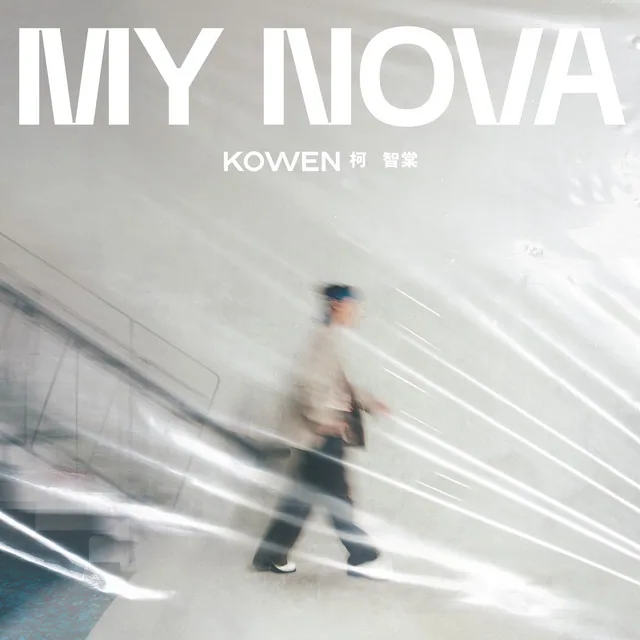
2024’s 'My Nova,' Kowen Ko’s return after seven years of immersion, and his first full English album. © forgood music, fair use editorial commentary.
What truly brought him back was an unfamiliar piano. Once, after Chen Jianqi’s concert, he casually touched a piano he hadn’t played in a long time, playing randomly, but couldn’t stop. He described that moment: "It’s been so long since I played, so unfamiliar, but playing randomly, I found I really wanted to continue playing."42 Guitar had always been his creative standard, but the piano was a completely unfamiliar interface, and it was precisely this unfamiliarity that bypassed the stuck channel. He said, "Since I started writing songs, I had never written a complete song using the piano, but playing some pieces I was interested in back then, I unexpectedly started writing some melodies again."43
In November 2024, he released My Nova—ten brand new creations, and his first full English album44. Unlocking it didn’t rely on willpower; it relied on changing to an unfamiliar instrument, returning to a language he was more comfortable with. The closing track "A Sigh" sampled Liszt’s piano piece "Un Sospiro" (A Sigh), with the theme "This is life, but I’m still alive"45.
(The album release concert was originally scheduled for January 2025, but was postponed to March due to a family tragedy46. This was a personal sorrow for him; we won’t dwell on it here; just know that it happened after he had already returned, not the reason for the seven-year pause.)
Three Albums Chen Jianqi Didn’t Rush for Nine Years
Behind these three albums stands the same person: Chen Jianqi.
You Really Don’t Want to Wander (2015), Songs of the Bards (2018), My Nova (2024)—spanning nine years, all three full-length albums produced by Chen Jianqi47. Chen Jianqi is a recognized heavyweight producer in the Taiwanese music scene: he won a Golden Horse (theme song "Same Style" for the film Today’s Public Holiday) and also won the 32nd Golden Melody Award for Best Album Producer for Hebe Tien’s Unspoken48. The "forgood music" label he founded in 2011 includes artists like Wei Wu-hsuan, Hsu Han-kuang, and Crispy Crispy Band, finding musicians whose voices are outside the mainstream market49.
According to reports, the opportunity for Chen Jianqi to discover Kowen Ko was "first electrified by the voice, then discovering he could also write songs well"50. The most special thing about this collaboration is that "non-rushing." From Songs of the Bards to My Nova, nearly seven years passed; Chen Jianqi didn’t force him to rush out the next album, but waited for him to arrive at a state where he could create again51. As early as 2019, Kowen Ko mentioned that the company would get anxious due to waiting, but for someone with his slow creative pace, they were "quite tolerant"52.
📝 Curator’s Note: In an industry that pushes creators to be regularly exposed and algorithms force continuous output, Kowen Ko’s path is more like an invisible choice about "time." Wei Wu-hsuan gave him advice early on: "You should have your own style; you should write what you want to write."53 Behind this sentence lies an unspoken alternative—he could have worked hard on appearances, released albums densely when resources were best and momentum was highest, making the name "Kowen Ko" big. He chose another time scale: slow, and only writing when he could. This choice’s viability requires a producer willing to wait, a label willing to tolerate low output. This isn’t a luxury every creator has, but it also proves that another rhythm can exist in Taiwan.
Outside of albums, Kowen Ko actually had another line running parallel for a long time: film and television scoring. This line didn’t start in 2025. In 2018, he sang "Tonight" in the Love Is Not All soundtrack and the ending theme "Far Away" for the idol drama The Goddess of Vegetables; 2022 was "Count to One" for Hi! My Pet Monster54. He had been singing for dramas for years, just not noticed by many.
A Song Sung for a Drama, Getting a Bit More Light
In 2025, this seven-year film and television scoring line was illuminated by the highest规格 for the first time.
In March that year, the Hakkatv flagship drama Black Tide Island Under the Starry Sky premiered—a drama set against the backdrop of White Terror and Green Island, with the production team attempting "to package such a politically serious subject with science and medicine"55. Its ending theme was "God's Reply," composed by Chen Jianqi, with Mandarin lyrics by Ge Da-wei, adapted into Hakka (Sioxian dialect) by Rao Rui-jun, releasing Hakka, Mandarin, and English versions, with the English version rewritten and sung by Kowen Ko himself56.
"God's Reply" Hakka version (forgood music official channel), ending theme for Black Tide Island Under the Starry Sky. Chen Jianqi hoped it wouldn’t write sadness, but rather "like a lullaby a mother would sing to her child."
Hakka was a new challenge for Kowen Ko. He originally received Mandarin lyrics, but it gradually became "entirely Hakka" from "adding a few lines of Hakka," making him want to refuse but unable to; he joked that he was "kidnapped onto the boat"57. Chen Jianqi’s idea for this song was: not writing a sad melody, "but hoping it’s more like a lullaby a mother would sing to her child"58.
In October 2025, at the 60th Golden Bell Awards, "God's Reply" won the "Original Song for Drama Program Award," with Kowen Ko, Chen Jianqi, Ge Da-wei, and Rao Rui-jun sharing the award59. The four winning together was due to registration rules: the Ministry of Culture’s reward guidelines explicitly stated, "Co-lyricists, co-composers, and co-singers should be jointly listed as participants"60.
Here, one must be careful of an easy misreading: treating the Golden Bell Award as "compensation" or "comeback" after Golden Melody losses. This analogy is actually wrong. The Golden Melody Awards judge individual singers and albums; this Golden Bell Award judges "a song’s service to a drama"; the objects of evaluation are fundamentally different, two parallel lines61. (Incidentally, My Nova was nominated for the 36th Golden Melody Awards’ "Best Recording Album Award," but the reward for that award goes to recording and mixing engineers, not the singer; additionally, online sometimes confuses Kowen Ko with another scoring composer, Kowen Hao; they are completely different people62.) "God's Reply" winning the Golden Bell isn’t anyone overturning a verdict for another; it’s just that his parallel seven-year film and television scoring line finally got a bit more light.
A More Comfortable Voice
2025 was a complete year for Kowen Ko. Early year facing family tragedy, February press conference admitting the pause of these years, March three-language new song premiering with the drama, June standing on the stage of the Toronto Pride Music Festival, July special show at Weiwuying, October winning the Golden Bell63. After the Golden Bell until now, he hasn’t announced his next album or new tour—that’s an honest blank, no need to force a conclusion.
He still isn’t a traffic-type singer. On Spotify, his monthly listeners are about 49,00064. This number explains exactly what he has always been: not huge volume, but a group willing to sit down and quietly listen to him sing.
Back to that voice. From the 2013 competition pranked by classmates to the 2025 Golden Bell stage, twelve years passed. These twelve years he wrote slowly, sang little, venues were often cold, and he never treated these as problems. When heckled "Who are you?", he said "It’s reasonable you don’t know me"; when nominated but not winning, he said "Nominations are blessings, I don’t put winning/losing there"6528.
A "weathered" voice, a slow pace that doesn’t rush. Kowen Ko didn’t become a name many recognize, but with his own rhythm, he carved out a small, deep position in Taiwan’s indie music that never stopped. That position isn’t noisy, nor crowded, only reserved for those willing to sit quietly.
Where this story traveled
🧬 What Semiont was thinking while writing this
Further Reading:
- Wei Wu-hsuan — Kowen Ko’s female cousin, two-time Golden Melody Award Best Female Artist, and fellow artist under "forgood music."
- Chen Jianqi — The producer who made three albums for Kowen Ko over nine years without ever rushing him, a three-award (Golden Horse, Golden Melody, Golden Bell) pusher.
- Hello Nico — Another Taiwanese indie music group framed by media as "disappeared for N years," actually with sporadic output at the beginning and end.
Image Sources
- Cover: Kowen Ko portrait. Source forgood music, Spotify Official Artist Page. © forgood music, fair use editorial commentary.
- Body: You Really Don’t Want to Wander (2015) album cover. © forgood music, fair use editorial commentary.
- Body: My Nova (2024) album cover. © forgood music, fair use editorial commentary.
- Videos: "Dance Partner" (feat. Hung Pei-yu), "It Was May," "God's Reply" Hakka version, all embedded from forgood music’s YouTube official channel, for commentary citation only.
References
- Wikipedia: Kowen Ko — Chinese Wikipedia entry for Kowen Ko, recording his debut experience, album list, and award records, noting he won the Hai Xian Award championship in 2013 with self-accompanied Coldplay covers.↩
- Marie Claire: Kowen Ko Interview — 2019 Golden Melody Season interview, Kowen Ko recounts the origin of his debut "classmates wanted to embarrass me, so they signed me up for the school singing competition," with a self-deprecating and plain tone.↩
- dashi.streetvoice.cn: Kowen Ko Interview — StreetVoice Simplified Version in-depth interview, confirming his status as champion of the 25th Hai Xian Award Campus Folk Song Contest in 2013 and his musical upbringing context.↩
- Blow Music: Kowen Ko 'You Really Don’t Want to Wander' Interview — StreetVoice’s music media interview, source of Kowen Ko’s correction of the "uncle voice" title: "I’m not an uncle voice, just a bit weathered."↩
- forgood music: Kowen Ko Artist Intro — Label’s official artist page copy, describing his voice texture as "a rolling raw stone, wrapped in gravel, yet unexpectedly straightforward and pure" (label promotional text).↩
- Asian Pop Weekly: Live Review — Kowen Ko at Simple Life Festival 2016 — English independent music media live review, describing his vocals as "husky, comforting voice" and "meandering, world-weary vocals," a reliable primary English British positioning review.↩
- Asian Pop Weekly: Album Review — Kowen Ko, Songs of the Bards (2018) — English album review for Songs of the Bards, contrasting Kowen Ko’s "gruffness" with duet partner Hung Pei-yu’s "cleanness."↩
- dashi.streetvoice.cn: Kowen Ko Interview — In-depth interview recording his early childhood broken TV, disconnection from Taiwanese pop culture, and musical enlightenment of hearing Coldplay recommended by a friend in high school.↩
- Blow Music: Kowen Ko 'You Really Don’t Want to Wander' Interview — Interview mentioning his cousins Wei Wu-hsuan and Wei Wu-yun forming bands, and the family connection of Wei Wu-hsuan recommending him into the music circle.↩
- Asian Pop Weekly: Cream of the C-pop #3 — Interview with Kowen Ko — English primary interview, Kowen Ko’s own words "the kind of music that influences me is overseas music" and "I didn't listen to Taiwanese mandopop music because there was no TV at home."↩
- dashi.streetvoice.cn: Kowen Ko Interview — Recording that after high school internet became widespread, he was recommended Coldplay by a friend, "diving headfirst into the British band" turning point.↩
- dashi.streetvoice.cn: Kowen Ko Interview — Recording his learning of Coldplay, Oasis, and Damien Rice’s singing styles, while simultaneously honing vocal technique by singing Eason Chan’s songs.↩
- Asian Pop Weekly: Cream of the C-pop #3 — Interview with Kowen Ko — Primary English interview mentioning his post-graduation solo trip to the UK, Scotland, and Ireland, wandering for 40 days without an itinerary.↩
- Asian Pop Weekly: Live Review — Kowen Ko at Simple Life Festival 2016 — Critic’s live judgment that he was "clearly subscribed more to British music than the normal American styles," and confirming his idol as Damien Rice, the most reliable primary evidence for British folk positioning.↩
- Asian Pop Weekly: Album Review — Kowen Ko, Songs of the Bards (2018) — The only specific genre comparison for Songs of the Bards made proactively by a professional critic, describing "Man Without A Mission" as "screams Coldplay."↩
- UDN Blog: Kingston 'Memory Platform' Ad and 'It Was May' — Blog article detailing the plot of Kingston’s long brand image ad "Memory Platform" and its theme song "It Was May," including filming and production background.↩
- UDN Blog: Kingston 'Memory Platform' Ad and 'It Was May' — Explicitly recording that the London Underground platform scene in the ad was built in a Linkou studio, the train pushed by staff manually, ad produced by Dentsu Aegis Network, length 7 minutes 33 seconds.↩
- YouTube: Kowen Ko 'It Was May' Official MV — Official MV page, cross-confirmed by multiple sources that views accumulated over a million (no reliable evidence for "5 million," so conservative number adopted).↩
- Wikipedia: Kowen Ko — Entry confirming "It Was May" lyrics by Tsai Po-chang, music by Luo En-ni, sung by Kowen Ko, distinguishing it from other self-created tracks.↩
- Wikipedia: Kowen Ko — Recording November 2020 Kowen Ko duetted with Ruth Liu on "Daily Imperfections" (Kowen Ko composed, Ge Da-wei wrote lyrics), included in the "Imperfect Life Guide" project, a public output in the middle of the seven-year pause on personal Chinese albums.↩2
- Wikipedia: Kowen Ko — Recording 2022 Kowen Ko sang the theme song "Count to One" for the animated film Hi! My Pet Monster, which premiered February 1, 2022, directed by Chi Chia-ching.↩2
- Blow Music: Kowen Ko 'You Really Don’t Want to Wander' Interview — Recording first full-length album You Really Don’t Want to Wander released August 28, 2015, English-Chinese creation ratio about 4:6.↩
- Wikipedia: Kowen Ko — Recording You Really Don’t Want to Wander sold out Legacy’s large-scale ticketed concert less than four months after release, holding ten ticketed shows across Taiwan in 2015.↩
- Marie Claire: Kowen Ko Interview — Recording his "Sing Everywhere" tour chose to visit old record stores, general stores, and old theaters about to disappear, rather than famous Live Houses.↩
- Marie Claire: Kowen Ko Interview — Recording he performed outside a century-old general store facing convenience store competition and about to close in Taichung, residents sat quietly across the street to listen, including the quote "I’m truly honored to record this century-old store."↩
- Mirror Weekly: Kowen Ko Concert Report — 2018 concert report, source of Kowen Ko’s self-deprecation "Usually, the people watching my performance are like this, the venue is quite cold."↩
- Mirror Weekly: Kowen Ko Concert Report — Reporters described his path as "literati style," Kowen Ko stated himself "I’m usually a taciturn person."↩
- ETtoday Starlight Cloud: Kowen Ko Responds to 'Who Are You?' Doubts — Report on him being heckled "Who are you?" by the audience at a Damien Rice concert, his response "Those who like me are a niche audience; it’s quite reasonable that you don’t know me, I don’t feel anything."↩2
- CNA: 27th Golden Melody Awards Full Nominations and Winners List — Official primary list, confirming Kowen Ko double-nominated for Best New Artist and Best Mandarin Male Artist for You Really Don’t Want to Wander at the 27th Golden Melody Awards, winning neither; King of Songs that year was JJ Lin.↩
- CNA: 30th Golden Melody Awards Nominations — Official primary list, confirming Kowen Ko nominated for Best Mandarin Male Artist at the 30th Golden Melody Awards for Songs of the Bards, winner was Leo Wang.↩
- Marie Claire: Kowen Ko Interview — Kowen Ko’s own words on winning attitude "Whether I win or not is truly beyond my control… so I really take it lightly" (original text contains omissions).↩
- Asian Pop Weekly: Cream of the C-pop #3 — Interview with Kowen Ko — Primary English interview, Kowen Ko’s own words that creation is "a very spontaneous process," can’t write songs without inspiration, doesn’t consider himself a professional composer.↩
- myplus: Kowen Ko Interview — October 2019 interview, Kowen Ko’s own words on creation method "When there’s inspiration, I can finish it instantly; when there isn’t, I leave it halfway," at the start of the seven-year pause on personal Chinese albums.↩
- dashi.streetvoice.cn: Kowen Ko Interview — Recording the technical process difference between his Chinese and English creation: English songs melody-first "playing guitar, humming and singing, and lyrics just fill in"; Chinese songs require first writing down what to say, then matching melody.↩
- Asian Pop Weekly: Cream of the C-pop #3 — Interview with Kowen Ko — Primary English interview, Kowen Ko’s own words explaining preference for English creation "To me, English is more versatile … you can convey it in just one word with English."↩
- dashi.streetvoice.cn: Kowen Ko Interview — Recording his English and Chinese creation ratio is about 4:6.↩
- Tai Report: Kowen Ko 'Bright Sunshine' Creation Origin — Report recording Kowen Ko wrote the rough melody for "Bright Sunshine" in a Mumbai backpacker hostel during travel in India using a broken guitar, recorded on phone to send to producer Chen Jianqi, song theme praising the beauty of life’s essence.↩
- Liberty Times: Kowen Ko Returns After Seven Years Press Conference — 2025 press conference report, Kowen Ko’s own admission of the true reason for seven-year pause on personal Chinese album "Actually, it’s just that I couldn’t write a Chinese album."↩
- Liberty Times: Kowen Ko Returns After Seven Years Press Conference — Recording he once wanted to go to Australia for a working holiday to change environment and find inspiration, but plan disrupted by pandemic.↩
- Epoch Times: Immersed for Nearly Seven Years Before Returning, Kowen Ko: I Was Always in the Room — November 2024 My Nova return interview, source of Kowen Ko’s summary of the immersion period state "I was always in the room" ("calm and indifferent" is reporter’s word).↩
- Blow Music: Kowen Ko 'My Nova' Production Interview — Kowen Ko’s own words actively denying the low-point framework "So actually, it’s not really a low point; I still lived as happily as possible. But indeed, it was a more fragile and sensitive state, so I just wanted to stay in my own world."↩
- Blow Music: Kowen Ko 'My Nova' Production Interview — Recording his first-hand feeling of touching the piano at Chen Jianqi’s concert backstage and resuming creation "It’s been so long since I played, so unfamiliar, but playing randomly, I found I really wanted to continue playing."↩
- Blow Music: Kowen Ko 'My Nova' Production Interview — Kowen Ko’s own words on first using piano to write songs "Since I started writing songs, I had never written a complete song using the piano, but playing some pieces I was interested in back then, I unexpectedly started writing some melodies again."↩
- Blow Music: Kowen Ko 'My Nova' Production Interview — Recording My Nova released November 8, 2024, ten brand new creations, all English songs, produced with live simultaneous recording and video.↩
- Blow Music: Kowen Ko 'My Nova' Production Interview — Recording album closing track "A Sigh" sampled Liszt’s piano piece "Un Sospiro" (A Sigh), theme "This is life, but I’m still alive."↩
- ETtoday Starlight Cloud: Kowen Ko’s Father Passed Away, Album Release Concert Postponed — Report on Kowen Ko’s My Nova album release concert postponed from originally scheduled January 5, 2025 to March 9 due to family tragedy, held at Legacy TERA.↩
- Wikipedia: Kowen Ko — Confirming You Really Don’t Want to Wander (2015), Songs of the Bards (2018), My Nova (2024) three full-length albums spanning nine years, all produced by Chen Jianqi.↩
- Liberty Times: Chen Jianqi Wins 32nd Golden Melody Award Best Album Producer — Report on Chen Jianqi winning 32nd Golden Melody Award Best Album Producer for Hebe Tien’s Unspoken, proving he is a heavyweight producer in Taiwanese music scene.↩
- Taiwan Beats: forgood music Label Intro — Recording Chen Jianqi founded "forgood music" in 2011, artists include Wei Wu-hsuan, Hsu Han-kuang, Crispy Crispy Band, mission to promote musicians whose voices are outside the mainstream market.↩
- Blow Music: Kowen Ko 'You Really Don’t Want to Wander' Interview — Recording Chen Jianqi’s opportunity to discover Kowen Ko was "first electrified by the voice, then discovering he could also write songs well" (multiple reports, not verbatim recording).↩
- Epoch Times: Immersed for Nearly Seven Years Before Returning, Kowen Ko: I Was Always in the Room — Recording interval from Songs of the Bards to My Nova nearly seven years, Chen Jianqi didn’t rush Kowen Ko to rush out new album, letting him arrive at state to create again.↩
- myplus: Kowen Ko Interview — 2019 interview, Kowen Ko mentioned company would get anxious due to waiting, but for his slow creative pace "quite tolerant," closest to label cooperation mechanism primary statement.↩
- myplus: Kowen Ko Interview — Kowen Ko quoting cousin Wei Wu-hsuan’s advice to him "You should have your own style; you should write what you want to write."↩
- Wikipedia: Kowen Ko — Recording his film and television scoring trajectory: 2018 Love Is Not All "Tonight," The Goddess of Vegetables ending theme "Far Away," 2022 Hi! My Pet Monster "Count to One," showing film songs are a parallel second line for years.↩
- The Reporter: Black Tide Island Under the Starry Sky Production Special — In-depth report recording the drama set against White Terror and Green Island backdrop, producer Luo Yi-li discussing creative tension of "packaging such a politically serious subject with science and medicine."↩
- Hakka News: 'God's Reply' Three-Language Versions Premiered with Drama — Primary report verbatim confirming "God's Reply" has Hakka, Mandarin, English three versions (Chen Jianqi music, Ge Da-wei Mandarin lyrics, Rao Rui-jun Hakka adaptation Sioxian dialect, Kowen Ko rewrites English version and sings), March 30, 2025 premiered with drama simultaneous release.↩
- Hakka News: Kowen Ko Talks Hakka Version 'God's Reply' — Recording Kowen Ko originally received Mandarin lyrics, gradually became entirely Hakka from "adding a few lines of Hakka," joking he was "kidnapped onto the boat."↩
- China Times News Network: 'God's Reply' Three-Language Versions MV Online — Verbatim confirming Kowen Ko rewrites English lyrics version, recording Chen Jianqi’s creative concept "not writing sad melody, but hoping it’s more like a lullaby a mother would sing to her child."↩
- CNA: 60th Golden Bell Awards Winners List — Official primary report verbatim confirming "Original Song for Drama Program Award" won by "God's Reply" Kowen Ko, Chen Jianqi, Ge Da-wei, Rao Rui-jun four people sharing award, Black Tide Island Under the Starry Sky biggest winner of the session.↩
- Ministry of Culture: Drama and Program Golden Bell Award Reward Guidelines — Official regulation verbatim confirming definition of Original Song for Drama Program Award, and legal basis for four people sharing award "Co-lyricists, co-composers, and co-singers should be jointly listed as participants."↩
- CNA: 36th Golden Melody Awards Nominations — Official list, corroborating Golden Melody Awards judge individual singers/albums (including recording tech awards), different object from Golden Bell Award "Original Song for Drama Program Award," two parallel narrative lines.↩
- CNA: 36th Golden Melody Awards Nominations — Official list showing My Nova nominated for "Best Recording Album Award," reward object for that award is recording, mixing, mastering engineers; confirming nominated Best Single Producer is Kowen Hao (1976 born scoring composer), different person from Kowen Ko (1990 born singer).↩
- CTWANT: Kowen Ko 2025 Performance Schedule — Report on Kowen Ko’s 2025 performance dynamics, including June 22 Toronto "Love Is Not All Music Festival," July 23 Weiwuying My Little Nova special show, etc.↩
- Spotify: Kowen Ko Official Artist Page — Official artist page shows Spotify monthly listeners about 49,001 (number at research moment), corroborating his "small and deep" listener scale positioning.↩
- Liberty Times: Kowen Ko Returns After Seven Years Press Conference — Kowen Ko’s own words on Golden Melody gains/losses "Nominations are blessings, I don’t put winning/losing there" source.↩