
There is a kind of fish kept inside a transparent glass tank. It can see the world outside and the people who come to visit it, but no matter how it swims, it cannot leave that transparent room.
That fish was Jimmy Liao in 1995. He was 37 that year, diagnosed with acute myeloid leukemia, and admitted to a sterile room for chemotherapy. When friends came to visit, all he could do was open the curtains and wave to them through the glass. Years later he said: “That fish in the glass tank was me.”1
That is mostly not how Taiwanese people remember Jimmy Liao. We remember the man and woman who miss each other in Turn Left, Turn Right, the blind girl in Sound of Colors, and Jimmy Square in Yilan, where people can take photos and check in. We put him on the shelf labeled “healing,” “youth-culture,” and “bestseller.” But one comment put it more accurately: Jimmy Liao “is in fact someone who has gone through hell… and brought back the darkest and most terrifying things in hell in the warmest way.”2
30-second overview: Jimmy Liao, born Liao Fu-bin, was born in Luodong, Yilan, in 1958 and worked as an advertising art director for 12 years. In 1995 he was diagnosed with leukemia, underwent five months of chemotherapy, and only after leaving the hospital truly began drawing picture books. He likened illness to a “glass tank”: isolation, loneliness, being able to see but not touch. Behind A Fish with a Smile, The Moon Forgets, and Sound of Colors are real experiences of death and isolation. These images, treated as “healing,” are in fact a survivor’s translation of the darkest things into readable form. They later grew into a visual empire spanning film, musicals, circus, metro systems, and public art, with a 25th-anniversary special exhibition still being held in Hong Kong in 2026.
The Glass Tank of 1995
After completing military service, Liao Fu-bin joined an advertising company and stayed in the field for 12 years; according to reports, he worked as an art director at Ogilvy.3 It was a respectable job. He drew illustrations every day, and in those drawings were many tiny figures, which he called “little people.” “At first, I did not put emotion into the little people. They were merely tools I used to make money.”4
In 1995, the first thing to go wrong was his right thigh, which hurt abnormally. Tests showed acute myeloid leukemia.5 What followed was five months of chemotherapy, spinal taps, and isolation in a sterile room. Doctors were concerned about infection, so even friends who visited him had to remain on the other side of a pane of glass.
He later condensed those days into one complete sentence: “Illness was my glass tank. It completely separated me from other people, so no matter how hard I tried, I could not leave this transparent room. Things are a little better now, but I know I am still different from others.”6
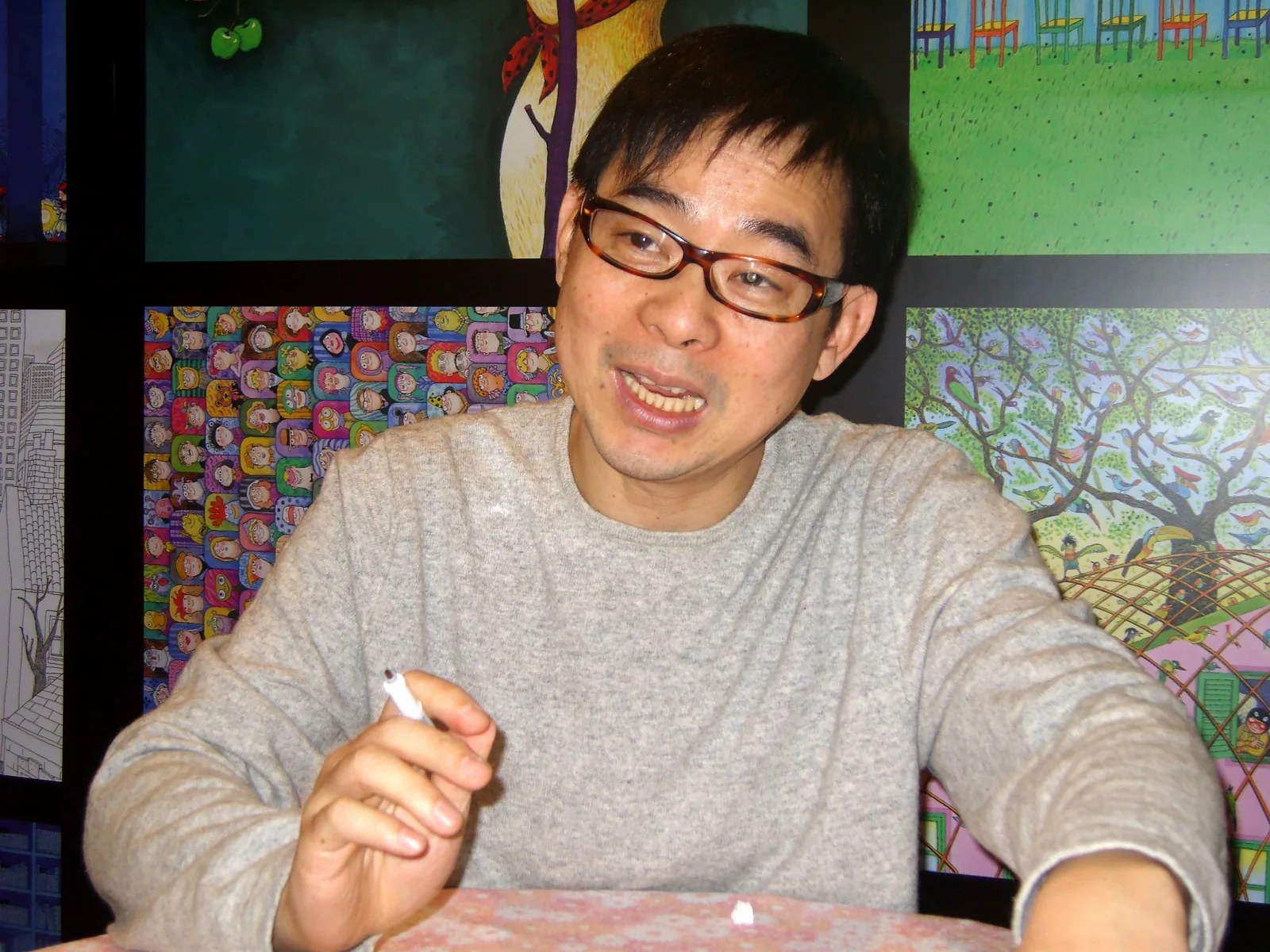
Strangely, that illness became the true starting point of his creation. Before being hospitalized, he had drawn illustrations for more than a decade, but those little people had no life. After he left the hospital, “it felt as though those little people had come alive… I began to feel there were many things I wanted to say.”7 He described the function of creation in practical terms: “Creation helped me forget the fear of illness and eased my sorrow.”8 In other words, drawing was first a way for someone who had just returned from death’s door to hold himself together. Whether anyone else would see it came later.
The person who accompanied him through that period was his wife, Peng Chien-wen, who later became the Chinese translator of the first four Harry Potter books.9 In interviews he has said that it was under his wife’s “careful and strict care” that his body slowly recovered.10 When a person is at their most fragile, having someone beside them to hold them up later seeped into his books as well. The loneliness Jimmy Liao draws is never pure despair; somewhere in a corner, there is always a slit of space where someone is present.
Surviving the ordeal gave him a sense of time that others did not have. “In 1995, I had leukemia. Every day I woke up, I felt I had gained another day.”10 Someone who wakes up every day feeling he has “gained another day” sees loneliness, missed encounters, and death differently from someone who has never been there.
But that perspective came at a cost. Creation was not light healing for him; it was more like opening the wound again and again. He once described those days: “When I entered the studio and saw what I had drawn the day before, I would finish crying first and then work.”11 Those little people that readers took as cute were drawn by someone crying as he worked. Every book he completed afterward carried the viewpoint of that glass tank, looking at an unreachable world through a transparent barrier.
“Drawn for Adults”
In January 1998, Jimmy Liao published two picture books in one burst: Secrets in the Woods and A Fish with a Smile. He was 40 that year.12 That same year, the two books won children’s-book awards from three major book-review platforms: Openbook, Good Books for Everyone, and The Reader.13
There is a paradox here. Jimmy Liao’s books won children’s-book awards, but he himself was clear: “The drawings were drawn for adults; the person being spoken to was even myself.”14 A 2003 master’s thesis found that 80 percent of his readers were between 16 and 30.15 A writer who won children’s-book awards was drawing books for adults, and his readers were mainly university students and office workers. That mismatch is itself the story.
Source: Huang Chiung-yao’s 2003 master’s thesis, quoted in National Taitung University’s Journal of Children’s Literature and Culture article “Jimmy Liao and Adult Picture Books.”
To say that Jimmy Liao single-handedly invented the “adult picture book” genre would be inaccurate. Before him, Yuan-Liou’s affiliate Yushan Publishing had launched its “Classic Picture Books” series in 1995, and in 1997 introduced the work of French picture-book artist Jean-Jacques Sempé, helping to build the adult picture-book market.16 Because Jimmy Liao loved Sempé, persuasion from a publishing house’s editor-in-chief helped bring about his debut. In other words, the soil was already prepared; he was the seed that fell at the right time and grew the tallest.
In Taiwan in the late 1990s, martial law had only been lifted a few years earlier, and urbanization and individualism were on the rise. Young people left their hometowns for Taipei to study and work, moved into small studio apartments, and for the first time tasted “being alone” on a large scale. A kind of picture book that spoke about loneliness, missed encounters, and adult life arrived just in time to receive the emotions of that era.
The reason Jimmy Liao’s images could move from one person’s self-healing into gifts exchanged by an entire generation was that what he drew happened to be what many people could not say aloud. At that time, his images were everywhere: in cafés, on dormitory walls, in metro stations. When couples broke up, friends were frustrated, or someone was leaving for military service, a Jimmy Liao book was never the wrong gift. The drawings he made for himself in a hospital room unexpectedly became the common language of an entire generation, an unspoken code everyone understood.
Each Book Was a Descent
When Jimmy Liao’s representative works are spread out, one easily overlooked fact becomes clear: almost every one of those images treated as healing begins in a very dark place.
Sources: Jimmy Liao’s official website (jimmyspa.com), Locus Publishing, Wikipedia, and official materials from film festivals; age at diagnosis and chemotherapy duration are based on Jimmy Liao’s own interview accounts.
A Fish with a Smile is that fish in the glass tank. A man sees a fish in an aquarium that smiles at him, buys it and brings it home, then releases it back into the sea one night. The isolated person, the desire to be confined, and the final act of letting go: when this book was published, Jimmy Liao had only recently walked out of that transparent room. The sentence “Illness was my glass tank” appears in A Fish with a Smile.17
The Moon Forgets was published in October 1999 and created on the eve of the 921 earthquake. Its origins were three real events: a former colleague at Jimmy Liao’s advertising company jumped from the roof during lunch break, leaving behind a wife and daughter; the husband of a close friend died of a cerebral hemorrhage while attending a meeting in Beijing; and there was a major blackout in Taipei.18 Beneath a picture book that looks gentle and speaks of the moon lie two deaths and a city suddenly plunged into darkness. Jimmy Liao said he “owed the moon a story.”19 The official description of the book says: “Carloads of smiling moons are transported to every sorrowful dark city.”20 Death, in his hands, became round after round of moons that could shine and be sent out to comfort people.
Sound of Colors was published in 2001, the fifth year after Jimmy Liao became ill. A doctor had once told him: “If you survive past the fifth year, your survival rate can probably increase a great deal.”21 For a leukemia patient, the fifth year is a threshold between life and death. That year he drew a blind girl feeling her way through the metro, and the book opens: “The year the angel said goodbye to me at the entrance to the metro, I gradually lost my sight.”22
That blind girl was his own stand-in, and the entire book was drawn under the shadow of death. He was afraid as he drew it, afraid that before the book was finished, he would have to wave goodbye first. So he later said that “all the words” in this book “were written as a form of encouragement to myself.”23 Someone afraid he might not live to see the book published drew a girl who could not see, yet did not stop walking. In truth, that was his own voice cheering himself on at the edge of a cliff; he simply drew that voice so gently that readers mistook it for a bedtime story meant to soothe someone to sleep.
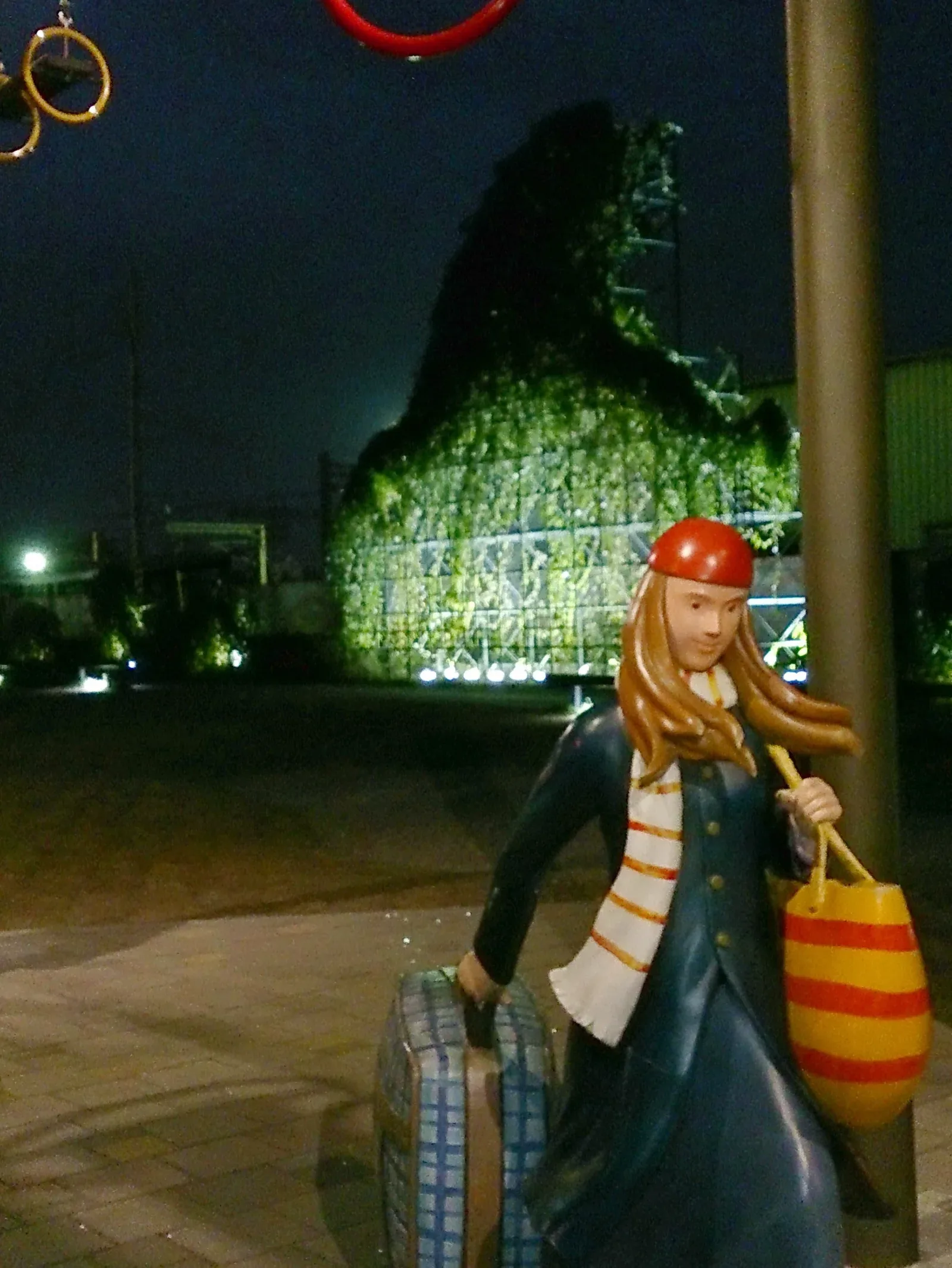
By comparison, Turn Left, Turn Right, published in 1999, is the book most remembered by the public, but it is also the cruelest. A girl used to turning left and a boy used to turning right live on opposite sides of the same apartment wall. They are clearly so close, yet they miss each other again and again. The book was inspired by “Love at First Sight,” a poem by Polish poet Wisława Szymborska, the 1996 Nobel laureate in literature, about two strangers who brush past one another though they are already connected.24 Missing each other is not an accident; it is the structure of daily life. You think meeting is the miracle, but in fact passing each other by is the norm.
The shadow of illness stretched long. Even in A Garden in My Heart, published in 2000, he still wrote: “When I drew this book, the shadow of illness still lingered in my heart.”25 The Blue Stone, published in 2006, has been described by some critics as his saddest book. It tells of a blue stone that is split apart, repeatedly fractured, and sent on a journey “gorgeous and full of vicissitudes”; yet Jimmy Liao’s own note did not stop at sadness: “Even a single ray of hope can illuminate the darkness of the entire universe.”26 He always left a little light on the other side of darkness. The 2008 book Hide in the Corner of the World reads like a whispered sentence for everyone who can no longer hold on: “Shh — hide in the corner of the world. Please keep quiet, forget time, and return to yourself.”27 Starry Starry Night, published in 2009, tells of two lonely adolescents who run away from home. The sentence “Where there is shadow, there must be light” can almost serve as a footnote to all of Jimmy Liao’s work.28
That smiling fish also swam onto the screen. In 2006, A Fish with a Smile was adapted into a 10-minute animated short without dialogue, co-directed by Lin Po-liang, Alan Tuan, and Shih Chang-chieh, with music by Chen Chien-chi.29 It was selected for the Generation section of the 56th Berlin International Film Festival and won a special prize for best short film from the German Children’s Fund.30 The loneliness that a Taiwanese person drew in a hospital room was translated into images without a single line of dialogue, understandable around the world.
🎙️ Curator’s note: Put these four books side by side, and the label “healing” turns out to have reversed cause and effect. The usual understanding is: Jimmy Liao’s images are cute, so they help people relax. But the sequence is precisely the opposite: readers feel healed because he first honestly entered isolation, death, missed encounters, and other darkest places, then came back out carrying a little light. The consolation works because it is being handed over by someone who truly spent time in the glass tank. Lu Jung-chih said his work “has never been realist; it always carries a somewhat dreamlike, surreal tone.” That layer of dream is a technique of translation: converting unbearable reality into a form a person can bear to read.
Jimmy Liao Beyond the Page
Perhaps the most counterintuitive thing about Jimmy Liao is this: the most private illness, one person’s loneliness in a hospital room, eventually grew into a public language that could be infinitely reproduced and moved onto all kinds of stages.
Film was the first path, and there were four films in one burst. Turn Left, Turn Right, released in 2003, was co-directed by Hong Kong directors Johnnie To and Wai Ka-fai, starred Takeshi Kaneshiro and Gigi Leung, and was Warner Bros.’ first investment in a Chinese-language film. Stefanie Sun’s “Encounter” was its Mandarin theme song.31 Sound of Colors, also released that year, was directed by Joe Ma, produced by Wong Kar-wai, and scored by Lo Ta-yu.32 Starry Starry Night, released in 2011, was directed by Tom Lin, adapted from the 2009 picture book of the same title, and received four nominations at the 49th Golden Horse Awards.33 There was also one film that is easily overlooked: The Floating Landscape, released in 2003, directed by Carol Lai, selected for the official competition at the Venice Film Festival, with illustrations in the film drawn by Jimmy Liao himself.34
Stage musicals were another path, and they formed a stable team: director Leon Dai? No, the director was Li Huan-hsiung, paired with musician Chen Chien-chi. From Sound of Colors in 2003, with Cheer Chen playing the blind girl, to The Lucky One in 2005, Turn Left, Turn Right at Taipei Arena in 2008, and Time Cinema in 2018, Jimmy Liao’s picture books were translated one by one into song and light.35 By 2025, even circus had arrived: The 100 Braveries of a Jimmy Boy, directed by Lin Hwai-min, was billed as Taiwan’s first repertory circus production.36
Beyond the theater, his images also seeped into the city itself. Six images from Sound of Colors hang on the platform of Taipei Metro’s Nangang Station. In 2014, Sinyi Realty turned The Moon Forgets into a real “Moon Bus” that ran on Xinyi Road Section 5.37 Television drama also took a share: Turn Left, Turn Right was remade in China in 2004 and Thailand in 2020, while Sound of Colors was adapted into a television drama in Taiwan in 2006.38 The same story about missing each other was restaged again and again with different actors and different languages.
Loneliness also crossed languages. Jimmy Liao’s books have been translated into roughly 20 languages, with nearly 200 foreign-language editions.39 Starting in 2014, he was shortlisted nine times for the Astrid Lindgren Memorial Award (ALMA), known as the “Nobel Prize of children’s literature.” In 2020, Time Cinema won the special prize in the Cinema category at the BolognaRagazzi Award, where the jury called him “an undisputed master of his craft.”40 From 2019 to 2020, he held his first major solo exhibition in Europe at Museo ABC in Madrid, showing 22 works and 174 original pieces.41 Someone who worked in the language of Taiwan and drew for himself finally had Madrid audiences standing before the original manuscripts he drew after illness. His own explanation to international readers was understated: “A serious illness changed my way of thinking about many things”; “I merely drew the pictures in my heart.”42
He also did not stop. In 2023, eslite gallery held a Jimmy Liao solo exhibition, where he presented oil paintings for the first time.43 From advertising art director to picture-book author to someone picking up oil paint more than two decades later, that fish in the glass tank has kept changing the way it says the same thing.
The entity that carried all this was Jimmy S.P.A., founded in 2000; in 2014, Jimmy Liao Studio took over work in film and television, exhibitions, and public art.44 A person who drew little people in a hospital room ultimately built a domain spanning film, musicals, circus, metro systems, and animation. The contrast worth remembering is this: the source of it all was an unshareable loneliness, separated from others by glass; the result was a language anyone could enter, see, and touch.
Sources: Compiled from Jimmy Liao’s official website (jimmyspa.com), National Theater & Concert Hall OPENTIX, Wikipedia, and materials from film festivals and publishers.
Returning to Luodong
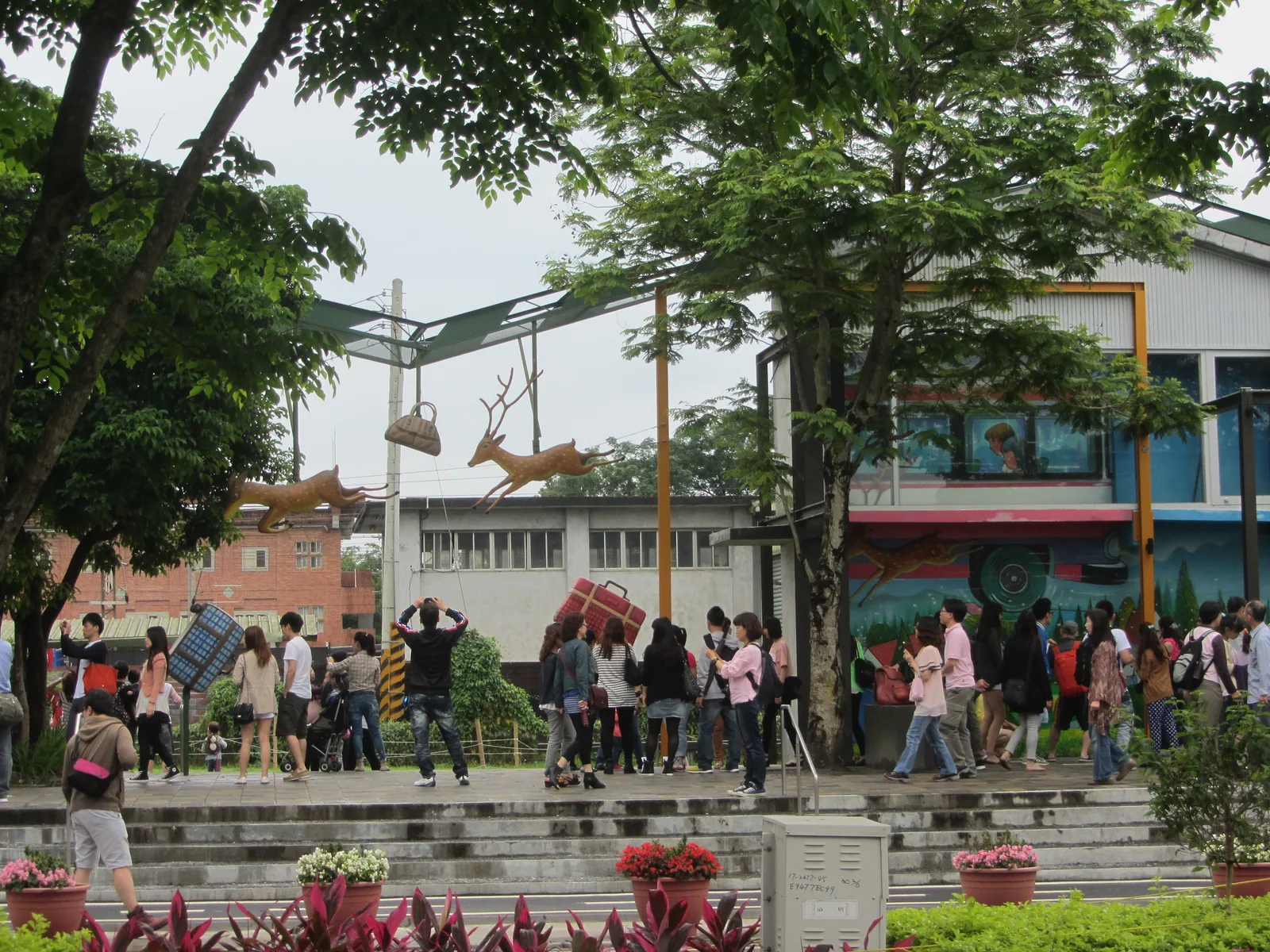
Jimmy Liao is from Luodong, Yilan. In late June 2013, about 200 meters south of Yilan Railway Station, an abandoned old dormitory area of the Taiwan Railways Administration was transformed into Jimmy Square: Taiwan’s first Jimmy Liao-themed square.45 Drawing on Turn Left, Turn Right, Starry Starry Night, and Sound of Colors, it turned scenes from the picture books into physical spaces readers could walk into, sit down in, and photograph.46
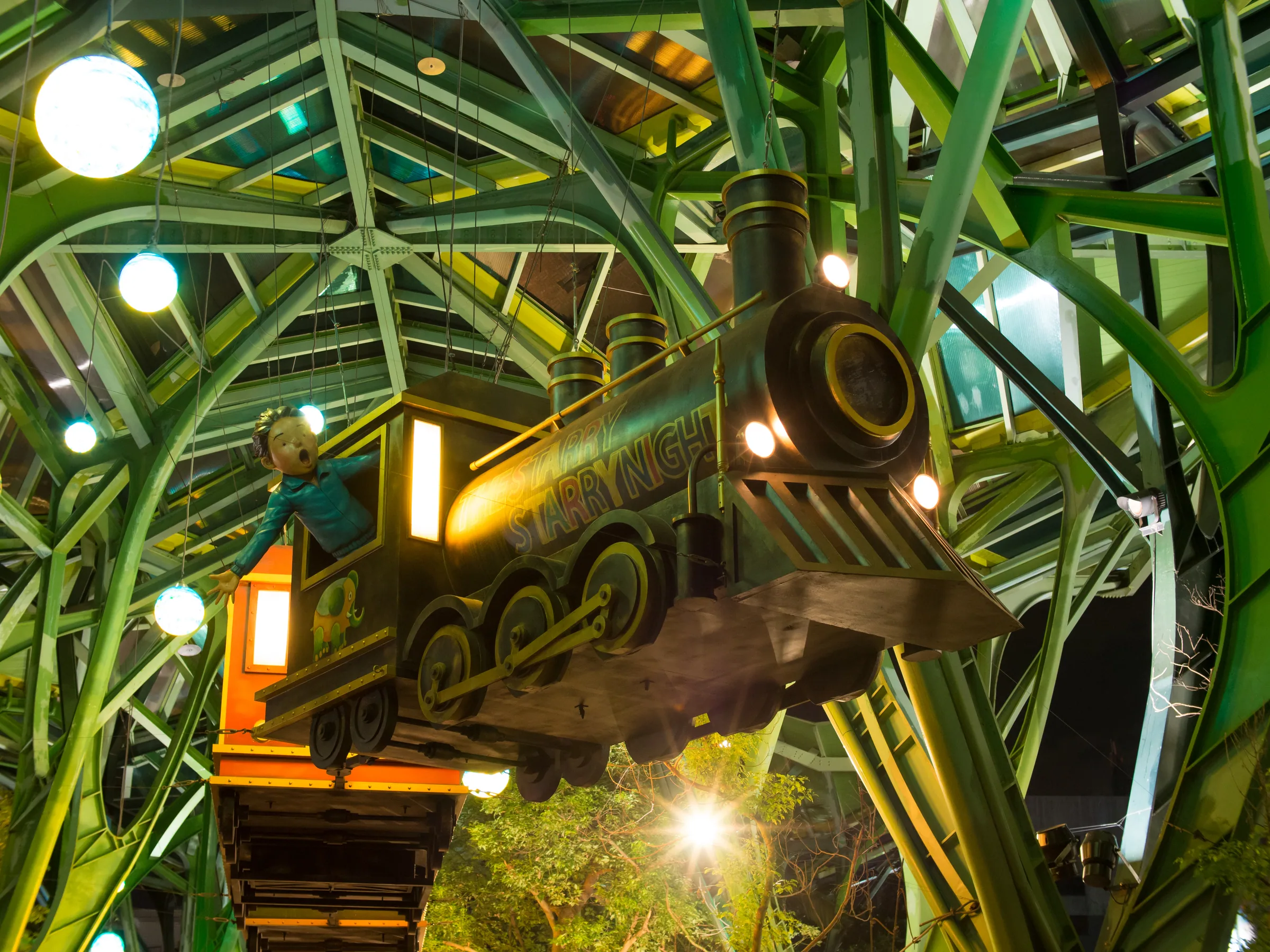
There is more nearby. Also designed by Fieldoffice Architects, the architecture team led by Huang Sheng-yuan, is another landmark: Diu Diu Dang Forest, nine steel trees about 14 meters tall, taking their imagery from “Jiuxiong City,” an old name for Yilan. Jimmy Liao’s Starry Starry Night flying train was later suspended inside this steel forest.47 The smiling giraffe in front of Yilan Railway Station, installed in 2014, was drawn from Kiss & Goodbye.48 Through architecture and sculpture, a city kept the images of one of its wanderers.
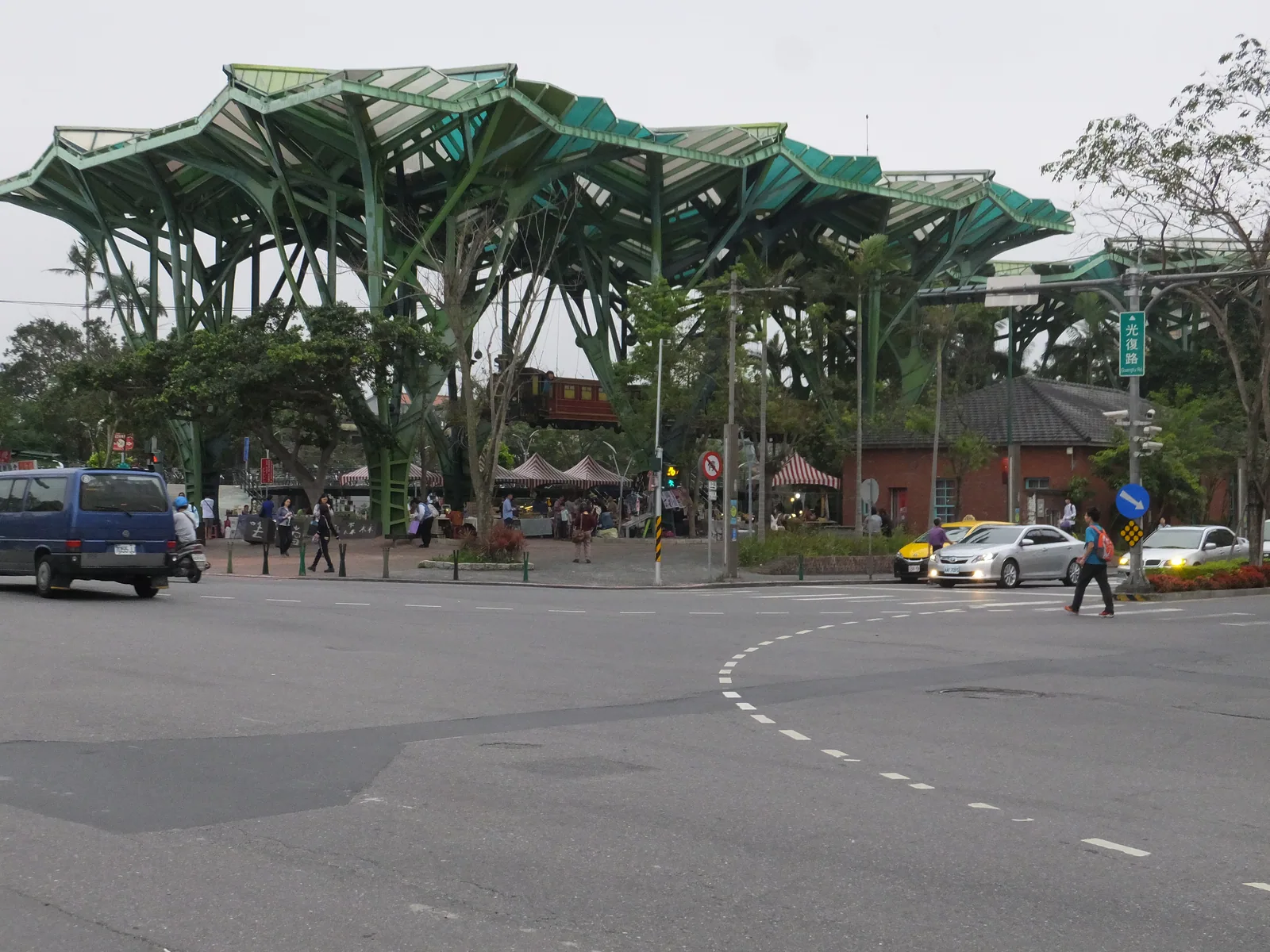
In 2016, an old building beside Yilan Railway Station also became Happy Station; Jimmy Liao’s flying train hung in midair there, was upgraded several years later, and then moved after several more years to Wushih Harbor Station, where it continued to fly.49 A small city originally meant only for transfers and passersby was gradually turned by a wanderer’s images into a place where people deliberately stopped.
Jimmy Liao once said that these public artworks were “in part to give back to my hometown.”50 Returning home and tourism are not mutually exclusive here. Someone who left Luodong, was reborn in a hospital room, and later had his images translated into 20 languages ultimately returned his entire visual world to the small town where he began. The figures he drew in his loneliest moments now stand on the streets where he grew up, with strangers walking past and taking photos with them every day.
Serendipitous Glimmers
From March 28 to April 19, 2026, Harbour City Gallery in Tsim Sha Tsui, Hong Kong, held a 25th-anniversary special exhibition for the Jimmy Liao brand titled Serendipitous Glimmers. Officially authorized by the Jimmy Liao brand, it was co-organized by Square Street May and Meiyuan Paper.51 The exhibition was divided into three zones: “Life Is Always Full of the Unexpected,” “When You Are Holding On Alone,” and “Landscapes in Accidental Glimmers.”
The exhibition’s “25th anniversary” counts from the founding of Jimmy S.P.A. in 2000. But if counted from that glass tank, it has already been 30 years. Over three decades, his images have been printed as books, made into films, adapted into musicals, hung on metro platforms, set up on street corners in Yilan, and translated into 20 languages. Yet when all of that is peeled back, the core has never changed: how a person, in his loneliest moment, was still willing to wave to the outside world. Some have said that behind Jimmy Liao’s “colorful stories of fantastic imagination there is often a sorrowful interior.”52 Twenty-five years later, that sorrowful interior remains; it is just wrapped in more and more light.
The names of those three exhibition zones read like headings for the things Jimmy Liao has been drawing for 30 years: the unexpected, the moment of holding on alone, and then glimmers. This is also what the “glass tank” metaphor looks like after completing a full circle. Back then, the fish swimming alone in the tank was drawing “when you are holding on alone”; what he brought back from there was “landscapes in accidental glimmers.”
Jimmy Liao has no public record of relapse. In December 2024, he safely finished The Moon Forgets 25th-anniversary road run; it was the 29th year after he became ill.53 Someone who had once been diagnosed with leukemia, once waved to friends through glass, and once feared he might have to wave goodbye before Sound of Colors was completed finished a run named after his own book.
The fish in the glass tank finally swam out. What it brought out was a world an entire generation was willing to live inside together.
In the past, my creation was to comfort myself. Now I hope… it can comfort others.54
Further reading: Jimmy Liao official website | Jimmy Liao — Wikipedia | Ministry of Culture Books From Taiwan: Jimmy Liao
Image Sources
- Jimmy Square (hero): photograph by 迷惘的人生, Wikimedia Commons, CC BY-SA 2.0
- Jimmy Liao (2008 Taipei International Book Exhibition): photograph by Rico Shen, Wikimedia Commons, CC BY-SA 4.0
- The Girl Who Turns Left nighttime sculpture: photograph by lienyuan lee, Wikimedia Commons, CC BY 3.0
- Square installation: photograph by SSR2000, Wikimedia Commons, CC BY-SA 3.0
- Diu Diu Dang Forest: photograph by lienyuan lee, Wikimedia Commons, CC BY 3.0
Videos are embedded from official YouTube channels: Mayday’s “Starry Starry Night” MV (BinMusic), Jimmy Liao’s Little Butterfly Little Cape animation teaser, and the 25th-anniversary interactive exhibition (Jimmy Liao official channel @jimmyspa).
References
- Mirror Media: Jimmy Liao interview — Jimmy Liao recalled that during chemotherapy hospitalization he “waved to them through the glass; that fish in the glass tank was me.”↩
- VERSE: Jimmy Liao feature — Comments that Jimmy Liao “is in fact someone who has gone through hell… and brought back the darkest and most terrifying things in hell in the warmest way.”↩
- CMoney: Jimmy Liao’s story — Jimmy Liao recalled: “After leaving the military, I joined an advertising company and stayed in this field for 12 years”; the company name “Ogilvy” is summarized from multiple reports and was not named directly by Jimmy Liao in the interview.↩
- Mirror Media: Jimmy Liao interview — Jimmy Liao discusses his illustrated figures, the “little people”: “At first, I did not put emotion into the little people. They were merely tools I used to make money.”↩
- Wikipedia: A Fish with a Smile (picture book) — Confirms the 1995 diagnosis of acute myeloid leukemia (AML); the initial symptom of severe right-thigh pain appears in media reports.↩
- Wikipedia: A Fish with a Smile (picture book) — Includes Jimmy Liao’s full statement, “Illness was my glass tank.”↩
- CMoney: Jimmy Liao’s story — Jimmy Liao recalled that after leaving the hospital, “it felt as though those little people had come alive… I began to feel there were many things I wanted to say.”↩
- CMoney: Jimmy Liao’s story — Jimmy Liao: “Creation helped me forget the fear of illness and eased my sorrow.”↩
- Wikipedia: Jimmy Liao — Jimmy Liao’s wife is Peng Chien-wen, translator of the first four Harry Potter books into Chinese.↩
- CMoney: Jimmy Liao’s story — Jimmy Liao: “In 1995, I had leukemia. Every day I woke up, I felt I had gained another day.”↩2
- FTNN News: Jimmy Liao interview — Jimmy Liao on creative anxiety: “When I entered the studio and saw what I had drawn the day before, I would finish crying first and then work.”↩
- Jimmy Liao official website: About Jimmy — Secrets in the Woods and A Fish with a Smile were both published in January 1998 and were Jimmy Liao’s first two picture books.↩
- Wikipedia: Jimmy Liao — In 1998, his two debut works won children’s-book awards from three major book-review platforms: Openbook, Good Books for Everyone, and The Reader.↩
- Journal of Children’s Literature and Culture, “Jimmy Liao and Adult Picture Books,” National Taitung University — Quotes Jimmy Liao’s statement that “the drawings were drawn for adults; the person being spoken to was even myself.”↩
- Journal of Children’s Literature and Culture, “Jimmy Liao and Adult Picture Books,” National Taitung University — Cites Huang Chiung-yao’s 2003 master’s thesis, which found that readers aged 16-30 accounted for about 80 percent of Jimmy Liao’s total readership.↩
- Journal of Children’s Literature and Culture, “Jimmy Liao and Adult Picture Books,” National Taitung University — Yushan Publishing launched its “Classic Picture Books” series in 1995 and introduced Sempé in 1997, helping to build the adult picture-book market and paving the way for Jimmy Liao’s debut.↩
- Wikipedia: A Fish with a Smile (picture book) — A Fish with a Smile was published in 1998 and includes the statement “Illness was my glass tank.”↩
- Womany: Jimmy Liao’s The Moon Forgets — Jimmy Liao recalled the origins of the work: a former colleague at his advertising company “silently jumped from the office roof” during lunch break, the husband of a friend died of a cerebral hemorrhage while attending a meeting in Beijing, and there was a major blackout in Taipei; The Moon Forgets was published in 1999 on the eve of the 921 earthquake.↩
- eslite Meet: Jimmy Liao interview — Jimmy Liao on the origins of The Moon Forgets: “I owed the moon a story.”↩
- Jimmy Liao official website: The Moon Forgets — The official description of The Moon Forgets: “Carloads of smiling moons are transported to every sorrowful dark city.”↩
- eslite Meet: Jimmy Liao interview — Jimmy Liao paraphrased his doctor: “If you survive past the fifth year, your survival rate can probably increase a great deal.”↩
- Jimmy Liao official website: Sound of Colors — Sound of Colors was published in 2001 and opens: “The year the angel said goodbye to me at the entrance to the metro, I gradually lost my sight”; the blind girl is Jimmy Liao’s stand-in.↩
- eslite Meet: Jimmy Liao interview — Jimmy Liao on Sound of Colors: all the words “were written as a form of encouragement to myself.”↩
- The News Lens: Wisława Szymborska’s “Love at First Sight” — Wisława Szymborska’s “Love at First Sight,” by the 1996 Nobel laureate in literature, inspired Jimmy Liao’s Turn Left, Turn Right; both the poem and the picture book depict two strangers who meet by chance yet miss each other.↩
- Jimmy Liao official website: A Garden in My Heart — A Garden in My Heart was published in 2000; Jimmy Liao recalled: “When I drew this book, the shadow of illness still lingered in my heart.”↩
- Jimmy Liao official website: The Blue Stone — The Blue Stone was published in 2006; the official description calls it “a story about loneliness and searching,” and the book says: “Even a single ray of hope can illuminate the darkness of the entire universe”; VERSE described it as one of Jimmy Liao’s saddest works.↩
- Jimmy Liao official website: Hide in the Corner of the World — Hide in the Corner of the World was published in 2008 and includes the sentence: “Shh — hide in the corner of the world. Please keep quiet, forget time, and return to yourself.”↩
- Locus Publishing: Starry Starry Night — Starry Starry Night was published in 2009 and contains the well-known line: “Where there is shadow, there must be light.”↩
- Wikipedia: A Fish with a Smile (picture book) — The animated short A Fish with a Smile was released in 2006, with a 10-minute running time and no dialogue. It was directed by Lin Po-liang (2D, Chingho Animation), Alan Tuan (3D, Bon Art Animation), and Shih Chang-chieh (coordination), with Jimmy Liao as producer and screenwriter, and music by Chen Chien-chi.↩
- Taipei Times: A Fish with a Smile at Berlinale — A Fish with a Smile was selected for the Generation section of the 56th Berlin International Film Festival and won the German Children’s Fund special prize for best short film.↩
- Wikipedia: Turn Left, Turn Right (film) — The 2003 film was co-directed by Johnnie To and Wai Ka-fai, starred Takeshi Kaneshiro and Gigi Leung, was Warner Bros.’ first Chinese-language film investment, and used Stefanie Sun’s “Encounter” as its Mandarin theme song.↩
- Wikipedia: Sound of Colors (film) — The 2003 film was directed by Joe Ma, produced by Wong Kar-wai, and scored by Lo Ta-yu.↩
- Golden Horse Awards official website: Starry Starry Night — The 2011 film was directed by Tom Lin, adapted from the 2009 picture book of the same title, and nominated for four awards at the 49th Golden Horse Awards; Mayday’s “Starry Starry Night” was the theme song.↩
- Wikipedia: The Floating Landscape — The 2003 film The Floating Landscape, directed by Carol Lai, was selected for the Venice Film Festival official competition, and the illustrations in the film were drawn by Jimmy Liao.↩
- National Theater & Concert Hall OPENTIX: Jimmy Liao musicals — The lineage of Jimmy Liao musicals directed by Li Huan-hsiung with music by Chen Chien-chi: Sound of Colors in 2003, with Cheer Chen as the blind girl; The Lucky One in 2005; Turn Left, Turn Right in 2008; and Time Cinema in 2018.↩
- Global Views Monthly: The 100 Braveries of a Jimmy Boy — The 2025 repertory circus production, directed by Lin Hwai-min and performed by FOCASA Circus in Tainan, was billed as Taiwan’s first repertory circus production.↩
- Wikipedia: Moon Bus — Moon Bus began service on November 1, 2014, was created by Sinyi Realty, drew on The Moon Forgets, and ran on Xinyi Road Section 5; Taipei Metro’s Nangang Station displays platform artworks from Sound of Colors.↩
- Wikipedia: Jimmy Liao — Turn Left, Turn Right was adapted into television dramas in 2004 in China and 2020 in Thailand; Sound of Colors was adapted into a television drama in Taiwan in 2006.↩
- Ministry of Culture Books From Taiwan: Jimmy Liao — Jimmy Liao’s works have been translated into roughly 20 languages, with nearly 200 foreign-language editions; they have been exhibited in Madrid, Munich, and elsewhere.↩
- Bologna Children’s Book Fair: BolognaRagazzi Award — Since 2014, Jimmy Liao has been shortlisted nine times for the Astrid Lindgren Memorial Award (ALMA); in 2020, Time Cinema won the special prize in the Cinema category at the BolognaRagazzi Award, with the jury calling him “an undisputed master of his craft.”↩
- Jimmy Liao official website (English): Museo ABC Madrid solo exhibition — The Museo ABC exhibition in Madrid ran from October 2019 to January 2020, was his first major solo exhibition in Europe, and showed 22 works and 174 original pieces.↩
- Picturebook Makers: Jimmy Liao — Jimmy Liao told international readers: “A serious illness changed my way of thinking about many things.” “I merely drew the pictures in my heart.”↩
- Locus Publishing / eslite gallery: Jimmy Liao oil-painting solo exhibition — eslite gallery held a Jimmy Liao solo exhibition in 2023, presenting his oil paintings for the first time.↩
- Taiwan Creative Content Agency: Jimmy S.P.A. — Jimmy S.P.A. was founded in 2000; Jimmy Liao Studio was founded in 2014 to handle film and television, exhibitions, and public art.↩
- Wikipedia: Jimmy Liao — Jimmy Square opened in late June 2013, about 200 meters south of Yilan Railway Station, transformed from an abandoned old Taiwan Railways Administration dormitory area, and was Taiwan’s first Jimmy Liao-themed square.↩
- Jimmy Liao official website: Yilan Jimmy Square (public art) — Jimmy Square uses Turn Left, Turn Right, Starry Starry Night, and Sound of Colors as its textual sources.↩
- TravelKing: Diu Diu Dang Forest — Diu Diu Dang Forest is located opposite Yilan Railway Station; its nine 14-meter steel trees, designed by architect Huang Sheng-yuan, symbolize the imagery of “Jiuxiong City,” an old name for Yilan; the installation inside the forest is the flying train from Jimmy Liao’s Starry Starry Night.↩
- Jimmy Liao official website: 2014 Yilan Railway Station (public art) — The smiling giraffe at Yilan Railway Station was drawn from Kiss & Goodbye and installed in 2014.↩
- Yilan County Lanyang Museum / Yilan County Government: Starry Flying Train — Happy Station opened in May 2016, with Jimmy Liao’s Starry Starry Night flying train suspended inside; it was upgraded in 2022, and the original wooden train was moved to Wushih Harbor Station in 2024.↩
- Jimmy Liao official website: About Jimmy — Jimmy Liao said of the Yilan public artworks that they were “in part to give back to my hometown.”↩
- Ta Kung Wen Wei: Jimmy Liao 25th-anniversary Hong Kong special exhibition — Serendipitous Glimmers ran from March 28 to April 19, 2026, at Harbour City Gallery; it was officially authorized by the Jimmy Liao brand, organized by Square Street May and Meiyuan Paper, and divided into three exhibition zones: “Life Is Always Full of the Unexpected,” “When You Are Holding On Alone,” and “Landscapes in Accidental Glimmers.”↩
- VERSE: Jimmy Liao feature — Comments that behind Jimmy Liao’s “colorful stories of fantastic imagination there is often a sorrowful interior.”↩
- Jimmy Liao official / zeczec 25th-anniversary crowdfunding — Jimmy Liao has no public record of relapse; in December 2024, he safely completed The Moon Forgets 25th-anniversary road run, the 29th year after his illness.↩
- Future Parenting / Wealth Magazine: Jimmy Liao interview — Jimmy Liao: “In the past, my creation was to comfort myself. Now I hope… it can comfort others.”↩